
One of the most common questions we hear sounds like: “I upgraded to a broker license—do I have extra CE hours now?” or “Do I have to take different classes than when I had my sales license?”
The Read more...
One of the most common questions we hear sounds like: “I upgraded to a broker license—do I have extra CE hours now?” or “Do I have to take different classes than when I had my sales license?”
The confusion is understandable. In California, brokers carry a higher level of legal responsibility—so it feels like the DRE should require more education. The reality is simpler: the total hours are the same, but the required subject mix is where brokers can get tripped up.
Key Takeaways
Total Hours: Brokers and salespersons both complete 45 hours of DRE-approved CE each 4-year renewal cycle.
The Content Mix: Brokers must include Management and Supervision as a mandatory topic (salespersons don’t on their first renewal).
The 9-Hour Survey: For second and subsequent renewals (for licenses expiring on/after Jan 1, 2023), a 9-hour survey can cover all mandatory topics in one course.
Interactive Requirement: For licenses expiring on/after Jan 1, 2023, Fair Housing must include an interactive, participatory component.
Quick Answer: Broker vs. Salesperson CE
In California, brokers and salespersons both need 45 hours of continuing education to renew. The difference is what’s inside the 45 hours: brokers must ensure they complete Management and Supervision as part of their mandatory topic mix. While the total hour count is identical, the DRE requires brokers to undergo specific training related to their role as a potential supervisor.
Comparison Table: Salesperson vs. Broker Renewal
Feature
Salesperson (First Renewal)
Broker (First Renewal)
Second+ Renewals (Both)*
Total Hours
45 hours
45 hours
45 hours
Mandatory Core Courses
4 Subjects (3-hrs each)
5 Subjects (3-hrs each)
Included in 9-hour survey
Fair Housing
3-hr + Interactive Implicit Bias
3-hr + Interactive Implicit Bias
Included in 9-hour survey
Implicit Bias
2-hr Required
2-hr Required
Included in 9-hour survey
Mgmt. & Supervision
Not Required
Required
Included in 9-hour survey
*Applies to licenses expiring on/after Jan 1, 2023, and late renewals filed after that date.
What’s the Same for Everyone?
Regardless of license type, the DRE’s CE structure is built around consumer protection—so the baseline framework stays consistent. That’s why the California Real Estate License Renewal Requirements don’t "punish" brokers with extra hours.
The 4-year renewal cycle applies to everyone.
The total is always 45 hours—no "broker bonus hours."
Mandatory topics + consumer protection hours are the backbone of every renewal package.
What’s Different for Brokers?
If the hours are the same, why does broker CE feel different? Accountability.
A broker isn’t just responsible for their own files—they’re responsible for the supervision standard in the office: policies, advertising compliance, trust fund handling, and risk reduction. That’s why Management and Supervision is explicitly part of the broker requirement - even on the first renewal.
Operator Scenarios: Where Brokers Actually Get Exposed
The Supervision Trap: A broker assumes "supervision" just means reviewing contracts. In reality, brokers can be on the hook for agent advertising and compliance breakdowns across the entire team.
Trust Fund Risk: Most salespersons never touch trust fund handling—brokers live inside it. Small process errors can turn into big consequences during a DRE audit.
First Renewal vs. Subsequent Renewals
This is where people accidentally choose the wrong package. Your path depends on your renewal "generation."
1) First Renewal
First renewal requires the mandatory subjects as individual courses, plus the required Fair Housing and Implicit Bias components.
Salespersons: 4 separate 3-hour courses (Ethics, Agency, Trust Funds, Risk Management) + 3-hour interactive Fair Housing + 2-hour Implicit Bias.
Brokers: All of the above PLUS a 3-hour Management and Supervision course.
To avoid confusion, view the full roadmap here: California Real Estate License Renewal Guide
2) Second and Future Renewals
For licenses expiring on/after Jan 1, 2023, the DRE allows a 9-hour survey course that covers all mandatory topics (including Management and Supervision) in a single module. You then complete the remaining hours with electives—ideally from clearly qualified Courses That Count Toward CE in California.
7 Common Mistakes That Trigger Delays
REALTOR® Ethics vs. DRE Ethics: Assuming NAR training counts (it usually doesn’t unless the provider specifically issued a DRE-approved CE certificate).
Non-Interactive Fair Housing: Taking an old-style text course for Fair Housing when your license expires after Jan 1, 2023.
Missing Implicit Bias: Failing to ensure the 2-hour standalone course is in your package. See: Does California Require Implicit Bias Training for Renewal?
Overbuying Hours: Thinking brokers need more than 45. Confirm your California CE hour requirements before paying.
Unverified Providers: Using a "national" school that lacks a California DRE Sponsor Number.
Waiting Until the Final 24 Hours: Because of the 15-hour exam limit (see below), you literally cannot finish 45 hours in one day.
Wrong Package Type: A broker taking a salesperson package and missing the Management and Supervision credit.
Step-by-Step: Choosing the Right CE Package
Verify Sponsor Details: Ensure the school is DRE-approved.
Check Fair Housing: Confirm it includes the "interactive participatory component."
Respect the 24-Hour Rule: The DRE limits licensees to completing final examinations for a maximum of 15 credit hours per 24-hour period. If you have 45 hours of testing to do, you need at least three separate 24-hour windows to complete your exams.
FAQ
Do brokers need more CE hours than salespersons in California?
No. Both license types require 45 hours every four years.
Is Management and Supervision required for brokers?
Yes. It is mandatory for all broker renewals (first and subsequent).
What is the 9-hour survey course?
It's a condensed course covering all seven mandatory subjects, available only for second and subsequent renewals.
Does Fair Housing have to be interactive?
For licenses expiring on or after Jan 1, 2023, yes. This includes late renewals filed after that date.
How early can I renew?
You can submit your renewal via eLicensing up to 90 days before your expiration date.
Broker renewal shouldn’t create uncertainty or cause you to buy the wrong package. The goal is simple: meet the DRE requirements cleanly, protect your license, and keep your business.
|
The Real Numbers for Year One.
Disclaimer: Real estate income is highly variable. There are no salary guarantees. Your earnings depend on market conditions, brokerage choice, and individual effort. Read more...
The Real Numbers for Year One.
Disclaimer: Real estate income is highly variable. There are no salary guarantees. Your earnings depend on market conditions, brokerage choice, and individual effort. All numbers provided are scenario-based assumptions used to illustrate business mechanics, not a promise of future earnings.
Why You Can’t Find a Straight Answer
Searching for a "California real estate agent salary" is a frustrating exercise. You'll find averages from $45,000 to six figures—a range so wide it's meaningless. Here’s why: those numbers lump together top-performing veterans with brand-new agents who may go months without a single check.
After 20+ years coaching professionals at ADHI Schools, I can tell you the real question isn't about averages. It's about your first-year reality. Let's replace the confusing hype with a clear, mechanics-based framework you can use to plan your survival and success.
The Framework (The Only Formula That Matters)
To understand your income, you must stop thinking about a "paycheck" and start thinking about "net profit."
The Core Formula:
What You Sold × What You Keep × - What It Costs = Actual Check
As an example, let’s say you sold a $800,000 house and you are on a 70% commission split at a 2% commission.
$800,000 x 2% (gross commission earned) x 70% (your commission split) = $11,200
Every number we discuss below is an attempt to solve for that final variable. If you don't track these levers, you aren't running a business; you're just hoping for a miracle.
Quick Answer: Realistic First-Year Income Ranges (Scenario Models)
The following tiers represent common outcomes we see in the California market based on an $800,000 sales price and a roughly 70% commission split. These are model outputs based on assumptions, not guarantees.
Scenario Profile
Est. Closed Deals
Gross Comm. (To Brokerage)
Net to Agent (Pre-Tax)
The Part-Time Learner
1–2
$20,000 – $40,000
$10,000 – $25,000
The Hustling Newcomer
4–7
$80,000 – $140,000
$50,000 – $90,000
The Team Player
8–12
$160,000 – $240,000
$60,000 – $100,000
Context for the Math:
Part-Time: 10–15 hours/week; primarily referral-based.
Hustling: 40+ hours/week; includes weekly open houses and daily lead generation.
Team: High volume via provided leads; typically involves a 50/50 split with the team leader.
Important: These figures are pre-tax; taxes and your personal burn rate determine what is "livable."
Volatility Note: A single cancelled escrow can wipe out weeks of income projections.
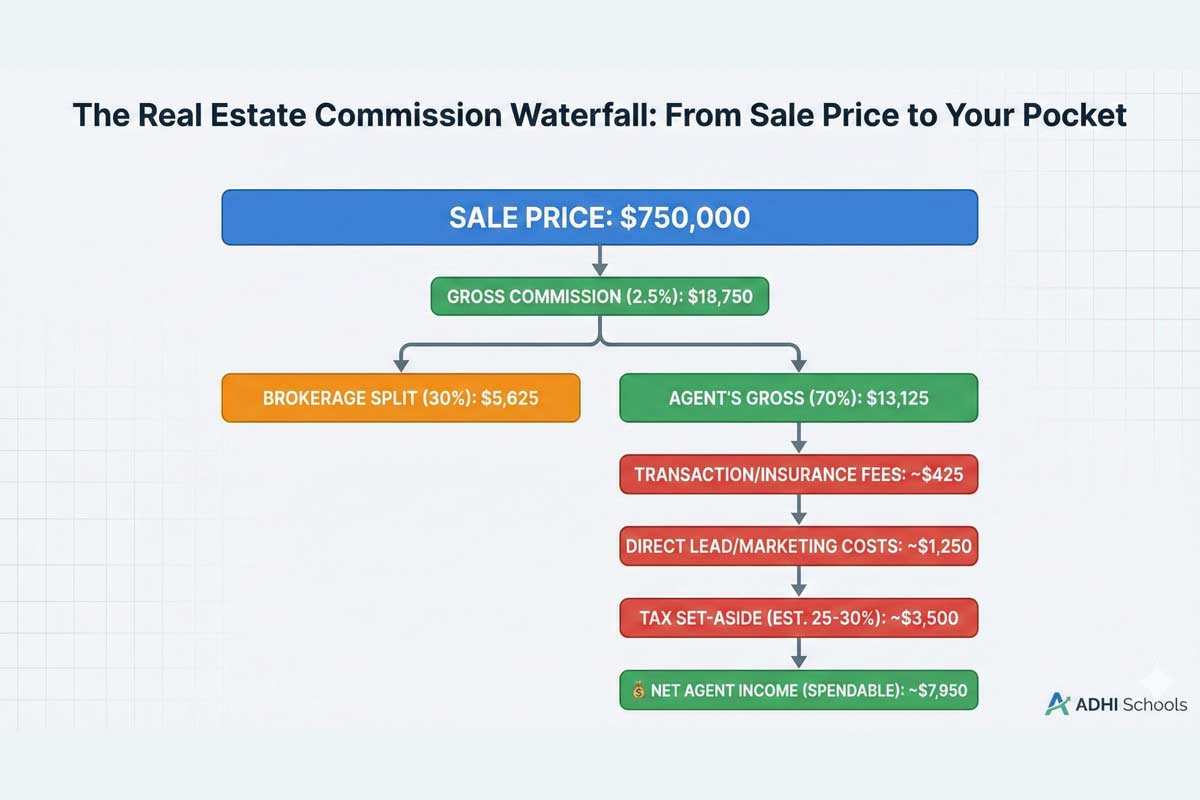
Commission Math Decoded (From Sale Price to Your Bank Account)
Many new agents assume a 3% commission is a fixed rule. In reality, commission rates and splits vary by market and brokerage. This is a simplified model to show the mechanics.
Example: The $750,000 Sale (Assumption Model)
Step
Assumption/Range
Remaining Balance
Sale Price
$750,000
—
Gross Commission to Broker (2.5%)
Model Assumption
$18,750
Brokerage Split (70/30)
Typical solo agent starting split
$13,125
Transaction/Insurance Fees
$250 – $600 (Per-deal variable)
$12,625
Direct Lead/Marketing Cost
$0 (Sphere) – $2,500 (Paid Leads)
$10,125
Tax Set-Aside
Varies by situation—confirm with CPA
Variable
The Takeaway: On a $750,000 sale, your actual spendable income is often less than half of the initial gross commission.
Timeline to Your First Commission Check (The Lag)
The biggest threat to a new agent isn't a lack of talent; it's a lack of capital during the "lag." Understanding how long it takes to start a real estate career is the first step in managing your cash flow, as the licensing process itself often takes a few months.
Once licensed, the wait for your first dollar of income is months, not weeks.
The Ramp: Active lead generation before an offer is accepted.
The Escrow: 30–45 days of waiting for the deal to fund and the check to clear.
Runway Reality: If you are going full-time, a 6–9 month cushion for living expenses is a common safety threshold.
What Slows You Down (Traps)
Administrative Perfectionism: Spending weeks on "branding" instead of talking to human beings.
Escrow Fallouts: In CA, inspections or loan issues can kill a deal late in the game, resetting your income timeline.
What Speeds It Up (Levers)
Focusing on Buyers: A motivated buyer can often be put into escrow faster than a listing can be prepped, staged, and marketed.
Open Houses: This is the fastest face-to-face way to meet unrepresented buyers without an upfront ad spend.
Hidden Expenses (Your First-Year “Cost of Existence”)
You are a business owner, and businesses have overhead. The "gotcha" is that expenses hit before income. You will be paying for access to the market while you are still trying to find your first client.
First-Year Expense Budget (Estimates)
Category
Item
Est. Annual Range
Fixed/Initial
Licensing, Exam, Fingerprints, Board Dues
$2,000 – $3,500
Operational
E&O Insurance, CRM, Signage
$1,500 – $4,000
Recurring Dues
Quarterly MLS Fees / Annual Association
$800 – $1,500
Transportation
Gas, vehicle maintenance, travel time
$1,500 – $4,000
Marketing
Mailers, Digital Ads, Lead Gen
$2,000 – $10,000+
TOTAL
$7,800 – $23,000+
Cash Flow Warning: Many board and MLS dues are due in full upon joining. Budget at least $2,000 for your "Day 1" operating costs.
Scenarios: Applying the Formula to Real Life
1. The Part-Time Learner
Assumptions: 2 deals/year ($800k avg), 70/30 split.
Math: ($40k Gross) x 0.70 = $28k. Minus $7k expenses.
Approx. Net Outcome: $21,000 (Pre-tax).
2. The Hustling Newcomer
Assumptions: 6 deals/year ($800k avg), 80/20 split (achieved via production or boutique brokerage; many start closer to 70/30).
Math: ($120k Gross) x 0.80 = $96k. Minus $15k expenses.
Approx. Net Outcome: $81,000 (Pre-tax).
Verdict: This is a common target for a dedicated full-time solo agent in their first year.
3. The Team Player
Assumptions: 10 deals/year ($800k avg), 50/50 team split.
Math: ($200k Gross) x 0.50 = $100k. Minus $8k expenses.
Approx. Net Outcome: $92,000 (Pre-tax).
What Moves the Needle Fastest (Highest-ROI Actions)
Lead Source Consistency: Pick two sources (e.g., Open Houses and Geographic Farming) and do them every week without fail.
Daily Lead Gen: A non-negotiable 3-hour block every morning dedicated to finding new business.
Database Mining: Your "Sphere of Influence" is your highest-ROI asset.
Common Mistakes That Keep New Agents Broke
Living on the Gross: Spending the full commission check and forgetting that a portion belongs to the IRS.
Compliance & Documentation: Missed signatures, missing disclosures, or late paperwork can delay funding and create liability.
Part-Time vs. Full-Time (The Financial Truth)
The reality of starting real estate part-time in CA is a common way to manage the financial gap while you learn the ropes. While your availability for mid-day tasks is limited—potentially extending your timeline—you bypass the immediate pressure of zero income during the ramp-up.
Fit Check (Should You Pursue This?)
Before diving in, ask yourself:
Runway: Do I have the cash to cover my life and my new business for several months?
Discipline: Can I work 40+ hours a week without a boss directing my daily tasks?
Risk: Am I comfortable with "lumpy" income where zero-dollar months are possible?
If you have the temperament, see if you align with the personality traits of successful California agents. If you're still on the fence, we have an honest assessment of whether you should become a real estate agent in California.
FAQs
“Do new agents really make $100,000 in their first year?”
It is possible, particularly in high-priced markets, but typically requires joining a high-volume team or having an existing, massive network.
“How many deals do I need to close to make $X in California?”
Don't use "rules of thumb." Use the formula: Calculate your local average price, subtract your broker's split, subtract your estimated expenses, and see how many deals it takes to reach your target.
“Is joining a team worth the split cut for a new agent?”
Usually. A 50/50 split of a closed deal is better than a 100% split of a deal that never happens. Teams offer immediate leads and coaching.
“What’s the fastest way to get my first commission check?”
Focusing on buyers is the most direct path to a contract, though "fast" in real estate still often means multiple weeks to months from meeting the client to getting paid.
“Can I survive on part-time real estate income in CA?”
Only if it is supplemental. Fixed costs remain the same whether you sell one house or twenty. You must close at least 1-2 deals a year just to cover your professional dues and expenses.
“What’s the biggest financial surprise for new agents?”
The self-employment tax and the fact that most business expenses hit your bank account before your first commission check does.
Key Takeaways + Your Next Step
You are a business: Gross commission is not your salary. Track your net income post-split and post-expense.
Mind the Lag: Budget for a multi-month ramp-up period.
Upfront Costs: Expect $2,000+ in startup fees before you can even begin marketing.
Now that you understand the math, the next variable is execution. If you want the step-by-step path from decision → licensing → first clients, the start a real estate career in California roadmap we use can help you build the right foundation.
TL;DR: * Gross vs. Spendable: You are a business owner. Your "take-home" is the remainder after brokerage splits, recurring dues, marketing costs, and tax obligations.
The Pipeline Lag: Due to licensing cycles and escrow, a common pattern we see is a multi-month wait for your first dollar of income.
Upfront Costs: Expect to pay $2,000–$4,000 in licensing and board fees before your first closing.
|

You’ve spent weeks staring at practice real estate exams and memorizing the difference between joint tenancy and community property.
You passed.
You have that provisional sense of accomplishment. Read more...
You’ve spent weeks staring at practice real estate exams and memorizing the difference between joint tenancy and community property.
You passed.
You have that provisional sense of accomplishment. But here is the unvarnished truth: Passing the California real estate exam tested your memory. Choosing your brokerage will test your judgment—and the wrong choice can be more expensive than a failed test.
In California, your broker is your supervisor. Your brokerage isn't just a place to hang your license; it is a professional partnership where they are responsible for your conduct and you are responsible for their reputation. This interview is a risk audit.
Imagine this: It’s 8:00 PM on a Thursday. You’re in your first escrow. The buyer’s agent is screaming about a missed disclosure deadline on the Transfer Disclosure Statement (TDS). If you miss this window, you risk triggering cancellation disputes, the potential loss of your client’s deposit, a DRE complaint, and significant professional liability. You call your broker. It goes to voicemail. You call the office manager. No answer. You are alone, and your license is on the line.
New agents don’t fail because they lack “hustle.” They fail because they lack structured support. This guide is designed to transform you from a nervous applicant into a confident investigator.
THE 10-MINUTE PRE-INTERVIEW CHECKLIST
Do not walk into the office until you have these items in your hand:
The Scorecard: A physical copy of the scoring rubric found at the bottom of this guide.
My Goals Sheet: Your target hours per week and your monthly “keep the lights on” budget.
The Evidence Folder: A notepad ready to document specific proof (calendars, checklists, and fee schedules).
The Deal Timeline: A printed sheet showing the lifecycle of a deal (Offer → Acceptance → Disclosures → Contingencies → Closing) to ask exactly where their review gates occur.
1. Your Pre-Interview Intelligence Gathering
Before you step into an office, you need to know who you are talking to. Not every brokerage is built for a rookie. First, you must Decode the Model. Is this a training-centric firm, a “desk-fee farm,” or a high-volume team? If you aren't sure which path fits your personality, stop and read Should You Join a Team or Go Solo before you schedule the meeting.
Next, scan for online red flags. Look at their social media. Are they constantly recruiting “unlimited potential” but showing zero photos of actual training sessions? For a deeper dive into the specific warning signs I’ve seen over the last 20 years, see our guide on Red Flags When Choosing Your First Brokerage.
2. The Five-Point Interrogation (The System Audit)
Category 1: Training PROOF, Not Promises
Core Question: Does this brokerage have a repeatable system to turn a student into a producer?
Ask the Script: “Walk me through the exact training schedule for my first 30 days. Can I see the syllabus for your contract writing role-play?”
Proof to Demand: Demand to see a Live Calendar, a Course Syllabus, and an Invitation to sit in as a guest at the next session.
Good Answer: “We have a 4-week ‘Launch’ program. It’s live every Tuesday and Thursday. Here is a copy of the calendar; you are welcome to attend the 10 AM session this Thursday to see for yourself.”
Dangerous Answer: “We have an amazing culture of learning. Everyone here is an open book, and you can watch our library of videos whenever you want.”
Category 2: Broker Access & Supervision (Your License SLA)
Core Question: Who saves you when a deal goes sideways at 9:00 PM?
Ask the Script: “What is your agent-to-supervisor ratio? What is your guaranteed response time for a contract emergency? If you aren't available, who is the designated backup by name and title?”
Proof to Demand: Demand a Written Service Level Agreement (SLA) or a clear, documented protocol for after-hours support.
Good Answer: “Our ratio is 25:1. I am available until 9 PM, after which [Name], our Assistant Manager, takes over. We guarantee a 30-minute response for active escrows.”
Dangerous Answer: “We’re like a family here. Someone is always around, and you can just text the group chat if you get stuck.”
Category 3: Compliance & Risk Protection
Core Question: How do they prevent you from making a career-ending disclosure error?
Ask the Script: “Where is your transaction checklist stored and who enforces it? Show me your broker review gates in writing—at what exact points am I blocked from proceeding without your signature?”
Proof to Demand: Demand to see a Transaction Checklist.
Good Answer: “We use [Software]. You cannot send an offer or release contingencies until our compliance officer signs off on these four specific gates. Here is the checklist we use.”
Dangerous Answer: “We trust our agents to be professional. Just upload everything to the folder before the deal closes so we can pay you.”
REALITY CHECK: Policy Varies, Presence Doesn't Exact review gates vary by brokerage based on their specific insurance requirements and workflow, but the presence of these gates is non-negotiable. If there is no formal checkpoint, you are flying without a parachute.
Category 4: The TRUE Cost (Splits & Effective Split)
Core Question: What do I actually take home after the "house" takes its cut?
Ask the Script: “I need a written fee schedule. Show me a sample commission breakdown for a new agent on a $10,000 gross commission with your exact fees, E&O, and franchise costs deducted.”
Proof to Demand: Demand a Written Fee Schedule and a $10,000 Net Commission Sample Printout.
Good Answer: “Here is a printed sheet showing that on a $10k check, your take-home is exactly $6,200 after all costs. We call this your ‘Effective Split.”
Dangerous Answer: “We offer a 70/30 split, which is the best in the area! The other fees are just standard industry stuff that comes out at the end.”
CRITICAL: If you don’t understand how “off-the-top” fees can gut your paycheck, stop and read Commission Splits Explained for New Agents before you sign anything.
Category 5: Lead Flow Mechanics
Core Question: How are leads (if any) distributed, and what is the "pay-to-play" reality?
Ask the Script: “How are office leads distributed? If I take a lead from the office, what is the split? More importantly, do I own my Sphere of Influence (SOI) leads if I choose to leave?”
Proof to Demand: Demand to see the Lead Distribution Rules and the Lead Ownership clause in the independent contractor agreement.
Good Answer: “Office leads are round-robin to ready agents at a 50/50 split. Your personal sphere leads are yours to keep, and the split on those is 70/30.”
Dangerous Answer: “We have more leads than we know what to do with! If you’re hungry, you’ll get your fair share. We put everyone in the company CRM.”
REALITY CHECK: Lead Ownership Trap (Teams) I’ve seen agents join a team and bring in a $1.2M listing from their own cousin. Because they hadn't audited the agreement, the team leader took 50% despite providing zero help. Worse, when the agent left, the leader claimed "ownership" of the cousin in the CRM. Audit your lead ownership before you sign.
3. THE MASTER QUESTION LIST
Group these into your notes to pressure-test their operations.
Systems & Evidence
What is the agent-to-supervisor ratio for new licensees?
Show me your transaction checklist (redacted).
Can I see your broker review gates in writing?
Who is the backup supervisor by name and title when the primary is on vacation?
Money & Ownership
Show me a sample commission breakdown for a $10,000 gross check.
In the event of a claim, what is the E&O insurance deductible I am personally responsible for?
Do I own my Sphere of Influence (SOI) leads if I choose to leave the brokerage?
What happens to my pending escrows if I move to another firm?
Lead Generation
Are there mandatory floor time requirements?
Do teams require giving up ownership of SOI leads to the team CRM?
How many agents who joined in the last 6 months have closed at least 2 deals?
THE “3+1” NON-NEGOTIABLES
Walk out of the room if they cannot provide these four things:
A Written Fee Schedule: No verbal promises on splits.
The $10k Breakdown: A clear example of take-home pay after all deductions.
A Live Training Calendar: Proof that support is a schedule, not a theory.
A Designated Supervisor: A specific person (not a group chat) responsible for your file.
4. THE 5-MINUTE TIE-BREAKER
If you are comparing two brokerages, lay their proof side-by-side and compare only these four data points:
The Net Check: Which $10k breakdown is higher?
The Support Ratio: Which agent-to-supervisor ratio is lower?
The Training Density: Which calendar has more live sessions in the next 14 days?
The Review Gates: Which checklist has more mandatory "Stop" points before an offer is sent?
5. THE SCORECARD & DECISION TOOL
Grade each brokerage from 1 (Poor) to 5 (Excellent) in these categories:
Training Proof: (Syllabus shown/Guest invite offered)
Broker Access: (SLA committed/Backup named)
Compliance Systems: (Checklist shown/Review gates enforced)
Cost Transparency: (Written fee schedule/$10k breakdown provided)
Lead Mechanics: (Clear distribution rules/No SOI ownership traps)
The Walk-Away Rule: If Training, Broker Access, or Compliance average below a 4, do not join. No split compensates for a failed deal, a DRE complaint, or a damaged reputation in your first year.
Now that you know how to audit a firm, see our list of the Best Brokerages for New Agents in California to see who tends to score well on these criteria.
Your Career, Your Choice
The brokerage you choose is the most important business decision of your first year. Treat it like a million-dollar acquisition. Once you have chosen the right supervisor to protect your license, your next step is to master the roadmap to actually close deals. Follow our sequence to Start a Real Estate Career in California correctly.
Frequently Asked Questions
What if no brokerage in my area meets a “4” on the scorecard? Keep looking. In major California markets, there are hundreds of options. If you must compromise, never compromise on Broker Access or Compliance. You can buy your own training, but you cannot buy protection from a DRE audit or a ruined reputation.
What should I email the broker after the meeting if they didn’t provide proof? Send this: "Thank you for the time today. To help me make my final decision, could you please email over the written fee schedule, the $10,000 commission breakdown example, and the training syllabus for next month that we discussed?"
In the event of a claim, am I always responsible for the E&O deductible? Usually, yes. It can range from $1,000 to $5,000 or more. You need to know this number upfront so you can budget for it in your "keep the lights on" plan.
Should my broker review offers before submission in California? Yes. While the DRE allows for various supervisory structures, it is a professional best practice to have a broker or manager review your first several offers and disclosure packets to protect your license and your client.
How do I verify training is real? Ask to be a guest. A brokerage with a strong training program is proud to show it off. If they claim it is "proprietary" and can only be seen after you sign a contract, they are likely hiding a lack of substance.
|

If you choose your first brokerage based on the commission split alone, you will lose money—probably a lot of it.
I have spent over 20 years watching new agents walk into a recruiter’s office, see Read more...
If you choose your first brokerage based on the commission split alone, you will lose money—probably a lot of it.
I have spent over 20 years watching new agents walk into a recruiter’s office, see a “90/10” split on a whiteboard, and start spending the money in their heads. Then reality hits. The "Smiling Recruiter" forgot to mention the $500 monthly desk fee, the transaction fees, and the fact that there is zero training to help you actually get a contract signed.
As you Start a Real Estate Career in California, your biggest risk isn't a low split; it's a high split that comes with no support, leaving you with 100% of zero.
TL;DR: The Bottom Line
Effective Split > Nominal Split: The "90/10" on the wall isn't what you take home.
Year 1 is Flight School: You are paying for supervision so you don't lose your license.
Fees are the "Silent Killer": Desk, franchise, and tech fees can eat 20% of your check before you see it.
Negotiability: By law, commissions and splits are negotiable; there is no "standard" rate.
The Goal: Choose the brokerage that gives you the highest probability of closing beyond Deal #1.
Decode the Pitch: The Real Vocabulary
To make a smart decision, you must stop using recruiter jargon and start using mine.
Gross Commission Income (GCI): This is the total pie. If you sell a $1.2M home at a 2.5% commission, the GCI is $30,000.
The Split: The first slice. If you are on a 70/30 split, the broker takes $9,000 and your "Initial Share" is $21,000.
Off-The-Top: Off the top fees are brokerage expenses deducted from a realtor's commission before they receive their share of the split.
Fees: The silent nibblers. They eat your slice from the edges after the split is taken.
Effective Split (The King Metric): The net percentage of the GCI that actually hits your bank account.
Kartik’s Rule of Thumb: The Effective Split Formula
To find the truth, use this calculation. "Your Share" is the dollar amount the broker hands you after their split but before they subtract desk fees, insurance, or transaction costs.
Takeaway: A "90% split" often results in a 65% effective split once the monthly "rent" is paid.
The Five Models: Who Are They Really For?
Model
The Pitch
The Reality
Choose This ONLY If...
The Apprenticeship
"We'll teach you everything."
50/50 or 60/40. High support.
You need a mentor to review every file.
The Ladder
"Earn more as you grow."
Graduated splits (e.g., 60% to 80% as you grow).
You have a clear 12-month lead-gen plan.
The Illusion
"Keep 100% of the cash."
You are a tenant, not a partner.
You have a massive, proven database.
The Gauntlet
"Cap your fees, then keep it all."
High pressure to hit the "cap" fast.
You have cash reserves.
The Safety Net
"We pay you a base salary."
Rare; heavy oversight/shackles.
You value stability over high upside.
Takeaway: Match the model to your current skill level, not your future ego.
The Fee Menu: What They Charge You For
I once reviewed a contract for a student who was promised an 80/20 split. After we calculated the "menu" below, their effective split was 52%. They walked away. Here is how those fees are usually grouped:
"The Rent" (Desk Fees): Monthly fees ranging from $50 to $1,000+.
Kartik’s Note: Paying over $200/month for a desk without a documented, daily training schedule is a major red flag when choosing a brokerage.
Errors & Omissions (E&O): Professional liability insurance. Some brokers charge this annually; others charge a flat fee per transaction.
"The Franchise Tax": Typically 5%–8%. As mentioned above, this may be deducted "off the top" before the split or calculated into your specific fee schedule.
Compliance/Risk Management Fee: A per-file fee charged for the broker's staff to review your disclosures and contracts for legal errors.
The Partnership Tax: If you join a team, expect them to also take a cut. See Should You Join a Team or Go Solo? for the math.
The War Game Scenarios
Scenario 1: The "High Split" vs. The Traditional Partner
Assumption: A $1M sale at 2.5% ($25,000 GCI).
Metric
85/15 "Cloud/Boutique"
60/40 Traditional
Initial Share
$21,250
$15,000
Monthly Desk Fee
–$500
$0
Franchise/Admin Fee
–$1,500
$0
Transaction Fee
–$500
–$250
NET TO AGENT
$18,750
$14,750
Effective Split
75%
59%
Support Provided
Software login + FAQ
Structured coaching & contract review
The Logic: If the 60/40 model provides the systems that help you close one deal a month, while the 85/15 model leaves you to figure out lead-gen alone (leading to zero deals), the "lower" split is more profitable over time.
Scenario 2: The Cap Crusher (The Cash Flow Trap)
An agent joins a "Cap" brokerage with a $20,000 annual cap and $800/month in fixed fees.
The Math: If that agent goes 6 months without a deal, they have spent $4,800 out of pocket.
The Risk: Most new agents quit by month 7. The "Cap" only benefits you if you have the volume to hit it. For a rookie, a no-monthly-fee 50/50 split is safer than a "100%" model that drains your savings while you're learning.
Scenario 3: The Team Tango (The Double Split)
You join a team on an 80/20 brokerage split. The team takes a 50% split for providing the lead.
GCI: $10,000.
Brokerage takes 20%: $8,000 left.
Team takes 50%: $4,000 left.
Effective Split: 40%. Is this lead worth 60% of the commission? If they handle the TC, lead gen and the marketing, it often is.
Audit Checklist: Offer A vs. Offer B
Before signing, put both offers side-by-side:
Item to Audit
Brokerage A
Brokerage B
Nominal Split %
Monthly Fixed Costs ($)
Per-Transaction Fees ($)
Off-the-top Franchise %
Who pays for the CRM?
Documented Weekly Training?
The Interview Playbook: Scripts for the Audit
Don't ask "what is the split?" That's a rookie question. Use these scripts from our guide on How to Interview a Brokerage as a New Agent:
"Can you provide a written, all-in fee schedule and walk me through the net income on a $1.25M sale?"
"What is your documented process for a new agent to get an offer reviewed under time pressure on a Sunday night?"
"If I use a company-provided lead, what is the total effective split after referral fees are deducted?"
The Verdict: What a New Agent MUST Do (Year 1)
For 19 out of 20 new agents, the Apprenticeship/Traditional model is the only logical choice.
I’ve seen too many agents go for a 100% split only to miss a critical disclosure contingency because no one was available to review their file on a weekend. That "saved" commission disappears the moment you're hit with a legal claim.
Year one is about risk mitigation. You need a broker who is financially incentivized to make sure you don't crash. Once you've closed three deals, you have the leverage to look at the Best Brokerages for New Agents in California that offer higher splits for producers.
Takeaway: Buy the education in Year 1 so you can own the market in Year 5.
FAQ: The Blunt Truth
1. Can I negotiate my split?
Yes, but as a new agent, your leverage is low. Focus on negotiating for better tools or waived initial fees rather than the split.
2. What is a "Cap"?
A ceiling on what the broker takes. After you pay them a set amount (e.g., $20k), you keep 100% for the rest of the anniversary year.
3. What is a typical split for a new agent in CA?
Usually between 50/50 and 70/30. Anything higher often indicates a lack of provided leads or support.
4. Is 100% commission ever worth it?
Only if you are a "business in a box" with your own systems, leads, and staff. For a rookie, it's a liability.
5. Do teams take another split?
Yes. Team splits are separate from and usually in addition to brokerage splits.
6. What fees are "normal" in California?
A transaction fee ($250-$500) and E&O insurance are standard. Watch out for hidden "marketing" or "admin" fees.
7. What if the brokerage provides the leads?
Expect a referral fee (25-40%) to be taken before the split is calculated.
8. What is a transaction fee vs. a TC fee?
Transaction fees go to the broker. TC (Transaction Coordinator) fees go to the professional who manages your escrow paperwork.
9. How do splits work on leases?
Often a flat fee or a much higher split (e.g., 50/50) because the dollar amounts are lower.
10. Should I join a high-split brokerage if I'm part-time?
No. Part-time agents need more supervision because they aren't in the office daily to catch changes in law or contracts.
11. Does the split change if I represent the buyer vs. the seller?
Usually no, but check your independent contractor agreement.
12. How do I avoid Red Flags When Choosing Your First Brokerage?
If they talk about the "split" for 30 minutes but can't show you a training calendar, walk out.
The Call to Arms
Your goal is not to find the perfect split. Your goal is to find the first broker who will turn you from a liability into an asset.
The commission split is just one piece of your launch plan. To build your complete, step-by-step career blueprint and avoid the "learning tax" most rookies pay, start here: Start a Real Estate Career in California.
|
Imagine you’re the listing agent for a 1970s fourplex in Los Angeles. The seller tells you the rents are "well below market" and the buyer can easily raise them by 20% to stabilize the asset. You include Read more...
Imagine you’re the listing agent for a 1970s fourplex in Los Angeles. The seller tells you the rents are "well below market" and the buyer can easily raise them by 20% to stabilize the asset. You include this in your MLS marketing.
The buyer closes, attempts the increase, and is immediately hit with a wrongful rent increase lawsuit and a city enforcement action. It turns out that because the property is in the City of L.A., it is subject to a local 3% cap for the current cycle (specifically the period through June 30, 2027)—not the statewide 10% maximum.
As an agent, you don’t need to be a lawyer, but you must be a high-level "compliance operator." In California’s 2026 regulatory environment, a single misstatement about "market rent potential" can lead to a professional liability nightmare.
Compliance Disclaimer: This is educational and not legal advice; agents should verify current rules as of the publish date. Local rules are frequently stricter than state law; always consult qualified counsel or local housing departments for jurisdiction-specific guidance.
The Two-Layer System: Statewide vs. Local
To keep your clients safe, use this mental model for every residential transaction:
The State Baseline (AB 1482): This applies to most multi-family housing and corporate-owned rentals statewide.
The Local Card: Cities like Los Angeles, San Francisco, and San Jose have local Rent Stabilization Ordinances (RSOs). If the local rule is more restrictive, the local rule prevails.
Field Scenario: You are showing a property in a city you aren't familiar with. Before discussing rent upside, your first move should be advising the buyer to check the city’s website for a "Rent Stabilization" or "Housing Department" page.
What Agents Must Know About Statewide Rent Caps (AB 1482)
Under the Tenant Protection Act, annual rent increases are capped at 5% plus the local Consumer Price Index (CPI), or 10% total, whichever is lower.
Common Exemptions (Verify for Every Deal)
Properties that are sometimes exempt from the state cap include:
Rolling 15-Year Rule: Residential property issued a certificate of occupancy within the last 15 years (verify the specific date on the CO).
Qualifying SFHs & Condos: Generally exempt only if the owner is not a REIT, a corporation, or an LLC with a corporate member.
Owner-Occupied Duplexes: If the owner occupied one of the units at the start of the tenancy and still lives there.
Agent Pitfall: A single-family home is not automatically exempt. For the exemption to hold, the landlord must have provided the tenant with specific statutory disclosure language in the lease. If that notice is missing, the property may remain "covered" by the rent cap.
“Just Cause” and Tenant Protections in a Sale
The "Just Cause" framework means a landlord cannot terminate a month-to-month lease without a valid legal reason once a tenant has been in place for 12 months.
Vacancy Assumptions: Never promise a buyer the property will be "delivered vacant." If the tenant is protected by "Just Cause," vacancy usually requires a "no-fault" reason like an owner move-in or a substantial remodel.
Relocation Assistance: "No-fault" evictions typically require the landlord to pay the tenant relocation assistance (often equal to one month’s rent, though local laws may require more).
Renovation Requirements: For a "substantial remodel" to be valid, the work must require permits (which must be provided with the notice) and must render the unit unsafe for occupancy for at least 30 consecutive days.
The Agent’s Rent-Control Workflow
Use this checklist during your due diligence period. This is the same logic we outline in our California Real Estate Laws & Compliance Guide.
Rent Control Compliance Checklist
Verify Age: Check the original Certificate of Occupancy date (do not rely solely on assessor data).
Audit Ownership: Confirm if the owner is a person, a trust, or a corporation.
Confirm Local Rules: Check the city/county for local RSO or unincorporated area protections.
Lease Review: Scan (also advise the buyer to) the current lease for AB 1482 "Notice of Exemption" or "Notice of Coverage" language.
Verify Rent History: Request the last 24 months of rent ledgers to ensure previous increases were lawful.
Confirm CPI Basis: Use the 2026 CPI figures for that specific metropolitan area (typically based on April data for increases after August 1).
Marketing Audit: Remove any "guaranteed" income or "easy eviction" claims from the MLS.
Advertising & Pricing Claims: What Not to Say
Risky Statement
Safer Alternative
“Can raise rent to market immediately.”
“Buyer to verify rent control applicability and allowable increases.”
“Guaranteed vacancy at close.”
“Subject to tenant rights; buyer to verify vacancy procedures with qualified professionals.”
“Property is exempt from rent control.”
“Owner-reported exemption to be verified by buyer during due diligence.”
Common Deal Killers (And How to Prevent Them)
Underwriting Mismatch: Lenders often use conservative rent growth assumptions if they see the property is subject to an RSO.
SB 9 & ADU Complications: Adding a unit can sometimes trigger different regulatory layers. See California ADU Laws Explained and SB 9 Explained for Real Estate Agents.
Missing Environmental Disclosures: Rent control isn't the only risk. See Environmental Regulations California Agents Should Know.
Water Rights Issues: Especially in rural properties, see Water Rights & Easements in California Real Estate.
FAQ
How do I know if a city has stricter rent control?
Search the city name + "Rent Stabilization Ordinance." If the city has its own cap (like the L.A. 3% limit), that number overrides the state floor.
Can rent be increased after a property sells?
A change in ownership does not reset the rent cap. The new owner is bound by the same annual limits as the previous owner for any existing tenants.
What is "Vacancy Decontrol"?
This is the concept that once a tenant moves out voluntarily, a landlord can usually reset the rent to market rate. However, once the new tenant moves in, the cap usually applies again.
Do local ordinances apply in unincorporated county areas?
Yes. For example, L.A. County has a dedicated Rent Stabilization and Tenant Protections Ordinance that covers unincorporated areas.
What documents should I request during due diligence?
Always request the original lease, all addendums, the Certificate of Occupancy, and a certified rent roll for the last 2 years.
Does AB 1482 apply to duplexes or triplexes?
Yes, unless they meet specific exemptions such as the "owner-occupied duplex" rule where the owner lived there before the tenancy began.
|
As a real estate professional in California, you’ve likely seen "SB 9 Potential" popping up in MLS remarks. With 20+ years helping California agents and students navigate compliance at ADHI Schools, Read more...
As a real estate professional in California, you’ve likely seen "SB 9 Potential" popping up in MLS remarks. With 20+ years helping California agents and students navigate compliance at ADHI Schools, I have seen how new laws create both massive opportunity and significant professional landmines.
The danger?
Marketing SB 9 as a "guaranteed" four-unit build. If a buyer closes based on your marketing, only to find the city rejects the permit due to local objective standards or utility constraints, you—and your broker—could be in the crosshairs.
Legal Disclaimer:This guide is for informational purposes only and does not constitute legal or land-use advice. SB 9 implementation varies significantly by local jurisdiction. Always advise clients to verify feasibility in writing with the local planning department and qualified land-use counsel.
FAST ANSWER: What is SB 9?
Senate Bill 9 (SB 9) provides a ministerial pathway for homeowners to subdivide a single-family lot (Urban Lot Split) or build up to two primary units on one lot. While it limits local discretionary review, projects must still meet "objective standards" and specific eligibility criteria.
Agent Note: Never guarantee approval; always verify site-specific feasibility in writing with the city.
SB 9 Eligibility: The Quick Screen
Before you spend hours on a property, run these four checks. If any of these "Red Flags" appear, the project may be ineligible under state or local rules.
Zoning: Is it a single-family residential zoning designation (e.g., R-1, RS, etc.)?
Location: Is it in an "Urbanized Area" or "Urban Cluster"? Verify this on the local agency’s SB 9 eligibility map.
Tenancy History: Hard-stop restrictions apply if the property was occupied by a tenant in the last 3 years. Generally, SB 9 cannot be used to alter or demolish tenant-occupied housing. Refer to Rent Control Laws in California (Agent Guide) to evaluate displacement risks.
Ineligible Sites: Sites in very high fire hazard severity zones, floodways, or earthquake fault zones often trigger ineligibility. Treat these as red flags requiring written confirmation from the city. See Environmental Regulations California Agents Should Know for more on these overlays.
What SB 9 Actually Does (Agent Translation)
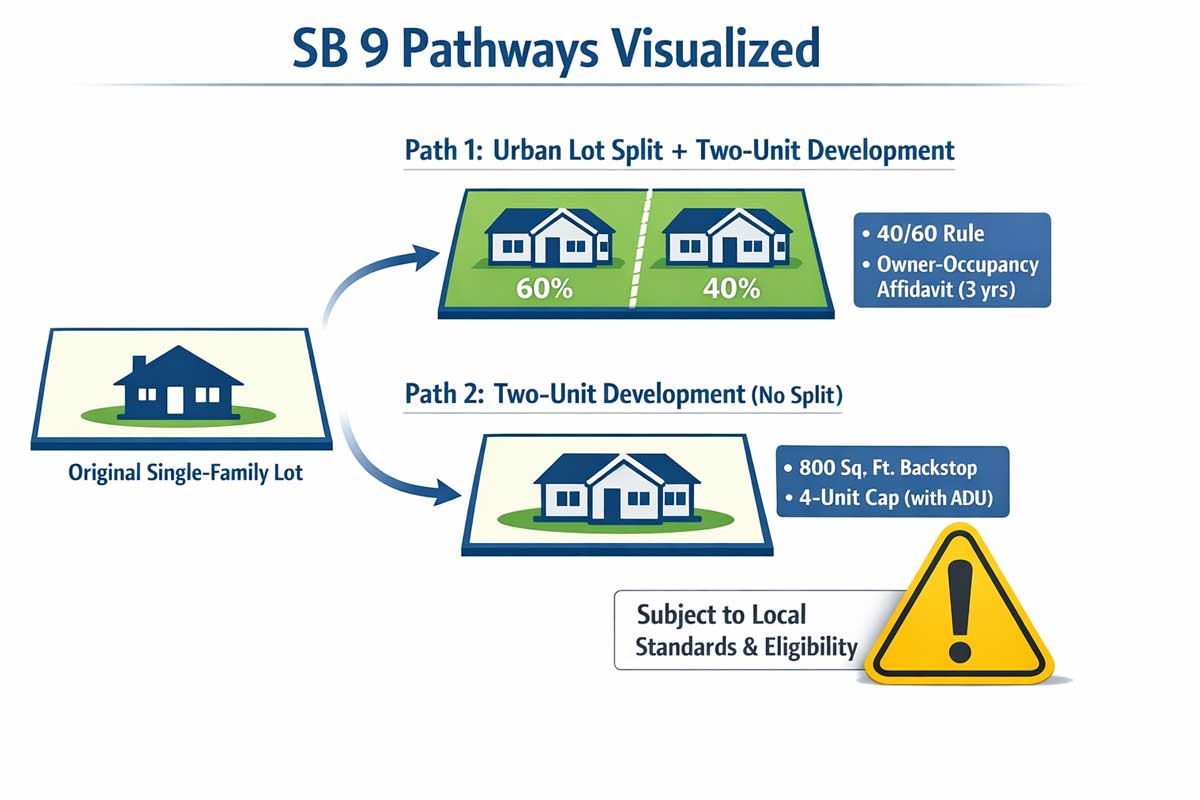
To advise clients safely, you must distinguish between the two separate pathways provided by the law.
1. Urban Lot Split (Gov. Code § 66411.7)
The "40/60" Rule: Per state statute, the split must result in two lots where the smaller lot is at least 40% of the original lot's size. Both newly created parcels must be at least 1,200 square feet, unless a local ordinance allows smaller.
Owner-Occupancy: State law requires an applicant to sign an affidavit stating they intend to occupy one of the units as a principal residence for at least three years. Exception: This requirement does not apply to "community land trusts" or "qualified nonprofit corporations."
2. Two-Unit Development (Gov. Code § 65852.21)
The "800 Sq. Ft." Rule: Local objective standards generally cannot be applied in a way that would physically preclude the construction of at least two units that are at least 800 square feet each. This is a "backstop" against restrictive local standards, not a guarantee that every lot can accommodate this size.
The Unit Cap: In practice, many jurisdictions treat the total unit count (including ADUs and JADUs) as capped at four across the original lot footprint. If a lot already has an ADU, your client’s SB 9 potential may be limited—verify local implementation.
SB 9 vs. ADU: Why Clients Get Confused
Agents risk misrepresentation claims when they conflate these two very different permit paths.
Primary vs. Accessory: SB 9 units are "primary" dwellings; ADUs are "accessory."
Separate Sale: SB 9 units can potentially be sold separately if a lot split is recorded and ownership is structured appropriately—verify with counsel. ADUs generally cannot be sold separately. (Learn more: California ADU Laws Explained).
Parking: While state law limits parking requirements to 1 space per unit, multiple local waivers apply—verify the city’s specific SB 9 standards.
Setbacks: State law generally allows a local agency to require up to 4-foot side and rear setbacks (Gov. Code § 65852.21), but no setback is required for existing structures rebuilt in the same footprint.
Marketing & Liability: How to Talk About "Potential" Safely
The "Do vs. Don't" Table
Don’t Say (High Risk)
Do Say (Compliance First)
"Approved SB 9 Lot Split"
"May qualify for SB 9; Buyer to verify with city."
"Guaranteed 4-Unit Build"
"Check local unit-count caps for SB 9 + ADU."
"Split Ready / No Restrictions"
"Subject to local objective standards & affidavits."
Pro-Tip: Do not use the words approved, guaranteed, by-right, or split-ready unless you have a written planning confirmation or city-stamped approval in your hand.
Verification Artifacts (The "Agent File" Checklist)
Written email confirmation from the Planning Department regarding the specific APN.
Preliminary Title Report highlighting any private CC&Rs (SB 9 does not automatically override private restrictions).
"Will-Serve" notes from utility providers (water/sewer/power).
A Seller-signed tenant history declaration.
Real-World Scenarios
The Unrecorded Access: A listing marketed "SB 9 split potential." The buyer discovered the "back lot" had no legal frontage and the neighbor refused an easement.
Agent Fix: Check for Water Rights & Easements in California Real Estate and ensure legal access is recorded on title. Document in file: Preliminary Title Report.
The Utility Capacity Halt: An investor bought a lot for a duplex build. The water district denied new meters due to infrastructure limits.
Agent Fix: Always include "will-serve" verification in your buyer's due diligence. Document in file: Water District written response.
The Tenant Surprise: A seller failed to disclose a roommate who paid rent. The city denied the permit because the property wasn't "tenant-free" for the required 3-year lookback.
Agent Fix: Document in file: Signed seller declaration regarding tenancy.
Frequently Asked Questions
Can I list "SB 9 potential" if there are HOAs?
SB 9 does not explicitly override private CC&Rs. Treat HOA/CC&Rs as a major red flag requiring attorney review before you market the project as feasible.
What kills SB 9 feasibility most often?
High-fire hazard zones, unrecorded easements, and the 3-year tenant occupancy rule are the most common "deal killers."
Is owner-occupancy always required?
For an Urban Lot Split, yes—a 3-year affidavit is required (Gov. Code § 66411.7(g)(1)), unless the applicant is a community land trust or qualified nonprofit. For a Two-Unit Development (no split), many cities do not require it.
Your Compliance Playbook
Navigating California land use requires more than just reading a headline. This article is part of our California Real Estate Laws & Compliance Guide, designed to be your professional compliance playbook.
|
Notice: This guide is for informational purposes only and does not constitute legal advice. California housing laws are subject to frequent legislative updates; always consult with a qualified land-use Read more...
Notice: This guide is for informational purposes only and does not constitute legal advice. California housing laws are subject to frequent legislative updates; always consult with a qualified land-use attorney, local planning department, and the applicable utility agency for property-specific feasibility.
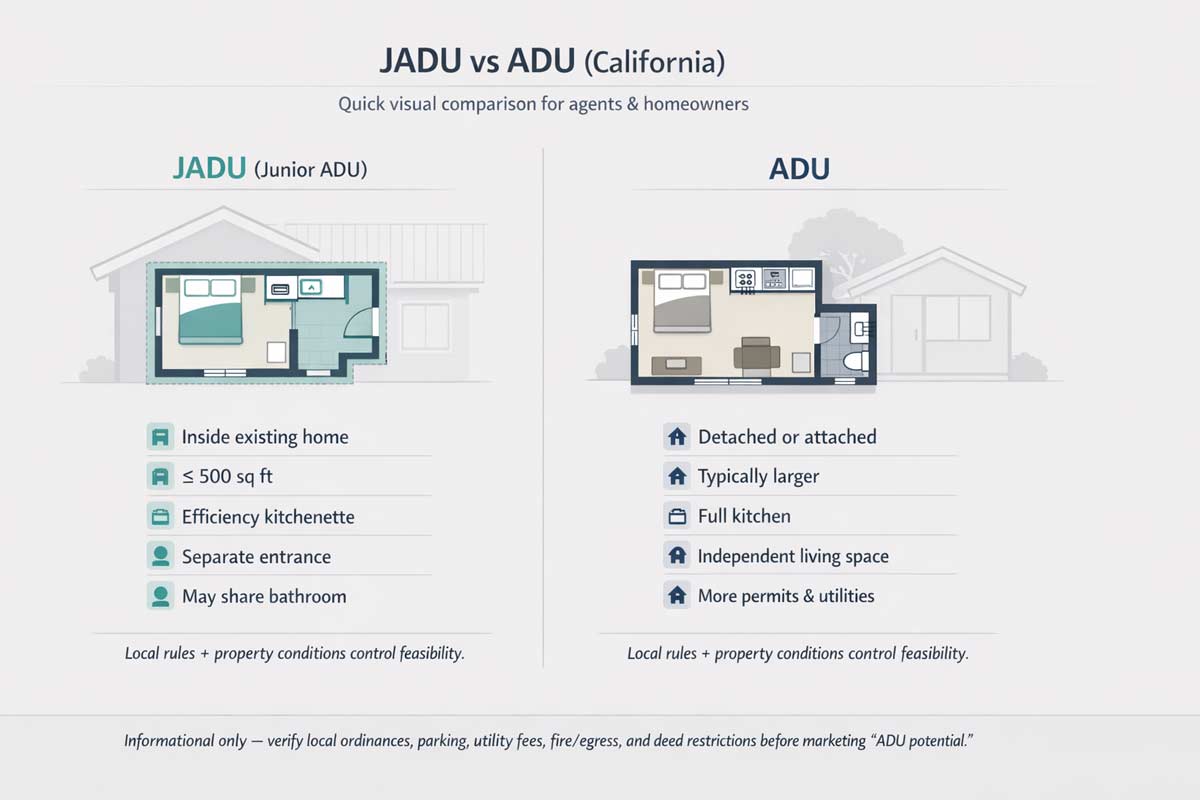
Accessory Dwelling Units (ADUs) can be a major inventory-growth lever in California — but “ADU potential” is also one of the easiest ways for an agent to create liability if it’s marketed like a guarantee. This guide is part of our California Real Estate Laws & Compliance Guide and focuses on what agents need most: the state’s ministerial (no-hearing) process and the administrative “shot clocks” designed to prevent permit stalling — plus the exact items you should verify in writing before you talk numbers.
Fast Answer: What California ADU Law Actually Does
California’s ADU framework is no longer “local preference.” It’s a state-enforced ministerial system: cities must approve ADU applications that meet objective standards, and they must process them on strict timelines.
“Ministerial” just means that there’s a checklist that has to be followed, and as long as everything on that checklist is done the approval doesn’t require a hearing. However, it’s still not a guarantee until the city confirms the application is complete and compliant.
The two clocks agents should know:
1) Completeness clock (15 business days)
Cities have a 15-business-day window to determine whether an application for an ADU is complete. If the permitting agency does not make a timely completeness determination, the application is treated as complete for timing purposes and the next clock starts.
VERIFY IN WRITING (do this every time):
Get a portal timestamp / receipt confirmation showing the submission date and time.
If submitted by email/mail, keep proof of receipt (and ask the agency to confirm the “received” date in writing).
2) Decision clock (60 days after complete)
Once an application is complete, the city generally has 60 days to approve or deny it. Missing that deadline can trigger “deemed approved” status, subject to the statutory mechanics (and tolling if the applicant requests delay).
VERIFY IN WRITING:
Ask the city (email is fine) to confirm the “complete” date that starts the 60-day clock.
If the city denies, request the full written set of correction comments (all departments) in one package — not piecemeal.
Key Considerations
1) State law sets the baseline (and limits local games)
State ADU law preempts conflicting local standards. Cities can add rules, but they must stay within the state framework and use objective standards — not subjective “we don’t like it here” discretion.
VERIFY IN WRITING:
Request the city’s current ADU ordinance + ADU handout/checklist (many cities have an “ADU packet”).
If staff cites a rule that seems to conflict with state standards, ask them to identify the code section in writing.
2) The 60-day clock is real — and denials must be “complete”
If the city denies, it must provide a full written set of correction comments describing what’s wrong and how to fix it. This is designed to prevent the “drip-feed denial” tactic.
VERIFY IN WRITING:
Please provide the complete set of correction comments from all reviewers and confirm this is the full list.
3) Parking: stop making promises; use exemptions carefully
Parking rules are often 0 spaces in common scenarios (especially conversions) but be sure to confirm local and state rules.
Parking may be capped and often waived under specific statutory exemptions (transit proximity, conversion of existing space, historic district rules, permit restrictions, etc.).
Replacement parking is often not required when converting certain existing parking structures — but don’t market that as universal without city confirmation.
VERIFY IN WRITING:
Ask planning to confirm how many parking spaces are required for the specific property and why (which exemption they’re applying).
4) Fees: impact fees ≠ utility connection/capacity charges
This is where agent marketing can get folks in hot water.
Impact fee rules can depend on ADU size thresholds and local fee programs.
Utility connection/capacity charges are a separate universe (water/sewer/power) and can still surprise owners even when impact fees don’t.
VERIFY IN WRITING:
City: “What impact fees apply for an ADU of approximately ___ sq ft?”
Utilities: “What connection/capacity charges apply and under what calculation method?”
Consider brushing up on Water Rights & Easements in California Real Estate (because easements + utility constraints are where projects can fall apart.
5) Short-Term Rentals (Airbnb): keep the warning, tighten the language
California law requires 30+ day rental terms for JADUs and for ADUs approved under the § 66323 “state standards” pathway.
For ADUs approved under a local ordinance, state law gives cities the authority to require 30+ day terms — and many jurisdictions do.
VERIFY IN WRITING:
Never market “ADU short-term rental income” unless you have the city’s short-term rental rule in writing for that parcel.
Agent Tip: To protect your commission and your client, never market “ADU short-term rental income” unless you have verified the city’s specific STR ordinance in writing.
6) Environmental overlays and recorded easements are the silent killers
Most “ADU denials” aren’t philosophical. They’re constraints: hillside grading, coastal, fire severity, biological, historic, sewer/water limitations, or recorded easements.
VERIFY IN WRITING:
Ask the city: “Are there any overlays affecting ADU placement (hillside/coastal/fire/historic/biological)?”
Confirm easements on the prelim/title report before promising anything.
Environmental Regulations California Agents Should Know
Water Rights & Easements in California Real Estate
7) The SB 9 Intersection: When ADUs Aren't Enough
If a client wants more than just an ADU, they may ask about SB 9. While ADUs add "accessory" units, SB 9 allows for primary density increases through ministerial lot splits and two-unit developments.
Summary of SB 9 (2025-2026 Updates):
The "Two-Unit" Rule: On a single-family lot, an owner can ministerially build two primary units (effectively a duplex) instead of a house + ADU.
The "Urban Lot Split": SB 9 allows a single lot to be split into two. Each new lot must be at least 1,200 sq ft.
The "Unit Cap" Trap: If a lot is split under SB 9, the city can limit the total number of units to two per new lot (inclusive of ADUs/JADUs).This means you generally cannot "stack" an SB 9 lot split with multiple ADUs to get 6 or 8 units unless the local ordinance specifically allows it.
Owner-Occupancy (The Big Catch): Unlike ADUs, an SB 9 lot split requires the owner to sign an affidavit stating they intend to occupy one of the units as their primary residence for at least three years.
VERIFY IN WRITING:
"Does this specific parcel qualify for an SB 9 lot split (check for historic districts/fire zones)?"
"If we split the lot, what is the maximum total unit count (including ADUs) allowed per parcel?"
8) The Rental Strategy Trap: Rent Control & AB 1482
This is a critical due diligence item for investors. While a single-family home (SFH) is typically exempt from statewide rent control under the Costa-Hawkins Rental Housing Act, adding an ADU can change that.
Rental strategy trap (state + local): don’t underwrite rents in your head.
If a client wants more than just an ADU, they may ask about SB 9. While ADUs add "accessory" units, under AB 1482 depending on the property type, ownership structure, and required tenant notices
VERIFY IN WRITING: Before you market “rent upside,” have the buyer/owner confirm (a) whether the property is covered by a local rent stabilization ordinance, and (b) whether AB 1482 applies or an exemption applies — preferably with a landlord-tenant attorney or written guidance from a credible local housing/rent authority.
“What to Say in Listing Remarks” (safe, punchy, defensible)
Use language like this:
Property may be eligible for an ADU (subject to city review, utility capacity, and recorded easements). Buyer to verify ADU feasibility, fees, parking, and rental restrictions with the City and utility providers.
Avoid language like:
“Guaranteed ADU”
“By-right ADU” (unless you’re prepared to prove the exact pathway + objective compliance)
“No fees”
“No parking required”
“Airbnb income”
The shift from local control to a state-mandated ADU framework has created a massive opportunity for California homeowners, but for real estate agents, it has also moved the goalposts for professional liability. Mastering ADU rules is no longer just about knowing square footage; it is about protecting your clients from expensive permitting delays and "soft" denials.
As we move through 2026, the key to a successful ADU-focused transaction is transparency. By using the "administrative shot clocks" provided by SB 543 and the streamlined pathways of AB 1154, you can help your clients navigate the process with confidence—provided you never mistake "potential" for a "guarantee."
Your Starter Checklist for Every ADU Listing:
Don't Guess on Fees: Get the city’s impact fee and the utility’s capacity charge schedules in writing.
Watch the Clock: Use timestamped receipts to hold agencies to their 15-business-day and 60-day legal windows.
Build the Professional Team: Always refer your clients to a qualified land-use attorney, a licensed architect, and a contractor to confirm site-specific feasibility.
Staying "compliance-first" is what separates top-tier agents from the rest. By facilitating the right conversations with the right experts, you protect your commission, your reputation, and your client’s investment.
|

TARGET AUDIENCE CHECK
This is for you if: You want a tactical tool to evaluate local California offices and identify which business model fits your specific personality.
This is NOT for you if: You Read more...
TARGET AUDIENCE CHECK
This is for you if: You want a tactical tool to evaluate local California offices and identify which business model fits your specific personality.
This is NOT for you if: You want a ranked list of "top brands" or corporate recruitment fluff.
Choosing your first brokerage in California is a high-stakes decision disguised as a simple choice. Your hard-earned license is a tool, not a trophy, and its value is determined entirely by the support system you choose to wield it.
You’ve passed the exam, but your license is truly tested the moment a client asks a question you can’t answer and you have nowhere to turn. In my 20+ years of experience, I’ve watched the same costly pattern repeat: agents seduced by a charismatic recruiter or a premium office, only to fail months later on a missed deadline or botched disclosure.
The fatal flaw isn’t picking the “wrong” brand—it’s choosing for atmosphere over accountability, for splits over support. This guide is your tactical framework. It replaces hope with strategy, helping you cut through the polish to find the partner that will truly protect your career and answer the phone when you’re in over your head.
The New Agent Brokerage Scorecard
Use this rubric to evaluate every office you visit. Score each category from 1 (poor) to 5 (excellent).
The Scorecard Rule:
If the average score for Training Proof, Compliance Review, and Broker Support is under 4, walk away.
If Broker Support cannot define a specific deadline-response path (how fast they answer on weekends), walk away.
If the All-in Fee Sheet isn't provided in writing, walk away.
Evaluation Rubric
Category
What to Look For
Why It Matters
Training Proof
A physical calendar showing weekly live contract drills and roleplay.
"We have training" is a platitude. You need to see the schedule.
All-In Fee Sheet
Get splits/caps/fees in writing. (Commission Splits Explained for New Agents)
If it isn't in writing, it will be "misremembered" later.
Broker Support
A documented response path for after-hours / deadline questions.
You need a manager with a defined response time when a deal is on the line.
TC Process
A dedicated Transaction Coordinator and a file-review checklist.
CA disclosures are paperwork-heavy; you need a professional safety net.
Mentor Structure
Minimum commitments: Weekly deal desk? Contract review? Shadowing?
You want a mentor with specific, documented responsibilities to you.
Required Tools
Who pays for the CRM, doc-sign software, and website?
Some brokerages hide "tech bundles" in your monthly fees.
Compliance Review
Does a broker review your RPA before it goes to a client?
This prevents expensive legal mistakes before they happen.
Lead Generation
Distribution rules, contact rates, and the specific cost (split/fee).
Avoid vague promises of "leads" without a defined system.
Exit Terms
Who owns team-provided leads? What are the non-solicit terms?
Some agreements restrict your ability to work your database if you leave.
E&O Insurance
A summary of coverage, deductible responsibility, and who pays.
New agents are often blindsided by deductible costs ($1k–$5k) after a mistake.
The "No-Go" Dealbreakers
Can't provide an all-in fee sheet: Hidden costs are a leading cause of first-year "quit" rates.
No broker review process: If no one audits your contracts, you are flying blind with your license on the line.
No training calendar: If they "can't show it right now," the training is unproven and likely inconsistent.
No after-hours support path: Real estate doesn't happen 9-to-5; you need a documented path for weekend deadlines.
The "Closed-Door" Policy: They won’t let you speak to 1–2 agents who joined in the last 12 months.
The Proof Pack (Ask for these in writing)
Full Fee Sheet (E&O, desk fees, franchise fees, deductibles)
Current month's onboarding/training calendar
Example Transaction Checklist / File Review Rubric
Written Mentor Structure (Frequency, responsibilities, and who covers the deal desk)
Copy of the Independent Contractor Agreement (ICA)
The Core: Brokerage Models (Choosing Your Fit)
The right choice depends on your learning style. Verify these details locally and do not rely on a national logo.
1. Training-First Model (The Classroom)
Best for: Career-changers who thrive in a structured environment and want a clear, step-by-step playbook.
The Trade-Off: You’re paying a higher split to buy speed-to-competence.
Verify This: Show me last month’s training recordings or the specific agenda for contract drills.
Failure Mode: If you skip the "reps," you will freeze in front of your first client.
2. Team-Centric Model (The Appointment Engine)
Best for: You want appointments now and accept a lower net commission to buy "reps" and experience.
The Trade-Off: You’re "renting" leads; you’ll pay for them forever unless you build your own pipeline.
Verify This: Show lead distribution rules, minimum activity requirements, and the team agreement. Need more context? I wrote a guide on whether you Should You Join a Team or Go Solo.
3. Boutique/Community Model (The Culture)
Best for: You value direct access to the owner and a localized, non-corporate vibe.
The Trade-Off: You’ll either become self-sufficient fast or you will drift.
Verify This: Show the file-audit checklist and the broker review cadence.
Failure Mode: If you require rigid structure to stay productive, you will likely stall here.
4. Fee-Based / Self-Directed Model (The High Margin)
Best for: You already have an existing pipeline or network and just need a place to "hang" your license.
The Trade-Off: Minimal hands-on supervision and zero provided training.
Verify This: Show support portal response standards and identify exactly who answers legal/compliance questions.
Failure Mode: This model is brutal without an existing pipeline; you will likely stall before your first closing.
5. Outbound Team (The Dialer)
Best for: You can commit to 2–4 hours a day of outbound calling and have a high tolerance for rejection.
The Trade-Off: High burnout risk and very low splits on team-provided leads.
Verify This: Show contact rate expectations and the script coaching cadence.
6. Traditional Full-Service Office (The Hybrid)
Best for: You want a mix of a brand name and on-site resources like transaction coordinators.
The Trade-Off: Mid-range splits; can often feel "sink-or-swim" if the manager is checked out.
Verify This: Show me the actual resources—TC availability, deal desk schedule, and broker-to-agent ratio.
Money Reality Check: The Math of Support
Don't be blinded by a split percentage. Consider this comparison for your first 6–9 months:
Scenario
Example A(High Split / Low Support)
Example B(Lower Split / High Support)
Training/Leads
None (Self-taught)
Intensive Coaching + Mentor
Production (6–9 mo)
0 Deals (Struggled to launch)
2 Deals (at an ~$800k price point)
Gross Commission (GCI)
$0
$40,000
Agent Net (Pre-Tax)
$0
$20,000
Note: Example only—commission rates and splits vary by market, brokerage, and side. Assumes 2.5% commission on a single side before broker fees, team splits, MLS dues, and taxes. The point remains: 2 deals at a lower split beats 0 deals at a high split.
Beginner Traps to Avoid
Paperwork Avoidance: Joining a model that doesn't force you to learn the RPA and disclosures. You cannot "out-sell" a lack of legal competence.
Recruitment Theater: Big promises during the interview but zero calendars, checklists, or accountability once you sign.
The "Invisible" Training: Accepting "we have online videos" as a substitute for live contract training.
Exit Term Surprises: Some team agreements claim ownership over team-provided leads and restrict solicitation. Red Flags When Choosing Your First Brokerage covers this in depth.
California-Specific Context: Compliance is Protection
California’s regulatory environment is demanding. Disclosures like the TDS, SPQ, and AVID are time-sensitive and legally heavy. For most new agents, joining an office without a documented file-audit process is gambling with your license.
Ask This: "Do you perform live RPA clause-by-clause drills and disclosure timeline walkthroughs?"
Ask This: "Who reviews my first 3 contracts before they go out to ensure I don't miss a disclosure deadline?"
The 60-Minute Decision Path
Self-Diagnose: Pick your top 2 needs (e.g., Appointments now vs. Paperwork Training).
Shortlist: Pick three local offices that represent different models.
Interview with a Weapon: Bring the Scorecard. Before you go, read How to Interview a Brokerage as a New Agent.
The Proof Pack: Do not leave without a fee sheet and training calendar.
Your first brokerage is a launchpad, not your final destination. Choose for speed-to-competence today; optimize splits later.
Ready to take the first step?
Start a Real Estate Career in California
FAQ SECTION
Q: Is a 100% commission brokerage good for new agents?
A: Only if you already have a solid lead pipeline and a documented plan for contract support. Without infrastructure, most rookies fail before their first deal.
Q: What should my broker’s response time be?
A: You should expect a response on the same day, and significantly faster during active contingency deadlines.
Q: Should I join a team my first year?
A: If you need a check quickly, a team accelerates the process. However, be aware of the long-term cost and the exit terms regarding lead ownership.
Q: How do I verify training is real?
A: Ask to see the calendar for the current month. If they can't show it, treat it as unproven and likely inconsistent.
TL;DR
Verify Training Proof: "We have training" is a placeholder until you see a live calendar with contract drills and roleplay.
Manager Availability (SLA): Your first crisis won't happen during office hours. You need a documented response path for deadlines.
All-In Cost Sheet: Get every desk, tech, insurance, and franchise fee in writing. If it isn't on the sheet, it doesn't exist.
Skill > Splits: A 100% split of zero is still zero. Prioritize speed-to-competence over high margins for your first 12 months.
|
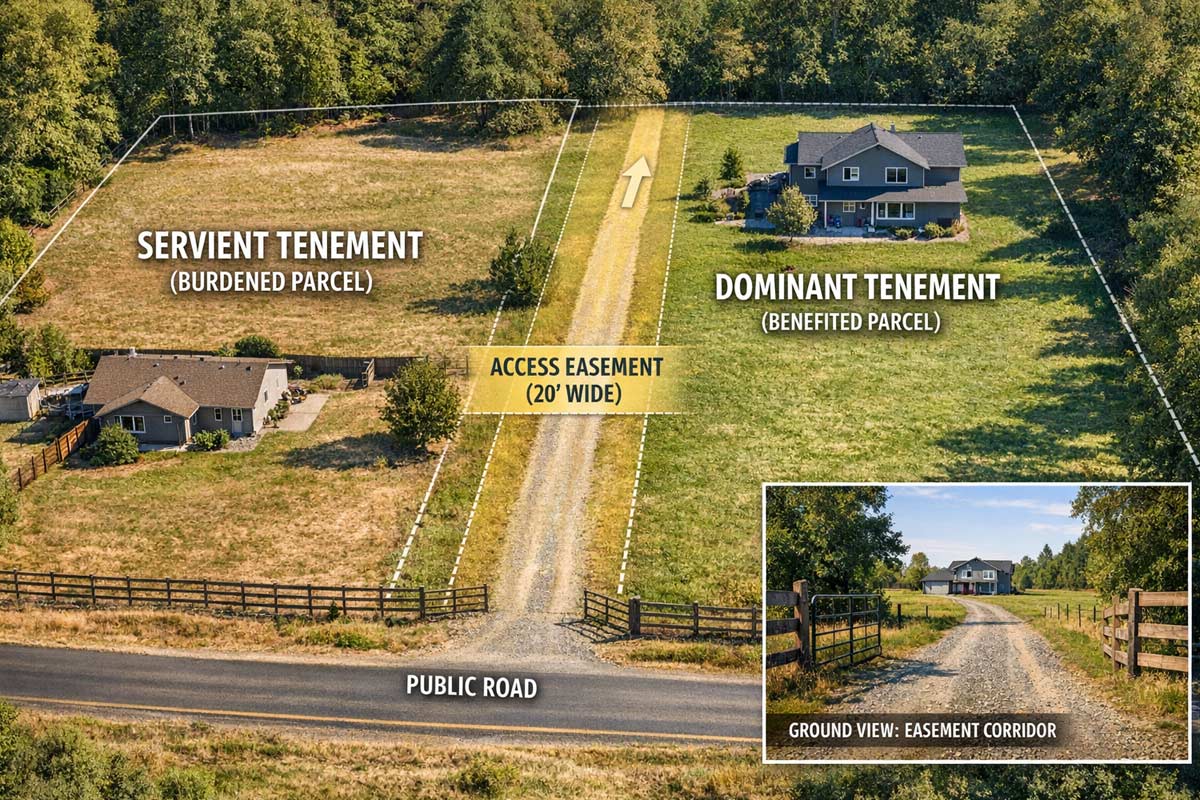
In California real estate, water and access are two of the easiest facts to misstate—and two of the hardest problems to fix after closing. If you market “water rights,” “year-round water,” or Read more...
In California real estate, water and access are two of the easiest facts to misstate—and two of the hardest problems to fix after closing. If you market “water rights,” “year-round water,” or “guaranteed access” without written verification, you’re not just risking a failed deal; you’re risking a misrepresentation claim.
The trap is predictable: agents often confuse legal entitlement with physical reality. A water bill is not the same thing as a legal right to a source, and a driveway you can drive today is not proof of a recorded right to use it tomorrow.
This guide is part of the California Real Estate Laws & Compliance Guide.
Notice: This guide is for informational purposes only and does not constitute legal advice. California water and land-use rules can be highly fact-specific. Always consult the local agency, title/escrow, and a qualified real estate attorney or land-use professional for property-specific guidance.
Fast Answer: Water Rights & Easements in California (What Agents Must Verify)
In California, water service (a meter/account with a district or mutual system) might be different from water rights (a legal claim to use a water source), and physical access is different from legal access (a recorded right to use a path for a defined purpose). Agents reduce liability by verifying: (1) the true water source and any conditions for continued service, and (2) the existence, scope, and map location of any access easement—in writing—before using those claims in marketing.
Verify in writing (minimum):
Water: District/mutual/well source, written confirmation of service availability/conditions, and any fees/limits.
Access: Recorded easement document + scope (ingress/egress, width, permitted uses), plus whether the actual road sits inside the easement boundaries.
Title: Easement exceptions, ambiguous “blanket” easements, or anything requiring a survey and/or legal review.
Water Rights vs. Water Service: The Critical Distinction
The most common mistake is assuming a property has "water rights" just because water is present.
Topic
What it is
What agents should verify
Common marketing mistake
Water Service
Utility delivery (district/mutual)
Service status, transfer requirements, written confirmation of service availability, connection fees, meter availability.
Saying “water rights included” when it’s only a service account.
Water Rights
Legal entitlement/claim to a source
Any documentation/agreements/permits, limitations, transferability, and counsel review when unclear.
Treating a claim as guaranteed capacity or permanent.
Physical Access
A road/driveway exists
Ownership, maintenance responsibility, gates/controls, visible encroachments.
Assuming physical use equals a legal right.
Legal Access
Recorded right to cross land
Recorded document, scope, width, map/exhibit location, and any lender/fire authority concerns.
Saying “deeded access” without reading the easement.
Who This Matters For (High-Risk Scenarios)
Verification is non-negotiable for these property types:
Rural & Ag Parcels: Properties with wells, irrigation, or horse/livestock needs.
Flag Lots & Private Roads: Properties relying on shared driveways or "off-main" access.
Waterfront & Creek-Adjacent: Land bordering natural watercourses where riparian claims may arise.
Development & ADU Sites: Parcels where "legal access" must meet specific fire-code widths or where utility capacity is capped.
California Water Rights Basics
Riparian and Appropriative Concepts
Riparian: Generally tied to land bordering a natural watercourse and typically used on that land; these rights are fact-specific and not something agents should "promise" without appropriate review.
Appropriative: Often tied to priority and permitting. If a property relies on diverted surface water, verification can require complex agency records and legal review.
Groundwater and Wells
Practical Reality: Well performance is a tested condition, not an assumption. Local groundwater rules and basin management can affect drilling, pumping, and long-term reliability.
What Documents Usually Prove What (Quick Reference)
Resource
Evidence/Document to Request
Water District Service
Recent bill + district confirmation of transfer/service status.
Mutual Water
Share certificate + current standing confirmation + transfer rules.
Private Well
Well records (if available) + current yield/flow + potability results.
Shared Well
Written agreement covering access, maintenance, and cost-sharing.
Access Easement
Recorded easement/right-of-way document + map/exhibit showing location.
How to Spot Easements in the Preliminary Title Report (Schedule B)
Your primary defense is the Preliminary Title Report—but only if you treat it like a checklist, not a formality.
Start with Schedule B (Exceptions): This is where easements, rights-of-way, and restrictions can appear.
Pull every referenced document: If an exception cites a recording date/instrument number, ask title/escrow for the actual recorded document—don’t rely on the one-line summary.
Identify scope: Does it allow ingress/egress, utilities, drainage, or something else? Is it limited to certain vehicles or purposes?
Check whether it’s appurtenant or in gross: Does it benefit the parcel (runs with land) or an entity (utility, agency)?
Find the map/exhibit: Many easements live on a plat or exhibit that shows location/width. If the easement isn’t clearly mapped, treat it as a risk flag.
Compare paper to pavement: If the road/driveway doesn’t appear to sit within the easement area, recommend a survey and/or legal review before removing contingencies.
Title Red Flags:
“Blanket” easements that cover large areas without a defined corridor.
Easement exists, but doesn’t connect to a public right-of-way or reach the actual structure.
Language that conflicts with current use (e.g., pedestrian-only vs. vehicle access).
Encroachments (fences/sheds sitting in the easement area).
Agent Workflow: The 6-Step Due Diligence Loop
Ask: Source, history, disputes, and shared agreements.
Pull: Title/prelim + exhibits; read Schedule B and referenced documents.
Confirm: District/mutual status, will-serve terms, and transfer rules.
Test: Yield and potability during contingencies (for wells).
Map: Confirm easement location vs. actual road; survey if needed.
Disclose + Market Safely: Use precise language tied to documents.
Water & Access SOP (Verify in Writing)
Water
Source type: District meter, mutual water company, shared well, or private well.
Transfer requirements: Rules/fees to transfer service or shares; confirm standing with the provider.
Vacant land: Get written confirmation of service availability/conditions (often called a “will-serve” confirmation).
Well properties: Recommend yield/flow and potability testing; ask for prior repair history.
Shared well: Confirm a written agreement exists covering maintenance, cost-sharing, and repair access.
Access / Easements
Recorded document: Obtain and read the recorded easement/right-of-way document.
Scope + width: Confirm permitted uses (vehicle/utility), width, and any restrictions.
Maintenance: Confirm who pays; if shared, verify if a recorded maintenance agreement exists (may be a lender/underwriting concern).
Physical reality: Check for gates, parking conflicts, or fences/encroachments; recommend survey if alignment is unclear.
Local requirements: Confirm emergency access expectations with the local fire authority.
Marketing Language: Safe vs. Risky
Risky Language (Avoid)
Safe Language (Use Instead)
"Unlimited water rights."
"Property served by private well; buyer to verify capacity and rights via current testing."
"Deeded access to the highway."
"Access via recorded ingress/egress easement; see preliminary title report and recorded documents for scope."
"Abundant water for horses."
"Buyer to verify water capacity for specific agricultural needs."
"Easy shared driveway."
"Shared driveway, see recorded maintenance agreement for details."
"Right-of-way guaranteed."
"Recorded right-of-way; see documents for scope and width."
"Build your dream home here."
"Buyer to verify utility availability, permits, and emergency access requirements."
"Water shares included."
"Sale includes shares in [Name] Mutual Water Co.; verify standing."
"Year-round creek access."
"Bordered by [Creek Name]; buyer to verify riparian claims/use."
Navigating the Broader Regulatory Landscape
Understanding the Dominant vs. Servient Tenement relationship is just one piece of the puzzle. This guide is a core component of our larger California Real Estate Laws & Compliance Guide, designed to help agents navigate the state’s complex land-use regulations.
Development and Density Constraints
Easements are often the "make-or-break" factor when a client is looking to increase property value through density. If you want to learn a little more about exploring a lot split, refer to our breakdown of SB 9 Explained for Real Estate Agents; access and utility feasibility are the primary hurdles that can quickly derail development assumptions.
Similarly, when evaluating the addition of secondary units, California ADU Laws Explained will help you distinguish between state-mandated allowances and the real-world water or access constraints that often limit buildable space.
Environmental and Tenant Considerations
For properties in coastal or rural settings, easements often intersect with protected land. Reviewing the Environmental Regulations California Agents Should Know is essential, as these restrictions can strictly limit the grading and drainage work necessary to maintain an easement.
Finally, if you are handling a tenant-occupied property where shared utilities or access rights are in play, our Rent Control Laws in California (Agent Guide) is a vital resource for ensuring that easement maintenance doesn't inadvertently trigger a tenant dispute or a violation of local habitability ordinances.
FAQ
Q: What is a “will-serve” letter?
A: A document from a utility district confirming they have the capacity to serve a property, often under specific conditions or fees.
Q: What’s the difference between an easement and a license?
A: An easement is a general right to use land that runs with the land; a license is personal and revocable.
Q: Can I say “legal access” in marketing?
A: Only if you’ve reviewed the recorded documents (and exhibits) and the claim matches the scope and location; otherwise use “access via recorded easement—buyer to verify.”
Q: What is a “blanket easement”?
A: An easement that isn't clearly defined on a map. It can create major development limits or disputes.
Q: Can a neighbor take away an easement?
A: It is difficult if recorded, but can happen via merger or court action. Always verify with title.
Water and access issues aren’t “rural quirks”—they’re core transaction risks. For the full framework on how agents avoid misrepresentation, read the California Real Estate Laws & Compliance Guide and keep a “verify in writing” file for every listing.
|
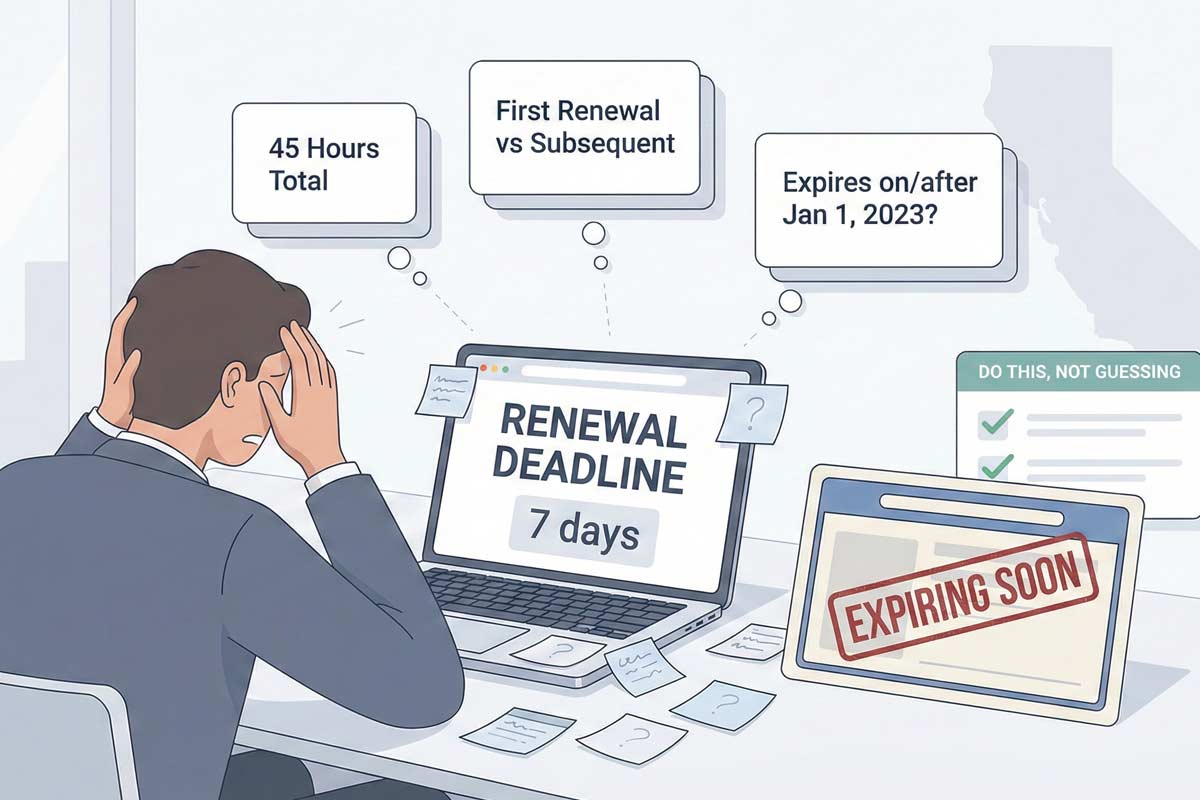
It starts with a notification or a glance at your license. The expiration date is looming—maybe next month, maybe next week—and the panic sets in.
You know you need "Continuing Education," but Read more...
It starts with a notification or a glance at your license. The expiration date is looming—maybe next month, maybe next week—and the panic sets in.
You know you need "Continuing Education," but the rules seem to change every time you check. Do you need the 9-hour survey or separate courses? Is implicit bias required this year? What happens if you take the wrong bundle?
If you are staring at a renewal deadline, stop guessing. Taking the wrong courses can result in a rejected application and a lapsed license—meaning you literally cannot practice real estate until your expired license is renewed.
Here is the no-fluff, compliance-grade breakdown of exactly how many hours you need and, more importantly, which hours count.
Fast Answer: How Many CE Hours Are Required?
The short answer: All California real estate licensees (salespersons and brokers) must complete 45 hours of DRE-approved Continuing Education to renew their license.
The critical nuance: You cannot just take "any" 45 hours. The DRE strictly regulates how those 45 hours are broken down based on three factors:
Your License Type (Salesperson vs. Broker)
Your Renewal Status (First-time renewal vs. Subsequent renewal)
Your Expiration Date (Whether your license expires on/after January 1, 2023, or you are renewing late after that date)
If you just buy the cheapest "45-hour bundle" without checking these factors, you risk taking courses that the DRE will not accept.
Bottom Line: Everyone needs 45 hours. But the composition of those hours changes depending on where you are in your career.
The 45-Hour Breakdown (Make It Simple)
To get your renewal approved, your 45 hours must be stacked correctly. The DRE divides CE into three specific buckets.
Mandatory Subjects: These are the "core" legal topics (like Ethics and Agency). You cannot skip these.
Consumer Protection: You must take a minimum of 18 hours in this category. These courses might cover technical skills like energy efficiency, land use, or valuation.
Consumer Service: These are "elective" topics (like sales skills or marketing).
First Renewal vs. Subsequent Renewals (Where People Get Burned)
This is the #1 source of confusion. The DRE requires first-time renewers to take "separate" courses to ensure they truly learn the basics. Veterans get to choose to take either a "survey" course or each course individually.
Scenario A: First-Time Renewal (Salesperson)
If you are renewing your salesperson license for the very first time, you cannot take the 9-hour survey. You must complete 5 separate 3-hour courses for the mandatory topics.
Your 45-Hour Stack:
Ethics (3 hours)
Agency (3 hours)
Fair Housing (3 hours, must include an interactive participatory component where you role-play as both a consumer and a real estate professional)
Trust Fund Handling (3 hours)
Risk Management (3 hours)
Implicit Bias Training (2 hours)
Consumer Protection (18 hours minimum)
Remaining Hours (Consumer Protection or Consumer Service)
Scenario B: First-Time Renewal (Broker)
Brokers have a higher standard of duty. If you are renewing a broker license for the first time, you have an extra mandatory topic: Management & Supervision.
Your 45-Hour Stack:
All 5 separate courses listed above
PLUS: Management & Supervision (3 hours)
Implicit Bias Training (2 hours)
Consumer Protection (18 hours minimum)
Remaining Hours (Consumer Protection or Consumer Service)
For a complete breakdown of every specific rule, bookmark our master California Real Estate License Renewal Guide.
Scenario C: Subsequent Renewals (All Licensees)
Once you have successfully renewed at least once, you graduate to "Subsequent Renewal" status. This applies to both salespersons and brokers.
Your 45-Hour Stack:
Individual courses or Survey Course: You can choose to take some of coursework either as a bundle or choose to take the courses individually.
Consumer Protection (18 hours minimum)
Remaining Hours (Consumer Protection or Consumer Service)
Warning: If you are a first-timer and you accidentally take the "9-Hour Survey" because it was cheaper or faster, the DRE will reject your renewal. You must take the separate courses.
Do Brokers Have Different CE Requirements?
Yes, but primarily on that first renewal.
As mentioned above, brokers typically need to complete the Management & Supervision course as a standalone 3-hour requirement during their first renewal cycle. The DRE expects brokers to understand how to manage offices and supervise agents from day one.
On subsequent renewals, brokers and salespersons are in the same boat—both can take the survey course, which includes the Management & Supervision module.
For a deeper dive into broker-specific nuances, read Do Brokers Have Different CE Requirements in CA?.
What Counts Toward CE Hours (And What Doesn’t)
Not every real estate class you take counts toward your 45 hours.
1. It Must Be DRE-Approved If you took a weekend seminar on "Luxury Home Marketing" at a hotel, or watched a YouTube series on sales tactics, those likely do not count. Only courses from a DRE-approved sponsor (like ADHI Schools) are valid, and you’ll enter the 8-digit CE course number in eLicensing to prove it.
2. Interactive Fair Housing (The "Interactive" Rule) Since 2023, you cannot just read a PDF on Fair Housing. If your license expires on or after January 1, 2023 (or you are renewing late after that date), your 3-hour Fair Housing course must include an interactive participatory component where you role-play as both a consumer and a real estate professional.
In-Person: This involves live role-play.
Online: This usually involves scenario-based questions where you "act" as the buyer or agent in a digital simulation.
For a full list of valid course types, check out What Courses Count Toward CE in California?
Realistic Time Planning (Stop the Last-Minute Crunch)
I see this happen every month: an agent realizes their license expires in 48 hours and tries to "cram" all 45 hours in one weekend.
This is physically impossible.
Why? Because of the 15-Hour Rule. This isn’t just an ADHI policy—DRE regulations limit correspondence CE to 15 credit hours of final exams in any 24-hour period, which is why true last-minute cramming often fails. These testing periods commence after the maximum of 8 hours per day of study time.
Day 1: Max 15 hours.
Day 2: Max 15 hours.
Day 3: Max 15 hours.
The Math: Including the study time, ADHI’s renewal package requires a minimum of just over 8 days to complete. This means if your license expires tomorrow and you haven’t started, you are going to expire.
My Advice: Start at least 30 days out. Do one course (3 hours) per evening. It’s stress-free, and you’ll actually retain the information rather than just clicking "Next" in a panic.
Common Mistakes That Delay Renewal
Over the last 20 years, we’ve seen thousands of renewals. Here are the most common reasons the DRE kicks them back:
Taking the "Subsequent" Package Too Early: First-time agents love the idea of a 9-hour survey. Don't do it. You need the separate courses.
Missing Implicit Bias: This is a newer requirement (effective 2023). If your bundle is old, check if it includes this. (Read more: Does California Require Implicit Bias Training for Renewal?)
Name Mismatch: If your CE certificate says "Bob Smith" but your license is under "Robert Smith," the eLicensing system might flag it. Ensure your profile matches your certificates.
Letting the license expire: You can renew during the two-year late renewal period, but you cannot perform licensed activity until the DRE renews you. To avoid any lapse, submit before your expiration date.
Assuming the "70/30 Exemption" Applies: Some agents think once they turn 70, they are exempt. You must be 70 AND have 30 years of continuous good standing. If you let your license lapse for a month 10 years ago, that clock might have reset.
To ensure you have the full checklist for this year, review California Real Estate License Renewal Requirements (2026).
Mini-Checklist: "Before You Hit Submit"
Before you log into eLicensing, ensure you have:
45 Hours Total on your certificates.
Correct Mandatory Topics (Separate courses for 1st timers; Survey or individual courses for subsequent).
Implicit Bias certificate (2 hours).
Interactive Fair Housing certificate.
At least 18 hours labeled "Consumer Protection."
Course Numbers (8-digit) ready to type in.
FAQ: California CE Hour Requirements
Is it always 45 hours to renew a California real estate license? Yes. Whether you are a salesperson or a broker, and whether it is your first or tenth renewal, the total requirement is 45 hours. The only exception is for licensees who qualify for the "70/30 Exemption" (70 years old with 30 years of continuous good standing).
Do brokers need more CE hours than salespersons? No, brokers also need 45 hours. However, for their first renewal, brokers must include a specific 3-hour course on "Management & Supervision," whereas salespersons do not. On subsequent renewals, both licensees typically take the same 9-hour survey course.
What if I’m renewing late—do I need extra CE? Generally, no. You can renew late for up to two years after expiration, but you cannot practice while expired. If you don’t complete late renewal within that two-year window, your renewal rights are forfeited.
Does implicit bias training count toward the 45 hours? Yes. The 2-hour Implicit Bias training is part of the 45-hour total. It is a mandatory course, meaning you cannot skip it, but the time spent on it counts toward your total requirement.
Can I finish all 45 hours in one day? No. DRE regulations limit you to completing 15 credit hours of final exams per 24-hour period. This means the fastest you can theoretically complete the 45 hours is over 3 to 4 days after the study period has lapsed.
|