
Passing the real estate exam is a milestone, but it isn’t the finish line.
The blunt truth that many schools won't tell you is this: The hardest part of real estate isn't the knowledge you've memorized—it's Read more...
Passing the real estate exam is a milestone, but it isn’t the finish line.
The blunt truth that many schools won't tell you is this: The hardest part of real estate isn't the knowledge you've memorized—it's performing under pressure.
In your first 90 days, you will face "jargon paralysis," inconsistent leads, and the crushing anxiety of an awkward conversation with a potential client. I’ve spent over 20 years at ADHI Schools building real-world competence in California agents, and I can tell you that the difference between the agents who wash out and those who thrive isn't luck. It is the intentional mastery of a specific "Skill Stack."
Key Takeaways
Execution Over Education: Real estate is a performance art; you must practice "doing," not just "knowing."
The 5-Layer Stack: Master Confidence, Communication, Terminology, EQ, and Self-Management.
Micro-Habits Win: 10-minute daily drills are more effective than 5-hour weekend cram sessions.
California Context: High consumer expectations in CA require a higher level of professional polish.
The New Agent Skill Stack (California Edition)
To succeed in the California real estate market, you need more than a license. You need a framework that allows you to handle complex transactions and high-stress negotiations.
1. Confidence (Execution Under Pressure)
What It Is: The ability to deliver information clearly even when you are uncertain or being challenged.
Why It’s Critical in California: California buyers and sellers are savvy. If they smell blood—or even a hint of hesitation—they will look for a more "experienced" veteran. To survive, you must learn how to build confidence as a new agent through repeated, controlled exposure to pressure.
Common Beginner Mistake: Over-apologizing for being new or saying "I don't know" without a confident follow-up plan.
10-Minute Daily Drill: Record yourself explaining agency on your phone. Listen back and delete "um," "uh," and "I think."
Improvement Signal: You stop feeling a "pit in your stomach" when the phone rings from an unknown number.
2. Communication (Clarity and Control)
What It Is: The art of leading a conversation rather than just participating in one.
Why It’s Critical in California: With high home prices, the stakes are massive. Clear communication prevents lawsuits and builds the trust necessary to close six-figure commissions. These are the communication skills that separate top agents from the rest in a crowded market.
Common Beginner Mistake: Talking too much. New agents often "oversell" because they are nervous, instead of asking discovery questions.
10-Minute Daily Drill:Practice "Active Listening" with a friend. Let them talk for two minutes; your only job is to summarize what they said back to them before responding.
Improvement Signal: Clients start saying, "I never thought of it that way," or "Thank you for explaining that so clearly."
3. Terminology (Speed-to-Competence)
What It Is: Fluency in the language of the California Residential Purchase Agreement (RPA) and local market trends.
Why It’s Critical in California: Ca: You lose authority the moment you misuse a term like "contingency" or "escrow." You need to understand how to master real estate terminology fast to gain instant respect from peers and clients.
Common Beginner Mistake: Using improper terms for important concepts, which can lead to misinterpretation of contract deadlines.
10-Minute Daily Drill:Open the RPA. Pick three paragraphs. Explain them out loud as if you were talking to a fifth-grader.
Improvement Signal: You can explain a "Notice to Perform" without looking at a cheat sheet.
4. Emotional Intelligence (EQ)
What It Is: Managing your own stress while navigating the high emotions of buyers and sellers.
Why It’s Critical in California: Real estate is a high-emotion, high-finance game. Emotional intelligence for real estate agents is what allows you to stay calm when a deal is falling apart at the eleventh hour.
Common Beginner Mistake: Taking a client’s frustration personally or getting "commission breath" (prioritizing your paycheck over their needs).
10-Minute Daily Drill: Journal about a recent stressful interaction. Identify exactly what triggered you and how you could respond with "neutral empathy" next time.
Improvement Signal: You remain the calmest person in the room during a heated negotiation.
5. Self-Management (Systems and Routines)
What It Is: The "bonus" skill. It is the ability to treat your career like a business, not a hobby.
Why It’s Critical in California: Without a boss hovering over you, it's easy to waste days on "busy work" that doesn't lead to a paycheck.
Common Beginner Mistake: Waiting for the "perfect time" to prospect instead of following a strict calendar.
10-Minute Daily Drill: Plan your next day's "Big 3" tasks the night before.
Improvement Signal: You start your workday at the same time every morning, regardless of how many appointments you have.
Why These Skills Matter More in the California Market
Skill
Why It Matters in CA
Daily Drill
Confidence
Defends your commission
Record and review your "elevator pitch."
Communication
Prevents transaction friction
Practice summarizing client needs.
Terminology
Establishes instant authority
Define 3 contract terms out loud.
EQ
Keeps deals from dying
Practice "Neutral Response" exercises.
Self-Management
Ensures long-term survival
Set your "Big 3" goals every evening.
Essential Skills Every New California Real Estate Agent Needs in the First 90 Days
Week
Focus Area
Primary Action
Week 1
The Lingo
Pick 5 terms from the RPA daily; define them without hesitation.
Week 2
The Script
Role-play "The Introduction" 10 times daily to build muscle memory.
Week 3
The Market
Visit 5 local open houses; practice asking listing agents high-value questions.
Week 4
The Routine
Execute a 2-hour "Lead Gen" block every morning; focus on EQ to handle rejection.
Real-World Scenarios: Putting Skills into Practice
Scenario 1: The "New Agent" Question
Situation: A buyer asks, "How many homes have you sold?"
Default (Bad) Response: "Um, I'm actually new, but I'm really hardworking!"
Skilled Response: "I am a newer part of a team at my brokerage that has overseen hundreds of transactions, and I have the full resources of our office behind every move I make for you."
Skill Tied To: Confidence
Scenario 2: The Jargon Trap
Situation: A seller asks what "escrow" actually does.
Default (Bad) Response: "It’s like... where the money goes during the deal."
Skilled Response: "Escrow is a party that holds funds and documents to ensure all conditions of the contract are met before the title transfers."
Skill Tied To: Terminology
Scenario 3: The Cold Shoulder
Situation: You’re door-knocking and a neighbor tells you to "get a real job."
Default (Bad) Response: Getting angry, arguing back, or going home to quit.
Skilled Response: "I understand you're busy! Have a great afternoon," then moving to the next door without a change in heart rate.
Skill Tied To: Emotional Intelligence
Scenario 4: The Vague Lead
Situation: A lead says, "I'm thinking of moving soon."
Default (Bad) Response: "Great! Let me know when you're ready."
Skilled Response: "That's exciting. Usually, when people say 'soon,' they have a specific goal in mind—are you looking to be in a new home before the school year starts, or are you just testing the waters?"
Skill Tied To: Communication
Master the Foundation
Think of your first year as a “competence-building year.” Your goal isn't just to sell a house; it's to build a version of yourself that is capable of selling any house. Mastery doesn't happen in the classroom; it happens in the daily drills and the uncomfortable conversations you choose to have anyway.
This article is part of a comprehensive framework designed to move you from "licensed" to "competent." To see how these skills integrate into a long-term career strategy, explore our full guide on Real Estate Agent Skills California
|

TL;DR: The 90-Minute Monthly Newsletter System (Beginner-Proof)
Pick a lane: Market Translator, Homeowner Value, or Buyer/Relocation.
Use one template: Stick to the same structure every Read more...
TL;DR: The 90-Minute Monthly Newsletter System (Beginner-Proof)
Pick a lane: Market Translator, Homeowner Value, or Buyer/Relocation.
Use one template: Stick to the same structure every month so you actually ship it.
Send monthly for 90 days: Focus on consistency first, then optionally move to bi-weekly once the habit is locked in.
Measure the right thing: Prioritize replies and booked conversations over "pretty design."
The Newsletter Mindset Shift: From Spam to Service
You have 250 contacts in your phone. Every time you think about emailing them, you panic. What do I say? Will they think I’m annoying?
Most agents treat a newsletter like a digital billboard. They blast out "Just Listed" photos and generic "Happy Spring" graphics. That isn't a newsletter; that’s noise. Your newsletter is a regular, valuable touchpoint that makes you the obvious choice when a real estate need arises.
In 20+ years as a California operator, I’ve rarely seen a consistent, value-first newsletter not produce replies—because it compounds familiarity. Every email is a trust deposit. This is the core of Real Estate Marketing Basics—the foundational system that shows California agents how marketing actually converts attention into conversations.
"Is this relevant enough that my ideal client might reply or forward it to a friend?"
Step 1: Choose Your "California Lane"
To avoid the Personal Branding Mistakes New Agents Make, you must pick a specific lane for the next 90 days. Your newsletter works best when it reinforces a clear positioning—something we break down further in Branding Yourself as a California Real Estate Agent.
Lane 1: The Local Market Translator: Explain what median price shifts in San Diego or DOM (Days on Market) in the Inland Empire actually mean for a homeowner's equity.
Lane 2: The Homeowner Value Engineer: Focus on Prop 19 benefits, ADU potential, and smart renovations. You help them manage their largest asset. Always frame these topics as educational and encourage homeowners to confirm details with a CPA, attorney, or their local jurisdiction.
Lane 3: The Buyer/Relocate Guide: Demystify the California buying process, neighborhood vibes, and school district nuances for newcomers.
Step 2: Set Up the Boring Stuff (So You Don’t Get Burned)
Before you write a single word, set these once to ensure you stay professional and compliant:
Sender name: “Kartik @ [Brokerage]” (Use your name; never use “No-Reply”).
Reply-to: Your real email address. Your goal is to start a dialogue.
Footer: Your full name, brokerage name, and DRE #. This is non-negotiable in California.
Unsubscribe link: Mandatory for every send.
One list only: Start with your sphere and warm contacts. Never buy a list.
Mobile check: Send a test to yourself and read it on your phone first.
Step 3: The “Same Every Time” Newsletter Template
Your newsletter should feel like a familiar TV show: same format, new episode. This builds the consistency required for branding yourself.
Subject (Benefit + Place): “What today’s OC inventory shift means for you.”
Human Opener (2 sentences): Local and relevant. Example: "The line at Porto’s was wrapped around the block today—reminded me how fast things move in Buena Park."
One Idea: One chart, one story, or one principle (e.g., why interest rates shouldn't stop a move-up buyer).
What it Means for You: Translate the idea into a decision. Example: “If you’ve been waiting for a 6% rate, you might be missing the best equity window in five years.”
One CTA: One action only. (See the Keyword System below).
Signature & Compliance Footer: Name, Brokerage, and DRE #.
The CTA That Actually Works: “Reply With One Word”
People often won’t click a link, but they will reply if it’s easy. Pick one of these for your newsletter:
Reply Keyword
What They Get
VALUE
I’ll send a quick home value range for your specific neighborhood.
ADU
I’ll send the California ADU feasibility checklist.
BUY
I’ll send my “first 30 days” buyer game plan.
SELL
I’ll send my pricing and prep checklist for your specific zip code.
Tip: When someone replies, respond within 24 hours—even if it’s just to acknowledge and schedule a follow-up. Speed compounds trust.
Step 4: The California-Ready Content Menu
Pick one idea for your next edition.
Note: Always include a disclaimer that you are not providing tax or legal advice.
Market Intelligence: California Association of REALTORS® (C.A.R.) monthly data decoded for your city.
Homeowner Wealth: How Prop 19 might affect your parents' ability to downsize.
Transaction Truths: Why the "Appraisal Gap" is the most important term in a CA contract right now.
Hyperlocal Spotlight: The best coffee shop in your neighborhood for a morning meeting.
Step 5: Frequency (What You Can Sustain Wins)
If you’re new, start monthly. One newsletter sent 12 times a year beats two newsletters sent twice.
Months 1–2: Monthly (Build the habit).
Month 3+: Optional bi-weekly if you are consistently getting replies.
Your First Newsletter Should Be an Intro (Copy/Paste)
Subject: Quick note — I’ll send one helpful real estate email each month
Body:
“Hey — quick note. I’m starting a simple monthly email where I share one California real estate insight (prices, inventory, and practical homeowner tips). No spam, no daily blasts.
If you ever want out, you can unsubscribe at the bottom. If you want something specific, reply with what city or zip code you care about and I’ll tailor future emails for you.”
California Compliance: Stay Professional
Broker Review: Have your broker-of-record glance at your template.
Accuracy: Be meticulous about sourcing your data (C.A.R., MLS, etc.).
Reply Goal: Treat open rates as noisy; prioritize replies and booked conversations. If you get 1–3 replies per 100 sends, you are winning.
The System is the Secret
Mastering your newsletter is just one part of the Real Estate Agent Skills California ecosystem. This hub explores the full range of technical and interpersonal skills required to thrive in the Golden State.
Your first newsletter is the hardest.
Send it anyway.
Then send 11 more.
That’s when the system starts working for you.
FAQ: Real Estate Newsletters
How often should a real estate agent send a newsletter?
Start monthly. Once you can produce a monthly email in under 90 minutes without stress, you can consider moving to a bi-weekly cadence.
What should I avoid putting in my newsletter?
Avoid politics, "listing-only" blasts, and generic national news that doesn't explain the impact on a local California homeowner.
Do I need permission to email people?
Start with people who know you (sphere, clients, and opted-in leads). Use honest subject lines, include your business info and an unsubscribe link, stay CAN-SPAM compliant and never email people who have asked you to stop. When in doubt, consult your office's specific policy.
What is the best email platform for agents?
Mailchimp and ConvertKit are excellent for beginners. If you use a CRM like Chime or LionDesk, ensure the templates are easily readable on mobile.
How do I measure if it's working?
The only metric that matters is the "Reply." If people are asking you questions or thanking you for the data, the system is working.
|

In California, your brand is your pre-qualification. Whether you are navigating the high-density condo market in Irvine or the tech-relocation waves in the Bay Area, your potential clients have likely Read more...
In California, your brand is your pre-qualification. Whether you are navigating the high-density condo market in Irvine or the tech-relocation waves in the Bay Area, your potential clients have likely Googled you before they ever return your text.
Branding isn’t about picking the perfect shade of navy blue for your business cards. It is about trust, clarity, and consistency. After 20+ years of coaching agents at ADHI Schools, I’ve seen that the most successful newcomers don't always have 100k followers; they have a system that makes a specific group of people remember them when it matters most.
Building these Real Estate Agent Skills California is the foundation of a long-term career.
What “Brand” Actually Means for a CA Agent
Forget the fluff. A high-converting personal brand consists of five pillars:
Positioning: Who you are for (and who you are not for).
Promise: The specific outcome you deliver.
Proof: Why you’re credible (education, local data, or process transparency).
Personality: How you communicate (the data-driven analyst vs. the high-energy negotiator).
Presence: Where your clients find you (Instagram, LinkedIn, or the local coffee shop).
Brand ≠ Marketing
Marketing is how often people see you.
Branding is what they remember and associate you with when they’re ready to move.
Choose Your California Niche Without Boxing Yourself In
Many new agents fear that choosing a niche means saying no to money. In reality, a focused California real estate agent branding strategy makes your marketing cheaper and more effective. Here are 8 CA-specific niches currently producing repeatable leads:
ADU Specialists: Helping SoCal homeowners maximize lot value.
First-Time Buyers (Inland Empire/Sacramento): Navigating FHA and down payment assistance.
VA Buyers: Dominating markets near San Diego or Oceanside bases.
Tech Relocation: Smooth transitions for Bay Area or Silicon Beach employees.
Probate & Inherited Property: Compassionate service for estate executors.
Bilingual Markets: Serving specific communities (Spanish, Mandarin, Vietnamese, etc.).
Condo/Townhome Experts: Mastering the nuances of HOAs in high-density LA/SD.
The "Move-Up" Specialist: Helping families sell their starter home and buy their "forever" home simultaneously.
Build Your “1-Sentence Brand Statement”
Stop saying "I help people buy and sell homes." Use this template to define your personal brand for real estate agents in California:
“I help [Target Audience] in [Specific California Market] [Buy/Sell] [Property Type] so they can [Desired Outcome], using [Unique Method/Differentiator].”
Examples for New Agents:
“I help first-time buyers in Sacramento navigate FHA loans so they can stop renting and start building equity, using my 5-step ‘Buyer Ready’ system.”
“I help families in Irvine downsize into luxury condos so they can enjoy retirement without maintenance stress, using my ‘White Glove’ relocation process.”
Your Brand Kit Lite: The Minimum Viable System
1. The Profile Checklist
Bio: Start with your Brand Statement. End with a CTA (e.g., “DM ‘LIST’ for my 2026 Buyer’s Guide”).
Headline: Use keywords like “Real Estate Agent” + “Your City.”
Visuals: One professional headshot and one “in‑action” shot.
2. The Proof Stack
Even with zero sales, you can show authority:
Education: “Licensed through ADHI Schools, coached by industry veteran Kartik Subramaniam.”
Market Data: Weekly screenshots of “Days on Market” in your specific zip code.
Process Transparency: A video explaining: “What happens during a California home inspection?”
Compliance Fluency: Clear explanations of disclosures, timelines, and consumer protections (without providing legal advice).
The Trust Engine: Credibility Without Overclaiming
New agents often feel like “fakes.” To avoid this, shift from being the Expert to being the Guide.
Show the Process: Don’t just say you're great; show the 12‑page disclosure packet you just reviewed for a client.
Leverage Partners: Interview your local lender or escrow officer on video.
Soft CTA: If you want your content and messaging to actually convert, make sure you’ve locked down the fundamentals in our Real Estate Marketing Basics (California Edition) guide.
California-Specific Branding Tactics That Convert
"Neighborhood Proof" Posts: Take a photo of a "Coming Soon" sign (not yours) and discuss why that specific street is trending.
The Open House System: Film a 30‑second “Sneak Peek” on Friday, a “Live Tour” on Saturday, and a “Market Wrap‑up” on Monday.
Local Business Spotlights: Interview the owner of the most popular coffee shop in your farm area.
Deal Breakdowns: “Here is how we helped a buyer in San Diego win a multiple‑offer situation without overpaying.”
Offline Branding Consistency: Your yard signs, open house conversations, and community presence must match your online positioning. In California’s tight‑knit neighborhoods, offline trust breaks instantly if the “online version” of you doesn’t show up in person.
30-Day Branding Implementation Plan
No ads. No funnels. Just clarity + consistency.
Week
Primary Focus
Primary Goal
Week 1
Positioning
Finalize niche, brand statement, and update all social bios.
Week 2
Content System
Post 3 educational videos and 5 local “neighborhood” stories.
Week 3
Direct Outreach
Create a Real Estate Newsletter and send to 20 local contacts.
Week 4
Refine & Track
Count DMs, coffee invites, and new email subscribers.
Mistakes That Kill Your Brand Fast
The fastest way to look like an amateur is to post generic, “corporate” content that has no local flavor. If you look like a robot, people will treat you like a transaction, not a partner. Learning how to brand yourself as a realtor in California requires avoiding the “all‑business, no‑substance” trap.
Common pitfalls include:
Inconsistency (posting 5 times in one day, then disappearing).
Ignoring the "California nuance" (failing to mention local tax implications or ADU laws).
For a deeper dive into what to avoid, read our full breakdown of Personal Branding Mistakes New Agents Make.
FAQ: Branding for New California Agents
Do I need to pick a niche as a new California real estate agent?
No—but you do need a clear starting point. A niche focuses your messaging and speeds up trust. You can expand later without rebranding your entire business once you have established your pipeline.
How long does it take to build a personal brand as a real estate agent?
Most agents begin seeing inbound conversations within 30–90 days of consistent, niche‑focused visibility. It’s not about years of effort; it’s about weeks of targeted, valuable content.
Your Brand is an Asset
A clear brand reduces price sensitivity, shortens decision cycles, and increases referral velocity—especially in competitive California markets. It is the only thing the "big portals" can't take away from you. By narrowing your focus and showing up consistently as a local guide, you build a pipeline that survives any market shift.
Ready to level up your business-building skills?
Explore our Real Estate Agent Skills California page for more advanced strategies on marketing, lead generation, and career growth.
TL;DR: The California Branding Blueprint
The Goal: Move from “random agent” to “trusted local authority.”
The Strategy: Define a specific niche, create a one‑sentence brand statement, and execute a 30‑day visibility plan.
The Key: In the competitive California landscape, your brand isn’t a logo—it’s the clarity of the problem you solve for a specific group of people.
|
Disclaimer: This guide is for educational purposes only and does not constitute legal or professional real estate advice. Always consult with your broker and legal counsel regarding DRE advertising Read more...
Disclaimer: This guide is for educational purposes only and does not constitute legal or professional real estate advice. Always consult with your broker and legal counsel regarding DRE advertising compliance.
The Post-License Panic: From "Licensed" to "Hired"
You passed the exam, hung your license with a broker, and ordered business cards. Now, you’re sitting at a desk in your real estate office waiting for the phone to ring.
It doesn’t.
Most new agents treat marketing like a lottery—post a house tour on Instagram, buy a few Zillow leads, and pray for a commission check. After 20 years of coaching California agents and seeing which systems actually scale, I can tell you that "luck" is not a business strategy.
Marketing isn't about having a "big personality" or being a TikTok star. It is a repeatable operating system designed to solve one problem: making sure the right people know you exist, trust your expertise, and remember you when they’re ready to sign.
What “Marketing” Actually Means (California Edition)
In one of the most competitive real estate markets in the country, “marketing” is often misunderstood. California consumers are sophisticated—they’ve seen every “Top Producer” ad in the book. If you’re searching for a marketing plan for new real estate agents in California, what you really need is a simple operating system you can run every week—because that’s what creates clients.
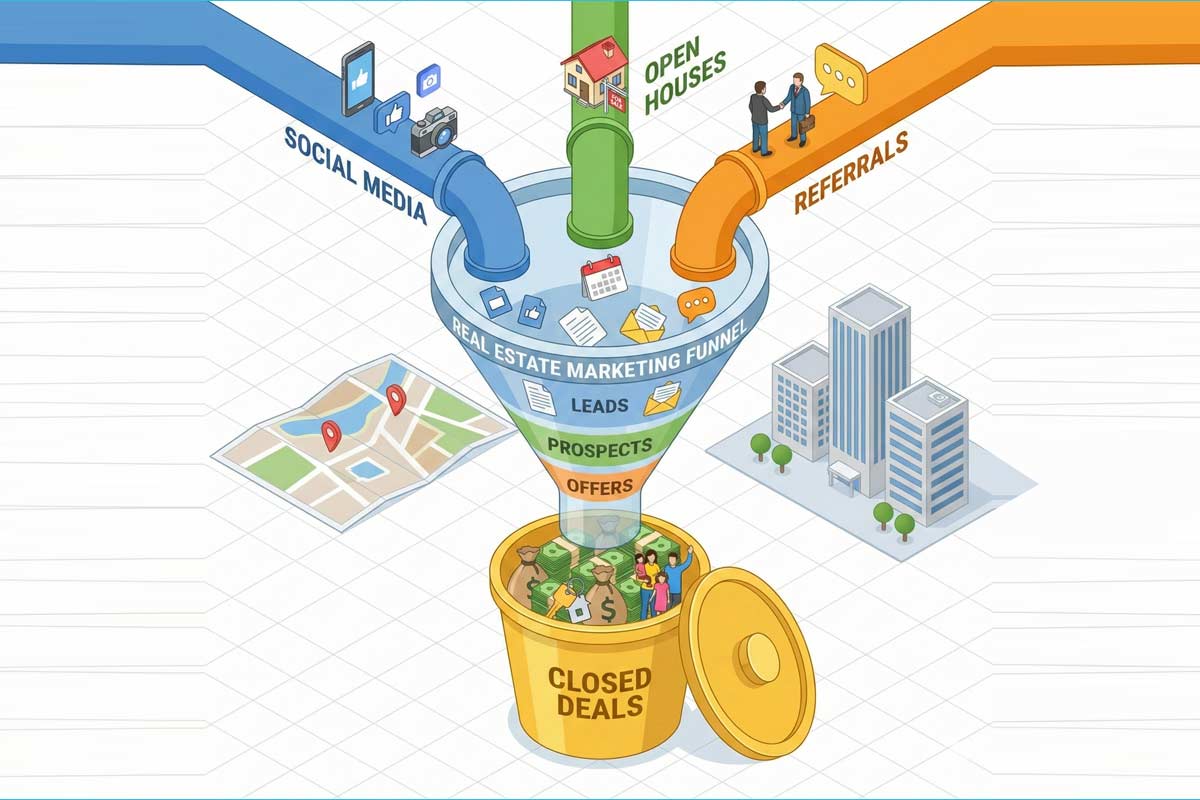
To win, you must view your marketing as a four-stage pipeline:
Attract: Getting someone to stop scrolling or start a conversation.
Pre-qualify: Filtering out the "looky-loos" from the serious buyers/sellers.
Convert: Turning a conversation into a signed listing or buyer representation agreement.
Follow-up: Staying top-of-mind for the 3–12 months it takes a CA lead to actually move.
Marketing is NOT:
Spending $500 on a logo before you’ve made a cold call.
Posting "Just Listed" photos of houses that aren't yours without permission.
Buying leads and letting them sit in a CRM without a phone call or other follow up.
The 4-Part Marketing Foundation
Before you spend a dime on ads, you need to stabilize your foundation. These are the basics that compound over time.
1. Positioning
This is "Who you help" and "What you're known for."
If you try to be the "California Expert," you’re the expert of nothing.
Actions: Define your farm (e.g., "The go-to condo specialist in Downtown Los Angeles"). Identify your unique value (e.g., "I help first-time buyers navigate FHA in high-cost counties").
Common Mistake: Being a generalist. To avoid this, read about Personal Branding Mistakes New Agents Make.
2. Proof
In California, skepticism is the default. You need assets that reduce skepticism and prove you can do the job.
Your First 5 Proof Assets (Even with zero closings):
1-page Zip Code Snapshot: Median price, Days on Market (DOM), and inventory trend for your farm area.
Open House Notes One-Pager: What buyers asked, what they ignored, and what moved them emotionally.
“Buyer Mistakes in CA” Mini Guide: A one-page PDF that shows you understand the process—this is marketing because it builds trust before you ever ask for an appointment.
Three Micro-Testimonials: Responsiveness, diligence, and follow-through from anyone you’ve helped (clients, colleagues, vendors).
Broker/Team Credibility Line: A factual, approved credibility line your broker is comfortable with (no hype, no unverifiable claims).
3. Pre-qualify & Convert
Marketing fails when it generates a lead but doesn't know what to do with it. You need a real estate lead follow-up system that includes the right questions.
The 5-Question Script (CA-Safe):
“Are you already speaking with a lender?”
“What’s your timeline if everything goes right?”
“Have you toured homes or open houses in the last 30 days?”
“Do you need to sell a home first?”
“What would make you say ‘let’s move’ within 2 weeks?”
The Appointment-Setters (CTAs):
“Want me to run a 10-minute price reality check for your zip code?”
“Want a 15-minute buyer game plan call so you know what you can win with in this market?”
4. Follow-Up
In California, most deals come from leads that “weren’t ready” the first time. Your follow-up system is your commission protection plan.
Actions: Set up a simple CRM. Create a "Long-Term Nurture" plan.
Common Mistake: Calling a lead once, getting no answer, and deleting them.
Common CA Marketing Mistakes
Avoid these traps that waste months of effort for new agents:
Buying leads before you have a repeatable follow-up cadence.
Posting listings you don’t represent without explicit permission or context.
Trying to be “Luxury” before you are trusted locally or understand the inventory.
No database hygiene: Failing to tag leads, leave notes, or remove duplicates.
Inconsistent schedule: Marketing in random bursts followed by weeks of silence.
Channels That Matter Most for New CA Agents
You cannot be everywhere. To learn how to get real estate clients in California, pick two of these to start:
Your Sphere (Database): This is your highest ROI. These are people who already know, like, and trust you.
Email Newsletters: A weekly touchpoint providing value. Learn How to Create a Real Estate Newsletter that people actually open.
Open Houses as Content Engines: Use an open house marketing plan where you film 3–4 videos while you’re there: a "Market Update," a "Home Feature," and a "Neighborhood Spotlight."
Google Business Profile: Essential for local SEO. If someone Googles "Agent near me," you want your name to appear with reviews. Learn the nuances of Branding Yourself as a California Real Estate Agent to stand out.
The 30-Day Marketing Plan for New California Agents
Stop theorizing. Here is your execution schedule for the next month.
Week
Focus
Key Task
Week 1
The Sphere
Call 10 people a day. Tell them you’re in the business and ask how they are.
Week 2
Local Credibility
Claim your Google Business Profile. Build a “Market Update” template for weekly use.
Week 3
Active Prospecting
Schedule 2 Open Houses. Use your "Open House Notes" one-pager to capture lead info.
Week 4
The Nurture
Send your first "Market Update" email to everyone you’ve talked to this month.
The "Minimum Viable" Daily List:
Add 2 new people to your database.
Send 5 personalized "Thinking of you" texts/DMs.
Post 1 local market data update to your Stories.
Compliance & Professionalism
The California Department of Real Estate (DRE) is vigilant. Your marketing must be as compliant as it is creative.
DRE Disclosures: In California, many advertisements must include your license ID and responsible broker identification—follow your broker’s policy and DRE guidance for each medium (print, digital, social, email, signage).
No "Guarantees": Avoid promising specific results unless you have the legal paperwork and broker approval to back it up.
Branding: Follow your brokerage policy for branding hierarchy and required identification across print, digital, and social.
Master the Skills Stack
Marketing is a powerful engine, but it’s only one part of the vehicle. Marketing is one spoke in the full skill stack—negotiation, contracts, timelines, and client psychology are what convert attention into commissions.
If you want the full “map,” start here: Real Estate Agent Skills California.
Your next move (today):
Pick two channels (sphere + newsletter, or open houses + newsletter).
Run the Week 1 plan.
Don’t change your system for 30 days.
FAQ Section:
Q: How much should a new agent spend on marketing?
A: Focus on "sweat equity" (calls/networking) first. Invest in a CRM and professional headshots before paid ads.
Q: Do I need a website as a new agent?
A: Use your brokerage-provided site and focus on your Google Business Profile for better local search results.
Q: How often should I post on social media?
A: Quality over quantity. 3 times a week with actual market data is better than daily generic "Happy Monday" posts.
Q: Is door knocking still effective in California?
A: Yes, if done with a "Give" (like a market report) rather than a "Take" (asking for a listing immediately).
Q: What is the best way to get reviews?
A: Ask for them immediately after a "win"—even if it's just helping someone understand their home's value.
TL;DR: The California Agent’s Marketing Blueprint
Marketing is a System: It is the repeatable process of Attract → Pre-qualify → Convert → Follow-up.
The CA Reality: High competition and sophisticated buyers mean "pretty" isn't enough; you need proof and persistence.
Focus on Inputs: Stop tracking "likes." Track outgoing calls, sent newsletters, and face-to-face meetings.
The Golden Rule: Choose two channels and master them before expanding.
|

The “Branding Panic” Reality
Most new agents think "branding" means picking a hex code, designing a logo on Canva, and maintaining a high-gloss Instagram aesthetic. The truth is that in the hyper-competitive Read more...
The “Branding Panic” Reality
Most new agents think "branding" means picking a hex code, designing a logo on Canva, and maintaining a high-gloss Instagram aesthetic. The truth is that in the hyper-competitive California real estate market, this is a dangerous distraction.
In California, branding isn't a decoration—it is pre-qualification. Before a lead ever picks up the phone, they have already vetted you online. They aren't looking for a celebrity; they are filtering for competence, trust, and consistency.
This article focuses on branding mistakes specifically, but branding is just one component of the broader Real Estate Agent Skills stack you need to succeed long-term. After 20+ years of coaching California agents at ADHI Schools, I’ve seen thousands of new licensees stall because they prioritized "vibes" over value. Despite what Instagram would have you believe, the goal of your brand isn’t fame; it is to create a predictable system for generating real estate leads.
The 60-Second Definition
Your brand is the pattern people remember: who you help, what you help them do, and proof you do it consistently. Branding is a functional system that supports your lead generation—it is not a vanity project. If you need a step-by-step framework, start with our guide on Branding Yourself as a California Real Estate Agent before you touch design tools.
12 Personal Branding Mistakes New Agents Make (And How to Fix Them)
1. Trying to Brand “For Everyone” (No Niche, No Message)
The Mistake: Posting generic "I love real estate" content and hoping anyone with a pulse calls you.
Why it Kills Trust: If you help everyone, you specialize in nothing. California consumers want a specialist.
The Fix: Pick a specific niche or neighborhood.
Do this today: Write down the one specific type of person you are best equipped to help right now (e.g., "First-time buyers in Eagle Rock").
2. Confusing Aesthetics with Positioning (Logo ≠ Brand)
The Mistake: Spending three weeks on a logo and zero hours on your value proposition.
Why it Kills Consistency: A logo doesn't sell a house; your ability to generate leads and navigate a CA purchase agreement does.
The Fix: Prioritize branding yourself as a real estate agent (California) based on your expertise first.
Do this today: Define your "Unique Value Proposition" in one sentence.
3. Copying Top Producers (The “Fake Luxury” Trap)
The Mistake: Renting a luxury car or posing in front of $10M listings you didn’t list to look "successful."
Why it Kills Trust: People can smell inauthenticity. It creates a "persona mismatch" when you finally meet in person.
The Fix: Match your branding to your actual inputs. Focus on being the "Hyper-Local Expert."
Do this today: Take a photo of yourself actually working—at a local coffee shop or touring a new listing.
4. Posting Randomly Instead of a Real Estate Marketing System
The Mistake: Posting a sunset today, a quote tomorrow, and nothing for three weeks.
Why it Kills Consistency: Inconsistency signals a lack of professional discipline. This is where agents skip the fundamentals covered in Real Estate Marketing Basics (California Edition) and mistake activity for strategy.
The Fix: Use content buckets (Market Updates, Behind the Scenes, Local Spotlights).
Do this today: Choose three "content buckets" and commit to posting one of each every week.
5. No Proof: Claims Without Evidence
The Mistake: Claiming to be an "expert" without showing any data, neighborhood knowledge, or process.
Why it Kills Trust: California buyers are data-driven. They need proof you know the market.
The Fix: Share "Proof Assets"—market trends, neighborhood walk-throughs, or process explainers.
Do this today: Find one interesting stat about your target zip code and explain what it means for buyers.
6. Over-Sharing Personal Noise
The Mistake: Posting what you ate for lunch more often than you post about real estate.
Why it Kills Leads: It creates noise, not value. Clients want a professional, not just a person with a phone.
The Fix: Follow the 80/20 rule: 80% professional value, 20% personal flavor.
Do this today: Audit your last 10 posts. If more than 3 have zero real estate relevance, delete the weakest one.
Quick gut check: If your brand disappeared tomorrow, would anyone in your database notice? If not, that’s not a failure—it just means you need a system.
7. Under-Selling: Hiding the CTA
The Mistake: Writing a great post but never asking for the business.
Why it Kills Leads: People won't take the next step unless you lead them there.
The Fix: Every piece of content should have a "Call to Action" (CTA).
Do this today: Add "DM me 'Market' for a copy of my neighborhood report" to your next post.
8. Talking Like a Brochure (Generic Slogans)
The Mistake: Using generic slogans like "Honesty, Integrity, Results."
Why it Kills Trust: These are "table stakes"—everyone says them, so they mean nothing.
The Fix: Speak to specific problems (e.g., "I help sellers find buyers even when inventory is low").
Do this today: Replace one generic adjective on your bio with a specific problem you solve.
9. Not Owning a “Signature Framework”
The Mistake: Having no repeatable way to explain your process to a lead.
Why it Kills Trust: It makes you look like you’re "winging it."
The Fix: Create a 3-step or 5-step "Roadmap to Closing."
Do this today: Outline the 5 steps you take a buyer through from consultation to keys.
10. Ignoring the Trust Engine: The Real Estate Newsletter
The Mistake: Relying solely on social media algorithms you don't own.
Why it Kills Consistency: If the algorithm changes, your brand disappears.
The Fix: Learn how to create a real estate newsletter to stay top-of-mind.
Do this today: Start a simple list of 50 people you know and send them a "market-at-a-glance" email.
11. Mistaking Followers for Leads (The Wrong Scoreboard)
The Mistake: Focusing on "Likes" from other agents instead of "Leads" from potential clients.
Why it Kills Leads: You end up performing for peers rather than serving prospects.
The Fix: Measure your brand by the number of conversations it starts.
Do this today: Check your DMs. Count how many "real estate" conversations you started this week.
12. Branding Over Skill-Building
The Mistake: Having a world-class brand but 1st-grade contract knowledge.
Why it Kills Trust: You will get the lead, but you will lose the client if you can't perform.
The Fix: Align your brand with actual Real Estate Agent Skills (California).
Do this today: Spend 30 minutes reading a standard CAR form instead of scrolling.
Brand Kit Lite: The Fast System
Avoid the "branding trap" by sticking to this simple checklist:
1-Sentence Positioning: "I help [Target Audience] in [Location] achieve [Outcome] without [Common Pain Point]."
3 Content Buckets: Market Data, Local Lifestyle, Process Explainers.
1 Lead Capture Habit: A bi-weekly real estate newsletter for agents to nurture your database.
1 Proof Asset: A "Neighborhood Guide" PDF you can offer for free.
California-Specific Reality Checks
In California, you aren't just competing with the agent down the street; you are competing with tech-enabled platforms and highly sophisticated consumers. Your brand must communicate high-level competence.
Practical advice for real estate agents in the Golden State: Your brand is built in small reps. It’s the consistency of your messaging followed by the consistency of your follow-up.
Real-World Scenario: The Random Posting Trap
An agent posts a "Sold" post from their office, and a generic "Happy Friday" on Friday. A potential seller sees a hobbyist. Contrast this with an agent who posts a video explaining why property taxes in Orange County are calculated the way they are. One is noise; the other is a brand.
Building Your Career Stack
Personal branding is a critical skill, but it is only one piece of the puzzle. To succeed in California, you must integrate your marketing with technical mastery and client service.
To see how branding fits into the bigger picture of your career, explore our comprehensive guide on Real Estate Agent Skills.
|
TL;DR: The System Summary
A successful real estate CRM is a daily follow-up machine, not a contact list.
To make it work, you need:
Minimalist Data: Only track what helps you make the Read more...
TL;DR: The System Summary
A successful real estate CRM is a daily follow-up machine, not a contact list.
To make it work, you need:
Minimalist Data: Only track what helps you make the next call.
Strict Pipeline Stages: Define exactly where a lead sits in the journey.
The Golden Rule: Every contact must have a Next Step and a Next Date.
Daily Discipline: A 10-minute "CRM Block" to clear your tasks.
The CRM Graveyard: Why Most Systems Fail
Let’s be honest: Most California real estate agents have a "CRM graveyard." It’s a software subscription you pay for every month, filled with names you haven't called in 90 days and "leads" from an open house three years ago that were never categorized.
I’ve spent over 20 years coaching and operating in the California real estate education space, and I see the same mistake everywhere. Agents try to build a "database" when they should be building a real estate lead follow-up system.
If your CRM isn’t telling you exactly who to contact by 9:00 AM today, it’s not a CRM—it’s a hobby. In a market where you’re fighting 101 freeway traffic and juggling multiple escrows, speed-to-lead is the only metric that matters. If you aren't contacting an inbound lead within minutes, you are often competing with 3–5 other agents. Your CRM is what allows you to win that race.
CRM Setup in 30 Minutes (Beginner-Proof)
Don't spend weeks "researching" software. Pick a tool and follow this 30-minute sprint:
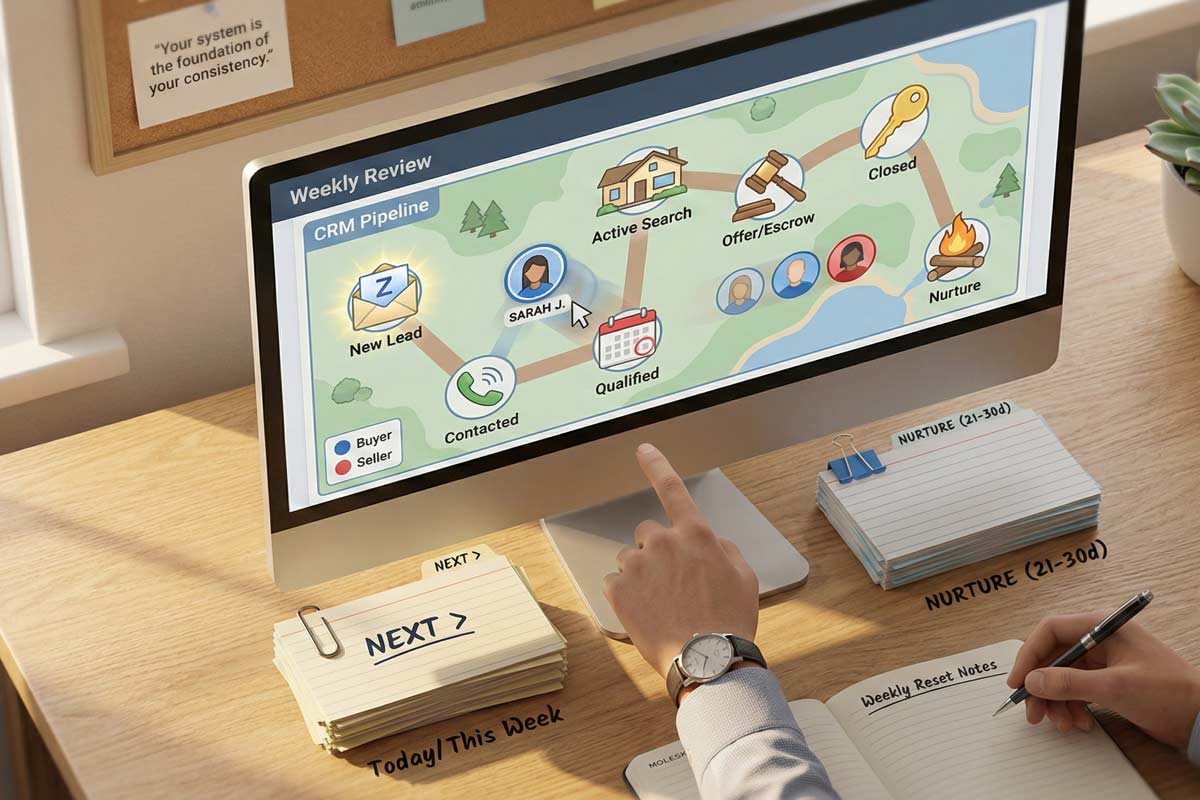
Create your 7 stages: (Use the framework in the table below).
Set your required fields: Source, Lead Type, Stage, Next Follow-Up Date, Tags.
Configure 3 saved views: Today, This Week, Nurture.
Import 10 contacts: Start with your phone’s "recent" list or warm sphere.
Assign a "Next Step + Next Date": Do this for every single one.
Calendar it: Put a recurring 10-minute CRM Block on your calendar for every weekday morning.
The CRM Build: Your Minimum Viable System
To build a real estate CRM that sticks, you need to strip away the "tech-bro" features most CRM for real estate agents are bloated with and focus on the core structure.
1.The Only Fields You Actually Need
Stop trying to fill out 50 fields of data. You’ll burn out. Stick to these:
Name & Contact Info: (Phone/Email)
Source: (Zillow, Open House, Sphere, Referral)
Lead Type: (Buyer, Seller, Investor, Renter)
Pipeline Stage: (Where are they in the process?)
Next Follow-Up Date: (The most important field in your business)
Tags: FHA-Buyer, Inland-Empire-Retail, Probate, Past-Client, Hot-Lead.
Common Mistake
Don't create a "custom field" for every little detail. Use the "Notes" section for the story; use "Tags" for the category. Over-complicating fields is the fastest way to stop using the system.
2. Your Pipeline Stages (Entry/Exit Criteria)
Your pipeline stages real estate logic must be tight. If you don't know why someone is in a specific stage, the system breaks.
Stage
What it means
Move forward when...
New Lead
Inbound or added, not contacted
You’ve attempted contact + set Next Date
Contacted
Two-way exchange happened
You have timeline + motivation basics
Qualified
Budget + timeline + reason confirmed
You scheduled consult/showing/listing appt
Active Search
You’re actively working inventory
They’re ready to offer or pause
Offer / Escrow
Under contract
You close or deal dies (then re-stage)
Closed / Past
Transaction complete
You set post-close follow-up + nurture
Nurture
6+ months out
They re-engage (then re-qualify)
The Follow-Up Engine (The Real Product)
Your real estate CRM workflow is only as good as your persistence. Most agents stop after two attempts. Top operators go further.
The “No-Response” Ladder
Use this framework when a lead goes quiet:
Touch 1 (Day 1): Call + short text: “Hey [Name], it’s Kartik—saw your inquiry about [area]. Quick question: are you looking to move in the next 30–90 days or just researching?”
Touch 2 (Day 2–3): Value text: “If you tell me your target city + price range, I’ll send 3 options that match your criteria today.”
Touch 3 (Day 5–7): Close-the-loop: “I don’t want to spam you—should I stop reaching out, or is there a better time next week?”
If no response occurs after Touch 3, move them to the Nurture stage and set a Next Date for 21–30 days out.
Workflow: The Daily Execution
A CRM is only as good as your Daily Habits. To stay organized, stop looking at "All Contacts." Instead, use these three saved views:
Today: Shows only leads where the Next Date = Today or is Overdue.
This Week: Shows leads with a Next Date within the next 7 days (for planning).
Nurture: Shows leads with a Next Date 21–30 days out.
The Daily & Weekly Rhythm
Success requires a Time Management for California Real Estate Agents strategy that protects your "system time."
Daily (10 Mins): Clear your "Today" view every morning. Log outcomes in one sentence. Set the next date.
Weekly Reset (15 Mins): Every Friday at 4:30 PM, review your pipeline. Drag leads back to the correct stages and ensure no one is missing a Next Date.
Automation vs. Human Touch
Automation should support you, not replace you.
Do Automate: Immediate "Thanks for reaching out" texts; Appointment reminders.
Don't Automate: Deep relationship building. If an automation can’t be answered with a human reply, it probably shouldn’t be sent.
Common Failure Points and Fixes
"I don't have time to update it."
Fix: Make the update process smaller. Log the outcome immediately after the call, not at the end of the day.
"I'm burning out on follow-up."
Fix: Read our guide on Burnout Prevention for Real Estate Professionals. Usually, burnout comes from the anxiety of forgetting someone, not the act of calling them.
"I'm in escrow chaos all week."
Fix: Use your CRM to set "reminders" for your active leads so you don't ignore your future income while processing current checks.
The Bigger Picture: Your CRM Is One Skill in the Stack
A CRM that works is revenue insurance—but it only performs when it’s paired with daily execution, clear targets, and protected time. As you Set Goals as a New Real Estate Agent, remember that your system is the foundation of your consistency.
If you want the complete operator framework behind follow-up, pipeline control, and professional consistency, start here: Real Estate Agent Skills California.
FAQ: Building Your Real Estate CRM
1. What should I put in the ‘Notes’ vs. ‘Tags’?
Tags are for categories you want to filter (e.g., "Buyer," "Past Client"). Notes are for the "story" and specific details from your last conversation (e.g., "Daughter is moving to San Diego in August").
2. What’s the best follow-up schedule for Zillow or open house leads?
High intensity for the first 10 days (5–7 touches), then transition to a 21-day "Nurture" cycle. Speed is everything in the first 48 hours.
3. How do I use a CRM when I’m in escrow all week?
The CRM is what protects your next paycheck while you’re busy earning the current one. Treat your escrow tasks like lead tasks. Use the CRM to remind you of contingency removals, but don't let your "Today" view of new leads go uncleared. Spend 5 minutes on leads, then 55 minutes on your escrow.
4. How many stages should my real estate pipeline have?
Keep it between 5 and 8 stages. Any more and you will spend more time organizing the list than calling the people on it.
|
Your Real Estate License Number and Advertising
Imagine this: You’ve just spent $2,000 on a high-end video shoot for a new listing. The Reel goes viral—DMs, likes, and shares are pouring in. Then, Read more...
Your Real Estate License Number and Advertising
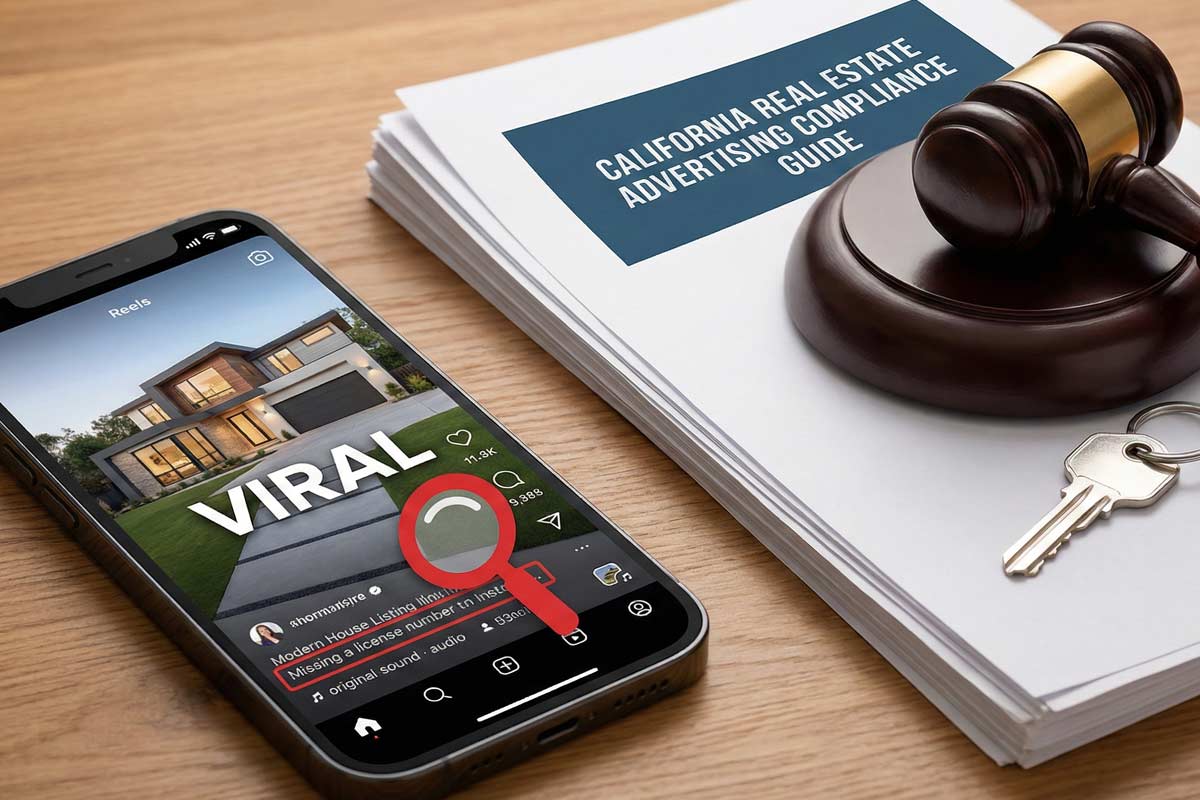
Imagine this: You’ve just spent $2,000 on a high-end video shoot for a new listing. The Reel goes viral—DMs, likes, and shares are pouring in. Then, you get a different kind of notification: a formal letter from the California Department of Real Estate (DRE).
A competitor noticed your license identification number was missing from the video. They filed a complaint through the DRE’s online portal in minutes. Now, instead of prepping for your open house, you’re prepping a response to a DRE investigator.
At ADHI Schools, I’ve spent over 20 years training agents to comply with the California Real Estate Laws.
If there is one thing I’ve learned, it’s this:
The DRE doesn't care how "aesthetic" your feed is; they care about consumer protection.
In California, your license identification number isn’t a suggestion—it’s a non-negotiable anchor for every piece of solicitation you put into the world.
TL;DR: Compliance at a Glance
Placement
Requirement Status
Bio / Profile
Required (If used for solicitation/first contact)
Individual Posts
Best Practice (Strongly recommended)
Website Pages
Required (On all pages you "own, control, and/or maintain")
Branded Signs
Required (If it identifies any individual licensee)
The Non-Negotiables: You must disclose your eight-digit license identification number AND your responsible broker’s licensed name. (Note: The broker's license number is generally optional if their name/logo appears).
Consequences:A DRE citation can include an administrative fine plus corrective actions.
The Core Rule: What Counts as "Advertising"?
Under Business and Professions Code and Commissioner’s Regulation 2773, any "solicitation materials intended to be the first point of contact with consumers" must include your license identification number. The DRE calls these "first point of contact" solicitation materials.
The Non-Negotiable Box
Licensee Name + License Identification Number.
Responsible Broker Identity: This must be the brokerage name as currently licensed with the DRE, not a nickname or team handle.
NMLS ID: Must also be included if you are performing mortgage-related acts.
The Operational Test: Content vs. Advertising
In practice, the DRE treats many consumer-inviting posts as solicitation.
Use this 3-part test: If a post contains
(1) your identity as an agent/broker,
(2) a specific property or service, and
(3) any invitation to contact, treat it as solicitation.
If the post has branding and services, even without an explicit CTA, it can still be construed as solicitation designed to incentivize a professional relationship.
Where Your License Number MUST Appear (Channel-by-Channel)
Instagram & TikTok
Required: Your license identification number must be in your Bio/Profile description if the profile is used for business.
Best Practice: Put “DRE #xxxxxxx” in your bio and on any post that could be screenshotted and shared. Legal standards focus on "first point of contact," but any single post can become that first interaction.
Common Mistake: Assuming a link aggregator (like LinkTree) counts as disclosure. The DRE expects disclosure on the solicitation surface itself, not hidden behind clicks.
YouTube & Shorts
Required: In the "About" section and the opening section of video descriptions.
Best Practice: For Shorts, where descriptions are often hidden, use an on-screen text overlay. Ensure it is legible on mobile and stays on screen long enough to be read.
Website (Agent & Team Pages)
Required: On all websites you own, control, and/or maintain. This includes agent bio pages, landing pages, valuation pages, and contact pages.
Note: This also applies to IDX or property search subdomains you control.
Placement: The footer works, but only if it’s present on every relevant page and not reduced to unreadable microtype. The type size must be no smaller than the smallest size type used elsewhere in the solicitation. ( 10 CCR § 2773)
Print & Digital Cards
Requirement: Mandatory for business cards, stationery, flyers, and mailers.
Digital Analog: Digital business cards and email signatures are explicitly viewed as "first point of contact" materials.
Yard Signs & Open House Signs
Branded Signs: If the sign displays the name of a licensee, disclosure rules trigger (§ 2773).
Unbranded Signs: A "For Sale" sign with no name, trademark, or branding (or only the responsible broker's licensed identity) is generally exempt.
The Reality of DRE Enforcement
Most complaints come with a single asset screenshot—one Reel frame or one flyer image. In practice, "it’s elsewhere on my site" is rarely a strong defense. If you’re wondering what actually gets the Department’s attention in the field, check out our report on What the California DRE Actually Enforces.
A pattern of sloppiness in your public-facing materials often signals deeper systemic issues to an investigator, which can lead to a wider review of Common DRE Violations and How to Avoid Them.
Traps: Common Compliance Misses
Collab Posts / "Featuring": If an ad names multiple licensees, you must include each individual license identification number.
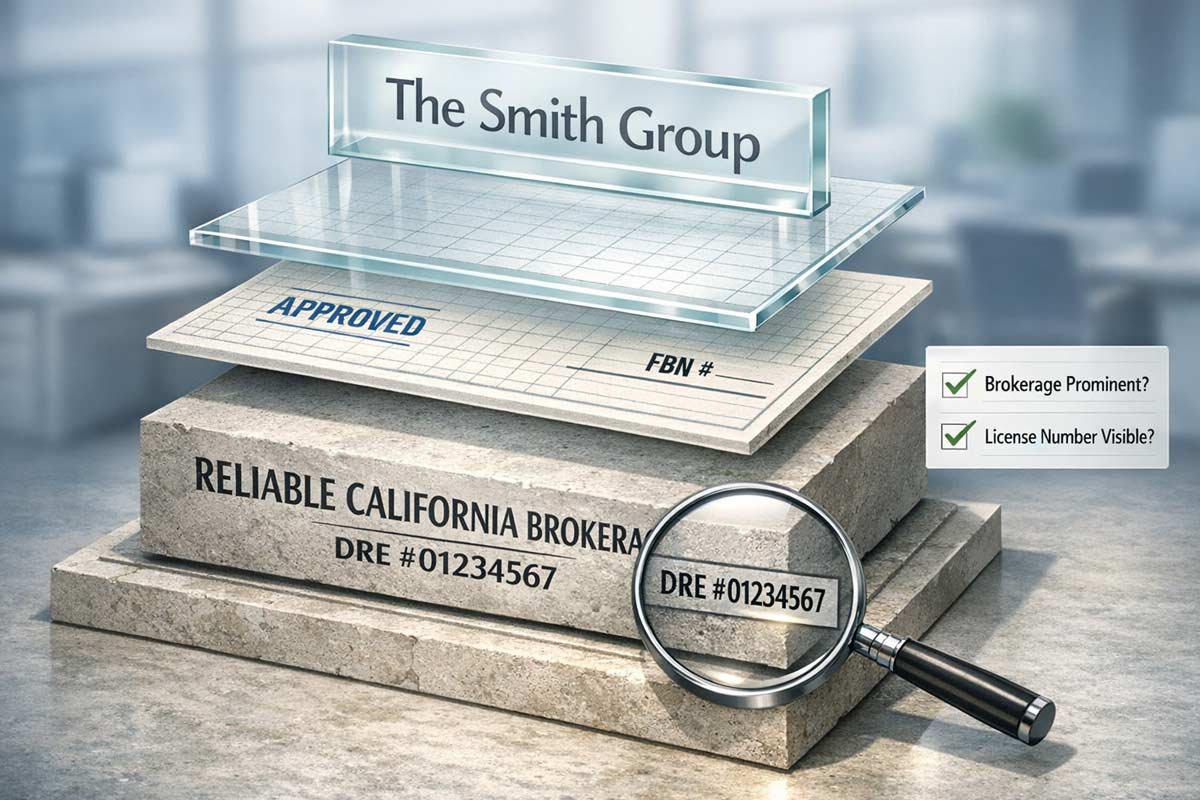
Team Handle vs. Broker Name: A classic miss is a team page that shows a team name (e.g., "The Smith Group") but omits the responsible broker’s licensed name. Ensure your branding doesn't blur this line by reviewing the Team Name & DBA Rules for California Agents.
The 60-Second Compliance System
As a broker, here is exactly how I would protect your license: Systematize the boring stuff so you can focus on the selling.
The Locked Template: Create a "Footer Block" in Canva that includes your Name | DRE # | Responsible Broker's Licensed Name. Lock this as a template for all graphics.
The Bio Lock: Put your DRE# and responsible broker's licensed name in every social bio today.
The Monthly Audit: Set a recurring calendar invite to check (1) your last 5 posts, (2) your website footer, (3) your email signature, and (4) your top 2 directory profiles and team pages.
The same systems discipline required for advertising also applies to your backend operations, such as Trust Fund Handling Rules for California Agents.
FAQ: Real-World Advertising Questions
Do I need my license number on every Instagram post?
If it functions as first point-of-contact solicitation, disclosure is required. Since any "real estate" post can become someone’s first contact via a share or search, the safest system is to include it by default.
Does a real estate team page need license numbers?
Yes. Every licensee featured on the page must have their license number displayed next to their name.
What if I’m just posting market updates?
If you are presenting yourself as a professional to attract clients, it’s solicitation. The DRE is very broad in its interpretation of "incentivizing" a consumer to contact you.
If you want the full compliance map for your career, start with our California Real Estate Laws & Compliance Guide. If you’re wondering what actually gets the Department's attention in the field, check out our report on What the California DRE Actually Enforces.
|
This isn't just about choosing a cool name for your Instagram bio. This is about staying compliant with the rules of the California Department of Real Estate.
In California, the line between "clever Read more...
This isn't just about choosing a cool name for your Instagram bio. This is about staying compliant with the rules of the California Department of Real Estate.
In California, the line between "clever marketing" and non-compliance is thinner than most agents realize. Get the compliance setup right from day one so you can focus on selling—not defending your license.
The "Oh No" Inquiry: A $2,500 Marketing Mistake
Imagine an agent—we’ll call her Sarah. Sarah is talented, hungry, and just launched "Elite SoCal Properties" on Instagram. It’s a great name. It sounds established and sounds like a powerhouse.
Three months later, she gets a formal inquiry from the DRE.
The issue?
"Elite SoCal Properties" sounds like a standalone brokerage. Sarah is a salesperson, but her branding suggests she’s the responsible broker or operating an independent brokerage.
By the time she pays the citation and rebrands everything—from signs to business cards—she’s out thousands of dollars and months of momentum.
A lot of these problems don’t start with the DRE "finding you"—they start with a competitor or unhappy party filing a complaint. If your branding is sloppy, you're giving your rivals a weapon to use against you.
The Foundational Mindset: Why the DRE Cares
The DRE has one primary mission: Consumer Protection. When a consumer sees your ad, they need to know exactly who the responsible broker is on that transaction. If your branding obscures that identity, you are creating consumer confusion, which is a fast track to a formal inquiry.
To build a truly bulletproof practice, you need to understand how branding fits into the bigger picture of professional responsibility. I’ve mapped the compliance hierarchy in our California Real Estate Laws & Compliance Guide—treat it as your home base for staying out of trouble and to help understand What the California DRE Actually Enforces.
Team Name vs DBA vs Brokerage Name (California)
Before you print a single flyer, you need to understand the three layers of your professional identity. In California, the name that matters legally is the one tied to the broker’s license—which is why your broker must approve your entire setup.
Term
What it is
What can go wrong
Team Name
A marketing label for your group
Looks like an independent brokerage
DBA / FBN
Name used in advertising other than the broker's licensed name (handled through broker policy)
Used without approval / inconsistent disclosures
Brokerage Name
The responsible broker identity
Hidden or minimized on advertising
Your Team Name: This is your nickname. It identifies your specific group (e.g., "The Smith Group").
A DBA (Doing Business As): This is a legal alias. If the public-facing name is not your broker’s licensed name, your broker may need to treat it as a fictitious business name. Start with your broker's policy—don’t guess.
The Brokerage: Think of this as your “last name”. No matter how big your nickname gets, the responsible broker must always be visible and dominant.
60-Second Compliance Checklist
Brokerage name is clear and prominent on all media.
My name matches exactly what is on my DRE license.
My license number is on all "first point of contact" ads.
Team name does not imply an independent brokerage.
Broker approved the setup before I printed or posted anything.
If you can’t pass this checklist in 60 seconds, don’t print, don’t post and consult with your broker.
Screenshot this checklist. It's your Friday audit.
Walk-Thru Scenarios: Is Your Brand Compliant?
Scenario A: The "Pseudo-Brokerage" Team
The Name: "Golden State Realty Team."
Risk: High. Words like "Realty" can imply you are an independent firm, which is a major trigger for What the California DRE Actually Enforces.
Why it’s risky: It suggests the team is the licensed entity, not the broker.
Do this now:
Stop using this if the DRE hasn’t approved the DBA/Corporation.
Clear the name with your broker's compliance department first.
Scenario B: The Instagram "Solo-Preneur"
The Post: A "Just Listed" graphic with your phone number and "The Luxury Specialist." No license number. No broker logo.
Risk: High. It’s a technical violation that usually leads to a citation.
Why it’s risky: Every "first point of contact" material must disclose your license status. This is a core rule in Real Estate Advertising With Your License Number.
Do this now:
Place your DRE license number on all social media graphics.
Add your broker's name to your Instagram bio.
Audit your YouTube channel for the same info.
Scenario C: The Team Branding Confusion
The Setup: You’ve created a team and want to handle property management for your clients.
Risk: Critical. Confusing your branding with the entity authorized to handle money leads to Trust Fund Handling Rules for California Agents violations.
Why it’s risky: Only the broker (or an authorized escrow) can handle funds; your "team" is not a legal repository for client money.
Do this now:
Never imply your "team" is the escrow holder.
Ensure all contracts clearly state the licensed broker’s legal name.
Review all trust fund-handling procedures with your broker.
Team Name Words That Trigger DRE Scrutiny
These words aren’t automatically illegal—but they increase the odds your branding is interpreted as implying a brokerage, which triggers higher scrutiny:
Realty / Real Estate
Broker / Brokerage
Land Company
Associates (if it implies more than one licensee is the lead)
The Friday Afternoon Audit
I tell my students to take 15 minutes every Friday to audit their brand.
Here are the four questions that prevent most of the issues we see in Common DRE Violations and How to Avoid Them:
Is my broker’s name dominant? If I look at my business card, is the brokerage name clearly visible and correctly spelled?
Is my license number everywhere? Check your email signature, your Facebook "About" section, and your latest YouTube description.
Are my "first point of contact" materials compliant? This includes business cards, stationery, flyers, and even those magnetic car signs.
Is my name consistent? Does the name on my marketing match my legal name on my DRE license?
The Compliance Coach’s Corner (FAQ)
Q: Can I use ‘Realty’ in my team name if I’m a salesperson?
A: It’s high-risk. Words like "Realty" or "Real Estate" can make your team look like a standalone brokerage. If your broker allows it, your disclosures must be crystal clear and your broker’s identity must be dominant everywhere and the DBA approved.
Q: Can my team name include “Properties,” “Homes,” or “Estates”?
A: Usually, yes—but treat them like “Realty-lite.” If the name makes you look like the brokerage, your broker identity must be dominant and consistent everywhere and you likely need the DBA approved by the DRE.
Q: Does my team name have to appear on my business card or can it be social-only?
A: If you use it anywhere, it should be used consistently and always accompanied by your broker’s identity and your license number.
Q: If I change brokerages, can I keep my team name and handles?
A: Usually, yes—but you must update every single asset (bio, headers, thumbnails) to reflect your new broker immediately.
Q: What counts as ‘first point of contact’ advertising?
A: Business cards, stationery, websites, social media profiles, and any promotional flyers or signs. If it can generate a call, DM, or lead, treat it like advertising.
Q: Can our team have a separate website domain?
A: Yes, but the website itself must comply with all disclosure rules, prominently featuring the broker’s name and your license number on every page.
Q: If my broker has multiple DBAs, which one do I use?
A: Use the one that is officially tied to your license and the office where you are hung. When in doubt, ask your manager.
The Protected Path Forward
Compliance isn't a hurdle; it’s the foundation of a scalable career. When you set up your brand correctly, you’re telling your clients—and the DRE—that you are a professional.
Start with the full map: California Real Estate Laws & Compliance Guide
Then tighten your biggest public-facing exposure: Real Estate Advertising With Your License Number
Finally, run the ‘am I accidentally violating something?’ scan: Common DRE Violations and How to Avoid Them
The goal is simple: your brand should look professional without ever looking like an unlicensed brokerage.
|
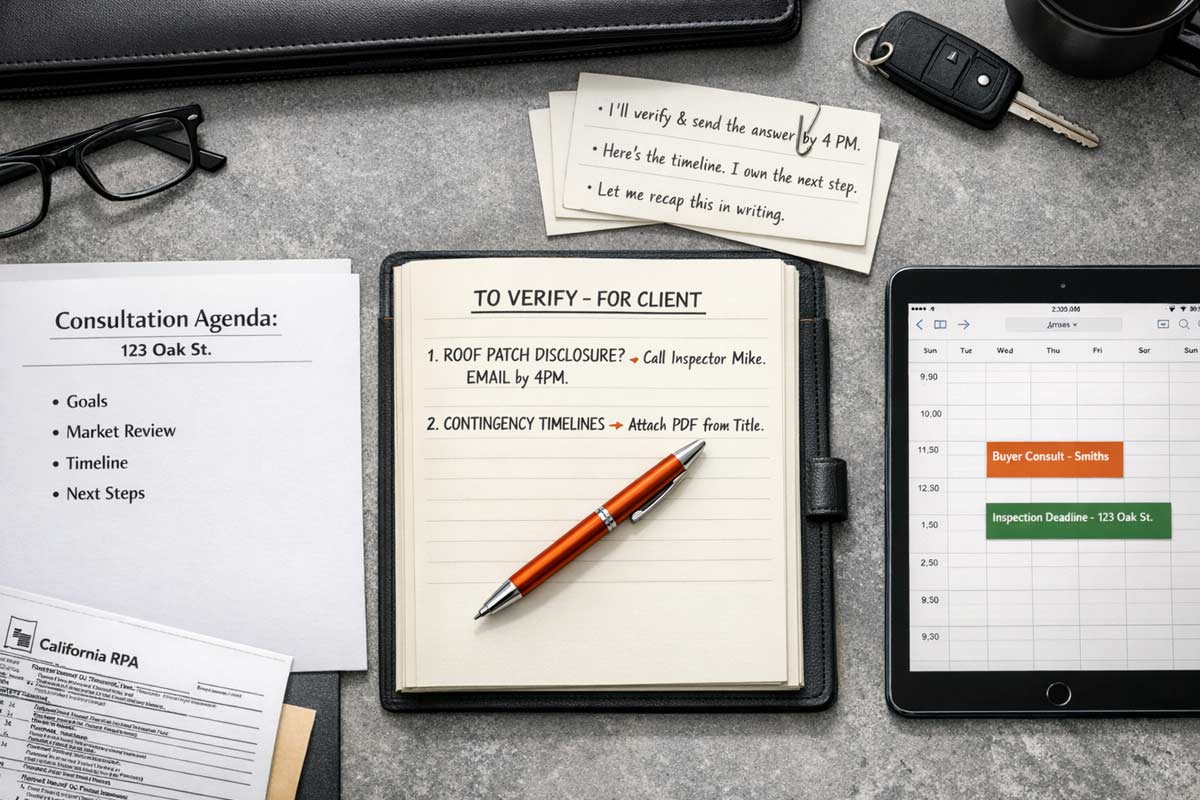
You’re at a coffee shop with a potential seller. They lean in and ask: “What’s the risk if we don’t disclose that old roof patch from three years ago?”
You hesitate. You glance at your phone. Read more...
You’re at a coffee shop with a potential seller. They lean in and ask: “What’s the risk if we don’t disclose that old roof patch from three years ago?”
You hesitate. You glance at your phone. You say, “I think…”
In that three-second pause, you just had credibility bleed.
Clients don't fire you because you’re new; they leave because you look unprepared, vague, or chaotic. Professionalism is not a personality trait—it is a system of repeatable signals.
TL;DR: The New Agent Credibility Fix
No Guessing: “I’ll verify and follow up by ___.”
Bring Structure: Agenda + comps + next steps (every time).
Own the Calendar: Deadlines don’t manage themselves.
Disclosures = Risk Management: Early delivery, clean tracking, zero surprises.
Practice Decision Trees: Scripts are branching logic, not lines to memorize.
12 New Agent Mistakes That Kill Your Credibility
1. The "I Think" Guess
The Mistake: Answering a technical or market question with "I think..." or "I’m pretty sure..."
Why It Hurts: In California, “I think” sounds like “I’m gambling with your equity.”
The Professional Fix: Use the Expert Deferral Script: "Great question. I’m not going to guess. I’m going to verify it and text/email you the correct answer by 4:00 PM."
Credibility Phrase Bank (Steal These):
“I’m not guessing.I’ll verify and send you the exact answer by 4:00 PM.”
“Here’s the timeline. I’ll own the next step and keep you ahead of deadlines.”
“Let me translate this into plain English, then we’ll decide.”
“I’ll recap this in writing so nothing gets lost.”
2. Showing Up Without a Printed Agenda
The Mistake: Entering a first listing appointment and asking,
"So, what would you like to talk about?"
Why It Hurts: If the client has to lead the meeting, they don't need you.
The Professional Fix: Bring three copies of a one-page agenda: one for them, one for you, and one as a backup. It signals you have a process for their success from day one.
3. Over-Talking to Fill the Silence
The Mistake: Talking incessantly because you’re nervous.
Why It Hurts: Silence is a high-status negotiation tool; over-talking signals nervousness and uncertainty. Calm beats charisma.
The Professional Fix: Study negotiation basics to understand that the person asking the questions controls the room. The first person who starts explaining is usually the one giving away leverage.
4. Robotic Script Delivery
The Mistake: Using a script exactly as written without adjusting for tone or context.
Why It Hurts: You sound like a telemarketer. Clients can sense when you’re "doing a routine."
The Professional Fix: You must practice real estate scripts until they become "decision trees"—you know the intent of the words, not just the order.
5. Skipping the Buyer Discovery Phase
The Mistake: Taking a buyer to see houses before conducting a formal first buyer consultation.
Why It Hurts: You look like a tour guide. It suggests you have no system for protecting their time.
The Professional Fix: Push for an office or Zoom consultation. Use a standardized questionnaire to uncover their "must-haves" vs. "nice-to-haves."
6. Vagueness on California Timelines
The Mistake: Not explaining the common contingency periods (e.g., 3, 7, or 17 days) clearly.
Why It Hurts: California contracts are timeline-heavy. If a client is surprised by a "Notice to Perform," you lose their trust instantly.
The Professional Fix: Create a "Transaction Calendar" for every client. Explain the most common contingency timelines in your contract before they sign.
Micro-checklist:
Put all deadlines in a shared calendar invite.
Send a one-page timeline PDF the same day.
Confirm the “Next deadline” at the end of every call.
The Contingency Scare: A rookie agent forgot to track the inspection contingency deadline. On day 18, the listing agent sent a "Notice to Perform." The buyer panicked, thinking they were in trouble (they may have been if the inspections weren’t even ordered). The agent had to spend three days in "damage control" because they hadn't pre-framed the timeline.
7. Not Pre-Framing the RPA Before the First Offer
The Mistake: Waiting until the offer is written to introduce the 25-page California Residential Purchase Agreement.
Why It Hurts: Clients feel ambushed by massive paperwork. Ambush destroys trust.
The Professional Fix: Give a 3-minute “RPA orientation” during the consult: what they’ll see, what matters, and how you’ll translate it into plain English.
8. Sloppy Email and Documentation
The Mistake: Missing subject lines, typos, or disorganized attachments.
Why It Hurts: Sloppy emails = sloppy contracts (in the client’s mind).
The Professional Fix: Use a clear format: [Property Address] - [Document Name] - [Action Required].
9. Answering Outside Your Expertise
The Mistake: Giving tax, legal, or structural engineering advice.
Why It Hurts: It’s a liability and makes you look like you don't understand professional boundaries.
The Professional Fix: Build a "Partner List." When asked about taxes, say: "That’s a great question for a CPA. I have two my clients use; would you like their contact info?"
10. Being "Always Available"
The Mistake: Answering every text in 30 seconds at 11:00 PM.
Why It Hurts: It signals you aren't busy. High-demand professionals have boundaries.
The Professional Fix: Set communication expectations early. Tell clients you respond between 8:30 AM and 6:30 PM. Add: "Emergencies are different—if something is truly time-sensitive, call me."
11. Reactionary Negotiation
The Mistake: Passing an offer to a client without a summary or strategy.
Why It Hurts: It makes you a "delivery person," not a negotiator.
The Professional Fix: Before calling the client, analyze the offer against the comps and prepare a "Net Sheet."
12. Treating Disclosures as "Admin" instead of Protection
The Mistake: Treating disclosures like paperwork instead of risk management.
Why It Hurts: The fastest way to lose trust with a real estate client is a surprise after the fact.
The Professional Fix: Always default to the TDS. If you’re asking whether it’s disclosable, treat it as disclosable until your broker says otherwise.
Micro-checklist:
Deliver disclosures as early as possible.
Track the exact date of receipt and review.
Confirm in writing: “No surprises later.”
Common Rookie Realtor Mistakes (Quick List)
Guessing on technical questions instead of verifying.
Winged meetings without a printed agenda.
Filling silence with over-explanations.
Robotic script reading instead of conversational mastery.
Skipping the formal consultation to go "tour" houses.
Fumbling CA timelines like contingency removals.
Ambushing clients with the 25-page RPA at the last minute.
Messy email habits that signal a lack of discipline.
Giving legal/tax advice outside of professional scope.
Lacking boundaries around late-night availability.
Presenting offers without a summary or strategy.
Downplaying disclosures and risking future lawsuits.
The Credibility System: Your Daily Protocol
To Start a Real Estate Career in California and actually thrive, you need to turn these fixes into daily discipline:
Prep (30 min): Comps + form set + agenda + timeline before every meeting.
Lead the Meeting: Frame → Discovery → Recommendation → Next Step.
Recap in Writing (2 hours): Bullets + deadlines + who owns what in an email.
Own the Next Step: If it’s important, it gets a specific date and time on the calendar.
FAQ: Building Credibility in California
How do I sound confident if I’m brand new?
Confidence comes from the process, not the result. If you follow a checklist, you don't have to be confident in yourself—you just have to be confident in the system.
Should I admit I’m new?
Don't lead with it, but don't lie. Pivot to your team:
"I’m a newer associate at [Brokerage Name], so you get my full focus, backed by my broker’s 30 years of experience and our firm's legal team."
What if a client asks how many deals I’ve done?
Don’t inflate numbers. Be honest and pivot to process:
"You’re getting my full focus, plus broker oversight and a transaction system that prevents mistakes in timelines and disclosures."
Your Professional Path Forward
You don’t need a decade of experience to be the most professional person in the room.
You simply need a repeatable process that removes doubt.
Pick Your Lane (Do this this week):
Buyers: Master your first buyer consultation so you stop being a tour guide and start being a decision coach.
Sellers: Run a real first listing appointment with a printed agenda and a clear pricing conversation.
Confidence: Practice real estate scripts as decision trees so you don’t freeze when clients throw curveballs.
Stop trying to sound experienced. Start sounding prepared.
|

In California, the gap between getting your real estate license and closing your first deal is a "post-license cliff" where most agents quit. It’s not for lack of effort; it’s a lack of systems and Read more...
In California, the gap between getting your real estate license and closing your first deal is a "post-license cliff" where most agents quit. It’s not for lack of effort; it’s a lack of systems and processes.
After you get licensed, you don’t need more motivation—you need a system. Most new agents aren't failing because they aren't working; they are failing because they are fragmented. If you’re still building your full launch plan, bookmark our guide on how to Start a Real Estate Career in California to see the big picture.
Put simply, your calendar is your pipeline. If a task doesn't live on your calendar, it doesn't exist.
The simplest rule in real estate:
If your calendar doesn’t include a protected daily block for prospecting + lead follow-up, you will drift into admin, content, and “busy work.” That drift is what kills new agents—not lack of talent.
Your job for the next 30 days is not ‘real estate.’
Your job is: new conversations + follow-up = appointments.
Everything else supports that.
The 80/20 Rule: What Actually Makes Money
In real estate, 80% of your results come from 20% of your activities. As an operator who has coached agents for over two decades, I categorize these as Money-Making Activities (MMAs).
New Conversations: Active outreach to the best lead sources. Lead sources don’t fix your pipeline—execution does. This schedule is how you actually run those systems.
Follow-Up: Moving people from "met" to "appointment."
Appointments Set: Conducting buyer presentations or listing appointments.
Why Time Management Is Non-Negotiable
California isn't a "casual" market. High competition and geographic sprawl mean that time management is your only real edge.
Consumer Behavior: In CA, buyers shop on weekends; your calendar must match their availability.
Speed-to-Lead: Buyers often talk to three agents. If you don't call back within 5 minutes, you're invisible.
Geography & Commutes: Commute time is a profit-killer. A "system" means clustering appointments by area.
Open House Consistency: This is the fastest way to get "conversation reps" in California. They are a core pillar of your weekly rhythm.
8 Time Management Traps (and the Swaps)
Starting in the Inbox:
Swap: Start with 10 outbound touches before opening email.
The CRM Rabbit Hole:
Swap: Spend only 15 minutes on data entry after calls are done.
Waiting to "Feel Ready":
Swap: Use a simple script; don't freestyle or overthink.
Admin during Prime Hours:
Swap: Move all paperwork and flyers to after 4:00 PM.
Avoiding "Awkward" Follow-Up:
Swap: Schedule the next touch during the current conversation.
No Protected Prospecting Block:
Swap: Mark 8:30 AM – 10:30 AM as "Busy" on your calendar.
Open Houses without a Plan:
Swap: Use a checklist for Friday prep and Monday follow-up.
Treating Weekends as Optional:
Swap: View Saturday/Sunday as your "Game Day."
Do This Today (15 Minutes)
Create a recurring calendar block: 8:30–10:30 Prospecting.
Create another recurring block: 11:00–12:00 Follow-up.
Write your “Top 10” follow-up list for tomorrow morning.
The ADHI “Weekly Operating System”
The Daily Template (Mon–Fri)
8:00–8:30: Hot leads + “yesterday follow-up”
8:30–10:30: Pipeline Block (Prospecting)
10:30–11:00: Log notes + schedule next actions
11:00–12:00: Follow-up block (top 10 active)
12:00–1:00: Lunch + admin triage
1:00–4:00: Appointments/showings/fieldwork
4:00–5:00: Admin + learning
5:00–5:15: Plan tomorrow’s “Big 3”
The Weekly Map
Time
Monday – Friday
Saturday
Sunday
8:00–8:30
Hot Lead Follow-up
Prep for Open House
Prep for Open House
8:30–10:30
Prospecting Block
Market Research
Personal Time
10:30–12:00
Follow-up Block
Travel to Site
Travel to Site
12:00–1:00
Lunch / Admin Triage
Set up Open House
Set up Open House
1:00–4:00
Appointments / Showings
Open House
Open House
4:00–6:00
Admin / Learning
Wrap-up
Monday Prep
The Minimum Effective Dose (90 Minutes)
If life blows up, do not scrap the day. Run the minimum:
15 minutes: Pick 10 people who haven’t heard from you in 72 hours.
45 minutes: Call + text all 10 using one script (no freestyle).
30 minutes: Log notes and schedule the next action for every person.
Simple script: “Hey [Name]—quick one. I saw a couple of new listings in [Neighborhood] and thought of you. Are you still thinking about buying this year, or has your timeline shifted?”
A Follow-Up System That Works
You must have a "Next Action" rule: No contact remains in your database without a scheduled next step. If you don’t have a clean place to track these actions, start by learning how to build a real estate database from scratch.
Use 3 Follow-Up Lanes:
Hot (0–14 days): Touch every 48–72 hours.
Warm (15–60 days): Weekly touch.
Nurture (61+ days): Monthly touch + quarterly call.
Open Houses Are a 3-Day System
An open house isn't a four-hour event; it’s a strategy for generating "now" business. Understanding how new agents should hold open houses is how you maximize your weekend time.
Friday: Prep materials and study neighborhood comps.
Sat/Sun: Execute the event and capture contact data.
Monday Morning: Execute your most important follow-up block by 11:00 AM.
The 30-Day Consistency Challenge
Do not worry about closings in your first 30 days. Focus on the scoreboard.
Week 1: Finalize your schedule + build your database.
Week 2: Complete 5 "reps" of your 2-hour prospecting blocks.
Week 3: Focus on "The Ask"—book your first buyer consult.
Week 4: Track your KPIs and tighten your scripts.
Your goal is to find your first 3 clients as a new agent by strictly hitting these daily numbers:
New conversations: 10+
Follow-up touches: 10
Appointments set: 1/week minimum
Database adds: 2/day
FAQ
Q: How many hours should a new agent work per week?
A: Plan for 40–50 hours. However, the quality of those hours matters. 20 hours of prospecting is worth more than 60 hours of admin.
Q: What’s the best time of day to prospect in real estate?
A: Primary: 8:30 AM – 10:30 AM. This is when you are freshest. Secondary: 4:30 PM – 6:00 PM for reaching working people. Test your market, but protect the block.
Q: "I get a lead at 7:40 PM. Do I wait until my morning block to call?"
A: No. Respond within 5 minutes with a text or call to acknowledge them. Move the deeper analysis into your morning follow-up block.
Q: "I feel behind on a Tuesday—how do I reset?"
A: Delete the minor admin tasks and do a 60-minute outreach power hour. One "Yes" from a lead fixes your mood faster than a clean desk.
Run This Schedule for 14 Days
Consistency is the only "secret" in this business. You don’t need a better personality; you need a better calendar. Run this system for 14 days without modification. Then adjust—don't abandon.
If you need the full roadmap for your new business, it’s in our Start a Real Estate Career in California guide.
|

For a brand-new California real estate agent, the first few months can feel like a race against an empty pipeline. You have a real estate license and ambition, but you don't yet have the clients.
This Read more...
For a brand-new California real estate agent, the first few months can feel like a race against an empty pipeline. You have a real estate license and ambition, but you don't yet have the clients.
This is why the open house remains an undisputed "fast track" to success. It provides the high-volume conversation reps you need and the immediate lead capture required to build a business from zero.
Who This Article Is For:
New Licensees: (0–12 months) looking for a repeatable system.
The Systems-Minded: Agents who want to move from "hosting" to "converting."
In California, an open house is more than a public showing—it’s a high-intent prospecting event. When run correctly, it becomes one of the best repeatable lead sources available to a new agent (especially when paired with other proven lead sources for new California agents).
Fair warning - if you don’t capture usable contact info from guests, you can’t follow up—and the open house becomes a branding event instead of a pipeline event. To win, you need to transition from "showing a house" to "running an operating system."
The Open House Kit (What to Bring)
Your goal is to look calm and prepared—because prospects pair “prepared” with “competent.” Pack this like a pilot packs a flight bag:
Signage: 10–15 directionals + 1 main “Open House” sign.
Lead Capture: QR placard + tablet sign-in + paper backup.
Property Materials: Feature sheets + disclosure packet access + MLS remarks.
Script Support: 1 small note card with your greeting + 3 discovery questions.
Ops Essentials: Pens, tape, small stapler, portable charger, water.
Safety Basics: Fully charged phone, keep keys on you, clear exit path.
California Note: Sign placement rules and HOA sensitivity vary by city—always confirm your brokerage standards and be respectful about placement to avoid fines.
The 90-Minute Open House Timeline (New Agent Checklist)
Follow this timestamped sequence to ensure you never look "scrambled":
45 minutes prior: Arrive at the property. Open all blinds, turn on every light, and do a quick "sanity sweep."
35 minutes prior: Signs placed + QR code placard at the entry.
25 minutes prior: Set up your "command center" (usually the kitchen island) with sign-in sheets and flyers.
15 minutes prior: Walk the "tour path" one last time. Rehearse your greeting.
Start: Greet guests warmly, but let them tour at their own pace.
During: Ask 2–3 discovery questions max. Jot down notes in between visitors.
End: Final lap, lock up, and retrieve signs.
30 minutes after: Enter all new leads into your CRM and tag them with specific notes.
Same Day: Send the first follow-up text to every "hot" prospect.
The Conversation System: Scripts That Convert
The biggest mistake new agents make is being too aggressive or too passive. Use these "Operator" scripts to gather data without the "salesy" vibe.
The Neighbor Line (The Listing Goldmine):
"Are you here because you’re curious about the value of your own place, or do you know someone thinking of moving into the neighborhood?"
The "We Already Have an Agent" Pivot:
"Perfect—then you’re in good hands. Are you already touring homes this weekend, or still narrowing neighborhoods?"
If Someone Refuses to Sign In:
"Totally fine—please take a look around. If you decide you want a feature sheet, or updates on similar homes in this school district, the QR code on the table makes it easy for me to send those over."
The Follow-Up Operating System
Every open house is a database-building event—log your leads the same day to avoid "lead decay."
To make this automatic, block time for it. The easiest way is to treat every open house like a scheduled workflow: 30 minutes after lock-up for CRM entry and 20 minutes that evening for follow-ups.
If you don’t protect that time, the week fills up and your leads decay—this is exactly why new agent time management strategies matter early in your career.
Email Template (Day 1)
Subject: Oak Street open house — quick follow-up
Body:
“Hi [Name] — great meeting you today at the Oak Street open house. Based on what you mentioned regarding your [Timeline] and [Specific Feature], I pulled 3 similar options currently on the market: [Links].
If you want, reply with your 'must-haves' and I’ll tailor a search for you. — [Your Name]”
California Compliance & Professionalism
As I have observed over 20+ years of training agents, professionalism in California is defined by how you handle the "gray areas."
Do
Don’t
Ask about timeline, financing readiness, and search criteria.
Ask about family status, religion, or national origin.
Offer disclosures and encourage professional inspections.
Speculate on protected-class suitability or schools.
Maintain a clear exit path and stay between guests and the door.
Follow people into small rooms or turn your back to a crowd.
Building Your System
Open houses work best when they’re part of a weekly prospecting cadence—so you’re not relying on luck, you’re running a pipeline. By using this system, you ensure that every weekend moves you closer to finding your first 3 clients as a new agent.
If you're ready to move beyond the "hosting" phase and start operating like a pro, it's time to Start a Real Estate Career in California with the right education and strategy.
FAQ: Open Houses for New Agents in California
Do I need to make everyone sign in at an open house?
No—but you do need a professional way to capture contact info if you want follow-up to be possible. Use a QR placard + soft language: “If you’d like a feature sheet, or updates on similar homes, the QR makes it easy for me to send them.” Some brokerages prefer a hard sign-in policy, others don’t—confirm your office standard.
What if the open house is dead and nobody shows up?
A slow open house still has value if you treat it like a pipeline block, not a social event. Use the time to:
Tighten your tour path + talking points,
Practice your script out loud,
Message neighbors and past visitors,
and review your follow-up workflow so you execute it automatically next time.
If your traffic is consistently low, pair open houses with other lead sources for new California agents so your week doesn’t depend on Saturday luck.
How many open house signs should a new agent use?
A good baseline is 10–15 directionals plus one main sign, placed at key turns that funnel traffic to the home. Keep them clean, consistent, and easy to read. Placement rules and HOA sensitivity vary by city—use good judgment and follow your brokerage policy.
What should I say when someone asks, “Is the seller desperate?”
Stay professional and stay factual. A clean response is: “I can’t speculate on motivation, but I can share what’s publicly available—price history, disclosures, and recent comparable sales.”
How do I follow up after an open house without sounding salesy?
Follow-up feels “salesy” when it’s vague. Make it helpful and specific:
“Here are 3 similar homes based on what you said.”
“Want disclosures/inspection reports sent over?”
“Do you want alerts for homes with [feature] in [area]?”
Then keep your cadence consistent—this is why new agent time management strategies matter early.
How soon should I follow up after an open house?
Same day is ideal—while the conversation is fresh. A simple standard:
Same day: quick text if opted-in
Day 2: “one helpful thing” (disclosures, comps, lender intro)
Day 7: soft next step
Log everyone into your CRM the same day so the open house becomes a true database-building event.
Should I sit or stand during an open house?
Stand if possible. Sitting signals “hosting.” Standing signals “present and available.” You don’t need to hover—just stay positioned so you can greet people without blocking the entry and maintain a clear safety posture.
How do I get clients from open houses if I’m not the listing agent?
By treating the home as the stage and the visitors as the opportunity. Your job is to:
Greet + create comfort,
Ask 2–3 discovery questions,
Capture contact info via value (disclosures, feature sheet, comps),
Follow up the same day.
|
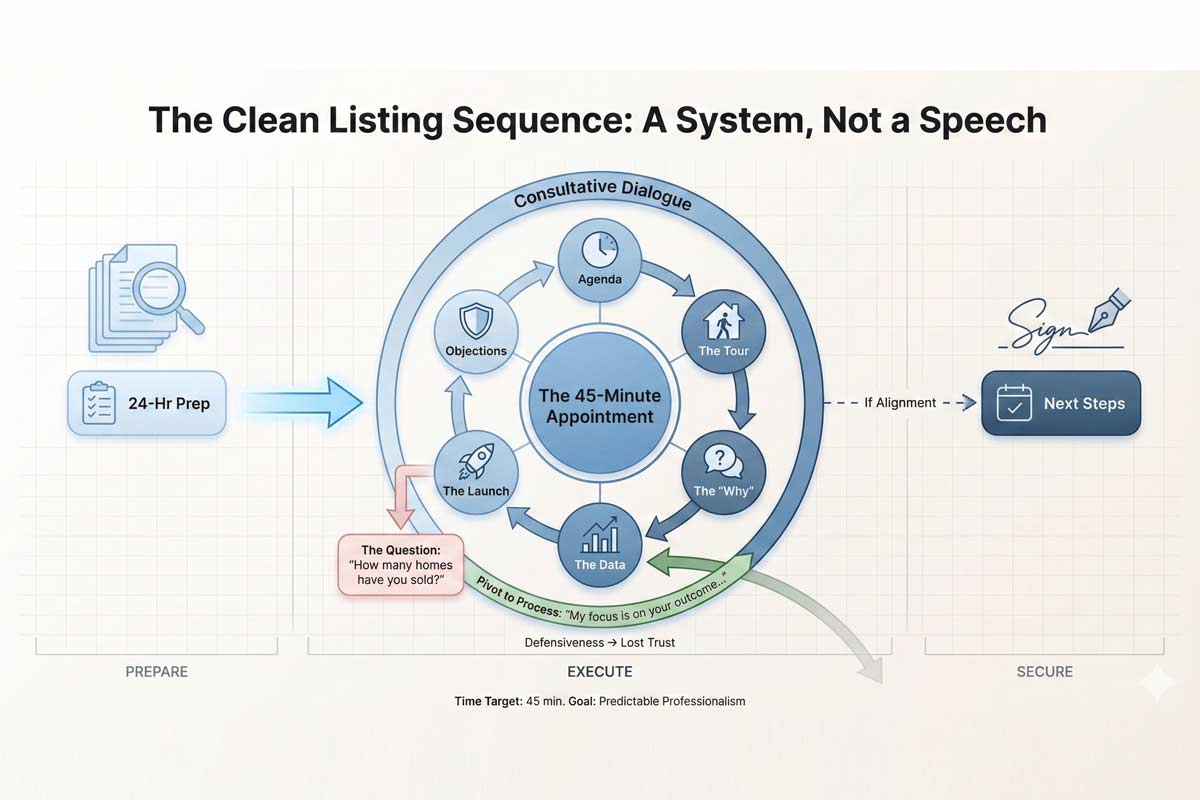
Most new agents walk into their first listing appointment with a gut-level fear: “What if they ask how many homes I’ve sold?”
This fear stems from a misunderstanding of seller psychology. Sellers Read more...
Most new agents walk into their first listing appointment with a gut-level fear: “What if they ask how many homes I’ve sold?”
This fear stems from a misunderstanding of seller psychology. Sellers aren’t buying your resume. They are buying a process that protects their equity and reduces mistakes. They aren't looking for a "veteran" as much as they are looking for a professional with a predictable, low-risk system.
In my 20+ years of training thousands of California agents at ADHI Schools, I’ve seen rookies beat top producers because they prioritized clarity over charisma. If you try to wing it, you’ll feel it—and they’ll feel it.
Confidence doesn’t come from your track record—it comes from your sequence.
The 7-Step Clean Sequence (One-Page Summary)
Agenda Setting: Confirm the timeline and goal immediately.
The Tour: Walk the property with a consultant’s eye.
The "Why": Deep-dive into seller goals and timeline.
The Data: Review pricing using the three-bucket method.
The Launch: Explain the marketing and feedback loop.
Objection Handling: Resolve concerns using prepared scripts.
The Close: Confirm the decision and set next steps.
Time target: 45 minutes total (10 tour / 25 table / 10 close & next steps).
Pre-Appointment Prep: The 24-Hour Intel Phase
The appointment is won or lost before you ring the doorbell.
The Property Intel Checklist The "Big Three"
CMA: Prepare a Comparative Market Analysis with Actives (competition), Pendings (market direction), and Solds (the reality check).
Title Profile: Check for liens, multiple owners, or solar panel UCC filings.
The "Motivation" Call: 24 hours prior, call to confirm. Ask: "Aside from the price, what is the one thing that must happen for this move to be a success?"
The Minimalist Kit
Sellers can interpret overly flashy materials as in security. Data and a calm process read as competence. Bring an iPad or a neatly organized folder containing:
The CMA
A 1-page "Launch Plan"
The California Residential Listing Agreement (RLA)
A seller net sheet (to show their estimated proceeds at close)
First 5 Minutes: Setting the Frame
You’re the guide. Your job is to run a clean, low-drama decision meeting.
The "Agenda" Script
Warm Seller: "Thanks for having me over. My goal today is to see the home, hear your goals, and show you exactly how we’ll find the right buyer. Does that work for you?"
Skeptical Seller: "I know your time is valuable. I’ve set aside 45 minutes to go over the data and our strategy. At the end, we’ll both know if I’m the right fit to get this sold. Should we start with a quick tour?"
The Walkthrough: Tour Like a Consultant (Not a Compliment Machine)
The biggest mistake new agents make is acting like a guest. You’re there to audit the asset.
Ask, don’t tell: Instead of complimenting the kitchen, ask “When were these appliances last updated?” or “Any HVAC issues during peak summer?”
The “Stay or Go” list: Ask what’s staying vs. leaving (fixtures, appliances, smart devices). This prevents later disputes over chandeliers, Ring cameras, or mounted TVs.
What NOT to do:
Price during the tour: “I have some thoughts, but I want to sit down with the data first so I can give you an accurate range.”
Contractor cosplay: Don’t guess repair costs. Label it a point of inspection and move on.
Insult the house: Stay neutral. “This layout is unique” beats “This room is too small.”
If They Ask How Many Homes You’ve Sold (The Clean Answer)
Handle this moment with zero defensiveness.
The "High-Touch" Pivot
"Fair question. My model is high-touch: fewer clients at a time, tighter communication, and a very structured launch plan. You won’t be competing for my attention."
The "Team-Backed" Angle:
"Great question. I’m your point of contact, and I run the process. And I’m backed by my broker and transaction team on pricing, disclosures, and contract execution—so you get personal attention with professional oversight."
The Table Meeting: 3 Phases of Authority
Phase 1: Motivation Intake
Ask: "If this home doesn't sell for six months, how does that affect your plans?" If you don't know their "Why," you cannot handle their objections later.
Phase 2: Pricing Reality (The Three Buckets)
Show the data. "The market is telling us that homes like yours sell fast... or they start going stale and get negotiated down." We’ll define ‘stale’ using showing volume, online saves, and buyer feedback—not vibes. Understanding negotiation basics for new California agents is critical here—you aren't negotiating against the seller; you are negotiating with the market.
Phase 3: Strategy & Execution
Show them your Launch Plan. This includes professional media, reverse prospecting, and the "Feedback Loop" (your scheduled weekly update).
Objection Handling: Consultative Scripts
If you have practiced how to practice real estate scripts effectively, you will stay calm here.
Objection Handling: The Consultative Response
Objection
Consultative Response
"Another agent said it's worth more."
"Interesting. When they gave you that number, did they anchor it to sold comps, or was it more of a 'marketing price'? I’m not here to win the listing—I’m here to protect your outcome."
"We want to try a higher price."
"If we start too high, we'll miss our best buyers right out of the gate. Then, if we have to lower the price later, we're dealing with buyers who know we couldn't sell it—and that weakens our position."
"Will you cut your commission?"
"I’m happy to talk commission. The real issue is net outcome. My job is to protect your equity and reduce risk. If we cut the steps that produce the result, the price reduction usually costs more than the commission ever would."
"We’re interviewing others."
"I respect that. Professionalism is about finding the right fit. What are you looking for in an agent that we haven't covered yet?"
The Close: Moving to Signature
The Direct Close: "I’m confident we can hit your timeline. Are you ready to get the paperwork started so we can get the photographers out here Monday?"
The "Think About It" Close: "I understand. Usually, when people want to think about it, it’s because I haven't clarified something. Which part of the plan are you still weighing?"
New Agent Mistakes That Kill Listings
Talking Too Much: If you talk more than 30% of the time, you aren't listening.
Ignoring the "Quiet" Owner: The person asking the fewest questions often holds the veto power.
Defending the Price: Never "defend" a price. Let the data do the talking.
No Time Boundary: If you stay for 3 hours, you look desperate.
Tech-Dependency: Always have a paper backup of your presentation.
Over-Promising: Don't promise daily calls if you can't sustain them.
Hiding Your Status: Don't lie about being new; lean on your broker's track record.
Vague Next Steps: Never leave without a clear follow-up date and time.8.. Avoiding these new agent mistakes that hurt credibility is your fastest path to a "Yes."
FAQ: The First Listing Appointment
Q: Should I bring the listing agreement to the first meeting?
A: Bring it every time—even if you don’t pull it out. It signals preparedness and lets you move forward immediately if they are ready.
Q: What if they ask about my experience?
A: Pivot to your process. Experience is just a proxy for "Will you mess this up?" Prove you won't by being the most organized person they meet.
Q: How does this differ from working with buyers?
A: Listings are about asset management; buyers are about search and discovery. You should prepare for a first buyer consultation with the same level of systematic rigor.
Your Professional Foundation
The listing appointment for new agents is a test of your business operating system. You do not need to be the most famous agent in California to win; you just need to be the most prepared.
Read more to see how this fits into our broader California real estate career guide, continue building your library of systems.
Your next step: practice these scripts out loud until they feel natural.
|

Your hand hovers over the dial. The script is pulled up on your screen, but the words feel unnatural and obvious at the same time.
In your head, you already sound like a telemarketer.
You’re terrified Read more...
Your hand hovers over the dial. The script is pulled up on your screen, but the words feel unnatural and obvious at the same time.
In your head, you already sound like a telemarketer.
You’re terrified of blanking mid-sentence or, worse, getting hit with a question that knocks you off your path.
Here is the field-tested truth:
Top-producing agents aren't "naturals."
They’re just prepared.
Whether you are working a buyer lead, a social media inquiry, or a guest at an open house, scripts are your foundation. This isn't about memorization; it's about building the muscle memory required to stop worrying about your next word and start listening to the client’s needs.
The Core Thesis: Scripts aren't lines to memorize. They are reps to build automaticity. You are training your brain to handle the structure of a deal so your mind is free to think and lead.
The 3-Level Progression: From Memorization to Mastery
In my 20+ years coaching California agents, I’ve seen thousands try to "wing it." They fail because they have no floor. Use this ladder to build your skills.
Level 1: Memorize the FRAME (The "GPS" of the Call)
Most agents fail because they try to memorize a script word-for-word. The moment a prospect goes off-script, the agent’s brain reboots.
The Goal: Know the structural milestones of the interaction.
The Drill: Summarize your script into three "anchor" points.
Example Frame (Universal Buyer Lead):
Connection: "I saw you were looking at the Main Street property—what was it about that home that caught your eye?"
Motivation: "Are you looking for something with that specific layout, or just that neighborhood?"
The Ask: "I’m seeing a few others in that pocket with similar features; would you like to see those this weekend?"
Level 2: Drill for Fluency (Diagnostic Reps)
Note: These characters are diagnostic tools to help you find your "natural" baseline; they are not your final delivery voice.
The Goal: Pacing and tonal control.
The Drill: Set a 60-second timer. Say your script 5 times, changing your "character" each rep:
Whispering: Focuses on crisp enunciation.
Over-excited: Highlights where you sound too "salesy."
Calm/Bored: Helps you find a neutral, professional baseline.
Fast-paced (Stress Test): Tests your ability to keep words fluid under pressure.
Final Rep: The "Curiosity" voice—slow, helpful, and inquisitive.
Level 3: Pressure-Test with Chaos
In the real world, people interrupt. They say, "I'm busy," or "Who is this again?"
The Goal: Progressive recovery.
The Drill: Have a partner interrupt you mid-sentence with a random objection. Your goal isn't to be perfect—it's to see how quickly you can get back into the "Frame."
The Target: Aim for a 7-second recovery initially, working your way down to a 3-second pivot back to the conversation.
The ADHI 10-Minute Daily Script Workout
This is your non-negotiable morning habit. Like a pre-flight checklist, it must be done before you touch the phone.
Min 1–2: Warm-Up. Read your script aloud. Just get used to the sound of your own voice in the room.
Min 3–5: Record & Replay. Use a voice memo. Listen for "um", "like", and "you know." Fix one verbal tic per session.
Min 6–8: Objection Reps. Pick one objection and drill the response 5 times using the Level 2 diagnostic characters.
Min 9–10: The Coffee Shop Test. Say the core message as if you were explaining it to a friend. If it sounds like a lecture, simplify the language.
The “Don't Sound Robotic” Fix: The 1-1-1 Method
Robotic agents deliver monologues. Professionals lead dialogues. Use this formula to stay human:
1 Consistent Opening Line: Your anchor. (e.g., "Hi [Name], this is [Your Name] with [Brokerage].")
1 Personalized Sentence: Use a specific observation. "I noticed you were looking at that listing on Main Street—that specific layout is quite rare for this pocket of the city."
1 Clean Question: This shifts the energy. "Is that the specific style of home you're looking for, or are you open to other layouts?"
The Big 5 Objections: Recovery Drills
"We already have an agent."
Response: "That's great. It's so important to have someone you trust in this market."
Pivot: "If anything ever changes, what's the best way for me to stay in touch with you?"
"I'm just looking."
Response: "Of course, most of my best clients started out just browsing."
Pivot: "Are you looking for a 'forever home' or more of an investment opportunity?"
"How did you get my number?"
Response: "I’m an agent with [Brokerage] and I’m following up on your inquiry regarding the property on [Address/Area]."
Pivot: "I apologize if I caught you at a bad time—were you still looking for information on that home, or has your search changed?"
"Will you cut your commission?"
Response: "I understand that the fee is a factor in your net return. I’m curious, is your priority the cost of the service, or the net amount you walk away with at closing?"
Pivot: "Would you be open to seeing how our specific marketing and negotiation services are designed to protect that net return?"
"Send me an email."
Response: "I'd be happy to. I have a lot of data I can send."
Pivot: "To make sure I don't clutter your inbox with things you don't need, which two or three things are most important to you right now?"
The Bridge: From Practice to Production
Fluency equals authority. When you don't fumble for words, you look like a seasoned professional who understands the market.
The "Messy" Middle: To stay calm and lead the conversation when escrow hurdles arise, master the Negotiation Basics for New California Agents.
Securing the Listing: Knowing your frame keeps you in control when you learn How New Agents Should Handle Their First Listing Appointment with confidence.
The Buyer Consultation: Fluency is your best tool for answering tough questions during your How to Prepare for Your First Buyer Consultation.
Building Credibility: You can learn How to Avoid the “New Agent Mistakes” That Hurt Credibility simply by sounding like a peer to the veteran brokers you'll be negotiating against.
The 7-Day Challenge
Commit to the 10-Minute Daily Workout for exactly seven days. Do not skip a morning. By Day 8, the phone won't feel like a 500-pound weight. You are building a system that turns "fear of the phone" into a reliable, professional skill.
If you’re ready to master the skills that separate the top earners from the rest, the next step is building your professional foundation. Our Start Real Estate Career in California guide is where your journey begins—start it with a system designed for success.
FAQ Section
What scripts should I learn first? Focus on the "Lead Follow-up" script. Most agents lose money not because they can't find leads, but because they don't know how to handle the first 60 seconds of a return call.
How do I practice scripts without a partner? Use the "Record & Replay" method. Record yourself on your phone, wait 10 minutes, and listen back as if you were the client. You will immediately hear where you sound "salesy" or unsure.
How long should I practice scripts daily? 10 to 15 minutes of high-intensity practice is better than an hour of casual reading over a script. Quality of focus matters more than the clock.
What is the #1 practice mistake? Practicing in your head. If the words aren't physically coming out of your mouth, you aren't training your vocal cords or your brain for the "live" environment.
|
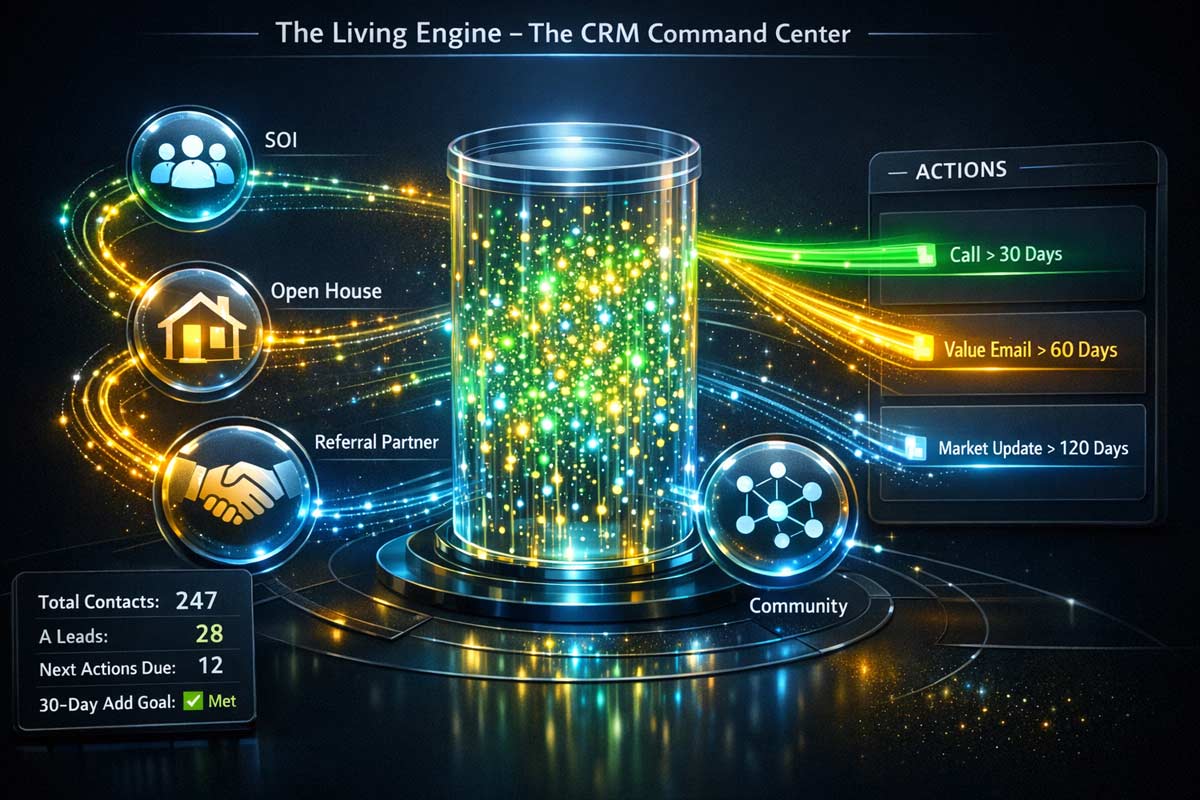
You’ve passed the real estate exam, your license is issued, and you’ve chosen a broker. Then, Monday morning hits. You sit at your desk, and the "post-license cliff" sets in: your calendar is empty, Read more...
You’ve passed the real estate exam, your license is issued, and you’ve chosen a broker. Then, Monday morning hits. You sit at your desk, and the "post-license cliff" sets in: your calendar is empty, and your phone isn't ringing.
The temptation for most new California agents is to reach for a credit card and buy leads. Every real estate office has that guest speaker pitching a magical "lead-gen tool" for $199 a month.
That is a short-term fix for a long-term problem.
In our industry, your database is your business. It is the only asset you truly own. One clean database can produce repeat clients for 10 years; one lead-buy produces, at best, a one-time conversation.
A database doesn’t magically create deals—it creates conversations, and conversations create appointments.
A "from scratch" database isn't about empty contacts—it's about missing the system for consistent, targeted follow-up.
By the end of this guide, you will have a clear, 30-day roadmap to move from zero contacts to a professional follow-up system that produces consistent commissions.
What a "Database" Actually Means
A database is not just a list of names or an exported CSV file from your phone. A database is a list with memory. It records context (notes) and creates the next action (follow-up date).
What Should You Track in a Real Estate Database?
To turn a contact list into a revenue-generating database, you need specific data points. If you don't know what columns to make in your spreadsheet, copy this exact template:
Full Name
Phone Number & Email
Preferred Contact Method (Text, Call, or Email)
City/Neighborhood (Crucial for California's hyper-local markets)
School District/Commute Corridor (The “why” behind their location)
Relationship Status (How do you know them?)
Source (Sphere, Open House, Referral, Social, Vendor)
Tags/Categories (A/B/C ranking, Buyer, Seller)
Last Contact Date
Next Follow-Up Date
Notes (Kids’ names, pets, hobbies, real estate goals)
Your First Database Rule: One Contact = One Next Action
If someone is worth saving, they’re worth scheduling. Every new entry in your system must have either:
A next follow-up date, OR
A "Do Not Contact" note.
There is no third option. Why: if it isn’t scheduled, it won’t happen.
Choose Your Tool (Without Overcomplicating)
Do not get stuck "tool shopping." You can lose weeks comparing software features while making zero phone calls.
Choose a system based on your current volume:
Google Sheets (0–100 Contacts): The fastest way to start. Google Sheets is free, searchable, and forces you to learn the mechanics of data entry.
Basic/Free CRM (100–300 Contacts): Many brokerages provide a CRM included when you join (like BoldTrail (formerly KV Core) or Chime). Use what you already have before paying for a third-party tool.
Full CRM (300+ Contacts): Only invest in premium platforms once you have a consistent lead flow and need advanced automation.
The Rule: If you have under 100 contacts, start with a spreadsheet. If you spend more than two days "researching" CRMs, you are procrastinating. Pick one and execute.
The 8 Best Places to Get Your First 100 Contacts
You aren't starting from zero; you’re starting from "unorganized." Here is where to find your first 100 entries:
Phone Contacts: Export your contact list. Don’t “clean first.” Import them, then add 25 per day for four days. Momentum beats perfection.
Past Coworkers: Start with 10 you’d confidently ask for advice. You were a professional before you were an agent; these people already trust your work ethic.
The Gym/School/Hobby Circle: Anyone you see at least once a month belongs in the database.
Vendors: Your lender, escrow officer, and local contractors. Tag these as “Vendors” to build a referral exchange.
Open House Sign-ins: This is your primary engine. Rule: If they sign in, they go into your database before you leave the property—while the conversation is still fresh enough to write real notes. Learn how new agents should hold open houses to maximize this capture.
Social DMs: Look at who “likes” your posts. Message them: “Hey [Name], I’m updating my professional directory—what’s the best email to send my local market reports to?”
Community Groups: Local neighborhood associations or Facebook groups (be the helper, not the solicitor).
Out-of-Area Agents: Tag them as “Referral Partners.” A small group of active agents outside your zip code can become your most consistent referral pipeline.
Clean Data Beats Big Data (Hygiene)
Before you chase "more contacts," fix the basics. A messy database is a useless database.
Standardize Names: "Mike Smith," not "Mike S." or "Dad's Friend."
One Primary Contact: Identify one main phone number and email per person.
Merge Duplicates: Do not have three entries for the same person.
Add "Source": Always know where a lead came from so you can track ROI later.
Fix Bouncebacks: If an email bounces or a number is wrong, update it the same day.
The "DNC" Tag: Create a "Do Not Contact" tag so you don’t burn relationships by calling people who asked you to stop.
Tagging & Segmentation: The Power of "A-B-C"
If you treat everyone in your database the same, you will burn out. You must segment your contacts so you know who to call first.
The Starter Tag Framework
Tag Category
Examples
Purpose
Ranking
A (Referral source), B (Met once), C (Cold)
Prioritizes your daily call list.
Timeline
Hot (0–3 mo), Warm (3–12 mo), Long-term
Focuses your energy on immediate deals.
Type
Buyer, Seller, Investor, Vendor, Referral Partner
Determines what kind of content you send.
Source
Open House, Sphere, Referral
Tracks which lead sources for new California agents are working.
The Follow-Up Operating System
Building the list is only 20% of the work. The remaining 80% is the follow-up. Successful agents use new agent time management strategies to ensure they aren't just "busy," but productive.
Follow-Up Cadence
"A" Leads (Referral Sources): Contact every 30 days.
"B" Leads (Met Once/Acquaintances): Contact every 60–90 days.
"C" Leads (Cold/Distant): Contact every 120–180 days (about twice a year) with broad value.
Value-Based Scripts
The "Permission" Text (Low Pressure, High Reply):
"Hey [Name]—quick question. Would it be helpful if I kept you posted when something notable happens in [Neighborhood] (sales, price changes, anything meaningful)? If yes, what’s the best email for you?"
The "Market Micro-Update" (Email/Text):
"Hey [Name], I saw that a house just like yours around the corner sold for [Price]. It's interesting to see how [City] is holding up right now. Let me know if you’d ever like a quick look at your current home value!"
The "Direct Ask" (Voice):
"I'm taking on a couple more clients this month. Who do you know that’s mentioned moving, upsizing, downsizing, or investing—even if it’s ‘later this year’?"
30-Day Build Plan
Follow this checklist to go from a blank screen to a functioning business engine.
The 30-Day Database Blueprint
Week 1: The Foundation. Create your spreadsheet using the template fields above. Import phone contacts. Apply "A, B, C" rankings to the first 50 people.
Week 2: The Reach Out. Add 25 more names. Send the "Permission" text script to everyone tagged "A" or "B."
Week 3: The Expansion. Log all responses. Call those who replied. Research how to find your first 3 clients as a new agent to convert these conversations into appointments.
Week 4: The Routine. Establish a "Minimum Daily Action": Add 5 new people, contact 5 existing people, and log 5 sets of notes.
Common Mistakes That Kill Databases
Over the last 20+ years, Kartik Subramaniam has seen thousands of students launch their careers.
The ones who fail usually hit these eight pitfalls:
Waiting until you "feel ready" to start calling.
Saving contacts with no notes (you will forget who they are).
Failing to use tags, leading to a "messy" list you eventually ignore.
No "Next Follow-Up" date— if it isn't scheduled, it won't happen.
Relying on "Likes"— social media engagement is not a database relationship.
Buying leads before you’ve exhausted your free sphere of influence.
Sounding like a salesperson instead of a local guide.
Ignoring Open Houses as a primary way to feed the database engine.
Kartik's Insider Tip: “I’ve seen agents turn a 'maybe next year' lead into a $30,000 commission simply because they had a 'follow up in 6 months' tag and actually made the call. Most agents quit after one 'no.' The database ensures you are there when the 'no' turns into a 'now.'”
Start Your Career the Right Way
A database is the difference between a "job" and a "business." Without it, you are unemployed every time a transaction closes. With it, you have a predictable stream of referrals and repeat clients.
If you are ready to move beyond the basics, it is time to look at the bigger picture of your professional development. If you’re building your first-year foundation in California, that’s the full roadmap.
Start a Real Estate Career in California →
FAQ
1. How many contacts should a new agent have?
Aim for 100 "met" contacts as quickly as possible. This is the baseline required to generate consistent referral traffic. Once you hit 100, aim for 250.
2. Do I need an expensive CRM to start in California?
No. A simple Google Sheet is often more effective for your first 100 contacts because it forces you to stay organized without the distraction of complex features.
3. What is a "Sphere of Influence" in real estate?
Your sphere of influence (SOI) consists of everyone you know personally who already likes and trusts you—friends, family, past coworkers, and neighbors. These are your warmest leads.
4. How often should I contact my database?
Contact "A" leads (referrals) every 30 days, "B" leads every 60–90 days, and "C" leads every 120–180 days (about twice a year).
5. What is the best way to ask for a referral?
Be direct but value-focused. Ask who they know that needs help navigating the current California market, rather than just asking for a name.
|

You’ve passed the real estate exam, your license is hanging at a brokerage, and the initial celebration has subsided. Now, you’re staring at a blank calendar and a quiet phone. It’s what I call the Read more...
You’ve passed the real estate exam, your license is hanging at a brokerage, and the initial celebration has subsided. Now, you’re staring at a blank calendar and a quiet phone. It’s what I call the “post-license cliff”. This moment is particularly acute in California, where high competition meets complex markets, and the pressure to “figure it out fast” can lead new agents toward expensive, ineffective shortcuts.
If you’re a new real estate agent in California wondering how to get your first clients without buying leads, this article is your playbook. Securing your first three clients isn't just about income—it’s about proof of concept. In my 20+ years of working in the California real estate market, I’ve noticed the agents who survive the first year are those who replace "hustle" with systems and processes.
What Success Looks Like in 30 Days
Before we dive in, let’s define a "win." Success in your first month isn't measured by closed escrows—it’s measured by inputs. These inputs work because they maximize trust-building touches, not impressions. If you follow this operating system, your 30-day scoreboard should look like this:
100+ Real Conversations (5 per business day)
40+ Contacts added to your database
4 Open Houses hosted
1–2 Buyer Consultations booked
Practice Over Profit: The First 3 Principle
This is the phase where most new real estate agents in California either build momentum—or quietly stall. Your first three clients are your learning labs. You are building the muscle memory of a professional. Success here comes from
Practice + Proximity + Follow-up
not expensive marketing.
Before You Prospect: Two Things You Must Set Up This Week
Before you pick up the phone, you need a professional foundation. California’s disclosure-heavy environment means your first clients are as much about the learning process as closing deals.
Broker Expectations: Sit down with your broker or team lead. Ask for (a) upcoming open house opportunities, (b) "floor time" for walk-ins (if this is still a thing in your area), and (c) their preferred CRM.
Compliance Guardrails: This is California—disclosures matter. Don’t wing it. Don't promise specific financial outcomes, keep all communications professional, and stay within your brokerage’s legal policies.
Pathway 1: The "Inner Circle" Strategy (The Database)
The Reality: Your first client is almost always someone you already know, or someone they know. People do business with people they trust.
The Action Plan: Stop "announcing" your career and start consulting. Use these micro-scripts to offer value:
The Call: "I’ve officially launched my real estate practice. I’m not calling for business—I just want to be your resource. If you ever need a quick valuation or want to know what’s moving in the neighborhood, I'm here."
The Text: "Hey! Just wrapped up my licensing. If you ever have a random real estate question or need a vendor recommendation, feel free to reach out!"
Micro-Credibility Boost:
Avoid: “I just got licensed and I’m looking for clients.”
Use: “I’m building my practice and want you to have a real resource.”
The 14-Day Follow-Up Cadence:
Day 0: Initial outreach (Call/Text).
Day 7: Value Touch (Send a quick, one-page market snapshot of their specific zip code).
Day 14: The Soft Ask: "I’m helping a few people find homes this month. Do you know anyone else thinking about a move this year?"
The Deeper Resource:
A "system" is simply: Name + Source + Last Contact + Next Action. In week one, a spreadsheet is fine. To move toward a sustainable pipeline, you need to build a real estate database from scratch.
Pathway 2: The Open House Capture & Conversion
The Reality: Open houses are one of the few places consumers actually expect to talk to an agent. It is a high leverage use of your time.
The Action Plan (The 3-Step Flow):
The Welcome: "Welcome! Are you from the neighborhood or just starting your search?"
The Qualification: "Have you seen anything else in this price point, or are you still getting a feel for the local inventory?"
The Close for the Next Step: "I have a list of three similar homes nearby that aren't on everyone's radar yet. Would you like me to send those over?"
A productive open house for a new agent isn’t measured by attendance—it’s measured by 2–3 follow-up conversations scheduled within 48 hours.
The Deeper Resource:
To turn a handshake into a contract, you need a specific follow-up method. Learn the full process in our guide: How New Agents Should Hold Open Houses in California.
Pathway 3: Leverage Office Inventory & Stale Leads
The Reality: While most agents chase "perfect" leads, you can find your first three clients by looking where others don't.
High-volume agents often ignore these opportunities because they require follow-up instead of marketing scale.
The Action Plan:
Support High-Volume Listings: Call top listing agents in your office. Offer to host their "stale" listings or prospect the surrounding neighborhood for them.
Renters-to-Buyers: Many people attending open houses are currently renting. Position yourself as the guide who helps them transition.
The Guardrails: Always follow "Do Not Call" rules and brokerage policy. Your job is service, not pressure. Once you've mastered these manual methods, you can explore broader lead sources for new California agents to scale.
The Two Moments That Start Real Careers
Moment #1: Someone trusts you enough to ask a "small" question (e.g., "What's my neighbor's house listed for?").
Moment #2: You followed up when the "rockstar" agent in your office forgot to.
Neither moment looks dramatic—but both are how real careers actually start.
Practical Pitfalls
Most new agents quit because they confuse activity with income-producing actions. This is how agents stay ‘busy’ for six months and exit the industry silently.
The below activities do NOT count as prospecting:
Perfecting your logo or business cards.
Scrolling Instagram for "content ideas."
Endlessly "tinkering" with CRM tags.
Watching "motivational" YouTube videos.
Re-designing your email signature.
The only 3 activities that count:
Real conversations
Intentional follow-up
Studying local inventory.
Managing this focus is the difference between a hobby and a career. Implement these New Agent Time Management Strategies to stay on track.
Your 30-Day Plan (Simple Version)
Week
Primary Focus
Daily Minimum
Week 1
Database Outreach + 1 Open House
5 Conversations
Week 2
Follow-ups + 1 Open House
5 Conversations
Week 3
Repeat + Book 1 Buyer Consult
5 Conversations
Week 4
Tighten Pipeline + Ask for Referrals
5 Conversations
Note: Five conversations means real two-way dialogue—not texts sent or DMs unanswered.
The Path Forward
Finding your first three clients is the hardest part of this business because it requires the most faith. But once you close that third deal, the "imposter syndrome" fades.
Mastering these first three clients is how you build a durable practice, not just a fleeting side hustle. For the complete framework on launching correctly—from mindset to long-term planning—your next step is our foundational guide: Start Your Real Estate Career in California.
|

You’ve passed the real estate exam, joined a brokerage, and ordered your business cards. Now comes the most pressing question every new California agent faces:
"Where do I get my first lead?"
The Read more...
You’ve passed the real estate exam, joined a brokerage, and ordered your business cards. Now comes the most pressing question every new California agent faces:
"Where do I get my first lead?"
The industry is flooded with marketing noise and subscription platforms promising instant closings. But after 20 years in the California real estate business, I’ve seen thousands of agents burn through their savings chasing the wrong leads. The truth is that lead sources are far less important than your lead-to-relationship conversion and your consistency.
A lead isn't a commission check; it’s an introduction. California markets are fragmented—what works in Riverside won't always work in West LA. To start a real estate career in California that actually lasts, you need a system, not just a tactic.
Key Takeaways
Trust over Tech: Your Sphere of Influence (SOI) remains the highest-converting lead source.
Sweat Equity: Open houses are the fastest way to meet "now" buyers without an upfront budget.
Speed Wins: The agent who follows up same-day—often within minutes—usually wins the client. This is often called “speed-to-lead”.
Local Authority: Consistency in a small "micro-farm" beats sporadic efforts across a whole city.
Best Lead Sources by Situation
Fastest results: Open houses + tight follow-up
No budget: SOI + community networking
If you hate cold outreach: Database + partner referrals
Long-term dominance: Micro-farm + simple local content
Commercial-lite path: Small lease deals + local owner conversations
Ranked: The Best Lead Sources for New Agents
Note: "Skill Level" refers to your conversion and communication skill, not your personality type.
Lead Source
Cost
Time-to-Result
Skill Level
Best For...
Sphere of Influence (SOI)
Free
Days/Weeks
Low
Immediate trust & referrals
Open Houses
Free/Low
Days/Weeks
Medium
Meeting unrepresented buyers fast
Open House Follow-Up
Free
Days/Weeks
Medium
Turning “tourists” into clients
Database + CRM Follow-Up
Free/Low
Weeks
Medium
Staying top-of-mind consistently
Local Partner Referrals
Low
Weeks/Months
Medium
Warm intros from lenders/escrow
Agent-to-Agent Referrals
Low
Weeks/Months
Medium
Relocation + overflow clients
Community Networking
Low
Weeks/Months
Medium
Trust-building (schools, chambers)
Micro-Farming (100–300 homes)
Medium
Months
High
Long-term local dominance
Rentals / Landlords
Low
Weeks/Months
Medium
Leads that become buyers later
FSBO / Expireds
Low
Weeks
High
High-volume conversations
Online Inbound Basics
Low/Medium
Months
Medium
Compounding flow (reviews)
Paid Leads (Optional)
High
Days/Weeks
High
Agents with a break-even mindset
The Core Strategy: Where to Start
1. Your Sphere of Influence (SOI)
Your SOI includes friends, family, and past coworkers. These are people who already want you to succeed.
Why it works: Trust is pre-built. You aren't "selling"; you're informing.
Scenario: Instead of a sales pitch, try: "I'm not calling to sell you anything—I just wanted to let you know I'm officially with [Brokerage]. If you ever have a quick question about what's happening in our neighborhood, I'm happy to be your resource."
Do this this week: Call 5 people a day. Update their contact info in your CRM.
2. Open Houses as a Lead Engine
Don't just "sit" in a house. Use it as a platform. Learning how new agents should hold open houses effectively can transform a boring Saturday into three new buyer representation agreements.
Why it works: You meet active buyers in a specific zip code.
Scenario: When a visitor walks in: "Thanks for coming by. Most people I meet here are either neighbors or looking to move in the next 90 days—which one are you?"
Do this this week: Ask a top producer in your office to host their listing open this weekend.
3. Building Your Database
Every person you meet belongs in a CRM. You must build a real estate database from scratch to automate your "top of mind" awareness.
A Simple Follow-Up Cadence
Day 0: Quick text + “What stood out to you at the house?”
Day 1: Phone call (short, human).
Day 3: Value add (neighborhood note or listing link).
Day 7: Call + clarify timeline.
Month 2+: Monthly market update + personal check-in.
Expanding Your Reach
Local Partner & Agent Referrals
Lenders, escrow officers, and out-of-area agents are massive referral sources.
Why it works: These are professional, warm introductions.
#1 Rookie Mistake: Asking for leads before offering any value.
Do this this week: Invite a local lender to coffee to learn about their specific programs.
Community Networking & Micro-Farming
Become the "Digital Mayor" of a small area. Focus on 100–300 homes (a micro-farm) or your local PTA/Chamber.
Why it works: It builds "omnipresence" in a small, manageable pond.
Do this this week: Draft a simple, one-page market update for your specific neighborhood.
Online Inbound & Rentals
Claim your Google Business Profile and gather reviews immediately. Additionally, don't ignore renters; in California, today’s tenant is often next year’s first-time buyer.
FSBO / Expireds
Why it works: These are people with high "intent to sell."
Compliance Reminder: Strictly follow the National Do Not Call (DNC) Registry, respect all opt-outs, and follow your brokerage’s specific outreach policies.
What to Avoid: The "New Agent Traps"
Paid Leads: The "High Tuition" Trap
Paid leads aren't evil—they're just expensive if you aren't ready. If you can't respond in under 5 minutes and don't have a conversion system, paid leads are just a donation to a tech company.
Small Commercial (The "Lite" Path)
You don’t need to be a commercial specialist on day one. Start commercial-lite: small retail/office leases and local owner conversations. Partner with a senior agent when complexity rises. Done right, it builds a professional reputation that feeds your residential business.
The 30-Day Lead Generation Operating System
Success requires strict new agent time management strategies.
Week 1: Set up CRM. Call everyone in your phone. Schedule two open houses.
Week 2: Execute follow-up cadence (Day 0–7). Meet one local partner.
Week 3: Start your 100-home micro-farm. Drop off a market report.
Week 4: Evaluate metrics. How many conversations did you actually have?
Weekly Scorecard
Contacts added to CRM: ________
Real estate conversations: ________
Speed-to-lead (Avg minutes): ________
Follow-up attempts: ________
Appointments set: ________
FAQ
What is the best lead source for new California real estate agents?
Your sphere of influence (SOI) is the highest-converting starting point because trust is built-in. Pair it with open houses for faster “now buyer” conversations.
Are open houses a good way to get clients in California?
Yes—they are one of the fastest ways to meet unrepresented buyers. The key is capturing contact info and running a same-day follow-up plan.
How quickly should I follow up with a new lead?
Same day—ideally within minutes. In California’s fast-paced market, the first agent to provide value and set the next step usually wins the client.
Can I get real estate leads for free?
Yes. SOI outreach, open houses, and partner relationships produce leads with $0 in ad spend; your main cost is time and consistency.
How many follow-ups does it take to convert a lead?
Many leads convert after 5–12 touches over weeks or months. Most new agents fail by stopping after the second attempt.
Are paid leads worth it?
Only if you have a proven conversion system and understand break-even math. Without these, they are "expensive tuition."
Is cold calling illegal in California?
It is not automatically illegal, but it is heavily regulated. You must follow the National DNC Registry, honor opt-outs, and follow brokerage policy.
Should I focus on buyers or sellers first?
Buyers are often easier to find early through open houses. Sellers usually require the trust and proof you build through consistent activity.
Can new agents get commercial leads?
Yes, via "commercial-lite" paths like small leases. Keep expectations realistic and how to find your first 3 clients as a new agent often involves starting with these accessible opportunities.
Build Your Career Foundation
Lead generation is the heartbeat of your business, but it only works if you have the competence to back it up. Focus on building a career system rather than chasing the tactic of the month. Remain consistent, lead with value, and treat every contact like a long-term relationship.
|

Your Blueprint for Referrals and Repeat Business
The moment you receive your real estate license marks the beginning, not the end, of your professional journey. While our real estate school teaches Read more...
Your Blueprint for Referrals and Repeat Business
The moment you receive your real estate license marks the beginning, not the end, of your professional journey. While our real estate school teaches you the fundamentals of property law and transaction mechanics, the true art of building a career centered on client retention lies in what happens after the closing.
In today's competitive market, the most successful agents understand a fundamental truth: relationships are a form of currency. The cost of acquiring a new client can be five to seven times higher than nurturing an existing one. Yet many agents, caught in the endless cycle of chasing new leads, overlook the goldmine sitting in their past client database. This shift from transactional thinking to cultivating luxury client relationships isn't just good karma—it's innovative business that generates consistent real estate referrals, repeat transactions, and a personal brand that stands the test of time.
For newer agents fresh out of real estate school, developing this client-centric mindset early establishes the foundation for long-term success. Seasoned brokers will find advanced strategies here to deepen existing relationships, particularly within luxury markets where discretion and personalization are paramount.
Mastering Client Engagement: Tech-Powered, Human-Centric
Forget the old days of just holiday cards. Today's top agents blend cutting-edge tech with authentic human connection to create systematic, personalized client touchpoints that scale.
Develop a tiered communication rhythm. In the first 30 days post-closing, check in weekly. These aren't sales calls; they're genuine inquiries about their move, new home, or local recommendations. As time goes on, these touchpoints become less frequent but more valuable, shifting from problem-solving to relationship-building.
Modern CRM systems like Follow Up Boss, Chime, or HubSpot, supercharge this process. They use AI to analyze client behavior, predict needs, and suggest optimal contact times. These platforms segment your database by transaction type, property value, communication preferences, and even life events. Imagine your CRM alerting you that a past client's child is nearing college age—perfect for discussing downsizing or investment properties. Tech handles the remembering and organizing, freeing you to focus on the human connection.
The real magic is when high-tech efficiency meets high-touch authenticity. Your CRM prompts the outreach, but the message should feel like it's from a friend.
Send a handwritten note within 48 hours of closing—it speaks volumes in our digital world. Mark home purchase anniversaries not with a generic email, but with a personalized video message showing their home's appreciation.
Creating Value Beyond the Transaction
Your digital presence should position you as a trusted advisor and community connector, not just another agent flooding social media with listing photos. Think about what your past clients need and want to know. They're not shopping for homes anymore—they're living in them. They're wondering when to refinance, how to maximize their home's value, which local contractor won't overcharge them, and where to find the best pizza in their new neighborhood.
This is where your content strategy becomes crucial:
Social Media Excellence: Share seasonal home maintenance tips that save them from costly repairs. Spotlight the local coffee shop owner who remembers everyone's order, or the family-run hardware store that still offers personalized service. Celebrate community events and milestones. When you position yourself as a curator of local knowledge and lifestyle enhancement, you remain valuable long after the sold sign comes down.
Newsletter Mastery: Your monthly newsletter shouldn't read like a market report designed for economists. Instead, translate those statistics into stories your clients care about. Rather than simply stating that home values increased 8%, explain what this means for their family's wealth-building journey. Include practical guides like "Five Weekend Projects That Add $10,000 to Your Home Value" or "The Hidden Gems of [Neighborhood Name] Only Locals Know About."
Website as Resource Hub: Transform your website from a listing showcase into a comprehensive resource center. Create downloadable seasonal maintenance guides, maintain a vetted vendor directory, and publish neighborhood insights that keep past clients returning for valuable information.
The Art of Memorable Client Appreciation
Moving beyond generic closing gifts requires understanding what creates lasting impressions. That standard gift basket gets regifted or forgotten, but the client who loves cooking will remember the private chef who prepared a gourmet meal in their new kitchen. The wine enthusiast will talk for years about the sommelier-led tasting you arranged at their housewarming. The family with young children will be touched by the custom treehouse plans you commissioned for their backyard oak.
These thoughtful gestures extend beyond closing day. When you learn through your ongoing conversations that a client received a promotion, send congratulations. When their child graduates, take a moment to acknowledge the milestone. When they mention training for their first marathon, surprise them with a gift certificate to the local running store. These moments of recognition build emotional equity that no competitor can match.
Creating exclusive experiences amplifies this effect exponentially. Your annual client appreciation event shouldn't feel like a networking mixer—it should feel like a reunion of friends. Some agents host summer barbecues in local parks where clients' kids play together while adults swap renovation stories. Others organize holiday cookie decorating parties that become cherished traditions.
For luxury clientele, discretion is paramount. Ensure your outreach respects their privacy, providing value without intrusion. The bar for experiences rises accordingly: private art gallery tours with the curator, sunset yacht cruises, or exclusive wine harvest experiences at boutique vineyards. The key to these events isn't their extravagance—it's their authenticity combined with impeccable attention to privacy preferences.
Building Your Referral Engine
The most successful agents never have to ask for referrals—they create experiences so remarkable that clients naturally want to share them. However, there's an art to facilitating this process without appearing pushy or transactional.
The best moments for referral conversations arise organically during your regular touchpoints. When a client expresses gratitude for your help resolving a post-sale issue, that's your cue. When they mention at your summer barbecue that their coworker is house-hunting, that's your opportunity.
Here's a simple script that works: "Thank you so much for your trust in working with me. If anyone you care about mentions real estate—whether buying, selling, or just curious about the market—I'd be honored if you'd pass along my contact information. I'm never too busy for your referrals."
Make referring effortless by providing these tools:
Digital business cards they can text instantly
Pre-written introduction emails like: "I wanted to connect you with [Your Name], who helped us find our dream home. They made the entire process smooth and stress-free, and I think you'd appreciate their approach."
Social media templates for sharing experiences
QR codes linking to your testimonial page
When legal and ethical, some agents enhance referral relationships through thoughtful incentives that strengthen bonds rather than create obligations. Consider donating to a client's favorite charity in their name as a reward for successful referrals or as a way to provide exclusive experiences, such as tickets to local cultural events. The key is to ensure that any incentive feels like a natural extension of your relationship, not a transaction.
Becoming the Indispensable Advisor
The transformation from a transaction-focused agent to a trusted advisor occurs when you expand your value proposition beyond buying and selling. Offer annual home equity reviews that help clients understand their growing wealth. Provide market updates contextualized to their investment strategies. Connect them with resources for renovations, refinancing, or navigating real estate implications of significant life changes.
Sarah, a luxury agent specializing in equestrian properties, exemplifies this approach perfectly. When clients close on horse properties, she doesn't just hand over keys—she delivers custom stable signs featuring their property name and includes a year's membership to the local riding club. Her monthly "Saddle Up" newsletter has become a must-read in the equestrian community, featuring regional event calendars, seasonal property maintenance tips tailored to horse facilities, and spotlights on trusted veterinarians and trainers.
But Sarah's genius lies in her "Equestrian Services Directory"—a carefully vetted list of providers from farriers to fence contractors, all offering preferred rates to her clients. She introduces each client to relevant providers, hosts quarterly "Boots & Bourbon" networking events at a local ranch, and has positioned herself as the hub of the luxury equestrian real estate community.
The result?
Sixty percent of her business comes from referrals and repeat clients; she commands premium commissions, and she has built a list of potential clients who seek her out specifically.
Measuring What Matters
Success in relationship-based real estate isn't measured solely in transaction volume. Here's how to track what truly matters:
Referral Rate: Aim for 20-30% of new business from past client referrals. Track this through your CRM by tagging lead sources and running quarterly reports to monitor progress.
Client Lifetime Value (CLV): Calculate total revenue per client relationship using this formula: Initial transaction commission + repeat transaction commissions + referral-generated commissions. Most CRMs can automatically generate these reports.
Repeat Business Rate: Monitor the percentage of clients who complete multiple transactions with you. Set up annual reviews in your CRM to track this metric over time.
Engagement Metrics: Use email marketing platforms to track open rates (target 25%+), click-through rates, and event RSVPs. Tools like Mailchimp or Constant Contact can provide detailed analytics.
Net Promoter Score (NPS): Send quarterly surveys using tools like SurveyMonkey or Google Forms, asking: "On a scale of 1-10, how likely are you to recommend me to a friend?" Scores of 9-10 indicate strong advocates.
These metrics tell a story far more valuable than monthly sales figures. They indicate whether you're building a sustainable practice or just churning through transactions.
Your Path Forward
Your real estate license opens doors, but your relationships determine how far you'll walk through them. In an industry where lots of agents fail within five years, those who thrive understand that each closed transaction isn't an ending—it's the beginning of a potentially lifelong professional relationship.
The lessons from our real estate school lay the foundation, but applying these relationship strategies truly builds the skyscraper of your career. This approach requires a fundamental mindset shift. Instead of viewing your database as a list of past clients, see them as your professional community. Instead of measuring success by the number of new leads generated, measure it by the relationships deepened. Instead of chasing the next transaction, invest in creating such remarkable experiences that transactions naturally follow.
The choice is yours: continue the exhausting chase for cold leads, or invest in the warm relationships already in your sphere. Your future success in real estate isn't determined by how many people you meet—it's defined by how many relationships you nurture.
Take a moment today to revisit your past client list. Identify five clients to reconnect with this week—perhaps send a handwritten note, share a relevant market update, or check in on how they're enjoying their home. Your future business depends on these small but significant actions.
Love,
Kartik
|

From Classroom to Closing – ADHI Schools’ Playbook for New Agents Who Want to Win Early
Nearly every rookie in real estate believes success comes down to “working hard.” Yet industry numbers Read more...
From Classroom to Closing – ADHI Schools’ Playbook for New Agents Who Want to Win Early
Nearly every rookie in real estate believes success comes down to “working hard.” Yet industry numbers show that only a small portion of real estate licensees ever break into the top-earner tier. What’s the real difference? Top producers follow a systematic, six-pillar framework that blends discipline, strategy, and emotional intelligence. Below is that framework, rewritten for brand-new licensees and current ADHI Schools students so that you can plug it into your business on Day 1.
td {
padding: 20px;
font-weight: 500;
border: 1px solid gray !important;
border-style: dashed !important;
}
th {
padding: 20px;
text-align: center !important;
border: 1px solid gray !important;
border-style: dashed !important;
}
table {
border-collapse: collapse;
border: 1px solid gray !important;
border-style: dashed !important;
border-collapse: collapse !important;
}
@media (max-width: 428px) {
.table-wrapper{
max-width: 100%;
overflow: scroll;
}
}
1. Prospecting Power Hour
|

Generating real estate leads can feel overwhelming, but did you know that you can generate business without solely relying on online ads. By focusing on real estate networking and building your referral Read more...
Generating real estate leads can feel overwhelming, but did you know that you can generate business without solely relying on online ads. By focusing on real estate networking and building your referral program, you can strengthen your real estate business through genuine connections. In-person meetings, community involvement, and strong relationships with centers of influence are crucial in generating real estate leads and creating a steady flow of clients. These personal connections will help you become a local expert on home values and market trends.
Mastering Real Estate Networking at Events
Attending local industry events, community fairs, and neighborhood gatherings is a proven way to attract real estate clients. The effectiveness of face-to-face interactions at these events allows you to build trust, stand out among other real estate agents, and ultimately generate leads that can turn into profitable referrals.
Prepare a Strong Elevator Pitch
Keep It Short: In 30 seconds, explain who you are, what you do, and who you help.
Highlight Your Specialty: If you’re a buyer’s agent specializing in first-time homebuyers or a seller’s agent focusing on property listings, mention it.
Example: “Hi, I’m Jane Smith, a local real estate agent helping first-time homebuyers navigate the market and find their dream homes.”
Make Meaningful Connections
Ask Questions: Inquire about their needs, such as buying a first home or exploring market trends in the area.
Listen Carefully: Show genuine interest, and offer a helpful tip about local home values or popular neighborhoods.
Quality Over Quantity: Focus on a few strong contacts rather than simply handing out dozens of business cards.
Follow Up Promptly
Send a Friendly Note: A short email or social media message referencing what you discussed.
Offer Value: Share a helpful article on local property listings or a guide to understanding market trends.
Build Trust Over Time: Consistent follow-ups turn a casual chat into a reliable referral source.
Building Relationships With Centers of Influence (COIs)
Centers of influence—like mortgage brokers, attorneys, and financial advisors—can guide their clients to you, helping you generate real estate leads with less effort. By forming strong connections with these trusted professionals, you gain access to their client base and raise your profile as a go-to real estate agent.
Tips for Working With COIs
Offer Value First: Refer a client needing a home loan to a dependable mortgage broker.
Frequent Contact: Set up monthly coffee meetings or send regular updates on home values, property listings, and local market trends.
Provide Useful Resources: Share guides on buying or selling homes, and keep them updated on zoning changes or community developments that influence real estate marketing.
Over time, your centers of influence will recognize you as a trustworthy partner who can handle their clients’ real estate needs.
Building a Strong Real Estate Referral Network
Cultivating a strong referral network is essential for sustained growth in the real estate business. It's about building genuine relationships and providing exceptional service that naturally encourages clients, friends, and family to recommend you. A well-structured system for nurturing these relationships can become a cornerstone of your marketing strategy, consistently generating valuable real estate leads.
Strategies for Encouraging Referrals:
Exceptional Client Service: The most powerful driver of referrals is providing outstanding service that exceeds client expectations. When clients are truly satisfied with their experience, they are naturally more inclined to recommend you to others. Focus on clear communication, proactive problem-solving, and going the extra mile.
Stay Top-of-Mind: Regularly connect with past clients through various touchpoints:
Personalized Check-ins: Send personalized emails, phone calls, or handwritten notes on anniversaries, birthdays, or other relevant occasions.
Valuable Content: Share helpful content such as market updates, home maintenance tips, or local community guides. This keeps you top-of-mind and positions you as a trusted resource.
Social Media Engagement: Engage with past clients on social media by liking, commenting, and sharing their posts. This helps maintain a connection without being overly intrusive.
Client Appreciation Events: Host client appreciation events, such as holiday gatherings, open house previews, or community events. These events provide opportunities to connect with past clients in a relaxed setting and strengthen relationships. These events must be free to attend and not contingent on referrals.
Request Feedback and Testimonials: Actively solicit feedback from clients after a transaction. Positive feedback can be used as testimonials on your website and marketing materials, further building your credibility and attracting new clients. This can also open the door for a conversation about referrals.
Express Gratitude: Always express sincere gratitude to anyone who refers you, whether with a handwritten thank-you note, a small gift (of nominal value and not contingent on a closed transaction), or simply a heartfelt verbal acknowledgment.
Increasing Visibility Through Community Involvement
Being active in the community shows you care and helps you generate real estate leads through trust and visibility. By volunteering, sponsoring local teams, or joining community groups, you meet people who value personal connections.
Community Involvement Ideas
Sponsor a Local Sports Team: Get your name on jerseys and connect with families who may need a buyer’s agent or seller’s agent.
Volunteer at a Local Charity: Build relationships with local leaders, who often become key centers of influence.
Host a Neighborhood Workshop: Teach residents about market trends, home values, and smart buying or selling strategies.
Example: One agent volunteered at a local food drive. While sorting donations, they met a range of people—small business owners, teachers, and young professionals—several of whom later approached the agent for help with property listings and to understand the current market trends.
Staying Connected With Past Clients
Past clients are a treasure trove of real estate referrals. By keeping these relationships warm, you remain top-of-mind when they—or their friends and family—need to buy or sell.
Follow-Up Methods
Personal Emails or Calls: Check in on their home’s value, update them on market trends, or see if they need any contractor referrals.
Handwritten Notes: Send a thank-you card or congratulate them on a home anniversary. A personal touch makes you memorable.
Social Media Engagement: Comment on their posts, share helpful articles on property listings, and offer tips about maintaining or increasing home values.
Example: An agent who helped first-time homebuyers regularly emailed them a yearly “Home Health Check” update, adding a personal touch to each message. This update included recent home values and market trends for their neighborhood. As a result, several past clients felt the warmth of the agent's communication and contacted them when family members started looking for homes, thus generating real estate leads without extra advertising.
At the heart of real estate lies the power of human connection. As a real estate professional, you'll create a thriving ecosystem of leads by prioritizing genuine networking, building trust with centers of influence, cultivating a strong referral network, actively participating in your community, and nurturing relationships with past clients. These personal connections not only open doors to unique property listings and enable you to serve buyers and sellers effectively but also establish you as a trusted and valued community member, deeply attuned to local market trends and home values.
So, what are your top strategies for attracting and retaining real estate clients through networking and referrals? Don't be shy, share your tips in the comments below!
Love,
Kartik
|
Entering the real estate world and finishing your real estate classes is exciting, but landing those first few listings can feel daunting. I know you're putting in the effort, but even minor missteps can Read more...
Entering the real estate world and finishing your real estate classes is exciting, but landing those first few listings can feel daunting. I know you're putting in the effort, but even minor missteps can cost you valuable clients. Don't worry, I’m here to help! This article explores 12 common mistak
|