For a brand-new California real estate agent, the first few months can feel like a race against an empty pipeline. You have a real estate license and ambition, but you don't yet have the clients.
This Read more...
For a brand-new California real estate agent, the first few months can feel like a race against an empty pipeline. You have a real estate license and ambition, but you don't yet have the clients.
This is why the open house remains an undisputed "fast track" to success. It provides the high-volume conversation reps you need and the immediate lead capture required to build a business from zero.
Who This Article Is For:
New Licensees: (0–12 months) looking for a repeatable system.
The Systems-Minded: Agents who want to move from "hosting" to "converting."
In California, an open house is more than a public showing—it’s a high-intent prospecting event. When run correctly, it becomes one of the best repeatable lead sources available to a new agent (especially when paired with other proven lead sources for new California agents).
Fair warning - if you don’t capture usable contact info from guests, you can’t follow up—and the open house becomes a branding event instead of a pipeline event. To win, you need to transition from "showing a house" to "running an operating system."
The Open House Kit (What to Bring)
Your goal is to look calm and prepared—because prospects pair “prepared” with “competent.” Pack this like a pilot packs a flight bag:
Signage: 10–15 directionals + 1 main “Open House” sign.
Lead Capture: QR placard + tablet sign-in + paper backup.
Property Materials: Feature sheets + disclosure packet access + MLS remarks.
Script Support: 1 small note card with your greeting + 3 discovery questions.
Ops Essentials: Pens, tape, small stapler, portable charger, water.
Safety Basics: Fully charged phone, keep keys on you, clear exit path.
California Note: Sign placement rules and HOA sensitivity vary by city—always confirm your brokerage standards and be respectful about placement to avoid fines.
The 90-Minute Open House Timeline (New Agent Checklist)
Follow this timestamped sequence to ensure you never look "scrambled":
45 minutes prior: Arrive at the property. Open all blinds, turn on every light, and do a quick "sanity sweep."
35 minutes prior: Signs placed + QR code placard at the entry.
25 minutes prior: Set up your "command center" (usually the kitchen island) with sign-in sheets and flyers.
15 minutes prior: Walk the "tour path" one last time. Rehearse your greeting.
Start: Greet guests warmly, but let them tour at their own pace.
During: Ask 2–3 discovery questions max. Jot down notes in between visitors.
End: Final lap, lock up, and retrieve signs.
30 minutes after: Enter all new leads into your CRM and tag them with specific notes.
Same Day: Send the first follow-up text to every "hot" prospect.
The Conversation System: Scripts That Convert
The biggest mistake new agents make is being too aggressive or too passive. Use these "Operator" scripts to gather data without the "salesy" vibe.
The Neighbor Line (The Listing Goldmine):
"Are you here because you’re curious about the value of your own place, or do you know someone thinking of moving into the neighborhood?"
The "We Already Have an Agent" Pivot:
"Perfect—then you’re in good hands. Are you already touring homes this weekend, or still narrowing neighborhoods?"
If Someone Refuses to Sign In:
"Totally fine—please take a look around. If you decide you want a feature sheet, or updates on similar homes in this school district, the QR code on the table makes it easy for me to send those over."
The Follow-Up Operating System
Every open house is a database-building event—log your leads the same day to avoid "lead decay."
To make this automatic, block time for it. The easiest way is to treat every open house like a scheduled workflow: 30 minutes after lock-up for CRM entry and 20 minutes that evening for follow-ups.
If you don’t protect that time, the week fills up and your leads decay—this is exactly why new agent time management strategies matter early in your career.
Email Template (Day 1)
Subject: Oak Street open house — quick follow-up
Body:
“Hi [Name] — great meeting you today at the Oak Street open house. Based on what you mentioned regarding your [Timeline] and [Specific Feature], I pulled 3 similar options currently on the market: [Links].
If you want, reply with your 'must-haves' and I’ll tailor a search for you. — [Your Name]”
California Compliance & Professionalism
As I have observed over 20+ years of training agents, professionalism in California is defined by how you handle the "gray areas."
Do
Don’t
Ask about timeline, financing readiness, and search criteria.
Ask about family status, religion, or national origin.
Offer disclosures and encourage professional inspections.
Speculate on protected-class suitability or schools.
Maintain a clear exit path and stay between guests and the door.
Follow people into small rooms or turn your back to a crowd.
Building Your System
Open houses work best when they’re part of a weekly prospecting cadence—so you’re not relying on luck, you’re running a pipeline. By using this system, you ensure that every weekend moves you closer to finding your first 3 clients as a new agent.
If you're ready to move beyond the "hosting" phase and start operating like a pro, it's time to Start a Real Estate Career in California with the right education and strategy.
FAQ: Open Houses for New Agents in California
Do I need to make everyone sign in at an open house?
No—but you do need a professional way to capture contact info if you want follow-up to be possible. Use a QR placard + soft language: “If you’d like a feature sheet, or updates on similar homes, the QR makes it easy for me to send them.” Some brokerages prefer a hard sign-in policy, others don’t—confirm your office standard.
What if the open house is dead and nobody shows up?
A slow open house still has value if you treat it like a pipeline block, not a social event. Use the time to:
Tighten your tour path + talking points,
Practice your script out loud,
Message neighbors and past visitors,
and review your follow-up workflow so you execute it automatically next time.
If your traffic is consistently low, pair open houses with other lead sources for new California agents so your week doesn’t depend on Saturday luck.
How many open house signs should a new agent use?
A good baseline is 10–15 directionals plus one main sign, placed at key turns that funnel traffic to the home. Keep them clean, consistent, and easy to read. Placement rules and HOA sensitivity vary by city—use good judgment and follow your brokerage policy.
What should I say when someone asks, “Is the seller desperate?”
Stay professional and stay factual. A clean response is: “I can’t speculate on motivation, but I can share what’s publicly available—price history, disclosures, and recent comparable sales.”
How do I follow up after an open house without sounding salesy?
Follow-up feels “salesy” when it’s vague. Make it helpful and specific:
“Here are 3 similar homes based on what you said.”
“Want disclosures/inspection reports sent over?”
“Do you want alerts for homes with [feature] in [area]?”
Then keep your cadence consistent—this is why new agent time management strategies matter early.
How soon should I follow up after an open house?
Same day is ideal—while the conversation is fresh. A simple standard:
Same day: quick text if opted-in
Day 2: “one helpful thing” (disclosures, comps, lender intro)
Day 7: soft next step
Log everyone into your CRM the same day so the open house becomes a true database-building event.
Should I sit or stand during an open house?
Stand if possible. Sitting signals “hosting.” Standing signals “present and available.” You don’t need to hover—just stay positioned so you can greet people without blocking the entry and maintain a clear safety posture.
How do I get clients from open houses if I’m not the listing agent?
By treating the home as the stage and the visitors as the opportunity. Your job is to:
Greet + create comfort,
Ask 2–3 discovery questions,
Capture contact info via value (disclosures, feature sheet, comps),
Follow up the same day.
|
Most new agents walk into their first listing appointment with a gut-level fear: “What if they ask how many homes I’ve sold?”
This fear stems from a misunderstanding of seller psychology. Sellers Read more...
Most new agents walk into their first listing appointment with a gut-level fear: “What if they ask how many homes I’ve sold?”
This fear stems from a misunderstanding of seller psychology. Sellers aren’t buying your resume. They are buying a process that protects their equity and reduces mistakes. They aren't looking for a "veteran" as much as they are looking for a professional with a predictable, low-risk system.
In my 20+ years of training thousands of California agents at ADHI Schools, I’ve seen rookies beat top producers because they prioritized clarity over charisma. If you try to wing it, you’ll feel it—and they’ll feel it.
Confidence doesn’t come from your track record—it comes from your sequence.
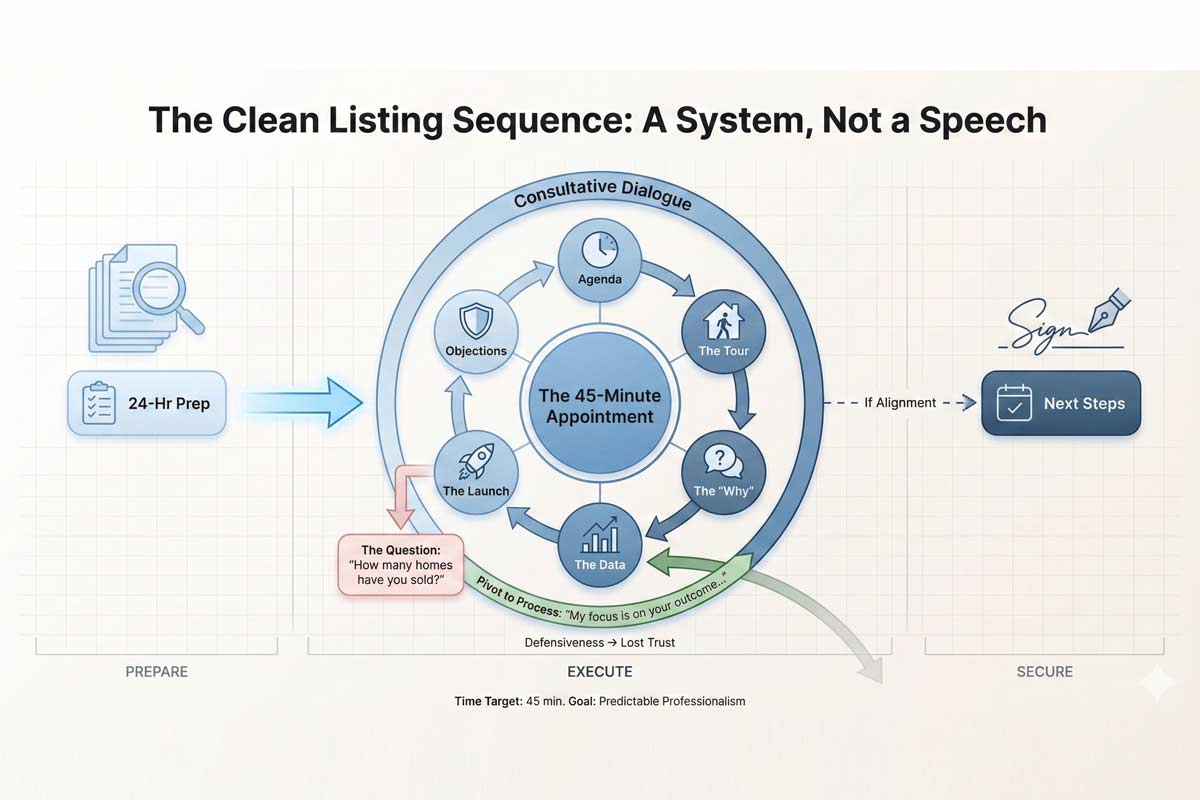
The 7-Step Clean Sequence (One-Page Summary)
Agenda Setting: Confirm the timeline and goal immediately.
The Tour: Walk the property with a consultant’s eye.
The "Why": Deep-dive into seller goals and timeline.
The Data: Review pricing using the three-bucket method.
The Launch: Explain the marketing and feedback loop.
Objection Handling: Resolve concerns using prepared scripts.
The Close: Confirm the decision and set next steps.
Time target: 45 minutes total (10 tour / 25 table / 10 close & next steps).
Pre-Appointment Prep: The 24-Hour Intel Phase
The appointment is won or lost before you ring the doorbell.
The Property Intel Checklist The "Big Three"
CMA: Prepare a Comparative Market Analysis with Actives (competition), Pendings (market direction), and Solds (the reality check).
Title Profile: Check for liens, multiple owners, or solar panel UCC filings.
The "Motivation" Call: 24 hours prior, call to confirm. Ask: "Aside from the price, what is the one thing that must happen for this move to be a success?"
The Minimalist Kit
Sellers can interpret overly flashy materials as in security. Data and a calm process read as competence. Bring an iPad or a neatly organized folder containing:
The CMA
A 1-page "Launch Plan"
The California Residential Listing Agreement (RLA)
A seller net sheet (to show their estimated proceeds at close)
First 5 Minutes: Setting the Frame
You’re the guide. Your job is to run a clean, low-drama decision meeting.
The "Agenda" Script
Warm Seller: "Thanks for having me over. My goal today is to see the home, hear your goals, and show you exactly how we’ll find the right buyer. Does that work for you?"
Skeptical Seller: "I know your time is valuable. I’ve set aside 45 minutes to go over the data and our strategy. At the end, we’ll both know if I’m the right fit to get this sold. Should we start with a quick tour?"
The Walkthrough: Tour Like a Consultant (Not a Compliment Machine)
The biggest mistake new agents make is acting like a guest. You’re there to audit the asset.
Ask, don’t tell: Instead of complimenting the kitchen, ask “When were these appliances last updated?” or “Any HVAC issues during peak summer?”
The “Stay or Go” list: Ask what’s staying vs. leaving (fixtures, appliances, smart devices). This prevents later disputes over chandeliers, Ring cameras, or mounted TVs.
What NOT to do:
Price during the tour: “I have some thoughts, but I want to sit down with the data first so I can give you an accurate range.”
Contractor cosplay: Don’t guess repair costs. Label it a point of inspection and move on.
Insult the house: Stay neutral. “This layout is unique” beats “This room is too small.”
If They Ask How Many Homes You’ve Sold (The Clean Answer)
Handle this moment with zero defensiveness.
The "High-Touch" Pivot
"Fair question. My model is high-touch: fewer clients at a time, tighter communication, and a very structured launch plan. You won’t be competing for my attention."
The "Team-Backed" Angle:
"Great question. I’m your point of contact, and I run the process. And I’m backed by my broker and transaction team on pricing, disclosures, and contract execution—so you get personal attention with professional oversight."
The Table Meeting: 3 Phases of Authority
Phase 1: Motivation Intake
Ask: "If this home doesn't sell for six months, how does that affect your plans?" If you don't know their "Why," you cannot handle their objections later.
Phase 2: Pricing Reality (The Three Buckets)
Show the data. "The market is telling us that homes like yours sell fast... or they start going stale and get negotiated down." We’ll define ‘stale’ using showing volume, online saves, and buyer feedback—not vibes. Understanding negotiation basics for new California agents is critical here—you aren't negotiating against the seller; you are negotiating with the market.
Phase 3: Strategy & Execution
Show them your Launch Plan. This includes professional media, reverse prospecting, and the "Feedback Loop" (your scheduled weekly update).
Objection Handling: Consultative Scripts
If you have practiced how to practice real estate scripts effectively, you will stay calm here.
Objection Handling: The Consultative Response
Objection
Consultative Response
"Another agent said it's worth more."
"Interesting. When they gave you that number, did they anchor it to sold comps, or was it more of a 'marketing price'? I’m not here to win the listing—I’m here to protect your outcome."
"We want to try a higher price."
"If we start too high, we'll miss our best buyers right out of the gate. Then, if we have to lower the price later, we're dealing with buyers who know we couldn't sell it—and that weakens our position."
"Will you cut your commission?"
"I’m happy to talk commission. The real issue is net outcome. My job is to protect your equity and reduce risk. If we cut the steps that produce the result, the price reduction usually costs more than the commission ever would."
"We’re interviewing others."
"I respect that. Professionalism is about finding the right fit. What are you looking for in an agent that we haven't covered yet?"
The Close: Moving to Signature
The Direct Close: "I’m confident we can hit your timeline. Are you ready to get the paperwork started so we can get the photographers out here Monday?"
The "Think About It" Close: "I understand. Usually, when people want to think about it, it’s because I haven't clarified something. Which part of the plan are you still weighing?"
New Agent Mistakes That Kill Listings
Talking Too Much: If you talk more than 30% of the time, you aren't listening.
Ignoring the "Quiet" Owner: The person asking the fewest questions often holds the veto power.
Defending the Price: Never "defend" a price. Let the data do the talking.
No Time Boundary: If you stay for 3 hours, you look desperate.
Tech-Dependency: Always have a paper backup of your presentation.
Over-Promising: Don't promise daily calls if you can't sustain them.
Hiding Your Status: Don't lie about being new; lean on your broker's track record.
Vague Next Steps: Never leave without a clear follow-up date and time.8.. Avoiding these new agent mistakes that hurt credibility is your fastest path to a "Yes."
FAQ: The First Listing Appointment
Q: Should I bring the listing agreement to the first meeting?
A: Bring it every time—even if you don’t pull it out. It signals preparedness and lets you move forward immediately if they are ready.
Q: What if they ask about my experience?
A: Pivot to your process. Experience is just a proxy for "Will you mess this up?" Prove you won't by being the most organized person they meet.
Q: How does this differ from working with buyers?
A: Listings are about asset management; buyers are about search and discovery. You should prepare for a first buyer consultation with the same level of systematic rigor.
Your Professional Foundation
The listing appointment for new agents is a test of your business operating system. You do not need to be the most famous agent in California to win; you just need to be the most prepared.
Read more to see how this fits into our broader California real estate career guide, continue building your library of systems.
Your next step: practice these scripts out loud until they feel natural.
|

Your hand hovers over the dial. The script is pulled up on your screen, but the words feel unnatural and obvious at the same time.
In your head, you already sound like a telemarketer.
You’re terrified Read more...
Your hand hovers over the dial. The script is pulled up on your screen, but the words feel unnatural and obvious at the same time.
In your head, you already sound like a telemarketer.
You’re terrified of blanking mid-sentence or, worse, getting hit with a question that knocks you off your path.
Here is the field-tested truth:
Top-producing agents aren't "naturals."
They’re just prepared.
Whether you are working a buyer lead, a social media inquiry, or a guest at an open house, scripts are your foundation. This isn't about memorization; it's about building the muscle memory required to stop worrying about your next word and start listening to the client’s needs.
The Core Thesis: Scripts aren't lines to memorize. They are reps to build automaticity. You are training your brain to handle the structure of a deal so your mind is free to think and lead.
The 3-Level Progression: From Memorization to Mastery
In my 20+ years coaching California agents, I’ve seen thousands try to "wing it." They fail because they have no floor. Use this ladder to build your skills.
Level 1: Memorize the FRAME (The "GPS" of the Call)
Most agents fail because they try to memorize a script word-for-word. The moment a prospect goes off-script, the agent’s brain reboots.
The Goal: Know the structural milestones of the interaction.
The Drill: Summarize your script into three "anchor" points.
Example Frame (Universal Buyer Lead):
Connection: "I saw you were looking at the Main Street property—what was it about that home that caught your eye?"
Motivation: "Are you looking for something with that specific layout, or just that neighborhood?"
The Ask: "I’m seeing a few others in that pocket with similar features; would you like to see those this weekend?"
Level 2: Drill for Fluency (Diagnostic Reps)
Note: These characters are diagnostic tools to help you find your "natural" baseline; they are not your final delivery voice.
The Goal: Pacing and tonal control.
The Drill: Set a 60-second timer. Say your script 5 times, changing your "character" each rep:
Whispering: Focuses on crisp enunciation.
Over-excited: Highlights where you sound too "salesy."
Calm/Bored: Helps you find a neutral, professional baseline.
Fast-paced (Stress Test): Tests your ability to keep words fluid under pressure.
Final Rep: The "Curiosity" voice—slow, helpful, and inquisitive.
Level 3: Pressure-Test with Chaos
In the real world, people interrupt. They say, "I'm busy," or "Who is this again?"
The Goal: Progressive recovery.
The Drill: Have a partner interrupt you mid-sentence with a random objection. Your goal isn't to be perfect—it's to see how quickly you can get back into the "Frame."
The Target: Aim for a 7-second recovery initially, working your way down to a 3-second pivot back to the conversation.
The ADHI 10-Minute Daily Script Workout
This is your non-negotiable morning habit. Like a pre-flight checklist, it must be done before you touch the phone.
Min 1–2: Warm-Up. Read your script aloud. Just get used to the sound of your own voice in the room.
Min 3–5: Record & Replay. Use a voice memo. Listen for "um", "like", and "you know." Fix one verbal tic per session.
Min 6–8: Objection Reps. Pick one objection and drill the response 5 times using the Level 2 diagnostic characters.
Min 9–10: The Coffee Shop Test. Say the core message as if you were explaining it to a friend. If it sounds like a lecture, simplify the language.
The “Don't Sound Robotic” Fix: The 1-1-1 Method
Robotic agents deliver monologues. Professionals lead dialogues. Use this formula to stay human:
1 Consistent Opening Line: Your anchor. (e.g., "Hi [Name], this is [Your Name] with [Brokerage].")
1 Personalized Sentence: Use a specific observation. "I noticed you were looking at that listing on Main Street—that specific layout is quite rare for this pocket of the city."
1 Clean Question: This shifts the energy. "Is that the specific style of home you're looking for, or are you open to other layouts?"
The Big 5 Objections: Recovery Drills
"We already have an agent."
Response: "That's great. It's so important to have someone you trust in this market."
Pivot: "If anything ever changes, what's the best way for me to stay in touch with you?"
"I'm just looking."
Response: "Of course, most of my best clients started out just browsing."
Pivot: "Are you looking for a 'forever home' or more of an investment opportunity?"
"How did you get my number?"
Response: "I’m an agent with [Brokerage] and I’m following up on your inquiry regarding the property on [Address/Area]."
Pivot: "I apologize if I caught you at a bad time—were you still looking for information on that home, or has your search changed?"
"Will you cut your commission?"
Response: "I understand that the fee is a factor in your net return. I’m curious, is your priority the cost of the service, or the net amount you walk away with at closing?"
Pivot: "Would you be open to seeing how our specific marketing and negotiation services are designed to protect that net return?"
"Send me an email."
Response: "I'd be happy to. I have a lot of data I can send."
Pivot: "To make sure I don't clutter your inbox with things you don't need, which two or three things are most important to you right now?"
The Bridge: From Practice to Production
Fluency equals authority. When you don't fumble for words, you look like a seasoned professional who understands the market.
The "Messy" Middle: To stay calm and lead the conversation when escrow hurdles arise, master the Negotiation Basics for New California Agents.
Securing the Listing: Knowing your frame keeps you in control when you learn How New Agents Should Handle Their First Listing Appointment with confidence.
The Buyer Consultation: Fluency is your best tool for answering tough questions during your How to Prepare for Your First Buyer Consultation.
Building Credibility: You can learn How to Avoid the “New Agent Mistakes” That Hurt Credibility simply by sounding like a peer to the veteran brokers you'll be negotiating against.
The 7-Day Challenge
Commit to the 10-Minute Daily Workout for exactly seven days. Do not skip a morning. By Day 8, the phone won't feel like a 500-pound weight. You are building a system that turns "fear of the phone" into a reliable, professional skill.
If you’re ready to master the skills that separate the top earners from the rest, the next step is building your professional foundation. Our Start Real Estate Career in California guide is where your journey begins—start it with a system designed for success.
FAQ Section
What scripts should I learn first? Focus on the "Lead Follow-up" script. Most agents lose money not because they can't find leads, but because they don't know how to handle the first 60 seconds of a return call.
How do I practice scripts without a partner? Use the "Record & Replay" method. Record yourself on your phone, wait 10 minutes, and listen back as if you were the client. You will immediately hear where you sound "salesy" or unsure.
How long should I practice scripts daily? 10 to 15 minutes of high-intensity practice is better than an hour of casual reading over a script. Quality of focus matters more than the clock.
What is the #1 practice mistake? Practicing in your head. If the words aren't physically coming out of your mouth, you aren't training your vocal cords or your brain for the "live" environment.
|
You’ve passed the real estate exam, your license is issued, and you’ve chosen a broker. Then, Monday morning hits. You sit at your desk, and the "post-license cliff" sets in: your calendar is empty, Read more...
You’ve passed the real estate exam, your license is issued, and you’ve chosen a broker. Then, Monday morning hits. You sit at your desk, and the "post-license cliff" sets in: your calendar is empty, and your phone isn't ringing.
The temptation for most new California agents is to reach for a credit card and buy leads. Every real estate office has that guest speaker pitching a magical "lead-gen tool" for $199 a month.
That is a short-term fix for a long-term problem.
In our industry, your database is your business. It is the only asset you truly own. One clean database can produce repeat clients for 10 years; one lead-buy produces, at best, a one-time conversation.
A database doesn’t magically create deals—it creates conversations, and conversations create appointments.
A "from scratch" database isn't about empty contacts—it's about missing the system for consistent, targeted follow-up.
By the end of this guide, you will have a clear, 30-day roadmap to move from zero contacts to a professional follow-up system that produces consistent commissions.
What a "Database" Actually Means
A database is not just a list of names or an exported CSV file from your phone. A database is a list with memory. It records context (notes) and creates the next action (follow-up date).
What Should You Track in a Real Estate Database?
To turn a contact list into a revenue-generating database, you need specific data points. If you don't know what columns to make in your spreadsheet, copy this exact template:
Full Name
Phone Number & Email
Preferred Contact Method (Text, Call, or Email)
City/Neighborhood (Crucial for California's hyper-local markets)
School District/Commute Corridor (The “why” behind their location)
Relationship Status (How do you know them?)
Source (Sphere, Open House, Referral, Social, Vendor)
Tags/Categories (A/B/C ranking, Buyer, Seller)
Last Contact Date
Next Follow-Up Date
Notes (Kids’ names, pets, hobbies, real estate goals)
Your First Database Rule: One Contact = One Next Action
If someone is worth saving, they’re worth scheduling. Every new entry in your system must have either:
A next follow-up date, OR
A "Do Not Contact" note.
There is no third option. Why: if it isn’t scheduled, it won’t happen.
Choose Your Tool (Without Overcomplicating)
Do not get stuck "tool shopping." You can lose weeks comparing software features while making zero phone calls.
Choose a system based on your current volume:
Google Sheets (0–100 Contacts): The fastest way to start. Google Sheets is free, searchable, and forces you to learn the mechanics of data entry.
Basic/Free CRM (100–300 Contacts): Many brokerages provide a CRM included when you join (like BoldTrail (formerly KV Core) or Chime). Use what you already have before paying for a third-party tool.
Full CRM (300+ Contacts): Only invest in premium platforms once you have a consistent lead flow and need advanced automation.
The Rule: If you have under 100 contacts, start with a spreadsheet. If you spend more than two days "researching" CRMs, you are procrastinating. Pick one and execute.
The 8 Best Places to Get Your First 100 Contacts
You aren't starting from zero; you’re starting from "unorganized." Here is where to find your first 100 entries:
Phone Contacts: Export your contact list. Don’t “clean first.” Import them, then add 25 per day for four days. Momentum beats perfection.
Past Coworkers: Start with 10 you’d confidently ask for advice. You were a professional before you were an agent; these people already trust your work ethic.
The Gym/School/Hobby Circle: Anyone you see at least once a month belongs in the database.
Vendors: Your lender, escrow officer, and local contractors. Tag these as “Vendors” to build a referral exchange.
Open House Sign-ins: This is your primary engine. Rule: If they sign in, they go into your database before you leave the property—while the conversation is still fresh enough to write real notes. Learn how new agents should hold open houses to maximize this capture.
Social DMs: Look at who “likes” your posts. Message them: “Hey [Name], I’m updating my professional directory—what’s the best email to send my local market reports to?”
Community Groups: Local neighborhood associations or Facebook groups (be the helper, not the solicitor).
Out-of-Area Agents: Tag them as “Referral Partners.” A small group of active agents outside your zip code can become your most consistent referral pipeline.
Clean Data Beats Big Data (Hygiene)
Before you chase "more contacts," fix the basics. A messy database is a useless database.
Standardize Names: "Mike Smith," not "Mike S." or "Dad's Friend."
One Primary Contact: Identify one main phone number and email per person.
Merge Duplicates: Do not have three entries for the same person.
Add "Source": Always know where a lead came from so you can track ROI later.
Fix Bouncebacks: If an email bounces or a number is wrong, update it the same day.
The "DNC" Tag: Create a "Do Not Contact" tag so you don’t burn relationships by calling people who asked you to stop.
Tagging & Segmentation: The Power of "A-B-C"
If you treat everyone in your database the same, you will burn out. You must segment your contacts so you know who to call first.
The Starter Tag Framework
Tag Category
Examples
Purpose
Ranking
A (Referral source), B (Met once), C (Cold)
Prioritizes your daily call list.
Timeline
Hot (0–3 mo), Warm (3–12 mo), Long-term
Focuses your energy on immediate deals.
Type
Buyer, Seller, Investor, Vendor, Referral Partner
Determines what kind of content you send.
Source
Open House, Sphere, Referral
Tracks which lead sources for new California agents are working.
The Follow-Up Operating System
Building the list is only 20% of the work. The remaining 80% is the follow-up. Successful agents use new agent time management strategies to ensure they aren't just "busy," but productive.
Follow-Up Cadence
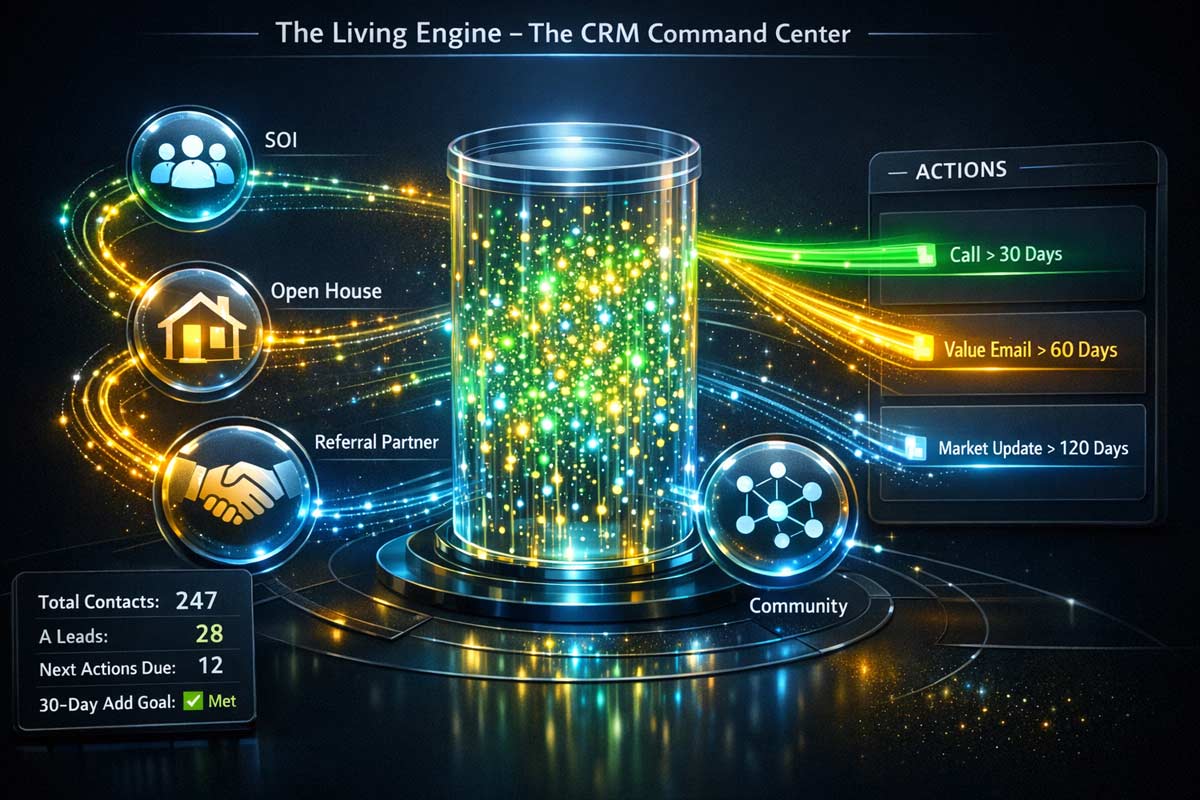
"A" Leads (Referral Sources): Contact every 30 days.
"B" Leads (Met Once/Acquaintances): Contact every 60–90 days.
"C" Leads (Cold/Distant): Contact every 120–180 days (about twice a year) with broad value.
Value-Based Scripts
The "Permission" Text (Low Pressure, High Reply):
"Hey [Name]—quick question. Would it be helpful if I kept you posted when something notable happens in [Neighborhood] (sales, price changes, anything meaningful)? If yes, what’s the best email for you?"
The "Market Micro-Update" (Email/Text):
"Hey [Name], I saw that a house just like yours around the corner sold for [Price]. It's interesting to see how [City] is holding up right now. Let me know if you’d ever like a quick look at your current home value!"
The "Direct Ask" (Voice):
"I'm taking on a couple more clients this month. Who do you know that’s mentioned moving, upsizing, downsizing, or investing—even if it’s ‘later this year’?"
30-Day Build Plan
Follow this checklist to go from a blank screen to a functioning business engine.
The 30-Day Database Blueprint
Week 1: The Foundation. Create your spreadsheet using the template fields above. Import phone contacts. Apply "A, B, C" rankings to the first 50 people.
Week 2: The Reach Out. Add 25 more names. Send the "Permission" text script to everyone tagged "A" or "B."
Week 3: The Expansion. Log all responses. Call those who replied. Research how to find your first 3 clients as a new agent to convert these conversations into appointments.
Week 4: The Routine. Establish a "Minimum Daily Action": Add 5 new people, contact 5 existing people, and log 5 sets of notes.
Common Mistakes That Kill Databases
Over the last 20+ years, Kartik Subramaniam has seen thousands of students launch their careers.
The ones who fail usually hit these eight pitfalls:
Waiting until you "feel ready" to start calling.
Saving contacts with no notes (you will forget who they are).
Failing to use tags, leading to a "messy" list you eventually ignore.
No "Next Follow-Up" date— if it isn't scheduled, it won't happen.
Relying on "Likes"— social media engagement is not a database relationship.
Buying leads before you’ve exhausted your free sphere of influence.
Sounding like a salesperson instead of a local guide.
Ignoring Open Houses as a primary way to feed the database engine.
Kartik's Insider Tip: “I’ve seen agents turn a 'maybe next year' lead into a $30,000 commission simply because they had a 'follow up in 6 months' tag and actually made the call. Most agents quit after one 'no.' The database ensures you are there when the 'no' turns into a 'now.'”
Start Your Career the Right Way
A database is the difference between a "job" and a "business." Without it, you are unemployed every time a transaction closes. With it, you have a predictable stream of referrals and repeat clients.
If you are ready to move beyond the basics, it is time to look at the bigger picture of your professional development. If you’re building your first-year foundation in California, that’s the full roadmap.
Start a Real Estate Career in California →
FAQ
1. How many contacts should a new agent have?
Aim for 100 "met" contacts as quickly as possible. This is the baseline required to generate consistent referral traffic. Once you hit 100, aim for 250.
2. Do I need an expensive CRM to start in California?
No. A simple Google Sheet is often more effective for your first 100 contacts because it forces you to stay organized without the distraction of complex features.
3. What is a "Sphere of Influence" in real estate?
Your sphere of influence (SOI) consists of everyone you know personally who already likes and trusts you—friends, family, past coworkers, and neighbors. These are your warmest leads.
4. How often should I contact my database?
Contact "A" leads (referrals) every 30 days, "B" leads every 60–90 days, and "C" leads every 120–180 days (about twice a year).
5. What is the best way to ask for a referral?
Be direct but value-focused. Ask who they know that needs help navigating the current California market, rather than just asking for a name.
|

You’ve passed the real estate exam, your license is hanging at a brokerage, and the initial celebration has subsided. Now, you’re staring at a blank calendar and a quiet phone. It’s what I call the Read more...
You’ve passed the real estate exam, your license is hanging at a brokerage, and the initial celebration has subsided. Now, you’re staring at a blank calendar and a quiet phone. It’s what I call the “post-license cliff”. This moment is particularly acute in California, where high competition meets complex markets, and the pressure to “figure it out fast” can lead new agents toward expensive, ineffective shortcuts.
If you’re a new real estate agent in California wondering how to get your first clients without buying leads, this article is your playbook. Securing your first three clients isn't just about income—it’s about proof of concept. In my 20+ years of working in the California real estate market, I’ve noticed the agents who survive the first year are those who replace "hustle" with systems and processes.
What Success Looks Like in 30 Days
Before we dive in, let’s define a "win." Success in your first month isn't measured by closed escrows—it’s measured by inputs. These inputs work because they maximize trust-building touches, not impressions. If you follow this operating system, your 30-day scoreboard should look like this:
100+ Real Conversations (5 per business day)
40+ Contacts added to your database
4 Open Houses hosted
1–2 Buyer Consultations booked
Practice Over Profit: The First 3 Principle
This is the phase where most new real estate agents in California either build momentum—or quietly stall. Your first three clients are your learning labs. You are building the muscle memory of a professional. Success here comes from
Practice + Proximity + Follow-up
not expensive marketing.
Before You Prospect: Two Things You Must Set Up This Week
Before you pick up the phone, you need a professional foundation. California’s disclosure-heavy environment means your first clients are as much about the learning process as closing deals.
Broker Expectations: Sit down with your broker or team lead. Ask for (a) upcoming open house opportunities, (b) "floor time" for walk-ins (if this is still a thing in your area), and (c) their preferred CRM.
Compliance Guardrails: This is California—disclosures matter. Don’t wing it. Don't promise specific financial outcomes, keep all communications professional, and stay within your brokerage’s legal policies.
Pathway 1: The "Inner Circle" Strategy (The Database)
The Reality: Your first client is almost always someone you already know, or someone they know. People do business with people they trust.
The Action Plan: Stop "announcing" your career and start consulting. Use these micro-scripts to offer value:
The Call: "I’ve officially launched my real estate practice. I’m not calling for business—I just want to be your resource. If you ever need a quick valuation or want to know what’s moving in the neighborhood, I'm here."
The Text: "Hey! Just wrapped up my licensing. If you ever have a random real estate question or need a vendor recommendation, feel free to reach out!"
Micro-Credibility Boost:
Avoid: “I just got licensed and I’m looking for clients.”
Use: “I’m building my practice and want you to have a real resource.”
The 14-Day Follow-Up Cadence:
Day 0: Initial outreach (Call/Text).
Day 7: Value Touch (Send a quick, one-page market snapshot of their specific zip code).
Day 14: The Soft Ask: "I’m helping a few people find homes this month. Do you know anyone else thinking about a move this year?"
The Deeper Resource:
A "system" is simply: Name + Source + Last Contact + Next Action. In week one, a spreadsheet is fine. To move toward a sustainable pipeline, you need to build a real estate database from scratch.
Pathway 2: The Open House Capture & Conversion
The Reality: Open houses are one of the few places consumers actually expect to talk to an agent. It is a high leverage use of your time.
The Action Plan (The 3-Step Flow):
The Welcome: "Welcome! Are you from the neighborhood or just starting your search?"
The Qualification: "Have you seen anything else in this price point, or are you still getting a feel for the local inventory?"
The Close for the Next Step: "I have a list of three similar homes nearby that aren't on everyone's radar yet. Would you like me to send those over?"
A productive open house for a new agent isn’t measured by attendance—it’s measured by 2–3 follow-up conversations scheduled within 48 hours.
The Deeper Resource:
To turn a handshake into a contract, you need a specific follow-up method. Learn the full process in our guide: How New Agents Should Hold Open Houses in California.
Pathway 3: Leverage Office Inventory & Stale Leads
The Reality: While most agents chase "perfect" leads, you can find your first three clients by looking where others don't.
High-volume agents often ignore these opportunities because they require follow-up instead of marketing scale.
The Action Plan:
Support High-Volume Listings: Call top listing agents in your office. Offer to host their "stale" listings or prospect the surrounding neighborhood for them.
Renters-to-Buyers: Many people attending open houses are currently renting. Position yourself as the guide who helps them transition.
The Guardrails: Always follow "Do Not Call" rules and brokerage policy. Your job is service, not pressure. Once you've mastered these manual methods, you can explore broader lead sources for new California agents to scale.
The Two Moments That Start Real Careers
Moment #1: Someone trusts you enough to ask a "small" question (e.g., "What's my neighbor's house listed for?").
Moment #2: You followed up when the "rockstar" agent in your office forgot to.
Neither moment looks dramatic—but both are how real careers actually start.
Practical Pitfalls
Most new agents quit because they confuse activity with income-producing actions. This is how agents stay ‘busy’ for six months and exit the industry silently.
The below activities do NOT count as prospecting:
Perfecting your logo or business cards.
Scrolling Instagram for "content ideas."
Endlessly "tinkering" with CRM tags.
Watching "motivational" YouTube videos.
Re-designing your email signature.
The only 3 activities that count:
Real conversations
Intentional follow-up
Studying local inventory.
Managing this focus is the difference between a hobby and a career. Implement these New Agent Time Management Strategies to stay on track.
Your 30-Day Plan (Simple Version)
Week
Primary Focus
Daily Minimum
Week 1
Database Outreach + 1 Open House
5 Conversations
Week 2
Follow-ups + 1 Open House
5 Conversations
Week 3
Repeat + Book 1 Buyer Consult
5 Conversations
Week 4
Tighten Pipeline + Ask for Referrals
5 Conversations
Note: Five conversations means real two-way dialogue—not texts sent or DMs unanswered.
The Path Forward
Finding your first three clients is the hardest part of this business because it requires the most faith. But once you close that third deal, the "imposter syndrome" fades.
Mastering these first three clients is how you build a durable practice, not just a fleeting side hustle. For the complete framework on launching correctly—from mindset to long-term planning—your next step is our foundational guide: Start Your Real Estate Career in California.
|

You’ve passed the real estate exam, joined a brokerage, and ordered your business cards. Now comes the most pressing question every new California agent faces:
"Where do I get my first lead?"
The Read more...
You’ve passed the real estate exam, joined a brokerage, and ordered your business cards. Now comes the most pressing question every new California agent faces:
"Where do I get my first lead?"
The industry is flooded with marketing noise and subscription platforms promising instant closings. But after 20 years in the California real estate business, I’ve seen thousands of agents burn through their savings chasing the wrong leads. The truth is that lead sources are far less important than your lead-to-relationship conversion and your consistency.
A lead isn't a commission check; it’s an introduction. California markets are fragmented—what works in Riverside won't always work in West LA. To start a real estate career in California that actually lasts, you need a system, not just a tactic.
Key Takeaways
Trust over Tech: Your Sphere of Influence (SOI) remains the highest-converting lead source.
Sweat Equity: Open houses are the fastest way to meet "now" buyers without an upfront budget.
Speed Wins: The agent who follows up same-day—often within minutes—usually wins the client. This is often called “speed-to-lead”.
Local Authority: Consistency in a small "micro-farm" beats sporadic efforts across a whole city.
Best Lead Sources by Situation
Fastest results: Open houses + tight follow-up
No budget: SOI + community networking
If you hate cold outreach: Database + partner referrals
Long-term dominance: Micro-farm + simple local content
Commercial-lite path: Small lease deals + local owner conversations
Ranked: The Best Lead Sources for New Agents
Note: "Skill Level" refers to your conversion and communication skill, not your personality type.
Lead Source
Cost
Time-to-Result
Skill Level
Best For...
Sphere of Influence (SOI)
Free
Days/Weeks
Low
Immediate trust & referrals
Open Houses
Free/Low
Days/Weeks
Medium
Meeting unrepresented buyers fast
Open House Follow-Up
Free
Days/Weeks
Medium
Turning “tourists” into clients
Database + CRM Follow-Up
Free/Low
Weeks
Medium
Staying top-of-mind consistently
Local Partner Referrals
Low
Weeks/Months
Medium
Warm intros from lenders/escrow
Agent-to-Agent Referrals
Low
Weeks/Months
Medium
Relocation + overflow clients
Community Networking
Low
Weeks/Months
Medium
Trust-building (schools, chambers)
Micro-Farming (100–300 homes)
Medium
Months
High
Long-term local dominance
Rentals / Landlords
Low
Weeks/Months
Medium
Leads that become buyers later
FSBO / Expireds
Low
Weeks
High
High-volume conversations
Online Inbound Basics
Low/Medium
Months
Medium
Compounding flow (reviews)
Paid Leads (Optional)
High
Days/Weeks
High
Agents with a break-even mindset
The Core Strategy: Where to Start
1. Your Sphere of Influence (SOI)
Your SOI includes friends, family, and past coworkers. These are people who already want you to succeed.
Why it works: Trust is pre-built. You aren't "selling"; you're informing.
Scenario: Instead of a sales pitch, try: "I'm not calling to sell you anything—I just wanted to let you know I'm officially with [Brokerage]. If you ever have a quick question about what's happening in our neighborhood, I'm happy to be your resource."
Do this this week: Call 5 people a day. Update their contact info in your CRM.
2. Open Houses as a Lead Engine
Don't just "sit" in a house. Use it as a platform. Learning how new agents should hold open houses effectively can transform a boring Saturday into three new buyer representation agreements.
Why it works: You meet active buyers in a specific zip code.
Scenario: When a visitor walks in: "Thanks for coming by. Most people I meet here are either neighbors or looking to move in the next 90 days—which one are you?"
Do this this week: Ask a top producer in your office to host their listing open this weekend.
3. Building Your Database
Every person you meet belongs in a CRM. You must build a real estate database from scratch to automate your "top of mind" awareness.
A Simple Follow-Up Cadence
Day 0: Quick text + “What stood out to you at the house?”
Day 1: Phone call (short, human).
Day 3: Value add (neighborhood note or listing link).
Day 7: Call + clarify timeline.
Month 2+: Monthly market update + personal check-in.
Expanding Your Reach
Local Partner & Agent Referrals
Lenders, escrow officers, and out-of-area agents are massive referral sources.
Why it works: These are professional, warm introductions.
#1 Rookie Mistake: Asking for leads before offering any value.
Do this this week: Invite a local lender to coffee to learn about their specific programs.
Community Networking & Micro-Farming
Become the "Digital Mayor" of a small area. Focus on 100–300 homes (a micro-farm) or your local PTA/Chamber.
Why it works: It builds "omnipresence" in a small, manageable pond.
Do this this week: Draft a simple, one-page market update for your specific neighborhood.
Online Inbound & Rentals
Claim your Google Business Profile and gather reviews immediately. Additionally, don't ignore renters; in California, today’s tenant is often next year’s first-time buyer.
FSBO / Expireds
Why it works: These are people with high "intent to sell."
Compliance Reminder: Strictly follow the National Do Not Call (DNC) Registry, respect all opt-outs, and follow your brokerage’s specific outreach policies.
What to Avoid: The "New Agent Traps"
Paid Leads: The "High Tuition" Trap
Paid leads aren't evil—they're just expensive if you aren't ready. If you can't respond in under 5 minutes and don't have a conversion system, paid leads are just a donation to a tech company.
Small Commercial (The "Lite" Path)
You don’t need to be a commercial specialist on day one. Start commercial-lite: small retail/office leases and local owner conversations. Partner with a senior agent when complexity rises. Done right, it builds a professional reputation that feeds your residential business.
The 30-Day Lead Generation Operating System
Success requires strict new agent time management strategies.
Week 1: Set up CRM. Call everyone in your phone. Schedule two open houses.
Week 2: Execute follow-up cadence (Day 0–7). Meet one local partner.
Week 3: Start your 100-home micro-farm. Drop off a market report.
Week 4: Evaluate metrics. How many conversations did you actually have?
Weekly Scorecard
Contacts added to CRM: ________
Real estate conversations: ________
Speed-to-lead (Avg minutes): ________
Follow-up attempts: ________
Appointments set: ________
FAQ
What is the best lead source for new California real estate agents?
Your sphere of influence (SOI) is the highest-converting starting point because trust is built-in. Pair it with open houses for faster “now buyer” conversations.
Are open houses a good way to get clients in California?
Yes—they are one of the fastest ways to meet unrepresented buyers. The key is capturing contact info and running a same-day follow-up plan.
How quickly should I follow up with a new lead?
Same day—ideally within minutes. In California’s fast-paced market, the first agent to provide value and set the next step usually wins the client.
Can I get real estate leads for free?
Yes. SOI outreach, open houses, and partner relationships produce leads with $0 in ad spend; your main cost is time and consistency.
How many follow-ups does it take to convert a lead?
Many leads convert after 5–12 touches over weeks or months. Most new agents fail by stopping after the second attempt.
Are paid leads worth it?
Only if you have a proven conversion system and understand break-even math. Without these, they are "expensive tuition."
Is cold calling illegal in California?
It is not automatically illegal, but it is heavily regulated. You must follow the National DNC Registry, honor opt-outs, and follow brokerage policy.
Should I focus on buyers or sellers first?
Buyers are often easier to find early through open houses. Sellers usually require the trust and proof you build through consistent activity.
Can new agents get commercial leads?
Yes, via "commercial-lite" paths like small leases. Keep expectations realistic and how to find your first 3 clients as a new agent often involves starting with these accessible opportunities.
Build Your Career Foundation
Lead generation is the heartbeat of your business, but it only works if you have the competence to back it up. Focus on building a career system rather than chasing the tactic of the month. Remain consistent, lead with value, and treat every contact like a long-term relationship.
|

Your Blueprint for Referrals and Repeat Business
The moment you receive your real estate license marks the beginning, not the end, of your professional journey. While our real estate school teaches Read more...
Your Blueprint for Referrals and Repeat Business
The moment you receive your real estate license marks the beginning, not the end, of your professional journey. While our real estate school teaches you the fundamentals of property law and transaction mechanics, the true art of building a career centered on client retention lies in what happens after the closing.
In today's competitive market, the most successful agents understand a fundamental truth: relationships are a form of currency. The cost of acquiring a new client can be five to seven times higher than nurturing an existing one. Yet many agents, caught in the endless cycle of chasing new leads, overlook the goldmine sitting in their past client database. This shift from transactional thinking to cultivating luxury client relationships isn't just good karma—it's innovative business that generates consistent real estate referrals, repeat transactions, and a personal brand that stands the test of time.
For newer agents fresh out of real estate school, developing this client-centric mindset early establishes the foundation for long-term success. Seasoned brokers will find advanced strategies here to deepen existing relationships, particularly within luxury markets where discretion and personalization are paramount.
Mastering Client Engagement: Tech-Powered, Human-Centric
Forget the old days of just holiday cards. Today's top agents blend cutting-edge tech with authentic human connection to create systematic, personalized client touchpoints that scale.
Develop a tiered communication rhythm. In the first 30 days post-closing, check in weekly. These aren't sales calls; they're genuine inquiries about their move, new home, or local recommendations. As time goes on, these touchpoints become less frequent but more valuable, shifting from problem-solving to relationship-building.
Modern CRM systems like Follow Up Boss, Chime, or HubSpot, supercharge this process. They use AI to analyze client behavior, predict needs, and suggest optimal contact times. These platforms segment your database by transaction type, property value, communication preferences, and even life events. Imagine your CRM alerting you that a past client's child is nearing college age—perfect for discussing downsizing or investment properties. Tech handles the remembering and organizing, freeing you to focus on the human connection.
The real magic is when high-tech efficiency meets high-touch authenticity. Your CRM prompts the outreach, but the message should feel like it's from a friend.
Send a handwritten note within 48 hours of closing—it speaks volumes in our digital world. Mark home purchase anniversaries not with a generic email, but with a personalized video message showing their home's appreciation.
Creating Value Beyond the Transaction
Your digital presence should position you as a trusted advisor and community connector, not just another agent flooding social media with listing photos. Think about what your past clients need and want to know. They're not shopping for homes anymore—they're living in them. They're wondering when to refinance, how to maximize their home's value, which local contractor won't overcharge them, and where to find the best pizza in their new neighborhood.
This is where your content strategy becomes crucial:
Social Media Excellence: Share seasonal home maintenance tips that save them from costly repairs. Spotlight the local coffee shop owner who remembers everyone's order, or the family-run hardware store that still offers personalized service. Celebrate community events and milestones. When you position yourself as a curator of local knowledge and lifestyle enhancement, you remain valuable long after the sold sign comes down.
Newsletter Mastery: Your monthly newsletter shouldn't read like a market report designed for economists. Instead, translate those statistics into stories your clients care about. Rather than simply stating that home values increased 8%, explain what this means for their family's wealth-building journey. Include practical guides like "Five Weekend Projects That Add $10,000 to Your Home Value" or "The Hidden Gems of [Neighborhood Name] Only Locals Know About."
Website as Resource Hub: Transform your website from a listing showcase into a comprehensive resource center. Create downloadable seasonal maintenance guides, maintain a vetted vendor directory, and publish neighborhood insights that keep past clients returning for valuable information.
The Art of Memorable Client Appreciation
Moving beyond generic closing gifts requires understanding what creates lasting impressions. That standard gift basket gets regifted or forgotten, but the client who loves cooking will remember the private chef who prepared a gourmet meal in their new kitchen. The wine enthusiast will talk for years about the sommelier-led tasting you arranged at their housewarming. The family with young children will be touched by the custom treehouse plans you commissioned for their backyard oak.
These thoughtful gestures extend beyond closing day. When you learn through your ongoing conversations that a client received a promotion, send congratulations. When their child graduates, take a moment to acknowledge the milestone. When they mention training for their first marathon, surprise them with a gift certificate to the local running store. These moments of recognition build emotional equity that no competitor can match.
Creating exclusive experiences amplifies this effect exponentially. Your annual client appreciation event shouldn't feel like a networking mixer—it should feel like a reunion of friends. Some agents host summer barbecues in local parks where clients' kids play together while adults swap renovation stories. Others organize holiday cookie decorating parties that become cherished traditions.
For luxury clientele, discretion is paramount. Ensure your outreach respects their privacy, providing value without intrusion. The bar for experiences rises accordingly: private art gallery tours with the curator, sunset yacht cruises, or exclusive wine harvest experiences at boutique vineyards. The key to these events isn't their extravagance—it's their authenticity combined with impeccable attention to privacy preferences.
Building Your Referral Engine
The most successful agents never have to ask for referrals—they create experiences so remarkable that clients naturally want to share them. However, there's an art to facilitating this process without appearing pushy or transactional.
The best moments for referral conversations arise organically during your regular touchpoints. When a client expresses gratitude for your help resolving a post-sale issue, that's your cue. When they mention at your summer barbecue that their coworker is house-hunting, that's your opportunity.
Here's a simple script that works: "Thank you so much for your trust in working with me. If anyone you care about mentions real estate—whether buying, selling, or just curious about the market—I'd be honored if you'd pass along my contact information. I'm never too busy for your referrals."
Make referring effortless by providing these tools:
Digital business cards they can text instantly
Pre-written introduction emails like: "I wanted to connect you with [Your Name], who helped us find our dream home. They made the entire process smooth and stress-free, and I think you'd appreciate their approach."
Social media templates for sharing experiences
QR codes linking to your testimonial page
When legal and ethical, some agents enhance referral relationships through thoughtful incentives that strengthen bonds rather than create obligations. Consider donating to a client's favorite charity in their name as a reward for successful referrals or as a way to provide exclusive experiences, such as tickets to local cultural events. The key is to ensure that any incentive feels like a natural extension of your relationship, not a transaction.
Becoming the Indispensable Advisor
The transformation from a transaction-focused agent to a trusted advisor occurs when you expand your value proposition beyond buying and selling. Offer annual home equity reviews that help clients understand their growing wealth. Provide market updates contextualized to their investment strategies. Connect them with resources for renovations, refinancing, or navigating real estate implications of significant life changes.
Sarah, a luxury agent specializing in equestrian properties, exemplifies this approach perfectly. When clients close on horse properties, she doesn't just hand over keys—she delivers custom stable signs featuring their property name and includes a year's membership to the local riding club. Her monthly "Saddle Up" newsletter has become a must-read in the equestrian community, featuring regional event calendars, seasonal property maintenance tips tailored to horse facilities, and spotlights on trusted veterinarians and trainers.
But Sarah's genius lies in her "Equestrian Services Directory"—a carefully vetted list of providers from farriers to fence contractors, all offering preferred rates to her clients. She introduces each client to relevant providers, hosts quarterly "Boots & Bourbon" networking events at a local ranch, and has positioned herself as the hub of the luxury equestrian real estate community.
The result?
Sixty percent of her business comes from referrals and repeat clients; she commands premium commissions, and she has built a list of potential clients who seek her out specifically.
Measuring What Matters
Success in relationship-based real estate isn't measured solely in transaction volume. Here's how to track what truly matters:
Referral Rate: Aim for 20-30% of new business from past client referrals. Track this through your CRM by tagging lead sources and running quarterly reports to monitor progress.
Client Lifetime Value (CLV): Calculate total revenue per client relationship using this formula: Initial transaction commission + repeat transaction commissions + referral-generated commissions. Most CRMs can automatically generate these reports.
Repeat Business Rate: Monitor the percentage of clients who complete multiple transactions with you. Set up annual reviews in your CRM to track this metric over time.
Engagement Metrics: Use email marketing platforms to track open rates (target 25%+), click-through rates, and event RSVPs. Tools like Mailchimp or Constant Contact can provide detailed analytics.
Net Promoter Score (NPS): Send quarterly surveys using tools like SurveyMonkey or Google Forms, asking: "On a scale of 1-10, how likely are you to recommend me to a friend?" Scores of 9-10 indicate strong advocates.
These metrics tell a story far more valuable than monthly sales figures. They indicate whether you're building a sustainable practice or just churning through transactions.
Your Path Forward
Your real estate license opens doors, but your relationships determine how far you'll walk through them. In an industry where lots of agents fail within five years, those who thrive understand that each closed transaction isn't an ending—it's the beginning of a potentially lifelong professional relationship.
The lessons from our real estate school lay the foundation, but applying these relationship strategies truly builds the skyscraper of your career. This approach requires a fundamental mindset shift. Instead of viewing your database as a list of past clients, see them as your professional community. Instead of measuring success by the number of new leads generated, measure it by the relationships deepened. Instead of chasing the next transaction, invest in creating such remarkable experiences that transactions naturally follow.
The choice is yours: continue the exhausting chase for cold leads, or invest in the warm relationships already in your sphere. Your future success in real estate isn't determined by how many people you meet—it's defined by how many relationships you nurture.
Take a moment today to revisit your past client list. Identify five clients to reconnect with this week—perhaps send a handwritten note, share a relevant market update, or check in on how they're enjoying their home. Your future business depends on these small but significant actions.
Love,
Kartik
|

From Classroom to Closing – ADHI Schools’ Playbook for New Agents Who Want to Win Early
Nearly every rookie in real estate believes success comes down to “working hard.” Yet industry numbers Read more...
From Classroom to Closing – ADHI Schools’ Playbook for New Agents Who Want to Win Early
Nearly every rookie in real estate believes success comes down to “working hard.” Yet industry numbers show that only a small portion of real estate licensees ever break into the top-earner tier. What’s the real difference? Top producers follow a systematic, six-pillar framework that blends discipline, strategy, and emotional intelligence. Below is that framework, rewritten for brand-new licensees and current ADHI Schools students so that you can plug it into your business on Day 1.
td {
padding: 20px;
font-weight: 500;
border: 1px solid gray !important;
border-style: dashed !important;
}
th {
padding: 20px;
text-align: center !important;
border: 1px solid gray !important;
border-style: dashed !important;
}
table {
border-collapse: collapse;
border: 1px solid gray !important;
border-style: dashed !important;
border-collapse: collapse !important;
}
@media (max-width: 428px) {
.table-wrapper{
max-width: 100%;
overflow: scroll;
}
}
1. Prospecting Power Hour
|

Generating real estate leads can feel overwhelming, but did you know that you can generate business without solely relying on online ads. By focusing on real estate networking and building your referral Read more...
Generating real estate leads can feel overwhelming, but did you know that you can generate business without solely relying on online ads. By focusing on real estate networking and building your referral program, you can strengthen your real estate business through genuine connections. In-person meetings, community involvement, and strong relationships with centers of influence are crucial in generating real estate leads and creating a steady flow of clients. These personal connections will help you become a local expert on home values and market trends.
Mastering Real Estate Networking at Events
Attending local industry events, community fairs, and neighborhood gatherings is a proven way to attract real estate clients. The effectiveness of face-to-face interactions at these events allows you to build trust, stand out among other real estate agents, and ultimately generate leads that can turn into profitable referrals.
Prepare a Strong Elevator Pitch
Keep It Short: In 30 seconds, explain who you are, what you do, and who you help.
Highlight Your Specialty: If you’re a buyer’s agent specializing in first-time homebuyers or a seller’s agent focusing on property listings, mention it.
Example: “Hi, I’m Jane Smith, a local real estate agent helping first-time homebuyers navigate the market and find their dream homes.”
Make Meaningful Connections
Ask Questions: Inquire about their needs, such as buying a first home or exploring market trends in the area.
Listen Carefully: Show genuine interest, and offer a helpful tip about local home values or popular neighborhoods.
Quality Over Quantity: Focus on a few strong contacts rather than simply handing out dozens of business cards.
Follow Up Promptly
Send a Friendly Note: A short email or social media message referencing what you discussed.
Offer Value: Share a helpful article on local property listings or a guide to understanding market trends.
Build Trust Over Time: Consistent follow-ups turn a casual chat into a reliable referral source.
Building Relationships With Centers of Influence (COIs)
Centers of influence—like mortgage brokers, attorneys, and financial advisors—can guide their clients to you, helping you generate real estate leads with less effort. By forming strong connections with these trusted professionals, you gain access to their client base and raise your profile as a go-to real estate agent.
Tips for Working With COIs
Offer Value First: Refer a client needing a home loan to a dependable mortgage broker.
Frequent Contact: Set up monthly coffee meetings or send regular updates on home values, property listings, and local market trends.
Provide Useful Resources: Share guides on buying or selling homes, and keep them updated on zoning changes or community developments that influence real estate marketing.
Over time, your centers of influence will recognize you as a trustworthy partner who can handle their clients’ real estate needs.
Building a Strong Real Estate Referral Network
Cultivating a strong referral network is essential for sustained growth in the real estate business. It's about building genuine relationships and providing exceptional service that naturally encourages clients, friends, and family to recommend you. A well-structured system for nurturing these relationships can become a cornerstone of your marketing strategy, consistently generating valuable real estate leads.
Strategies for Encouraging Referrals:
Exceptional Client Service: The most powerful driver of referrals is providing outstanding service that exceeds client expectations. When clients are truly satisfied with their experience, they are naturally more inclined to recommend you to others. Focus on clear communication, proactive problem-solving, and going the extra mile.
Stay Top-of-Mind: Regularly connect with past clients through various touchpoints:
Personalized Check-ins: Send personalized emails, phone calls, or handwritten notes on anniversaries, birthdays, or other relevant occasions.
Valuable Content: Share helpful content such as market updates, home maintenance tips, or local community guides. This keeps you top-of-mind and positions you as a trusted resource.
Social Media Engagement: Engage with past clients on social media by liking, commenting, and sharing their posts. This helps maintain a connection without being overly intrusive.
Client Appreciation Events: Host client appreciation events, such as holiday gatherings, open house previews, or community events. These events provide opportunities to connect with past clients in a relaxed setting and strengthen relationships. These events must be free to attend and not contingent on referrals.
Request Feedback and Testimonials: Actively solicit feedback from clients after a transaction. Positive feedback can be used as testimonials on your website and marketing materials, further building your credibility and attracting new clients. This can also open the door for a conversation about referrals.
Express Gratitude: Always express sincere gratitude to anyone who refers you, whether with a handwritten thank-you note, a small gift (of nominal value and not contingent on a closed transaction), or simply a heartfelt verbal acknowledgment.
Increasing Visibility Through Community Involvement
Being active in the community shows you care and helps you generate real estate leads through trust and visibility. By volunteering, sponsoring local teams, or joining community groups, you meet people who value personal connections.
Community Involvement Ideas
Sponsor a Local Sports Team: Get your name on jerseys and connect with families who may need a buyer’s agent or seller’s agent.
Volunteer at a Local Charity: Build relationships with local leaders, who often become key centers of influence.
Host a Neighborhood Workshop: Teach residents about market trends, home values, and smart buying or selling strategies.
Example: One agent volunteered at a local food drive. While sorting donations, they met a range of people—small business owners, teachers, and young professionals—several of whom later approached the agent for help with property listings and to understand the current market trends.
Staying Connected With Past Clients
Past clients are a treasure trove of real estate referrals. By keeping these relationships warm, you remain top-of-mind when they—or their friends and family—need to buy or sell.
Follow-Up Methods
Personal Emails or Calls: Check in on their home’s value, update them on market trends, or see if they need any contractor referrals.
Handwritten Notes: Send a thank-you card or congratulate them on a home anniversary. A personal touch makes you memorable.
Social Media Engagement: Comment on their posts, share helpful articles on property listings, and offer tips about maintaining or increasing home values.
Example: An agent who helped first-time homebuyers regularly emailed them a yearly “Home Health Check” update, adding a personal touch to each message. This update included recent home values and market trends for their neighborhood. As a result, several past clients felt the warmth of the agent's communication and contacted them when family members started looking for homes, thus generating real estate leads without extra advertising.
At the heart of real estate lies the power of human connection. As a real estate professional, you'll create a thriving ecosystem of leads by prioritizing genuine networking, building trust with centers of influence, cultivating a strong referral network, actively participating in your community, and nurturing relationships with past clients. These personal connections not only open doors to unique property listings and enable you to serve buyers and sellers effectively but also establish you as a trusted and valued community member, deeply attuned to local market trends and home values.
So, what are your top strategies for attracting and retaining real estate clients through networking and referrals? Don't be shy, share your tips in the comments below!
Love,
Kartik
|
Entering the real estate world and finishing your real estate classes is exciting, but landing those first few listings can feel daunting. I know you're putting in the effort, but even minor missteps can Read more...
Entering the real estate world and finishing your real estate classes is exciting, but landing those first few listings can feel daunting. I know you're putting in the effort, but even minor missteps can cost you valuable clients. Don't worry, I’m here to help! This article explores 12 common mistak
|
Read more...
Stepping into the real estate industry can feel like venturing into uncharted territory. One of the most pressing questions new agents grapple with is, 'Where do I find my first leads and clients?'
|

As a newly licensed real estate agent looking to build a robust client pipeline, you’ve likely heard the buzz about digital marketing channels—social media, paid ads, and content marketing.
Read more...
As a newly licensed real estate agent looking to build a robust client pipeline, you’ve likely heard the buzz about digital marketing channels—social media, paid ads, and content marketing.
However, email marketing is one of the most powerful, often underutilized tools at your disposal. Unlike social feeds that scroll by in seconds, emails land directly in your subscribers’ inboxes, offering a prime opportunity to nurture trust, credibility, and long-term loyalty. Through strategic, personalized emails, you can educate prospects, highlight your unique expertise, and position yourself as a go-to resource in your local market. Over time, these meaningful connections pave the way for loyal clients, repeat business and valuable referrals.
Email marketing is more than just a message—it’s your chance to build enduring relationships that translate into lasting success.
Why Email Marketing Matters for Real Estate Agents
Email marketing stands apart from other channels in several key ways. First, it’s personal. Your message arrives in a lead’s private inbox, free from the noise and distractions of social media. This direct connection lets you address subscribers by name, speak to their interests, and consistently provide valuable information.
Second, email marketing allows for pinpoint targeting. Not every lead is the same. Some may be first-time buyers who need help understanding mortgage options, while others are seasoned investors scouting their next opportunity. By segmenting your lists, you ensure your message resonates, increasing the likelihood of engagement and action.
Finally, emails support long-term relationship building—consistent messages filled with insights and educational content position you as a knowledgeable authority. Over time, this credibility makes clients more inclined to trust you when they’re ready to buy or sell—and more likely to refer your services to friends and family, instilling a sense of hope and optimism in the audience.
Building a Quality Subscriber List
A strong email strategy begins with attracting subscribers who genuinely care about what you offer. Quality outperforms quantity. Rather than stuffing your list with contacts with no genuine interest in real estate, focus on leads who find value in your expertise, reassuring the audience and boosting their confidence in their marketing strategy.
Create compelling lead magnets, which are essentially valuable resources or offers that you provide in exchange for a visitor's contact information. These could be a downloadable “10 Steps to Finding Your First Home” guide or a local market report that simplifies buying. Feature these offers prominently on your website’s landing page, social media posts, and in-person events such as open houses. Highlight the exclusive benefits subscribers will receive—early access to new listings, monthly tips on home maintenance, or insights into market trends. By emphasizing valuable content and sincere interest, you ensure the people on your list genuinely want to hear from you.
Crafting Engaging, Value-Packed Emails
The key to successful email marketing in real estate lies in delivering meaningful, easy-to-consume content. Start with a compelling subject line that sparks curiosity or promises immediate value: “5 Neighborhood Trends You Can’t Afford to Ignore” or “Your Quick Guide to Navigating Closing Costs.” Good subject lines can dramatically improve open rates.
Inside the email, keep messaging concise and organized. Use bullet points, short paragraphs, and strong visuals—such as property images, infographics, or charts showing market trends. Above all, deliver valuable insights, not just sales pitches. Share relevant statistics, offer practical tips, or highlight success stories from past clients who found their perfect home with your guidance. Add a clear call-to-action (CTA) that prompts readers to take the next step: book a consultation, explore a featured listing, or read a more in-depth article.
Segmenting and Personalizing Content
One-size-fits-all emails rarely inspire action. Instead, segment your subscribers based on their interests, homebuying stage, or other factors. For instance, first-time buyers might receive emails on understanding closing costs or securing the best mortgage rates, while sellers might see content focused on home staging and pricing strategies. Investors, on the other hand, might appreciate market forecast reports or rental yield calculators.
Personalization goes beyond using a subscriber’s name. Leverage customer relationship management (CRM) data to tailor content based on user behavior. If someone downloaded a guide on property investing, follow up with emails that explore up-and-coming neighborhoods or tax strategies. The more your emails feel like tailored advice rather than generic broadcasts, the more trust you’ll earn—and the more likely readers will be to engage and eventually convert.
Automating Nurture Sequences and Drip Campaigns
Automation can take much of the heavy lifting out of email marketing. Instead of manually sending emails individually, set up sequences triggered by specific actions. When a new lead subscribes to your list, automatically send a welcome email introducing yourself, explaining your services, and what they can expect from you. Follow up with drip emails over the next few weeks to slowly nurture the relationship.
A typical buyer drip campaign might include:
Step-by-step guidance on the homebuying process.
Timelines for due diligence.
Checklists for mortgage pre-approval.
Meanwhile, a seller sequence might focus on preparing a home for the market, understanding appraisal values, and maximizing the final sale price. When you introduce a call-to-action to schedule a showing or discuss listing options, your subscribers receive a consistent, credible value that warms them to work with you.
Establishing Authority and Trust
Your emails should reflect your expertise and position you as a trusted authority. Consider sending monthly market reports that simplify local real estate trends into easily digestible insights. Offer how-to guides for tackling common homeowner challenges or highlight local community features that make specific neighborhoods attractive.
Include stories of satisfied clients who overcame hurdles in their homebuying journey with your help. Share interviews with mortgage brokers, home inspectors, or interior designers. Host Q&A sessions via email or share recorded webinars that address common concerns. The more you present yourself as a knowledgeable, well-connected professional, the stronger your brand becomes—and the more credibility you create.
Measuring Success and Making Improvements
Data is your compass for continuous improvement. Track open rates (do your subject lines resonate?), click-through rates (are CTAs compelling?), and conversion rates (are leads taking desired actions?). Low open rates might indicate that you need more captivating subject lines, while poor click-through rates suggest that your content or calls to action need refinement.
Analyze unsubscribe rates to determine whether you’re emailing too frequently or providing irrelevant content. Implement A/B tests, a method where you compare two versions of an email or a landing page to see which one performs better, to compare different subject lines, email templates, or CTAs. Continuous monitoring and optimization ensure your email campaigns stay effective and align with your audience's evolving needs.
Advanced Strategies
Once you’ve mastered the fundamentals, consider taking your email marketing to the next level with more advanced tactics. A/B testing, for instance, allows you to compare two versions of a subject line, email copy, or CTA to see which performs better. You might test a data-driven subject line against one that highlights urgency. Over time, these experiments hone your messaging to resonate more deeply with your audience.
Another advanced technique is the use of dynamic content. With dynamic content, the email’s body can adapt based on subscriber attributes. For example, an investor might see rental property tips at the top of the email, while a first-time buyer might see mortgage checklists. This level of personalization enhances the reader’s experience and increases the likelihood of engagement.
Even if you are fresh out of real estate school, embracing email marketing as a newly licensed real estate agent can dramatically boost your visibility, credibility, and client conversion. By building a quality subscriber list, crafting compelling content, segmenting your audience, automating nurture sequences, and positioning yourself as a trusted authority, you’ll attract more leads and nurture them into satisfied clients who drive your business growth.
By embracing strategic email marketing, you’ll build a thriving, sustainable career that stands out in the competitive real estate landscape.
Love,
Kartik
|

Starting in real estate school and breaking into the real estate world can feel like stepping into a high-pressure and rapidly evolving industry. There are contracts to learn, open houses to host, and Read more...
Starting in real estate school and breaking into the real estate world can feel like stepping into a high-pressure and rapidly evolving industry. There are contracts to learn, open houses to host, and a constant stream of new information to absorb. Yet, amidst all the hustle, one cornerstone of success rises above the rest: networking.
It shouldn’t be surprising that building a strong network is essential for new agents. The intimidating question is “How do you establish connections when you're just starting out?”
The good news is that networking isn't about being pushy or overly polished; it's about forming genuine relationships. In this guide, you'll find practical tips to help you build a thriving network based on authenticity and trust, helping to set your real estate career in motion.
Understand the Power of Networking in Real Estate
Forget the stereotype of the slick, fast-talking salesperson. In today's market, real estate thrives on relationships. Networking is the foundation of the industry, and success often comes down to trust and connection. Clients want to work with agents they know, like, and trust. Focus on providing value by:
Share helpful advice.
Stay informed about local market trends.
Position yourself as a resource.
When people see you as someone who genuinely cares about their needs, the business you want naturally follows.
Define Your Networking Goals
Before diving into events and meetups, take a moment to clarify your objectives.
Identify your target audience: Are you passionate about helping first-time homebuyers? Do you dream of working with luxury clients? Or are you drawn to investors? Knowing who you want to help will guide your networking efforts.
Set measurable goals: Instead of vague aspirations like 'meet more people,' aim to collect some stated number of new connections per month. This clear direction will keep you focused and motivated in your networking efforts.
Align with your career vision: Consider how your networking activities support your long-term goals. Are you working to become a top local agent or build a referral-based business? Keep the big picture in mind.
Start with Your Inner Circle
Leverage existing relationships: Friends, family, former colleagues, or even the barista at your favorite café can help spread the word about your new career. Who knows - Your most substantial network may already be within reach.
Announce your new role on social media: Share your excitement and update your profiles to reflect your new path. A simple post can spark conversations and referrals.
Ask for introductions: Don't be shy about asking your inner circle to connect you with people they know. A friend-of-a-friend introduction could lead to your first sale.
Attend Local Events and Join Real Estate Groups
Get out there and meet people face-to-face!
Participate in local events: Attend Chamber of Commerce meetings, charity fundraisers, and community festivals. Don't overlook smaller gatherings like HOA meetings or school fundraisers, which can also be great for meeting locals.
Join industry groups: Connect with peers through local real estate associations or online communities. Sharing insights with other professionals can open unexpected doors.
Volunteer and sponsor: Increase your visibility by sponsoring a local sports team, organizing a neighborhood cleanup, or volunteering at a soup kitchen. These activities build goodwill and name recognition.
Master the Art of the Elevator Pitch
Opportunities to connect often come at unexpected moments. Be prepared with a short, engaging introduction that highlights your value.
Craft a 30-second pitch: For example: "I'm a real estate agent who loves helping first-time homebuyers navigate the exciting journey to their dream home. I focus on making the process smooth and stress-free."
Or
“I’m a real estate agent who specializes in helping investors identify properties that align with their financial goals. Whether it’s finding undervalued assets, analyzing cash flow potential, or navigating complex transactions, I provide the expertise and resources to make every investment a strategic success.”
Be conversational: Your pitch should feel natural, not rehearsed. Practice until you can deliver it confidently.
Engage on platforms like LinkedIn, Instagram, and Facebook: Share your expertise and connect with potential clients and industry professionals. By consistently sharing helpful, engaging, or entertaining posts, newer agents can build trust and connection, making their eventual sales pitches more effective and well-received.
Post valuable content: You must schedule an appointment with a Share market updates, home-buying tips, and success stories to position yourself as a helpful resource.
Join local groups and forums: Participating in community discussions online is an easy way to make connections and grow your influence.
Collaborate with Other Professionals
Real estate doesn't exist in a vacuum.
Build partnerships: Form relationships with mortgage brokers, home inspectors, contractors, and interior designers. These professionals often refer clients and appreciate referrals in return.
Create mutual opportunities: For example, a mortgage broker could refer pre-approved buyers to you, while you could recommend their services to your clients. Collaboration helps everyone succeed.
Follow Up and Stay Top of Mind
Networking is just the first step. Staying connected turns acquaintances into clients.
Follow up promptly: Send a quick, personalized email or connect on LinkedIn after meeting someone.
Stay organized: Use a CRM or a simple calendar to track contacts and schedule follow-ups.
Add value regularly: Share helpful articles, send holiday greetings, or provide market updates to maintain relationships without overwhelming your contacts.
Be Consistent and Patient
Networking is a marathon, not a sprint. It's important to stay patient and committed to your efforts, knowing that every connection brings you closer to your goals.
Commit to consistency: Attend events regularly, engage on social media, and follow up with new connections. Over time, these efforts compound into meaningful relationships.
Celebrate small wins: Every connection counts, whether a new lead or a productive conversation.
Learn from setbacks: Only some contacts will lead to immediate results. Use each interaction as a learning opportunity and keep building.
Networking is the cornerstone of success for new real estate agents. By building genuine relationships, you can grow your business, establish trust, and position yourself as a go-to expert in your market.
Start small, stay consistent, and always look for ways to add value. Whether a friendly conversation at a local event or a thoughtful follow-up email, every connection brings you closer to your goals.
Your journey in real estate is just beginning—get out there and start building your network today!
Love,
Kartik
|

Building a Personal Brand in Real Estate: A Step-by-Step Guide
The real estate market is a crowded field. To navigate this competitive landscape, building a solid personal brand is essential for any Read more...
Building a Personal Brand in Real Estate: A Step-by-Step Guide
The real estate market is a crowded field. To navigate this competitive landscape, building a solid personal brand is essential for any Realtor looking to stand out, attract their dream clients, and achieve long-term success. But what exactly is a personal brand, and how is it different from the branding of your brokerage?
Your personal brand is how you present yourself to the world. It's the unique combination of your skills, experience, personality, and values that makes you stand apart from all the other agents out there. A strong brand creates trust, fosters recognition, and ultimately positions you as the go-to expert in your niche.
Let’s look at this from the perspective of someone who wants to brand themselves as a luxury real estate professional.
Why Personal Branding Matters in Real Estate
Sets You Apart: In a market full of agents, a well-defined personal brand makes you memorable and helps you cut through the noise.
Builds Trust & Credibility: Clients want to work with professionals they like and trust. Your brand showcases your expertise and establishes you as a reliable source of information.
Attracts Your Ideal Clients: A clear brand lets the right clients find you, saving you time and energy on leads that aren't a good fit.
Step 1: Define Your Unique Value Proposition (UVP)
Your Unique Value Proposition (UVP) is simply a clear statement of what makes you different and why clients should choose you. Here's how to start uncovering yours:
Know Your Strengths: What are you exceptionally good at? Do you have a knack for negotiation, a talent for staging homes, or an in-depth market knowledge of a particular neighborhood?
Tap into Your Passions: Do you specialize in a certain type of property (luxury homes, first-time buyer properties, etc.) or have a particular passion related to real estate?
Client Feedback is Gold: Think back to positive client testimonials or reviews. What did they praise you for? These comments often reveal your true value proposition.
Examples of Real Estate UVPs
The Data-Driven Negotiator: "I help my clients make informed decisions with my market expertise and get the best possible deal."
The Luxury Home Specialist: "I elevate the experience of buying and selling high-end properties with my refined service and market knowledge."
The First-Time Buyer's Advocate: "I make your dream of homeownership a reality with guidance, patience, and unwavering support."
Additional Questions for Reflection
What problems do you consistently solve for your clients?
What type of client experience do you want to be known for? (efficient, warm and friendly, etc.)
Is there a specific community or neighborhood you focus on and know inside out?
The "Only I" Exercise
Complete this sentence: "I am the only Realtor who..."
...specializes in historic homes in [city/neighborhood]
...is both a real estate agent and a certified home stager.
...offers a complete relocation package for out-of-state buyers.
Step 2: Identify Your Target Audience
You can't be everything to everyone. Understanding your ideal client is key to focusing your branding and marketing efforts. Here's where to start:
Think Beyond Demographics: Age, income, and location are important, but go deeper. What are their lifestyle goals, pain points, and motivations when it comes to buying or selling?
Visualize Your Dream Client: Create a 'buyer persona' that gives your ideal client a name, a job, hobbies, and any other details that help you imagine them as a real person.
Step 3: Develop a Professional Image
First impressions matter, and this applies to your online and offline presence. Your professional image is an extension of your brand and needs to be consistent across all platforms. Here's where to focus:
Professional Photography: Invest in high-quality headshots and, if relevant, photos of you working with clients or showcasing your listings.
Branding Materials: Create visually appealing business cards, brochures, or presentation materials that reflect your chosen brand style and colors.
Consistent Theme: Maintain a consistent look and feel across your website, social media, and email signature. This creates a sense of professionalism and builds recognition.
Appearance and Demeanor: When meeting clients in person, dress professionally and maintain a courteous, approachable demeanor.
Your Website: Think of your website as your virtual storefront. It should be user-friendly, visually appealing, and clearly convey your brand and services. Include your UVP, professional bio, testimonials, and easy-to-use contact forms.
Optimize for Search (SEO): Employ basic SEO (Search Engine Optimization) techniques so potential clients can easily find you online. This involves using relevant keywords throughout your website's content.
Social Media Strategy: Choose the social media platforms where your target audience is most active (Facebook, Instagram, LinkedIn, etc.) Maintain a consistent tone and visual style with your other branding. Focus on providing value over self-promotion.
Questions for Reflection:
Does your current headshot and attire accurately reflect the image you want to project?
Could your branding materials like business cards be improved?
Tailoring Your Image to Your Audience
Consider how your ideal client uses technology and tailor your online presence accordingly. Here are a few examples:
Tech-Savvy Millennials: A modern website with slick design and video content might appeal to young, first-time buyers.
Busy Professionals: This audience might appreciate efficient information delivery on your website and prefer streamlined communication options like text or live chat.
Luxury Clientele: High-quality photography, elegant website design, and a presence on sophisticated platforms like LinkedIn might be the right approach.
Step 4: Develop a Professional Image (Luxury Clientele Focus As An Example)
I'll expand this section with points specifically geared towards conveying sophistication and refined taste:
Website Design: Emphasize an elegant design aesthetic, clean lines, and ample white space, reflecting the luxurious experience you offer.
Photography & Videography: Invest in top-notch photographers or videographers for showcasing listings. Consider drone footage or virtual walkthroughs for a premium feel.
Discretion and Confidentiality: Highlight your ability to handle transactions with the utmost discretion, as this is often a top priority for high-net-worth clients.
Tailored Social Media: While LinkedIn is important, consider platforms like Instagram as well. Showcase your access to high-end listings, share tasteful glimpses of luxury lifestyle elements, but always maintain professionalism.
Step 5: Optimize Your Online Presence (Luxury Focus As An Example)
Website Refinement: Include sections dedicated to luxury listings and market analysis specific to sought-after neighborhoods.
SEO Deep Dive: Research high-value keywords used by luxury buyers (e.g., waterfront properties, golf course communities, etc.) and incorporate them strategically.
Targeted Social Media: Focus on platforms like LinkedIn for professional networking. Share insights into the luxury market and connect with high-net-worth individuals. Consider curating Instagram content on design or architectural trends relevant to this market segment.
Step 6: Create Valuable Content (Luxury Focus)
High-value Blog Posts: Topics like "Understanding the Luxury Home Appraisal Process" or "5 Smart Home Features Luxury Buyers Love."
Luxury Market Reports: Compile data and visuals to offer insights valuable to affluent clients.
Email Newsletters: Stay top-of-mind with a curated newsletter featuring new luxury listings, exclusive market stats, and upcoming luxury-focused events (previews, art shows, etc.).
Step 7: Network and Collaborate (Luxury Focus)
Relevant Associations: Join real estate organizations specifically for the luxury market.
Industry Events: Attend charity benefits, galas, or upscale trade shows where you can network with potential clients or referral partners.
Collaborations with Luxury Brands: Explore potential collaborations with businesses catering to an affluent clientele (landscape architects, interior designers, etc.).
Step 8: Gather and Utilize Testimonials (Luxury Focus)
Highlight Exclusivity: Encourage testimonials that emphasize your discretion, deep understanding of their needs, and successful outcomes in luxury transactions.
Step 9: Analyze and Adjust Your Strategy (Luxury Focus)
Metrics that Matter: Focus on website traffic from affluent zip codes, high-quality leads, engagement on luxury-focused content.
Building a personal brand in the real estate industry, especially within the luxury market, is a journey that requires dedication, strategy, and a personal touch. By defining your unique value proposition, understanding your target audience, and creating a professional image tailored to your ideal clients, you lay the groundwork for a brand that resonates and stands out. The steps outlined—from optimizing your online presence to creating valuable content and leveraging testimonials—serve as a blueprint for establishing a brand that not only attracts but also retains high-net-worth clients.
Remember, the essence of a strong personal brand lies in the consistency of your message, the quality of your interactions, and your ability to adapt and refine your strategies based on feedback and evolving market trends. As you navigate the complexities of the luxury real estate market, let your personal brand be the beacon that guides your ideal clients to you, establishing you as the go-to expert in your niche. With persistence and attention to detail, your personal brand will become your most valuable asset, driving your success in the real estate industry.
Love,
Kartik
|
Forget dusty signs and crowded open houses. The real estate game has gone digital, and it's time to grab your smartphone and join the revolution. Why? The Internet has opened up a whole new world of marketing Read more...
Forget dusty signs and crowded open houses. The real estate game has gone digital, and it's time to grab your smartphone and join the revolution. Why? The Internet has opened up a whole new world of marketing possibilities for real estate agents, and it's packed with tools to reach more buyers, build deeper connections, and close more deals.
You likely encountered some of this information during your real estate education or stumbled upon these concepts while planning your steps after passing your real estate exam.
Digital lets you:
Target buyers with laser precision: No more shouting into the void. Digital lets you tailor your message to specific demographics, whether young urbanites or growing families. Think Instagram for trendy lofts and Facebook groups for suburban dream homes.
Turn viewers into buyers: Ditch the one-way street of traditional ads. With social media, blogs, and interactive websites, you can chat, answer questions, and guide buyers through the process, building trust and turning leads into gold.
Know exactly what works (and what doesn't): No more guessing games. Digital marketing gives you real-time data on how people respond to your efforts. See which posts get the most clicks and which listings generate buzz, and adjust your strategy accordingly.
But how do you navigate this digital Wild West?
Build your online HQ: Your website is your digital home base. Make it mobile-friendly, showcase your listings with stunning visuals, and offer valuable content like local guides and market insights. Become the neighborhood expert they can trust.
Master the social media jungle: Facebook, Instagram, YouTube – each platform offers a unique path to connect. Share stunning photos, host live Q&A sessions, and join relevant communities. Remember, authenticity is key – let your personality shine through!
Email like a pro: This trusty tool isn't dead yet. Use it to nurture leads, send targeted offers, and stay top-of-mind. Offer valuable content like downloadable guides or exclusive reports in exchange for email addresses.
But wait, there's more!
Get tech-savvy: Virtual reality tours let buyers virtually walk through homes, while 3D imaging brings floor plans to life. Chatbots answer questions 24/7, and AI personalizes the online experience. Embrace these tools to stand out from the crowd.
Of course, it's not all sunshine and rainbows:
Competition is fierce: Stand out with creative thinking and unwavering dedication. Build trust, prioritize transparency, and respect data privacy regulations. Your reputation is your digital gold.
The game keeps changing: Stay curious, embrace new trends, and invest in learning new skills. The digital landscape is constantly evolving, so adapt or get left behind.
The bottom line? Digital marketing in real estate is the new frontier, and it's time to stake your claim. Ditch the dusty playbook, grab your smartphone, and get ready to unlock unprecedented opportunities. The future is digital, and the keys to success are just a click away. So, what are you waiting for? Go digital and go big!
I hope it is becoming clear that the shift to digital is not just a trend but a fundamental change in how leads in real estate are procured and cultivated. The digital world offers vast opportunities, but navigating it requires strategy, creativity, and a willingness to embrace change.
Expanding Your Digital Reach
Engaging Content Creation: Content is king in the digital world. To captivate your audience, create blog posts, videos, and infographics that showcase properties and provide valuable information about the real estate market, home improvement tips, and neighborhood highlights. This content positions you as a knowledgeable and reliable source in the industry.
Leveraging SEO: Search Engine Optimization (SEO) is crucial for increasing your online visibility. Use relevant keywords, optimize your website's speed and user experience, and create quality content regularly. This ensures that your website ranks higher in search engine results when potential buyers or sellers search for real estate services online.
Utilizing Paid Advertising: Invest in paid digital advertising such as Google AdWords and targeted social media ads. These tools allow you to reach potential clients actively searching for real estate services. By targeting specific keywords and demographics, you can ensure your ads are seen by those most likely interested in your offerings.
Strengthening Client Relationships
Personalized Communication: Digital tools enable customized communication at scale. Utilize CRM (Customer Relationship Management) systems to track client interactions and preferences. This allows you to tailor your communication, making clients feel valued and understood.
Follow-Up Strategies: The digital realm makes follow-ups more effective. Automated email sequences, retargeting ads, and personalized messages can keep you in touch with potential clients without being intrusive. These strategies ensure that you remain at the forefront of their minds when they are ready to decide.
Gathering Client Feedback: Use digital surveys and feedback tools to understand your client's needs better. This information can guide your marketing strategies and improve your services, increasing client satisfaction and referrals.
The Challenges of Digital Marketing in Real Estate
Navigating Data Privacy: In the digital age, data privacy is paramount. Ensure that your marketing practices comply with regulations and be transparent about collecting and using data, and provide options for clients to control their information.
Dealing with Information Overload: The sheer volume of digital information can overwhelm leads and clients. Develop a strategy to filter and prioritize information, focusing on what is most relevant and beneficial to your target audience.
Maintaining a Consistent Brand Image: In the digital world, your brand image must be consistent across all platforms. From your website to social media profiles, ensure your brand message, values, and aesthetics are coherent and reflect your professional identity.
Embracing the Future of Real Estate Marketing
Digital marketing in real estate is not just about adopting new technologies; it's about transforming how you connect and communicate with clients. It's an opportunity to redefine your business, differentiate yourself in a crowded market, and build lasting relationships. The future of real estate is digital, and by embracing this new frontier with open arms, you can unlock a world of opportunities.
Remember, the digital journey in real estate is continuous. Keep exploring, innovating, and adapting to stay ahead in this dynamic landscape. The digital revolution in real estate is here to stay, and by embracing it, you're not just following a trend - you're paving the way for a successful, tech-savvy future in the industry.
Love,
Kartik
|

Real Estate Marketing and Sales Techniques
Forget "For Sale" signs and generic listings. In today's competitive real estate market, success hinges on mastering two crucial skills: effective marketing Read more...
Real Estate Marketing and Sales Techniques
Forget "For Sale" signs and generic listings. In today's competitive real estate market, success hinges on mastering two crucial skills: effective marketing along with sales skills.
These aren't just buzzwords. They're the power couple that transforms ordinary real estate agents into skilled salespeople able to attract the right buyers, and ultimately close more transactions.
This article is your no-nonsense guide to unlocking that potential. We'll cut through the fluff and dive into practical strategies you can implement right away, from crafting magnetic marketing campaigns to understanding your client's deepest desires and navigating the intricacies of negotiation.
Get ready to ditch the dusty real estate playbook and embrace the future of real estate success. By the end of this journey, you'll be equipped to turn leads into loyal clients, close deals with confidence, and solidify your position as a market leader.
Understanding Your Market
Identifying Your Target Demographic: Homebuyers, Sellers, Investors
To excel in real estate marketing, knowing who you're marketing to is crucial. This includes understanding the needs, preferences, and behavior patterns of homebuyers, sellers, and investors.
Homebuyers often prioritize location, price, and the potential for a property to feel like home. Tailoring your marketing to highlight these aspects can be more effective in attracting this group.
Sellers, on the other hand, are typically focused on maximizing their return on investment and the speed of the sale. Therefore, marketing strategies emphasizing your ability to sell properties quickly and at a reasonable price will resonate with them.
Investors look for properties that promise a good return through rental income or capital appreciation. Your marketing should showcase your expertise in identifying properties with high investment potential.
Analyzing Local Real Estate Trends and Market Needs
Staying updated with local real estate trends is imperative. This includes monitoring changes in property values, understanding the factors driving the local market, and being aware of new developments. Analyzing these trends helps to create marketing campaigns that are relevant and timely. It's also essential to understand the specific needs of your local market.
As an example, imagine you're a real estate agent in a city experiencing a tech boom. Your local market analysis reveals a surge in demand for affordable housing options near tech hubs. Micro-units, previously niche apartments, are suddenly trending.
Armed with this knowledge, you craft a targeted marketing campaign showcasing local micro-units alongside their proximity to trendy cafes, co-working spaces, and public transport. You highlight their space-saving features and emphasize their appeal to young professionals seeking urban convenience.
This local focus not only resonates with potential buyers but also positions you as the expert on this emerging market segment. The result? You're inundated with inquiries, closing deals with ease, and leaving behind your competitors who remained oblivious to the micro-unit wave.
The Importance of Local Knowledge in Real Estate Marketing
Local knowledge is a powerful tool in real estate marketing. Being well-informed about the community, from schools and amenities to local events and future urban planning, adds immense value to your service. Clients often look for agents with deep insights into the local area, as this knowledge helps them make informed decisions.
Demonstrating your local expertise in your marketing materials can set you apart from competitors and establish you as the go-to expert in your area.
Remember that understanding your market is about more than just knowing the properties; it's about connecting with your audience, staying ahead of market trends, and leveraging your local knowledge to meet the specific needs of homebuyers, sellers, and investors. This approach helps in crafting more effective marketing strategies and building lasting relationships with your clients.
Dominating the Digital Domain
Forget "location, location, location." Today's market is all about "visibility, visibility, visibility." And the virtual world is your new prime real estate. This section lays bare the digital tools you need to turn online browsers into eager buyers.
1. Crafting Your Online Hub: Your website is your digital headquarters, the first impression that sets the tone for your entire brand. Ditch the cookie-cutter templates and inject personality. Showcase stunning visuals, highlight your expertise, and make it easy for buyers to navigate from "dreaming" to "dialing" and “clicking”.
2. SEO Secrets Revealed: The magic of SEO? Climbing the ranks of search engine results ensures your listings are the first feast for hungry buyers' eyes. Master keywords, optimize content, and build local authority to become the neighborhood's online kingpin.
3. Social Savvy: Facebook, Instagram, LinkedIn – each platform a stage for your unique brand story. Craft engaging content, showcase properties with drool-worthy visuals, and foster genuine connections. Remember, it's not just about selling; it's about building trust and becoming the go-to source for real estate.
4. Email Alchemy: Don't underestimate the power of the inbox. Targeted email campaigns can nurture leads, educate buyers, and keep you top-of-mind. Offer valuable insights, exclusive listings, and sneak peeks into stunning spaces sprinkled with a dash of personality.
Mastering these digital tactics will transform your online presence from a dusty storefront into a vibrant marketplace buzzing with engaged buyers. Remember, in the digital realm, consistency is key. So, post regularly, engage with your audience, and watch those leads roll in like virtual foot traffic.
Traditional Marketing Techniques
The Role of Print Media: Flyers, Brochures, and Direct Mail
Traditional print media remains a valuable tool in real estate marketing in the digital age. Flyers, brochures and real estate postcards can be incredibly effective for open houses or as leave-behinds during meetings with potential clients. These materials should be professionally designed and include high-quality images and detailed information about the properties.
Don’t be afraid to use these physical marketing pieces to target specific neighborhoods or demographics, keeping your brand top-of-mind for potential clients.
Hosting Open Houses and Real Estate Events
Open houses are a classic but powerful marketing technique. They provide a firsthand look at the property and an opportunity to interact directly with potential buyers. To enhance these events, consider staging the home to showcase its potential, providing detailed property information, and even offering small tokens or refreshments to visitors.
Additionally, hosting or participating in real estate events like community fairs or expos can increase your visibility and allow you to connect with a broader audience.
Networking and Building Partnerships Within the Community
Building a solid network is critical in the real estate business. This includes forming relationships with other real estate professionals, such as agents, brokers, and local business owners. Attending community events, joining local business groups, and actively participating in community projects can help establish your presence in the area. Building partnerships with local businesses can also be beneficial.
Picture this: Sarah, a rising real estate agent, actively participates in her local chamber of commerce. Through regular coffee mornings and networking events, she forms genuine friendships with mortgage lenders, home inspectors, and interior designers. She even joins the community beautification project, planting trees and sprucing up parks with fellow business owners.
These seemingly casual interactions pay off big time. Sarah becomes the go-to agent for mortgage referrals from the lender she bonded with over coffee. The home inspector recommends her to clients seeking a trustworthy advocate. And when a local magazine needs an expert voice on up-and-coming neighborhoods, guess who gets the call?
Sarah, the community-connected powerhouse.
The Power of Word-of-Mouth and Referrals in Real Estate
Word-of-mouth remains one of the most effective marketing tools. Satisfied clients are likely to recommend your services to friends and family. To encourage referrals and maintain strong relationships with past clients through regular follow-ups or sending personalized notes on special occasions. Remember, a strong reputation in the community is invaluable and often leads to new business opportunities.
Traditional marketing techniques in real estate are about creating tangible connections and fostering relationships. Whether through high-quality print materials, engaging open houses, robust community networking, or leveraging the power of referrals, these strategies can complement your digital efforts and help solidify your brand in the real estate market.
Future-Proofing Your Success
Imagine yourself cruising down a winding real estate market road, confident in your skills, only to encounter a sharp, tech-induced U-turn. This section equips you with the night vision to navigate the ever-evolving landscape and stay ahead of the curve.
1. Trendspotting Prowess: Real estate marketing is a living, breathing beast, constantly morphing with new tools and strategies. Become a trend whisperer! Read industry blogs, attend conferences, and network with fellow agents to learn the next big thing. Virtual tours yesterday, AI-powered valuations tomorrow – stay at the forefront, and your buyers will thank you (and reward you) for it.
2. Lifelong Learner: Knowledge is not power; it's the gasoline that fuels your real estate engine. Invest in continuous learning – take online courses, attend workshops, and devour industry publications. Hone your negotiation skills, master video marketing, and delve into financial analysis. The more you know, the more adaptable and valuable you become.
3. Market Chameleon: Remember that U-turn I mentioned? That's market shifts for you. The key is not to panic and screech to a halt. Instead, be like a chameleon, blending seamlessly with changing tides. Understand how economic fluctuations and buyer preferences impact your business and adjust your strategies accordingly. It may be time to pivot to a different niche, refine your target audience, or offer new services. Agility is your friend in this game.
By embracing these tips, you'll transform from a passive observer to an active architect of your success. Remember, the future of real estate belongs to those who dare to anticipate, learn, and adapt. So, buckle up, put your foot on the pedal of continuous improvement, and enjoy the breathtaking view from the winner's lane.
To claim your rightful place as a market leader, embrace the role of a lifelong learner:
Devour industry insights.
Experiment with cutting-edge tools.
Hone your skills like a sculptor chiseling a masterpiece.
Become a trend whisperer:
Listen to the murmurs of innovation.
Sniff out the next big thing.
Adapt your strategies with chameleon-like agility.
Virtual tours and drone photography today, AI-powered valuations tomorrow – stay ahead of the curve, and your clients will reap the rewards.
Finally, remember that relationships are your currency in the grand game of real estate.
Connect with your community, build bridges with fellow professionals, and nurture trust with every client. Referrals become your treasure map, leading you to new opportunities and solidifying your reputation as the go-to guide in the property world.
This isn't just about selling houses but crafting a legacy. It's about becoming the trusted confidante, the market maestro who unlocks the doors to dream homes and financial freedom. Go forth, armed with the knowledge in this guide, and paint your masterpiece on the canvas of the real estate landscape. The future is yours to build, one perfectly marketed listing at a time.
And remember, the key to success isn't locked in a dusty filing cabinet. It's held in your hands right now.
Love,
Kartik
|

I recently received the below email, and I'm guessing that many of our newer real estate agents ask this question as they start their careers. I told this person I would write an article about the Read more...
I recently received the below email, and I'm guessing that many of our newer real estate agents ask this question as they start their careers. I told this person I would write an article about the topic, so here are the email and the response below.
I hope this helps!
Subject: Prospecting vs. Lead Generation?
Hi Kartik:
I trust this email finds you well.
I just got back from a sales seminar with Mike Ferry, and there was a lot of talk about the importance of "prospecting." I get that prospecting is essential to the job of a real estate agent. However, I'm also watching a lot of YouTube videos, and there is a lot of reference to "lead generation."
Are "lead generation" and "prospecting" the same thing? I’m confused by the two.
Thanks again for everything!
Prospecting:
Prospecting is like treasure hunting! Imagine you have a map and know there's a hidden treasure (potential clients) somewhere out there. Prospecting involves actively seeking out these treasures instead of waiting for them to find you.
Actively Seeking: Real estate agents might initiate contact by making phone calls, sending emails, or even knocking on doors. They're reaching out to people interested in buying or selling a property. This could also include sending messages on social media to prospects.
Direct Interaction: There's often direct communication between the agent and the potential client. The agent might converse, understand their needs, and offer solutions.
Lead Generation:
On the other hand, lead generation is like setting up a net to catch butterflies (potential clients). Instead of hunting them down, you create enticing environments (marketing strategies) that naturally draw them toward your business.
Attracting Attention: Real estate agents might use advertising, social media campaigns, or online content to create awareness about their services. This could be through informative blog posts about the housing market or ads about properties they sell.
Capture Interest: Once people show interest, perhaps by liking a post, signing up for a newsletter, responding to a mail piece or visiting a website and filling out a form, they become 'leads.' These people have shown some level of interest in the services offered.
Contrasting the Two:
Active vs. Passive: Prospecting is more active and direct, while lead generation is more passive, trying to lure leads in.
Personal vs. General: Prospecting often involves personal communication, whereas lead generation might not necessarily involve direct interactions.
In a nutshell:
Prospecting: Actively and directly reaching out to potential clients.
Lead Generation: Creating strategies to make potential clients come to you.
Lead generation could also be known in the business world by the generic term "marketing."
So which one is more important? Prospecting or marketing and lead generation?
Determining which is more important, prospecting or lead generation, is difficult. Both play essential, yet different, roles in the success of a new real estate agent.
Measuring the success of broad marketing as opposed to prospecting can be challenging as both have different goals and metrics. Prospecting and direct sales can be measured by the number of contacts to the number of appointments to the number of deals closed, while marketing might be evaluated based on brand awareness, lead generation, and long-term engagement.
They both also have varied timelines. Prospecting can often bring immediate results, while marketing and lead generation can take longer to bear fruit. This makes it challenging to weigh the immediate value of one against the other.
They are both essential components to the success of the real estate agent. Together, they create a balanced approach to reaching customers and securing success beyond just passing the real estate exam.
Lead Generation: The Essential Strategy Creator
Broad Reach: Marketing is a real estate agent's eyes and ears, reaching broader audiences and creating a presence in an area. It generates widespread awareness through advertising, social media, content creation, and more.
Long-term Impact: Marketing strategies typically aim for lasting impressions and sustained market presence, establishing a real estate agent as trustworthy and top-of-mind when a consumer is ready to purchase.
Brand Building: Marketing is vital for building a real estate agent's image and reputation, creating narratives that resonate with consumers on a broader level, affecting their perception and long-term loyalty.
Prospecting: The Crucial Deal Closer
Immediate Results: Prospecting and direct sales are the engines that propel a real estate agent forward, directly driving commissions through immediate conversions. It's about closing deals and getting results now!
Personal Connections: Real estate agents who interact directly with potential clients and understand their immediate needs and objections can tailor their approach, making it more personal and effective.
Revenue Assurance: With target quotas and direct influence on purchases, sales ensure that the real estate agent maintains a steady cash flow, securing financial stability.
Both strategies are crucial in the real estate world. Agents might use prospecting to build immediate connections and lead generation to ensure a steady flow of potential clients. They're different tactics but work toward the same goal: finding people who need the services offered and converting them into clients.
Does that help clarify things? Both processes are about finding new business, but they go about it differently!
Love,
Kartik
PS: If you are interested in getting your real estate license, reach out to us at www.adhischools.com or call 888-768-5285.
|
The beginning of any career is crucial, but this is especially true for real estate agents. A
strong start sets the stage for long-term success, establishing Read more...
The beginning of any career is crucial, but this is especially true for real estate agents. A
strong start sets the stage for long-term success, establishing credibility and building
momentum.
|
In the complex and rapidly evolving world of real estate, having the correct information at the right time can make all the difference.
In our great real Read more...
In the complex and rapidly evolving world of real estate, having the correct information at the right time can make all the difference.
In our great real estate business, if you are involved in the real estate sector, your role might be that of an agent
|

As a real estate agent, prospecting is one of the most critical aspects of your job. It's the foundation of building a solid client base and ensuring a steady stream of business. One of the most effective Read more...
As a real estate agent, prospecting is one of the most critical aspects of your job. It's the foundation of building a solid client base and ensuring a steady stream of business. One of the most effective ways to maximize your prospecting efforts is to do it first thing in the morning, before you do anything else. In this blog post, I wanted to discuss the benefits of morning prospecting and how it can contribute to your success as a real estate agent, from getting started at a reputable California real estate school to acing the real estate exam and beyond.
Why Morning Prospecting is Essential for Real Estate Agents
Many successful individuals, including top-performing real estate agents, have established morning routines that help set the tone for a productive day. By incorporating prospecting into a consistent morning routine, agents can establish a strong habit that becomes an integral part of their daily success strategy. This consistency helps agents stay disciplined and focused on their goals, leading to increased productivity and success in their real estate careers.
Mornings are when most people feel refreshed and energized after a good night's sleep. This is the perfect time to channel that energy into prospecting, as it will allow you to approach potential clients with enthusiasm and a positive attitude. It’s no secret that after a good night's sleep, the body has had time to recover from the previous day's activities, repair tissues, and consolidate memories. This restoration process leaves people feeling refreshed and rejuvenated when they wake up in the morning - and ready to make those calls!
Also, don’t forget that cortisol levels are typically at their highest in the early morning, which helps increase alertness and energy levels. Cortisol, the "stress hormone," helps regulate the body's sleep-wake cycle. This rhythm is influenced by exposure to natural light and helps the body prepare for waking up in the morning by increasing body temperature, blood pressure, and hormone levels.
Also, in the morning, the mind is generally less cluttered with thoughts and distractions from the previous day. This clear mental state allows for improved focus and concentration, contributing to higher energy levels - you’ll sound better on the phone!
Not to mention that there are typically fewer distractions in the early hours of the day, making it an ideal time to focus on prospecting. With fewer emails, calls, and meetings to attend, you can dedicate your full attention to connecting with potential clients and setting up appointments.
Also people are generally more receptive in the morning. Many people are more open to having conversations and making decisions in the morning when their minds are fresh and not yet cluttered with the day's tasks. This receptiveness can lead to more productive discussions and a higher likelihood of securing appointments with potential clients.
Reaching Clients Before the Competition
By prospecting in the morning, real estate agents can get a head start on their competition. Many agents may not begin their workday until later, giving those who start early an advantage in connecting with potential clients first. This early-bird approach can help real estate agents stand out and make a lasting impression on prospects before their competitors even have the chance to reach them.
Getting Started: Enroll in a California Real Estate School
Before beginning your journey as a real estate agent, you must enroll in a reputable California real estate school, like ADHI Schools. This is the first step towards obtaining your real estate license, as the school will provide you with the necessary knowledge and skills to succeed in the industry and pass the real estate exam. Our high-quality real estate school will offer comprehensive courses, experienced instructors, and proven results, ensuring you are well-prepared for the challenges.
Passing the Real Estate Exam
After completing your real estate courses at a California real estate school, you must pass the real estate exam. This is a crucial milestone in your journey towards becoming a successful real estate agent, demonstrating your knowledge of real estate laws, vocabulary, and principles. By adequately preparing for the exam, you can boost your chances of success and set yourself up for a prosperous career in real estate.
Before you get too deep down the prospecting rabbit hole, your journey towards becoming a successful real estate agent begins with enrolling in a reputable California real estate school and passing the real estate exam. By investing in your education and honing your prospecting skills, you can build a thriving career in the real estate industry.
Love,
Kartik
|