Failing the California real estate exam can feel confusing and discouraging—especially if you studied hard and thought you were prepared. After teaching thousands of students at ADHI Schools, I can tell Read more...
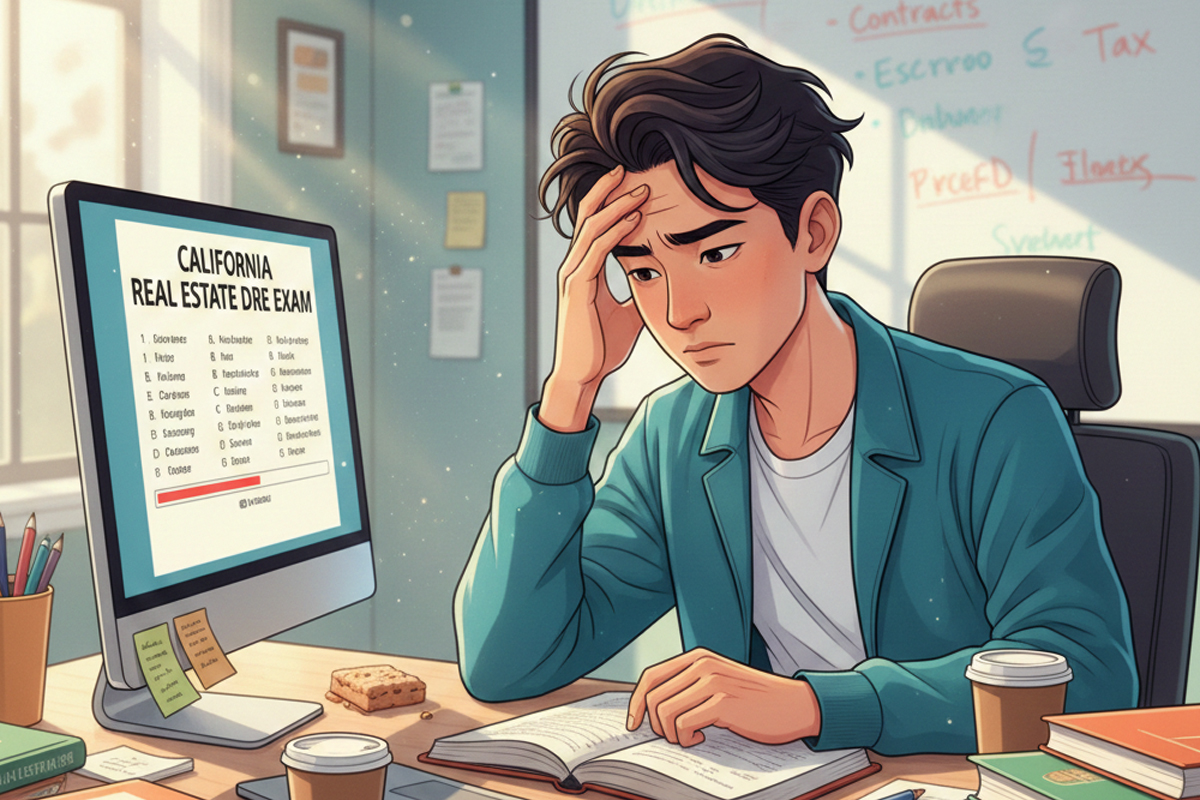
Failing the California real estate exam can feel confusing and discouraging—especially if you studied hard and thought you were prepared. After teaching thousands of students at ADHI Schools, I can tell you this: good people fail this exam for predictable, fixable reasons.
Most students who fail aren’t lacking intelligence. They’re dealing with:
Studying the wrong material
Misreading the way the DRE writes questions
Mismanaging time and anxiety
Not truly understanding the concepts
This 2026 update breaks down why people fail—and how to avoid doing it again. If you need the full roadmap, revisit our California Real Estate Exam Guide for big-picture context.
1. Studying the Wrong Material
This is the most common failure point for people that don’t pass the real estate exam on the first attempt.
Most students think they know what’s important, but the DRE’s actual blueprint tells a different story. People over-study math, obscure facts, or random topics—and under-study the heavy hitters like Practice of Real Estate and Mandated Disclosures, Agency, and Contracts.
If the exam felt “nothing like what I studied,” it’s usually a blueprint mismatch not because the California real estate exam is inherently hard.
Fix: Study according to weighting, not feeling. Your score follows the blueprint—your study plan should too.
2. Memorizing Instead of Understanding Concepts
The DRE exam is not a vocabulary quiz. It’s a psychometric, scenario-based exam.
Even when two answers look right, only one reflects the best professional judgment.
Examples:
Knowing the definition of “fiduciary” isn’t enough—you must know how it applies in real situations.
Memorizing loan definitions won’t help if you can’t apply financing concepts to a buyer scenario.
Students who memorize instead of understanding get crushed by paragraph-style questions.
Fix:
Study concepts, not sentences.
Ask: “How would this play out in practice?”
Practice explaining rules out loud as if teaching a new agent.
Understanding beats memorization every time.
3. Weak Test-Taking Strategy
Even with strong knowledge, poor strategy sinks scores.
The CA exam is designed with:
Four options per question
Distractors that look reasonable
Trap words like always, never, must, only
Questions that hide the real ask behind long paragraphs
Weak strategy leads to:
Rushing
Misreading
Overthinking
Getting tricked by distractors
Fix:
Slow your brain, not your pace.
Your process should be:
Identify what the question is actually asking.
Eliminate two bad choices.
Choose the best remaining answer—not the first one that feels right.
4. Not Completing the 135 Hours Effectively
Yes, you “completed” the hours. But did you learn the material?
Common problems:
Clicking through content while multitasking
Rushing to unlock final exams
Treating quizzes as speed bumps instead of diagnostics
Finishing the course fast but retaining very little
The DRE requires structured pacing for a reason: cramming destroys comprehension.
Fix:
Go back into your course with intentionality:
Redo chapter quizzes
Slow down on mandated disclosures, agency, and practice
Take notes instead of scanning
Your 135 hours are the foundation. If the foundation is weak, the exam will expose it.
5. Mismanaging Exam-Day Timing and Anxiety
The pacing is strict:
150 questions in 180 minutes
≈ 1.2 minutes per question
Two patterns cause failure:
A. Poor timing
Spending too long on early questions → panic later → rushed guesses at the end.
B. Snowball anxiety
When tension rises, accuracy drops. Even easy questions start to feel hard.
You can know the material and still fail simply from mismanaging the clock or stress.
Fix:
If a question hits 90 seconds, mark it and move on
Answer all “easy confidence” questions first.
Use structured breathing to reset between sections.
The exam rewards calm, not perfection.
6. Overconfidence After Practice Exams
Practice tests help—but they can also mislead.
Students score 80–85% on practice questions and assume the real test will feel similar. But:
Practice questions are often easier
Some aren’t written in true DRE style
Students memorize patterns instead of concepts
Most don’t simulate full, timed testing conditions
Overconfidence destroys focus on test day.
Fix:
Treat practice scores as data, not predictions.
Switch question banks to avoid memorization.
Take at least one full-length timed exam to feel real pacing.
If you “crushed the practice tests” but failed the DRE exam, this is likely the reason.
7. Not Reviewing Weak Areas Using Data
Most people study based on what feels comfortable, not what the data shows.
Real patterns:
Students love reviewing topics they already understand
They avoid areas where they miss questions
They never measure category-level performance
But the DRE doesn’t care about your feelings—it cares whether you get the heavy-weighted categories right.
Fix:
Track your misses by category:
Agency
Practice & Disclosures
Contracts
Financing
Property Ownership
Land Use & Regulation
Then study ONLY your weakest two or three areas until they improve.
This is how repeat test-takers turn scores around fast.
8. Misunderstanding How the DRE Scores the Exam
There is so much myth around how the exam is scored.
Here’s the truth:
Raw scoring only
No curve
70% required for salesperson, 75% for broker
Different exam forms exist but are statistically balanced
Missing “easy questions” hurts exactly as much as missing hard ones
When students misunderstand scoring, they:
Over-focus on hard questions
Ignore high-weighted fundamentals
Think the curve will “save” them
If scoring confuses you, read How the CA Real Estate Exam Is Scored for a full breakdown.
Fix:
Aim for consistent accuracy—not perfection or “beating the curve.”
You can miss many questions and still pass. You just can’t miss the wrong ones.
If You’ve Already Failed Once (or More): What To Do Next
Failing once is common. Failing repeatedly happens only when students don’t change their approach.
Here’s your reset plan.
1. Shift mindset
Give yourself a day to be upset. Then move into diagnosis-mode:
“Where exactly did things break down?”
2. Rebuild using the blueprint
Anchor everything to the California Real Estate Exam Guide and the Content Breakdown.
3. Identify your three weakest categories
Use chapter quizzes, practice tests, and memory from the exam.
4. Fix your strategy
If timing or distractors tripped you up, revisit our Multiple-Choice Strategy article.
5. Re-engage the 135 hours
Slow down. Relearn. Retest.
6. Plan your retake intentionally
If you need reassurance about retake limits, see How Many Times Can You Take the CA Real Estate Exam?
You have time—and unlimited attempts within your application window.
7. Treat your next attempt like a professional dry run
Your goal isn’t to “beat the test.”
Your goal is to perform like the licensee the DRE is willing to approve.
Ready to Finally Pass?
At ADHI Schools, everything we teach—including exam prep, crash courses, and strategy coaching—is built around California-specific DRE standards, psychometrics, and student performance data.
If you’re tired of guessing, overwhelmed with conflicting advice, or don’t want another exam fee on your credit card, we can help you approach the next attempt correctly, confidently, and strategically.
You don’t have to be the person who almost became an agent.
With the right structure, the right content, and the right test strategy, you will pass this exam.
Ready when you are.
1. What is the number one reason people fail the California real estate exam?
Most students fail because they study the wrong material. The DRE blueprint emphasizes topics like Practice of Real Estate and Mandated Disclosures, Agency, and Contracts, not the random facts or formula-heavy topics many students focus on. Aligning your study plan with the actual DRE weighting dramatically improves pass rates.
2. Is the California real estate exam harder than people expect?
Yes—mainly because the exam is a psychometric, scenario-based test, not a memorization test. Students who rely on flashcards or definitions often struggle with paragraph-style questions that require judgment, application, and analysis.
3. What score do I need to pass the California real estate exam?
You must score at least:
70% on the Salesperson Exam → 105 correct out of 150 questions
75% on the Broker Exam → 113 correct out of 150 questions
The DRE uses raw scoring, not a curve. A miss is a miss—whether the question was “easy” or difficult.
4. Why do I pass practice tests but fail the real exam?
This is extremely common. Practice tests often:
Use easier or differently phrased questions
Encourage memorization instead of true understanding
Don’t simulate real timing or pressure
Lack scenario depth compared to DRE questions
Students should treat practice test scores as data, not predictions. Using an Error Log to categorize missed questions is one of the most effective ways to improve.
5. Does anxiety really cause people to fail the California real estate exam?
Absolutely. The exam is a timed endurance test, and anxiety causes students to:
Overspend time on early questions
Second-guess correct answers
Rush the last 20–30 questions
Misread wording or fall for distractors
Using a simple reset phrase like “One question at a time” or “Slow is smooth” helps regain focus.
6. Can you fail the CA real estate exam even if you know the material?
Yes. Many students understand the concepts but still fail due to:
Poor pacing
Weak test-taking strategy
Missing fundamentals instead of difficult questions
Misinterpreting what the question is really asking
Knowledge without a strategy leads to preventable mistakes.
7. How many times can I take the California real estate exam if I fail?
California allows unlimited retakes within your two-year application window. There is no penalty for failing besides paying the exam fee again. See our guide: How Many Times Can You Take the CA Real Estate Exam?
8. What should I do after failing the California real estate exam?
You should follow a structured reset plan:
Diagnose your weakest categories
Re-align with the DRE content outline
Re-engage your 135 hours with intention
Practice full-length timed exams
Strengthen test-taking strategy
Track mistakes using an Error Log
Repeat test-takers improve fastest when they take a data-driven approach, not a “study everything again” approach.
9. Is the California real estate exam curved?
No. The DRE does not curve, scale, or adjust scores. Each question carries equal weight. Different exam forms are equated psychometrically to ensure fairness, meaning the difficulty level is balanced statistically—not curved.
10. What topics should I focus on to avoid failing the exam again?
Focus on the highest-weighted categories, which often include:
Practice of Real Estate & Mandated Disclosures
Agency & Fiduciary Duties
Contracts
Property Ownership & Regulations
These areas make up a significant portion of the exam and must be mastered to pass. See our California Real Estate Exam Content Breakdown for details.
|
The "License Cliff": Why Agents Can Stall in the First 30 Days
You pass the state exam, celebrate, and then the email arrives from the DRE: "Your license is active." Suddenly, the guided path of mandatory Read more...
The "License Cliff": Why Agents Can Stall in the First 30 Days
You pass the state exam, celebrate, and then the email arrives from the DRE: "Your license is active." Suddenly, the guided path of mandatory courses and proctored exams ends. You are no longer a student with a syllabus; you are a business owner with a blank canvas.
If you aren’t careful, you can end up on the wrong side of what we call the “License Cliff”.
Without guidance or deadlines, new agents can drift into "luxury cosplay"—spending weeks on logos and business cards while their momentum evaporates. Here’s what to do after you get your California real estate license in the first 30 days to move from "licensed" to "in business."
The 30-Day Launch Sequence
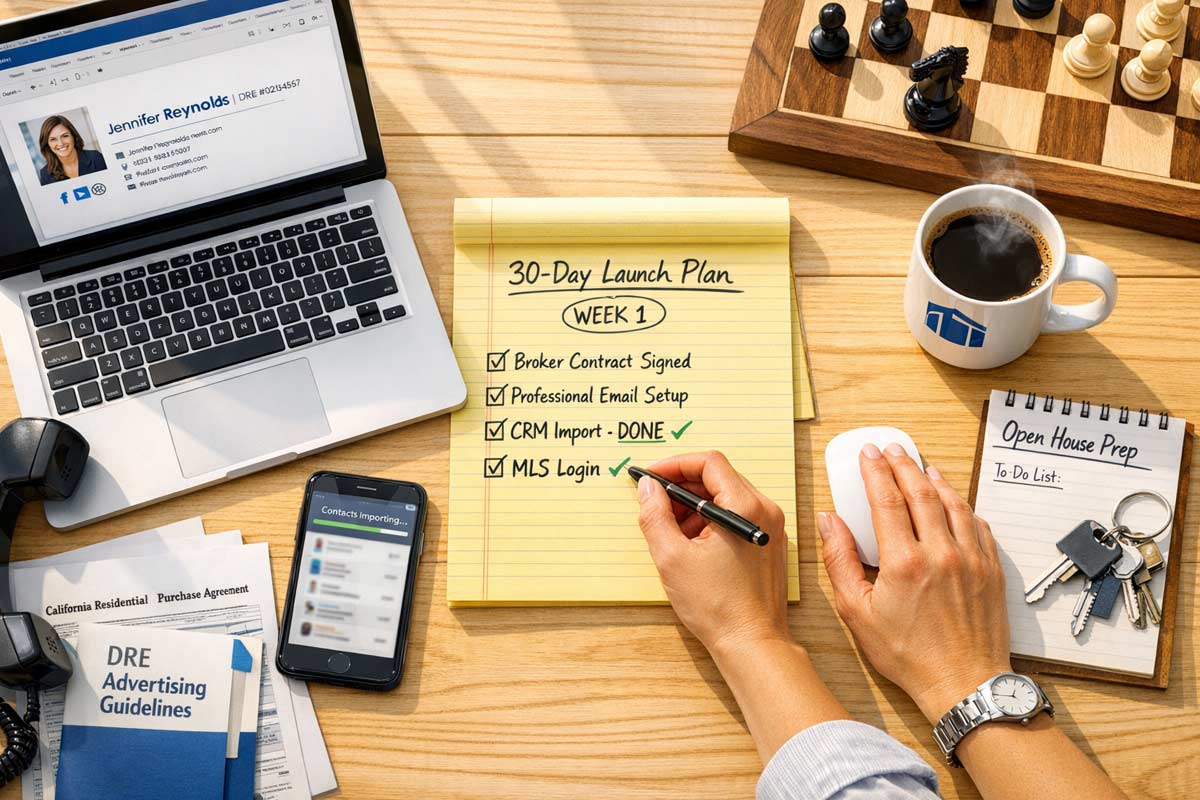
✅ The Day 1–2 Checklist: Immediate Momentum
Identify 3 Brokerages: Do not over-analyze. Pick three based on proximity and reputation.
Call the Managers: Request a "New Agent Interview." Do not wait for an "opening."
Audit Your Finances: Make sure you can cover 3–6 months of dues + basic expenses.
Phase 1: The Mandatory First Step – Hang Your License
Practically speaking, you can’t operate solo in California. Your license becomes usable when it’s placed under a supervising broker. Your broker sponsors your license and provides the supervision and compliance umbrella that lets you practice.
Who is this for?
The Solo Agent: You want to build your own brand from Day 1 and keep a higher split.
The Team Agent: You want provided leads and high accountability.
ADHI Recommendation: For most brand-new agents, training beats split—by a lot. A training-heavy team environment provides the systems you need to survive Year 1.
The Brokerage Interview Scorecard
Onboarding: Is there a structured 30-day plan or just a desk?
Costs: What are the monthly tech, desk, and E&O (Errors & Omissions) fees?
Live Training: Can you shadow a listing presentation or an inspection this week?
Directive: Schedule 3–5 interviews. Your goal is a qualified launchpad for your first 12–24 months. If you’re still navigating the timing of your application, read Do You Need to Join a Brokerage Before Applying for a License?.
Phase 2: Setup Week – Activating Your Toolkit
Once sponsored, your first week is about technical setup. Avoid the "Branding Black Hole" and focus on permission-to-play tasks.
Your First 7-Day Setup Checklist
Task
Action Item
Compliant Signature
Include your Name, DRE License #, and Brokerage info (required for compliant advertising).
CRM Import
Export your phone and social media contacts. This is your "Sphere of Influence."
MLS & Supra
Get your MLS login and set up your Supra key for lockbox access.
The "Ask" Rule
Bookmark your broker's guidelines. When unsure on a disclosure, pause and ask your broker.
Phase 3: Your First 30 Days – The "Conversation Engine"
In real estate, Activity > Results. You cannot control a closing, but you can control your scoreboard.
Your First 30-Day Activity Scoreboard
10 New Conversations: Direct, two-way dialogues about the market.
5 Value-Add Follow-Ups: Sending a useful report or link (not just "checking in").
1 Hosted/Shadowed Open House: Your field laboratory for meeting neighbors.
1 Practice RPA: Write a mock Purchase Agreement using your broker’s templates.
Reality Snapshots
The “Ghost” Agent: I’ve seen students pass the exam but wait 60 days to pick a broker. By then, their momentum is dead. The knowledge from the exam has a half-life; use it immediately.
The Branding Trap: One agent spent $500 on a custom logo before their first sphere call. Six months later, they were out of the business with a beautiful, empty website.
The Open House Win: A new agent hosted an open house for a top producer. They didn't sell that house, but met a neighbor who listed with them four months later. That one conversation turned into a $25k commission.
The Top 3 Post-License Traps
"I need a perfect brand first": Your brand is competence and responsiveness. Use your brokerage's templates for 6 months while you learn the contracts.
Tool Overload: You will be pitched "guaranteed leads" by dozens of vendors. The Fix: Use only what your brokerage provides for the first 90 days.
The Expert Fear: You don't need to know everything. Your script is: "That's a great question. Let me confirm this with my broker/manager so I give you the exact answer."
FAQ
"Can I get my license first and choose a broker later?"
Technically yes, but you are losing momentum. Read Top Reasons People Fail to Get Licensed in California to see why delay is the enemy of success.
"What if I feel unprepared?"
The exam proves you know the law; the first 30 days prove you can follow a system. If you haven't finished your hours yet, check Can You Take the Exam Before Completing All 135 Hours? to speed up your timeline.
"What does my broker actually do?"
They are your regulatory partner. They review your files for compliance, provide legal contracts, and pay your commissions. They are the "adult in the room" for your professional liability.
Your Next Step
Getting licensed was the "license to learn." Now, you must execute. If you are still navigating the pre-license requirements, solidify your foundation with our complete California Real Estate License Guide.
Open your calendar now and block 9:00 AM – 11:00 AM tomorrow for "Brokerage Research and Outreach." Treat it like an appointment.
|
TL;DR: The Bottom Line
The Answer (in plain English): No — you can’t be authorized to schedule or take the California real estate exam until the Department of Real Estate Read more...
TL;DR: The Bottom Line
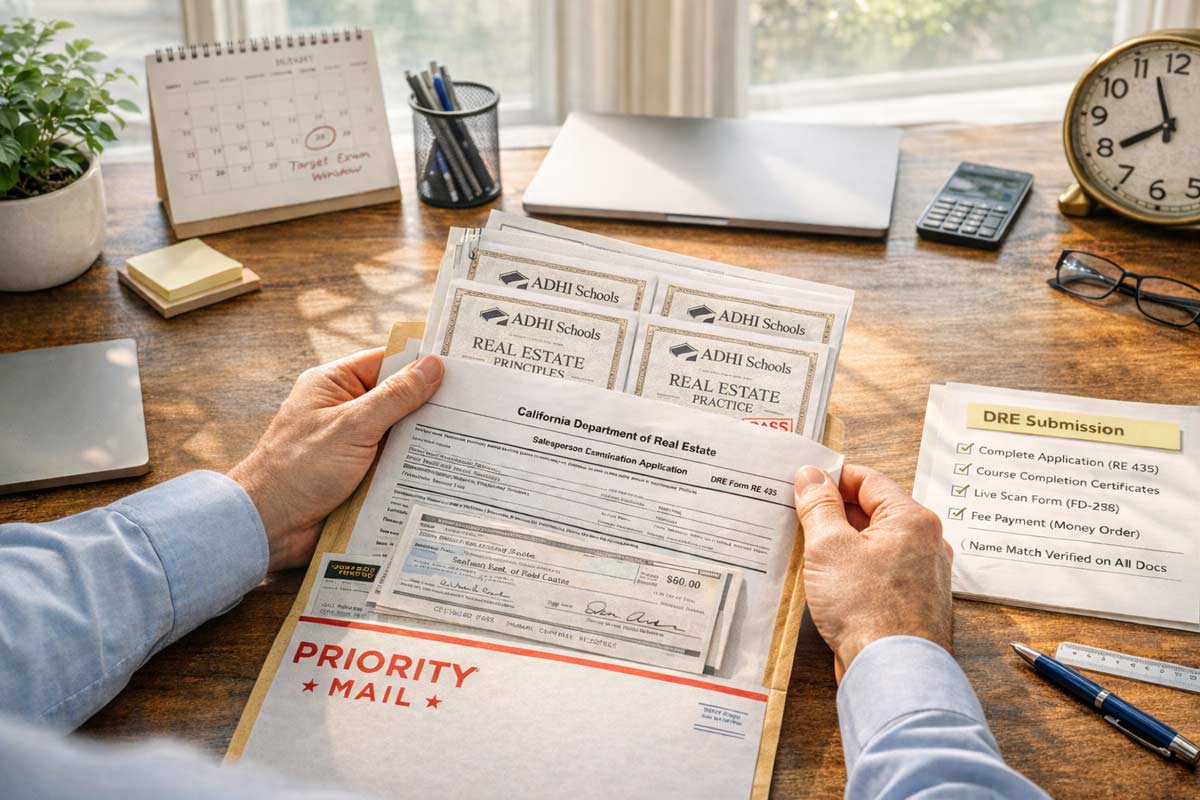
The Answer (in plain English): No — you can’t be authorized to schedule or take the California real estate exam until the Department of Real Estate (DRE) verifies you’ve completed all 135 hours (three 45-hour courses).
The Risk: Submitting your application while you’re “still finishing” your last course is the fastest way to trigger a DRE deficiency notice and delay.
The Solution: Finish your courses, secure your certificates, and follow the "clean-file sequence" to move from candidate to licensee without bureaucratic friction.
Most confusion comes from mixing up applying to the DRE with scheduling an exam date—scheduling your state exam can only happen after DRE approval.
The Truth Table: What You Can (and Can’t) Do Right Now
Action
Possible before 135 hours?
Outcome / Practical Advice
Submit DRE application
Yes (don’t)
Triggers a deficiency notice and adds weeks of delay.
Get Authorization to Schedule
No
The DRE won’t issue an exam invite until your file is 100% complete.
Choose an exam date
No
You can’t access the eLicensing calendar until you’re approved.
Study & exam prep
Yes
Recommended — this is the only “shortcut” that actually works.
The Speed Trap: Why "Almost Done" Is Still a "No"
In my 20-plus years of training thousands of agents at ADHI Schools, I’ve seen one mistake repeat more than any other: the Speed Trap.
It usually starts with a highly motivated candidate who is halfway through their third course. They look at the DRE’s current processing times—which fluctuate—and think they’ve found a loophole. They decide to mail their exam application today, assuming that by the time a DRE processor actually opens their envelope, they will have finished the course and can just "send in the final certificate later."
This is a high-stakes gamble that almost nobody wins. The DRE does not "hold" your spot in line while you finish your homework. If a processor opens your application and the course completion certificate is missing, the process doesn’t pause—it breaks. You won’t just lose time; you’ll lose your momentum and you'll be waiting for a deficiency notice and a new review cycle before you can fix it.
The DRE’s system is built to verify eligibility first — clean files move faster than hopeful ones. In practice, the fastest candidates aren’t the ones who rush—they’re the ones who submit a file with nothing for the DRE to question.
The 135-Hour Rule, Explained Simply
To qualify for the California real estate salesperson exam, state law requires the completion of three DRE-approved pre-licensing courses, totaling 135 hours:
Real Estate Principles (45 hours)
Real Estate Practice (45 hours)
An Elective Course (45 hours—most of our students choose Finance, Appraisal, or Legal Aspects)
Enrollment in these courses is subject to California’s minimum time-in-course rules (usually enforced as a minimum number of days per course). You cannot "crash" these courses in a weekend; the regulatory framework is designed to ensure a minimum level of exposure to the material before you are given the ability to test out.
The "Completed" Checklist
The DRE only considers a course "complete" when you have checked these three boxes:
Time Requirement: You have spent the mandated number of days enrolled in the course (18 calendar days typically).
Examination: You have passed the final exam for that specific course with a score of 60% or higher with ADHI Schools.
Documentation: You have received a formal course completion certificate or transcript showing the exact course title and your legal name as it appears on your government-issued ID.
Until you have all three certificates in your possession, you are not an eligible candidate for the state exam.
The Real Answer: "Exam Before Hours" Scenarios
Let’s break down the specific scenarios candidates use to try and bypass the timeline.
Can I schedule the exam before finishing 135 hours?
No. In California, you don’t simply call a testing center and pick a date like you would for a haircut. You must first apply to the DRE. They review your education proof, and only then do they issue an Authorization to Schedule (also known as an Exam Invite). Until you’re approved, you’re not “in line” for an exam seat.
Can I take the state exam before finishing 135 hours?
No. There is no "provisional" testing. The education is a statutory prerequisite. Without the 135 hours, you aren't a candidate; you're just someone with an incomplete application.
What if I’m 90% done with my last course?
No. The DRE does not recognize partial credit. Whether you have 0 hours or 134 hours, the result is the same: Ineligible. You must wait until the final certificate is issued before mailing your application packet.
What if my course is done, but I’m waiting for my certificate?
No. Do not mail your application with a note saying "Certificate coming soon."
What if I finished courses years ago?
Only If. In many cases, older course completion records can still be usable, but the safest move is to verify your course titles and the provider's approval status to make sure you're applying under current DRE rules. If you are unsure if your older classes still count, check our California Real Estate License Guide to ensure your education aligns with today’s standards.
The Fastest Path: The "Clean-File" Sequence
If you want to get licensed as quickly as possible, stop looking for shortcuts and follow this proven sequence. This is the timeline we see work most efficiently for our students.
Complete the 135 Hours: Finish Principles, Practice, and your Elective.
Gather Your Proof: Secure all three course completion certificates. Ensure your name matches your government-issued ID exactly.
Submit the "Combined" Application: Use form RE 435 (Salesperson Exam/License Application). Most first-time applicants should use the combined path so you don’t create a second processing cycle after passing.
The Waiting Window: Once your application is mailed, the DRE enters a review period where they process your file.
Pro-Tip: If you want the full, granular step-by-step from choosing your courses to passing the state exam, start with our California Real Estate License Guide.
What You Should Do While Waiting for Your Exam Date
The period between mailing your application and receiving your Authorization to Schedule is not "dead time." If you just sit and wait, you are actually slowing yourself down. Use this window to handle the "back-office" of your new career:
Live Scan Fingerprints:You don't have to wait until you pass the exam to do your background check. Doing it now means your license can be issued almost immediately after you pass.
Master the Material: The 135 hours of pre-licensing education is the "what." Now you need to learn the "how" of passing the exam. This is when you should be high-quality exam prep tools.
Brokerage Interviews: You can't actually sell real estate without a broker. Use this time to interview different firms. You can learn more about this by reading: Do You Need to Join a Brokerage Before Applying for a License?.
Planning Your Launch: And if you’re trying to plan the first 30 days after activation, read: What Happens After You Get Your California Real Estate License?.
Name Matching Audit: Double-check that your certificates, your application, and your driver’s license all use the same name. If one says "Jim" and the others say "James," fix it now.
3 Costly Mistakes That Will Slow You Down
1. The "In-Progress" Application
As discussed, mailing your application while still enrolled in a course is a guaranteed delay. The DRE is a high-volume government agency; they do not have the resources to "match" a late certificate to an existing file easily. Your file will be set aside, a DRE deficiency notice will be generated, and you will likely have to start the waiting clock all over again.
2. Using the Wrong Application Form
Candidates often use the "Exam Only" form (RE 400) because it's shorter. However, this means after you pass the exam, you have to submit another application for the license itself. This can add significant time to the total process. Always use the combined exam and license application to bypass that second wait.
3. Underestimating the State Exam
I've seen students finish their 135 hours, wait for an exam date, and then fail the exam because they thought the state test would be as easy as the course quizzes. If you fail, you have to reschedule and pay the fee again. This is one of the Top Reasons People Fail to Get Licensed in California.
FAQ: Your Timeline Questions, Answered
Can I apply to the DRE before finishing classes?
Technically, you can mail the form, but it will be treated as a deficient file and you’ll receive a deficiency notice. The DRE requires all three course completion certificates to be included in the initial packet to prove eligibility.
What is an "Authorization to Schedule"?
This is the document the DRE sends you once they have approved your 135 hours and your application. It grants you access to the eLicensing system where you can finally pick your date, time, and location for the exam.
How long are the course certificates valid?
Currently, there is no expiration date on pre-licensing course completions in California.
Is there any way to skip the 135 hours?
Only if you are a member of the California State Bar.
What happens if I pass the exam but haven't picked a broker?
Your license will be issued in "Inactive" status. You won't be able to perform any acts requiring a license or earn commissions until you officially "hang your license" with a broker. See What Happens After You Get Your California Real Estate License? for the next steps.
Speed Comes From Sequence, Not Shortcuts
In the world of California real estate, "slow is smooth, and smooth is fast." The desire to rush the process is understandable—this is a career that offers incredible freedom and income potential. But trying to take the California real estate exam before completing 135 hours is a tactical error that almost always backfires.
True efficiency is found in the "clean-file" sequence: complete your courses, gather your proof, and submit a perfect application. By doing the work correctly the first time, you ensure that once you pass the exam, you are ready to hit the ground running.
Next step (don’t guess):
Start here: California Real Estate License Guide
Ready to begin your courses? → ADHI Schools Pre-Licensing Packages
Choosing a broker next? → Do You Need to Join a Brokerage Before Applying for a License?
|
You have spent months studying principles, practices, and finance. You’ve memorized the difference between a freehold estate and a leasehold estate. You’ve taken practice tests until your eyes Read more...
You have spent months studying principles, practices, and finance. You’ve memorized the difference between a freehold estate and a leasehold estate. You’ve taken practice tests until your eyes blurred. But there is one variable that textbooks cannot fully replicate: the environment of the testing center itself.
Anxiety often stems from the unknown. For many students, the fear isn’t just about the questions; it is about the logistics. Where do I park? What can I bring into the room? What does the computer interface look like? When do I find out if I passed?
At ADHI Schools, we believe that removing the mystery of the process allows your brain to focus entirely on the content. By understanding the flow of the day, you can walk in with confidence rather than apprehension. This overview is an essential component of our comprehensive California Real Estate Exam Guide, designed to help you navigate every step of the licensing journey.
The DRE Difference: Who Runs the Exam?
First, it is important to understand who is in charge. Unlike many other states that outsource their testing to third-party vendors like Pearson VUE or PSI, California does things differently. The California Department of Real Estate (DRE) both creates the exam and administers it.
This means that when you walk into the testing center, you are walking into a state-controlled environment. The proctors are state employees or contracted strictly by the state, and the security protocols come directly from the DRE.
Before You Leave Home
Your exam day strategy begins before you even start your car. The DRE is incredibly strict regarding punctuality and identification. If you are late, you may be denied entry and will forfeit your exam fee.
The Identification Rule: You must bring one current, valid (not expired), government-issued ID with a photograph and signature. This is usually a driver’s license, state ID, or passport. The name on your ID must exactly match the name on your exam registration. If you recently got married or changed your name and your ID doesn't reflect that yet, you will be turned away.
The "Car Strategy": Since you cannot bring personal items into the testing room, and locker space is sometimes limited or cramped, the best place for your phone, wallet, and study notes is often the trunk of your car. However, do not leave your ID and exam schedule notice in the car. Double-check that you have them in your hand before locking the vehicle.
Successful candidates often plan these logistics weeks in advance when they figure out how to schedule the California real estate exam through the eLicensing system, ensuring they have ample travel time buffered into their morning commute.
Arrival and Check-In Process
Plan to arrive at the testing site at least 30 to 45 minutes before your scheduled start time. This buffer is necessary for parking, locating the suite within the building, and the check-in line.
Once you enter the facility, the atmosphere shifts. It is generally quiet and sterile. You will approach the reception desk where a proctor will verify your ID. You can choose to place your belongings inside a locker for personal items like car keys. Do not try to sneak anything into the testing room. The proctors are vigilant, and the rules are generally uniform regardless of which of the California real estate exam testing centers you selected for your test.
Security Procedures
The security measures at DRE centers feel comparable to airport screening. This is to ensure the integrity of the state exam. Be prepared for the following:
Empty Pockets: You will likely be asked to turn your pockets inside out to prove they are empty.
Visual Inspection: You may be asked to roll up your sleeves or lift pant legs slightly to ensure no notes are hidden.
Jewelry and Accessories: Large jewelry, heavy coats, and brimmed hats are generally prohibited. You cannot wear a smartwatch or a Fitbit. Analog watches are also usually banned to prevent hidden cameras or timing devices.
Calculators: Since there is no longer any math on the real estate exam, no calculators can be brought into the exam site nor will the state provide you with one.
The Testing Room Environment
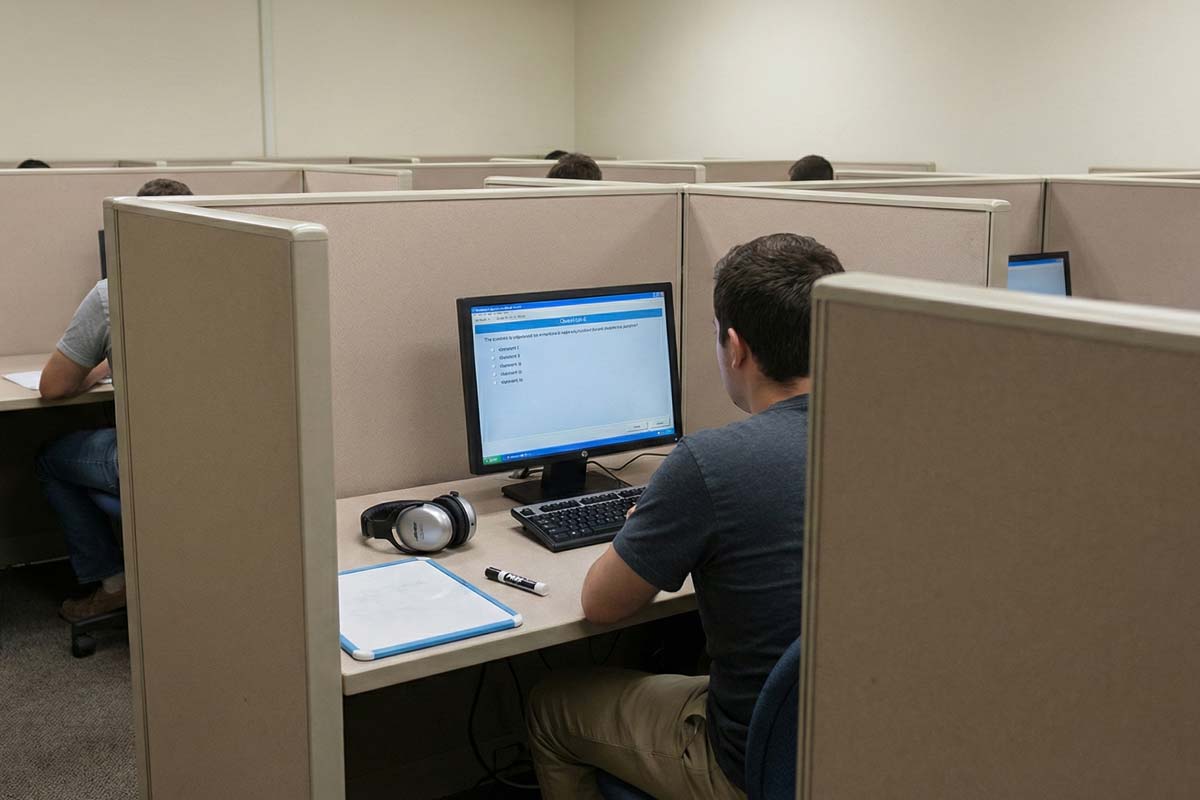
Once you pass security, you are escorted into the testing room. It is typically a room filled with cubicles, similar to a computer lab or a call center. You will be assigned a specific workstation.
Expect the First 5 Minutes to Feel Strange
It is completely normal to feel a surge of panic during these first few minutes. Most students report a spike in heart rate as they sit in the chair. This is a physiological response to stress, not a reflection of your preparation. Acknowledge it, take a deep breath, and trust that it usually fades once you answer the first five questions.
The Interface: The exam is taken on a computer. This is not a sleek or modern testing interface; it is functional, simple, and dated. You will use the mouse to select A, B, C, or D—there are no fill-in-the-blank or essay questions.
The Restroom Rule: You are permitted to use the restroom during the exam, but be aware that the exam timer does not stop. If you take a 10-minute break, that is 10 minutes less you have to answer questions. Plan your water intake accordingly.
It is important to remember that you must be physically present at the proctored center; current DRE regulations do not allow you to take the California real estate exam online remotely.
Top 5 Things That Surprise Students
The "Old School" Tech: The mouse might be clunky, and the screen resolution low.
Unpredictable Temps: The room might be freezing cold or uncomfortably warm. Dress in layers.
No Immediate Score: You won't see "PASS" on the screen the moment you finish (more on that below).
Ambient Noise: You will hear mouse clicks, coughing, and chairs shifting.
Small Lockers: If you bring a giant backpack, it might not fit.
Pacing, Fatigue, and Strategy
You have 3 hours to answer 150 multiple-choice questions for the salesperson exam and 4 hours and 200 questions for the broker test. This breaks down to roughly 1 minute and 12 seconds per question. However, this is an average, not a rigid rule. Some vocabulary questions will take you 10 seconds; some longer “story type” questions might take you 3 minutes.
The "Halfway" Landmark: A good rule of thumb for pacing is to check the timer when you are halfway through the questions. Based on where you are at the halfway mark you might need to speed it up.
The Fatigue Factor: The hardest part of the exam often isn't the difficulty of question #1, but the brain fog that sets in by question #115. Decision fatigue is real. Toward the end of the exam, your brain may try to rush you just to escape the uncomfortable environment.
Pro Tip: Watch out for "overthinking." As fatigue sets in, students often stare at simple questions and convince themselves there must be a trick. Usually, there isn't. If you know the definition, mark it and move on.
Recognizing your own biological clock is vital here; if you know your focus crashes after lunch, you should have considered the best time of day to take the California real estate exam to ensure you are testing during your peak mental performance window.
What Happens After You Click “Submit”
This is the moment that causes the most heart palpitations.
You do not see your result on the screen immediately in the testing cubicle. The screen typically goes blank or returns to a welcome page. You must gather your things and walk out to the proctor at the front desk.
The Result: The proctor will print a piece of paper, fold it, and hand it to you.
If you passed: The paper will typically say "CONGRATULATIONS" and provide instructions on how to apply for your license. It will not tell you your score. Whether you got 80% or 100%, a pass is a pass.
If you failed: The paper will show you your actual numerical score and a breakdown of the percentages you scored in each of the seven topic areas. This is diagnostic, helping you know where to study for the next attempt.
Final Exam-Day Checklist
To ensure a smooth experience, run through this mental checklist before walking out the door:
Valid ID: Check it twice.
Directions: Have the address loaded in your GPS.
Comfortable Clothing: Dress in layers to handle unpredictable room temps.
Keys and Wallet: Ready to be locked in the provided locker or your trunk.
Positive Mindset: Leave the panic at home.
Walk In Prepared
The California Real Estate Exam is designed to be rigorous, but it is not impossible. By knowing exactly what to expect when you walk through those doors, you eliminate the element of surprise.
Trust your preparation. You have put in the work, you understand the material, and now you understand the logistics. If you want a complete step-by-step walkthrough of the entire journey—from qualifying to scheduling to test day—the California Real Estate Exam Guide ties everything together to ensure you are ready to launch your new career.
FAQs
1. What identification is required to check in at the testing center? You must present one current, valid, government-issued ID with a photograph and signature (such as a driver’s license, state ID, or passport). The name on the ID must exactly match the name on your exam registration.
2. Can I bring a calculator into the exam room? No, there is no longer any math on the California real estate exam.
3. Will I see my pass/fail result on the computer screen immediately? No. After you click "Submit," the screen will typically return to a welcome page. You must exit the room to receive a printed report from the proctor. If you pass, it will not list a score; if you fail, it will provide your numerical score and a breakdown.
4. Can I use the restroom during the exam? Yes, you are permitted to use the restroom, but the exam timer does not stop. Any time taken for a break is deducted from your total testing time.
5. How many questions are on the exam and what is the time limit? The salesperson exam consists of 150 multiple-choice questions and you have up to 3 hours to complete. The broker exam is 200 multiple-choice questions and you get 4 hours to complete it.
|
You’ve done the heavy lifting. You’ve read the textbooks, highlighted the key terms, and passed your three required college-level courses. Congratulations on reaching this milestone! But now, a new Read more...
You’ve done the heavy lifting. You’ve read the textbooks, highlighted the key terms, and passed your three required college-level courses. Congratulations on reaching this milestone! But now, a new mix of excitement and nerves is likely setting in.
You are standing at the threshold of your new career, and there is just one major logistical hurdle left before you can earn your license: getting your test date on the books.
By the end of this article, you’ll know every step required to get approved and schedule your exam date successfully using the DRE’s eLicensing system.
Scheduling your exam is the turning point where you stop being a student and get a little closer to becoming a real estate licensee. However, the process isn’t as simple as clicking a button on a calendar. The California Department of Real Estate (DRE) has a specific workflow that must be followed.
To help you navigate this process without the headache, we’ve broken down exactly how to secure your spot. For a broader look at the entire testing landscape, be sure to bookmark our comprehensive California Real Estate Exam Guide, which covers everything from study tactics to licensing requirements.
Prerequisites Before You Can Schedule
Before you even log into a computer to pick a date, you must ensure you are actually eligible to sit for the exam. The DRE will not allow you to schedule an exam until your application has been fully processed and approved.
To reach the scheduling phase, you must have the following ready:
Required Courses: You must have finished your Real Estate Principles, Real Estate Practice, and one elective course (like Legal Aspects or Finance).
Certificates You Need: You must possess the physical or digital certificates/transcripts from your school (like ADHI) proving completion.
Submitting Your Application: You must submit your Salesperson Examination Application (Form RE 400A) or the Combined Examination and License Application (RE 435), along with the required fees. In theory, you could fill out the forms online.
Crucial Note: The DRE does not allow walk-ins or same-day scheduling. All appointments must be booked in advance through eLicensing.
How the DRE eLicensing System Works
Once your application is in the mail, the waiting game begins. California does not use third-party testing vendors like PSI or Pearson VUE; everything is handled directly through the DRE’s internal systems. The hub for this activity is the eLicensing portal.
Timeline Expectations
To give you a birds-eye view of how long this usually takes, here is the standard sequence:
Complete 3 required courses.
Mail application packet to the DRE.
Wait for processing/approval: This can take several weeks depending on the backlog. Always check the DRE website for current processing timeframes.
Receive eligibility notification: You get the “Green Light” via email or letter.
Log into eLicensing: Select your exam date and location.
What You’ll See in eLicensing
Once you have created your account and logged in, you need to know what to look for.
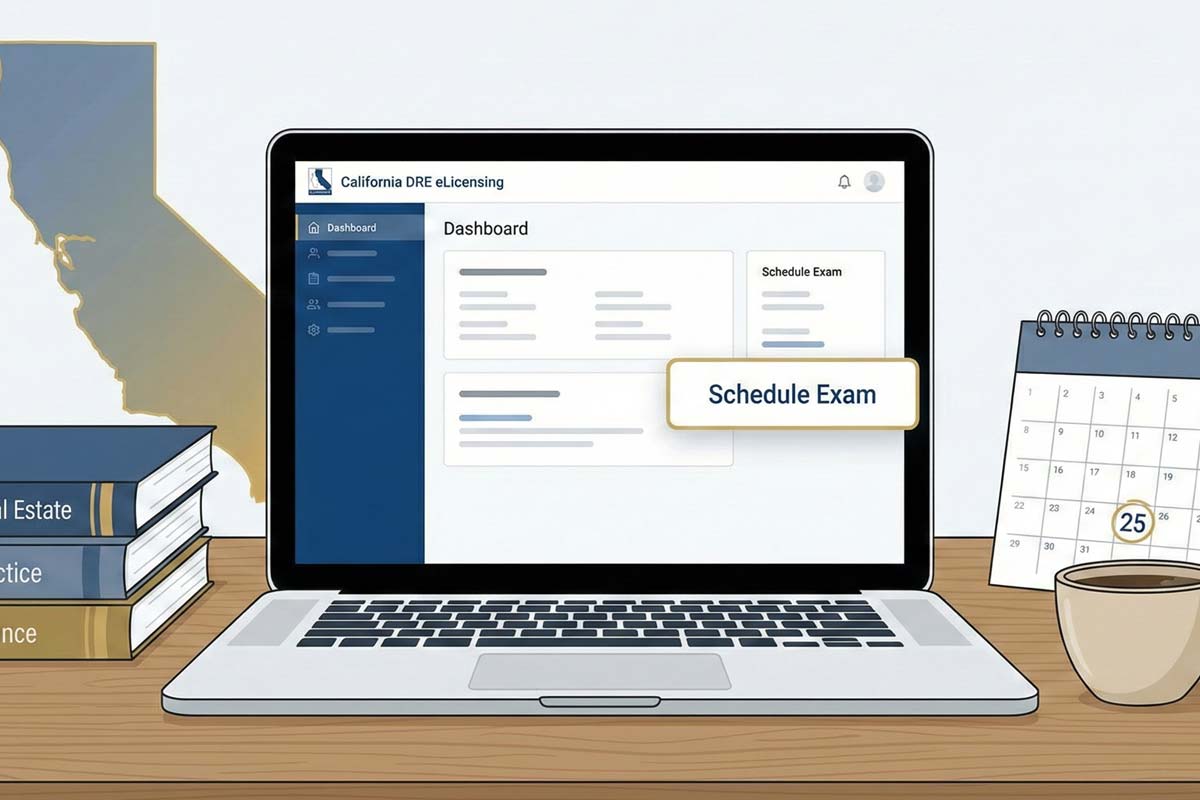
If your application is still processing, Your dashboard will likely show your license information as “NO RECORDS FOUND”.
Once approved, You will see a new menu option labeled “Schedule Examination.”
If this button does not appear, Your application is not yet eligible, and you cannot book a slot.
Step-by-Step Scheduling Overview
Create Your Account: If you haven’t already, go to the DRE website and register for an eLicensing account.
Wait for Approval: Be patient during the mail processing window.
Log In and Schedule: Click the “Schedule Examination” button once it appears.
Select Your Slot: You will be able to view the calendar, filter by location, and select the date and time that works for you.
Choosing Your Exam Location
While California is massive, the DRE only operates five specific testing centers. Unlike the vast network of DMV offices, you have limited choices, so you will need to plan your travel accordingly.
The five official DRE exam centers are located in:
Fresno
Los Angeles area (La Palma)
Oakland
Sacramento
San Diego
Peak Season Note: Late spring and early summer are peak testing seasons. Exam slots—especially in the popular La Palma location—can fill up weeks in advance. If you're deciding which center fits your commute, explore our guide to explore our guide to California real estate exam testing center locations, parking instructions, and security policies. It breaks down the specifics of each site so you aren't stressing about parking meters on the big day.
Can You Take the Exam Online?
We hear this question almost daily. In an era where you can order groceries, attend college, and even buy a car from your phone, it is natural to assume you can take the real estate exam online also.
The answer is No.
The DRE requires in-person testing to maintain exam security, prevent identity fraud, and ensure standardized administration. While the exam is administered electronically (on a computer terminal), it must be taken physically at one of the five DRE centers listed above. There is no remote proctoring option.
Choosing the Right Date & Time
Once you are in the eLicensing system and looking at the calendar, you might be tempted to just grab the first available slot. However, strategy matters here.
We recommend a "Goldilocks" approach to scheduling:
Don't schedule too far out: If you book a date three months away, you risk "knowledge decay." You want the material fresh in your mind.
Don't schedule too soon: If you book for tomorrow but haven't touched your notes in weeks, you're setting yourself up for anxiety.
Check your biology: For example, many students who test on Tuesday mornings report feeling more rested and less rushed than those trying to squeeze it in on a Friday afternoon.
For a deeper dive into strategy, read our article on the best time of day to take the California real estate exam to maximize your chances of passing on the first try.
Common Scheduling Mistakes to Avoid
Even smart students can hit road bumps. Watch out for these common errors:
Trying to use an expired ID: This is a critical error. Even if your driver’s license expired yesterday, the DRE will turn you away at the door. Check your expiration date now.
Scheduling before you are ready: Don’t book a date just to “get it over with.” Only book when you are scoring well on your practice exams.
Name Mismatches: Ensure the name on your application matches your Government ID exactly. If your ID says “Robert” and you apply as “Bob,” you will likely face issues at the testing center.
Final Preparations After You Schedule
Once you hit “Confirm” on your exam date, the countdown clock begins. This is the time to shift your focus from bureaucracy to performance.
Quick Exam-Day Prep Checklist:
Printed Exam Schedule Notice (from eLicensing)
Valid, unexpired Government ID (Driver’s License/Passport)
Route planned (account for traffic/parking)
Backup alarm set
Light review of key concepts
Once scheduled, make sure you review what to expect on exam day so nothing catches you off guard. Knowing the rules about lockers, cell phones, and bathroom breaks will help keep your heart rate down so you can focus on the questions.
Scheduling your exam is the moment this journey becomes real. It’s a commitment to yourself and your future career. While the DRE website can be a little clunky and the wait times can be frustrating, thousands of agents navigate this process every year—and you will too.
If you have your date set and want to ensure you walk in with total confidence, now is the time to buckle down. Most students who pass on their first attempt combine their coursework with a structured crash course or dedicated exam prep. ADHI Schools is here to help you cross that finish line.
Good luck scheduling, and happy studying!
Frequently Asked Questions About Scheduling the California Real Estate Exam
1. How long does it take for the DRE to approve my exam application?
Processing can take several weeks, depending on backlog and volume. You cannot schedule your exam until the DRE has officially approved your application and the “Schedule Examination” button appears in your eLicensing account.
How to Schedule the California …
2. Why does my eLicensing dashboard say “NO RECORDS FOUND”?
This simply means your application is still processing. Once you’re approved, your dashboard will update and the exam-scheduling option will appear automatically.
How to Schedule the California …
3. Can I schedule the California real estate exam online?
Yes — but only the scheduling part. The exam must be taken in person at one of the five DRE testing centers. There is no online or remote-proctored option.
How to Schedule the California …
4. Where can I take the exam?
California offers only five official DRE testing centers:
Fresno
La Palma (Los Angeles area)
Oakland
Sacramento
San DiegoThese fill up quickly during peak seasons (especially La Palma), so book early once eligible.
How to Schedule the California …
5. Can I walk in or schedule the exam same-day?
No. Walk-ins and same-day appointments are not allowed. All scheduling must be done through the DRE’s eLicensing system once you’ve been approved.
How to Schedule the California …
6. What if the date I want is unavailable?
Exam seats open and fill continuously. Students often check eLicensing daily—sometimes even multiple times a day—because cancellations do happen. Securing your preferred date requires persistence.
7. What should I consider when choosing my exam date?
Use the “Goldilocks strategy”:
Not too far out: Avoid losing study momentum.
Not too soon: Only book when your practice-test scores show you’re ready.
Pick your best time of day: Morning testers tend to feel fresher and less rushed.
How to Schedule the California …
8. What ID do I need on exam day?
A valid, unexpired government-issued ID. Even being one day expired will get you turned away — no exceptions. Double-check before scheduling and again before exam day.
How to Schedule the California …
9. What happens if the name on my ID doesn’t match my application?
You may be denied entry. Make sure your application reflects your legal name exactly as it appears on your ID (e.g., “Robert” vs. “Bob”).
How to Schedule the California …
10. What should I bring on exam day?
At minimum,
Printed Exam Schedule Notice
Valid ID
Your planned travel route
Final light study notes
These basics help prevent last-minute stress and ensure a smooth check-in.
How to Schedule the California …
11. Can I reschedule my exam?
Yes — as long as you log into eLicensing and change your appointment before your scheduled date. Seats are limited, so expect availability to vary.
12. When should I start serious exam prep?
Immediately after scheduling. The period between confirmation and test day should be used for structured review, practice exams, and tuning your test-taking strategy. Most first-time passers follow a crisp study plan and often add a crash course.
|
The short answer is no. You cannot take the California real estate salesperson or broker license exam online from your home or office.
While many states have adopted remote proctoring for their Read more...
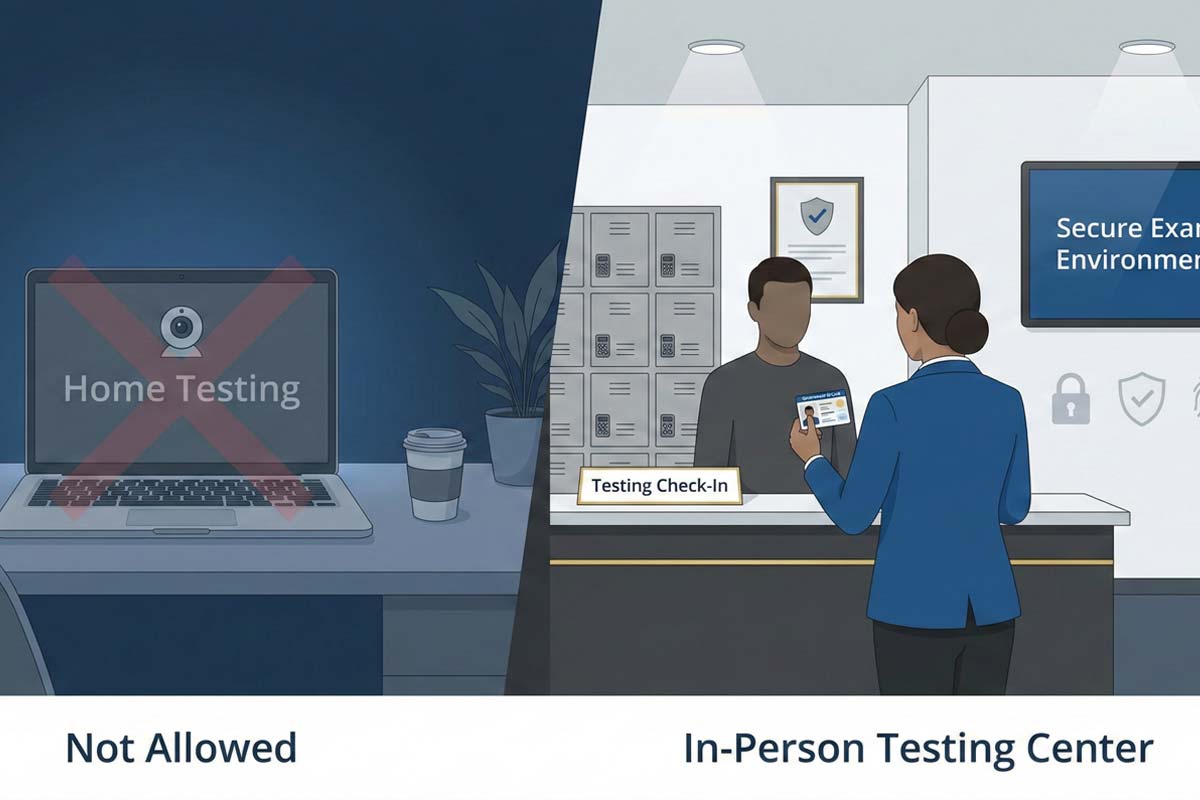
The short answer is no. You cannot take the California real estate salesperson or broker license exam online from your home or office.
While many states have adopted remote proctoring for their licensing tests, the California Department of Real Estate (DRE) strictly requires all candidates to take the exam in person at one of five official testing centers.
As of 2026, the DRE has not adopted an online “remote” alternative for any candidates. While the state provides robust on-site accommodations for candidates with disabilities who apply for them, there is currently no option to take the exam off-site.
Why the California Real Estate Exam Is Not Offered Online
The DRE’s refusal to move the exam online revolves around one core principle: exam integrity.
The California real estate license grants significant legal and financial authority. To maintain the value of this license, the DRE must ensure that every person who passes the exam does so fairly and without outside assistance. Because California has the largest licensee population in the country, the risk of widespread fraud is higher here than in smaller states, leading to stricter protocols.
Many students are surprised by how different the DRE’s rules are from their school exams. Understanding this distinction early prevents confusion later in the process.
Security and Identity Verification
Remote proctoring—where a webcam watches you take the test—has improved, but it is not yet foolproof. The DRE enforces strict identity verification standards that are difficult to replicate remotely. At a physical test center, proctors can physically inspect government-issued IDs, verify that the person taking the test matches the photo, and ensure no one else is in the room.
Preventing Exam Subversion
California Business and Professions Code explicitly prohibits "subverting or attempting to subvert any licensing examination." This basically means trying to remove exam content from the site or cheat on the exam. The DRE views the controlled environment of a physical test center as the most effective way to prevent subversion techniques, such as using hidden earpieces, having a third party take the test, or accessing unauthorized notes.
By keeping the exam offline, the DRE ensures that the test score accurately reflects the candidate's actual knowledge, not their ability to bypass security software.
Why People Confuse Online Coursework With the Exam
A common source of confusion for students is the difference between pre-licensing education and the state licensing exam.
Pre-Licensing Coursework (Online Allowed): You can complete your required 135 hours of college-level education online. ADHI Schools offers these courses digitally, and the final exams for these specific classes are open-book and taken online.
State Licensing Exam (In-Person Only): Once you finish school and receive your certificates, you must apply to the state. The final hurdle—the state exam—is a completely separate event that must be taken at a DRE facility.
Students often assume the state uses the same rules as schools—it doesn’t. It is critical to mentally prepare for the shift from a relaxed home environment to a formal, secure testing facility.
The Only Approved Way to Take the Exam
Since remote testing is unavailable, you must schedule your exam at a designated proctoring facility. The DRE currently operates five locations across the state: Fresno, La Palma (Orange County/Los Angeles), Oakland, Sacramento, and San Diego.
Students often start by reviewing the California real estate exam testing centers before choosing where to test. It is important to note that you cannot use third-party testing sites (like Pearson VUE centers used for other exams); you must use one of these five specific DRE locations. Furthermore, availability varies by center, so securing a seat requires forward planning.
Once you have selected your location, you should also consider the best time to take the California real estate exam to ensure you avoid heavy traffic and align the date with your peak study readiness.
What the In-Person Testing Process Looks Like
Taking the exam in person is a formal process, similar to airport security. Understanding the protocol beforehand can help reduce anxiety.
Arrival and Check-In
You should plan on arriving at least 30 minutes before your scheduled exam time. Upon arrival, you will check in at the reception desk where your identification will be rigorously scrutinized. You must present a valid, current government-issued photo ID.
Security Measures
The testing room is a secure environment. You are not allowed to bring personal items to your desk. This includes:
Cell phones (must be powered off and stored).
Watches and smartwatches.
Wallets, purses, and backpacks.
Most centers provide small lockers for your personal belongings. Your arrival routine is similar to what’s described in what to expect on exam day, where the focus is on minimizing distractions so you can focus entirely on the questions.
Note-Taking Materials
You cannot bring your own scratch paper, and the DRE no longer provides any note-taking materials. Fortunately, the state exam no longer includes math questions, so you will not need to perform calculations during the test. All questions can be answered directly on the computer screen without the need for any written work.
Will California Ever Offer an Online Version?
The testing industry is moving toward remote proctoring, and large providers already have the technology to facilitate secure online exams.
However, the California DRE has historically been conservative regarding changes to the licensing process, often lagging behind national testing trends by 5 to 10 years due to regulatory caution. They prioritize the security of the "gatekeeper" exam over convenience. While they have modernized other aspects of the process, there have been no official announcements regarding a pilot program for online testing. For now, candidates should plan their timeline assuming they will need to travel.
What Parts of the Licensing Process Can Be Done Online?
While you can't take the test online, almost every other step of the licensing journey is digital. You can streamline your experience by handling the logistics from your computer.
Coursework: Complete all 135 hours of required education.
Application: Submit your exam and license application via the eLicensing system.
Scheduling: After completing your coursework, the next logistical step is understanding how to schedule the California real estate exam using the DRE’s online portal.
Results: While you don't get them instantly on screen, you can view your pass/fail status online shortly after the results are officially posted by the DRE.
Final Thoughts
The requirement to test in person ensures that every licensed agent in California has met the same high standard of competency. While it requires a bit more logistical planning than an online test, the process is straightforward if you are prepared.
Focus your energy on studying the material rather than worrying about the format. A solid grasp of the concepts in the California Real Estate Exam Guide is the best way to ensure that, when you sit down at that computer in the testing center, you are ready to pass.
Frequently Asked Questions (FAQ)
Can I use a calculator on the California real estate exam? No. This is a critical point where many online resources are outdated. You are not allowed to bring a calculator of any kind (including basic or silent models). Furthermore, the testing center does not provide calculators, and the exam software does not have a calculator function. There’s no longer any math on the exam.
Is the California real estate exam open book? No. The state licensing exam is closed book. You cannot use notes, textbooks, or outside resources during the test.
Can I take the California real estate exam out of state? No. You must take the exam at one of the five approved testing centers located within California (Fresno, La Palma, Oakland, Sacramento, or San Diego).
Is the exam on a computer or paper? The exam is electronic. You will sit at a computer terminal at the testing center to answer the multiple-choice questions. It is not a "paper and pencil" test, but strictly an in-person electronic exam.
What happens if I’m late to the testing center? If you arrive after your scheduled start time, you may be denied entry and will likely forfeit your exam fee. It is highly recommended to arrive at least 30 minutes early.
|
Selecting a date for your state licensing exam is a milestone, but selecting the right time of day is a strategy.
Most students treat the time slot as a matter of convenience—scheduling around Read more...
Selecting a date for your state licensing exam is a milestone, but selecting the right time of day is a strategy.
Most students treat the time slot as a matter of convenience—scheduling around work shifts or childcare. However, when you are preparing to sit for an exam that could determine your career future, convenience should be secondary to cognitive performance.
The Department of Real Estate (DRE) typically offers morning and afternoon sessions. The content of the exam does not change based on the time, nor does the scoring criteria. However, your ability to focus, recall information, and manage anxiety absolutely fluctuates. By aligning your exam slot with the two biggest variables—your biological chronotype and local logistics—you give yourself a statistical edge.
Quick Decision Matrix
Choose Morning (AM) If: You are an "Early Bird" who wakes up alert, you have high anticipatory anxiety (need to "get it over with"), or your route involves driving against rush hour traffic.
Choose Afternoon (PM) If: You are a "Night Owl" who feels groggy before 10:00 AM, you are traveling a long distance that risks morning gridlock, or you rely on a slow warm-up routine to manage stress.
Is There a Best Time of Day to Take the Exam?
There is no officially mandated "correct" time that guarantees a passing grade. However, research suggests there is a best time for your specific physiology.
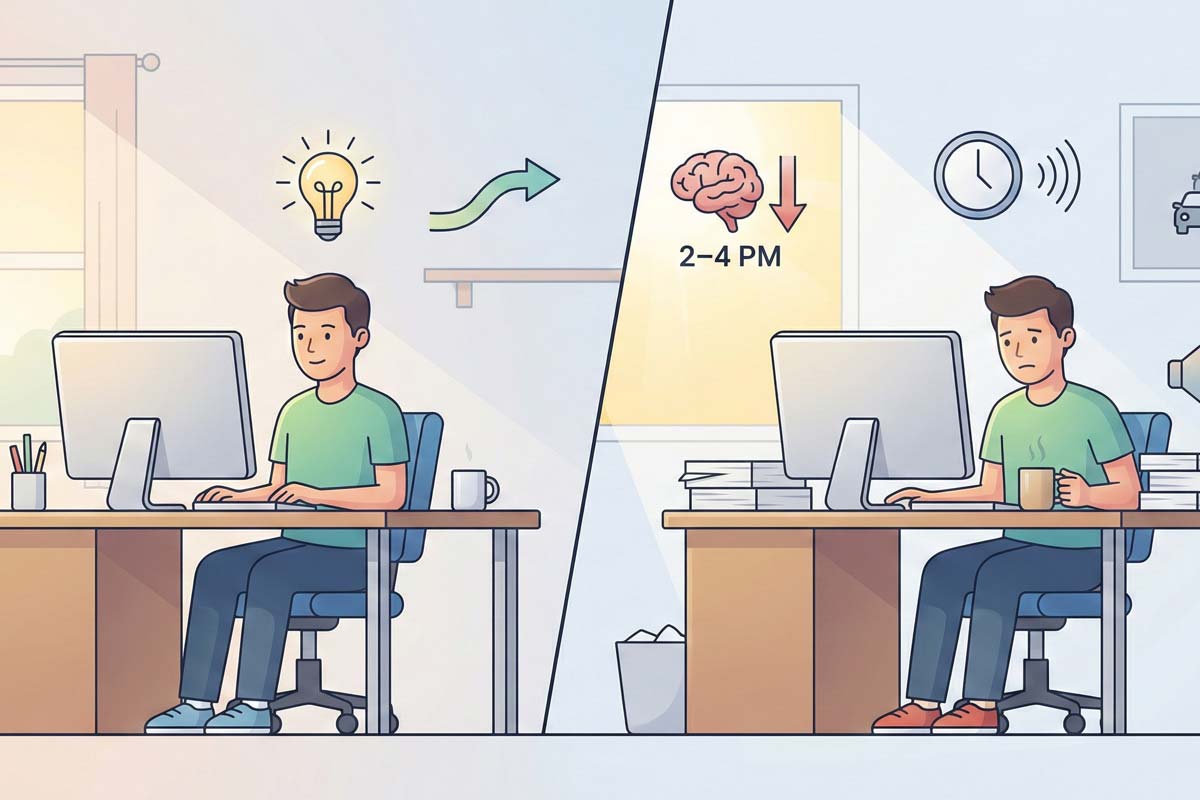
Cognitive science indicates that for approximately 75% of adults, analytical thinking and focus peak in the late morning. Conversely, the "post-lunch dip"—a documented circadian trough occurring between 2:00 PM and 4:00 PM—can significantly impact mental endurance. However, biology is adaptable; if you are forced into a time slot that doesn't match your rhythm, you can shift your circadian peak by taking practice exams at that specific time for a couple of weeks prior to the test.
But biology isn't the only factor. Your choice must also account for:
Traffic density at the specific arrival time.
Parking availability at the test site.
Commute stress and its effect on your adrenaline levels.
Because the 2026 California real estate exam contains no math questions and allows no calculators, the test consists entirely of conceptual questions, vocabulary, and scenario-based reading comprehension. You do not need calculation power; you need sustained mental endurance. You must choose a time slot that aligns with your peak mental alertness.
How Time of Day Affects Your Performance
Your brain’s performance on a standardized test is influenced by three main biological factors: cortisol levels, body temperature, and decision fatigue.
Cortisol and Alertness
Cortisol is the "waking hormone." For most people, it peaks around 30 to 45 minutes after waking up. This natural spike helps clear morning grogginess. If you schedule an 8:00 AM exam but usually wake up at 7:30 AM, you may be sitting in the testing chair before your brain has fully engaged.
Decision Fatigue vs. Scenario Questions
Decision fatigue is real. As the day progresses, the brain becomes tired of making choices. By the afternoon, after navigating traffic, scrolling through emails, or handling domestic tasks, your "willpower battery" is depleted. Because the California exam is heavily weighted toward scenario-based questions ("What should the agent do next?"), decision fatigue is particularly dangerous here. It can lead to careless errors on nuance questions you actually know the answers to.
The "No-Math" Factor
Since the DRE removed math from the exam, the test is less about formulas and more about linguistic nuance. Reading 150 or more scenario-based questions requires high-level executive function. If you are prone to afternoon slumps, the sheer volume of reading in a PM session can feel overwhelming compared to an AM session.
Morning Exam Slots — Pros and Cons
Morning slots (typically starting between 8:00 AM and 9:00 AM) are the most popular choice for first-time test takers, but they come with specific trade-offs.
The Pros:
Peak Cognitive Freshness: You capture the natural late-morning cognitive peak.
Reduced Anticipatory Anxiety: You wake up, get ready, and go. You have less time to sit around stressing about the outcome.
Operational Smoothness: Testing centers are generally cleaner and quieter in the morning. Additionally, morning sessions rarely face delays caused by technical bottlenecks or check-in backlogs from previous groups.
The Cons:
Rush Hour Traffic: If your testing center is in a metro area like Los Angeles or Oakland, getting there by 7:45 AM means battling peak traffic.
Sleep Deprivation: If you are too nervous to sleep the night before, an early alarm can leave you exhausted before you start.
Do NOT Choose Morning If:
You are a "night owl" who feels groggy until 10:00 AM.
Your commute is unpredictable (e.g., crossing major bridges or freeways prone to accidents).
You know that anxiety keeps you awake past midnight.
Afternoon Exam Slots — Pros and Cons
Afternoon slots (typically starting between 1:00 PM and 1:30 PM) offer a buffer for those who need a slower start to their day.
The Pros:
Traffic Avoidance: You can usually travel to the testing center after the morning rush has subsided.
Warm-Up Time: You have time to eat a decent meal and review the material one last time (though cramming is not recommended).
Ideal for Night Owls: If your brain doesn't fully "turn on" until 11:00 AM, this is your only viable option.
The Cons:
The Post-Lunch Slump: The body’s natural circadian dip occurs between 2:00 PM and 4:00 PM. If your exam starts at 1:30 PM, this fatigue hits you exactly around question #60 or #70—right in the middle of the test.
Ambient Noise: Afternoon sessions often contend with higher ambient noise from hallway traffic, deliveries, and street sounds as the city fully wakes up.
Accumulated Stress: You spend the whole morning waiting for the event, which can spike adrenaline levels prematurely and lead to a crash during the test.
Logistics That Influence Your Time Choice
Biology is important, but geography often dictates your schedule. California is vast, and the location of your test center should heavily influence whether you choose an AM or PM slot.
For example, if you are testing in San Diego or Oakland, an 8:00 AM exam requires arriving by 7:30 AM at the latest. This places you on the freeway during the absolute worst congestion of the day.
Remember: Traffic conditions are determined by your arrival time, not your appointment time. The stress of being late can spike your heart rate and scramble your focus before you even see the first question.
When evaluating specific California real estate exam testing centers, consider the local traffic patterns surrounding the facility. If the center is located in a high-density office park, parking might be scarce in the mid-morning but open in the early morning. Conversely, some centers have dedicated lots that fill up by 8:30 AM.
How Scheduling Works
The DRE uses a "first come, first served" model through the eLicensing system.
Morning slots tend to fill up faster than afternoon slots because many professionals prefer to take the exam and then head to work. This is especially true during the busy spring season (Q1 and Q2), where morning availability can become scarce. Once you've chosen the testing time that aligns with your chronotype, make sure you know how to schedule the California real estate exam properly—popular morning slots often fill quickly. Delaying your scheduling may force you into a less ideal time block.
What Your Exam Time Means for Exam-Day Prep
Your strategy for the day changes based on your clock.
For Morning Exams: Focus on a high-protein breakfast. Avoid heavy carbohydrates that induce sleepiness. Your goal is immediate, sustained energy. Arrive early enough to use the restroom and acclimate to the room temperature.
For Afternoon Exams: Eat a moderate lunch. A heavy meal right before a 1:00 PM test precipitates cognitive decline and drowsiness. Use the morning to relax, not to panic-study. Your arrival protocol changes slightly based on the time of day, understand what to expect on exam day regarding check-in lines and lobby congestion. Afternoon lobbies are often crowded with morning test-takers leaving as afternoon candidates arrive.
Why You Can’t Take a “Flexible Online Exam”
In the modern era, students often assume they can take the test at midnight from their home computer. This is a dangerous misconception.
Because it is currently impossible to take the California real estate exam online, you are bound to the physical constraints and operating hours of a brick-and-mortar test center. While rigid, this standardized schedule offers predictability. You cannot choose a random start time like 10:45 AM, and you cannot control the environment. This makes your choice of the standard AM or PM block even more critical. You must perform on their schedule, in person, under proctored conditions.
Final Thoughts
There is no magical time slot that makes the questions easier. The DRE creates a standardized difficulty level regardless of when you sit for the test. However, you can control the variables surrounding the test.
Choose Morning if: You wake up early, you want to avoid anticipation anxiety, and you have a clear commute.
Choose Afternoon if: You are a night owl, you have a long commute through heavy traffic, or you need the morning to settle your nerves.
Aligning your biological clock with your testing schedule is just one component of a broader strategy found in our comprehensive California Real Estate Exam Guide. Success is about preparation—both of your mind and your logistics.
Frequently Asked Questions
Is the morning or afternoon real estate exam easier? Statistically, neither exam is "easier." The difficulty level is identical, and time of day does not impact scoring. However, some students find morning exams subjectively easier because their brains are fresher and less fatigued by the day's events.
Do testing centers ever run behind schedule? Yes. While morning sessions almost always start on time, afternoon sessions can occasionally face delays if the morning check-out process runs long or if there are technical glitches at the facility.
Should I try a practice exam at the same time of day I plan to test? Yes. This is highly recommended. Taking a full-length simulated exam at the exact time of your scheduled test helps train your brain to be alert during that specific window, effectively shifting your circadian rhythm.
Should I drink coffee before the exam? If you normally drink coffee, yes. Do not change your caffeine routine on exam day. However, avoid drinking too much liquid immediately before the test, as unscheduled restroom breaks eat into your exam time.
Are morning exam slots quieter? Generally, yes. Morning sessions often have fewer distractions because the office building or testing complex hasn't fully "woken up" yet. Afternoon sessions may have more ambient noise from hallway traffic or street noise.
How early should I arrive for a morning exam? You should aim to arrive at the testing center at least 30 minutes before your scheduled start time. For an 8:00 AM exam, this means arriving by 7:30 AM to handle parking and check-in procedures.
|
The California real estate exam is administered only in five official Department of Real Estate (DRE) testing centers, each with unique parking, security, and arrival requirements. While mastering the Read more...
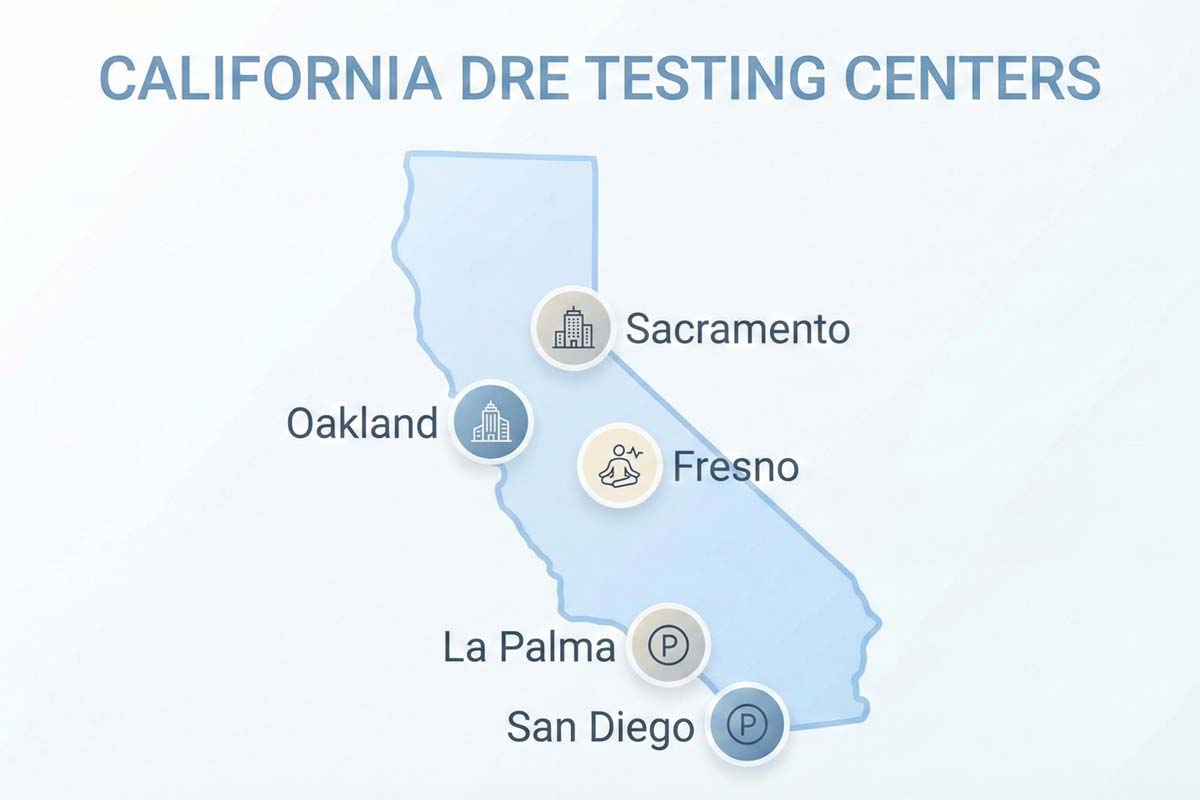
The California real estate exam is administered only in five official Department of Real Estate (DRE) testing centers, each with unique parking, security, and arrival requirements. While mastering the material is critical, understanding the logistics of these exam facilities is just as important to lowering stress on game day.
For a complete roadmap of the entire licensing journey—from application to license issuance—be sure to bookmark our comprehensive California Real Estate Exam Guide.
Many students assume they can simply log in and take the test from home. However, as we cover in our article on taking the CA Real Estate Exam Online, the answer is currently no. To ensure exam integrity, you must physically travel to one of the five specific DRE exam locations listed below.
How to Decide Which Center to Choose
Before you book, don't just pick the one closest to your house on a map. Consider these factors:
Parking Anxiety: If hunting for a meter stresses you out, avoid the downtown locations (Oakland/Fresno) and opt for La Palma or Sacramento.
Traffic Patterns: A 20-mile drive can take 90 minutes in Los Angeles. Choose a center where the commute is reliable.
Morning vs. Afternoon: Your brain power varies by time of day. Match your location choice with a time slot that suits your biology, a concept we explore in our guide on the Best Time of Day to Take the CA Real Estate Exam.
The Five California DRE Testing Locations
Here are the specific details for every active testing site in California. We have included notes on the "vibe" of each location to help you mentally prepare.
1. La Palma (Orange County)
Address: 1 Centerpointe Drive, Suite 370, La Palma, CA 90623
Parking: Do not park directly in front of the building. Head to the parking structure at Centerpointe Drive (usually the top deck).
The Vibe: This is a standard business park. It is generally quiet, landscaped, and calm.
Emotional Check: If you are prone to exam nerves, this location’s orderly, low-chaos environment is excellent for keeping your heart rate down.
2. San Diego
Address: 8620 Spectrum Center Blvd, Suite 301B, San Diego, CA 92123
Parking: Onsite parking is available but expect to pay a fee (approx. $2/hr). Have a credit/debit card ready.
The Vibe: Located in the Kearny Mesa area, this is a very busy commercial district.
Emotional Check: Because the area is bustling, give yourself extra time to park so you aren't rushing into the lobby feeling flustered.
3. Oakland
Address: 1515 Clay Street, Oakland, CA 94612
Parking: Notoriously difficult. Do not use 2-hour street meters—you cannot leave the exam to feed them, and you will get ticketed or towed. Use a long-term garage or take BART.
The Vibe: This is a government building in a dense urban center.
Emotional Check: The logistics here are high-stress. If you drive during rush hour, traffic can be brutal. If this is your only option, consider booking a time slot that avoids peak commute hours (see our Best Time to Take the Exam guide for strategies on this).
4. Sacramento
Address: 651 Bannon Street, Sacramento, CA 95811
Parking: Public lots across the street (approx. $8).
The Vibe: As the DRE headquarters, this location is efficient but sits in a somewhat industrial area.
Emotional Check: The parking lots can fill up fast in the morning. Arriving early here is mandatory to secure a spot so you aren't circling the block while your exam clock is ticking.
5. Fresno
Address: 2550 Mariposa Mall, Room 3070, Fresno, CA 93721
Parking: Metered or use the ParkMobile app.
The Vibe: Located right in the heart of downtown.
Emotional Check: Like Oakland, strict parking enforcement can cause anxiety. Pay for more time than you think you need so you aren't distracted during the test wondering if your meter expired.
Scheduling & Timing Your Arrival
Once you've picked your ideal location, you need to lock it in. If you haven't confirmed your date yet, follow the steps in our tutorial on How to Schedule the California Real Estate Exam.
Pro-Tip: Arrive at the testing center at least 30 minutes early. But don't walk in immediately. Park your car, turn off the radio, and sit in silence for 5 minutes. Deep breathing in the safety of your car before entering the building can significantly lower your cortisol levels.
Security Procedures: What to Expect Inside
The DRE treats these testing facilities like airport security. Knowing the rules prevents awkward moments at check-in.
The "No Phone" Policy: Cell phones are strictly prohibited. Lockers are sometimes available, but they are small and not guaranteed. Best advice: Leave your phone in the car.
Identification: You must have a valid photo ID (Driver’s License, Passport, Military ID).
Restroom Strategy: You can use You can use the restroom during the exam, but the clock does not stop. Micro-Tip: Use the restroom before you enter the secure exam room. Losing 5 minutes to a break can be the difference between finishing and timing out.
Getting through security is just the first step. For a full walkthrough of the check-in process and the exam interface, read our guide on What to Expect on Exam Day.
Frequently Asked Questions (FAQ)
Which California real estate testing center is the easiest? The exam content is identical at all five locations. However, students often find the La Palma and Sacramento locations "easiest" logistically because parking is more straightforward than in Oakland or Fresno.
How early should I arrive for my real estate exam? We recommend arriving at the building 30 minutes before your scheduled time. This allows for parking, finding the suite, and using the restroom without rushing.
Can I switch my exam location after booking? Yes, you can reschedule your exam location through the eLicensing system, provided there are open slots available at your desired center. However, rescheduling must be done at least four business days prior to your exam date to avoid forfeiting your fee.
Final Thoughts
Success on the California Real Estate Exam requires three things: preparation, logistics, and confidence. By verifying your exam location and parking situation now, you remove the "unknowns" from your big day.
ADHI Schools students walk into these testing centers prepared—not just academically, but logistically.
Drive safe, arrive early, and go crush that exam!
|
One of the most frequent questions we hear from students after they finish thceir statutory college-level courses is, "Okay, I’m done with the classes. Now, how long will it take me to actually prepare Read more...
One of the most frequent questions we hear from students after they finish thceir statutory college-level courses is, "Okay, I’m done with the classes. Now, how long will it take me to actually prepare for the state test?"
Valid.
The California Department of Real Estate (DRE) salesperson exam consists of 150 multiple-choice questions to be answered in 3 hours and 15 minutes. It covers everything from property ownership to mandated disclosures. Study too little, and you risk failing and waiting weeks for a re-test. Study too long, and you risk "information decay"—forgetting the material you learned at the start of your prep.
The broker exam is 200 questions and you are given up to 4 hours to complete it.
After over 20 years of teaching real estate in California and analyzing the habits of thousands of successful agents, I can tell you there is no single "magic number" that applies to every human being. However, by looking at data from our most successful students, we can identify a distinct "success window."
This guide will help you determine where you fall on that spectrum so you can build a study timeline that maximizes your chances of passing on the first try.
The Short Answer: The 40–90 Hour Rule
For the vast majority of students, the sweet spot for exam preparation lies between 40 and 90 hours of focused study after completing the three required pre-licensing courses.
The Full-Time Student (2–3 Weeks): If you can treat studying like a job (4–6 hours a day), you can be ready in just a few weeks. This immersion method is highly effective because the material stays fresh.
The Working Professional (4–6 Weeks): If you are balancing a full-time job and can only study 1–2 hours a day and more on weekends, you will need about a month to six weeks. This requires discipline to prevent the "forgetting curve" from eroding your progress.
The Crash Course Hybrid (1–2 Weeks): Students who combine independent review with a crash course often reduce their total necessary study hours because the instruction is condensed. Instructors help with pattern recognition and point out specific exam cues, which speeds up the learning process.
FAQ: Can you pass with less than 40 hours of study?
While outlier students with extensive legal or financial backgrounds sometimes pass with 20–30 hours of prep, we strongly advise against it. The DRE exam relies heavily on specific vocabulary and tricky syntax. Under-preparing significantly increases the risk of failing, which triggers a mandatory waiting period before you can re-test.
FAQ: How many weeks should you study for the California real estate exam?
Most successful candidates schedule their exam 4 to 8 weeks after finishing their college-level courses. Extending the process beyond 8 weeks often leads to diminishing returns, as you begin to forget early material while trying to learn new concepts.
Factors That Influence Your Study Timeline
1. Prior Industry Knowledge
If you have worked as an assistant to a broker or in property management, you might be familiar with terms like "escrow" or "fiduciary." However, be careful—real estate "street knowledge" is often different from the "book knowledge" the DRE tests. You still need to study, but you may grasp concepts faster.
2. Reading Comprehension Speed
The California real estate exam is a vocabulary and reading comprehension test. Questions are often complex scenarios spanning 2–4 sentences. If you have working memory limitations or cognitive bottlenecks that make it hard to hold multiple variables in your head while reading, you will need more time to practice deconstructing these questions.
3. Chronotypes and Study Habits
When do you study? Data suggests that aligning study blocks with your natural circadian rhythm (chronotype) can improve retention by 20–30%. A morning person studying at 8:00 AM retains significantly more than when they force themselves to study at 10:00 PM while exhausted.
4. Decision Fatigue
If you spend the first 15–20 minutes of every study session deciding what to study, you are wasting valuable cognitive energy. Students who use a structured syllabus or prep course move faster because they eliminate decision fatigue.
5. Study Environment and Distraction Levels
Are you studying in a quiet office or at a kitchen table with distractions? Studies show that multitasking and constant interruptions can reduce retention by up to 40%. A fragmented hour of study is worth only about 20 minutes of "deep work." Students with high-distraction environments inevitably push their timeline toward the 90-hour mark.
Recommended Study Timelines
Note: These timelines assume you have already completed the required 135 hours of statutory coursework. Your actual pace may shift depending on your learning environment and retention style.
Based on our experience at ADHI Schools, here are three structured plans. Choose the one that fits your life.
The "Standard" Plan (4 Weeks)
Ideal for: Working professionals.
Schedule: 90 minutes every weeknight; 4–5 hours on weekends.
Focus:
Week 1: Property ownership and land use controls.
Week 2: Law of agency and valuation/market analysis.
Week 3: Financing and contracts.
Week 4: Practice exams and review of weak areas.
The "Accelerated" Plan (2 Weeks)
Ideal for: Students between jobs or with open schedules.
Schedule: 4–5 hours daily.
Focus: This is an immersion technique. You will cover two major topics per day, utilizing spaced repetition in the evenings to reinforce what you learned in the morning.
The "Hybrid" Plan (Crash Course + Self Study)
Ideal for: Visual/Auditory learners who struggle with textbooks.
Strategy: You might wonder, should you take a crash course for the CA real estate exam
If you struggle with self-motivation or complex legal jargon, a crash course acts as a force multiplier. Instructors help identify the most frequently tested concepts, cutting down your self-study time.
Schedule: Review terminology for one week, attend a weekend crash course twice and schedule your exam for the following week while the information is peak-accessible in your short-term memory.
Note: Determining your timeline is just one step. To see how this fits into the broader roadmap of prerequisites and applications, refer to our comprehensive California Real Estate Exam Guide.
How Long Is Too Long?
While under-studying is dangerous, over-studying is a real trap. We generally advise against study timelines extending beyond 8 to 10 weeks.
If your prep stretches past three months, you encounter The Forgetting Curve. By the time you are studying Week 10's topic (e.g., Taxation), you have likely forgotten the nuances of Week 1's topic (e.g., Estates in Land).
Extended timelines also can lead to emotional fatigue and procrastination. The urgency to study fades, and confidence erodes as the material starts to feel stale rather than fresh. If life circumstances force a long timeline, you must dedicate specific days to reviewing older material to keep it active.
Signs You Are Ready to Take the Exam
How do you know when you have studied enough? It isn't a feeling; it's a metric. The biggest mistake students make is scheduling their exam date based on a hope rather than data. You are ready when:
You are consistently scoring 85% or higher: At ADHI, we recommend aiming for 85–90% on practice exams regularly. The actual state exam is stressful, and your score will likely drop a few points due to nerves. You need a buffer.
You have completed at least 3–5 full-length simulations: You need to know how to take practice exams for the California real estate license test properly. This means taking full-length, 150-question mock exams in one sitting without checking your phone or notes. If you haven't simulated the fatigue of the actual test, you aren't ready.
You understand the "Why": When you answer a question correctly, can you explain why the other three answers are wrong? If you can, you have mastered the concept.
Study Smarter, Not Longer: Methods That Compress the Timeline
You can brute-force your way through 100 hours of reading, or you can use learning science to get the same result in 50 hours.
In teaching thousands of students through ADHI Schools, I have found that those who pass fastest use these specific techniques:
Retrieval Practice (Active Recall): Instead of re-reading a chapter, look at the heading and force yourself to summarize the content out loud. This strengthens neural pathways far better than passive reading.
Strategic Topic Weighting: The DRE weights the exam heavily toward specific topics like Agency and Disclosures. Focusing your energy on these high-value areas is the best way to study for the California real estate exam, ensuring you don't waste time on low-yield topics like riparian rights.
Spaced Repetition: Instead of cramming vocabulary all at once, review terms in increasing intervals (1 day, 3 days, 1 week). This relies on memorization techniques that work for the CA exam to move data from short-term to long-term memory.
When You Should Not Schedule the Exam Yet
If you are eager to get your license, it is tempting to rush. However, postpone your exam date if:
You haven't taken a timed mock exam without pausing: If you are used to taking breaks every 20 questions, you will struggle with the 3+ hour endurance required for the real test.
You are relying on memorizing answer keys: If you are memorizing "C is the answer for the question starting with 'The Truth in Lending Act'," you will fail. The DRE changes question wording constantly.
You are scoring wildly inconsistently: Scoring 90% on one topic and 50% on another indicates a knowledge gap, not exam readiness.
Vocabulary is still a struggle: If you are tripping over terms like "hypothecation" or "alienation," you are not fluent enough in the language of real estate to pass.
Putting It All Together
There is no badge of honor for studying 200 hours if you could have passed with 60 hours of focused effort. Your goal is to reach a level of "unconscious competence" where the definitions and laws come to you naturally.
Start with a diagnostic practice exam to see where you stand.
Commit to a schedule. Bring the same discipline to studying that you plan to bring to the job, and this exam becomes just the first of many deals you close.
For a full understanding of the entire testing journey, see our comprehensive California Real Estate Exam Guide.
|

As the date of your California Department of Real Estate (DRE) exam approaches, a familiar panic often sets in. You’ve finished the mandatory 135 hours of pre-licensing coursework, but looking at Read more...
As the date of your California Department of Real Estate (DRE) exam approaches, a familiar panic often sets in. You’ve finished the mandatory 135 hours of pre-licensing coursework, but looking at a textbook filled with property codes and legalese can feel overwhelming.
Many students ask me, "Kartik, is it worth paying for a crash course, or should I just study on my own?"
It is a valid question. You have likely already spent money on the pre-license courses and application fees. However, the state exam is notorious for its difficulty—pass rates often hover around 50%. Students usually seek out crash courses because they feel unstructured, have run out of time, or simply don’t trust that their solo reading was enough to retain the information.
In my 20+ years of teaching real estate in California, I have seen crash courses save careers, but I have also seen students treat them like magic pills. A crash course amplifies existing knowledge; it doesn’t replace it. Let’s break down exactly what these courses offer, the learning science behind them, and whether one is right for you.
What Exactly Is a Crash Course?
A crash course is distinct from your statutory college-level courses (Real Estate Principles, Practice, and an Elective). It is not about satisfying a legal requirement; it is about pure exam performance.
Think of it as the difference between learning to play a sport and studying the playbook right before the big game. A crash course typically takes place over a weekend (or two full days) and provides accelerated instruction focused on:
High-Yield Topics: Focusing on the concepts the DRE tests most frequently (like Agency and Property Ownership) rather than obscure laws that rarely appear.
Because the DRE heavily weights topics like Agency and Disclosures, crash courses prioritize the sections that move your score the most.
Pattern Recognition: Learning to spot how the state constructs "distractor" answers designed to trick you.
Vocabulary Density: Rapid-fire review of the specific terminology used on the test.
Who Benefits Most?
Not every student needs a crash course. Some people are autodidacts who can read a glossary once and retain it perfectly. However, based on thousands of students I’ve observed, the following learner profiles benefit the most from live or livestreamed exam prep:
The Visual/Auditory Learner: If reading a 600-page textbook makes your eyes glaze over, hearing an instructor explain why a dual agency violation is risky makes the concept stick.
The “Rusty” Student: Perhaps you finished your certificates six months ago and life got in the way. You have forgotten the difference between a freehold and a less-than-freehold estate.
The Working Professional: You don't have hours to study every evening. You need a forced, immersive environment to clear your schedule and focus.
The Retaker: If you have failed once, you likely know the material but are falling for the DRE’s trick wording.
A crash course also acts as a litmus test for your timeline. If you sit through a weekend review and feel completely lost, it is a sign you need to push your exam date back. Conversely, if you are unsure how long should you study for the CA real estate exam, a crash course can serve as a final validation that you are ready to schedule your test immediately.
How Crash Courses Improve Exam Readiness
There is cognitive science at play in a good cram session. It isn't just about stuffing facts into your brain; it’s about retrieval practice.
When you study alone, you often suffer from "illusion of competence"—you read a chapter and think you know it. In a crash course, the instructor asks questions that force you to retrieve information under pressure. This highlights your blind spots immediately.
Furthermore, these courses reduce decision fatigue. When studying alone, you waste energy deciding what to study. In a structured review, the instructor curates the curriculum based on the DRE’s weighted content outline.
Most importantly, expert instructors teach you how to practice exams for the California real estate license test by decoding the structure of the questions themselves. They show you how to identify the "stem" of the question, eliminate the two obviously wrong answers, and navigate the subtle differences between the remaining two choices.
When a Crash Course Alone Is Not Enough
I want to be transparent: a crash course is a catalyst, not a replacement for foundational knowledge. It cannot teach you an entire semester’s worth of law in 16 hours.
A crash course will likely fail you if:
You have zero prior knowledge: If you skimmed through your online courses without reading, a crash course will move too fast for you.
Your reading comprehension is low: The exam is as much a reading test as it is a real estate test.
You expect a shortcut: You cannot passively listen to a lecture and expect to pass. You must actively engage.
If your grasp of the terminology is weak, you will need to spend time mastering specific memorization techniques that work for the CA exam — such as flashcards or mnemonics — before a weekend review can truly help you.
The Hybrid Approach (Best for Most Students)
The students who pass on the first try rarely use only self-study or only a crash course. They use a hybrid strategy.
In my experience, best way to study for the California real estate exam involves a specific sequence:
Foundation: Skim your textbooks and finish your qualification courses.
Immersion: Take the crash course 1–2 weeks before your test day to organize your mental filing cabinet while the content is still fresh.
Application: Spend the final week doing nothing but timed, challenging mock exams to build stamina.
This “sandwich” approach ensures you have the background knowledge to understand the crash course, and the practice time afterward to cement what you learned.
Is It Worth It?
Deciding whether a crash course is worth it starts with understanding the critical tradeoff between time saved and clarity gained.
From a cost-benefit perspective, consider the cost of failure. If you fail the exam, you have to pay the state re-application fee, but more importantly, you lose weeks of potential income and momentum.
A crash course provides clarity, and it reduces anxiety by demystifying the exam. It allows you to walk into the testing center knowing you didn’t leave your preparation to chance. If the course helps you answer just five or six difficult questions correctly that you otherwise would have missed, it has paid for itself in the form of a passing grade.
Ultimately, the decision to take a crash course depends on your learning style and your confidence level. If you are disciplined, organized, and testing above 85% on practice exams at home, you might be fine on your own. But for most students, the structure, expert guidance, and pattern recognition taught in a weekend review are the difference between a confusing failure and a confident pass.
Assess your timeline, be honest about your study habits, and use the course to amplify your existing knowledge.
If you want to see how a crash course fits into the full licensing timeline and find resources for the next step, check out our comprehensive guide:
➡ California Real Estate Exam Guide
FAQ
1. Is a crash course required to take the California real estate exam?
No. A crash course is optional and not required by the California Department of Real Estate (DRE). The mandatory requirement is completing the 135 hours of pre-licensing education. A crash course is simply a performance booster designed to improve exam readiness.
2. Will a crash course help me pass the CA real estate exam on the first try?
For most students, yes. Crash courses improve your chances by focusing on the highest-weighted exam topics, teaching test-taking patterns, and reinforcing retention through active recall. Many students say the review helped them answer tricky “distractor” questions they would have otherwise missed.
3. How do I know if I actually need a crash course?
You may benefit from a crash course if you feel unstructured, haven’t studied in weeks, struggle with vocabulary, or score inconsistently on practice exams. If you’re unsure how long you should study for the CA real estate exam, attending a review session can confirm whether you’re ready to schedule the test.
4. Can a crash course replace studying the textbooks?
No. A crash course amplifies what you already know—it does not substitute the foundational material in your Principles, Practice, and elective courses. If you haven’t mastered basic vocabulary or concepts, you should reinforce those first with memorization techniques that work for the CA exam.
5. Should I take a crash course right before the exam?
Yes. Most students benefit most when they take a crash course 1–2 weeks before test day, then follow it with a week of timed practice exams. This sequence helps the material stay fresh and improves endurance for the 3+ hour state test.
6. Will a crash course help if I already failed the exam once?
Absolutely. Retakers often know the content but struggle with the DRE’s tricky question structure. Crash courses teach pattern recognition, how to identify the question “stem,” and how to eliminate wrong answer choices—skills that improve second-attempt success rates.
7. Is a livestream or online crash course as effective as an in-person one?
For most students, yes. Online crash courses still allow for real-time Q&A, instructor interaction, and guided pattern recognition. If you prefer learning from home or have limited time, a remote session can be equally effective.
8. What should I do after finishing a crash course?
The most important next step is taking full-length, timed practice exams to cement what you learned. This builds stamina and exposes any weak areas. Continue reviewing high-yield topics until you consistently score 85% or higher.
|