You’re not crazy for searching for these numbers. Whether you are just starting your real estate pre-licensing courses or you’ve already scheduled your date at the testing center, everyone wants to Read more...
You’re not crazy for searching for these numbers. Whether you are just starting your real estate pre-licensing courses or you’ve already scheduled your date at the testing center, everyone wants to know the "odds."
The problem? If you search for the California real estate exam pass rate, you’ll find a dozen different numbers from a dozen different blogs.
Some use outdated data, while others guess.
At ADHI Schools, we believe in objective authority. We’ll show you the most recent, source-pure numbers available from the California Department of Real Estate (DRE), explain what they actually mean for your attempt, and provide an action plan to ensure you end up on the right side of the statistics. Drawing from over 20 years of helping students navigate this process, I can tell you that while the numbers seem daunting, they are entirely beatable with the right approach.
Updated Feb 2026: The latest DRE RE-149 report publicly posted at the time of writing is December 2025.
The Official Data: DRE RE-149 Snapshot
The most "official" look at pass rates comes from the DRE’s monthly RE-149 Comparative Production Statistics. These reports track exams scheduled, exams administered, and the attempt-based % passed for each month and fiscal year-to-date.
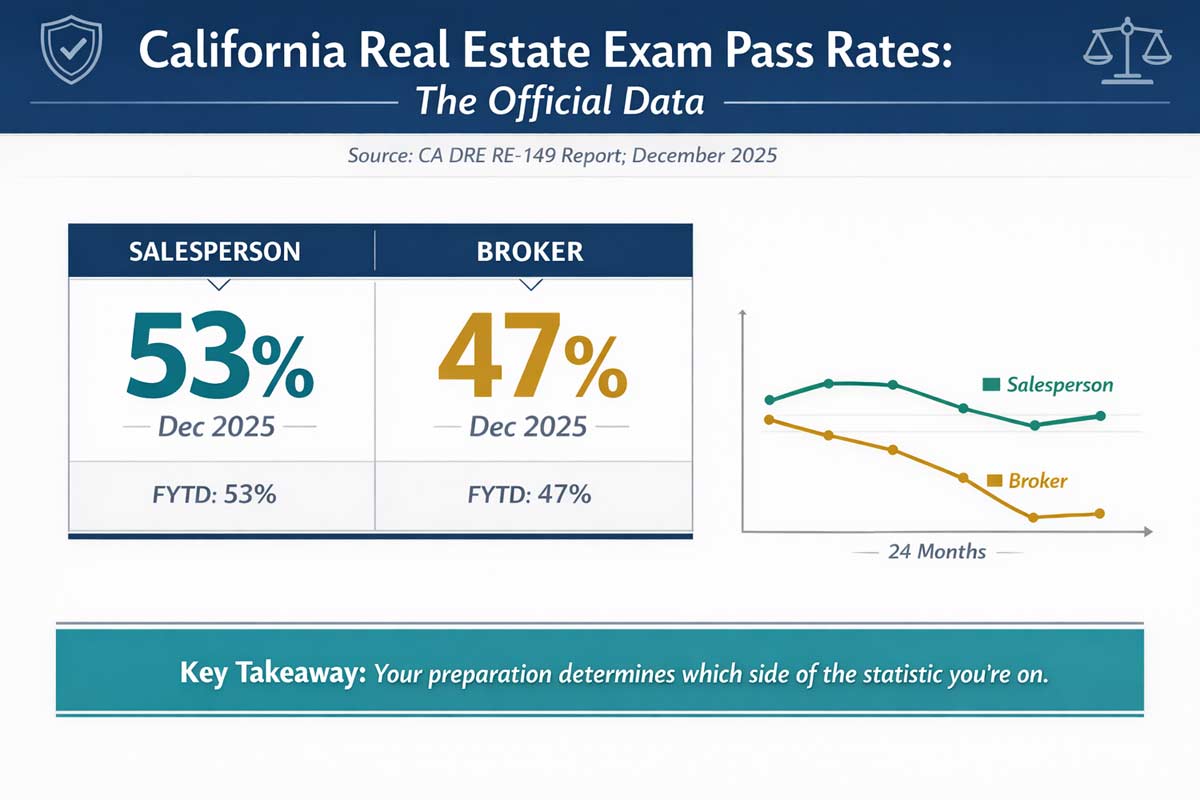
According to the December 2025 RE-149 report, here is how the state performed:
DRE Exam Pass Rates (RE-149, Dec 2025)
License Type
Dec 2025
Nov 2025
Dec 2024
FYTD
Last FYTD
Salesperson
53%
52%
50%
53%
52%
Broker
47%
45%
50%
47%
48%
Source: California Department of Real Estate, RE-149 Comparative Production Statistics. "FYTD" is the DRE fiscal year-to-date shown in RE-149 (not a rolling 12-month average).
Key Takeaway: Pass rates move month to month. RE-149 gives you the statewide attempt-based baseline—your job is to prepare so you’re in the passing half when you sit.
How Pass Rates Are Calculated (And Why They Vary)
You might see one website claim a 70% pass rate and another claim 40%. Both can be "kind of" right depending on the data source, but the DRE's reporting is specific:
Attempt-Based Rate: The RE-149 report is attempt-based. Every single exam administered counts toward the total. If one student fails twice and passes on the third try, the DRE records two "fails" and one "pass." This reflects the general preparedness of everyone in the room that day, including retakers.
Candidate-Based Outcomes: Some academic studies track whether an individual eventually passes. Most people who stick with it do eventually get their license, but they may not pass on the first try.
Licenses Issued vs. Exams Administered: This is an imperfect proxy. Some people pass the exam but never complete the background check or pay their licensing fee, so they don't show up in the "Licenses Issued" column.
When looking at the CA DRE exam pass rate, always look for the 'Statewide Average' to see the true baseline. This is exactly why we designed the ADHI Schools Crash Course—to give students a specialized environment where they can move past general state averages and focus on the specific logic the DRE uses to write their questions.
Why the discrepancy?
Many schools report their own internal pass rates, which are often higher than the state average because their students are using specific prep tools. When looking at the CA DRE exam pass rate, always look for the "Statewide Average" to see the true baseline.
Pass Rate Trends: Stability vs. Volatility
The RE-149 includes a built-in two-year FYTD comparison. In Dec 2025, the Salesperson FYTD pass rate was 53% vs. 49% two years ago, while Broker FYTD was 47% vs. 49% two years ago—meaning the baseline shifts, but it doesn’t swing wildly.
Relative Consistency: Historically, both salesperson and broker exams fluctuate between the mid-40s and mid-50s.
Volume Shifts: When the real estate market is "hot," exam volume spikes. Interestingly, pass rates often dip during these times because more people "try" the exam without adequate preparation.
The Retake Effect: While the RE-149 doesn't separate first-timers from retakers, industry observations suggest that first-time candidates who have recently completed a high-quality prep course generally perform above the state average.
What These Stats Mean for You
Statistics are macro; your performance is micro. A 53% pass rate doesn't mean you have a coin-flip's chance of passing. It means that nearly half of the people who showed up that day were not prepared.
Real-World Scenarios from Kartik's 20+ Years
In my experience coaching thousands of students, I’ve seen two types of candidates fall into the "fail" category:
The Triage Failure: A student who is brilliant at contracts but ignores "Practice" or "Financing." They fail because they didn't balance their study time across the DRE's seven main topics.
The "Practice Exam" memorizer: A student who memorizes 1,000 practice questions but doesn't understand the concepts. When the DRE rewords the question on the actual exam, the student freezes.
If you're asking yourself, is the California real estate exam hard?, the answer is: it’s a high-standard professional gatekeeper. But it is not an IQ test. It is a preparation test.
Why People Fail (And How to Bridge the Gap)
Most failures aren't due to a lack of intelligence; they are due to test-day execution and content gaps. Common culprits include:
Misreading the "except" or "not" in a question.
Over-studying niche topics that only account for 5% of the exam.
Anxiety leading to second-guessing original (and often correct) answers.
For a deeper look at the specific pitfalls that trip up candidates, read our guide on why people fail the California real estate exam.
Action Plan: How to Beat the Average
To ensure you are in the 50% that passes, you need a system.
1. Topic Prioritization
Don't treat all chapters equally. Focus heavily on Practice of Real Estate and Disclosures, as this single category accounts for roughly 25% of the salesperson exam.
2. The Error Log Method
Every time you get a practice question wrong, don't just look at the right answer. Write down why you got it wrong. Was it a lack of knowledge or a trick of the wording?
3. The 14-Day Reset (For Retakers)
If you didn't pass, don't rush back in 15 days later doing the exact same thing. You need to know how many times can you take the CA real estate exam? (Spoiler: as many as you need within two years), but each attempt costs time and money. Use a 14-day reset to focus exclusively on the "weak" areas identified in your DRE result bridge.
For those looking to one-and-done this process, check out our tips for passing the CA real estate exam on the first try.
FAQ: California Real Estate Exam Pass Rates
What is the California real estate exam pass rate?
As of December 2025, the salesperson pass rate was 53% and the broker pass rate was 47%.
Is the broker exam pass rate always lower?
Not always. Pass rates fluctuate. While brokers often have higher averages due to more experience, current trends show the salesperson pass rate is slightly higher.
What is the first-time pass rate vs. retake pass rate?
The DRE does not break these out in their monthly RE-149 reports. These terms are addressed conceptually by prep schools, but state data is strictly attempt-based.
Where can I find official DRE statistics?
The DRE publishes monthly RE-149 reports on their official website.
Take the Next Step
The pass rate is just a number; your preparation is a choice. Whether you are using our California Real Estate Exam Guide to start your journey or you're troubleshooting a recent attempt, we are here to help you navigate the data and get your license.
Don't let the stats scare you—let them motivate you to be the most prepared person in the room.
|

TL;DR: The 90-Minute Monthly Newsletter System (Beginner-Proof)
Pick a lane: Market Translator, Homeowner Value, or Buyer/Relocation.
Use one template: Stick to the same structure every Read more...
TL;DR: The 90-Minute Monthly Newsletter System (Beginner-Proof)
Pick a lane: Market Translator, Homeowner Value, or Buyer/Relocation.
Use one template: Stick to the same structure every month so you actually ship it.
Send monthly for 90 days: Focus on consistency first, then optionally move to bi-weekly once the habit is locked in.
Measure the right thing: Prioritize replies and booked conversations over "pretty design."
The Newsletter Mindset Shift: From Spam to Service
You have 250 contacts in your phone. Every time you think about emailing them, you panic. What do I say? Will they think I’m annoying?
Most agents treat a newsletter like a digital billboard. They blast out "Just Listed" photos and generic "Happy Spring" graphics. That isn't a newsletter; that’s noise. Your newsletter is a regular, valuable touchpoint that makes you the obvious choice when a real estate need arises.
In 20+ years as a California operator, I’ve rarely seen a consistent, value-first newsletter not produce replies—because it compounds familiarity. Every email is a trust deposit. This is the core of Real Estate Marketing Basics—the foundational system that shows California agents how marketing actually converts attention into conversations.
"Is this relevant enough that my ideal client might reply or forward it to a friend?"
Step 1: Choose Your "California Lane"
To avoid the Personal Branding Mistakes New Agents Make, you must pick a specific lane for the next 90 days. Your newsletter works best when it reinforces a clear positioning—something we break down further in Branding Yourself as a California Real Estate Agent.
Lane 1: The Local Market Translator: Explain what median price shifts in San Diego or DOM (Days on Market) in the Inland Empire actually mean for a homeowner's equity.
Lane 2: The Homeowner Value Engineer: Focus on Prop 19 benefits, ADU potential, and smart renovations. You help them manage their largest asset. Always frame these topics as educational and encourage homeowners to confirm details with a CPA, attorney, or their local jurisdiction.
Lane 3: The Buyer/Relocate Guide: Demystify the California buying process, neighborhood vibes, and school district nuances for newcomers.
Step 2: Set Up the Boring Stuff (So You Don’t Get Burned)
Before you write a single word, set these once to ensure you stay professional and compliant:
Sender name: “Kartik @ [Brokerage]” (Use your name; never use “No-Reply”).
Reply-to: Your real email address. Your goal is to start a dialogue.
Footer: Your full name, brokerage name, and DRE #. This is non-negotiable in California.
Unsubscribe link: Mandatory for every send.
One list only: Start with your sphere and warm contacts. Never buy a list.
Mobile check: Send a test to yourself and read it on your phone first.
Step 3: The “Same Every Time” Newsletter Template
Your newsletter should feel like a familiar TV show: same format, new episode. This builds the consistency required for branding yourself.
Subject (Benefit + Place): “What today’s OC inventory shift means for you.”
Human Opener (2 sentences): Local and relevant. Example: "The line at Porto’s was wrapped around the block today—reminded me how fast things move in Buena Park."
One Idea: One chart, one story, or one principle (e.g., why interest rates shouldn't stop a move-up buyer).
What it Means for You: Translate the idea into a decision. Example: “If you’ve been waiting for a 6% rate, you might be missing the best equity window in five years.”
One CTA: One action only. (See the Keyword System below).
Signature & Compliance Footer: Name, Brokerage, and DRE #.
The CTA That Actually Works: “Reply With One Word”
People often won’t click a link, but they will reply if it’s easy. Pick one of these for your newsletter:
Reply Keyword
What They Get
VALUE
I’ll send a quick home value range for your specific neighborhood.
ADU
I’ll send the California ADU feasibility checklist.
BUY
I’ll send my “first 30 days” buyer game plan.
SELL
I’ll send my pricing and prep checklist for your specific zip code.
Tip: When someone replies, respond within 24 hours—even if it’s just to acknowledge and schedule a follow-up. Speed compounds trust.
Step 4: The California-Ready Content Menu
Pick one idea for your next edition.
Note: Always include a disclaimer that you are not providing tax or legal advice.
Market Intelligence: California Association of REALTORS® (C.A.R.) monthly data decoded for your city.
Homeowner Wealth: How Prop 19 might affect your parents' ability to downsize.
Transaction Truths: Why the "Appraisal Gap" is the most important term in a CA contract right now.
Hyperlocal Spotlight: The best coffee shop in your neighborhood for a morning meeting.
Step 5: Frequency (What You Can Sustain Wins)
If you’re new, start monthly. One newsletter sent 12 times a year beats two newsletters sent twice.
Months 1–2: Monthly (Build the habit).
Month 3+: Optional bi-weekly if you are consistently getting replies.
Your First Newsletter Should Be an Intro (Copy/Paste)
Subject: Quick note — I’ll send one helpful real estate email each month
Body:
“Hey — quick note. I’m starting a simple monthly email where I share one California real estate insight (prices, inventory, and practical homeowner tips). No spam, no daily blasts.
If you ever want out, you can unsubscribe at the bottom. If you want something specific, reply with what city or zip code you care about and I’ll tailor future emails for you.”
California Compliance: Stay Professional
Broker Review: Have your broker-of-record glance at your template.
Accuracy: Be meticulous about sourcing your data (C.A.R., MLS, etc.).
Reply Goal: Treat open rates as noisy; prioritize replies and booked conversations. If you get 1–3 replies per 100 sends, you are winning.
The System is the Secret
Mastering your newsletter is just one part of the Real Estate Agent Skills California ecosystem. This hub explores the full range of technical and interpersonal skills required to thrive in the Golden State.
Your first newsletter is the hardest.
Send it anyway.
Then send 11 more.
That’s when the system starts working for you.
FAQ: Real Estate Newsletters
How often should a real estate agent send a newsletter?
Start monthly. Once you can produce a monthly email in under 90 minutes without stress, you can consider moving to a bi-weekly cadence.
What should I avoid putting in my newsletter?
Avoid politics, "listing-only" blasts, and generic national news that doesn't explain the impact on a local California homeowner.
Do I need permission to email people?
Start with people who know you (sphere, clients, and opted-in leads). Use honest subject lines, include your business info and an unsubscribe link, stay CAN-SPAM compliant and never email people who have asked you to stop. When in doubt, consult your office's specific policy.
What is the best email platform for agents?
Mailchimp and ConvertKit are excellent for beginners. If you use a CRM like Chime or LionDesk, ensure the templates are easily readable on mobile.
How do I measure if it's working?
The only metric that matters is the "Reply." If people are asking you questions or thanking you for the data, the system is working.
|

The phrase “135 hours” sounds simple enough—until you realize that doing it wrong can cost you months of delays and hundreds of dollars in wasted fees.
Many aspiring agents assume the California Read more...
The phrase “135 hours” sounds simple enough—until you realize that doing it wrong can cost you months of delays and hundreds of dollars in wasted fees.
Many aspiring agents assume the California 135-hour real estate course requirement is a single marathon class or a weekend workshop. Others worry that if they choose the wrong elective or an unapproved provider, the Department of Real Estate (DRE) will reject their application entirely.
I have spent over 20 years helping students navigate these exact hurdles. Whether you are a busy parent, working a 9-to-5, or moving from out of state, the mission is the same: get your hours done right the first time so you can get to the exam.
Key Takeaways
The Magic Number: You must complete three 45-hour college-level courses with an approved course provider like ADHI Schools.
The Lineup: Real Estate Principles, Real Estate Practice, and one elective.
The Requirement: All courses must be completed through a DRE-approved provider.
The Goal: These hours are the mandatory prerequisite for your salesperson application.
Definition: The California 135-hour real estate course consists of three 45-hour, DRE-approved pre-licensing classes: Real Estate Principles, Real Estate Practice, and one elective.
The Quick Breakdown: What Makes Up the 135 Hours?
To qualify for a salesperson license in California, the DRE requires 135 hours of pre-licensing education.This is strictly divided into three specific buckets:
Real Estate Principles (45 Hours)
Real Estate Practice (45 Hours)
One Approved Elective (45 Hours)
You don’t just "sit in a room" for 135 hours straight. You complete these three distinct courses, pass a final exam for each, and receive a course completion certificate for your records.
Why California Requires 135 Hours
This isn't just "busywork" or a regulatory hurdle. The 135-hour requirement serves several critical purposes:
Baseline Competency: It ensures every agent understands the legal and ethical framework of the industry.
Consumer Protection: It teaches the complex disclosure laws designed to protect California homeowners.
Exam Readiness: Each course domain maps directly to sections of the State Exam. If you skip the depth here, the exam will likely find your weak spots.
What Exactly Counts Toward the 135 Hours?
In the eyes of the DRE, "hours" are a measure of curriculum coverage. To ensure your education counts, follow this checklist:
DRE-Approved Provider: Check the school’s DRE statutory sponsor ID number before enrolling. For context the ADHI Schools sponsor ID is S0348.
Course Completion: You must complete the required material and pass a school-level final exam for each 45-hour course.
Digital Records: Keep your completion certificates saved as PDFs; you will need to upload (preferred) or mail these with your exam and license application.
Deep Dive: The 3 Course Requirements
1. Real Estate Principles (45 Hours)
This is your foundation. It covers the "language" of the industry—titles, deeds, encumbrances, and financing. This isn't just about passing a test; it’s about understanding the legal framework of every transaction.
2. Real Estate Practice (45 Hours)
If Principles is the "what," Practice is the "how." This course covers agency relationships, disclosures, and the actual mechanics of a real estate transaction. This is where most students realize real estate is about lead generation, contracts and consumer protection.
3. The Elective (45 Hours)
You must choose one additional 45-hour course from a DRE-approved list. Here is how to choose:
If you want to learn about loans → Choose Real Estate Finance.
If you want to learn about loans → Choose Legal Aspects of Real Estate.
If you want to learn about loans → Choose Real Estate Appraisal.
ADHI Schools offers a wide variety of elective courses.
Common Mistakes That Trigger Delays
Don't let a simple clerical error or a lapse in planning stall your career. While speed is a priority for most, you should focus on the fastest way to complete the 135-hour CA real estate course without taking shortcuts that lead to rejection. Avoid these common "landmines":
Common Pitfalls to Avoid:
The "Cram" Trap: Trying to rush the last 45 hours in a weekend. Most DRE-approved programs have pacing controls and required unit progression, so rushing usually backfires. Remember that the state requires 18 days per course before you can take the final exam and obtain the certificates of completion.
Using Non-Approved Providers: Ensure the school is licensed for pre-licensing specifically.
Passive Reading: Treating the course like "background noise." If you don't engage, you'll finish the hours but will have a tough time with the state exam.
Missing Documentation: Not having your three certificates organized when you are ready to apply for the exam.
Setting Realistic Expectations: Timelines and Formats
Understanding the curriculum is only half the battle; you also need to know how long it takes to finish CA real estate classes based on your current lifestyle. Highly disciplined students might finish in under two months, while students with less urgency often take four to six.
Your pace is often dictated by the medium you choose. When deciding between online vs. in-person CA real estate classes: pros & cons, consider whether you need the structure of a classroom or the 24/7 flexibility of a digital portal. Both can satisfy the online 135-hour real estate course California standards, provided the school maintains its DRE approval.
Avoiding the Risk of Failure
Is it actually difficult to pass these initial hurdles? Many students ask, "can you fail California real estate school?" While the school-level exams are manageable, failing to respect the 135-hour requirement can lead to "timing out" of your enrollment (all courses must be finished within one year) or failing to retain enough information to pass the state exam on your first try.
Mini FAQ
Do I need to finish all 135 hours before applying for the exam?
Yes, the California Department of Real Estate requires that all 135 hours are complete before applying for the real estate exam.
Is the 135-hour requirement the same for a Broker's license?
No. Broker applicants generally need eight college-level courses. The 135-hour (3-course) requirement is specifically for the Salesperson license.
Can I take the three courses in any order?
While you technically can, we strongly suggest starting with Practice. Taking them out of order can lead to confusion when you hit advanced topics in Legal Aspects of Real Estate or other Electives.
Do my course hours expire?
Under the current regulations of the Real Estate Commissioner the certificates never expire.
Your Next Steps
Understanding the 135-hour real estate course requirements California mandates is just the first hurdle. Once you’ve started your classes, you need to know how they fit into the larger picture of fingerprints, background checks, and the state exam itself.
To ensure you don't miss a single detail in the process, follow our comprehensive California Real Estate License Guide to take your career from the classroom to the closing table.
|
The “Branding Panic” Reality
Most new agents think "branding" means picking a hex code, designing a logo on Canva, and maintaining a high-gloss Instagram aesthetic. The truth is that in the hyper-competitive Read more...
The “Branding Panic” Reality
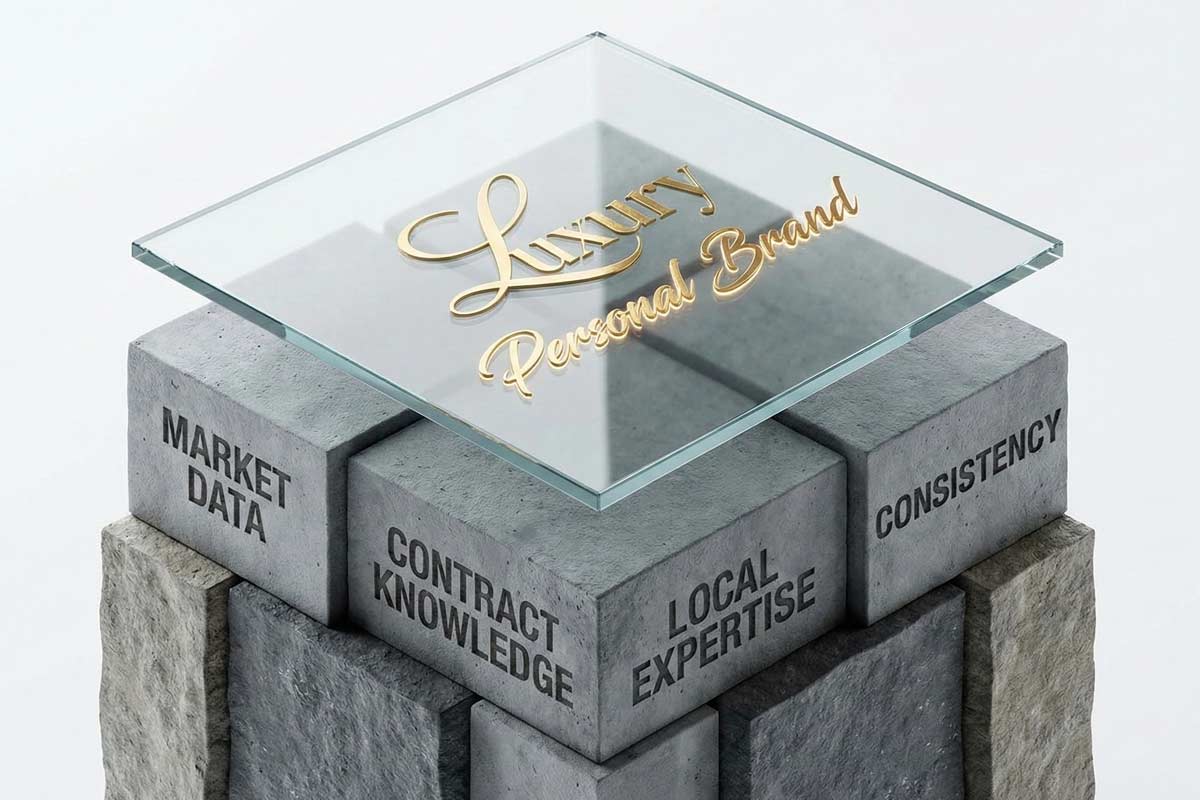
Most new agents think "branding" means picking a hex code, designing a logo on Canva, and maintaining a high-gloss Instagram aesthetic. The truth is that in the hyper-competitive California real estate market, this is a dangerous distraction.
In California, branding isn't a decoration—it is pre-qualification. Before a lead ever picks up the phone, they have already vetted you online. They aren't looking for a celebrity; they are filtering for competence, trust, and consistency.
This article focuses on branding mistakes specifically, but branding is just one component of the broader Real Estate Agent Skills stack you need to succeed long-term. After 20+ years of coaching California agents at ADHI Schools, I’ve seen thousands of new licensees stall because they prioritized "vibes" over value. Despite what Instagram would have you believe, the goal of your brand isn’t fame; it is to create a predictable system for generating real estate leads.
The 60-Second Definition
Your brand is the pattern people remember: who you help, what you help them do, and proof you do it consistently. Branding is a functional system that supports your lead generation—it is not a vanity project. If you need a step-by-step framework, start with our guide on Branding Yourself as a California Real Estate Agent before you touch design tools.
12 Personal Branding Mistakes New Agents Make (And How to Fix Them)
1. Trying to Brand “For Everyone” (No Niche, No Message)
The Mistake: Posting generic "I love real estate" content and hoping anyone with a pulse calls you.
Why it Kills Trust: If you help everyone, you specialize in nothing. California consumers want a specialist.
The Fix: Pick a specific niche or neighborhood.
Do this today: Write down the one specific type of person you are best equipped to help right now (e.g., "First-time buyers in Eagle Rock").
2. Confusing Aesthetics with Positioning (Logo ≠ Brand)
The Mistake: Spending three weeks on a logo and zero hours on your value proposition.
Why it Kills Consistency: A logo doesn't sell a house; your ability to generate leads and navigate a CA purchase agreement does.
The Fix: Prioritize branding yourself as a real estate agent (California) based on your expertise first.
Do this today: Define your "Unique Value Proposition" in one sentence.
3. Copying Top Producers (The “Fake Luxury” Trap)
The Mistake: Renting a luxury car or posing in front of $10M listings you didn’t list to look "successful."
Why it Kills Trust: People can smell inauthenticity. It creates a "persona mismatch" when you finally meet in person.
The Fix: Match your branding to your actual inputs. Focus on being the "Hyper-Local Expert."
Do this today: Take a photo of yourself actually working—at a local coffee shop or touring a new listing.
4. Posting Randomly Instead of a Real Estate Marketing System
The Mistake: Posting a sunset today, a quote tomorrow, and nothing for three weeks.
Why it Kills Consistency: Inconsistency signals a lack of professional discipline. This is where agents skip the fundamentals covered in Real Estate Marketing Basics (California Edition) and mistake activity for strategy.
The Fix: Use content buckets (Market Updates, Behind the Scenes, Local Spotlights).
Do this today: Choose three "content buckets" and commit to posting one of each every week.
5. No Proof: Claims Without Evidence
The Mistake: Claiming to be an "expert" without showing any data, neighborhood knowledge, or process.
Why it Kills Trust: California buyers are data-driven. They need proof you know the market.
The Fix: Share "Proof Assets"—market trends, neighborhood walk-throughs, or process explainers.
Do this today: Find one interesting stat about your target zip code and explain what it means for buyers.
6. Over-Sharing Personal Noise
The Mistake: Posting what you ate for lunch more often than you post about real estate.
Why it Kills Leads: It creates noise, not value. Clients want a professional, not just a person with a phone.
The Fix: Follow the 80/20 rule: 80% professional value, 20% personal flavor.
Do this today: Audit your last 10 posts. If more than 3 have zero real estate relevance, delete the weakest one.
Quick gut check: If your brand disappeared tomorrow, would anyone in your database notice? If not, that’s not a failure—it just means you need a system.
7. Under-Selling: Hiding the CTA
The Mistake: Writing a great post but never asking for the business.
Why it Kills Leads: People won't take the next step unless you lead them there.
The Fix: Every piece of content should have a "Call to Action" (CTA).
Do this today: Add "DM me 'Market' for a copy of my neighborhood report" to your next post.
8. Talking Like a Brochure (Generic Slogans)
The Mistake: Using generic slogans like "Honesty, Integrity, Results."
Why it Kills Trust: These are "table stakes"—everyone says them, so they mean nothing.
The Fix: Speak to specific problems (e.g., "I help sellers find buyers even when inventory is low").
Do this today: Replace one generic adjective on your bio with a specific problem you solve.
9. Not Owning a “Signature Framework”
The Mistake: Having no repeatable way to explain your process to a lead.
Why it Kills Trust: It makes you look like you’re "winging it."
The Fix: Create a 3-step or 5-step "Roadmap to Closing."
Do this today: Outline the 5 steps you take a buyer through from consultation to keys.
10. Ignoring the Trust Engine: The Real Estate Newsletter
The Mistake: Relying solely on social media algorithms you don't own.
Why it Kills Consistency: If the algorithm changes, your brand disappears.
The Fix: Learn how to create a real estate newsletter to stay top-of-mind.
Do this today: Start a simple list of 50 people you know and send them a "market-at-a-glance" email.
11. Mistaking Followers for Leads (The Wrong Scoreboard)
The Mistake: Focusing on "Likes" from other agents instead of "Leads" from potential clients.
Why it Kills Leads: You end up performing for peers rather than serving prospects.
The Fix: Measure your brand by the number of conversations it starts.
Do this today: Check your DMs. Count how many "real estate" conversations you started this week.
12. Branding Over Skill-Building
The Mistake: Having a world-class brand but 1st-grade contract knowledge.
Why it Kills Trust: You will get the lead, but you will lose the client if you can't perform.
The Fix: Align your brand with actual Real Estate Agent Skills (California).
Do this today: Spend 30 minutes reading a standard CAR form instead of scrolling.
Brand Kit Lite: The Fast System
Avoid the "branding trap" by sticking to this simple checklist:
1-Sentence Positioning: "I help [Target Audience] in [Location] achieve [Outcome] without [Common Pain Point]."
3 Content Buckets: Market Data, Local Lifestyle, Process Explainers.
1 Lead Capture Habit: A bi-weekly real estate newsletter for agents to nurture your database.
1 Proof Asset: A "Neighborhood Guide" PDF you can offer for free.
California-Specific Reality Checks
In California, you aren't just competing with the agent down the street; you are competing with tech-enabled platforms and highly sophisticated consumers. Your brand must communicate high-level competence.
Practical advice for real estate agents in the Golden State: Your brand is built in small reps. It’s the consistency of your messaging followed by the consistency of your follow-up.
Real-World Scenario: The Random Posting Trap
An agent posts a "Sold" post from their office, and a generic "Happy Friday" on Friday. A potential seller sees a hobbyist. Contrast this with an agent who posts a video explaining why property taxes in Orange County are calculated the way they are. One is noise; the other is a brand.
Building Your Career Stack
Personal branding is a critical skill, but it is only one piece of the puzzle. To succeed in California, you must integrate your marketing with technical mastery and client service.
To see how branding fits into the bigger picture of your career, explore our comprehensive guide on Real Estate Agent Skills.
|
Disclaimer: This guide is for educational purposes only and does not constitute legal or professional real estate advice. Always consult with your broker and legal counsel regarding DRE advertising Read more...
Disclaimer: This guide is for educational purposes only and does not constitute legal or professional real estate advice. Always consult with your broker and legal counsel regarding DRE advertising compliance.
The Post-License Panic: From "Licensed" to "Hired"
You passed the exam, hung your license with a broker, and ordered business cards. Now, you’re sitting at a desk in your real estate office waiting for the phone to ring.
It doesn’t.
Most new agents treat marketing like a lottery—post a house tour on Instagram, buy a few Zillow leads, and pray for a commission check. After 20 years of coaching California agents and seeing which systems actually scale, I can tell you that "luck" is not a business strategy.
Marketing isn't about having a "big personality" or being a TikTok star. It is a repeatable operating system designed to solve one problem: making sure the right people know you exist, trust your expertise, and remember you when they’re ready to sign.
What “Marketing” Actually Means (California Edition)
In one of the most competitive real estate markets in the country, “marketing” is often misunderstood. California consumers are sophisticated—they’ve seen every “Top Producer” ad in the book. If you’re searching for a marketing plan for new real estate agents in California, what you really need is a simple operating system you can run every week—because that’s what creates clients.
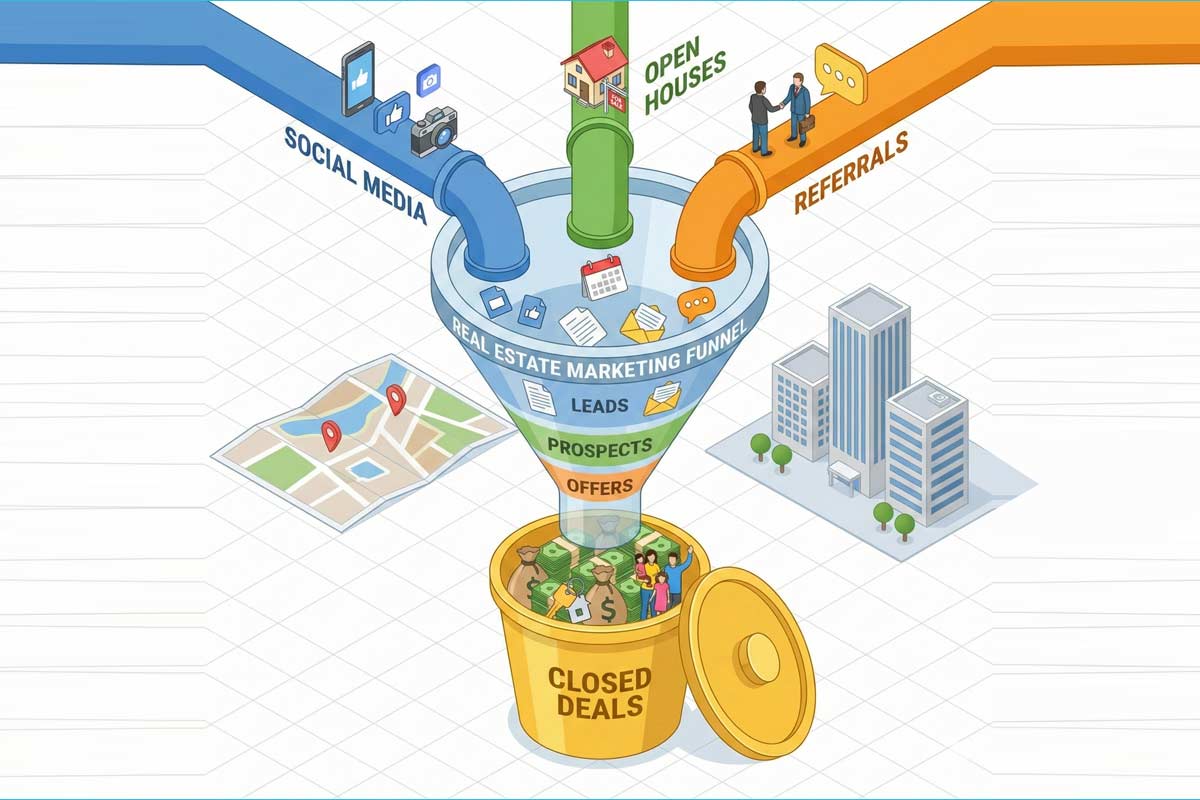
To win, you must view your marketing as a four-stage pipeline:
Attract: Getting someone to stop scrolling or start a conversation.
Pre-qualify: Filtering out the "looky-loos" from the serious buyers/sellers.
Convert: Turning a conversation into a signed listing or buyer representation agreement.
Follow-up: Staying top-of-mind for the 3–12 months it takes a CA lead to actually move.
Marketing is NOT:
Spending $500 on a logo before you’ve made a cold call.
Posting "Just Listed" photos of houses that aren't yours without permission.
Buying leads and letting them sit in a CRM without a phone call or other follow up.
The 4-Part Marketing Foundation
Before you spend a dime on ads, you need to stabilize your foundation. These are the basics that compound over time.
1. Positioning
This is "Who you help" and "What you're known for."
If you try to be the "California Expert," you’re the expert of nothing.
Actions: Define your farm (e.g., "The go-to condo specialist in Downtown Los Angeles"). Identify your unique value (e.g., "I help first-time buyers navigate FHA in high-cost counties").
Common Mistake: Being a generalist. To avoid this, read about Personal Branding Mistakes New Agents Make.
2. Proof
In California, skepticism is the default. You need assets that reduce skepticism and prove you can do the job.
Your First 5 Proof Assets (Even with zero closings):
1-page Zip Code Snapshot: Median price, Days on Market (DOM), and inventory trend for your farm area.
Open House Notes One-Pager: What buyers asked, what they ignored, and what moved them emotionally.
“Buyer Mistakes in CA” Mini Guide: A one-page PDF that shows you understand the process—this is marketing because it builds trust before you ever ask for an appointment.
Three Micro-Testimonials: Responsiveness, diligence, and follow-through from anyone you’ve helped (clients, colleagues, vendors).
Broker/Team Credibility Line: A factual, approved credibility line your broker is comfortable with (no hype, no unverifiable claims).
3. Pre-qualify & Convert
Marketing fails when it generates a lead but doesn't know what to do with it. You need a real estate lead follow-up system that includes the right questions.
The 5-Question Script (CA-Safe):
“Are you already speaking with a lender?”
“What’s your timeline if everything goes right?”
“Have you toured homes or open houses in the last 30 days?”
“Do you need to sell a home first?”
“What would make you say ‘let’s move’ within 2 weeks?”
The Appointment-Setters (CTAs):
“Want me to run a 10-minute price reality check for your zip code?”
“Want a 15-minute buyer game plan call so you know what you can win with in this market?”
4. Follow-Up
In California, most deals come from leads that “weren’t ready” the first time. Your follow-up system is your commission protection plan.
Actions: Set up a simple CRM. Create a "Long-Term Nurture" plan.
Common Mistake: Calling a lead once, getting no answer, and deleting them.
Common CA Marketing Mistakes
Avoid these traps that waste months of effort for new agents:
Buying leads before you have a repeatable follow-up cadence.
Posting listings you don’t represent without explicit permission or context.
Trying to be “Luxury” before you are trusted locally or understand the inventory.
No database hygiene: Failing to tag leads, leave notes, or remove duplicates.
Inconsistent schedule: Marketing in random bursts followed by weeks of silence.
Channels That Matter Most for New CA Agents
You cannot be everywhere. To learn how to get real estate clients in California, pick two of these to start:
Your Sphere (Database): This is your highest ROI. These are people who already know, like, and trust you.
Email Newsletters: A weekly touchpoint providing value. Learn How to Create a Real Estate Newsletter that people actually open.
Open Houses as Content Engines: Use an open house marketing plan where you film 3–4 videos while you’re there: a "Market Update," a "Home Feature," and a "Neighborhood Spotlight."
Google Business Profile: Essential for local SEO. If someone Googles "Agent near me," you want your name to appear with reviews. Learn the nuances of Branding Yourself as a California Real Estate Agent to stand out.
The 30-Day Marketing Plan for New California Agents
Stop theorizing. Here is your execution schedule for the next month.
Week
Focus
Key Task
Week 1
The Sphere
Call 10 people a day. Tell them you’re in the business and ask how they are.
Week 2
Local Credibility
Claim your Google Business Profile. Build a “Market Update” template for weekly use.
Week 3
Active Prospecting
Schedule 2 Open Houses. Use your "Open House Notes" one-pager to capture lead info.
Week 4
The Nurture
Send your first "Market Update" email to everyone you’ve talked to this month.
The "Minimum Viable" Daily List:
Add 2 new people to your database.
Send 5 personalized "Thinking of you" texts/DMs.
Post 1 local market data update to your Stories.
Compliance & Professionalism
The California Department of Real Estate (DRE) is vigilant. Your marketing must be as compliant as it is creative.
DRE Disclosures: In California, many advertisements must include your license ID and responsible broker identification—follow your broker’s policy and DRE guidance for each medium (print, digital, social, email, signage).
No "Guarantees": Avoid promising specific results unless you have the legal paperwork and broker approval to back it up.
Branding: Follow your brokerage policy for branding hierarchy and required identification across print, digital, and social.
Master the Skills Stack
Marketing is a powerful engine, but it’s only one part of the vehicle. Marketing is one spoke in the full skill stack—negotiation, contracts, timelines, and client psychology are what convert attention into commissions.
If you want the full “map,” start here: Real Estate Agent Skills California.
Your next move (today):
Pick two channels (sphere + newsletter, or open houses + newsletter).
Run the Week 1 plan.
Don’t change your system for 30 days.
FAQ Section:
Q: How much should a new agent spend on marketing?
A: Focus on "sweat equity" (calls/networking) first. Invest in a CRM and professional headshots before paid ads.
Q: Do I need a website as a new agent?
A: Use your brokerage-provided site and focus on your Google Business Profile for better local search results.
Q: How often should I post on social media?
A: Quality over quantity. 3 times a week with actual market data is better than daily generic "Happy Monday" posts.
Q: Is door knocking still effective in California?
A: Yes, if done with a "Give" (like a market report) rather than a "Take" (asking for a listing immediately).
Q: What is the best way to get reviews?
A: Ask for them immediately after a "win"—even if it's just helping someone understand their home's value.
TL;DR: The California Agent’s Marketing Blueprint
Marketing is a System: It is the repeatable process of Attract → Pre-qualify → Convert → Follow-up.
The CA Reality: High competition and sophisticated buyers mean "pretty" isn't enough; you need proof and persistence.
Focus on Inputs: Stop tracking "likes." Track outgoing calls, sent newsletters, and face-to-face meetings.
The Golden Rule: Choose two channels and master them before expanding.
|

In California, your brand is your pre-qualification. Whether you are navigating the high-density condo market in Irvine or the tech-relocation waves in the Bay Area, your potential clients have likely Read more...
In California, your brand is your pre-qualification. Whether you are navigating the high-density condo market in Irvine or the tech-relocation waves in the Bay Area, your potential clients have likely Googled you before they ever return your text.
Branding isn’t about picking the perfect shade of navy blue for your business cards. It is about trust, clarity, and consistency. After 20+ years of coaching agents at ADHI Schools, I’ve seen that the most successful newcomers don't always have 100k followers; they have a system that makes a specific group of people remember them when it matters most.
Building these Real Estate Agent Skills California is the foundation of a long-term career.
What “Brand” Actually Means for a CA Agent
Forget the fluff. A high-converting personal brand consists of five pillars:
Positioning: Who you are for (and who you are not for).
Promise: The specific outcome you deliver.
Proof: Why you’re credible (education, local data, or process transparency).
Personality: How you communicate (the data-driven analyst vs. the high-energy negotiator).
Presence: Where your clients find you (Instagram, LinkedIn, or the local coffee shop).
Brand ≠ Marketing
Marketing is how often people see you.
Branding is what they remember and associate you with when they’re ready to move.
Choose Your California Niche Without Boxing Yourself In
Many new agents fear that choosing a niche means saying no to money. In reality, a focused California real estate agent branding strategy makes your marketing cheaper and more effective. Here are 8 CA-specific niches currently producing repeatable leads:
ADU Specialists: Helping SoCal homeowners maximize lot value.
First-Time Buyers (Inland Empire/Sacramento): Navigating FHA and down payment assistance.
VA Buyers: Dominating markets near San Diego or Oceanside bases.
Tech Relocation: Smooth transitions for Bay Area or Silicon Beach employees.
Probate & Inherited Property: Compassionate service for estate executors.
Bilingual Markets: Serving specific communities (Spanish, Mandarin, Vietnamese, etc.).
Condo/Townhome Experts: Mastering the nuances of HOAs in high-density LA/SD.
The "Move-Up" Specialist: Helping families sell their starter home and buy their "forever" home simultaneously.
Build Your “1-Sentence Brand Statement”
Stop saying "I help people buy and sell homes." Use this template to define your personal brand for real estate agents in California:
“I help [Target Audience] in [Specific California Market] [Buy/Sell] [Property Type] so they can [Desired Outcome], using [Unique Method/Differentiator].”
Examples for New Agents:
“I help first-time buyers in Sacramento navigate FHA loans so they can stop renting and start building equity, using my 5-step ‘Buyer Ready’ system.”
“I help families in Irvine downsize into luxury condos so they can enjoy retirement without maintenance stress, using my ‘White Glove’ relocation process.”
Your Brand Kit Lite: The Minimum Viable System
1. The Profile Checklist
Bio: Start with your Brand Statement. End with a CTA (e.g., “DM ‘LIST’ for my 2026 Buyer’s Guide”).
Headline: Use keywords like “Real Estate Agent” + “Your City.”
Visuals: One professional headshot and one “in‑action” shot.
2. The Proof Stack
Even with zero sales, you can show authority:
Education: “Licensed through ADHI Schools, coached by industry veteran Kartik Subramaniam.”
Market Data: Weekly screenshots of “Days on Market” in your specific zip code.
Process Transparency: A video explaining: “What happens during a California home inspection?”
Compliance Fluency: Clear explanations of disclosures, timelines, and consumer protections (without providing legal advice).
The Trust Engine: Credibility Without Overclaiming
New agents often feel like “fakes.” To avoid this, shift from being the Expert to being the Guide.
Show the Process: Don’t just say you're great; show the 12‑page disclosure packet you just reviewed for a client.
Leverage Partners: Interview your local lender or escrow officer on video.
Soft CTA: If you want your content and messaging to actually convert, make sure you’ve locked down the fundamentals in our Real Estate Marketing Basics (California Edition) guide.
California-Specific Branding Tactics That Convert
"Neighborhood Proof" Posts: Take a photo of a "Coming Soon" sign (not yours) and discuss why that specific street is trending.
The Open House System: Film a 30‑second “Sneak Peek” on Friday, a “Live Tour” on Saturday, and a “Market Wrap‑up” on Monday.
Local Business Spotlights: Interview the owner of the most popular coffee shop in your farm area.
Deal Breakdowns: “Here is how we helped a buyer in San Diego win a multiple‑offer situation without overpaying.”
Offline Branding Consistency: Your yard signs, open house conversations, and community presence must match your online positioning. In California’s tight‑knit neighborhoods, offline trust breaks instantly if the “online version” of you doesn’t show up in person.
30-Day Branding Implementation Plan
No ads. No funnels. Just clarity + consistency.
Week
Primary Focus
Primary Goal
Week 1
Positioning
Finalize niche, brand statement, and update all social bios.
Week 2
Content System
Post 3 educational videos and 5 local “neighborhood” stories.
Week 3
Direct Outreach
Create a Real Estate Newsletter and send to 20 local contacts.
Week 4
Refine & Track
Count DMs, coffee invites, and new email subscribers.
Mistakes That Kill Your Brand Fast
The fastest way to look like an amateur is to post generic, “corporate” content that has no local flavor. If you look like a robot, people will treat you like a transaction, not a partner. Learning how to brand yourself as a realtor in California requires avoiding the “all‑business, no‑substance” trap.
Common pitfalls include:
Inconsistency (posting 5 times in one day, then disappearing).
Ignoring the "California nuance" (failing to mention local tax implications or ADU laws).
For a deeper dive into what to avoid, read our full breakdown of Personal Branding Mistakes New Agents Make.
FAQ: Branding for New California Agents
Do I need to pick a niche as a new California real estate agent?
No—but you do need a clear starting point. A niche focuses your messaging and speeds up trust. You can expand later without rebranding your entire business once you have established your pipeline.
How long does it take to build a personal brand as a real estate agent?
Most agents begin seeing inbound conversations within 30–90 days of consistent, niche‑focused visibility. It’s not about years of effort; it’s about weeks of targeted, valuable content.
Your Brand is an Asset
A clear brand reduces price sensitivity, shortens decision cycles, and increases referral velocity—especially in competitive California markets. It is the only thing the "big portals" can't take away from you. By narrowing your focus and showing up consistently as a local guide, you build a pipeline that survives any market shift.
Ready to level up your business-building skills?
Explore our Real Estate Agent Skills California page for more advanced strategies on marketing, lead generation, and career growth.
TL;DR: The California Branding Blueprint
The Goal: Move from “random agent” to “trusted local authority.”
The Strategy: Define a specific niche, create a one‑sentence brand statement, and execute a 30‑day visibility plan.
The Key: In the competitive California landscape, your brand isn’t a logo—it’s the clarity of the problem you solve for a specific group of people.
|

If you are researching your next career move at 11:00 PM after a long shift or while the kids are finally asleep, you probably have one burning question:
Can you get a California real estate license Read more...
If you are researching your next career move at 11:00 PM after a long shift or while the kids are finally asleep, you probably have one burning question:
Can you get a California real estate license online?
The short answer is: Mostly, but not entirely.
While the California Department of Real Estate (DRE) has embraced digital transformation—allowing you to complete your education and submit your paperwork from your couch—there are still physical "gatekeepers" that require you to show up in person.
The Reality Check: Online vs. In-Person
What You CAN Do Online
What You MUST Do In Person
Complete all 135 hours of pre-licensing courses.
Sit for the actual State Exam at a DRE exam center.
Submit your application via eLicensing.
Get your Live Scan (digital) fingerprints taken.
Pay your application and license fees.
Present valid government-issued photo ID.
Manage your license renewals later on.
Physically attend the testing center.
The Bottom Line: You can complete 100% of your required education online, but the State of California requires you to physically appear for your exam and your background check. It is important to check the fine print: while the "schooling" is digital, the "licensing" still has a few real-world milestones.
Defining "Online" in the California Licensing Process
When people ask about getting a California real estate license online, they are usually referring to the flexibility of the curriculum. In California, you are required to complete three college-level courses: Real Estate Principles, Real Estate Practice, and one elective.
At ADHI Schools, we’ve spent over 20 years helping students navigate this. We know that for a busy professional, the ability to take online real estate courses in California is the difference between starting a career and just dreaming about one.
However, the "license" itself isn't a digital download. It is a credential granted by the state after you prove your knowledge in a proctored, high-security environment.
The 18-Day Regulatory Rule For Coursework
In California, DRE regulations specify that a student must spend a minimum amount of time with their course materials before they are eligible to take a final exam. This is typically implemented as a seat-time requirement of 18 days per course. Because you must take three courses, your total minimum education time is 54 days—a timeline that applies even if you are the fastest reader in the state.
Step-by-Step: What Parts Can Be Done Online?
To help you plan, here is the numbered flow of the licensing process, showing exactly where the "online" part ends and the "real world" begins.
Pre-Licensing Education (Online): Complete your three courses (Real Estate Principles, Practice, and an elective). This takes a minimum of 54 days due to mandated study timers.
Application Submission (Online): Use the DRE eLicensing system to submit your combined Exam/License application.
Live Scan Fingerprints (In Person): You must visit a Live Scan provider to have your fingerprints electronically transmitted to the DOJ and FBI.
The State Exam (In Person): Once your application is processed, you will schedule a date to visit one of the five DRE testing centers (Sacramento, Oakland, Fresno, La Palma, or San Diego).
License Issuance (Digital/Mail): Once you pass, the DRE processes your results. You can often see your license number online before the paper certificate even arrives.
What Must Be Done In Person (And Why)
The DRE takes the integrity of the real estate profession seriously. The reasons you can't do it all from a laptop come down to two things:
Security and Compliance.
Exam Integrity: To prevent cheating and ensure that the person taking the test is actually the applicant, exams are held in monitored facilities where phones and notes are prohibited.
Identity Verification: Live Scan fingerprinting ensures that your criminal background check is tied to your actual identity, which requires a physical "chain of custody" at a licensed provider.
Expert Tip: If you’re in a rush, you’ll want to look into the fastest way to get a real estate license in California.
Timeline Planning
If you are trying to map out your calendar, your "online" progress is the most predictable part of the journey. Once you move into the "in-person" phase, you are at the mercy of DRE processing times and exam seat availability.
For most students, a realistic schedule involves finishing the online coursework while simultaneously preparing their paperwork. For a detailed breakdown of these phases, check out our California real estate license timeline. If you're wondering how those months look on a week-to-week basis, read our deep dive on how long it takes to become a real estate agent in CA.
Cost & Convenience Reality Check
While you save time and gas money by choosing to get a real estate license online in California, you still need to budget for the state-mandated fees.
As of 2026, the DRE fee for a salesperson exam is $100, and the original license fee is $350, totaling $450 paid directly to the state. Additionally, you will need to account for Live Scan fingerprinting. This involves a $49 state processing fee, plus a "rolling fee" charged by the private provider (typically $30–$45).
For a full breakdown of every nickel and dime, see our guide on how much it costs to get a real estate license in California.
Common Misconceptions
"I can take the state exam from home."
No. You must travel to a DRE-approved testing site.
"Online courses are instant."
No. California law requires you to spend a minimum amount of time with the material (typically 18 days per course).
"Once I finish courses, my license is automatic."
No. Finishing courses only makes you eligible to apply for the state exam.
"Online = instant approval."
Even if you submit online, the DRE may take several weeks to review your file and authorize you to test.
FAQ Section
Can I take the California real estate exam online from home?
No. The California State Exam must be taken in person at one of the Department of Real Estate’s designated testing centers to ensure exam security.
Can I complete the required real estate courses online?
Yes. You can complete all 135 hours of required pre-licensing education (Principles, Practice, and an elective) through an approved online provider like ADHI Schools.
Do I have to do Live Scan in person?
Yes. Live Scan requires a physical scan of your fingerprints by a certified technician at a licensed provider. This cannot be done via a smartphone or home scanner.
How long does it take if I do everything possible online?
Most students finish in 3 to 5 months. This accounts for the 54-day mandatory study period and current DRE administrative processing times.
What is the fastest way to get licensed in California?
The fastest route is to submit a "Combined" Exam and License application and complete your Live Scan immediately after finishing your online courses to avoid "dead time" while waiting for your test date.
How much does it cost to get licensed in California?
You should budget roughly $600 to $1,100 total. This includes your online course tuition, the $450 in DRE exam and license fees, and your Live Scan fingerprinting costs.
What is the most common reason people get delayed?
The most common delay is waiting to schedule the state exam. If you wait until after your courses are finished to start your DRE application, you may find yourself in a weeks-long queue for a testing seat.
Ready to Start Your Journey?
The road to a new career starts with the right map. While you can't do everything online, choosing a flexible, high-quality online education provider is the best way to maintain your current lifestyle while building a new one.
For a comprehensive look at the entire process, visit our California Real Estate License Guide.
|

You’ve spent weeks mastering the principles of California real estate. You’re ready to pass the real estate exam and start your career. But for some, the final hurdle isn't the exam itself; it’s Read more...
You’ve spent weeks mastering the principles of California real estate. You’re ready to pass the real estate exam and start your career. But for some, the final hurdle isn't the exam itself; it’s the paperwork.
At ADHI Schools, we’ve seen it happen: a qualified candidate is sidelined for over a month because of a missing middle initial or a forgotten signature. This is known as the "delay cycle." You submit your form to the California Department of Real Estate (DRE), wait for processing, receive a "deficiency notice," and then move to the back of the line after resubmitting.
I have spent over 20 years guiding thousands of students through the DRE bureaucracy. In my experience, the DRE doesn't "fail" applications—they pause files that can’t be verified. Your goal is a "reviewable file": one that is clean, consistent, and complete on day one.
What This Guide Covers:
The "80/20 Truth" of why applications stall.
12 specific mistakes that trigger DRE deficiency notices.
The "Clean Application Checklist" for eLicensing and mail.
Operational steps to take if you’ve already submitted an error.
Before you hit submit, ensure you are following the California Real Estate License Guide to understand where this paperwork fits into your larger journey.
The 80/20 Truth: Why DRE Forms Get Rejected
About 80% of application delays are caused by only 20% of possible errors. Most rejections aren't due to "hard problems" like criminal history; they are "soft errors"—clerical mismatches and omissions.
DRE reviewers are auditors. They compare your application against your identity details and eligibility documents. If a single data point—like the spelling of your last name on the certificates of completion—doesn't align across your ID and your transcripts, the reviewer cannot legally proceed.
Quick Reference: Mistake vs. Fix
Common Mistake
Why It Stalls
The Fast Fix
Name Mismatch
Can't verify identity
Match ID exactly (incl. hyphens/initials)
Missing Signature
Not a valid legal doc
Sign and date every required line
Wrong Form Version
Missing disclosures
Download fresh PDFs from DRE
Missing Education Docs
Can't confirm eligibility
Include transcripts or certificates
Wrong Fee/Payment
File won't open
Verify fee + include RE 909 (if mailing card info)
Inconsistent Contact
Missed correspondence
Use one email/address everywhere
The Top 12 Mistakes Applicants Make
1. The Name Mismatch
The Mistake: Using "Jon Doe" on the form while your ID says "Jonathan A. Doe."
Why It Triggers a Delay: The DRE cannot verify that the person who took the courses is the same person applying for the license.
How to Fix It: Your name on every DRE form must match your government-issued ID exactly.
Pro Tip from Kartik: Treat your name like a serial number. If it’s on your ID, it belongs on the form. No nicknames and watch out for suffixes!
2. Missing Signatures or Dates
The Mistake: Filling out a multi-page form but missing a signature line on a secondary page.
Why It Triggers a Delay: An unsigned form is not a valid application.
How to Fix It: Review every page for the "Signature of Applicant" box.
Real Scenario: A student once missed the signature on the credit card authorization page. The DRE couldn't process the payment, so they couldn't even open the file for review.
3. Using Outdated Form Versions
The Mistake: Using a PDF saved from a random website years ago.
Why It Triggers a Delay: The DRE updates forms periodically to include new statutory disclosures.
How to Fix It: Always download fresh forms (RE 400A for exams, RE 435 for combined apps) or apply online (recommended). If you’re not sure which application type you’re submitting, use How to Apply for the California Real Estate Exam as your form-selection map.
4. Education Documentation Timing
The Mistake: Applying before your education proof is ready or submitting unaccepted document types.
Why It Triggers a Delay: The reviewer can’t confirm you’ve met the education prerequisites, so your file pauses for a deficiency response.
How to Fix It: Submit only when your required education proof is ready—official transcripts or school-issued completion documentation, based on what the DRE requires for your specific application type.
5. Incorrect Fees or Payment Methods
The Mistake: Sending a personal check with insufficient funds or entering the wrong fee amount.
Why It Triggers a Delay: No payment = no processing.
How to Fix It: If paying by card on a mailed packet, include the RE 909 Credit Card Payment authorization. DRE states the credit card info must be mailed with the appropriate forms.
6. Leaving Blanks / Inconsistent "N/A"
The Mistake: Leaving a section blank because it "doesn't apply" to you.
Why It Triggers a Delay: Reviewers don't know if the section is irrelevant or if you simply forgot it.
How to Fix It: If a section doesn't apply, write "N/A." Never leave a field empty.
7. Illegible Handwriting
The Mistake: Rushing through the form with a ballpoint pen.
Why It Triggers a Delay: If they can't read your contact info, correspondence stalls.
How to Fix It: Use a PDF filler to type the form, then print and sign. If you must handwrite, use black ink and print in all caps.
8. Missing "Sponsor" Info (For License Activation)
The Mistake: Applying for a salesperson license without including the broker’s information.
Why It Triggers a Delay: You can apply for "Exam Only," but the How to Apply for Your California Real Estate License After Passing the Exam process requires a broker's signature for an active license.
How to Fix It: Ensure your employing broker’s license number is active and their signature is fresh if you are seeking an active license immediately.
9. Not Keeping Copies
The Mistake: Mailing the only copy of your application.
Why It Triggers a Delay: If the mail is lost, you have no proof of what you sent.
How to Fix It: Scan a copy of every single page you send to the DRE before mailing it. But remember, we recommend applying online!
10. Applying Before Eligibility
The Mistake: Submitting the application before you finish your final course.
Why It Triggers a Delay: All 135 hours of education must be finished prior to application.
How to Fix It: Check your course completion dates against your application signature date.
11. Incomplete Disclosure Answers (Yes/No Questions)
The Mistake: Skimming background/disciplinary questions and leaving one blank, or answering “Yes” without attaching the required explanation.
Why It Triggers a Delay: Reviewers can’t move forward if a required disclosure is unanswered.
How to Fix It: Treat every Yes/No question like a required field. If you answer “Yes,” attach a clean, organized explanation packet with clear dates and documentation.
Pro Tip from Kartik: If a reviewer has to guess what happened, your file pauses. If they can verify it in one pass, your file moves.
12. Inconsistent Contact Details (Email/Address/Phone)
The Mistake: Using an old email on the application but a different email in eLicensing.
Why It Triggers a Delay: If the DRE details don’t match, correspondence stalls and you lose time without realizing it.
How to Fix It: Pick one primary email + mailing address and use it everywhere.
Real Scenario: An applicant missed their ZIP code—mail landed late, the deficiency response window tightened, and the timeline stretched unnecessarily.
Clean Application Checklist
Before you submit, verify these points:
Name Match: Matches Government ID exactly (including middle names).
Fees: Correct amount verified. If paying by credit card on a mailed packet, include RE 909. (For eLicensing, follow the portal flow).
Signatures: All required boxes signed (wet signatures required for mail).
Education Proof: Official transcripts or certificates for all 3 courses included.
No Blanks: Every field is filled or marked "N/A."
Submission Proof: If mailing, use a trackable method and keep the receipt. If eLicensing, save confirmation screenshots.
What To Do If You Already Submitted and Think You Messed Up
Don't panic. Sending a second "corrected" application before the first is processed can create conflicting files and further delays.
Wait for the Deficiency: Wait for the DRE to issue a notice telling you exactly what is missing or incorrect.
Respond in One Packet: When you receive a deficiency notice, respond with all requested items in a single, clean response packet.
Check eLicensing: Use the DRE’s eLicensing system to check your status. If it says "Pending," they are still in the review cycle.
Timeline Reality: What a Mistake Costs You
Processing times vary, but deficiencies reliably add weeks because you are essentially restarting a review cycle. A single typo or a missing "N/A" can cost you months of earning potential while you wait for your file to be re-opened.
FAQ: Common DRE Form Questions
Q: Should I mail my application or use eLicensing?
A: If you can submit through eLicensing, that’s typically the fastest route because the DRE is set up to process online submissions efficiently. You can also apply by mail if you prefer a single physical packet workflow, but paper applications must be mailed (not faxed), and original signatures are required.
Q: What does “deficiency notice” actually mean?
A: It means the DRE reviewed your file and found something they can’t verify yet. Your application isn’t “failed”—it’s paused until you provide the missing/incorrect item in a clean response packet.
Q: Can I use white-out on my DRE forms?
A: It is highly discouraged. If you make a mistake, print a fresh page. White-out can look like an unauthorized alteration of a legal document.
Final Next Step
Precision now prevents frustration later. Use our California Real Estate License Guide to map your exact sequence—education → exam application → license application—so you don’t lose weeks to avoidable paperwork errors.
|

Every real estate school in California shares one thing: they must be approved by the Department of Real Estate (DRE) and will have a 4-digit sponsor ID number. Because the curriculum is regulated, many Read more...
Every real estate school in California shares one thing: they must be approved by the Department of Real Estate (DRE) and will have a 4-digit sponsor ID number. Because the curriculum is regulated, many students make the mistake of assuming the schools themselves are identical. They treat the pre-license course like a commodity, shopping strictly on price or the "fastest" promise.
However, after 20 years of coaching students through the licensing process, I can tell you that while the certificate at the end looks the same, the experience of getting it varies wildly. The "commodity" is the credit; the differentiator is the path to passing the real estate exam.
How to use this article: Use the TL;DR to shortlist schools, then use the verification questions at the end of each section to confirm reality before you buy.
Key Takeaways
Approval is the floor, not the ceiling: Every school is DRE-approved, but "approval" doesn't guarantee the content is modern or easy to navigate.
Friction kills momentum: Technical glitches and poor support are the leading reasons students drop out before finishing.
The "Final" isn't the end: The school's final exam is a hurdle; the California State Exam is the finish line. Choose a school that builds a bridge between the two.
Quick TL;DR: The 10 Differences at a Glance
/* Mobile-only scroll */
@media (max-width: 768px) {
.responsive-scroll {
overflow-x: auto !important;
-webkit-overflow-scrolling: touch !important;
}
}
Difference
What to Look For (The Check)
Impact
1. Course Format
True self-paced vs. scheduled sessions.
Flexibility vs. Accountability.
2. Tech & UX
Mobile-responsive + progress auto-saves.
Reduces study friction.
3. Student Support
Published hours + phone availability.
Faster resolution of DRE hurdles.
4. Instructor Access
Direct paths to clarify complex concepts.
Better grasp of legal nuances.
5. Exam Prep Tools
Timed simulated exams + "why" explanations.
Higher first-time pass odds.
6. Content Quality
Updated for current California law changes.
Prevents learning "stale" info.
7. Compliance Ease
Automated tracking of mandatory hours and enrolled time.
Prevents DRE rejection of hours.
8. Price Transparency
All-in pricing vs. hidden retake/book fees.
Protects your total budget.
9. Speed to Cert
Streamlined reporting to the DRE.
Gets you to the state exam faster.
10. Career Bridge
Post-course coaching and guidance.
Smooths transition to a brokerage.
1. Course Format & Time Flexibility
What it is: The delivery method—ranging from independent reading to live-streamed webinars.
Why it matters: California’s pre-licensing courses are time-regulated. Most providers enforce a minimum time window per 45-hour course (commonly 18 days), which creates a realistic floor for your timeline. If a school’s format doesn’t match your life, you will fall behind.
How to verify: Check if the "online" component is just a static PDF or an interactive platform.
Verification Question: "If I miss a scheduled session, what is the specific process and cost to make it up?"
2. Technology & User Experience (UX)
What it is: The stability and intuitiveness of the learning management system.
Why it matters: I’ve seen students lose hours of progress because a platform didn't save their quiz scores. If the tech is frustrating, you won't study.
How to verify: Ensure the platform works in modern browsers (Chrome/Safari) and auto-saves progress. Evaluate course format, student support, and pass rates carefully before committing.
Verification Question: "Does your platform allow me to switch between my laptop and my phone without losing my place in the chapter?"
3. Student Support Quality
What it is: The ability to get a human on the phone when you have a DRE paperwork question.
Why it matters: The DRE application process is notoriously bureaucratic. A school with poor support leaves you to figure out background checks and transcripts alone.
How to verify: Call the school before you buy. If you can’t get a human during sales, you likely won't during support.
Verification Question: "What is your average response time for student support emails during business days?"
4. Instructor Access & Clarification Path
What it is: A direct line to an expert who can explain complex fiduciary duties or legal concepts.
Why it matters: Some concepts in California real estate are counter-intuitive. Without an instructor to clarify, you'll end up memorizing answers without understanding them, which leads to surprises on the state exam.
How to verify: Ask specifically who answers content-related questions—a licensed instructor or a general clerk?
Verification Question: "If I don't understand a concept in Chapter 4, is there a licensed instructor I can speak with or email directly?"
5. Exam Readiness Tools
What it is: Tools beyond the basic quizzes, such as simulated state exams and performance analytics.
Why it matters: Passing the state exam is where many candidates get surprised—the questions are scenario-based, time-pressured, and unforgiving if you’re only memorizing. You need tools that target your weak areas.
How to verify: Look for "simulated exams" that mimic the DRE’s phrasing and provide "why" explanations for every answer.
Verification Question: "Does your exam prep software track my 'weak areas' across different categories like Agency or Contracts?"
6. Content Quality & Updates
What it is: Whether the material reflects current California law and disclosure practices.
Why it matters: Real estate law changes. If your school is using a curriculum from several years ago, you're learning outdated information that won't match how questions are framed today.
How to verify: Low price sometimes correlates with older platforms or less frequent updates—verify the revision date before buying.
Verification Question: "What major legislative or forms updates were incorporated into your curriculum in the last 12 months?"
7. Completion Tracking & Compliance Friction
What it is: How the school tracks your mandatory hours and issues the certificate.
Why it matters: If the school’s tracking isn't DRE-compliant, your application could be rejected weeks after you think you’ve finished.
How to verify: Check what matters most when choosing a real estate school regarding their reporting reputation.
Verification Question: "Is my completion certificate issued automatically the moment I complete the course requirements and meet the pacing/time requirements?"
8. Pricing Structure & Hidden Fees
What it is: The "all-in" cost versus the "teaser" price.
Why it matters: These fees don't just raise cost—they slow you down when you’re trying to finish. Some schools lure you with a low price but charge for certificate reprints, final exam retakes, and course extensions.
How to verify: Read the refund and extension policy before clicking "Buy."
Verification Question: "Are there any additional fees for retaking a school final exam or extending my access if I don't finish in six months?"
9. Speed to Certificate
What it is: The actual time it takes from payment to being eligible for the state exam.
Why it matters: Even if you’re highly motivated, there’s a built-in pacing floor for completing three 45-hour courses, so any ‘finish instantly’ marketing should trigger verification.
How to verify: Use a step-by-step guide on how to compare California real estate schools to map out your realistic timeline.
Verification Question: "How long after I pass my third exam will it take for me to receive the transcripts I need for the DRE?"
10. Career Bridge After the Certificate
What it is: What the school does for you once you have your certificate but before you have your license.
Why it matters: The "gap" between finishing the course and taking the state exam can be months. A good school provides resources to keep your knowledge fresh during that wait.
How to verify: Ask if they offer post-completion study groups or crash courses.
Verification Question: "Do I still have access to the practice exams and instructors after I receive my completion certificates?"
Decision Framework: Match the School to the Student
Not every student needs the same features. When researching the Best Real Estate Schools in California, prioritize based on your profile:
The Full-Time Professional: Prioritize Tech & UX and Mobile Flexibility. You need to be able to study during a commute or lunch break without a clunky interface slowing you down.
The Procrastinator: Prioritize Instructor Access and Live Components. You likely need to weigh the Online vs. In-Person Real Estate Schools in CA: Pros & Cons to see if you need the structure of a classroom.
The "Bad" Test Taker: Prioritize Exam Readiness Tools. You need a school that provides detailed explanations for why an answer is wrong, mimicking the state exam's style.
The Fast Tracker: Prioritize Compliance Ease and Support Speed. You want a school that ensures you hit the "pacing floor" accurately so your DRE application isn't delayed.
The Budget-Conscious Strategist: Prioritize Price Transparency. Cheapest isn't actually cheapest if you have to pay $100 for a course extension because life got in the way.
FAQ
Are all DRE-approved schools basically the same?
No. While they teach the same legal requirements, the delivery, technology, and level of student support vary significantly. A school is a service, not just a textbook.
Does online vs. in-person affect passing?
It depends on the student. Online offers convenience, but in-person offers immediate clarification. The best schools often offer a hybrid approach to provide both.
Do pass-rate claims matter?
The DRE does not officially publish pass rates for individual schools. Any school claiming a "99% pass rate" should be viewed with healthy skepticism—ask them how they verify that data.
How long does it take to finish?
Most providers enforce a minimum time window of 18 days per course. For the three required courses, this creates a realistic floor of about 54 days, though most students finish in 3 to 4 months.
What should I compare before buying?
Look at the "hidden" costs (retakes/extensions), the age of the technology, and whether you can actually communicate with a human when you have a question.
Choosing Your Path
Selecting a school is the first professional decision you make in your real estate career. It sets the tone for your licensing journey—either one of constant technical frustration or one of focused, supported growth.
Use Best Real Estate Schools in California to compare these factors side-by-side. Your goal isn't just to get the certificates; it’s to walk into the state exam with the confidence that you actually know the material.
Every real estate school in California shares one thing: they must be approved by the Department of Real Estate (DRE) and will have a 4-digit sponsor ID number. Because the curriculum is regulated, many students make the mistake of assuming the schools themselves are identical. They treat the pre-license course like a commodity, shopping strictly on price or the "fastest" promise.
However, after 20 years of coaching students through the licensing process, I can tell you that while the certificate at the end looks the same, the experience of getting it varies wildly. The "commodity" is the credit; the differentiator is the path to passing the real estate exam.
How to use this article: Use the TL;DR to shortlist schools, then use the verification questions at the end of each section to confirm reality before you buy.
Key Takeaways
Approval is the floor, not the ceiling: Every school is DRE-approved, but "approval" doesn't guarantee the content is modern or easy to navigate.
Friction kills momentum: Technical glitches and poor support are the leading reasons students drop out before finishing.
The "Final" isn't the end: The school's final exam is a hurdle; the California State Exam is the finish line. Choose a school that builds a bridge between the two.
Quick TL;DR: The 10 Differences at a Glance
/* Mobile-only scroll */
@media (max-width: 768px) {
.responsive-scroll {
overflow-x: auto !important;
-webkit-overflow-scrolling: touch !important;
}
}
Difference
What to Look For (The Check)
Impact
1. Course Format
True self-paced vs. scheduled sessions.
Flexibility vs. Accountability.
2. Tech & UX
Mobile-responsive + progress auto-saves.
Reduces study friction.
3. Student Support
Published hours + phone availability.
Faster resolution of DRE hurdles.
4. Instructor Access
Direct paths to clarify complex concepts.
Better grasp of legal nuances.
5. Exam Prep Tools
Timed simulated exams + "why" explanations.
Higher first-time pass odds.
6. Content Quality
Updated for current California law changes.
Prevents learning "stale" info.
7. Compliance Ease
Automated tracking of mandatory hours and enrolled time.
Prevents DRE rejection of hours.
8. Price Transparency
All-in pricing vs. hidden retake/book fees.
Protects your total budget.
9. Speed to Cert
Streamlined reporting to the DRE.
Gets you to the state exam faster.
10. Career Bridge
Post-course coaching and guidance.
Smooths transition to a brokerage.
1. Course Format & Time Flexibility
What it is: The delivery method—ranging from independent reading to live-streamed webinars.
Why it matters: California’s pre-licensing courses are time-regulated. Most providers enforce a minimum time window per 45-hour course (commonly 18 days), which creates a realistic floor for your timeline. If a school’s format doesn’t match your life, you will fall behind.
How to verify: Check if the "online" component is just a static PDF or an interactive platform.
Verification Question: "If I miss a scheduled session, what is the specific process and cost to make it up?"
2. Technology & User Experience (UX)
What it is: The stability and intuitiveness of the learning management system.
Why it matters: I’ve seen students lose hours of progress because a platform didn't save their quiz scores. If the tech is frustrating, you won't study.
How to verify: Ensure the platform works in modern browsers (Chrome/Safari) and auto-saves progress. Evaluate course format, student support, and pass rates carefully before committing.
Verification Question: "Does your platform allow me to switch between my laptop and my phone without losing my place in the chapter?"
3. Student Support Quality
What it is: The ability to get a human on the phone when you have a DRE paperwork question.
Why it matters: The DRE application process is notoriously bureaucratic. A school with poor support leaves you to figure out background checks and transcripts alone.
How to verify: Call the school before you buy. If you can’t get a human during sales, you likely won't during support.
Verification Question: "What is your average response time for student support emails during business days?"
4. Instructor Access & Clarification Path
What it is: A direct line to an expert who can explain complex fiduciary duties or legal concepts.
Why it matters: Some concepts in California real estate are counter-intuitive. Without an instructor to clarify, you'll end up memorizing answers without understanding them, which leads to surprises on the state exam.
How to verify: Ask specifically who answers content-related questions—a licensed instructor or a general clerk?
Verification Question: "If I don't understand a concept in Chapter 4, is there a licensed instructor I can speak with or email directly?"
5. Exam Readiness Tools
What it is: Tools beyond the basic quizzes, such as simulated state exams and performance analytics.
Why it matters: Passing the state exam is where many candidates get surprised—the questions are scenario-based, time-pressured, and unforgiving if you’re only memorizing. You need tools that target your weak areas.
How to verify: Look for "simulated exams" that mimic the DRE’s phrasing and provide "why" explanations for every answer.
Verification Question: "Does your exam prep software track my 'weak areas' across different categories like Agency or Contracts?"
6. Content Quality & Updates
What it is: Whether the material reflects current California law and disclosure practices.
Why it matters: Real estate law changes. If your school is using a curriculum from several years ago, you're learning outdated information that won't match how questions are framed today.
How to verify: Low price sometimes correlates with older platforms or less frequent updates—verify the revision date before buying.
Verification Question: "What major legislative or forms updates were incorporated into your curriculum in the last 12 months?"
7. Completion Tracking & Compliance Friction
What it is: How the school tracks your mandatory hours and issues the certificate.
Why it matters: If the school’s tracking isn't DRE-compliant, your application could be rejected weeks after you think you’ve finished.
How to verify: Check what matters most when choosing a real estate school regarding their reporting reputation.
Verification Question: "Is my completion certificate issued automatically the moment I complete the course requirements and meet the pacing/time requirements?"
8. Pricing Structure & Hidden Fees
What it is: The "all-in" cost versus the "teaser" price.
Why it matters: These fees don't just raise cost—they slow you down when you’re trying to finish. Some schools lure you with a low price but charge for certificate reprints, final exam retakes, and course extensions.
How to verify: Read the refund and extension policy before clicking "Buy."
Verification Question: "Are there any additional fees for retaking a school final exam or extending my access if I don't finish in six months?"
9. Speed to Certificate
What it is: The actual time it takes from payment to being eligible for the state exam.
Why it matters: Even if you’re highly motivated, there’s a built-in pacing floor for completing three 45-hour courses, so any ‘finish instantly’ marketing should trigger verification.
How to verify: Use a step-by-step guide on how to compare California real estate schools to map out your realistic timeline.
Verification Question: "How long after I pass my third exam will it take for me to receive the transcripts I need for the DRE?"
10. Career Bridge After the Certificate
What it is: What the school does for you once you have your certificate but before you have your license.
Why it matters: The "gap" between finishing the course and taking the state exam can be months. A good school provides resources to keep your knowledge fresh during that wait.
How to verify: Ask if they offer post-completion study groups or crash courses.
Verification Question: "Do I still have access to the practice exams and instructors after I receive my completion certificates?"
Decision Framework: Match the School to the Student
Not every student needs the same features. When researching the Best Real Estate Schools in California, prioritize based on your profile:
The Full-Time Professional: Prioritize Tech & UX and Mobile Flexibility. You need to be able to study during a commute or lunch break without a clunky interface slowing you down.
The Procrastinator: Prioritize Instructor Access and Live Components. You likely need to weigh the Online vs. In-Person Real Estate Schools in CA: Pros & Cons to see if you need the structure of a classroom.
The "Bad" Test Taker: Prioritize Exam Readiness Tools. You need a school that provides detailed explanations for why an answer is wrong, mimicking the state exam's style.
The Fast Tracker: Prioritize Compliance Ease and Support Speed. You want a school that ensures you hit the "pacing floor" accurately so your DRE application isn't delayed.
The Budget-Conscious Strategist: Prioritize Price Transparency. Cheapest isn't actually cheapest if you have to pay $100 for a course extension because life got in the way.
FAQ
Are all DRE-approved schools basically the same?
No. While they teach the same legal requirements, the delivery, technology, and level of student support vary significantly. A school is a service, not just a textbook.
Does online vs. in-person affect passing?
It depends on the student. Online offers convenience, but in-person offers immediate clarification. The best schools often offer a hybrid approach to provide both.
Do pass-rate claims matter?
The DRE does not officially publish pass rates for individual schools. Any school claiming a "99% pass rate" should be viewed with healthy skepticism—ask them how they verify that data.
How long does it take to finish?
Most providers enforce a minimum time window of 18 days per course. For the three required courses, this creates a realistic floor of about 54 days, though most students finish in 3 to 4 months.
What should I compare before buying?
Look at the "hidden" costs (retakes/extensions), the age of the technology, and whether you can actually communicate with a human when you have a question.
Choosing Your Path
Selecting a school is the first professional decision you make in your real estate career. It sets the tone for your licensing journey—either one of constant technical frustration or one of focused, supported growth.
Use Best Real Estate Schools in California to compare these factors side-by-side. Your goal isn't just to get the certificates; it’s to walk into the state exam with the confidence that you actually know the material.
|
In California, the Department of Real Estate (DRE) maintains a rigorous standard for what must be taught. Because of this, many students assume that every DRE-approved real estate school is essentially Read more...
In California, the Department of Real Estate (DRE) maintains a rigorous standard for what must be taught. Because of this, many students assume that every DRE-approved real estate school is essentially the same. After all, if they all cover the same 135 hours of mandated material, why does it matter where you go?
The reality is that while the curriculum is standardized, the delivery, support, and outcomes vary wildly. This framework helps you evaluate real estate school quality in California without relying on price or marketing claims. In my two decades of coaching students to pass the California exam and launch their careers, I’ve watched many come to us after a false start elsewhere. They often chose a program based on the lowest price, only to lose months—and momentum—in the process.
In this guide, “quality” means: (1) you finish the coursework, (2) you get real help when stuck, and (3) you’re actually prepared for the state exam.
Course Format — What Actually Matters
The "best" format is the one you will actually finish. Life in California is busy, and a format that worked for your friend might not work for your particular schedule. When evaluating a school, you need to look at how the content is delivered and reinforced.
Choosing Your Delivery Method
Self-Paced Online: Best for the self-motivated student who needs total flexibility.
Livestream or In-Person (Zoom-based): Best for those who need accountability and real-time interaction.
The Operator Criteria Most Schools Dodge
Deadline & Extension Policy: What happens if life hits? Ask what it costs to extend your access if you don't finish in the initial window.
Certificate Speed & Reliability: How fast do certificates generate after you pass a final? If a school takes a week to "process" a digital certificate, you lose a week of your DRE application window.
Mobile Experience: You should be able to study on your phone as easily as a desktop. If the dashboard is clunky on mobile, you won't use it during small pockets of free time.
Kartik’s Insider Tip: Understanding Online vs. In-Person Real Estate Schools in CA: Pros & Cons is the first step in narrowing your search.
Student Support — The Hidden Differentiator
Most students don't think about support until they are stuck on a complex concept or facing a technical glitch. In practice, most preventable delays come from certificate processing issues or unanswered support tickets—not from course difficulty. This is where budget schools usually cut corners.
What "Good" Support Looks Like
Support isn't just a "Contact Us" page; it’s a dedicated system. Look for:
Content Support: Access to instructors who can explain the why behind the question.
Published Response-Time Standard: A professional school should set clear expectations. Ideally, you receive a human response within one business day.
Technical & Admin Help: Assistance with DRE applications is just as important as the coursework.
Real-World Scenario: Imagine you have a tech issue the night before a self-imposed deadline. If the school has no support or escalation path, you lose your momentum.
Before you pay, run the Support Test today. Email a specific question about the California exam. You’ll know who’s real pretty quickly.
Understanding What Matters Most When Choosing a Real Estate School? often comes down to who is there to pick up the phone when you’re confused.
Exam Readiness & Pass Rate Transparency
"99% Pass Rate!" is a common marketing headline, but these numbers are often noise. To find the truth, you must look for exam readiness transparency.
The DRE does not publish a public school-by-school pass-rate leaderboard, so most pass-rate claims you see are self-reported. To verify these claims, ask these questions:
Which exam does this rate refer to? Is it the school final or the actual California State Exam?
What is the time period and sample size?
Is it first-time test takers only?
Are "inactive students" excluded from the denominator?
If they won’t define the metric, treat it as a marketing number.
If a school cannot provide a clear methodology, look at The 10 Biggest Differences Between California Real Estate Schools to see how they stack up in areas like practice exam quality. High-quality practice exams with detailed rationales are a better predictor of your success than a vague marketing percentage.
The Quality Scorecard
If you want a full shortlist approach, start with Best California Real Estate Schools and then apply this rubric to your top choices.
Category
What to Look For
Score (0–2)
Format Fit
Matches your schedule and learning style.
/2
Mobile UX
High-quality interface on all devices.
/2
Support Speed
Human response within 24 business hours.
/2
Assessment Quality
Practice exams mirror state exam difficulty.
/2
Transparency
Clear extension, refund, and pass-rate policies.
/2
Total Score
/10
8–10: High-confidence choice.
6–7: Acceptable, but verify support and practice exam quality before paying.
0–5: High risk; likely to cost you more time and money in the long run.
Before you commit, it helps to know How to Compare California Real Estate Schools (Step-by-Step Guide) so you can compare apples to apples.
FAQ (California‑Specific)
Q: Does DRE approval guarantee quality?
A: No. It only means the school meets the minimum legal requirements. It says nothing about the quality of the teaching or support.
Q: What support do I need if I work full‑time?
A: You need a school with a published response‑time standard—the ability to get a clear, helpful answer waiting for you the next morning.
Q: How long should the courses take realistically?
A: While the legal minimum is 7.5 weeks, most working adults take 10–16 weeks to finish without rushing and truly master the material.
Wrapping it Up
Choosing a school is the first business decision you make as a future agent. Don't base it on the lowest price; base it on the highest probability of success.
12 Questions to Ask Any California Real Estate School
Use this list to separate schools with real systems from schools with good sales pages. Copy and paste these into an email or ask them over the phone:
Can I see a sample lesson and the actual student dashboard today?
What does the mobile experience look like for quizzes and videos?
What’s your average response time for student questions?
Do you offer phone support, or only email/tickets?
What hours is support available (evenings/weekends)?
If my certificate doesn’t generate, what’s the escalation path?
How long do I have to finish each course? What do extensions cost?
What’s your refund policy in plain English?
What practice exams do you provide—and do they include rationales?
Is exam prep included, or sold separately?
When you say “pass rate,” which exam is that—and what’s the methodology?
If I fail the state exam, what’s your remediation or study plan?
|