
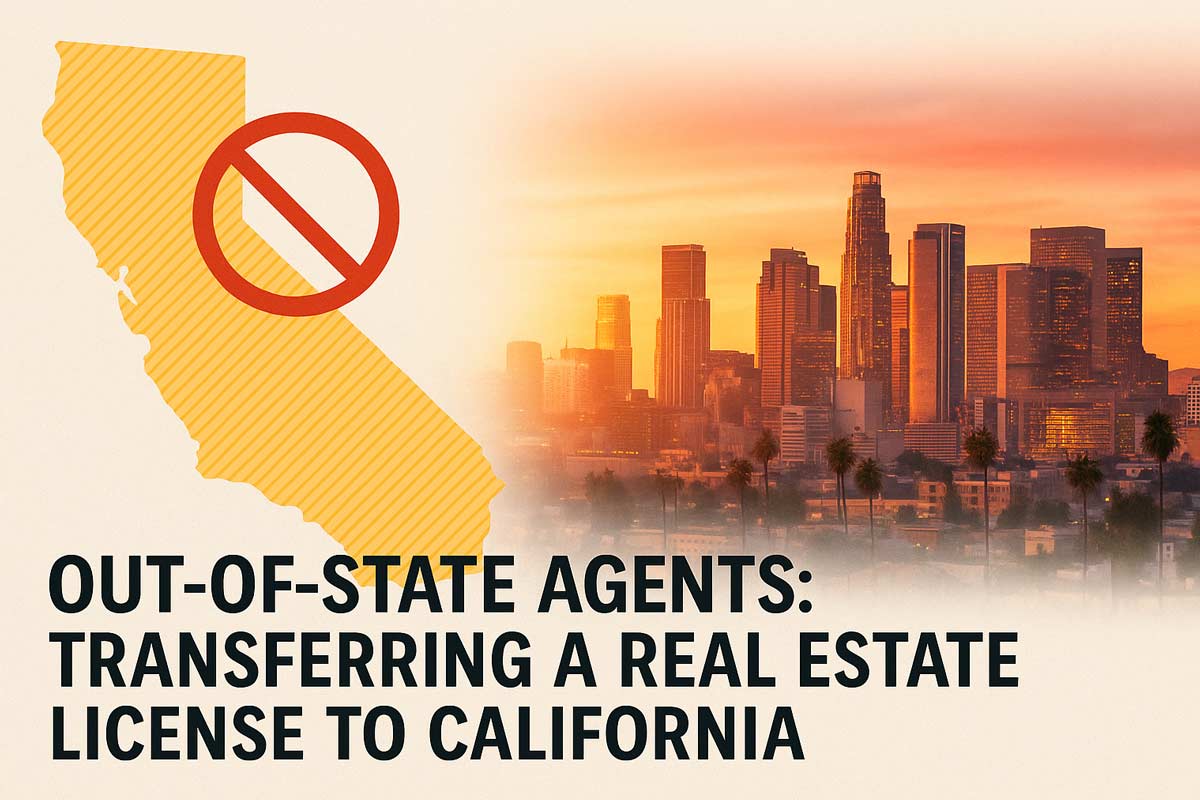
California has always been a magnet for real estate professionals. Its market is vast, complex, and full of opportunity — from high-end coastal homes and bustling Los Angeles neighborhoods to the fast-growing Inland Empire and tech-driven Silicon Valley. It’s no wonder that licensed agents from across the country often ask how they can bring their expertise to California and start working there.
But there’s one critical fact that every out-of-state agent needs to understand right away: California does not have real estate license reciprocity with any other state. No matter where you’re currently licensed — Nevada, Texas, Florida, or New York — you’ll need to go through the same process as a first-time applicant to become licensed here.
That may sound daunting at first, but the process is straightforward once you understand the California Department of Real Estate’s (DRE) requirements and how to navigate them efficiently.
This article is for informational purposes only. Licensing requirements and forms may change. Always verify details directly with the California Department of Real Estate (dre.ca.gov) before applying.
Many states have reciprocity agreements, which allow agents to move between jurisdictions without having to repeat the entire licensing process. These arrangements recognize that an agent’s existing education and experience often meet the host state’s requirements.
California, however, is different. The DRE maintains its own set of standards for education, testing, and licensing, meaning every applicant — regardless of background — must satisfy them in full. There’s no fast track, no waiver, and no exemption for those who already hold a license elsewhere. In practical terms, this means that even if you’ve been selling homes in Arizona for a decade, you’ll still need to complete the same 135 hours of pre-licensing coursework, pass the California salesperson exam, and apply for your license just like any new entrant.

While there’s no shortcut to reciprocity, the steps are logical and accessible. The DRE requires that all applicants be at least eighteen years old, demonstrate honesty and integrity, and submit to a fingerprint-based background check . Residency in California isn’t mandatory — out-of-state applicants complete an extra form called the Consent to Service of Process
Education is the foundation of the process. California mandates 135 hours of approved coursework, divided into three 45-hour classes: Real Estate Principles, Real Estate Practice, and one elective such as Finance, Escrow, or Property Management.
ADHI Schools offers DRE-approved courses that can be taken online from anywhere in the country.
Once your coursework is complete, you’ll move on to the application phase. This is where many out-of-state agents make a small but important mistake. The DRE provides two ways to apply:
For most applicants — especially those eager to get licensed quickly — the RE 435 “combo” application is the better choice. It saves several weeks of processing time by letting the DRE review your license paperwork while you’re preparing for or taking the exam. You’ll simply pay both the exam and license fees upfront, and once you pass the test, your license can be issued immediately after fingerprint clearance.
The California salesperson exam itself consists of 150 multiple-choice questions covering real estate law, agency, contracts, financing, property ownership, and disclosures. A passing score is 70 percent or higher.
When the DRE has processed your background check and verified your passing score, your California real estate license is activated — allowing you to officially begin working under a licensed broker.
The entire process can be tracked and managed through the DRE’s eLicensing portal , which allows you to submit forms, check exam dates, pay fees, and even schedule or reschedule your test online. Using eLicensing not only speeds up communication but also helps ensure that your application doesn’t get delayed in the mailroom queue, which is a common issue for paper submissions.
For out-of-state agents, experience is both a blessing and a challenge. Your background in real estate transactions, client service, and market analysis will serve you well — but California’s real estate landscape comes with its own set of rules and nuances.
Purchase agreements, disclosures, and agency laws in California are among the most detailed in the nation. The state also has unique consumer protection regulations and local ordinances that vary by county and city. That’s why, even for seasoned professionals, the real estate coursework isn’t just a formality — it’s an essential orientation to how business is done here.
Programs like ours at ADHI Schools help bridge that gap by tailoring instruction to out-of-state agents, emphasizing California-specific contracts and exam preparation. Because all of the coursework can be completed online, you can begin the process before relocating — saving months of waiting time.
Brokers face a slightly higher bar. To qualify for the California Broker Exam, applicants must show at least two years of full-time licensed salesperson experience within the last five years and complete eight college-level real estate courses. Like salesperson applicants, out-of-state brokers are not exempt from these requirements. Each must apply, document their prior experience, and pass the California Broker Exam before conducting brokerage activities in the state.
This process ensures that all brokers operating in California understand local regulations, disclosure obligations, and the DRE’s stringent compliance framework — something that ultimately protects both consumers and licensees.
There are several misconceptions that persist among agents seeking to transfer their real estate licenses to California. The first is the idea that prior licensing automatically waives the education requirement. It doesn’t — the DRE treats every applicant the same.
The second misconception is that California has some form of reciprocity or “mutual recognition” with nearby states. It does not. Every applicant must complete their California specific education and pass the state exam.
Finally, some assume that they can start practicing immediately upon moving to California. In reality, no real estate activity — marketing, advising, or representing clients — can occur until your California license is officially issued and hung with a broker.
The effort required to become licensed in California is well worth it. The state’s real estate industry is one of the most dynamic in the world, spanning everything from residential sales and new construction to commercial leasing and investment opportunities. Agents who build a foothold here gain access to a massive client base and some of the most sophisticated markets anywhere.
Out-of-state agents who complete the process often find that their broader perspective gives them a competitive edge. The key is preparation — and selecting a trusted education provider to ensure a smooth transition. Schools like ADHI Schools specialize in helping aspiring agents meet California DRE requirements efficiently, offering flexible schedules, instructor support, and comprehensive exam prep designed for busy professionals.
Relocating or expanding your real estate career to California isn’t as simple as transferring your existing license — but with clear guidance, it’s entirely achievable. Understanding that California operates without reciprocity allows you to plan correctly, meet the DRE’s expectations, and start building relationships in one of the most lucrative real estate markets in the country.
Whether you’re an agent from another state looking to get licensed or a seasoned broker ready to grow your business on the West Coast, the path begins with education. Start with your 135-hour pre-licensing courses through ADHI Schools , prepare for the state exam, and take the next step toward your California real estate career.
California Real Estate License Renewal: 2026 CE Guide
How Long Does It Take to Finish CA Real Estate Classes?
California DRE Exam Application (eLicensing) Fast-Path Checklist

Founder, Adhi Schools
Kartik Subramaniam is the Founder and CEO of ADHI Real Estate Schools, a leader in real estate education throughout California. Holding a degree from Cal Poly University, Subramaniam brings a wealth of experience in real estate sales, property management, and investment transactions. He is the author of nine books on real estate and countless real estate articles. With a track record of successfully completing hundreds of real estate transactions, he has equipped countless professionals to thrive in the industry.

"Hey guys,
I took the exam today and passed!!!!
It only took me one try which was one of my goals. I took the online
classes and follow your suggestions so I took the crash course,
used the crash course app a lot, took 7 mock tests and went
confident to present the exam. Thank you for the great job you are
doing, you guys are awesome!!!! May God continue to bless you!"
Willie V.