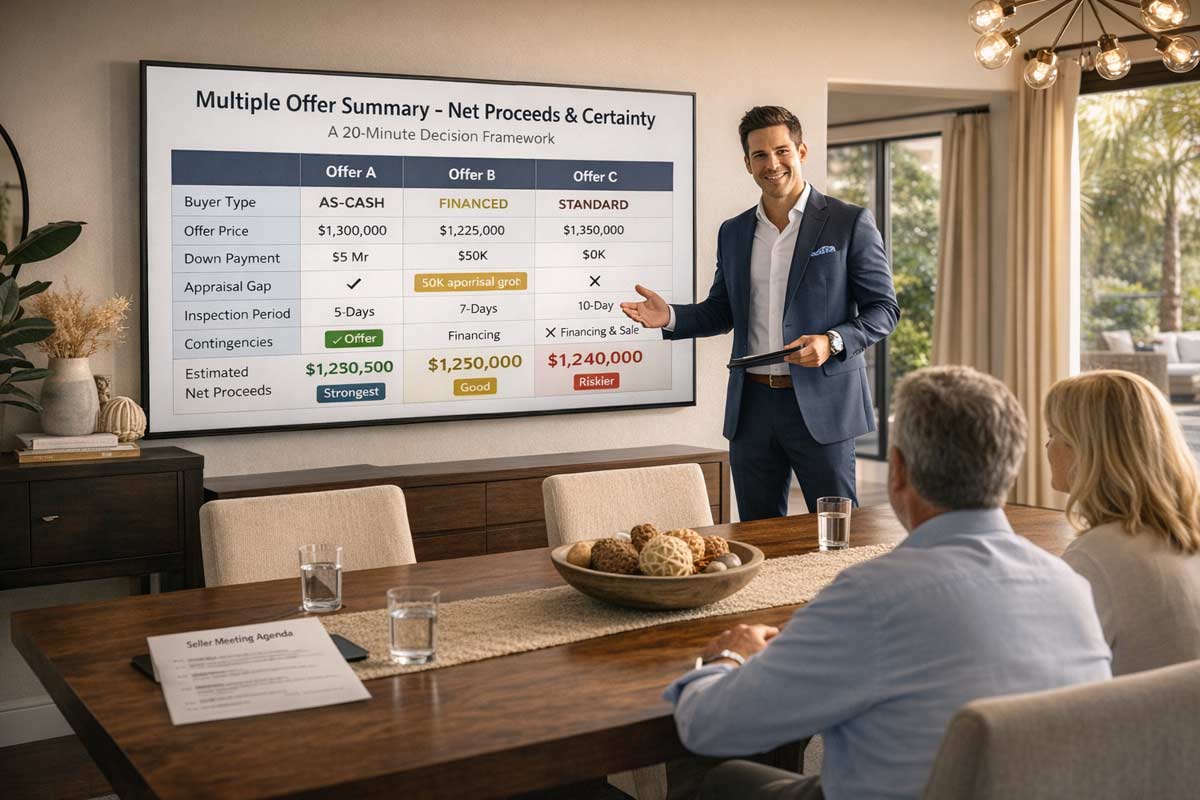
Imagine a Friday afternoon and you’ve just listed a well-priced three-bedroom home. Within 72 hours, your inbox is a graveyard of PDF attachments. You have 12 offers, three "love letters" (which must Read more...
Imagine a Friday afternoon and you’ve just listed a well-priced three-bedroom home. Within 72 hours, your inbox is a graveyard of PDF attachments. You have 12 offers, three "love letters" (which must be handled with extreme caution related to Fair Housing), and a seller who is already mentally spending the overage.
In the high-velocity California real estate market, a multiple-offer situation isn't just a sign of success—it is a high-stakes test of your professional systems. At ADHI Schools, we teach this as a repeatable Multiple-Offer Operating System: a clinical, step-by-step method that removes emotion, protects the seller, and increases the odds of closing without post-acceptance drama.
This article serves as your field manual for presenting, positioning, and closing multiple offers without losing control of the transaction.
Navigation Cue:
Listing Agents: Focus on Sections 1, 2, 4, and 7.
Buyer’s Agents: Focus on Sections 1, 3, 5, and 6.
1. Define the Two Games: Listing-Side vs. Buyer-Side
To successfully present multiple offers in California, you must first acknowledge that your objective shifts depending on which side of the negotiating table you occupy.
The Listing Agent’s Game (Risk Mitigation): Your goal is to organize the data so the seller can make an informed, objective decision based on "certainty of close," not merely the highest number.
The Buyer’s Agent’s Game (Strategic Positioning): Your goal is to make your offer the "path of least resistance" for the listing agent and the highest "certainty" for the seller.
Mastering these dynamics is a foundational component of the Real Estate Agent Skills California framework that separates top-tier producers from the pack.
2. The Listing Agent’s Operating System (Step-by-Step)
Do not present offers one by one as they arrive, they should be presented together in a non-prejudicial manner. This creates emotional fatigue for the seller and leads to sloppy decision-making. Normalize the data using an Offer Summary Sheet. You are looking for more than just price; you are also looking for the buyer’s "skin in the game."
The Listing-Side Checklist
Before sitting down with your seller, vet every offer for these specific "lethal" details:
Completeness: Is the RPA fully executed? Are all boxes checked, or is it a "sloppy" submission?
Proof of Funds (POF): Does the liquid cash cover the down payment plus estimated closing costs?
Lender Vetting: Have you personally called the buyer’s lender to verify the strength of the pre-approval?
Contingency Periods: Are they standard (17/21 days) or aggressively shortened to 7 or 10?
Verification Risk: Are there any unverifiable claims (gifted funds, bonus income, stock liquidation timelines) that could delay underwriting?
Presentation Script: The "Clinical" Approach
The Script: "Mr. and Mrs. Seller, we have 12 offers. Our goal today isn't just to find the highest price, but the one most likely to cross the finish line. We’re going to look at these through three lenses: Net Proceeds, Certainty of Close, and Post-Closing Flexibility (Rent-backs)."
3. The Buyer’s Agent Playbook: How to Win Without Overpaying
To win a multiple-offer situation, you must address the listing agent's biggest fear: the deal falling out of escrow.
Offer Strength Levers
The Earnest Money Deposit (EMD): Increasing the EMD (within the 3% owner occupied liquidated damages cap) signals serious intent.
Seller-Centric Timing: Matching the seller’s preferred close date or offering a rent-back often outperforms a higher price with rigid timing.
Clean Paperwork: A messy offer is a red flag. Ensure your contract terms are explained clearly and the package is sent as a single, bookmarked PDF.
Script: The Buyer Coaching Call
The Script: "I know the list price is $800,000, but in this micro-market, that’s just the starting whistle. To win, we need to look at what 'winning' actually costs. Are you prepared to cover an appraisal gap of $20,000 if the bank doesn't see value like we do?"
Script: The Listing Agent "Intel" Call
The Script: "Hi [Name], this is [Agent] with [Brokerage]. I’m calling to understand what ‘strength’ looks like for your seller beyond price. Is certainty of close, specific timing, or post-closing flexibility the biggest concern for them right now?"
4. Highest & Best vs. Counters: The Logic Ladder
Choosing the wrong response strategy is one of the most common deal-killing mistakes. Use this logic to decide your next move:
Consider Using “Highest & Best” (SMCO) When:
You have 5+ offers that are materially similar in terms.
Financing types (e.g., all Conventional 20% down) are comparable.
The seller prioritizes simplicity and wants to "clear the field" quickly.
Avoid “Highest & Best” When:
One offer is already dominant in price and terms.
Buyer profiles vary widely (e.g., one cash vs. one hard money).
You want to maintain leverage without reopening the field to everyone and risking "buyer ghosting."
Bottom line: “Highest & Best” is a blunt instrument. Use it to simplify decisions—not to abdicate strategy.
5. Appraisal Gap Risk: A Cautionary Tale
In a multiple-offer situation in California, the purchase price often outpaces recent comparable sales. This is why appraisal strategy is one of the most overlooked factors in a multiple-offer situation in California.
The Failure Scenario: I’ve seen sellers accept the highest offer—$60,000 over list—only to be back on the market 21 days later when the appraisal came in low and the buyer would not cover the difference. This costs the seller momentum, leverage, and credibility.
To prevent this, you must handle appraisal gaps proactively by requiring "Appraisal Gap Coverage" language in the counter-offer, ensuring the buyer has the cash to bridge the difference between the bank’s value and the contract price.
6. Terms That Win Deals vs. Terms That Kill Deals
Winning Terms
Deal-Killing Mistakes
Verified "Pre-Approval" (not Pre-Qual)
Vague "Seller Credits" for repairs
Shortened Inspection/Loan periods
Incomplete disclosures
Appraisal Gap Coverage
Escalation clauses with no "cap"
21-day or shorter escrow
Misaligned closing dates with seller's move
Winning these situations requires high-level negotiation tactics. It’s about finding the "hidden" needs of the other party—often, a seller needs a 30-day rent-back more than they need an extra $5,000.
7. "Present Like a Pro": The Seller Meeting Agenda
This is the 20-Minute Seller Decision Framework we teach agents to use when emotions are highest. When you sit down with your seller to present multiple offers, follow this structure:
The Landscape: Summarize total inquiries vs. showings vs. offers.
The Summary Sheet: Present the top 3–5 offers side-by-side.
The "Certainty" Talk: Highlight which lenders are reputable and which buyers have verified cash "above" the down payment.
The Decision: Select the strategy (Multiple Counter vs. Highest and Best).
Master the System
Agents who master multiple-offer situations don’t rely on luck—they rely on systems. Multiple-offer mastery sits at the intersection of communication, negotiation, contract control, and emotional regulation.
If this article exposed gaps in how you present, negotiate, or structure offers, your next step is to master the full Real Estate Agent Skills California framework. Stop reacting to the market and start commanding the transaction.
|

You are sitting in your car in a driveway in Irvine or Walnut Creek, staring at a repair request that just came in. Your seller is already livid because they feel they "gave away the house" on price. The Read more...
You are sitting in your car in a driveway in Irvine or Walnut Creek, staring at a repair request that just came in. Your seller is already livid because they feel they "gave away the house" on price. The buyer is threatening to walk over a water heater and some minor electrical work. Most agents at this moment start sweating, worried about their commission or the deal falling apart. They start "pushing" both sides, which usually results in everyone feeling like they lost.
Negotiation isn’t about being a "shark" or a "closer." In the California market, negotiation is a technical competency involving the structure of the deal, the flow of information, and the temperature of the room. Negotiation is one layer inside the broader Real Estate Agent Skills California framework—when you master it, everything else (pricing, scripts, client control) gets easier. Having coached thousands of California agents over the last 20+ years, I’ve seen that the most successful negotiators aren't the loudest—they are the most prepared.
Key Takeaways
Control the Frame: Whoever sets the parameters of the conversation usually wins.
Trade, Don't Give: Never concede a point without getting something in return.
Emotion vs. Numbers: Reframe emotional outbursts into transactional math.
Master the RPA: Leverage the timelines built into the California Residential Purchase Agreement.
The ADHI Negotiation Stack: A Five-Step Framework
To win consistently, you need a repeatable process. Use this stack to organize your thoughts before you pick up the phone:
CLARITY: Know exactly what your client needs (e.g., "Must close by the 15th") versus what they want ("A $5,000 credit").
LEVERAGE: Identify the pressure points. Is the seller in escrow on a replacement property? Is the buyer’s rate lock expiring?
OPTIONS: Never present a client with a "Yes/No" choice. Provide 2–3 paths forward to keep them in control.
TIMING: Use the clock and contract timelines to restore urgency. Formal notices can create clarity, but use them strategically and in line with your broker’s process.
DOCUMENT: If it isn't in writing, it didn't happen. Move verbal agreements to a C.A.R. form immediately.
The 30-Second Rule Before Any Negotiation Call
Before dialing the other agent, ensure you can answer these four questions:
What’s the ask? (The specific outcome you want)
What’s the trade? (What you are willing to give up to get it)
What’s the deadline? (When the offer or response expires)
What’s the written next step? (Which C.A.R. form will you send immediately after?)
12 Essential Real Estate Negotiation Tactics
1. Framing & Anchoring
When to use: Presenting the first offer or a counter-offer.
Why it works: The first number or condition mentioned sets the psychological "anchor."
Script: "Based on the four most recent comps in this area, we are coming in at $950k. This number reflects the current market reality while acknowledging the property's condition."
2. The "Two Options" Close
When to use: Resolving a deadlock.
Why it works: It prevents "analysis paralysis" and makes the client feel in control.
Script: ""We can either offer them a $3,000 credit toward their closing costs, or we can fix the roof leak ourselves prior to close. Which path would you prefer?"
3. Strategic Concession (The Trade)
When to use: Presenting the first offer or a counter-offer.
Why it works: If you give for free, they ask for more. If you trade, they realize concessions are expensive.
Script: "My seller is willing to leave the high-end refrigerator, but in exchange, we need to shorten the inspection contingency to 10 days."
4. Strategic Silence
When to use: Immediately after delivering a counter-offer or a hard "no."
Why it works: People are uncomfortable with silence and often talk themselves into a weaker position just to fill the void.
Script: [State your terms clearly]... [Wait 5–10 seconds].
5. Deadline Urgency
When to use: When the other side is dragging their feet on contingency removals.
Why it works: It forces a "fish or cut bait" moment using the contract timeline to restore clarity and urgency.
Script: "We’re past the agreed contingency timeline. My sellers want to stay on track for closing, so we need a clear update today on whether your buyer is removing contingencies or requesting an extension in writing."
6. Information Guarding
When to use: During initial "get to know you" calls with the other agent.
Why it works: Revealing your client's desperation (e.g., "They already bought a house in Texas") kills your leverage.
Script: "My clients are very motivated to find the right buyer who can appreciate the upgrades they've made."
7. Repair-to-Credit Pivot
When to use: After a difficult home inspection.
Why it works: Credits are cleaner for sellers and don't require the agent to manage contractors.
Script: "Rather than having the seller manage these repairs, why don't we do a $4,000 credit? It allows your buyer to choose their own contractors after they move in."
Real-world example: I’ve seen deals nearly die over a 12-item repair list where the seller felt “nickel-and-dimed.” We pivoted to a credit tied to two high-impact concerns (safety + major system), and the buyer accepted within an hour—because they didn’t want contractor scheduling to delay closing.
8. The "What If" Question
When to use: Testing the waters before a formal counter.
Why it works: It allows you to find boundaries without committing in writing first.
Script: "What if we could get closer to your price, but kept the closing date exactly where the seller needs it? Is that something your buyers would entertain?"
9. Escalation Positioning
When to use: In a highly competitive multiple-offer environment.
Why it works: It shows the seller your buyer is serious about winning without starting at their absolute ceiling.
Script: "We’ve included an escalation clause that beats the highest verifiable offer by $5,000, up to a cap of $1.1M." (Note: Ensure you know How to Present and Win Multiple-Offer Situations before using this).
10. The Appraisal Gap Anchor
When to use: When you know a property might not appraise at the offer price.
Why it works: It solves a future problem before it kills the deal.
Script: "We love your offer, but to move forward, we need a 'gap' clause stating the buyer will cover up to $20k if the appraisal comes in short."
Real-world example: In one coastal California deal, the buyer “won” at a premium price—then froze when the appraisal came in short. Because we had already framed a clear plan, the renegotiation became math, not panic, and escrow stayed alive.
11. Reframing Emotions back to Numbers
When to use: When a client is taking a negotiation personally.
Why it works: It detaches ego from the transaction.
Script: "I understand that their offer feels like an insult. But let’s look at the math: at this price, you still walk away with $400k in equity. Does $5,000 in emotion outweigh $400k in reality?"
12. The BATNA (Best Alternative To Negotiated Agreement) Thinking
When to use: Deciding whether to walk away.
Why it works: You cannot negotiate effectively if you are afraid to lose the deal.
Script: "If we can't reach an agreement here, we are prepared to go back on the market on Friday. We had three other parties at the open house who were very interested."
California-Specific Guardrails: Stay Clean, Stay Professional
Negotiation can be a high-wire act. California paperwork and brokerage policies vary—use these tactics as a framework and follow your broker’s specific process for notices, counters, and timelines.
Never Misrepresent Offers: Don’t play games with phantom offers. It’s unethical, risks your license, and can blow up trust with the other side instantly.
Verify the Lender: A high price means nothing if the lender can’t perform. Always call the loan officer.
Document Everything: Verbal agreements are worthless. Use the RR (Request for Repair) and RRRR (Seller Response to RR) forms correctly. If you are unsure of the phrasing, learn How to Explain Contract Terms to Clients Clearly so you don't over-promise.
Follow Broker Policy: Every brokerage has specific rules on escalation clauses. When in doubt, consult your manager.
Mini Playbooks: 3 Quick Scenarios
Scenario 1: Multiple Offers Appear
If you're on the listing side, don't just pick the highest price. A cash offer at $900k is often better than a financed offer at $920k with a massive appraisal gap. Master the strategy for How to Present and Win Multiple-Offer Situations to guide your seller.
Scenario 2: The Appraisal Gap Appears
When the appraisal comes in $30,000 short, you have three choices: price drop, more cash, or meet in the middle. When this happens, follow the step-by-step scripts in How to Handle Appraisal Gaps in California to save the escrow.
Scenario 3: The Repair Showdown
The buyer wants $10,000 in repairs; the seller wants zero. To keep escrow alive, follow How to Avoid Deal-Killing Mistakes—and focus on the "Big Three": Health, Safety, and Structural issues. Everything else is a trade.
Negotiation Is a Skill, Not a Personality
Many new agents believe you have to be born a "natural" negotiator. That is a myth. Negotiation is a practiced skill. When you walk into your next negotiation, remember: you aren't there to fight; you are there to solve a problem. Sticking to the Real Estate Agent Skills California framework ensures you remain the calm, clinical professional your clients hired.
Frequently Asked Questions
How do I negotiate repairs without losing the buyer?
Negotiating repairs requires prioritizing health and safety items while offering a credit for cosmetic or minor issues. This keeps the seller from feeling "nickeled and dimed" while ensuring the buyer feels the property is safe.
What should I say when the other agent goes silent?
When an agent goes silent, do not fill the void with concessions. Use a professional check-in: "I wanted to follow up on our counter-offer. My sellers are looking for a response so they can plan their weekend. Do you have an update from your clients?"
How do I negotiate contingencies in the California RPA?
Contingencies are negotiated by adjusting the number of days for the inspection, appraisal, and loan periods. Shortening these periods is a powerful trade when asking the seller for a lower price or credits.
What is the most important negotiation tactic for real estate agents?
The most important tactic is the Strategic Trade. Never give a concession without asking for something in return to maintain the value of your client's position.
Should I use an escalation clause in California?
Escalation clauses can be effective but must be used with caution and broker approval. Many California sellers prefer a "Highest and Best" call to avoid the complexity of multiple triggers.
Do This Before You Call the Other Agent:
What do we need vs. what do we want?
What is our real Plan B (BATNA)?
What deadline matters most right now?
What can we trade (not give)?
Which C.A.R. form is the cleanest path for this next step?
Ready to level up your professional game? Ensure you have mastered the complete list of Real Estate Agent Skills California to dominate your local market.
|
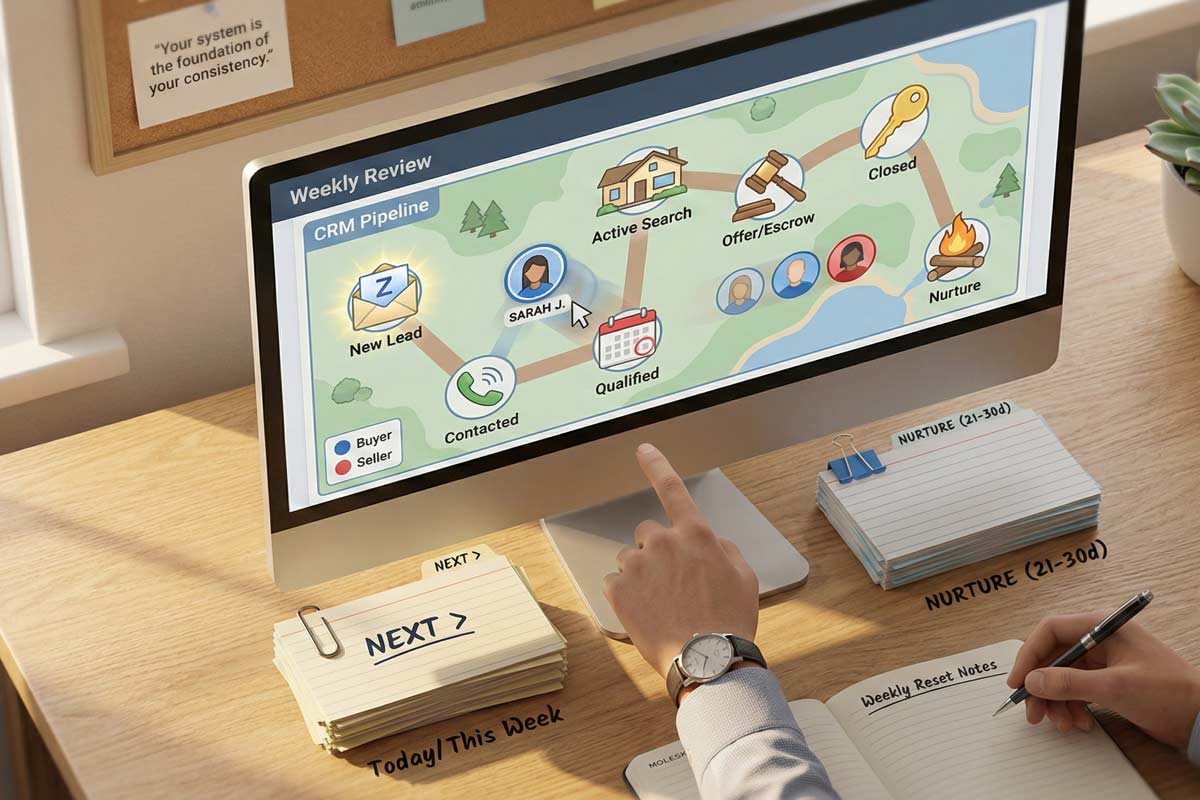
TL;DR: The System Summary
A successful real estate CRM is a daily follow-up machine, not a contact list.
To make it work, you need:
Minimalist Data: Only track what helps you make the Read more...
TL;DR: The System Summary
A successful real estate CRM is a daily follow-up machine, not a contact list.
To make it work, you need:
Minimalist Data: Only track what helps you make the next call.
Strict Pipeline Stages: Define exactly where a lead sits in the journey.
The Golden Rule: Every contact must have a Next Step and a Next Date.
Daily Discipline: A 10-minute "CRM Block" to clear your tasks.
The CRM Graveyard: Why Most Systems Fail
Let’s be honest: Most California real estate agents have a "CRM graveyard." It’s a software subscription you pay for every month, filled with names you haven't called in 90 days and "leads" from an open house three years ago that were never categorized.
I’ve spent over 20 years coaching and operating in the California real estate education space, and I see the same mistake everywhere. Agents try to build a "database" when they should be building a real estate lead follow-up system.
If your CRM isn’t telling you exactly who to contact by 9:00 AM today, it’s not a CRM—it’s a hobby. In a market where you’re fighting 101 freeway traffic and juggling multiple escrows, speed-to-lead is the only metric that matters. If you aren't contacting an inbound lead within minutes, you are often competing with 3–5 other agents. Your CRM is what allows you to win that race.
CRM Setup in 30 Minutes (Beginner-Proof)
Don't spend weeks "researching" software. Pick a tool and follow this 30-minute sprint:
Create your 7 stages: (Use the framework in the table below).
Set your required fields: Source, Lead Type, Stage, Next Follow-Up Date, Tags.
Configure 3 saved views: Today, This Week, Nurture.
Import 10 contacts: Start with your phone’s "recent" list or warm sphere.
Assign a "Next Step + Next Date": Do this for every single one.
Calendar it: Put a recurring 10-minute CRM Block on your calendar for every weekday morning.
The CRM Build: Your Minimum Viable System
To build a real estate CRM that sticks, you need to strip away the "tech-bro" features most CRM for real estate agents are bloated with and focus on the core structure.
1.The Only Fields You Actually Need
Stop trying to fill out 50 fields of data. You’ll burn out. Stick to these:
Name & Contact Info: (Phone/Email)
Source: (Zillow, Open House, Sphere, Referral)
Lead Type: (Buyer, Seller, Investor, Renter)
Pipeline Stage: (Where are they in the process?)
Next Follow-Up Date: (The most important field in your business)
Tags: FHA-Buyer, Inland-Empire-Retail, Probate, Past-Client, Hot-Lead.
Common Mistake
Don't create a "custom field" for every little detail. Use the "Notes" section for the story; use "Tags" for the category. Over-complicating fields is the fastest way to stop using the system.
2. Your Pipeline Stages (Entry/Exit Criteria)
Your pipeline stages real estate logic must be tight. If you don't know why someone is in a specific stage, the system breaks.
Stage
What it means
Move forward when...
New Lead
Inbound or added, not contacted
You’ve attempted contact + set Next Date
Contacted
Two-way exchange happened
You have timeline + motivation basics
Qualified
Budget + timeline + reason confirmed
You scheduled consult/showing/listing appt
Active Search
You’re actively working inventory
They’re ready to offer or pause
Offer / Escrow
Under contract
You close or deal dies (then re-stage)
Closed / Past
Transaction complete
You set post-close follow-up + nurture
Nurture
6+ months out
They re-engage (then re-qualify)
The Follow-Up Engine (The Real Product)
Your real estate CRM workflow is only as good as your persistence. Most agents stop after two attempts. Top operators go further.
The “No-Response” Ladder
Use this framework when a lead goes quiet:
Touch 1 (Day 1): Call + short text: “Hey [Name], it’s Kartik—saw your inquiry about [area]. Quick question: are you looking to move in the next 30–90 days or just researching?”
Touch 2 (Day 2–3): Value text: “If you tell me your target city + price range, I’ll send 3 options that match your criteria today.”
Touch 3 (Day 5–7): Close-the-loop: “I don’t want to spam you—should I stop reaching out, or is there a better time next week?”
If no response occurs after Touch 3, move them to the Nurture stage and set a Next Date for 21–30 days out.
Workflow: The Daily Execution
A CRM is only as good as your Daily Habits. To stay organized, stop looking at "All Contacts." Instead, use these three saved views:
Today: Shows only leads where the Next Date = Today or is Overdue.
This Week: Shows leads with a Next Date within the next 7 days (for planning).
Nurture: Shows leads with a Next Date 21–30 days out.
The Daily & Weekly Rhythm
Success requires a Time Management for California Real Estate Agents strategy that protects your "system time."
Daily (10 Mins): Clear your "Today" view every morning. Log outcomes in one sentence. Set the next date.
Weekly Reset (15 Mins): Every Friday at 4:30 PM, review your pipeline. Drag leads back to the correct stages and ensure no one is missing a Next Date.
Automation vs. Human Touch
Automation should support you, not replace you.
Do Automate: Immediate "Thanks for reaching out" texts; Appointment reminders.
Don't Automate: Deep relationship building. If an automation can’t be answered with a human reply, it probably shouldn’t be sent.
Common Failure Points and Fixes
"I don't have time to update it."
Fix: Make the update process smaller. Log the outcome immediately after the call, not at the end of the day.
"I'm burning out on follow-up."
Fix: Read our guide on Burnout Prevention for Real Estate Professionals. Usually, burnout comes from the anxiety of forgetting someone, not the act of calling them.
"I'm in escrow chaos all week."
Fix: Use your CRM to set "reminders" for your active leads so you don't ignore your future income while processing current checks.
The Bigger Picture: Your CRM Is One Skill in the Stack
A CRM that works is revenue insurance—but it only performs when it’s paired with daily execution, clear targets, and protected time. As you Set Goals as a New Real Estate Agent, remember that your system is the foundation of your consistency.
If you want the complete operator framework behind follow-up, pipeline control, and professional consistency, start here: Real Estate Agent Skills California.
FAQ: Building Your Real Estate CRM
1. What should I put in the ‘Notes’ vs. ‘Tags’?
Tags are for categories you want to filter (e.g., "Buyer," "Past Client"). Notes are for the "story" and specific details from your last conversation (e.g., "Daughter is moving to San Diego in August").
2. What’s the best follow-up schedule for Zillow or open house leads?
High intensity for the first 10 days (5–7 touches), then transition to a 21-day "Nurture" cycle. Speed is everything in the first 48 hours.
3. How do I use a CRM when I’m in escrow all week?
The CRM is what protects your next paycheck while you’re busy earning the current one. Treat your escrow tasks like lead tasks. Use the CRM to remind you of contingency removals, but don't let your "Today" view of new leads go uncleared. Spend 5 minutes on leads, then 55 minutes on your escrow.
4. How many stages should my real estate pipeline have?
Keep it between 5 and 8 stages. Any more and you will spend more time organizing the list than calling the people on it.
|

You passed the real estate exam, joined a brokerage, and ordered business cards. Week one feels like an adrenaline rush of “limitless potential.” By week four, the anxiety sets in. You’re staring Read more...
You passed the real estate exam, joined a brokerage, and ordered business cards. Week one feels like an adrenaline rush of “limitless potential.” By week four, the anxiety sets in. You’re staring at an empty CRM, your inbox is full of industry noise, and you haven’t had a “real” real estate conversation in days.
Most new agents fail here because they set outcome goals (like “I want to make $100k”) without building the machine required to produce them. In my 20+ years coaching California agents, I’ve seen the pattern: goals don’t fail because of a lack of hustle. They fail because they aren’t connected to a weekly scorecard and a daily plan.
If you want to survive year one, stop acting like an enthusiast and start acting like an operator.
The Operator Goal Stack Framework
To succeed, stop obsessing over the commission check and start obsessing over the architecture of your day.
Use the Operator Goal Stack:
Outcome Goals (The “What”): Lagging indicators like closings, GCI, or listings taken. You can’t control these directly—you can only influence them.
Input Goals (The “How”): Leading indicators: conversations, appointments set, and follow-ups completed.
System Goals (The “Machine”): Your infrastructure: protected time blocks, a weekly review, and a CRM that prevents leads from dying of neglect—starting with How to Build a Real Estate CRM That Actually Works.
Start With One 12-Week Sprint
Annual goals are too far away to create urgency. For a new agent, a year is an eternity of “I’ll start tomorrow.” Instead, operate in 12-week sprints. You get four “New Years” per year—and fast feedback loops.
Example goal sets for your first sprint:
The “Zero Database” Agent: Add 10 new contacts to your database per week through open houses, local networking, and community events.
The “Warm Network” Agent: Conduct 15 coffee chats or catch-up calls per week to re-announce your career and create referrals the right way.
Choose 3 Numbers That Matter (The Scorecard)
Stop tracking “busyness.” Remember that merely checking email does not equal work. Similarly, designing a flyer does not equal real work. For new agents, only three numbers reliably move the needle.
Metric
Weekly Target (Average)
Definition
New Conversations
40–50
Two-way conversations about real estate (sphere or new leads).
Appointments Set
1–2
A scheduled meeting (Zoom/in-person) to discuss a move timeline.
Follow-ups Completed
100+
Logged touches (call/text/email/DM) that advance a next step.
Pro Tip: These numbers are averages—not quotas. Some weeks will exceed them, others won’t. Consistency over 12 weeks is what creates results. If you aren’t hitting these averages, the problem usually isn’t the market—it’s your calendar. The Daily Habits of Top-Producing Agents are consistent because they protect the morning for these activities.
Translate Goals Into a Daily Plan
Your goals are fantasy until they’re time-blocked. An operator structures the day so input goals happen before the day’s chaos takes over.
Option 1: Standard New-Agent Schedule
8:00–10:00 AM: Pipeline Block (Non-Negotiable) — Outbound calls, follow-ups, open house nurture. No email. No scrolling. If it doesn’t directly create a conversation or an appointment, it doesn’t belong in this block.
10:00–11:00 AM: Admin/Ops Window — Email, paperwork, CRM updates.
1:00–2:00 PM: Visibility Block — Content creation, networking, event outreach.
3:00–5:00 PM: Appointments & Field Work — Showings, buyer consults, listing meetings.
Option 2: Aggressive Pipeline Schedule
Extend the Pipeline Block to 8:00–11:00 AM if you are in full "build mode" and need to generate immediate momentum.
If you want to keep your day from being hijacked, study Time Management for California Real Estate Agents—because if you don’t have an appointment, your job is to go create one.
5 Common Goal-Setting Mistakes
Setting income goals with no activity plan: “I want $200k” is a wish. “I will have 10 conversations/day” is a plan.
Copying a top producer’s goals: A veteran runs on referrals. Newer agents need to do more hunting and direct engagement. Don’t copy “maintenance” goals when you need growth goals.
The “Ghost Week”: Going hard for four days and disappearing for three kills momentum—and fuels the feast-or-famine cycle and contributes to Burnout for Real Estate Professionals.
Tracking too much: You don’t need 27 metrics. Track the three numbers in the scorecard above. Everything else is noise.
Letting escrow kill production: One deal in escrow isn’t a business. Keep prospecting or you’ll close and then go starve for the next two months.
Goal Templates (Copy/Paste)
Activity Goal: “For the next 12 weeks, I will have [Number] real estate conversations per week by [Prospecting Method] daily from [Start Time] to [End Time].”
Conversion Goal: “I will set [Number] appointments/week by following up with [Number] people from my CRM each morning.”
Structure Goal: “I will protect my calendar by batching admin/ops from [Start Time] to [End Time] and never allowing it into my morning pipeline block.”
Build the Full Skill Set
Goal-setting is step one—but it’s only one part of becoming a professional operator. To thrive in a competitive market, you need the full toolkit outlined in Real Estate Agent Skills California — from pipeline habits to systems, communication, and execution.
At ADHI Schools, we don’t just help you get licensed. We help you stay in business.
|

Disclaimer: This article provides operational and professional strategies for performance management. It is not a substitute for professional medical or psychological advice. If you are experiencing severe Read more...
Disclaimer: This article provides operational and professional strategies for performance management. It is not a substitute for professional medical or psychological advice. If you are experiencing severe mental health distress, please consult a licensed professional.
It’s 7:45 PM on a Tuesday. You’re finally sitting down to dinner when your phone buzzes. It’s a "quick question" from a buyer about an escrow contingency. Against your better judgment, you reply.
That one text turns into a 45-minute email chain with the lender and the listing agent. By 9:00 PM, you’re staring at the ceiling, mentally rehearsing tomorrow’s showings while your adrenaline spikes.
If this sounds familiar, you aren’t "working hard"—you’re redlining. At ADHI Schools, I’ve spent over 20 years coaching California agents through every market cycle, and I can tell you that burnout prevention for real estate professionals is not a luxury; it is a fundamental requirement for production. You don’t need a vacation; you need a sustainable operating cadence.
This guide is the operator’s plan to reduce your mental load, protect your commission, and build the real estate agent skill stack pillar that the top 1% use to stay at the top.
The Death Spiral: From "Busy" to Burnout
In a commission-based business, it is easy to mistake "constant access" for "high performance." However, ignoring the early warning signs of real estate agent burnout creates a dangerous downstream effect on your bank account.
The Symptoms To Consequences Bridge
If you ignore the symptoms, the professional consequences are inevitable:
Symptom: You dread opening your CRM or email.Consequence: Your follow-up slips and your pipeline dries up causing your panic level to increase.
Symptom: You have a "short fuse" with clients or TCs.Consequence: Your reputation takes a hit and your referrals drop causing you to work twice as hard to find new business.
Symptom: You are "always busy" but nothing moves.Consequence: You enter a cycle of "random activity" and your decision fatigue sets in causing you stop doing the high-ROI tasks that actually close deals.
Operational Strategies for Burnout Prevention for Real Estate Professionals
To survive the California market, you must stop being a "responder" and start being an "operator." This requires moving away from a reactive calendar and toward a structured system.
1. The "Two Windows Rule" (Communication Framework)
The primary cause of mental fry is constant context switching. Stop answering texts the second they arrive. Instead, implement the Two Windows Rule:
Window 1 (11:30 AM): Process all morning inquiries, lender updates, and escrow fires.
Window 2 (4:30 PM): Wrap up the day’s communication and set expectations for the following morning.
The Result: You train your clients that you are a professional with a schedule, not a 24-hour concierge. This single shift is the cornerstone of time management for California real estate agents.
2. One Source of Truth (The CRM)
Your brain is for processing information, not storing it. Trying to remember which buyer needs a disclosure sent and which listing needs a sign-post update is the fastest path to exhaustion. Learning how to build a real estate CRM that actually works is the only way to offload that mental weight. If it’s in the CRM, your brain can let it go.
3. Minimum Viable Habits
Don't try to overhaul your life. Pick three non-negotiables that keep your energy stable. For most top producers, this includes a set wake-up time, 60 minutes of proactive lead generation, and a "shutdown ritual." Mastering the daily habits of top-producing agents creates a performance floor that protects you even when the market gets volatile.
Practical Playbooks for the Fried Agent
The 2-Hour Daily Stabilizer
Before you open email or social media, spend the first two hours of your workday on Pipeline Defense.
0–30 mins: Review your CRM tasks.
30–90 mins: Proactive reach-out (calls/texts/notes).
90–120 mins: Appointment setting.
Why? If you spend the rest of the day fighting escrow fires or stuck in California traffic, you’ve already secured your future income.
The Boundary Scripts
The Late Night Text: "Hi [Name], I’m currently away from my desk for the evening, but I’ve prioritized this for my 8:30 AM updates. I’ll have an answer for you then!"
The "Urgent" Non-Urgent Item: "I want to ensure I give this the proper review. Let’s discuss this during my next update window at 4:30 PM."
The Operator’s Comparison
Feature
The Burnout Path (Reactive)
The Sustainable Path (Systematic)
Morning Routine
Checking emails in bed
CRM task review & proactive calls
Client Access
24/7 "on-call"
The Two Windows Rule
Goal Tracking
"I hope I close something"
Using how to set goals as a new real estate agent to track daily inputs
Recovery
Crashing from exhaustion
Scheduled "Hard Stops" and 24-hour disconnects
The 7-Day Reset Mini-Plan
If you're currently redlining, follow this sequence to regain control:
Day 1: Audit your phone. Turn off all non-human notifications (social, news, retail).
Day 2: Clean the CRM. Move every "reminder" out of your head and into the system.
Day 3: Set a "Hard Stop" time (e.g., 7:00 PM). The phone goes in a drawer.
Day 4: Schedule one 3-hour "Deep Work" block. No phone, no distractions.
Day 5: Proactive Triage. Update every active client before they ask you for a status report.
Day 6: Design your "Ideal Week" on paper, including gym time and family meals.
Day 7: Total disconnect. No real estate for 24 hours.
The Bottom Line on Sustainable Production
In the California market, burnout prevention for real estate professionals is an operational skill. If you operate without a system, the business will eventually consume your personal life and your health. If you operate with a system, you can handle higher volume with lower stress.
To build a career that lasts decades rather than months, you must master the fundamental Real Estate Agent Skills California requires. Stop reacting to the chaos and start engineering your success.
Burnout Prevention Checklist
One Source of Truth: Is every lead and task documented in your CRM?
The Two Windows Rule: Have you set specific times for client updates?
Pipeline First: Have you completed your 90-minute lead-gen block today?
Hard Stop: Is there a time tonight when you will officially "log off"?
Weekly Recovery: Is there a 24-hour block in your calendar for total disconnect?
Next Step: Build your foundation by exploring the full Real Estate Agent Skills California pillar to see how systems-first agents dominate the market.
|

You’re stuck in traffic on the 405, your phone is buzzing with a frantic text about a repair contingency in Santa Monica, and you just realized you forgot to follow up with that listing lead from Sunday’s Read more...
You’re stuck in traffic on the 405, your phone is buzzing with a frantic text about a repair contingency in Santa Monica, and you just realized you forgot to follow up with that listing lead from Sunday’s open house.
You feel "busy," but your production doesn't reflect the chaos.
In my 20+ years of coaching thousands of California agents at ADHI Schools, I’ve seen this movie before. Most agents mistake motion for progress. They react to their inbox, their phone, and their fires, leaving their income to chance.
Top producers—the ones with consistent listing flow and a steady referral engine—don’t have more "hustle" than you. They have a better operating system.
They protect three specific pillars every single day:
Pipeline
Operations
Visibility
Here is the exact daily habit stack used by the most successful agents in the California market.
The 10 Daily Habits of Top-Producing Agents
1. The Morning Pipeline Block
What they do: Spend the first 90 minutes of the workday on proactive outbound lead generation (calls, texts, or door knocking) before getting deep into email.
Why it works: Your pipeline is the only thing that guarantees future commissions. If you don't feed the engine first, the fires of the day will consume your time.
How to implement:
Set a "Do Not Disturb" on your phone from 8:00 AM to 9:30 AM.
Use a simple script: "Hi [Name], I was looking at the latest comps in [Neighborhood] and thought of you. Have you had any thoughts on the market lately?"
Common mistake to avoid: Checking your "Escrow is closing" emails first. That money is already earned; go find the money you haven't earned yet.
2. The 5-5-4 Follow-Up Loop
What they do: Every day, they contact 5 new leads, 5 past clients, and 4 people in their "active" sphere.
Why it works: Real estate is a game of attrition. Most deals are lost because an agent stopped calling after the second attempt.
How to implement:
Use your CRM to pull a daily "Touch List."
If you're struggling with what to say, check out our guide on how to set goals as a new real estate agent to align these calls with your production targets.
Common mistake to avoid: "Checking in" without offering value (like a market update or a vendor recommendation).
3. Strict CRM Hygiene
What they do: Every conversation is logged, and every contact has a "Next Action" date before the agent closes their laptop.
Why it works: A top producer’s brain is for creating solutions, not storing dates. If it isn't in the CRM, it doesn't exist.
How to implement:
Spend 15 minutes at the end of every meeting logging notes. Tag leads by "Temperature" (Hot, Warm, Cold) so you know who to prioritize tomorrow.
Learn how to build a real estate CRM that actually works to automate this process.
Common mistake to avoid: Keeping lead info on sticky notes or in your phone’s "Notes" app.
4. The "Deal Protection" Audit
What they do: A quick 20-minute daily review of all active escrows and pending contracts to ensure deadlines (contingencies, disclosures) are met.
Why it works: In California, missing a contingency date can cost your client thousands and cost you your reputation.
How to implement:
Create a checklist for every transaction.
Ask: "Who is the ball currently with—the lender, the escrow officer, or the other agent?"
Common mistake to avoid: Assuming the escrow officer or TC (Transaction Coordinator) is handling everything without your oversight.
5. One Daily Visibility Action
What they do: Produce one piece of "social proof" or community-focused content (a video tour, a market stat graphic, or a photo at a local business).
Why it works: Visibility amplifies ability. If people don't see you working, they assume you aren't.
How to implement:
Document, don't create. Take a photo of a home inspection or a beautiful kitchen during a showing.
Post it with a caption explaining a specific Real Estate Agent Skills California trait, like negotiation or local expertise.
Common mistake to avoid: Aiming for "viral" instead of "local and helpful."
6. The 15-Minute Market Pulse
What they do: Review the "Hot Sheet" in the MLS to see what went pending, what sold, and what price-dropped in their target zip codes.
Why it works: You cannot be an advisor if you don't know the inventory. Clients pay for your interpretation of the data.
How to implement:
Set an MLS alert for your primary farm areas.
Internalize the numbers: "The average days on market in Irvine just dropped to 12."
Common mistake to avoid: Relying on national news headlines instead of local MLS data.
7. Script & Objection Mastery
What they do: Practice handling common California objections (e.g., "The rates are too high," or "I want to wait for the market to crash") for 10 minutes.
Why it works: Professional athletes practice more than they play. Top agents practice so their delivery is natural and confident.
How to implement:
Roleplay with a partner or record yourself on your phone.
Focus on empathy first: "I hear you, and many of my clients feel the same way. What I’ve found is..."
Common mistake to avoid: Winging it during a high-stakes listing presentation.
8. Hard Energy Boundaries
What they do: Set specific "Off" times where they do not answer the phone, ensuring they recharge for the next day.
Why it works: High-performance requires recovery. Constant "on-call" status leads to the errors that kill deals.
How to implement:
Use "Auto-Reply" texts after 7:00 PM: "I am currently with my family, but I will return your call first thing tomorrow morning."
Review these strategies for burnout prevention for real estate professionals.
Common mistake to avoid: Answering non-emergency client texts at 10:00 PM (it trains them to disrespect your time).
9. The End-of-Day Shutdown
What they do: Clear the desk, review the calendar for tomorrow, and identify the "Big 3" tasks that must happen.
Why it works: You win the morning the night before. This prevents the "What should I do now?" paralysis at 9:00 AM.
How to implement:
The Shutdown Checklist:
Inbox to zero (or filed).
CRM tasks updated.
Tomorrow’s "Pipeline Block" list ready.
Common mistake to avoid: Ending the day mid-task without a plan for tomorrow.
10. The 3-Number Scoreboard
What they do: Track three specific numbers at the end of every day: conversations, follow-ups completed, and one visibility asset shipped.
Why it works: What gets measured gets repeated. This turns "I was busy" into "I moved the business forward."
How to implement:
Use a sticky note, Notion, or your CRM dashboard.
Target: 10 conversations, 10 follow-ups, 1 visibility post (adjust as you scale).
Review weekly and identify what’s slipping—pipeline, operations, or visibility.
Common mistake to avoid: Tracking vanity metrics (likes, followers) instead of conversations and appointments.
Top Producer Reality Check: What They Don’t Do
Success is often about what you remove from your day. Top agents:
Don’t check email as the first act of the day.
Don’t keep lead information in text threads or DMs; it goes to the CRM.
Don’t take random vendor meetings during their Pipeline Block.
Don’t confuse "scrolling" and consuming social media with "creating" visibility.
What Top Agents Do Before 9:00 AM
Most California agents start their day in a "reactive" state. Top producers use the time before 9:00 AM to build a mental moat:
No Screens: Avoid the "inbox trap" for at least the first 30 minutes of waking.
Movement: A quick walk or workout to handle the high-stress nature of the industry.
Review the Big 3: Confirm the three non-negotiable tasks for the day before the world starts calling.
Daily Habits: New vs. Experienced Agents
Your routine should shift as your business matures:
New Agents (Years 1–2): 80% of your day should be pipeline and visibility. You have more time than clients; use it to build the database.
Experienced Agents (Years 5+): 50% pipeline/visibility and 50% systems and depth. Focus on deepening existing relationships and refining time management for California real estate agents to handle increased transaction volume.
Sample Daily Schedule: The California Operator Template
If your calendar keeps getting hijacked by non-urgent tasks, mastering your time as a real estate agent is your first priority. Use this block schedule to regain control.
Time
Activity
Focus
8:00 AM
Market Pulse
Review MLS Hot Sheets & local news.
9:00 AM
Pipeline Block
Non-negotiable outbound calls/prospecting.
10:30 AM
The Follow-Up Loop
Returning voicemails, texts, and emails.
12:00 PM
Lunch / Visibility
Eat at a local spot; post a "Day in the life" story.
1:30 PM
Operations & Admin
Listing prep, transaction review, CRM cleanup.
3:00 PM
Field Work
Showings, listing appointments, or door knocking.
5:30 PM
Shutdown
Plan tomorrow; set phone to "Do Not Disturb."
Why Most Agents Fail to Keep Habits (And the Fix)
Most agents fail because they are reactive. If your calendar is a blank slate, other people will write on it. This creates a "feast or famine" cycle that leads to burnout.
The Fix: The 2-Day Rule:
Never miss your daily habits two days in a row. If a closing goes sideways and you miss your morning calls today, that’s life. If you miss them tomorrow, that’s a choice. This isn’t about working longer hours—it’s about protecting the few actions that compound.
Start Here Today: The Minimum Viable Day (MVD)
If you are overwhelmed, do this 60-minute checklist to keep your business alive:
30 Minutes: Pipeline outreach (Contact 5 people).
15 Minutes: CRM Hygiene (Log calls/set next follow-ups).
10 Minutes: Visibility (Post one market update to social media).
5 Minutes: Plan tomorrow’s "Big 3" tasks.
Frequently Asked Questions
What do top producing agents do every day?
They prioritize "Revenue Generating Activities" (RGAs) like lead generation and follow-up during their peak energy hours and leave administrative tasks for the afternoon.
How many calls do top agents make per day?
Many top producers aim for 10–20 real conversations per day and increase volume during growth phases. The key metric is meaningful conversations, not just dials.
What is a good daily schedule for a real estate agent?
A good schedule is "time-blocked," meaning specific hours are dedicated to lead gen, client meetings, and admin. This prevents administrative "busy work" from eating into your prospecting time.
How do agents stay consistent without burnout?
By setting firm boundaries and treating their "recharge" time as a non-negotiable appointment on their calendar, just like a listing presentation.
Ready to Master the Business?
Habits are the foundation, but skills are the ceiling. If you want to move from "busy" to "profitable," you need to master the full stack of Real Estate Agent Skills California required for this unique market.
Next Steps for Your Growth:
New Agents: Start by setting your 90-day goals.
Mid-Career Agents: Audit your CRM system to find the holes in your follow-up.
|

In California real estate, "busy" is sometimes viewed a badge of honor. But after 20 years of coaching and operating in this industry, I can tell you the truth: Busy isn't the goal. Profit and freedom Read more...
In California real estate, "busy" is sometimes viewed a badge of honor. But after 20 years of coaching and operating in this industry, I can tell you the truth: Busy isn't the goal. Profit and freedom are.
This guide provides a practical, operator-level time management system for California real estate agents designed to move you from a reactive state to a systems-first mindset. If you don't control your calendar, your clients, escrow officers, and the 405 freeway will control it for you.
To master the essential Real Estate Agent Skills California requires a shift from chasing the day to owning it.
TL;DR: The California Operator System
The 3-Bucket Filter: If it creates revenue, it’s Pipeline. If it saves a deal, it’s Operations. If it builds the future, it’s Visibility.
The Morning Power: 8:00 AM – 10:00 AM is for non-negotiable follow-up. No email allowed.
The "One Window" Rule: Batch all escrow and admin tasks into a single 90-minute block.
The Guardrail: If it isn't on the calendar, it doesn't exist.
Reactive Calendar vs. Revenue Calendar
Most agents operate on a Reactive Calendar. You wake up, check your email, respond to a frustrated buyer, get lost in a DM rabbit hole, and suddenly it’s 2:00 PM. You’ve done "work," but you haven't generated a single dollar of future revenue.
A Revenue Calendar is designed to protect income-producing activities first.
Diagnostic: 5 Signs You Are Operating Reactively
You start your day by answering emails instead of making outbound calls.
You don't have a recurring "Follow-Up" block in your digital calendar.
An inspection or appraisal request can derail your entire afternoon.
You find yourself scrolling Instagram under the guise of "content research."
Your "lead generation" only happens when you realize you have no active escrows.
The 3-Bucket Decision Rule
To manage your time, you must categorize your tasks instantly. Stop treating an escrow signature with the same urgency as a cold lead follow-up. Use these filters:
Pipeline (Revenue): Does this create or advance a commission check today or tomorrow? (Follow-up, appointments, negotiations)
Operations (Delivery): Does this protect a deal currently in motion? (Disclosures, inspections, TC coordination)
Visibility (Future): Does this build my pipeline for 6 months from now? (Content creation, networking, database building)
The secret to consistency is ensuring all three buckets have a "home" in your week. This balance is one of the daily habits of top-producing agents that separates the earners from the hobbyists.
The California Agent Weekly Template
California real estate has a specific rhythm. Traffic is a factor, and weekend "work" is mandatory. Use this table as your base real estate agent schedule:
Time Block
Focus
Purpose
8am – 10am
Revenue (Pipeline)
Calls, texts, and CRM follow-up.
10am – 11:30am
Delivery (Operations)
Escrow Command Center / Admin.
12pm – 1pm
Recharge
Lunch / Personal time (No pings).
1pm – 5pm
Appointments / Field
Showings, listing presentations, previews.
5pm – 6pm
Future (Visibility)
Social media content / Networking.
The "New Agent" vs. "Busy Agent" Flex
New Agents: Spend 4+ hours daily in the Pipeline bucket. You need reps more than you need "systems" right now.
Busy Agents: Spend more time in Operations but must protect the 8 AM – 10 AM window at all costs to avoid the "income roller coaster."
Effective time management begins by knowing how to set goals as a new real estate agent—once your goals are clear, the calendar follows.
Win the Morning: The Follow-Up Operating System
The first two hours of your day dictate your commission check three months from now. Time management for California real estate agents lives or dies in the CRM.
The Daily Priority Stack:
New Leads: Contact within 5 minutes (or first thing in your 8 AM block).
Hot Nurtures: Clients likely to transact in the next 30–60 days.
Active Clients: Brief status updates (even if the update is "no news").
Past Clients: Staying top-of-mind for referrals.
To make this work, you need a system. Learning how to build a real estate CRM that actually works is the only way to automate your reminders so you don't spend hours "organizing" instead of "doing."
Escrow and Transaction Control
In California’s fast-paced escrow environment, a single inspection report can trigger 20 phone calls. If you handle these as they come in, you will never have a productive day.
The Escrow Command Center Rule: Schedule one "Operations Window" (e.g., 10:00 AM – 11:30 AM). Batch all your emails to escrow officers, lenders, and TCs during this time.
Kartik’s Tip: When a lender calls at 2:00 PM while you're at a showing, let it go to voicemail. Listen, then reply during your next designated admin block. Most "emergencies" are simply other people’s poor planning.
Open Houses & Traffic Realities
California traffic is a variable you must account for. If you have a showing in Irvine at 4:00 PM, you aren't "working" from 3:30 PM to 6:00 PM—you are commuting and showing.
The 20% Buffer: Always add 20% more time to travel than GPS suggests.
Weekend Recovery: If you work 6 hours on Saturday and Sunday, you must protect Monday morning as "Off" time to prevent the burnout cycle.
Pre-Prep: Don't print flyers on Sunday morning. Do all "Visibility" prep on Thursday so your weekend is focused on the people in front of you.
Burnout Guardrails (Energy Management)
"Always on" is a recipe for a short career. Sustainable time management requires energy management.
The Hard Stop: Pick a time (e.g., 7:00 PM) where the phone goes in the drawer.
The One True Day Off: One day a week, you are not an agent. You are a human being.
Boundary Scripts: "I’m headed into an appointment, but I will check this first thing at 8:00 AM tomorrow."
Effective burnout prevention for real estate professionals is built into the calendar, not added as an afterthought.
FAQ: Real Estate Time Management
How many hours should a real estate agent work?
A: Successful full-time agents typically work 40–50 hours per week, but the composition of those hours matters more than the total. 15 hours of focused lead generation is more valuable than 60 hours of "random busywork."
What’s a good daily schedule for real estate agents?
A: A high-production schedule starts with 2 hours of follow-up (8–10 AM), 90 minutes of admin/escrow (10–11:30 AM), and afternoons dedicated to appointments and field work.
How do I handle "looky-loo" buyers who waste my time?
A: Use a mandatory buyer consultation. If they won't meet for 20 minutes to discuss their needs and financing, they aren't worth a 2-hour drive.
What if a client gets mad because I didn't answer at 9:00 PM?
A: Set expectations early. Tell them: "I am fully focused on my clients from 8:00 AM to 7:00 PM. If you text after that, I'll have an answer for you first thing in the morning."
Implementation Challenge: The 14-Day Reset
Commit to this for the next 14 days before you customize:
Block 8:00 AM – 10:00 AM for lead follow-up only. No email. No social media.
Batch your "Operations" into one 90-minute window.
Identify 3 "Stop-Doing" items: Activities that resulted in zero revenue last week.
Time management isn't about doing more; it's about doing what matters. Master these systems, and you’ll find that a successful California real estate career doesn't have to cost you your sanity.
Ready to level up your entire business? Visit our Real Estate Agent Skills California hub to learn more about building a sustainable, high-performance career with ADHI Schools.
|
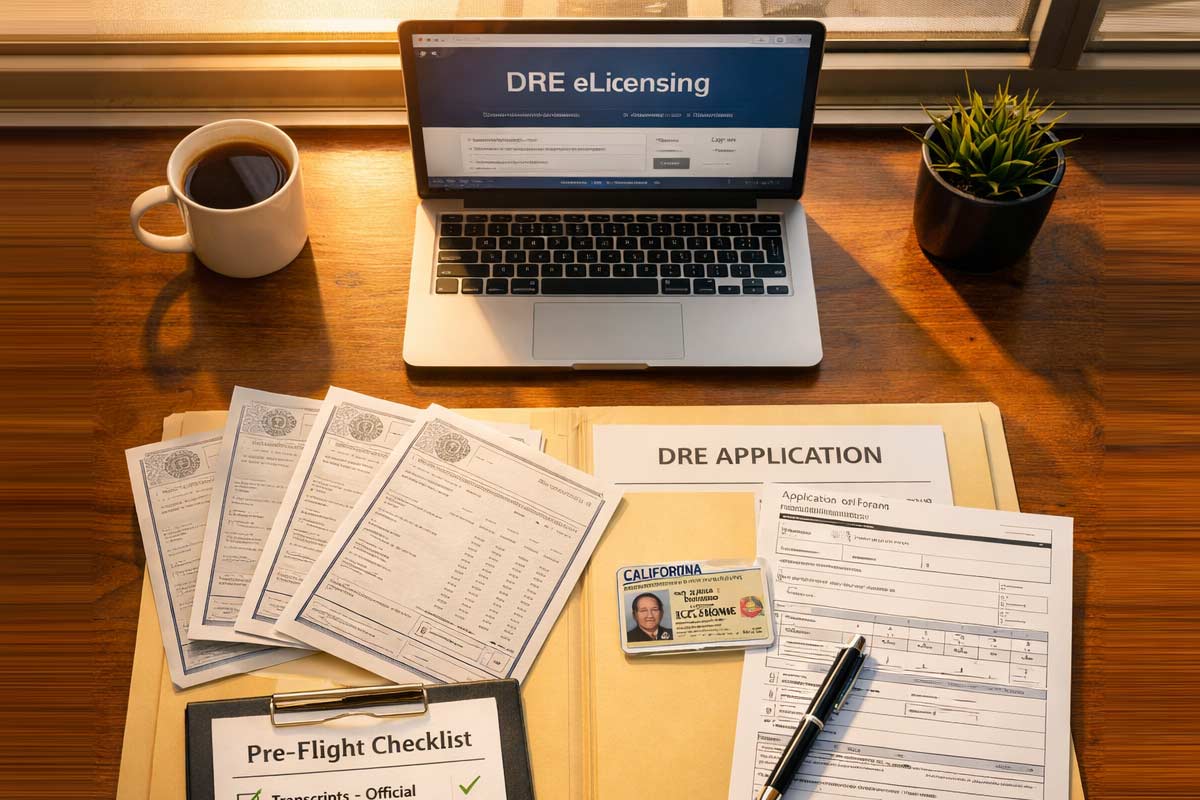
The most stressful part of getting your license isn't usually the math or the laws—it’s the paperwork. At ADHI Schools, we’ve seen thousands of students stall their careers not because they couldn't Read more...
The most stressful part of getting your license isn't usually the math or the laws—it’s the paperwork. At ADHI Schools, we’ve seen thousands of students stall their careers not because they couldn't pass the test, but because a simple clerical error on their California real estate exam application delayed their eligibility by months.
When you apply for the exam, you are essentially asking the Department of Real Estate (DRE) to verify that you have met the legal requirements to sit for the test. Precision is your best friend here. Treat this application like a professional transaction: precision prevents the "delay cycle."
Quick Summary
Official Transcripts: Ensure your three college-level courses are finished and you have official transcripts (or copies of official transcripts) ready.
Select Your Path: Choose between the Exam-Only (RE 400A) or the "Combo" Exam/License (RE 435) application - ADHI Schools always recommends the combo application.
Verify Details: Your application must match your government-issued ID exactly to prevent identity mismatches.
Track Progress: Save copies of everything and monitor the DRE processing timelines.
What “Applying for the Exam” Actually Means
Applying for the real estate exam is the formal bridge between finishing your education and actually scheduling a test date. The DRE is not just checking your name; they are auditing your pre-license education and your fitness for licensure.
Key Distinctions:
Education vs. Eligibility: Completing your courses makes you eligible to apply; it does not automatically register you for the exam.
Application vs. Scheduling: You cannot pick a date the day you apply. The DRE must first process your paperwork and "qualify" you. Only then can you schedule a date via the eLicensing system.
This guide covers the pre-flight checklist, the step-by-step submission process, and how to avoid the common pitfalls of application delays. For a broader look at the entire journey, refer to our California Real Estate License Guide.
Before You Apply: Your Pre-Flight Checklist
In my 20+ years of preparing candidates, I’ve noticed a pattern: those who rush the application usually end up waiting the longest. Before you touch a physical form or complete a form online, confirm the following:
✅ Course Checklist for Salesperson Exam Eligibility
The DRE requires completion of three college-level courses. Ensure your transcripts reflect:
Real Estate Principles (Required)
Real Estate Practice (Required)
One Elective (e.g., Finance, Appraisal, Legal Aspects, or Property Management)
Documentation Standard: The DRE requires official transcripts or copies of official transcripts showing successful completion. While your course provider may issue "completion certificates," the DRE’s instructions emphasize transcripts as the primary proof of education. Keep your certificates for your personal records, but submit transcripts to the state.
Step-by-Step: How to Apply for the California Real Estate Exam
Step 1: Gather Required Documentation
Collect your official transcripts. If you are applying for the salesperson exam, ensure they clearly show the successful completion (there should be a six-digit approval number on each certificate) of all three required courses from a DRE statutory course provider or other qualifying accredited institution (such as a community college or university).
Step 2: Choose Your Application Type
The DRE provides two primary pathways for the application process:
Salesperson Examination Application (RE 400A): This is for students who want to apply for the exam only and handle the license application after they pass.
Salesperson Exam/License Application (RE 435): Often called the "Combo," this pathway lets you apply for the exam and license at the same time using one package (following the RE 435A instructions). ADHI Schools recommends this path.
Step 3: Complete the Form with Precision
Whether you use the online eLicensing system or a paper form, every field matters. I once saw an applicant's process halted because they forgot to check a "Yes/No" box.
Before You Submit:
Check Signatures: If mailing, ensure all signature lines are signed and dated.
Match Your ID: Ensure "Robert" isn't listed as "Bob" if your ID says "Robert."
Review Disclosures: Answer all background questions honestly and completely.
If you're worried about the fine print, it helps to review the common mistakes applicants make on DRE forms before you hit submit.
Step 4: Pay Fees and Submit
If mailing, use a method with tracking (like USPS Priority or Certified Mail). If applying online, take a screenshot of the "Success" or "Submitted" confirmation screen.
The Two Biggest Delay Traps
Trap #1: Inconsistent Identity Details
The DRE's system is highly sensitive to name variations. If you omit a middle initial or suffix (Jr. etc.) that appears on your ID, the background check or education verification may fail to sync.
How to avoid it: Use your full legal name as it appears on your driver’s license on every single document—no exceptions.
Trap #2: Missing Transcripts or Unapproved Providers
Using a non-approved provider, will trigger an immediate delay.
How to avoid it: Confirm your courses were completed at an accredited institution or a DRE statutory provider and ensure you are requesting transcripts from the registrar or provider with the six-digit approval number.
After You Submit: What Happens Next?
Once your California real estate exam application is in their hands, the DRE must verify your eligibility.
Processing Timelines: Do not rely on "guesses." Check the DRE Current Processing Timeframes
The Golden Ticket: Once approved, you will receive an "Examination Schedule Notice." This is your signal to log into eLicensing and pick your date and location.
Once you’ve secured your date, it is also a good time to look ahead at how to apply for your California real estate license after passing the exam so you can start working the moment your results are in.
FAQ
How long does it take after I apply to be able to schedule?
Timelines vary based on DRE volume. You should check the DRE’s official "Current Processing Timeframes" page weekly for the most accurate window.
What if I made a mistake on my application?
If the DRE finds an error, they will notify you (often via a deficiency notice) explaining what is missing. You must then correct it and resubmit, which adds time to the process.
Do small typos matter?
Yes. In a regulatory environment, accuracy is a prerequisite for a professional license. Typos in your SSN or name can cause significant background check delays.
What should I save for my records?
Save a PDF of your completed application, your payment receipt, and your mail tracking number.
What is the most common reason applications get delayed?
Incomplete signatures or failing to provide official transcripts as required.
Your Next Step
Applying for the exam is a major milestone—it means your education is behind you and your career is in front of you. Take an extra 10 minutes today to review your application one last time to ensure they are "DRE-ready."
|

Quick Take: How to Beat the Mid-Course Slump
Systems > Motivation: Motivation is a feeling that fades; systems are habits that finish the job.
The 20/2/1 Plan: Commit to 20 mins daily, 2 deep Read more...
Quick Take: How to Beat the Mid-Course Slump
Systems > Motivation: Motivation is a feeling that fades; systems are habits that finish the job.
The 20/2/1 Plan: Commit to 20 mins daily, 2 deep sessions weekly, and 1 weekly review.
Motivation ≠ Mood: You don't need to "feel like it" to start; movement creates the mood.
Active Recall: Stop passive reading. Quiz yourself early and often to see visible progress.
Protect Your Time: Treat your study blocks like non-negotiable appointments with a client.
Why "Real Estate School Motivation" Fades (And How to Get It Back)
It happens to almost everyone. You sign up for your California real estate courses with high energy. You envision the "For Sale" signs and the freedom of being your own boss. Then you hit the first boring chapter—and your calendar starts winning.
If you feel stuck, you aren't "bad at school." You are simply relying on motivation, which is a fickle emotion. After over 20 years of leading one of the Best Real Estate Schools in California, I can tell you that the most successful agents aren't the most "motivated"—they are the most disciplined.
The Motivation Truth: Identity vs. Emotion
Most students approach real estate school with the mindset of "I'll study when I have time and feel like it." This is a recipe for a "never-ending" course.
Real momentum comes from an Identity Shift. You have to decide: "I am the kind of person who finishes what I start." In my two decades of experience, I’ve seen students who work 60 hours a week finish in 54 days, while others with open schedules take two years. The difference? The former group built a "study identity" where the books opened regardless of how they felt.
Motivation ≠ Mood
It is a common myth that you need to be in the right "mood" to study. The not so big secret is that Motivation often shows up after starting. *You’re not trying to “feel motivated.”*
You’re trying to remove decisions.
When you remove the choice of whether to study, the resistance disappears.
The 7 Motivation Killers (and How to Fix Them)
1. Vague Scheduling
Symptom: Saying "I’ll study this weekend" but never opening the laptop.
If/Then Fix: If it’s 9:05 AM and you haven’t started, then open the course and commit to doing only 5 practice questions.
2. Passive Reading
Symptom: Reading the same paragraph five times without it sinking in.
If/Then Fix: If you realize you’re just staring at the page, then close the book and write down three things you remember from memory.
3. Isolation
Symptom: Feeling like you’re the only person struggling with "Escrow" or "Agency."
If/Then Fix: If you feel lonely in your studies, then sign up for a live webinar or instructor office hours to rejoin the community.
4. Unrealistic Timelines
Symptom: Feeling "behind" because you didn't finish in three weeks.
If/Then Fix: If you feel overwhelmed by the total hours, then check our guide on how long real estate school should take to reset your expectations.
5. High-Friction Environments
Symptom: Trying to study on the couch with the TV on.
If/Then Fix: If you find yourself reaching for your phone, then move to a dedicated desk. See our guide on the optimal study setup for real estate school.
6. Perfectionism
Symptom: Refusing to take a quiz until you know "everything."
If/Then Fix: If you are scared to fail a quiz, then take it anyway. A "failed" quiz is just a data point for what to review next.
7. No Feedback Loop
Symptom: Feeling like you aren't making progress.
If/Then Fix: If the finish line feels too far away, then print a physical progress bar and color in every chapter you complete.
The ADHI “Finish Line System”: The 20/2/1 Plan
To stay motivated during real estate school, stop guessing. Use this repeatable numeric framework to ensure you finish your hours:
20 Minutes Daily (The Habit Chain): This is your Minimum Viable Progress. Even on your busiest day, do 20 minutes of practice questions. It keeps the "real estate brain" active.
2 Deep-Work Blocks Weekly: Schedule two 90-minute sessions. These are your "power sessions" for heavy reading or complex topics like Finance or Legal descriptions.
1 Weekly Review: Spend 15 minutes every Sunday night. Review your "missed" questions from the week and plan your specific study times for the week ahead.
Do This Today: Set a recurring alarm on your phone for your "20-minute daily" session. Label it "Future Career Deposit."
Motivation by Scenario: Lived-In Examples
The Full-Time Professional (The 5 AM Trigger): Sarah worked 50 hours a week and felt she had no time. She stopped trying to study at night. Instead, she set a "5 AM Trigger"—coffee, then 20 minutes of online real estate classes. She finished in 60 days.
The Busy Parent (The Micro-Burst): Mark had two toddlers. Long study blocks were impossible. He switched to "micro-bursts"—doing 5-minute quizzes on his phone during nap times and park trips. He proved that online real estate classes actually prepare you even in small increments.
The "Re-Starter" (Breaking the Cycle): Elena had "started" school three times. Each time, she tried to restart from Chapter 1. The fix? She committed to picking up exactly where she left off, even if she felt "rusty." She prioritized forward motion over perfect review.
When to Pause vs. Push (The 48-Hour Reset)
There is a difference between "resistance" (procrastination) and "burnout" (true mental exhaustion).
The Rule: If you haven't made progress in three days, do a 48-Hour Reset.
The Plan: For two days, stop new content. Do a light reset: sleep, walk, and only review summaries if you feel anxious. Do not try to learn anything new. On the third day, return to your 20-minute habit.
Confidence Bridge: Progress is Visible
Motivation dies when the work feels invisible. Your fix is measurable progress: practice questions, error review, and a visible scoreboard. Remember: your goal isn't just to finish the course; it’s to pass the California State Exam on the first try. Reading student reviews of online real estate schools shows that those who stayed motivated were those who stopped "reading" and started "testing."
Frequently Asked Questions
How can I stay motivated in a self-paced real estate course? Create external pressure. Tell a friend your "graduation" date. Having someone ask "How's the school going?" creates the healthy social pressure needed to stay on track. Post that you are getting your license on social media.
Is it normal to feel overwhelmed by the real estate vocabulary? Yes. You are learning a new language. Treat the first pass like a survey and don't expect 100% comprehension until you start doing intensive practice exams.
What should I do if I’ve been away from the course for months? Don't start over. Review your last completed chapter's summary for 15 minutes, then move immediately into the next new chapter. Momentum is built by moving forward.
Does the school you choose affect your motivation? Absolutely. A school with no support or a clunky interface makes it easy to quit. Look for a program that offers clear progress tracking and access to instructors who can clarify difficult concepts.
Ready to Turn Momentum into a Career?
Staying motivated is easier when you have the right support system and a clear path to the finish line. If your current "self-paced" journey feels like a dead end, it might be time to evaluate the structure and support behind your education.
Evaluate your options and find the structure you need here: Explore the Best Real Estate Schools in California
|

In twenty years of leading students at ADHI Schools, I have seen thousands of students start their licensing journey. At this point, I can tell pretty quickly whether a student will be licensed in four Read more...
In twenty years of leading students at ADHI Schools, I have seen thousands of students start their licensing journey. At this point, I can tell pretty quickly whether a student will be licensed in four months or still "working on it" in twelve.
The difference isn't intelligence or background. It often comes down to their environment.
Folks often treat real estate school like a hobby—they fit it into the gaps of their life. First-time passers treat it like a closing. They don't rely on motivation; they rely on a Passive-to-Active (PTA) System. If you do not intentionally design your study setup, your environment will design your failure.
Quick Take: The High‑Pass System
The Framework: The "PTA System" (Environment, Tools, Routine).
The Non‑Negotiable: Total phone isolation and a "Single‑Task" browser setup.
The Metrics: Shift from "hours logged" to "concepts mastered via active recall."
The Goal: Eliminate the 3–6 month "drift" that kills most real estate careers.
The PTA System: A 3‑Pillar Framework
To pass the California state exam on your first attempt, you must move from Passive Consumption (watching videos) to Active Recall (retrieving information). My PTA System is the architecture that forces this transition.
1. Environment: The Distraction‑Free Command Center
Your brain is a proximity‑based machine. If your phone is within reach, a portion of your cognitive load is dedicated to not checking it.
The "Clean Desk" Mandate: Your workspace should contain exactly three things: your device, your notes, and a glass of water. Anything else—mail, laundry, other work—is a cognitive leak.
Phone Isolation (The "Faraday" Rule): Your phone does not belong on your desk. It belongs in another room. Research shows that even a silenced phone face-down on a desk reduces cognitive capacity.
The Lighting Trigger: Use a dedicated lamp for studying. When that light is on, you are a real estate student. When it’s off, you’re a parent/employee/spouse. This "context anchoring" is how busy professionals finish the course in record time.
The "Minimum Viable Corner": Don't have an office? Use noise-canceling headphones and a specific placemat. These are your "walls."
2. Tools: The "Single‑Task" Tech Stack
Most students fail because they use tools that encourage multitasking. A tablet with 15 open apps is not a study tool; it’s a distraction device.
The Hardware Hierarchy: A desktop or laptop is the only professional choice. You need a keyboard for rapid note-taking and a screen large enough to view the course side-by-side with practice exams.
The Browser Lockdown: Use a dedicated browser (e.g., Firefox if you usually use Chrome) solely for real estate school. No social media logins, no saved "distraction" bookmarks.
Note‑Taking (The "Write‑to‑Recall" Method):
Do not transcribe the course. That is passive and useless. Write down questions, not answers. (e.g., instead of writing "Joint Tenancy requires 4 unities," write "What are the 4 unities of Joint Tenancy?").
The 20‑Minute "Sprints": Use a physical kitchen timer. Digging into your phone to set a timer is an invitation for a 20-minute Instagram detour.
3. Routine: The "20/2/1" Execution Plan
The biggest mistake I see is “binge studying.” Students try to pull 8‑hour sessions on Sundays. They retain nothing.
The Daily 20: Twenty minutes of practice questions every morning before the world wakes up. This keeps your "exam brain" sharp.
The Deep 2: Two hours of new curriculum mid‑week.
The Sunday 1: One full, timed practice exam.
The "Start Ritual": A 60‑second sequence (Water → Headphones → Login) that signals to your brain that the "Real Estate School" gear has engaged.
The "Exam‑Readiness" Upgrade (Why Passive Students Fail)
This is where most students lose a year of their lives. They mistake familiarity for mastery.
I’ve seen students who claim to have “read” the textbook but can’t pass a 150‑question practice test. They fell into the trap of passive reading. They chose a setup that made it easy to "watch" but hard to "do."
Do online real estate classes actually prepare you? Only if your setup forces you to answer questions. If your study routine doesn't involve being "wrong" at least 30% of the time during practice, you aren't learning—you’re just scrolling.
Kartik’s Reality Check: In two decades, I have never seen a student fail the state exam because they didn't "read enough." They fail because they didn't "retrieve enough." Your setup must be a retrieval machine.
Common Setup Failures (The "Don't" List)
If your current study habit looks like this, you are effectively choosing to fail:
The "Second Screen" Trap: Having the TV on or a movie playing while "going through the slides."
The "Highlighter Fallacy": Thinking that coloring a page yellow equals moving it into your long‑term memory.
The "Drift": Not knowing exactly which lesson you will tackle before you sit down.
Skipping Practice Tests: Waiting until the "end" of the course to see if you actually know the material.
Profile
The "Pass" Strategy
The Failure Mode
The Busy Pro
20‑min daily sprints
"I'll do it all on Saturday"
The Career Changer
Active recall / PTA System
Passive reading / Highlighting
The Academic
Practice test drilling
Over‑studying theory / No testing
Implementation: Choose Your Path
You are at a crossroads that determines how long real estate school should take. You can either drift through the material and hope for the best, or you can build a PTA system that guarantees a result.
Consistency is the byproduct of a good environment. If you find yourself constantly losing steam, read our analysis on how to stay motivated during real estate school. Usually, it’s not a lack of "willpower"—it’s a broken setup.
When you compare the Best Real Estate Schools in California, look for the one that doesn't just give you a login, but gives you a framework for success. Check the student reviews of online real estate schools and you’ll see that the ones who pass are the ones who treated the process with the professional rigor it deserves.
PTA System FAQs
Q: Is it okay to study at a coffee shop?
A: Only if you have noise‑canceling headphones and can handle the "Portable PTA Kit." If people‑watching is more interesting than the Law of Agency, stay home.
Q: Should I use digital flashcards?
A: Yes, but only if you create them yourself. The act of writing the question is 50% of the learning.
Q: What if I miss a week of my routine?
A: Do not try to "catch up" by doubling your hours. You’ll just burn out. Return to the 20/2/1 plan immediately. The system is designed to absorb life’s interruptions.
Q: How do I know if my setup is working?
A: By your practice test scores. If your scores aren't rising, your environment is likely too passive.
Q: Does the PTA system work for everyone?
A: It works for everyone who actually implements it. It is the converged "best practice" of 20 years of successful California brokers.
The Verdict
If you don’t design your setup, your environment will design your outcome. A professional career starts with a professional study habit. Build your PTA Command Center today, put your phone in another room, and start your first 20‑minute sprint.
Your future as a California agent depends on the systems you build today.
|