Your hand hovers over the dial. The script is pulled up on your screen, but the words feel unnatural and obvious at the same time.
In your head, you already sound like a telemarketer.
You’re terrified Read more...
Your hand hovers over the dial. The script is pulled up on your screen, but the words feel unnatural and obvious at the same time.
In your head, you already sound like a telemarketer.
You’re terrified of blanking mid-sentence or, worse, getting hit with a question that knocks you off your path.
Here is the field-tested truth:
Top-producing agents aren't "naturals."
They’re just prepared.
Whether you are working a buyer lead, a social media inquiry, or a guest at an open house, scripts are your foundation. This isn't about memorization; it's about building the muscle memory required to stop worrying about your next word and start listening to the client’s needs.
The Core Thesis: Scripts aren't lines to memorize. They are reps to build automaticity. You are training your brain to handle the structure of a deal so your mind is free to think and lead.
The 3-Level Progression: From Memorization to Mastery
In my 20+ years coaching California agents, I’ve seen thousands try to "wing it." They fail because they have no floor. Use this ladder to build your skills.
Level 1: Memorize the FRAME (The "GPS" of the Call)
Most agents fail because they try to memorize a script word-for-word. The moment a prospect goes off-script, the agent’s brain reboots.
The Goal: Know the structural milestones of the interaction.
The Drill: Summarize your script into three "anchor" points.
Example Frame (Universal Buyer Lead):
Connection: "I saw you were looking at the Main Street property—what was it about that home that caught your eye?"
Motivation: "Are you looking for something with that specific layout, or just that neighborhood?"
The Ask: "I’m seeing a few others in that pocket with similar features; would you like to see those this weekend?"
Level 2: Drill for Fluency (Diagnostic Reps)
Note: These characters are diagnostic tools to help you find your "natural" baseline; they are not your final delivery voice.
The Goal: Pacing and tonal control.
The Drill: Set a 60-second timer. Say your script 5 times, changing your "character" each rep:
Whispering: Focuses on crisp enunciation.
Over-excited: Highlights where you sound too "salesy."
Calm/Bored: Helps you find a neutral, professional baseline.
Fast-paced (Stress Test): Tests your ability to keep words fluid under pressure.
Final Rep: The "Curiosity" voice—slow, helpful, and inquisitive.
Level 3: Pressure-Test with Chaos
In the real world, people interrupt. They say, "I'm busy," or "Who is this again?"
The Goal: Progressive recovery.
The Drill: Have a partner interrupt you mid-sentence with a random objection. Your goal isn't to be perfect—it's to see how quickly you can get back into the "Frame."
The Target: Aim for a 7-second recovery initially, working your way down to a 3-second pivot back to the conversation.
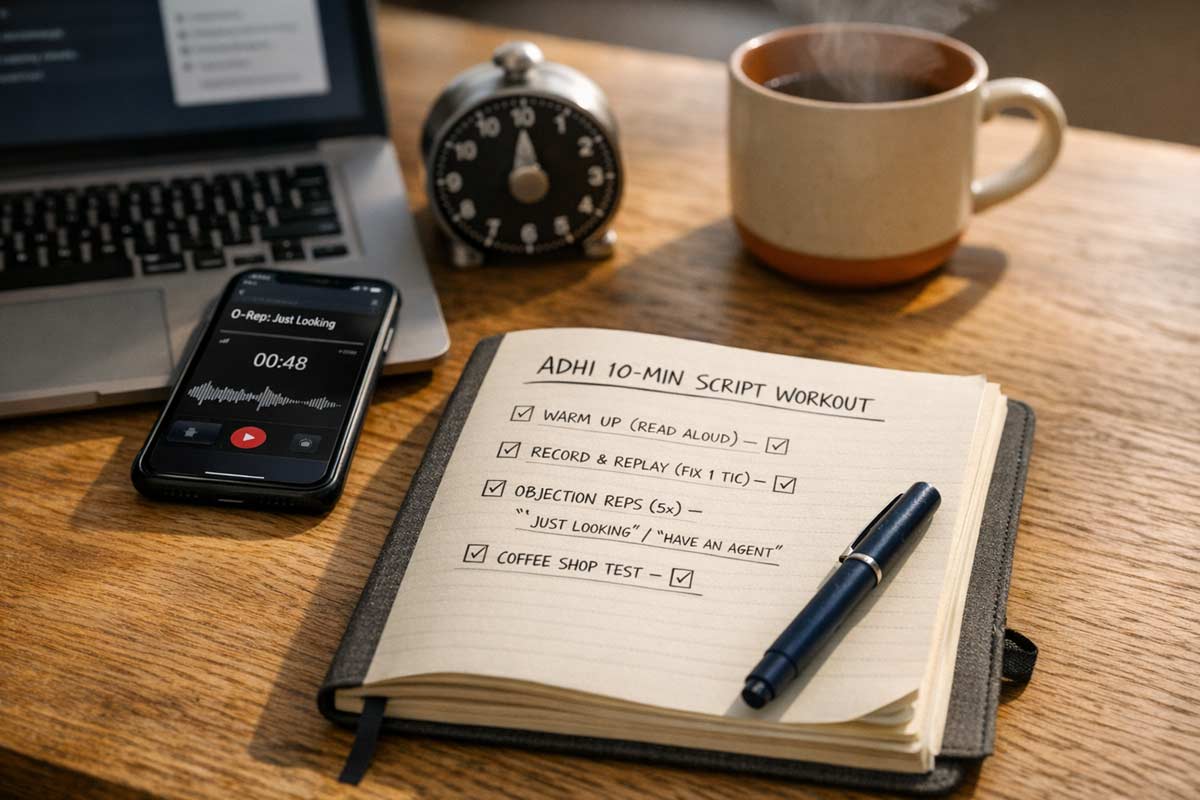
The ADHI 10-Minute Daily Script Workout
This is your non-negotiable morning habit. Like a pre-flight checklist, it must be done before you touch the phone.
Min 1–2: Warm-Up. Read your script aloud. Just get used to the sound of your own voice in the room.
Min 3–5: Record & Replay. Use a voice memo. Listen for "um", "like", and "you know." Fix one verbal tic per session.
Min 6–8: Objection Reps. Pick one objection and drill the response 5 times using the Level 2 diagnostic characters.
Min 9–10: The Coffee Shop Test. Say the core message as if you were explaining it to a friend. If it sounds like a lecture, simplify the language.
The “Don't Sound Robotic” Fix: The 1-1-1 Method
Robotic agents deliver monologues. Professionals lead dialogues. Use this formula to stay human:
1 Consistent Opening Line: Your anchor. (e.g., "Hi [Name], this is [Your Name] with [Brokerage].")
1 Personalized Sentence: Use a specific observation. "I noticed you were looking at that listing on Main Street—that specific layout is quite rare for this pocket of the city."
1 Clean Question: This shifts the energy. "Is that the specific style of home you're looking for, or are you open to other layouts?"
The Big 5 Objections: Recovery Drills
"We already have an agent."
Response: "That's great. It's so important to have someone you trust in this market."
Pivot: "If anything ever changes, what's the best way for me to stay in touch with you?"
"I'm just looking."
Response: "Of course, most of my best clients started out just browsing."
Pivot: "Are you looking for a 'forever home' or more of an investment opportunity?"
"How did you get my number?"
Response: "I’m an agent with [Brokerage] and I’m following up on your inquiry regarding the property on [Address/Area]."
Pivot: "I apologize if I caught you at a bad time—were you still looking for information on that home, or has your search changed?"
"Will you cut your commission?"
Response: "I understand that the fee is a factor in your net return. I’m curious, is your priority the cost of the service, or the net amount you walk away with at closing?"
Pivot: "Would you be open to seeing how our specific marketing and negotiation services are designed to protect that net return?"
"Send me an email."
Response: "I'd be happy to. I have a lot of data I can send."
Pivot: "To make sure I don't clutter your inbox with things you don't need, which two or three things are most important to you right now?"
The Bridge: From Practice to Production
Fluency equals authority. When you don't fumble for words, you look like a seasoned professional who understands the market.
The "Messy" Middle: To stay calm and lead the conversation when escrow hurdles arise, master the Negotiation Basics for New California Agents.
Securing the Listing: Knowing your frame keeps you in control when you learn How New Agents Should Handle Their First Listing Appointment with confidence.
The Buyer Consultation: Fluency is your best tool for answering tough questions during your How to Prepare for Your First Buyer Consultation.
Building Credibility: You can learn How to Avoid the “New Agent Mistakes” That Hurt Credibility simply by sounding like a peer to the veteran brokers you'll be negotiating against.
The 7-Day Challenge
Commit to the 10-Minute Daily Workout for exactly seven days. Do not skip a morning. By Day 8, the phone won't feel like a 500-pound weight. You are building a system that turns "fear of the phone" into a reliable, professional skill.
If you’re ready to master the skills that separate the top earners from the rest, the next step is building your professional foundation. Our Start Real Estate Career in California guide is where your journey begins—start it with a system designed for success.
FAQ Section
What scripts should I learn first? Focus on the "Lead Follow-up" script. Most agents lose money not because they can't find leads, but because they don't know how to handle the first 60 seconds of a return call.
How do I practice scripts without a partner? Use the "Record & Replay" method. Record yourself on your phone, wait 10 minutes, and listen back as if you were the client. You will immediately hear where you sound "salesy" or unsure.
How long should I practice scripts daily? 10 to 15 minutes of high-intensity practice is better than an hour of casual reading over a script. Quality of focus matters more than the clock.
What is the #1 practice mistake? Practicing in your head. If the words aren't physically coming out of your mouth, you aren't training your vocal cords or your brain for the "live" environment.
|

You’ve passed the real estate exam, hung your license with a broker, and got your first box of business cards.
Then, the silence hit.
Most new agents in California fall into the "motivation spiral." Read more...
You’ve passed the real estate exam, hung your license with a broker, and got your first box of business cards.
Then, the silence hit.
Most new agents in California fall into the "motivation spiral." You start with high energy, realize you don't have a boss telling you what to do, and quickly drift into "research" (scrolling Instagram) or "branding" (tweaking a logo no one has seen). Before long, the excitement turns to dread.
In my experience coaching thousands of new agents through ADHI Schools, I’ve seen this pattern over and over. Failure in this business rarely comes from a lack of talent; it comes from a lack of a plan and a measurable scoreboard. If you want to survive your first year, you need an operational field manual, not a 40-page theoretical document.
A business plan is not a static document. It’s a weekly operating system you should execute on even when you’re tired.
The 1-Page Real Estate Business Plan (Copy/Paste This)
A business plan is simply a set of decisions made in advance so you don’t have to "think" when you wake up.
The 60-Minute Build Checklist
Open a blank document and answer these points. If you spend more than an hour on this, you’ve drifted into procrastination.
Target Client: Pick two zip codes or one demographic (e.g., first-time buyers in Riverside).
Your Offer: Pick one "rookie-safe" value prop (see below).
Your ONE Lead Pillar: SOI, Open Houses, Cold Outreach, or Social Media.
Weekly Calendar: Set fixed blocks for prospecting and follow-up.
Weekly Activity Scoreboard: Define your "Input" numbers.
Budget & Runway: How much cash is in the bank today?
Tech Setup: Is your MLS, CRM, and e-signature software active?
14-Day Proof: Define what “working” looks like in two weeks (e.g., 20 conversations + 1 appointment held).
5 Rookie-Safe Offers (Choose One)
New agents often struggle with "positioning" because they lack a track record. Instead of selling "experience," sell a specific process:
The Hyper-Local Listing Concierge: "I run a pricing + prep timeline so sellers don’t guess—want me to walk you through it?"
The First-Time Buyer Roadmap: "I’ve mapped out the local lender and grant programs for first-timers; should I send you a copy?"
The Condo Seller Packet: "I have a pre-listing kit for this building with the HOA requirements and recent comps; want to see it?"
The Open House Matchmaking Offer: "I’ll send you the top 3 deals in your specific price range every Tuesday; want on the list?"
The Pricing & Prep Walkthrough: "I can give you a 30-minute walkthrough with a repair/ROI checklist to maximize your net; are you free Tuesday?"
To refine how you present these, review these Branding Tips for New California Agents.
The Scoreboard: The Numbers That Control Your Motivation
New agents quit because they focus on "closings," which are lagging indicators. You can’t control when a deal closes, but you can control how many people you talk to today.
When you feel the "dread" setting in, look at your scoreboard. In my experience, if the numbers
Activity (Input)
Weekly Target
Daily Target (Mon-Fri)
Why It Matters
New Conversations Logged
50
10
Finding "hand-raisers."
Follow-Ups
75
15
Most closings come from the 4th+ contact.
Appointments Held
2
—
Face-to-face (or Zoom) builds trust.
Contacts Added + Notes
50
10
If it isn't in the CRM, the lead doesn't exist.
are high, your progress becomes predictable. This is the secret to How to Stay Motivated as a New Agent.
Your Example Weekly Calendar (Copy/Paste)
You cannot manage what you do not schedule. Use this as your baseline:
Mon–Fri 9:00 AM – 11:00 AM: Lead pillar activity (Calls, Invites, DMs).
Mon–Fri 11:00 AM – 12:00 PM: Follow-up + CRM notes.
Tue/Thu 4:00 PM – 6:00 PM: Preview homes (Inventory research).
Sat/Sun: Open House (Host if possible; attend if you can't get one yet) + Sunday night prep.
Sun 7:00 PM – 7:20 PM: The 20-Minute Reset. Clean CRM, set follow-ups, and schedule next week’s prospecting blocks.
The 90-Day Execution Plan: A Brutally Specific Grind
Weeks 1–2: The Launch Phase
Build Your SOI List: Export your phone and email contacts. Goal: 120 names.
The Outreach Script: Call 5 people and text 5 people per day. "I’m with [Brokerage] now and I specialize in [Offer]. If you hear anyone mention buying or selling this year, I’d be grateful if you’d connect us."
The CRM: Log every single interaction.
Weeks 3–8: The System Phase
Implement 1-3-7-21: Follow up with every new lead on Day 1, Day 3, Day 7, and Day 21.
Market Knowledge: Preview 5 homes per week in your target zip codes.
Weeks 9–12: The Review & Diagnostic
The Scoreboard Audit:
If 0 conversations: You have a discipline/system issue.
If conversations but no appointments: You have an offer/script issue.
If appointments but no clients: You have a follow-up/conversion issue.
The Reset Rule: If you miss a day, don't spiral. Reset the clock to zero and start fresh tomorrow morning.
Choose Your ONE Lead Pillar (Stop the Chaos)
1. SOI/Referrals (Sphere of Influence)
Daily Actions: 5 calls, 5 texts, 5 social media interactions.
Success Metric (14 Days): 50 outreaches + 5 coffee meetings or consultations.
2. Open Houses
The Offer: "I’ll send you the 3 best buys in this neighborhood this week—text me your price range."
Daily Actions: Mon-Wed: Secure a listing. Thu-Fri: Prepare "Invite Lists." Sat-Sun: Host the event.
Success Metric: 10 guest sign-ins via QR code + 10 follow-up calls made by Monday noon.
3. Cold Outreach (Expireds/FSBOs)
Daily Actions: 2 hours of morning calls to homeowners who failed to sell or are trying to sell alone. Follow your brokerage policy and DNC rules; don't freestyle.
Success Metric (14 Days): 100 contacts + 10 real conversations + 1 appointment held.
4. Social Media Machine
Daily Actions: 3 short videos per week, 10 DMs to local followers, 1 weekly "market update" text to your SOI. Use these Social Media Best Practices for Realtors to ensure you’re actually creating leads.
Budget & Runway (The Part Everyone Avoids)
California is an expensive state for real estate professionals. You must know your "burn rate."
The Formula: Runway = (Savings / Monthly Burn)
Startup Estimate: DRE Fees, MLS dues, Association Dues (NAR/CAR), and E&O insurance. Treat $2,000–$4,000 as a planning estimate.
The Reality Check: If you don't have 6 months of savings, you probably need a "paid runway"—a side job, savings, partner income, or a brokerage lead source. Desperation is when agents start cutting corners on disclosure, honesty, and compliance. This financial pressure is a major reason Why Most New Agents Quit in the First Year.
“Busywork Traps” to Identify and Avoid
If a task doesn’t involve a conversation with a human, it’s likely a trap.
The Training Loop: Watching endless YouTube videos instead of prospecting.
Logo/Website Tinkering: Nobody cares about your font if you don't have a listing.
The CRM Perfection Trap: Rebuilding your CRM tags and pipelines instead of actually using it to call people.
The Checklist Rule: If the task doesn't directly create a conversation or an appointment, it's not a priority today.
Mini Case Studies: The Plan in Action
The "Passive Poster"
The Problem: Posted on Instagram daily but had 0 leads.
The Fix: Switched to the "Social Media Machine" pillar. They added 10 DMs per day to local residents.
Result: They secured two serious buyer consultations and a warm listing lead within 60 days.
The "Timid Rookie"
The Problem: Afraid to call their SOI.
The Fix: Used the "First-Time Buyer Roadmap" offer. It gave them a reason to call ("I have a new map for first-time buyers, want a copy?").
Result: Logged 50 CRM notes in a week and set their first "Appointment Held" by Friday.
Your Next 3 Steps
Fill out the one-page plan now. Don't wait for "perfect" clarity.
Set your weekly calendar. Use the template above to block your time.
Start your scoreboard. Log your first 10 conversations tomorrow morning.
Want the full roadmap?
Read our comprehensive guide: Start a Real Estate Career in California
It lays out the timeline, exact costs, and what to do first.
FAQ: Real Estate Business Planning
What should my real estate business plan include?
At a minimum, it must include your target market, your primary lead generation pillar, a daily activity scoreboard, and a budget for California-specific dues and fees.
Do I need a business plan to join a brokerage?
Technically, no. Most brokerages will hire anyone with a license. However, without one, you’re relying on hope instead of a system.
How many hours a day should a new agent prospect?
In my experience, a new agent should spend at least 2 hours every morning on lead generation and 1 hour on follow-up.
How much money do I need to start?
Aim for 6 months of living expenses. If you can’t, ensure you have a "paid runway" (side income) so you don't make desperate decisions out of financial fear.
How long should a business plan be?
One page. If it’s longer, you won't look at it. If you won't look at it, you won't follow it.
|
You’ve passed the real estate exam, your license is issued, and you’ve chosen a broker. Then, Monday morning hits. You sit at your desk, and the "post-license cliff" sets in: your calendar is empty, Read more...
You’ve passed the real estate exam, your license is issued, and you’ve chosen a broker. Then, Monday morning hits. You sit at your desk, and the "post-license cliff" sets in: your calendar is empty, and your phone isn't ringing.
The temptation for most new California agents is to reach for a credit card and buy leads. Every real estate office has that guest speaker pitching a magical "lead-gen tool" for $199 a month.
That is a short-term fix for a long-term problem.
In our industry, your database is your business. It is the only asset you truly own. One clean database can produce repeat clients for 10 years; one lead-buy produces, at best, a one-time conversation.
A database doesn’t magically create deals—it creates conversations, and conversations create appointments.
A "from scratch" database isn't about empty contacts—it's about missing the system for consistent, targeted follow-up.
By the end of this guide, you will have a clear, 30-day roadmap to move from zero contacts to a professional follow-up system that produces consistent commissions.
What a "Database" Actually Means
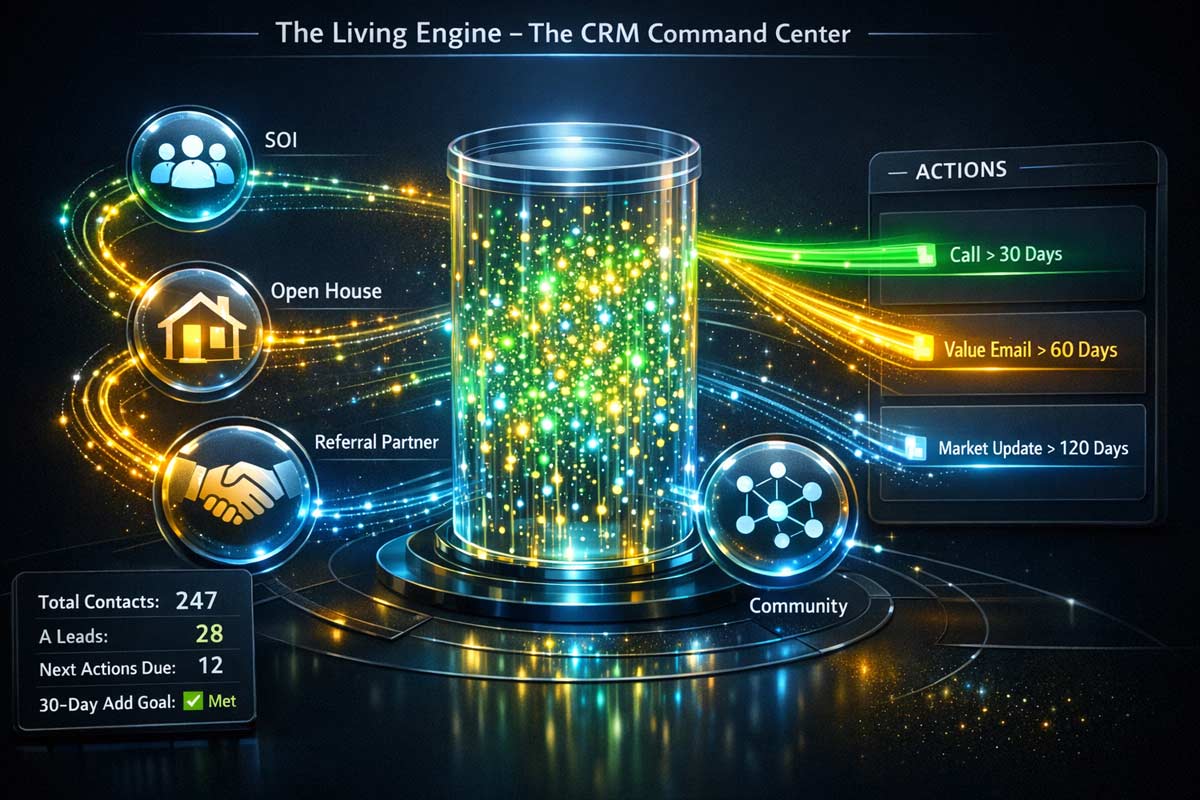
A database is not just a list of names or an exported CSV file from your phone. A database is a list with memory. It records context (notes) and creates the next action (follow-up date).
What Should You Track in a Real Estate Database?
To turn a contact list into a revenue-generating database, you need specific data points. If you don't know what columns to make in your spreadsheet, copy this exact template:
Full Name
Phone Number & Email
Preferred Contact Method (Text, Call, or Email)
City/Neighborhood (Crucial for California's hyper-local markets)
School District/Commute Corridor (The “why” behind their location)
Relationship Status (How do you know them?)
Source (Sphere, Open House, Referral, Social, Vendor)
Tags/Categories (A/B/C ranking, Buyer, Seller)
Last Contact Date
Next Follow-Up Date
Notes (Kids’ names, pets, hobbies, real estate goals)
Your First Database Rule: One Contact = One Next Action
If someone is worth saving, they’re worth scheduling. Every new entry in your system must have either:
A next follow-up date, OR
A "Do Not Contact" note.
There is no third option. Why: if it isn’t scheduled, it won’t happen.
Choose Your Tool (Without Overcomplicating)
Do not get stuck "tool shopping." You can lose weeks comparing software features while making zero phone calls.
Choose a system based on your current volume:
Google Sheets (0–100 Contacts): The fastest way to start. Google Sheets is free, searchable, and forces you to learn the mechanics of data entry.
Basic/Free CRM (100–300 Contacts): Many brokerages provide a CRM included when you join (like BoldTrail (formerly KV Core) or Chime). Use what you already have before paying for a third-party tool.
Full CRM (300+ Contacts): Only invest in premium platforms once you have a consistent lead flow and need advanced automation.
The Rule: If you have under 100 contacts, start with a spreadsheet. If you spend more than two days "researching" CRMs, you are procrastinating. Pick one and execute.
The 8 Best Places to Get Your First 100 Contacts
You aren't starting from zero; you’re starting from "unorganized." Here is where to find your first 100 entries:
Phone Contacts: Export your contact list. Don’t “clean first.” Import them, then add 25 per day for four days. Momentum beats perfection.
Past Coworkers: Start with 10 you’d confidently ask for advice. You were a professional before you were an agent; these people already trust your work ethic.
The Gym/School/Hobby Circle: Anyone you see at least once a month belongs in the database.
Vendors: Your lender, escrow officer, and local contractors. Tag these as “Vendors” to build a referral exchange.
Open House Sign-ins: This is your primary engine. Rule: If they sign in, they go into your database before you leave the property—while the conversation is still fresh enough to write real notes. Learn how new agents should hold open houses to maximize this capture.
Social DMs: Look at who “likes” your posts. Message them: “Hey [Name], I’m updating my professional directory—what’s the best email to send my local market reports to?”
Community Groups: Local neighborhood associations or Facebook groups (be the helper, not the solicitor).
Out-of-Area Agents: Tag them as “Referral Partners.” A small group of active agents outside your zip code can become your most consistent referral pipeline.
Clean Data Beats Big Data (Hygiene)
Before you chase "more contacts," fix the basics. A messy database is a useless database.
Standardize Names: "Mike Smith," not "Mike S." or "Dad's Friend."
One Primary Contact: Identify one main phone number and email per person.
Merge Duplicates: Do not have three entries for the same person.
Add "Source": Always know where a lead came from so you can track ROI later.
Fix Bouncebacks: If an email bounces or a number is wrong, update it the same day.
The "DNC" Tag: Create a "Do Not Contact" tag so you don’t burn relationships by calling people who asked you to stop.
Tagging & Segmentation: The Power of "A-B-C"
If you treat everyone in your database the same, you will burn out. You must segment your contacts so you know who to call first.
The Starter Tag Framework
Tag Category
Examples
Purpose
Ranking
A (Referral source), B (Met once), C (Cold)
Prioritizes your daily call list.
Timeline
Hot (0–3 mo), Warm (3–12 mo), Long-term
Focuses your energy on immediate deals.
Type
Buyer, Seller, Investor, Vendor, Referral Partner
Determines what kind of content you send.
Source
Open House, Sphere, Referral
Tracks which lead sources for new California agents are working.
The Follow-Up Operating System
Building the list is only 20% of the work. The remaining 80% is the follow-up. Successful agents use new agent time management strategies to ensure they aren't just "busy," but productive.
Follow-Up Cadence
"A" Leads (Referral Sources): Contact every 30 days.
"B" Leads (Met Once/Acquaintances): Contact every 60–90 days.
"C" Leads (Cold/Distant): Contact every 120–180 days (about twice a year) with broad value.
Value-Based Scripts
The "Permission" Text (Low Pressure, High Reply):
"Hey [Name]—quick question. Would it be helpful if I kept you posted when something notable happens in [Neighborhood] (sales, price changes, anything meaningful)? If yes, what’s the best email for you?"
The "Market Micro-Update" (Email/Text):
"Hey [Name], I saw that a house just like yours around the corner sold for [Price]. It's interesting to see how [City] is holding up right now. Let me know if you’d ever like a quick look at your current home value!"
The "Direct Ask" (Voice):
"I'm taking on a couple more clients this month. Who do you know that’s mentioned moving, upsizing, downsizing, or investing—even if it’s ‘later this year’?"
30-Day Build Plan
Follow this checklist to go from a blank screen to a functioning business engine.
The 30-Day Database Blueprint
Week 1: The Foundation. Create your spreadsheet using the template fields above. Import phone contacts. Apply "A, B, C" rankings to the first 50 people.
Week 2: The Reach Out. Add 25 more names. Send the "Permission" text script to everyone tagged "A" or "B."
Week 3: The Expansion. Log all responses. Call those who replied. Research how to find your first 3 clients as a new agent to convert these conversations into appointments.
Week 4: The Routine. Establish a "Minimum Daily Action": Add 5 new people, contact 5 existing people, and log 5 sets of notes.
Common Mistakes That Kill Databases
Over the last 20+ years, Kartik Subramaniam has seen thousands of students launch their careers.
The ones who fail usually hit these eight pitfalls:
Waiting until you "feel ready" to start calling.
Saving contacts with no notes (you will forget who they are).
Failing to use tags, leading to a "messy" list you eventually ignore.
No "Next Follow-Up" date— if it isn't scheduled, it won't happen.
Relying on "Likes"— social media engagement is not a database relationship.
Buying leads before you’ve exhausted your free sphere of influence.
Sounding like a salesperson instead of a local guide.
Ignoring Open Houses as a primary way to feed the database engine.
Kartik's Insider Tip: “I’ve seen agents turn a 'maybe next year' lead into a $30,000 commission simply because they had a 'follow up in 6 months' tag and actually made the call. Most agents quit after one 'no.' The database ensures you are there when the 'no' turns into a 'now.'”
Start Your Career the Right Way
A database is the difference between a "job" and a "business." Without it, you are unemployed every time a transaction closes. With it, you have a predictable stream of referrals and repeat clients.
If you are ready to move beyond the basics, it is time to look at the bigger picture of your professional development. If you’re building your first-year foundation in California, that’s the full roadmap.
Start a Real Estate Career in California →
FAQ
1. How many contacts should a new agent have?
Aim for 100 "met" contacts as quickly as possible. This is the baseline required to generate consistent referral traffic. Once you hit 100, aim for 250.
2. Do I need an expensive CRM to start in California?
No. A simple Google Sheet is often more effective for your first 100 contacts because it forces you to stay organized without the distraction of complex features.
3. What is a "Sphere of Influence" in real estate?
Your sphere of influence (SOI) consists of everyone you know personally who already likes and trusts you—friends, family, past coworkers, and neighbors. These are your warmest leads.
4. How often should I contact my database?
Contact "A" leads (referrals) every 30 days, "B" leads every 60–90 days, and "C" leads every 120–180 days (about twice a year).
5. What is the best way to ask for a referral?
Be direct but value-focused. Ask who they know that needs help navigating the current California market, rather than just asking for a name.
|

You’ve passed the real estate exam, your license is hanging at a brokerage, and the initial celebration has subsided. Now, you’re staring at a blank calendar and a quiet phone. It’s what I call the Read more...
You’ve passed the real estate exam, your license is hanging at a brokerage, and the initial celebration has subsided. Now, you’re staring at a blank calendar and a quiet phone. It’s what I call the “post-license cliff”. This moment is particularly acute in California, where high competition meets complex markets, and the pressure to “figure it out fast” can lead new agents toward expensive, ineffective shortcuts.
If you’re a new real estate agent in California wondering how to get your first clients without buying leads, this article is your playbook. Securing your first three clients isn't just about income—it’s about proof of concept. In my 20+ years of working in the California real estate market, I’ve noticed the agents who survive the first year are those who replace "hustle" with systems and processes.
What Success Looks Like in 30 Days
Before we dive in, let’s define a "win." Success in your first month isn't measured by closed escrows—it’s measured by inputs. These inputs work because they maximize trust-building touches, not impressions. If you follow this operating system, your 30-day scoreboard should look like this:
100+ Real Conversations (5 per business day)
40+ Contacts added to your database
4 Open Houses hosted
1–2 Buyer Consultations booked
Practice Over Profit: The First 3 Principle
This is the phase where most new real estate agents in California either build momentum—or quietly stall. Your first three clients are your learning labs. You are building the muscle memory of a professional. Success here comes from
Practice + Proximity + Follow-up
not expensive marketing.
Before You Prospect: Two Things You Must Set Up This Week
Before you pick up the phone, you need a professional foundation. California’s disclosure-heavy environment means your first clients are as much about the learning process as closing deals.
Broker Expectations: Sit down with your broker or team lead. Ask for (a) upcoming open house opportunities, (b) "floor time" for walk-ins (if this is still a thing in your area), and (c) their preferred CRM.
Compliance Guardrails: This is California—disclosures matter. Don’t wing it. Don't promise specific financial outcomes, keep all communications professional, and stay within your brokerage’s legal policies.
Pathway 1: The "Inner Circle" Strategy (The Database)
The Reality: Your first client is almost always someone you already know, or someone they know. People do business with people they trust.
The Action Plan: Stop "announcing" your career and start consulting. Use these micro-scripts to offer value:
The Call: "I’ve officially launched my real estate practice. I’m not calling for business—I just want to be your resource. If you ever need a quick valuation or want to know what’s moving in the neighborhood, I'm here."
The Text: "Hey! Just wrapped up my licensing. If you ever have a random real estate question or need a vendor recommendation, feel free to reach out!"
Micro-Credibility Boost:
Avoid: “I just got licensed and I’m looking for clients.”
Use: “I’m building my practice and want you to have a real resource.”
The 14-Day Follow-Up Cadence:
Day 0: Initial outreach (Call/Text).
Day 7: Value Touch (Send a quick, one-page market snapshot of their specific zip code).
Day 14: The Soft Ask: "I’m helping a few people find homes this month. Do you know anyone else thinking about a move this year?"
The Deeper Resource:
A "system" is simply: Name + Source + Last Contact + Next Action. In week one, a spreadsheet is fine. To move toward a sustainable pipeline, you need to build a real estate database from scratch.
Pathway 2: The Open House Capture & Conversion
The Reality: Open houses are one of the few places consumers actually expect to talk to an agent. It is a high leverage use of your time.
The Action Plan (The 3-Step Flow):
The Welcome: "Welcome! Are you from the neighborhood or just starting your search?"
The Qualification: "Have you seen anything else in this price point, or are you still getting a feel for the local inventory?"
The Close for the Next Step: "I have a list of three similar homes nearby that aren't on everyone's radar yet. Would you like me to send those over?"
A productive open house for a new agent isn’t measured by attendance—it’s measured by 2–3 follow-up conversations scheduled within 48 hours.
The Deeper Resource:
To turn a handshake into a contract, you need a specific follow-up method. Learn the full process in our guide: How New Agents Should Hold Open Houses in California.
Pathway 3: Leverage Office Inventory & Stale Leads
The Reality: While most agents chase "perfect" leads, you can find your first three clients by looking where others don't.
High-volume agents often ignore these opportunities because they require follow-up instead of marketing scale.
The Action Plan:
Support High-Volume Listings: Call top listing agents in your office. Offer to host their "stale" listings or prospect the surrounding neighborhood for them.
Renters-to-Buyers: Many people attending open houses are currently renting. Position yourself as the guide who helps them transition.
The Guardrails: Always follow "Do Not Call" rules and brokerage policy. Your job is service, not pressure. Once you've mastered these manual methods, you can explore broader lead sources for new California agents to scale.
The Two Moments That Start Real Careers
Moment #1: Someone trusts you enough to ask a "small" question (e.g., "What's my neighbor's house listed for?").
Moment #2: You followed up when the "rockstar" agent in your office forgot to.
Neither moment looks dramatic—but both are how real careers actually start.
Practical Pitfalls
Most new agents quit because they confuse activity with income-producing actions. This is how agents stay ‘busy’ for six months and exit the industry silently.
The below activities do NOT count as prospecting:
Perfecting your logo or business cards.
Scrolling Instagram for "content ideas."
Endlessly "tinkering" with CRM tags.
Watching "motivational" YouTube videos.
Re-designing your email signature.
The only 3 activities that count:
Real conversations
Intentional follow-up
Studying local inventory.
Managing this focus is the difference between a hobby and a career. Implement these New Agent Time Management Strategies to stay on track.
Your 30-Day Plan (Simple Version)
Week
Primary Focus
Daily Minimum
Week 1
Database Outreach + 1 Open House
5 Conversations
Week 2
Follow-ups + 1 Open House
5 Conversations
Week 3
Repeat + Book 1 Buyer Consult
5 Conversations
Week 4
Tighten Pipeline + Ask for Referrals
5 Conversations
Note: Five conversations means real two-way dialogue—not texts sent or DMs unanswered.
The Path Forward
Finding your first three clients is the hardest part of this business because it requires the most faith. But once you close that third deal, the "imposter syndrome" fades.
Mastering these first three clients is how you build a durable practice, not just a fleeting side hustle. For the complete framework on launching correctly—from mindset to long-term planning—your next step is our foundational guide: Start Your Real Estate Career in California.
|
You have spent months studying principles, practices, and finance. You’ve memorized the difference between a freehold estate and a leasehold estate. You’ve taken practice tests until your eyes Read more...
You have spent months studying principles, practices, and finance. You’ve memorized the difference between a freehold estate and a leasehold estate. You’ve taken practice tests until your eyes blurred. But there is one variable that textbooks cannot fully replicate: the environment of the testing center itself.
Anxiety often stems from the unknown. For many students, the fear isn’t just about the questions; it is about the logistics. Where do I park? What can I bring into the room? What does the computer interface look like? When do I find out if I passed?
At ADHI Schools, we believe that removing the mystery of the process allows your brain to focus entirely on the content. By understanding the flow of the day, you can walk in with confidence rather than apprehension. This overview is an essential component of our comprehensive California Real Estate Exam Guide, designed to help you navigate every step of the licensing journey.
The DRE Difference: Who Runs the Exam?
First, it is important to understand who is in charge. Unlike many other states that outsource their testing to third-party vendors like Pearson VUE or PSI, California does things differently. The California Department of Real Estate (DRE) both creates the exam and administers it.
This means that when you walk into the testing center, you are walking into a state-controlled environment. The proctors are state employees or contracted strictly by the state, and the security protocols come directly from the DRE.
Before You Leave Home
Your exam day strategy begins before you even start your car. The DRE is incredibly strict regarding punctuality and identification. If you are late, you may be denied entry and will forfeit your exam fee.
The Identification Rule: You must bring one current, valid (not expired), government-issued ID with a photograph and signature. This is usually a driver’s license, state ID, or passport. The name on your ID must exactly match the name on your exam registration. If you recently got married or changed your name and your ID doesn't reflect that yet, you will be turned away.
The "Car Strategy": Since you cannot bring personal items into the testing room, and locker space is sometimes limited or cramped, the best place for your phone, wallet, and study notes is often the trunk of your car. However, do not leave your ID and exam schedule notice in the car. Double-check that you have them in your hand before locking the vehicle.
Successful candidates often plan these logistics weeks in advance when they figure out how to schedule the California real estate exam through the eLicensing system, ensuring they have ample travel time buffered into their morning commute.
Arrival and Check-In Process
Plan to arrive at the testing site at least 30 to 45 minutes before your scheduled start time. This buffer is necessary for parking, locating the suite within the building, and the check-in line.
Once you enter the facility, the atmosphere shifts. It is generally quiet and sterile. You will approach the reception desk where a proctor will verify your ID. You can choose to place your belongings inside a locker for personal items like car keys. Do not try to sneak anything into the testing room. The proctors are vigilant, and the rules are generally uniform regardless of which of the California real estate exam testing centers you selected for your test.
Security Procedures
The security measures at DRE centers feel comparable to airport screening. This is to ensure the integrity of the state exam. Be prepared for the following:
Empty Pockets: You will likely be asked to turn your pockets inside out to prove they are empty.
Visual Inspection: You may be asked to roll up your sleeves or lift pant legs slightly to ensure no notes are hidden.
Jewelry and Accessories: Large jewelry, heavy coats, and brimmed hats are generally prohibited. You cannot wear a smartwatch or a Fitbit. Analog watches are also usually banned to prevent hidden cameras or timing devices.
Calculators: Since there is no longer any math on the real estate exam, no calculators can be brought into the exam site nor will the state provide you with one.
The Testing Room Environment
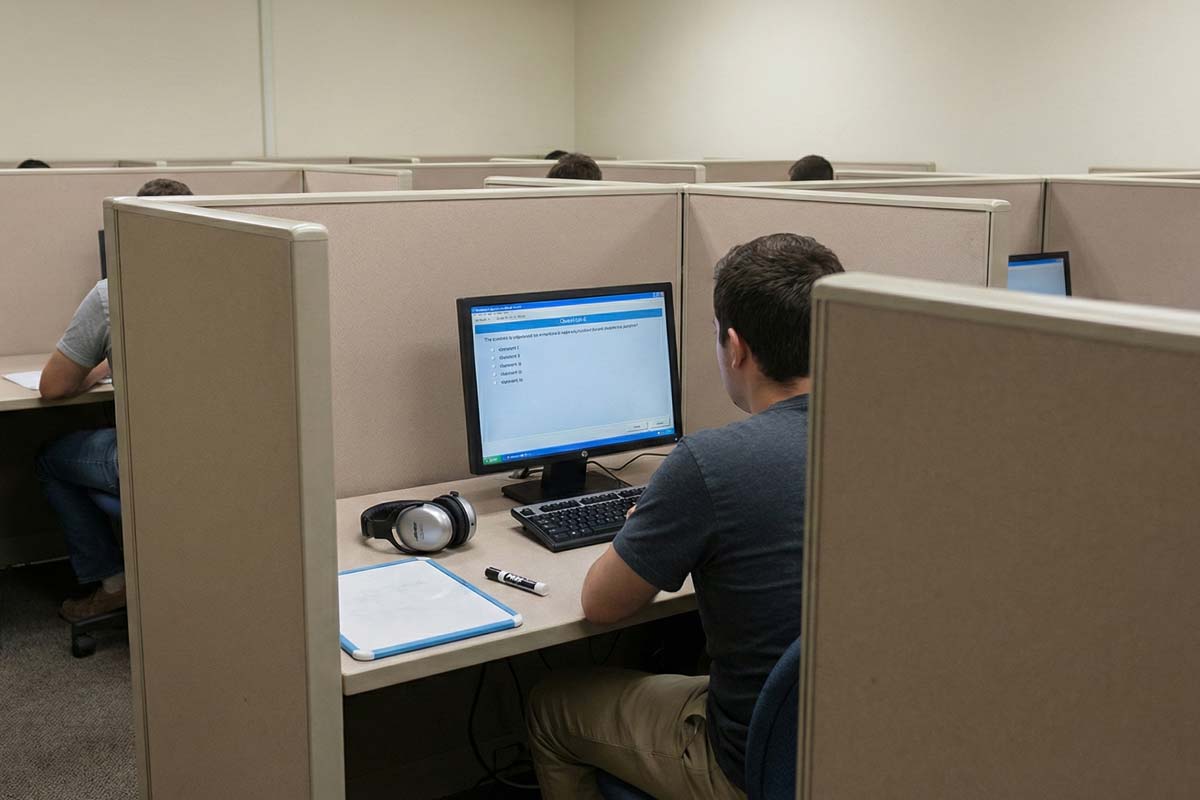
Once you pass security, you are escorted into the testing room. It is typically a room filled with cubicles, similar to a computer lab or a call center. You will be assigned a specific workstation.
Expect the First 5 Minutes to Feel Strange
It is completely normal to feel a surge of panic during these first few minutes. Most students report a spike in heart rate as they sit in the chair. This is a physiological response to stress, not a reflection of your preparation. Acknowledge it, take a deep breath, and trust that it usually fades once you answer the first five questions.
The Interface: The exam is taken on a computer. This is not a sleek or modern testing interface; it is functional, simple, and dated. You will use the mouse to select A, B, C, or D—there are no fill-in-the-blank or essay questions.
The Restroom Rule: You are permitted to use the restroom during the exam, but be aware that the exam timer does not stop. If you take a 10-minute break, that is 10 minutes less you have to answer questions. Plan your water intake accordingly.
It is important to remember that you must be physically present at the proctored center; current DRE regulations do not allow you to take the California real estate exam online remotely.
Top 5 Things That Surprise Students
The "Old School" Tech: The mouse might be clunky, and the screen resolution low.
Unpredictable Temps: The room might be freezing cold or uncomfortably warm. Dress in layers.
No Immediate Score: You won't see "PASS" on the screen the moment you finish (more on that below).
Ambient Noise: You will hear mouse clicks, coughing, and chairs shifting.
Small Lockers: If you bring a giant backpack, it might not fit.
Pacing, Fatigue, and Strategy
You have 3 hours to answer 150 multiple-choice questions for the salesperson exam and 4 hours and 200 questions for the broker test. This breaks down to roughly 1 minute and 12 seconds per question. However, this is an average, not a rigid rule. Some vocabulary questions will take you 10 seconds; some longer “story type” questions might take you 3 minutes.
The "Halfway" Landmark: A good rule of thumb for pacing is to check the timer when you are halfway through the questions. Based on where you are at the halfway mark you might need to speed it up.
The Fatigue Factor: The hardest part of the exam often isn't the difficulty of question #1, but the brain fog that sets in by question #115. Decision fatigue is real. Toward the end of the exam, your brain may try to rush you just to escape the uncomfortable environment.
Pro Tip: Watch out for "overthinking." As fatigue sets in, students often stare at simple questions and convince themselves there must be a trick. Usually, there isn't. If you know the definition, mark it and move on.
Recognizing your own biological clock is vital here; if you know your focus crashes after lunch, you should have considered the best time of day to take the California real estate exam to ensure you are testing during your peak mental performance window.
What Happens After You Click “Submit”
This is the moment that causes the most heart palpitations.
You do not see your result on the screen immediately in the testing cubicle. The screen typically goes blank or returns to a welcome page. You must gather your things and walk out to the proctor at the front desk.
The Result: The proctor will print a piece of paper, fold it, and hand it to you.
If you passed: The paper will typically say "CONGRATULATIONS" and provide instructions on how to apply for your license. It will not tell you your score. Whether you got 80% or 100%, a pass is a pass.
If you failed: The paper will show you your actual numerical score and a breakdown of the percentages you scored in each of the seven topic areas. This is diagnostic, helping you know where to study for the next attempt.
Final Exam-Day Checklist
To ensure a smooth experience, run through this mental checklist before walking out the door:
Valid ID: Check it twice.
Directions: Have the address loaded in your GPS.
Comfortable Clothing: Dress in layers to handle unpredictable room temps.
Keys and Wallet: Ready to be locked in the provided locker or your trunk.
Positive Mindset: Leave the panic at home.
Walk In Prepared
The California Real Estate Exam is designed to be rigorous, but it is not impossible. By knowing exactly what to expect when you walk through those doors, you eliminate the element of surprise.
Trust your preparation. You have put in the work, you understand the material, and now you understand the logistics. If you want a complete step-by-step walkthrough of the entire journey—from qualifying to scheduling to test day—the California Real Estate Exam Guide ties everything together to ensure you are ready to launch your new career.
FAQs
1. What identification is required to check in at the testing center? You must present one current, valid, government-issued ID with a photograph and signature (such as a driver’s license, state ID, or passport). The name on the ID must exactly match the name on your exam registration.
2. Can I bring a calculator into the exam room? No, there is no longer any math on the California real estate exam.
3. Will I see my pass/fail result on the computer screen immediately? No. After you click "Submit," the screen will typically return to a welcome page. You must exit the room to receive a printed report from the proctor. If you pass, it will not list a score; if you fail, it will provide your numerical score and a breakdown.
4. Can I use the restroom during the exam? Yes, you are permitted to use the restroom, but the exam timer does not stop. Any time taken for a break is deducted from your total testing time.
5. How many questions are on the exam and what is the time limit? The salesperson exam consists of 150 multiple-choice questions and you have up to 3 hours to complete. The broker exam is 200 multiple-choice questions and you get 4 hours to complete it.
|

You just received your license from the DRE.
You’ve joined a brokerage.
Now, you’re staring at a blank Canva template, wondering if your "brand" should be navy blue and gold or "modern minimalist" Read more...
You just received your license from the DRE.
You’ve joined a brokerage.
Now, you’re staring at a blank Canva template, wondering if your "brand" should be navy blue and gold or "modern minimalist" white.
Stop.
If you are spending your first week as an agent choosing fonts instead of making phone calls, you are falling into the trap of productive procrastination. You are hiding from the discomfort of lead generation behind the safety of "graphic design."
In the 2026 California market—defined by post-settlement commission transparency and a tightening insurance landscape—your brand is not a logo. Your brand is what people believe about you after an interaction. It is a lagging indicator of your behavior. You don't "build"; a brand; you earn one through proof, technical competence, and consistency.
The Branding Paralysis Spiral
Many new agents in California fail because they try to polish a mirror that hasn't been built yet. They believe they cannot ask for a listing until they have a high-end website and a curated Instagram aesthetic.
This is backward.
In my 20+ years of training thousands of agents at ADHI Schools, I’ve seen that the most successful "brands" start with an agent in a polo shirt showing a house at 7:00 PM on a Tuesday because they were the only ones who picked up the phone.
Your first job is your pipeline, not your polish. If you don't have clients, your brand is effectively invisible. If you want to Start a Real Estate Career in California that actually lasts, you must realize that your reputation is built in the field, not in a marketing suite.
Redefining Branding for the 2026 Market
In 2026, purely "aesthetic branding" is less effective than it used to be. With the shift in how buyer’s agents are compensated and the complexity of California’s property insurance crisis, clients are looking for technical navigators, not just friendly faces.
Trust Branding vs. Aesthetic Branding
Aesthetic Branding: Your business card, your headshot, your color palette. In my observation, this is rarely the deciding factor in why a client signs a contract.
Trust Branding: Your responsiveness, your ability to explain a buyer representation agreement, and your follow-up. This is what actually converts a lead into a client.
Client-Visible Signals: The 5 Behaviors That Define You
If you want to be known as a professional, master these observable signals:
Response Time → "They feel prioritized." In a fast-moving market, a delayed reply is a major signal of unreliability.
Local Competence → "They know the nuances." Can you explain the specific fire zone risks?
Process Transparency → "I’m never wondering what’s next." You tell the client what the escrow timeline looks like before they have to ask.
Value Articulation → "I know why I'm paying them." In 2026, you must be able to clearly state exactly what you do to earn your fee.
Directness → "They tell me the truth." Having the guts to tell a seller their home is overpriced creates a brand of high integrity.
The 2026 "Technical Navigator" Brand
To be a top-tier brand in 2026, you must prove you are current on new California regulations. Position yourself as an expert on these three pillars:
AB 2992 Compliance: Be the agent who explains why a written buyer agreement is required before the first showing and why the 90-day limit protects the consumer.
Marketing Transparency (AB 723) Build trust by being the first to disclose if listing photos are AI-staged or digitally altered, as now required by law.
The 90-Day Minimalist Branding Stack
For your first 90 days, you only need three foundational assets. Anything more is a distraction.
1. The Professional Bio (3-Line Formula)
Don't write a novel. Use this framework to capture long-tail search and build immediate E-E-A-T:
Line 1 (Who/Where): "I help first-time buyers in [City] navigate the local market to find homes that fit their budget."
Line 2 (Risk Reduction):: "Backed by the 20+ years of experience at [Brokerage Name], I specialize in simplifying California's complex disclosure process."
Line 3 (Proof of Work): "I’m in the field daily, tracking off-market opportunities and insurance updates for my clients."
2. The "One Value Slide"
This is your primary conversion asset. When a buyer asks, "Why do I need to sign this agreement?" or "What do you do for your fee?", you show them this list:
Agreement & Fee Clarity: Explaining the 2026 buyer-broker compensation rules.
Insurance Navigation: Identifying FAIR Plan eligibility and fire zone risks early.
Disclosure Management: Reviewing the TDS, SPQ, and the new smoke residue history reports.
Strategic Negotiation: Using data to win in multiple-offer scenarios without overpaying.
Vendor Coordination: Managing the 15+ people involved in a standard CA transaction.
3. A "Proof Stack" System
Post your "Learning Wins": "Just spent 4 hours studying the latest CA disclosure updates so my clients stay protected." Crucial Rule: Never imply you represented a party if you didn't. When in doubt, anonymize.
Positioning: Choose One Lane
California is too large to "do it all." Choose a lane you can genuinely service today:
Bilingual First-Time Specialist: Focus on underserved demographics in markets like the Central Valley.
Silicon Beach Tech Relocation: Focus on high-income earners moving for specific West LA industries.
Inland Empire ADU Specialist: Become the expert on "granny flats" and multi-generational living.
Active Adult (55+) Specialist: Focus on specific communities like Laguna Woods or Sun City.
Visual Branding & Social Media
Stop trying to be a "content creator" and start documenting your journey. Video platforms are increasingly important because they allow potential clients to "test drive" your personality.
For a deeper dive into this, check out How New Agents Should Use Social Media in 2026.
New Agent Branding Checklist
Google Business Profile: If you qualify under Google's guidelines (typically requiring a physical office or being a service-area business), claim your listing.
DRE Compliant Email Signature: Examples include your name, license number, and prominent brokerage name.
One Value Slide: A physical or digital page that lists your 5 core deliverables.
Consistent Social Handle: Keep your name consistent across all platforms.
CA-Specific Branding Mistakes (The Kill List)
The "Secret Agent" Syndrome: Having an Instagram but never mentioning you are a realtor to your neighbors.
Generic Quote Overposting: Posting "Home is where the heart is." This is filler; it adds zero technical value.
Deceptive Luxury: Using "luxury" branding when your license is 10 days old. Transparency is more attractive than a facade.
Ignoring the System: Many people fail because they lack a clear roadmap. This is Why Most New Agents Quit in the First Year.
The Earned Brand
In 2026, the only agents who will thrive are those who realize that a brand is earned through high-level service and technical competence. Stop designing your logo. Start designing your business. If you want to build a foundation that lasts, you need to How to Create a Real Estate Business Plan (New Agents) that prioritizes client value over aesthetics.
Your Next Step: Write your 3-line bio today. Don't worry about the font. Just make it clear. If you are struggling with the daily grind, learn How to Stay Motivated as a New Agent.
FAQ: Branding for New California Realtors
1. Do I need a personal website right away? Usually, no. Most brokerages provide a profile page. Focus your energy on local networking and your "Value Slide" first.
2. Should I use my own name or a team name? In California, team names must include the broker’s identity and follow specific DRE rules. For your first year, branding your own name is the simplest and safest path.
3. How much should I spend on branding in my first year? I typically advise agents to keep this under $500. A professional headshot is your only essential cost.
4. How do I brand myself if I have no experience? Brand yourself as the "most prepared." While others rely on old habits, you are the expert on the 2026 contract changes and new disclosure laws.
5. What is the most important social media platform in 2026? Instagram and YouTube remain leaders for real estate. They allow you to show your face and voice, which builds trust faster than a static image ever could.
Key Takeaways
Action > Aesthetics: A logo won't sell a house; a value-driven conversation will.
The "2026" Brand: Focus on being a navigator of insurance and new DRE laws.
Be a Niche Expert: Pick one California sub-market and own the local data.
Compliance is Mandatory: Ensure your DRE license number is visible on all solicitation materials as required by Regulation 2773.
Document the Journey: Use "behind the scenes" content to build trust without needing to "fake" success.
|

You’ve passed the real estate exam, joined a brokerage, and ordered your business cards. Now comes the most pressing question every new California agent faces:
"Where do I get my first lead?"
The Read more...
You’ve passed the real estate exam, joined a brokerage, and ordered your business cards. Now comes the most pressing question every new California agent faces:
"Where do I get my first lead?"
The industry is flooded with marketing noise and subscription platforms promising instant closings. But after 20 years in the California real estate business, I’ve seen thousands of agents burn through their savings chasing the wrong leads. The truth is that lead sources are far less important than your lead-to-relationship conversion and your consistency.
A lead isn't a commission check; it’s an introduction. California markets are fragmented—what works in Riverside won't always work in West LA. To start a real estate career in California that actually lasts, you need a system, not just a tactic.
Key Takeaways
Trust over Tech: Your Sphere of Influence (SOI) remains the highest-converting lead source.
Sweat Equity: Open houses are the fastest way to meet "now" buyers without an upfront budget.
Speed Wins: The agent who follows up same-day—often within minutes—usually wins the client. This is often called “speed-to-lead”.
Local Authority: Consistency in a small "micro-farm" beats sporadic efforts across a whole city.
Best Lead Sources by Situation
Fastest results: Open houses + tight follow-up
No budget: SOI + community networking
If you hate cold outreach: Database + partner referrals
Long-term dominance: Micro-farm + simple local content
Commercial-lite path: Small lease deals + local owner conversations
Ranked: The Best Lead Sources for New Agents
Note: "Skill Level" refers to your conversion and communication skill, not your personality type.
Lead Source
Cost
Time-to-Result
Skill Level
Best For...
Sphere of Influence (SOI)
Free
Days/Weeks
Low
Immediate trust & referrals
Open Houses
Free/Low
Days/Weeks
Medium
Meeting unrepresented buyers fast
Open House Follow-Up
Free
Days/Weeks
Medium
Turning “tourists” into clients
Database + CRM Follow-Up
Free/Low
Weeks
Medium
Staying top-of-mind consistently
Local Partner Referrals
Low
Weeks/Months
Medium
Warm intros from lenders/escrow
Agent-to-Agent Referrals
Low
Weeks/Months
Medium
Relocation + overflow clients
Community Networking
Low
Weeks/Months
Medium
Trust-building (schools, chambers)
Micro-Farming (100–300 homes)
Medium
Months
High
Long-term local dominance
Rentals / Landlords
Low
Weeks/Months
Medium
Leads that become buyers later
FSBO / Expireds
Low
Weeks
High
High-volume conversations
Online Inbound Basics
Low/Medium
Months
Medium
Compounding flow (reviews)
Paid Leads (Optional)
High
Days/Weeks
High
Agents with a break-even mindset
The Core Strategy: Where to Start
1. Your Sphere of Influence (SOI)
Your SOI includes friends, family, and past coworkers. These are people who already want you to succeed.
Why it works: Trust is pre-built. You aren't "selling"; you're informing.
Scenario: Instead of a sales pitch, try: "I'm not calling to sell you anything—I just wanted to let you know I'm officially with [Brokerage]. If you ever have a quick question about what's happening in our neighborhood, I'm happy to be your resource."
Do this this week: Call 5 people a day. Update their contact info in your CRM.
2. Open Houses as a Lead Engine
Don't just "sit" in a house. Use it as a platform. Learning how new agents should hold open houses effectively can transform a boring Saturday into three new buyer representation agreements.
Why it works: You meet active buyers in a specific zip code.
Scenario: When a visitor walks in: "Thanks for coming by. Most people I meet here are either neighbors or looking to move in the next 90 days—which one are you?"
Do this this week: Ask a top producer in your office to host their listing open this weekend.
3. Building Your Database
Every person you meet belongs in a CRM. You must build a real estate database from scratch to automate your "top of mind" awareness.
A Simple Follow-Up Cadence
Day 0: Quick text + “What stood out to you at the house?”
Day 1: Phone call (short, human).
Day 3: Value add (neighborhood note or listing link).
Day 7: Call + clarify timeline.
Month 2+: Monthly market update + personal check-in.
Expanding Your Reach
Local Partner & Agent Referrals
Lenders, escrow officers, and out-of-area agents are massive referral sources.
Why it works: These are professional, warm introductions.
#1 Rookie Mistake: Asking for leads before offering any value.
Do this this week: Invite a local lender to coffee to learn about their specific programs.
Community Networking & Micro-Farming
Become the "Digital Mayor" of a small area. Focus on 100–300 homes (a micro-farm) or your local PTA/Chamber.
Why it works: It builds "omnipresence" in a small, manageable pond.
Do this this week: Draft a simple, one-page market update for your specific neighborhood.
Online Inbound & Rentals
Claim your Google Business Profile and gather reviews immediately. Additionally, don't ignore renters; in California, today’s tenant is often next year’s first-time buyer.
FSBO / Expireds
Why it works: These are people with high "intent to sell."
Compliance Reminder: Strictly follow the National Do Not Call (DNC) Registry, respect all opt-outs, and follow your brokerage’s specific outreach policies.
What to Avoid: The "New Agent Traps"
Paid Leads: The "High Tuition" Trap
Paid leads aren't evil—they're just expensive if you aren't ready. If you can't respond in under 5 minutes and don't have a conversion system, paid leads are just a donation to a tech company.
Small Commercial (The "Lite" Path)
You don’t need to be a commercial specialist on day one. Start commercial-lite: small retail/office leases and local owner conversations. Partner with a senior agent when complexity rises. Done right, it builds a professional reputation that feeds your residential business.
The 30-Day Lead Generation Operating System
Success requires strict new agent time management strategies.
Week 1: Set up CRM. Call everyone in your phone. Schedule two open houses.
Week 2: Execute follow-up cadence (Day 0–7). Meet one local partner.
Week 3: Start your 100-home micro-farm. Drop off a market report.
Week 4: Evaluate metrics. How many conversations did you actually have?
Weekly Scorecard
Contacts added to CRM: ________
Real estate conversations: ________
Speed-to-lead (Avg minutes): ________
Follow-up attempts: ________
Appointments set: ________
FAQ
What is the best lead source for new California real estate agents?
Your sphere of influence (SOI) is the highest-converting starting point because trust is built-in. Pair it with open houses for faster “now buyer” conversations.
Are open houses a good way to get clients in California?
Yes—they are one of the fastest ways to meet unrepresented buyers. The key is capturing contact info and running a same-day follow-up plan.
How quickly should I follow up with a new lead?
Same day—ideally within minutes. In California’s fast-paced market, the first agent to provide value and set the next step usually wins the client.
Can I get real estate leads for free?
Yes. SOI outreach, open houses, and partner relationships produce leads with $0 in ad spend; your main cost is time and consistency.
How many follow-ups does it take to convert a lead?
Many leads convert after 5–12 touches over weeks or months. Most new agents fail by stopping after the second attempt.
Are paid leads worth it?
Only if you have a proven conversion system and understand break-even math. Without these, they are "expensive tuition."
Is cold calling illegal in California?
It is not automatically illegal, but it is heavily regulated. You must follow the National DNC Registry, honor opt-outs, and follow brokerage policy.
Should I focus on buyers or sellers first?
Buyers are often easier to find early through open houses. Sellers usually require the trust and proof you build through consistent activity.
Can new agents get commercial leads?
Yes, via "commercial-lite" paths like small leases. Keep expectations realistic and how to find your first 3 clients as a new agent often involves starting with these accessible opportunities.
Build Your Career Foundation
Lead generation is the heartbeat of your business, but it only works if you have the competence to back it up. Focus on building a career system rather than chasing the tactic of the month. Remain consistent, lead with value, and treat every contact like a long-term relationship.
|
Selecting a date for your state licensing exam is a milestone, but selecting the right time of day is a strategy.
Most students treat the time slot as a matter of convenience—scheduling around Read more...
Selecting a date for your state licensing exam is a milestone, but selecting the right time of day is a strategy.
Most students treat the time slot as a matter of convenience—scheduling around work shifts or childcare. However, when you are preparing to sit for an exam that could determine your career future, convenience should be secondary to cognitive performance.
The Department of Real Estate (DRE) typically offers morning and afternoon sessions. The content of the exam does not change based on the time, nor does the scoring criteria. However, your ability to focus, recall information, and manage anxiety absolutely fluctuates. By aligning your exam slot with the two biggest variables—your biological chronotype and local logistics—you give yourself a statistical edge.
Quick Decision Matrix
Choose Morning (AM) If: You are an "Early Bird" who wakes up alert, you have high anticipatory anxiety (need to "get it over with"), or your route involves driving against rush hour traffic.
Choose Afternoon (PM) If: You are a "Night Owl" who feels groggy before 10:00 AM, you are traveling a long distance that risks morning gridlock, or you rely on a slow warm-up routine to manage stress.
Is There a Best Time of Day to Take the Exam?
There is no officially mandated "correct" time that guarantees a passing grade. However, research suggests there is a best time for your specific physiology.
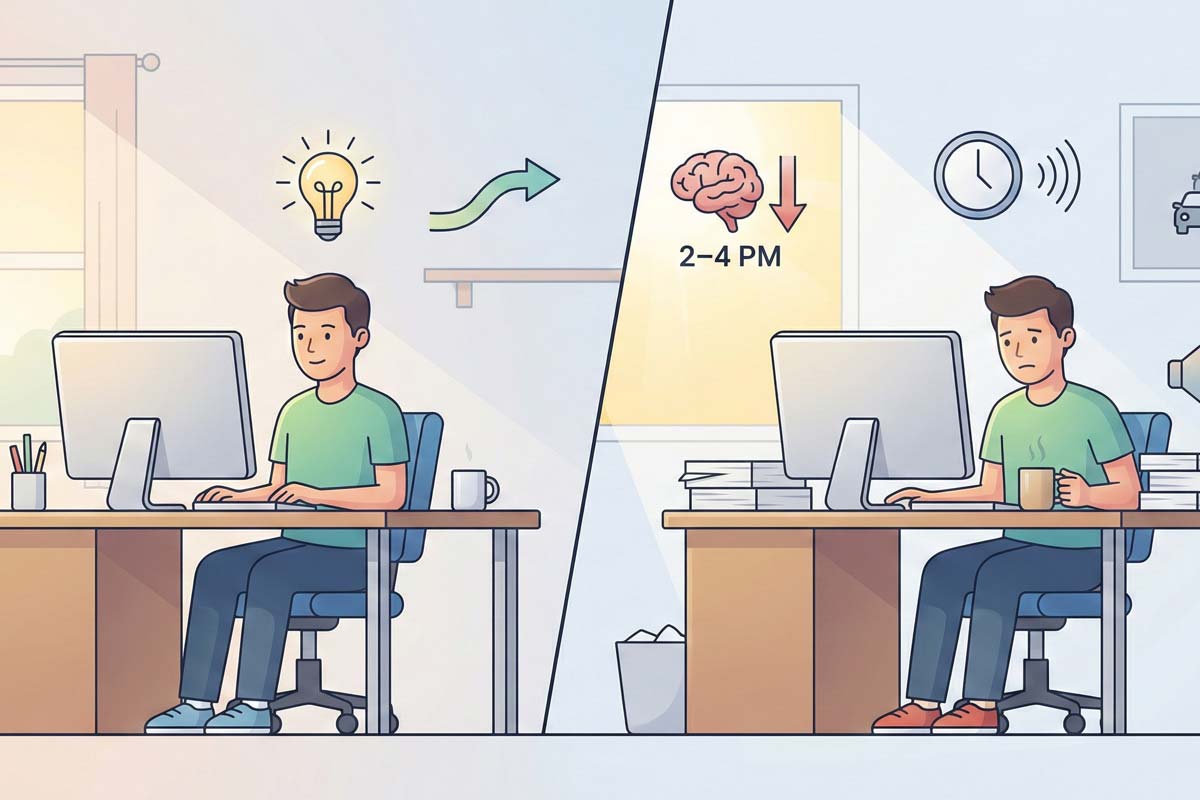
Cognitive science indicates that for approximately 75% of adults, analytical thinking and focus peak in the late morning. Conversely, the "post-lunch dip"—a documented circadian trough occurring between 2:00 PM and 4:00 PM—can significantly impact mental endurance. However, biology is adaptable; if you are forced into a time slot that doesn't match your rhythm, you can shift your circadian peak by taking practice exams at that specific time for a couple of weeks prior to the test.
But biology isn't the only factor. Your choice must also account for:
Traffic density at the specific arrival time.
Parking availability at the test site.
Commute stress and its effect on your adrenaline levels.
Because the 2026 California real estate exam contains no math questions and allows no calculators, the test consists entirely of conceptual questions, vocabulary, and scenario-based reading comprehension. You do not need calculation power; you need sustained mental endurance. You must choose a time slot that aligns with your peak mental alertness.
How Time of Day Affects Your Performance
Your brain’s performance on a standardized test is influenced by three main biological factors: cortisol levels, body temperature, and decision fatigue.
Cortisol and Alertness
Cortisol is the "waking hormone." For most people, it peaks around 30 to 45 minutes after waking up. This natural spike helps clear morning grogginess. If you schedule an 8:00 AM exam but usually wake up at 7:30 AM, you may be sitting in the testing chair before your brain has fully engaged.
Decision Fatigue vs. Scenario Questions
Decision fatigue is real. As the day progresses, the brain becomes tired of making choices. By the afternoon, after navigating traffic, scrolling through emails, or handling domestic tasks, your "willpower battery" is depleted. Because the California exam is heavily weighted toward scenario-based questions ("What should the agent do next?"), decision fatigue is particularly dangerous here. It can lead to careless errors on nuance questions you actually know the answers to.
The "No-Math" Factor
Since the DRE removed math from the exam, the test is less about formulas and more about linguistic nuance. Reading 150 or more scenario-based questions requires high-level executive function. If you are prone to afternoon slumps, the sheer volume of reading in a PM session can feel overwhelming compared to an AM session.
Morning Exam Slots — Pros and Cons
Morning slots (typically starting between 8:00 AM and 9:00 AM) are the most popular choice for first-time test takers, but they come with specific trade-offs.
The Pros:
Peak Cognitive Freshness: You capture the natural late-morning cognitive peak.
Reduced Anticipatory Anxiety: You wake up, get ready, and go. You have less time to sit around stressing about the outcome.
Operational Smoothness: Testing centers are generally cleaner and quieter in the morning. Additionally, morning sessions rarely face delays caused by technical bottlenecks or check-in backlogs from previous groups.
The Cons:
Rush Hour Traffic: If your testing center is in a metro area like Los Angeles or Oakland, getting there by 7:45 AM means battling peak traffic.
Sleep Deprivation: If you are too nervous to sleep the night before, an early alarm can leave you exhausted before you start.
Do NOT Choose Morning If:
You are a "night owl" who feels groggy until 10:00 AM.
Your commute is unpredictable (e.g., crossing major bridges or freeways prone to accidents).
You know that anxiety keeps you awake past midnight.
Afternoon Exam Slots — Pros and Cons
Afternoon slots (typically starting between 1:00 PM and 1:30 PM) offer a buffer for those who need a slower start to their day.
The Pros:
Traffic Avoidance: You can usually travel to the testing center after the morning rush has subsided.
Warm-Up Time: You have time to eat a decent meal and review the material one last time (though cramming is not recommended).
Ideal for Night Owls: If your brain doesn't fully "turn on" until 11:00 AM, this is your only viable option.
The Cons:
The Post-Lunch Slump: The body’s natural circadian dip occurs between 2:00 PM and 4:00 PM. If your exam starts at 1:30 PM, this fatigue hits you exactly around question #60 or #70—right in the middle of the test.
Ambient Noise: Afternoon sessions often contend with higher ambient noise from hallway traffic, deliveries, and street sounds as the city fully wakes up.
Accumulated Stress: You spend the whole morning waiting for the event, which can spike adrenaline levels prematurely and lead to a crash during the test.
Logistics That Influence Your Time Choice
Biology is important, but geography often dictates your schedule. California is vast, and the location of your test center should heavily influence whether you choose an AM or PM slot.
For example, if you are testing in San Diego or Oakland, an 8:00 AM exam requires arriving by 7:30 AM at the latest. This places you on the freeway during the absolute worst congestion of the day.
Remember: Traffic conditions are determined by your arrival time, not your appointment time. The stress of being late can spike your heart rate and scramble your focus before you even see the first question.
When evaluating specific California real estate exam testing centers, consider the local traffic patterns surrounding the facility. If the center is located in a high-density office park, parking might be scarce in the mid-morning but open in the early morning. Conversely, some centers have dedicated lots that fill up by 8:30 AM.
How Scheduling Works
The DRE uses a "first come, first served" model through the eLicensing system.
Morning slots tend to fill up faster than afternoon slots because many professionals prefer to take the exam and then head to work. This is especially true during the busy spring season (Q1 and Q2), where morning availability can become scarce. Once you've chosen the testing time that aligns with your chronotype, make sure you know how to schedule the California real estate exam properly—popular morning slots often fill quickly. Delaying your scheduling may force you into a less ideal time block.
What Your Exam Time Means for Exam-Day Prep
Your strategy for the day changes based on your clock.
For Morning Exams: Focus on a high-protein breakfast. Avoid heavy carbohydrates that induce sleepiness. Your goal is immediate, sustained energy. Arrive early enough to use the restroom and acclimate to the room temperature.
For Afternoon Exams: Eat a moderate lunch. A heavy meal right before a 1:00 PM test precipitates cognitive decline and drowsiness. Use the morning to relax, not to panic-study. Your arrival protocol changes slightly based on the time of day, understand what to expect on exam day regarding check-in lines and lobby congestion. Afternoon lobbies are often crowded with morning test-takers leaving as afternoon candidates arrive.
Why You Can’t Take a “Flexible Online Exam”
In the modern era, students often assume they can take the test at midnight from their home computer. This is a dangerous misconception.
Because it is currently impossible to take the California real estate exam online, you are bound to the physical constraints and operating hours of a brick-and-mortar test center. While rigid, this standardized schedule offers predictability. You cannot choose a random start time like 10:45 AM, and you cannot control the environment. This makes your choice of the standard AM or PM block even more critical. You must perform on their schedule, in person, under proctored conditions.
Final Thoughts
There is no magical time slot that makes the questions easier. The DRE creates a standardized difficulty level regardless of when you sit for the test. However, you can control the variables surrounding the test.
Choose Morning if: You wake up early, you want to avoid anticipation anxiety, and you have a clear commute.
Choose Afternoon if: You are a night owl, you have a long commute through heavy traffic, or you need the morning to settle your nerves.
Aligning your biological clock with your testing schedule is just one component of a broader strategy found in our comprehensive California Real Estate Exam Guide. Success is about preparation—both of your mind and your logistics.
Frequently Asked Questions
Is the morning or afternoon real estate exam easier? Statistically, neither exam is "easier." The difficulty level is identical, and time of day does not impact scoring. However, some students find morning exams subjectively easier because their brains are fresher and less fatigued by the day's events.
Do testing centers ever run behind schedule? Yes. While morning sessions almost always start on time, afternoon sessions can occasionally face delays if the morning check-out process runs long or if there are technical glitches at the facility.
Should I try a practice exam at the same time of day I plan to test? Yes. This is highly recommended. Taking a full-length simulated exam at the exact time of your scheduled test helps train your brain to be alert during that specific window, effectively shifting your circadian rhythm.
Should I drink coffee before the exam? If you normally drink coffee, yes. Do not change your caffeine routine on exam day. However, avoid drinking too much liquid immediately before the test, as unscheduled restroom breaks eat into your exam time.
Are morning exam slots quieter? Generally, yes. Morning sessions often have fewer distractions because the office building or testing complex hasn't fully "woken up" yet. Afternoon sessions may have more ambient noise from hallway traffic or street noise.
How early should I arrive for a morning exam? You should aim to arrive at the testing center at least 30 minutes before your scheduled start time. For an 8:00 AM exam, this means arriving by 7:30 AM to handle parking and check-in procedures.
|
You’ve done the heavy lifting. You’ve read the textbooks, highlighted the key terms, and passed your three required college-level courses. Congratulations on reaching this milestone! But now, a new Read more...
You’ve done the heavy lifting. You’ve read the textbooks, highlighted the key terms, and passed your three required college-level courses. Congratulations on reaching this milestone! But now, a new mix of excitement and nerves is likely setting in.
You are standing at the threshold of your new career, and there is just one major logistical hurdle left before you can earn your license: getting your test date on the books.
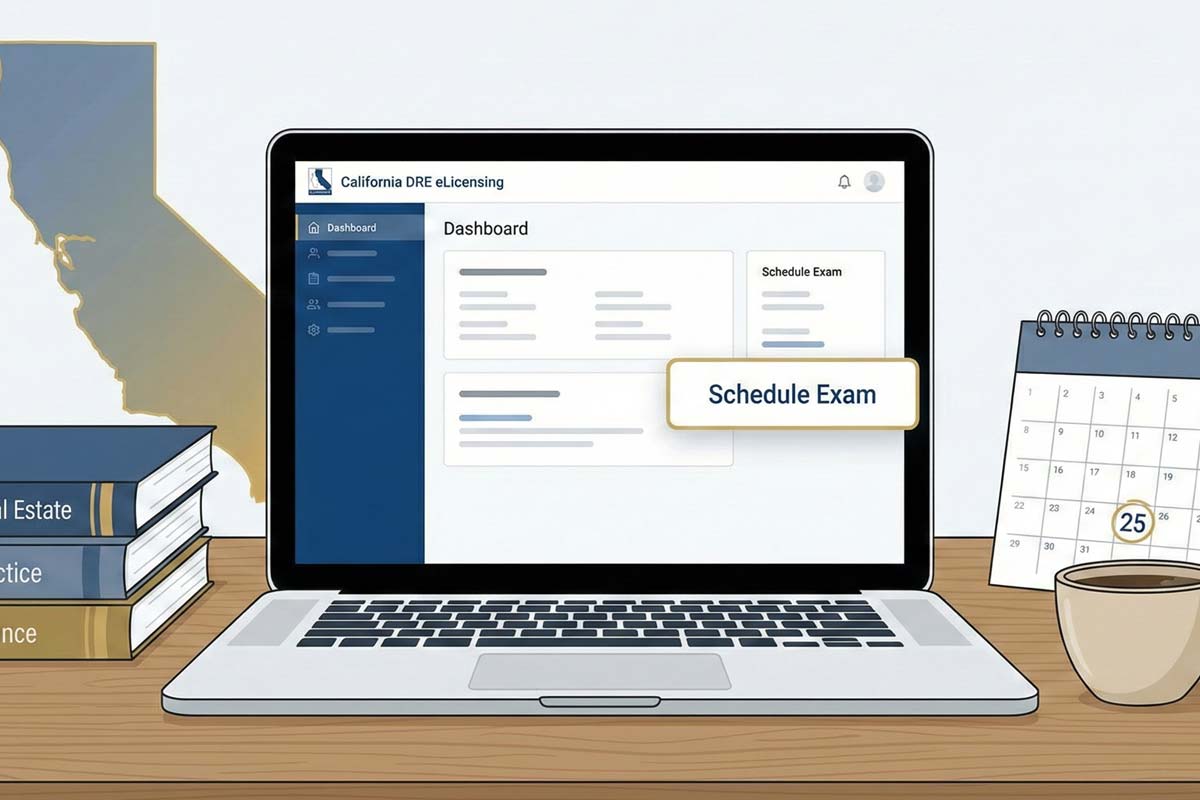
By the end of this article, you’ll know every step required to get approved and schedule your exam date successfully using the DRE’s eLicensing system.
Scheduling your exam is the turning point where you stop being a student and get a little closer to becoming a real estate licensee. However, the process isn’t as simple as clicking a button on a calendar. The California Department of Real Estate (DRE) has a specific workflow that must be followed.
To help you navigate this process without the headache, we’ve broken down exactly how to secure your spot. For a broader look at the entire testing landscape, be sure to bookmark our comprehensive California Real Estate Exam Guide, which covers everything from study tactics to licensing requirements.
Prerequisites Before You Can Schedule
Before you even log into a computer to pick a date, you must ensure you are actually eligible to sit for the exam. The DRE will not allow you to schedule an exam until your application has been fully processed and approved.
To reach the scheduling phase, you must have the following ready:
Required Courses: You must have finished your Real Estate Principles, Real Estate Practice, and one elective course (like Legal Aspects or Finance).
Certificates You Need: You must possess the physical or digital certificates/transcripts from your school (like ADHI) proving completion.
Submitting Your Application: You must submit your Salesperson Examination Application (Form RE 400A) or the Combined Examination and License Application (RE 435), along with the required fees. In theory, you could fill out the forms online.
Crucial Note: The DRE does not allow walk-ins or same-day scheduling. All appointments must be booked in advance through eLicensing.
How the DRE eLicensing System Works
Once your application is in the mail, the waiting game begins. California does not use third-party testing vendors like PSI or Pearson VUE; everything is handled directly through the DRE’s internal systems. The hub for this activity is the eLicensing portal.
Timeline Expectations
To give you a birds-eye view of how long this usually takes, here is the standard sequence:
Complete 3 required courses.
Mail application packet to the DRE.
Wait for processing/approval: This can take several weeks depending on the backlog. Always check the DRE website for current processing timeframes.
Receive eligibility notification: You get the “Green Light” via email or letter.
Log into eLicensing: Select your exam date and location.
What You’ll See in eLicensing
Once you have created your account and logged in, you need to know what to look for.
If your application is still processing, Your dashboard will likely show your license information as “NO RECORDS FOUND”.
Once approved, You will see a new menu option labeled “Schedule Examination.”
If this button does not appear, Your application is not yet eligible, and you cannot book a slot.
Step-by-Step Scheduling Overview
Create Your Account: If you haven’t already, go to the DRE website and register for an eLicensing account.
Wait for Approval: Be patient during the mail processing window.
Log In and Schedule: Click the “Schedule Examination” button once it appears.
Select Your Slot: You will be able to view the calendar, filter by location, and select the date and time that works for you.
Choosing Your Exam Location
While California is massive, the DRE only operates five specific testing centers. Unlike the vast network of DMV offices, you have limited choices, so you will need to plan your travel accordingly.
The five official DRE exam centers are located in:
Fresno
Los Angeles area (La Palma)
Oakland
Sacramento
San Diego
Peak Season Note: Late spring and early summer are peak testing seasons. Exam slots—especially in the popular La Palma location—can fill up weeks in advance. If you're deciding which center fits your commute, explore our guide to explore our guide to California real estate exam testing center locations, parking instructions, and security policies. It breaks down the specifics of each site so you aren't stressing about parking meters on the big day.
Can You Take the Exam Online?
We hear this question almost daily. In an era where you can order groceries, attend college, and even buy a car from your phone, it is natural to assume you can take the real estate exam online also.
The answer is No.
The DRE requires in-person testing to maintain exam security, prevent identity fraud, and ensure standardized administration. While the exam is administered electronically (on a computer terminal), it must be taken physically at one of the five DRE centers listed above. There is no remote proctoring option.
Choosing the Right Date & Time
Once you are in the eLicensing system and looking at the calendar, you might be tempted to just grab the first available slot. However, strategy matters here.
We recommend a "Goldilocks" approach to scheduling:
Don't schedule too far out: If you book a date three months away, you risk "knowledge decay." You want the material fresh in your mind.
Don't schedule too soon: If you book for tomorrow but haven't touched your notes in weeks, you're setting yourself up for anxiety.
Check your biology: For example, many students who test on Tuesday mornings report feeling more rested and less rushed than those trying to squeeze it in on a Friday afternoon.
For a deeper dive into strategy, read our article on the best time of day to take the California real estate exam to maximize your chances of passing on the first try.
Common Scheduling Mistakes to Avoid
Even smart students can hit road bumps. Watch out for these common errors:
Trying to use an expired ID: This is a critical error. Even if your driver’s license expired yesterday, the DRE will turn you away at the door. Check your expiration date now.
Scheduling before you are ready: Don’t book a date just to “get it over with.” Only book when you are scoring well on your practice exams.
Name Mismatches: Ensure the name on your application matches your Government ID exactly. If your ID says “Robert” and you apply as “Bob,” you will likely face issues at the testing center.
Final Preparations After You Schedule
Once you hit “Confirm” on your exam date, the countdown clock begins. This is the time to shift your focus from bureaucracy to performance.
Quick Exam-Day Prep Checklist:
Printed Exam Schedule Notice (from eLicensing)
Valid, unexpired Government ID (Driver’s License/Passport)
Route planned (account for traffic/parking)
Backup alarm set
Light review of key concepts
Once scheduled, make sure you review what to expect on exam day so nothing catches you off guard. Knowing the rules about lockers, cell phones, and bathroom breaks will help keep your heart rate down so you can focus on the questions.
Scheduling your exam is the moment this journey becomes real. It’s a commitment to yourself and your future career. While the DRE website can be a little clunky and the wait times can be frustrating, thousands of agents navigate this process every year—and you will too.
If you have your date set and want to ensure you walk in with total confidence, now is the time to buckle down. Most students who pass on their first attempt combine their coursework with a structured crash course or dedicated exam prep. ADHI Schools is here to help you cross that finish line.
Good luck scheduling, and happy studying!
Frequently Asked Questions About Scheduling the California Real Estate Exam
1. How long does it take for the DRE to approve my exam application?
Processing can take several weeks, depending on backlog and volume. You cannot schedule your exam until the DRE has officially approved your application and the “Schedule Examination” button appears in your eLicensing account.
How to Schedule the California …
2. Why does my eLicensing dashboard say “NO RECORDS FOUND”?
This simply means your application is still processing. Once you’re approved, your dashboard will update and the exam-scheduling option will appear automatically.
How to Schedule the California …
3. Can I schedule the California real estate exam online?
Yes — but only the scheduling part. The exam must be taken in person at one of the five DRE testing centers. There is no online or remote-proctored option.
How to Schedule the California …
4. Where can I take the exam?
California offers only five official DRE testing centers:
Fresno
La Palma (Los Angeles area)
Oakland
Sacramento
San DiegoThese fill up quickly during peak seasons (especially La Palma), so book early once eligible.
How to Schedule the California …
5. Can I walk in or schedule the exam same-day?
No. Walk-ins and same-day appointments are not allowed. All scheduling must be done through the DRE’s eLicensing system once you’ve been approved.
How to Schedule the California …
6. What if the date I want is unavailable?
Exam seats open and fill continuously. Students often check eLicensing daily—sometimes even multiple times a day—because cancellations do happen. Securing your preferred date requires persistence.
7. What should I consider when choosing my exam date?
Use the “Goldilocks strategy”:
Not too far out: Avoid losing study momentum.
Not too soon: Only book when your practice-test scores show you’re ready.
Pick your best time of day: Morning testers tend to feel fresher and less rushed.
How to Schedule the California …
8. What ID do I need on exam day?
A valid, unexpired government-issued ID. Even being one day expired will get you turned away — no exceptions. Double-check before scheduling and again before exam day.
How to Schedule the California …
9. What happens if the name on my ID doesn’t match my application?
You may be denied entry. Make sure your application reflects your legal name exactly as it appears on your ID (e.g., “Robert” vs. “Bob”).
How to Schedule the California …
10. What should I bring on exam day?
At minimum,
Printed Exam Schedule Notice
Valid ID
Your planned travel route
Final light study notes
These basics help prevent last-minute stress and ensure a smooth check-in.
How to Schedule the California …
11. Can I reschedule my exam?
Yes — as long as you log into eLicensing and change your appointment before your scheduled date. Seats are limited, so expect availability to vary.
12. When should I start serious exam prep?
Immediately after scheduling. The period between confirmation and test day should be used for structured review, practice exams, and tuning your test-taking strategy. Most first-time passers follow a crisp study plan and often add a crash course.
|
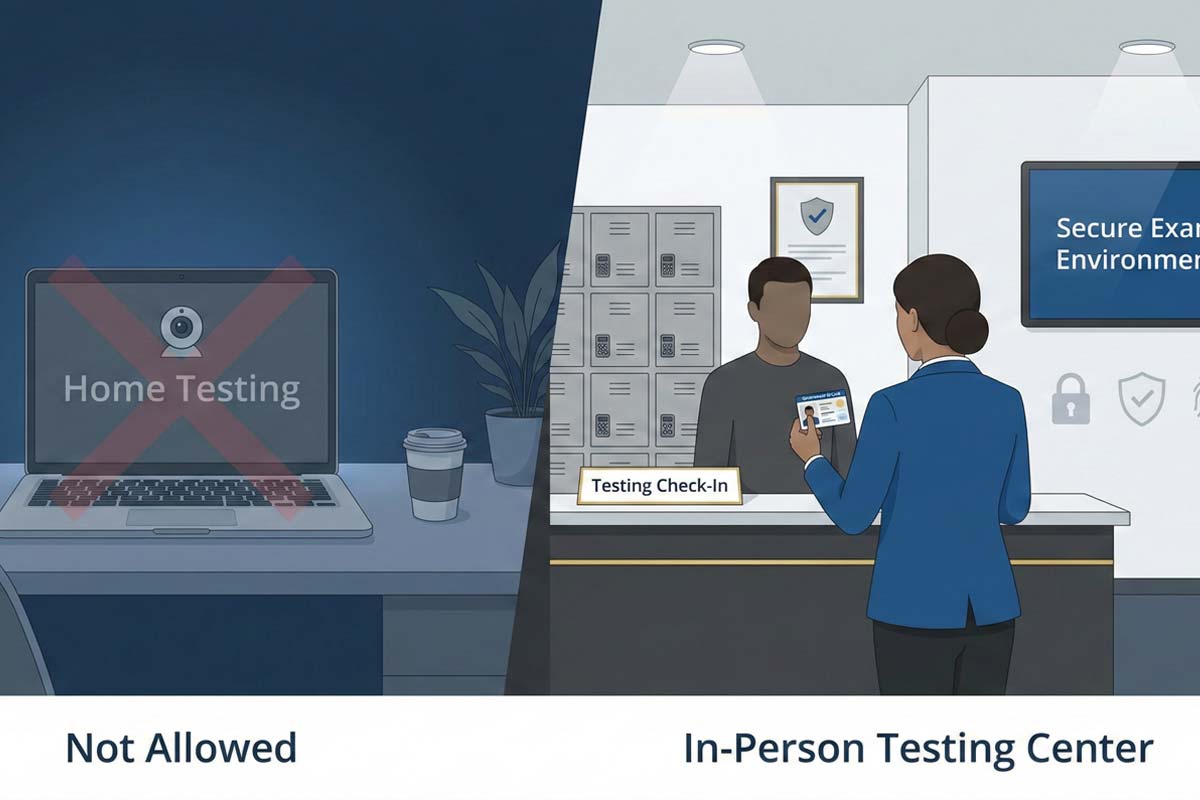
The short answer is no. You cannot take the California real estate salesperson or broker license exam online from your home or office.
While many states have adopted remote proctoring for their Read more...
The short answer is no. You cannot take the California real estate salesperson or broker license exam online from your home or office.
While many states have adopted remote proctoring for their licensing tests, the California Department of Real Estate (DRE) strictly requires all candidates to take the exam in person at one of five official testing centers.
As of 2026, the DRE has not adopted an online “remote” alternative for any candidates. While the state provides robust on-site accommodations for candidates with disabilities who apply for them, there is currently no option to take the exam off-site.
Why the California Real Estate Exam Is Not Offered Online
The DRE’s refusal to move the exam online revolves around one core principle: exam integrity.
The California real estate license grants significant legal and financial authority. To maintain the value of this license, the DRE must ensure that every person who passes the exam does so fairly and without outside assistance. Because California has the largest licensee population in the country, the risk of widespread fraud is higher here than in smaller states, leading to stricter protocols.
Many students are surprised by how different the DRE’s rules are from their school exams. Understanding this distinction early prevents confusion later in the process.
Security and Identity Verification
Remote proctoring—where a webcam watches you take the test—has improved, but it is not yet foolproof. The DRE enforces strict identity verification standards that are difficult to replicate remotely. At a physical test center, proctors can physically inspect government-issued IDs, verify that the person taking the test matches the photo, and ensure no one else is in the room.
Preventing Exam Subversion
California Business and Professions Code explicitly prohibits "subverting or attempting to subvert any licensing examination." This basically means trying to remove exam content from the site or cheat on the exam. The DRE views the controlled environment of a physical test center as the most effective way to prevent subversion techniques, such as using hidden earpieces, having a third party take the test, or accessing unauthorized notes.
By keeping the exam offline, the DRE ensures that the test score accurately reflects the candidate's actual knowledge, not their ability to bypass security software.
Why People Confuse Online Coursework With the Exam
A common source of confusion for students is the difference between pre-licensing education and the state licensing exam.
Pre-Licensing Coursework (Online Allowed): You can complete your required 135 hours of college-level education online. ADHI Schools offers these courses digitally, and the final exams for these specific classes are open-book and taken online.
State Licensing Exam (In-Person Only): Once you finish school and receive your certificates, you must apply to the state. The final hurdle—the state exam—is a completely separate event that must be taken at a DRE facility.
Students often assume the state uses the same rules as schools—it doesn’t. It is critical to mentally prepare for the shift from a relaxed home environment to a formal, secure testing facility.
The Only Approved Way to Take the Exam
Since remote testing is unavailable, you must schedule your exam at a designated proctoring facility. The DRE currently operates five locations across the state: Fresno, La Palma (Orange County/Los Angeles), Oakland, Sacramento, and San Diego.
Students often start by reviewing the California real estate exam testing centers before choosing where to test. It is important to note that you cannot use third-party testing sites (like Pearson VUE centers used for other exams); you must use one of these five specific DRE locations. Furthermore, availability varies by center, so securing a seat requires forward planning.
Once you have selected your location, you should also consider the best time to take the California real estate exam to ensure you avoid heavy traffic and align the date with your peak study readiness.
What the In-Person Testing Process Looks Like
Taking the exam in person is a formal process, similar to airport security. Understanding the protocol beforehand can help reduce anxiety.
Arrival and Check-In
You should plan on arriving at least 30 minutes before your scheduled exam time. Upon arrival, you will check in at the reception desk where your identification will be rigorously scrutinized. You must present a valid, current government-issued photo ID.
Security Measures
The testing room is a secure environment. You are not allowed to bring personal items to your desk. This includes:
Cell phones (must be powered off and stored).
Watches and smartwatches.
Wallets, purses, and backpacks.
Most centers provide small lockers for your personal belongings. Your arrival routine is similar to what’s described in what to expect on exam day, where the focus is on minimizing distractions so you can focus entirely on the questions.
Note-Taking Materials
You cannot bring your own scratch paper, and the DRE no longer provides any note-taking materials. Fortunately, the state exam no longer includes math questions, so you will not need to perform calculations during the test. All questions can be answered directly on the computer screen without the need for any written work.
Will California Ever Offer an Online Version?
The testing industry is moving toward remote proctoring, and large providers already have the technology to facilitate secure online exams.
However, the California DRE has historically been conservative regarding changes to the licensing process, often lagging behind national testing trends by 5 to 10 years due to regulatory caution. They prioritize the security of the "gatekeeper" exam over convenience. While they have modernized other aspects of the process, there have been no official announcements regarding a pilot program for online testing. For now, candidates should plan their timeline assuming they will need to travel.
What Parts of the Licensing Process Can Be Done Online?
While you can't take the test online, almost every other step of the licensing journey is digital. You can streamline your experience by handling the logistics from your computer.
Coursework: Complete all 135 hours of required education.
Application: Submit your exam and license application via the eLicensing system.
Scheduling: After completing your coursework, the next logistical step is understanding how to schedule the California real estate exam using the DRE’s online portal.
Results: While you don't get them instantly on screen, you can view your pass/fail status online shortly after the results are officially posted by the DRE.
Final Thoughts
The requirement to test in person ensures that every licensed agent in California has met the same high standard of competency. While it requires a bit more logistical planning than an online test, the process is straightforward if you are prepared.
Focus your energy on studying the material rather than worrying about the format. A solid grasp of the concepts in the California Real Estate Exam Guide is the best way to ensure that, when you sit down at that computer in the testing center, you are ready to pass.
Frequently Asked Questions (FAQ)
Can I use a calculator on the California real estate exam? No. This is a critical point where many online resources are outdated. You are not allowed to bring a calculator of any kind (including basic or silent models). Furthermore, the testing center does not provide calculators, and the exam software does not have a calculator function. There’s no longer any math on the exam.
Is the California real estate exam open book? No. The state licensing exam is closed book. You cannot use notes, textbooks, or outside resources during the test.
Can I take the California real estate exam out of state? No. You must take the exam at one of the five approved testing centers located within California (Fresno, La Palma, Oakland, Sacramento, or San Diego).
Is the exam on a computer or paper? The exam is electronic. You will sit at a computer terminal at the testing center to answer the multiple-choice questions. It is not a "paper and pencil" test, but strictly an in-person electronic exam.
What happens if I’m late to the testing center? If you arrive after your scheduled start time, you may be denied entry and will likely forfeit your exam fee. It is highly recommended to arrive at least 30 minutes early.
|