Disclaimer: This article provides operational and professional strategies for performance management. It is not a substitute for professional medical or psychological advice. If you are experiencing severe Read more...
Disclaimer: This article provides operational and professional strategies for performance management. It is not a substitute for professional medical or psychological advice. If you are experiencing severe mental health distress, please consult a licensed professional.
It’s 7:45 PM on a Tuesday. You’re finally sitting down to dinner when your phone buzzes. It’s a "quick question" from a buyer about an escrow contingency. Against your better judgment, you reply.
That one text turns into a 45-minute email chain with the lender and the listing agent. By 9:00 PM, you’re staring at the ceiling, mentally rehearsing tomorrow’s showings while your adrenaline spikes.
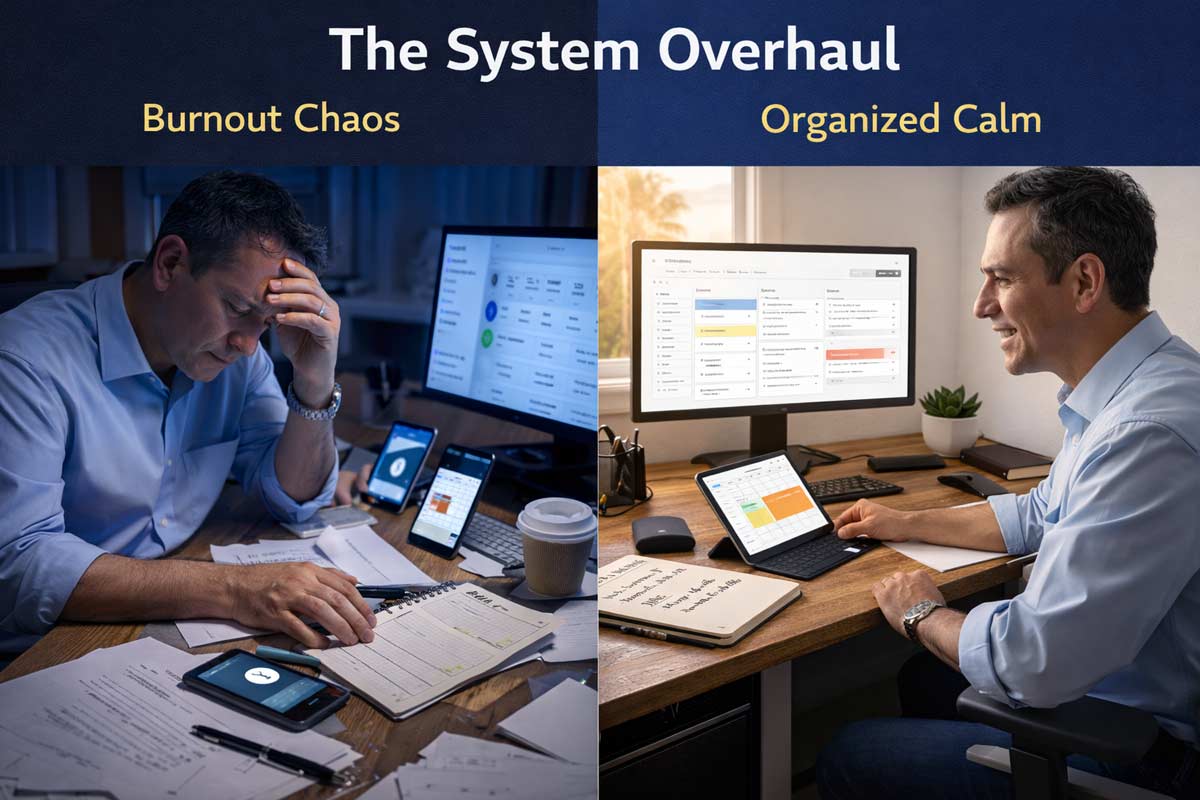
If this sounds familiar, you aren’t "working hard"—you’re redlining. At ADHI Schools, I’ve spent over 20 years coaching California agents through every market cycle, and I can tell you that burnout prevention for real estate professionals is not a luxury; it is a fundamental requirement for production. You don’t need a vacation; you need a sustainable operating cadence.
This guide is the operator’s plan to reduce your mental load, protect your commission, and build the real estate agent skill stack pillar that the top 1% use to stay at the top.
The Death Spiral: From "Busy" to Burnout
In a commission-based business, it is easy to mistake "constant access" for "high performance." However, ignoring the early warning signs of real estate agent burnout creates a dangerous downstream effect on your bank account.
The Symptoms To Consequences Bridge
If you ignore the symptoms, the professional consequences are inevitable:
Symptom: You dread opening your CRM or email.Consequence: Your follow-up slips and your pipeline dries up causing your panic level to increase.
Symptom: You have a "short fuse" with clients or TCs.Consequence: Your reputation takes a hit and your referrals drop causing you to work twice as hard to find new business.
Symptom: You are "always busy" but nothing moves.Consequence: You enter a cycle of "random activity" and your decision fatigue sets in causing you stop doing the high-ROI tasks that actually close deals.
Operational Strategies for Burnout Prevention for Real Estate Professionals
To survive the California market, you must stop being a "responder" and start being an "operator." This requires moving away from a reactive calendar and toward a structured system.
1. The "Two Windows Rule" (Communication Framework)
The primary cause of mental fry is constant context switching. Stop answering texts the second they arrive. Instead, implement the Two Windows Rule:
Window 1 (11:30 AM): Process all morning inquiries, lender updates, and escrow fires.
Window 2 (4:30 PM): Wrap up the day’s communication and set expectations for the following morning.
The Result: You train your clients that you are a professional with a schedule, not a 24-hour concierge. This single shift is the cornerstone of time management for California real estate agents.
2. One Source of Truth (The CRM)
Your brain is for processing information, not storing it. Trying to remember which buyer needs a disclosure sent and which listing needs a sign-post update is the fastest path to exhaustion. Learning how to build a real estate CRM that actually works is the only way to offload that mental weight. If it’s in the CRM, your brain can let it go.
3. Minimum Viable Habits
Don't try to overhaul your life. Pick three non-negotiables that keep your energy stable. For most top producers, this includes a set wake-up time, 60 minutes of proactive lead generation, and a "shutdown ritual." Mastering the daily habits of top-producing agents creates a performance floor that protects you even when the market gets volatile.
Practical Playbooks for the Fried Agent
The 2-Hour Daily Stabilizer
Before you open email or social media, spend the first two hours of your workday on Pipeline Defense.
0–30 mins: Review your CRM tasks.
30–90 mins: Proactive reach-out (calls/texts/notes).
90–120 mins: Appointment setting.
Why? If you spend the rest of the day fighting escrow fires or stuck in California traffic, you’ve already secured your future income.
The Boundary Scripts
The Late Night Text: "Hi [Name], I’m currently away from my desk for the evening, but I’ve prioritized this for my 8:30 AM updates. I’ll have an answer for you then!"
The "Urgent" Non-Urgent Item: "I want to ensure I give this the proper review. Let’s discuss this during my next update window at 4:30 PM."
The Operator’s Comparison
Feature
The Burnout Path (Reactive)
The Sustainable Path (Systematic)
Morning Routine
Checking emails in bed
CRM task review & proactive calls
Client Access
24/7 "on-call"
The Two Windows Rule
Goal Tracking
"I hope I close something"
Using how to set goals as a new real estate agent to track daily inputs
Recovery
Crashing from exhaustion
Scheduled "Hard Stops" and 24-hour disconnects
The 7-Day Reset Mini-Plan
If you're currently redlining, follow this sequence to regain control:
Day 1: Audit your phone. Turn off all non-human notifications (social, news, retail).
Day 2: Clean the CRM. Move every "reminder" out of your head and into the system.
Day 3: Set a "Hard Stop" time (e.g., 7:00 PM). The phone goes in a drawer.
Day 4: Schedule one 3-hour "Deep Work" block. No phone, no distractions.
Day 5: Proactive Triage. Update every active client before they ask you for a status report.
Day 6: Design your "Ideal Week" on paper, including gym time and family meals.
Day 7: Total disconnect. No real estate for 24 hours.
The Bottom Line on Sustainable Production
In the California market, burnout prevention for real estate professionals is an operational skill. If you operate without a system, the business will eventually consume your personal life and your health. If you operate with a system, you can handle higher volume with lower stress.
To build a career that lasts decades rather than months, you must master the fundamental Real Estate Agent Skills California requires. Stop reacting to the chaos and start engineering your success.
Burnout Prevention Checklist
One Source of Truth: Is every lead and task documented in your CRM?
The Two Windows Rule: Have you set specific times for client updates?
Pipeline First: Have you completed your 90-minute lead-gen block today?
Hard Stop: Is there a time tonight when you will officially "log off"?
Weekly Recovery: Is there a 24-hour block in your calendar for total disconnect?
Next Step: Build your foundation by exploring the full Real Estate Agent Skills California pillar to see how systems-first agents dominate the market.
|

In California real estate, "busy" is sometimes viewed a badge of honor. But after 20 years of coaching and operating in this industry, I can tell you the truth: Busy isn't the goal. Profit and freedom Read more...
In California real estate, "busy" is sometimes viewed a badge of honor. But after 20 years of coaching and operating in this industry, I can tell you the truth: Busy isn't the goal. Profit and freedom are.
This guide provides a practical, operator-level time management system for California real estate agents designed to move you from a reactive state to a systems-first mindset. If you don't control your calendar, your clients, escrow officers, and the 405 freeway will control it for you.
To master the essential Real Estate Agent Skills California requires a shift from chasing the day to owning it.
TL;DR: The California Operator System
The 3-Bucket Filter: If it creates revenue, it’s Pipeline. If it saves a deal, it’s Operations. If it builds the future, it’s Visibility.
The Morning Power: 8:00 AM – 10:00 AM is for non-negotiable follow-up. No email allowed.
The "One Window" Rule: Batch all escrow and admin tasks into a single 90-minute block.
The Guardrail: If it isn't on the calendar, it doesn't exist.
Reactive Calendar vs. Revenue Calendar
Most agents operate on a Reactive Calendar. You wake up, check your email, respond to a frustrated buyer, get lost in a DM rabbit hole, and suddenly it’s 2:00 PM. You’ve done "work," but you haven't generated a single dollar of future revenue.
A Revenue Calendar is designed to protect income-producing activities first.
Diagnostic: 5 Signs You Are Operating Reactively
You start your day by answering emails instead of making outbound calls.
You don't have a recurring "Follow-Up" block in your digital calendar.
An inspection or appraisal request can derail your entire afternoon.
You find yourself scrolling Instagram under the guise of "content research."
Your "lead generation" only happens when you realize you have no active escrows.
The 3-Bucket Decision Rule
To manage your time, you must categorize your tasks instantly. Stop treating an escrow signature with the same urgency as a cold lead follow-up. Use these filters:
Pipeline (Revenue): Does this create or advance a commission check today or tomorrow? (Follow-up, appointments, negotiations)
Operations (Delivery): Does this protect a deal currently in motion? (Disclosures, inspections, TC coordination)
Visibility (Future): Does this build my pipeline for 6 months from now? (Content creation, networking, database building)
The secret to consistency is ensuring all three buckets have a "home" in your week. This balance is one of the daily habits of top-producing agents that separates the earners from the hobbyists.
The California Agent Weekly Template
California real estate has a specific rhythm. Traffic is a factor, and weekend "work" is mandatory. Use this table as your base real estate agent schedule:
Time Block
Focus
Purpose
8am – 10am
Revenue (Pipeline)
Calls, texts, and CRM follow-up.
10am – 11:30am
Delivery (Operations)
Escrow Command Center / Admin.
12pm – 1pm
Recharge
Lunch / Personal time (No pings).
1pm – 5pm
Appointments / Field
Showings, listing presentations, previews.
5pm – 6pm
Future (Visibility)
Social media content / Networking.
The "New Agent" vs. "Busy Agent" Flex
New Agents: Spend 4+ hours daily in the Pipeline bucket. You need reps more than you need "systems" right now.
Busy Agents: Spend more time in Operations but must protect the 8 AM – 10 AM window at all costs to avoid the "income roller coaster."
Effective time management begins by knowing how to set goals as a new real estate agent—once your goals are clear, the calendar follows.
Win the Morning: The Follow-Up Operating System
The first two hours of your day dictate your commission check three months from now. Time management for California real estate agents lives or dies in the CRM.
The Daily Priority Stack:
New Leads: Contact within 5 minutes (or first thing in your 8 AM block).
Hot Nurtures: Clients likely to transact in the next 30–60 days.
Active Clients: Brief status updates (even if the update is "no news").
Past Clients: Staying top-of-mind for referrals.
To make this work, you need a system. Learning how to build a real estate CRM that actually works is the only way to automate your reminders so you don't spend hours "organizing" instead of "doing."
Escrow and Transaction Control
In California’s fast-paced escrow environment, a single inspection report can trigger 20 phone calls. If you handle these as they come in, you will never have a productive day.
The Escrow Command Center Rule: Schedule one "Operations Window" (e.g., 10:00 AM – 11:30 AM). Batch all your emails to escrow officers, lenders, and TCs during this time.
Kartik’s Tip: When a lender calls at 2:00 PM while you're at a showing, let it go to voicemail. Listen, then reply during your next designated admin block. Most "emergencies" are simply other people’s poor planning.
Open Houses & Traffic Realities
California traffic is a variable you must account for. If you have a showing in Irvine at 4:00 PM, you aren't "working" from 3:30 PM to 6:00 PM—you are commuting and showing.
The 20% Buffer: Always add 20% more time to travel than GPS suggests.
Weekend Recovery: If you work 6 hours on Saturday and Sunday, you must protect Monday morning as "Off" time to prevent the burnout cycle.
Pre-Prep: Don't print flyers on Sunday morning. Do all "Visibility" prep on Thursday so your weekend is focused on the people in front of you.
Burnout Guardrails (Energy Management)
"Always on" is a recipe for a short career. Sustainable time management requires energy management.
The Hard Stop: Pick a time (e.g., 7:00 PM) where the phone goes in the drawer.
The One True Day Off: One day a week, you are not an agent. You are a human being.
Boundary Scripts: "I’m headed into an appointment, but I will check this first thing at 8:00 AM tomorrow."
Effective burnout prevention for real estate professionals is built into the calendar, not added as an afterthought.
FAQ: Real Estate Time Management
How many hours should a real estate agent work?
A: Successful full-time agents typically work 40–50 hours per week, but the composition of those hours matters more than the total. 15 hours of focused lead generation is more valuable than 60 hours of "random busywork."
What’s a good daily schedule for real estate agents?
A: A high-production schedule starts with 2 hours of follow-up (8–10 AM), 90 minutes of admin/escrow (10–11:30 AM), and afternoons dedicated to appointments and field work.
How do I handle "looky-loo" buyers who waste my time?
A: Use a mandatory buyer consultation. If they won't meet for 20 minutes to discuss their needs and financing, they aren't worth a 2-hour drive.
What if a client gets mad because I didn't answer at 9:00 PM?
A: Set expectations early. Tell them: "I am fully focused on my clients from 8:00 AM to 7:00 PM. If you text after that, I'll have an answer for you first thing in the morning."
Implementation Challenge: The 14-Day Reset
Commit to this for the next 14 days before you customize:
Block 8:00 AM – 10:00 AM for lead follow-up only. No email. No social media.
Batch your "Operations" into one 90-minute window.
Identify 3 "Stop-Doing" items: Activities that resulted in zero revenue last week.
Time management isn't about doing more; it's about doing what matters. Master these systems, and you’ll find that a successful California real estate career doesn't have to cost you your sanity.
Ready to level up your entire business? Visit our Real Estate Agent Skills California hub to learn more about building a sustainable, high-performance career with ADHI Schools.
|

You’re stuck in traffic on the 405, your phone is buzzing with a frantic text about a repair contingency in Santa Monica, and you just realized you forgot to follow up with that listing lead from Sunday’s Read more...
You’re stuck in traffic on the 405, your phone is buzzing with a frantic text about a repair contingency in Santa Monica, and you just realized you forgot to follow up with that listing lead from Sunday’s open house.
You feel "busy," but your production doesn't reflect the chaos.
In my 20+ years of coaching thousands of California agents at ADHI Schools, I’ve seen this movie before. Most agents mistake motion for progress. They react to their inbox, their phone, and their fires, leaving their income to chance.
Top producers—the ones with consistent listing flow and a steady referral engine—don’t have more "hustle" than you. They have a better operating system.
They protect three specific pillars every single day:
Pipeline
Operations
Visibility
Here is the exact daily habit stack used by the most successful agents in the California market.
The 10 Daily Habits of Top-Producing Agents
1. The Morning Pipeline Block
What they do: Spend the first 90 minutes of the workday on proactive outbound lead generation (calls, texts, or door knocking) before getting deep into email.
Why it works: Your pipeline is the only thing that guarantees future commissions. If you don't feed the engine first, the fires of the day will consume your time.
How to implement:
Set a "Do Not Disturb" on your phone from 8:00 AM to 9:30 AM.
Use a simple script: "Hi [Name], I was looking at the latest comps in [Neighborhood] and thought of you. Have you had any thoughts on the market lately?"
Common mistake to avoid: Checking your "Escrow is closing" emails first. That money is already earned; go find the money you haven't earned yet.
2. The 5-5-4 Follow-Up Loop
What they do: Every day, they contact 5 new leads, 5 past clients, and 4 people in their "active" sphere.
Why it works: Real estate is a game of attrition. Most deals are lost because an agent stopped calling after the second attempt.
How to implement:
Use your CRM to pull a daily "Touch List."
If you're struggling with what to say, check out our guide on how to set goals as a new real estate agent to align these calls with your production targets.
Common mistake to avoid: "Checking in" without offering value (like a market update or a vendor recommendation).
3. Strict CRM Hygiene
What they do: Every conversation is logged, and every contact has a "Next Action" date before the agent closes their laptop.
Why it works: A top producer’s brain is for creating solutions, not storing dates. If it isn't in the CRM, it doesn't exist.
How to implement:
Spend 15 minutes at the end of every meeting logging notes. Tag leads by "Temperature" (Hot, Warm, Cold) so you know who to prioritize tomorrow.
Learn how to build a real estate CRM that actually works to automate this process.
Common mistake to avoid: Keeping lead info on sticky notes or in your phone’s "Notes" app.
4. The "Deal Protection" Audit
What they do: A quick 20-minute daily review of all active escrows and pending contracts to ensure deadlines (contingencies, disclosures) are met.
Why it works: In California, missing a contingency date can cost your client thousands and cost you your reputation.
How to implement:
Create a checklist for every transaction.
Ask: "Who is the ball currently with—the lender, the escrow officer, or the other agent?"
Common mistake to avoid: Assuming the escrow officer or TC (Transaction Coordinator) is handling everything without your oversight.
5. One Daily Visibility Action
What they do: Produce one piece of "social proof" or community-focused content (a video tour, a market stat graphic, or a photo at a local business).
Why it works: Visibility amplifies ability. If people don't see you working, they assume you aren't.
How to implement:
Document, don't create. Take a photo of a home inspection or a beautiful kitchen during a showing.
Post it with a caption explaining a specific Real Estate Agent Skills California trait, like negotiation or local expertise.
Common mistake to avoid: Aiming for "viral" instead of "local and helpful."
6. The 15-Minute Market Pulse
What they do: Review the "Hot Sheet" in the MLS to see what went pending, what sold, and what price-dropped in their target zip codes.
Why it works: You cannot be an advisor if you don't know the inventory. Clients pay for your interpretation of the data.
How to implement:
Set an MLS alert for your primary farm areas.
Internalize the numbers: "The average days on market in Irvine just dropped to 12."
Common mistake to avoid: Relying on national news headlines instead of local MLS data.
7. Script & Objection Mastery
What they do: Practice handling common California objections (e.g., "The rates are too high," or "I want to wait for the market to crash") for 10 minutes.
Why it works: Professional athletes practice more than they play. Top agents practice so their delivery is natural and confident.
How to implement:
Roleplay with a partner or record yourself on your phone.
Focus on empathy first: "I hear you, and many of my clients feel the same way. What I’ve found is..."
Common mistake to avoid: Winging it during a high-stakes listing presentation.
8. Hard Energy Boundaries
What they do: Set specific "Off" times where they do not answer the phone, ensuring they recharge for the next day.
Why it works: High-performance requires recovery. Constant "on-call" status leads to the errors that kill deals.
How to implement:
Use "Auto-Reply" texts after 7:00 PM: "I am currently with my family, but I will return your call first thing tomorrow morning."
Review these strategies for burnout prevention for real estate professionals.
Common mistake to avoid: Answering non-emergency client texts at 10:00 PM (it trains them to disrespect your time).
9. The End-of-Day Shutdown
What they do: Clear the desk, review the calendar for tomorrow, and identify the "Big 3" tasks that must happen.
Why it works: You win the morning the night before. This prevents the "What should I do now?" paralysis at 9:00 AM.
How to implement:
The Shutdown Checklist:
Inbox to zero (or filed).
CRM tasks updated.
Tomorrow’s "Pipeline Block" list ready.
Common mistake to avoid: Ending the day mid-task without a plan for tomorrow.
10. The 3-Number Scoreboard
What they do: Track three specific numbers at the end of every day: conversations, follow-ups completed, and one visibility asset shipped.
Why it works: What gets measured gets repeated. This turns "I was busy" into "I moved the business forward."
How to implement:
Use a sticky note, Notion, or your CRM dashboard.
Target: 10 conversations, 10 follow-ups, 1 visibility post (adjust as you scale).
Review weekly and identify what’s slipping—pipeline, operations, or visibility.
Common mistake to avoid: Tracking vanity metrics (likes, followers) instead of conversations and appointments.
Top Producer Reality Check: What They Don’t Do
Success is often about what you remove from your day. Top agents:
Don’t check email as the first act of the day.
Don’t keep lead information in text threads or DMs; it goes to the CRM.
Don’t take random vendor meetings during their Pipeline Block.
Don’t confuse "scrolling" and consuming social media with "creating" visibility.
What Top Agents Do Before 9:00 AM
Most California agents start their day in a "reactive" state. Top producers use the time before 9:00 AM to build a mental moat:
No Screens: Avoid the "inbox trap" for at least the first 30 minutes of waking.
Movement: A quick walk or workout to handle the high-stress nature of the industry.
Review the Big 3: Confirm the three non-negotiable tasks for the day before the world starts calling.
Daily Habits: New vs. Experienced Agents
Your routine should shift as your business matures:
New Agents (Years 1–2): 80% of your day should be pipeline and visibility. You have more time than clients; use it to build the database.
Experienced Agents (Years 5+): 50% pipeline/visibility and 50% systems and depth. Focus on deepening existing relationships and refining time management for California real estate agents to handle increased transaction volume.
Sample Daily Schedule: The California Operator Template
If your calendar keeps getting hijacked by non-urgent tasks, mastering your time as a real estate agent is your first priority. Use this block schedule to regain control.
Time
Activity
Focus
8:00 AM
Market Pulse
Review MLS Hot Sheets & local news.
9:00 AM
Pipeline Block
Non-negotiable outbound calls/prospecting.
10:30 AM
The Follow-Up Loop
Returning voicemails, texts, and emails.
12:00 PM
Lunch / Visibility
Eat at a local spot; post a "Day in the life" story.
1:30 PM
Operations & Admin
Listing prep, transaction review, CRM cleanup.
3:00 PM
Field Work
Showings, listing appointments, or door knocking.
5:30 PM
Shutdown
Plan tomorrow; set phone to "Do Not Disturb."
Why Most Agents Fail to Keep Habits (And the Fix)
Most agents fail because they are reactive. If your calendar is a blank slate, other people will write on it. This creates a "feast or famine" cycle that leads to burnout.
The Fix: The 2-Day Rule:
Never miss your daily habits two days in a row. If a closing goes sideways and you miss your morning calls today, that’s life. If you miss them tomorrow, that’s a choice. This isn’t about working longer hours—it’s about protecting the few actions that compound.
Start Here Today: The Minimum Viable Day (MVD)
If you are overwhelmed, do this 60-minute checklist to keep your business alive:
30 Minutes: Pipeline outreach (Contact 5 people).
15 Minutes: CRM Hygiene (Log calls/set next follow-ups).
10 Minutes: Visibility (Post one market update to social media).
5 Minutes: Plan tomorrow’s "Big 3" tasks.
Frequently Asked Questions
What do top producing agents do every day?
They prioritize "Revenue Generating Activities" (RGAs) like lead generation and follow-up during their peak energy hours and leave administrative tasks for the afternoon.
How many calls do top agents make per day?
Many top producers aim for 10–20 real conversations per day and increase volume during growth phases. The key metric is meaningful conversations, not just dials.
What is a good daily schedule for a real estate agent?
A good schedule is "time-blocked," meaning specific hours are dedicated to lead gen, client meetings, and admin. This prevents administrative "busy work" from eating into your prospecting time.
How do agents stay consistent without burnout?
By setting firm boundaries and treating their "recharge" time as a non-negotiable appointment on their calendar, just like a listing presentation.
Ready to Master the Business?
Habits are the foundation, but skills are the ceiling. If you want to move from "busy" to "profitable," you need to master the full stack of Real Estate Agent Skills California required for this unique market.
Next Steps for Your Growth:
New Agents: Start by setting your 90-day goals.
Mid-Career Agents: Audit your CRM system to find the holes in your follow-up.
|
The most stressful part of getting your license isn't usually the math or the laws—it’s the paperwork. At ADHI Schools, we’ve seen thousands of students stall their careers not because they couldn't Read more...
The most stressful part of getting your license isn't usually the math or the laws—it’s the paperwork. At ADHI Schools, we’ve seen thousands of students stall their careers not because they couldn't pass the test, but because a simple clerical error on their California real estate exam application delayed their eligibility by months.
When you apply for the exam, you are essentially asking the Department of Real Estate (DRE) to verify that you have met the legal requirements to sit for the test. Precision is your best friend here. Treat this application like a professional transaction: precision prevents the "delay cycle."
Quick Summary
Official Transcripts: Ensure your three college-level courses are finished and you have official transcripts (or copies of official transcripts) ready.
Select Your Path: Choose between the Exam-Only (RE 400A) or the "Combo" Exam/License (RE 435) application - ADHI Schools always recommends the combo application.
Verify Details: Your application must match your government-issued ID exactly to prevent identity mismatches.
Track Progress: Save copies of everything and monitor the DRE processing timelines.
What “Applying for the Exam” Actually Means
Applying for the real estate exam is the formal bridge between finishing your education and actually scheduling a test date. The DRE is not just checking your name; they are auditing your pre-license education and your fitness for licensure.
Key Distinctions:
Education vs. Eligibility: Completing your courses makes you eligible to apply; it does not automatically register you for the exam.
Application vs. Scheduling: You cannot pick a date the day you apply. The DRE must first process your paperwork and "qualify" you. Only then can you schedule a date via the eLicensing system.
This guide covers the pre-flight checklist, the step-by-step submission process, and how to avoid the common pitfalls of application delays. For a broader look at the entire journey, refer to our California Real Estate License Guide.
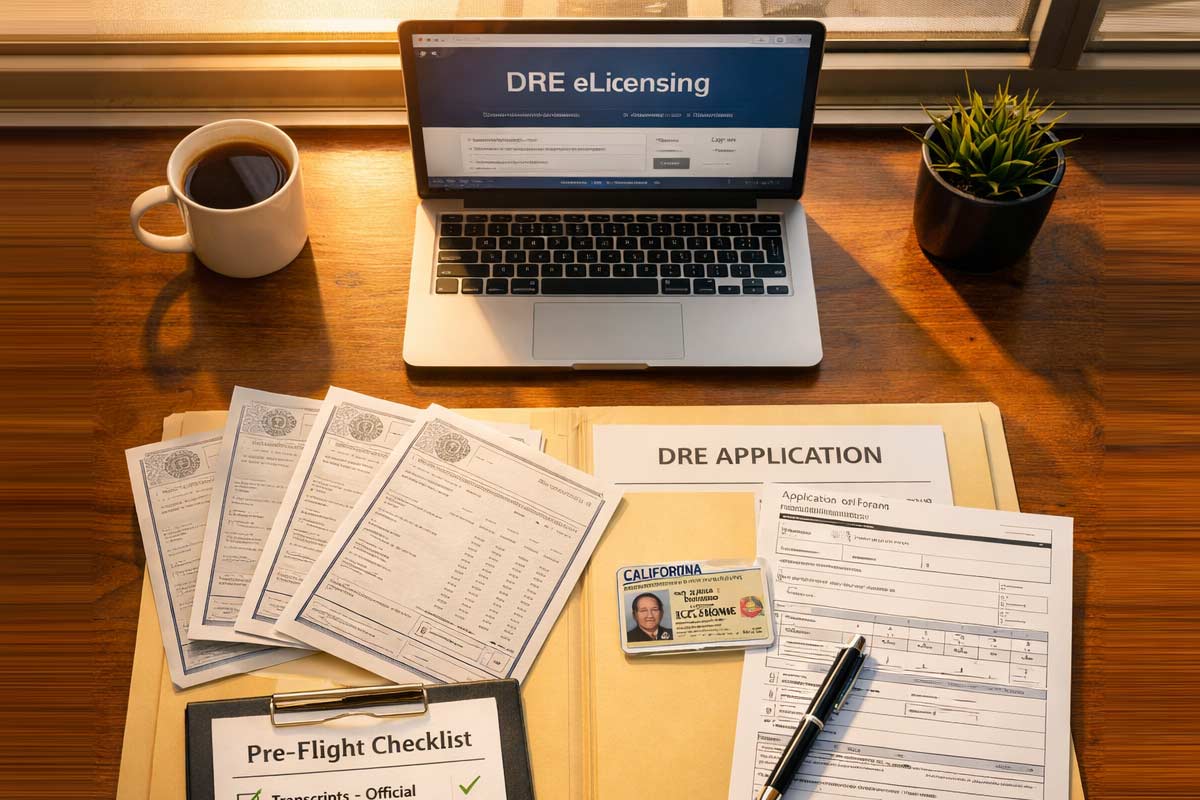
Before You Apply: Your Pre-Flight Checklist
In my 20+ years of preparing candidates, I’ve noticed a pattern: those who rush the application usually end up waiting the longest. Before you touch a physical form or complete a form online, confirm the following:
✅ Course Checklist for Salesperson Exam Eligibility
The DRE requires completion of three college-level courses. Ensure your transcripts reflect:
Real Estate Principles (Required)
Real Estate Practice (Required)
One Elective (e.g., Finance, Appraisal, Legal Aspects, or Property Management)
Documentation Standard: The DRE requires official transcripts or copies of official transcripts showing successful completion. While your course provider may issue "completion certificates," the DRE’s instructions emphasize transcripts as the primary proof of education. Keep your certificates for your personal records, but submit transcripts to the state.
Step-by-Step: How to Apply for the California Real Estate Exam
Step 1: Gather Required Documentation
Collect your official transcripts. If you are applying for the salesperson exam, ensure they clearly show the successful completion (there should be a six-digit approval number on each certificate) of all three required courses from a DRE statutory course provider or other qualifying accredited institution (such as a community college or university).
Step 2: Choose Your Application Type
The DRE provides two primary pathways for the application process:
Salesperson Examination Application (RE 400A): This is for students who want to apply for the exam only and handle the license application after they pass.
Salesperson Exam/License Application (RE 435): Often called the "Combo," this pathway lets you apply for the exam and license at the same time using one package (following the RE 435A instructions). ADHI Schools recommends this path.
Step 3: Complete the Form with Precision
Whether you use the online eLicensing system or a paper form, every field matters. I once saw an applicant's process halted because they forgot to check a "Yes/No" box.
Before You Submit:
Check Signatures: If mailing, ensure all signature lines are signed and dated.
Match Your ID: Ensure "Robert" isn't listed as "Bob" if your ID says "Robert."
Review Disclosures: Answer all background questions honestly and completely.
If you're worried about the fine print, it helps to review the common mistakes applicants make on DRE forms before you hit submit.
Step 4: Pay Fees and Submit
If mailing, use a method with tracking (like USPS Priority or Certified Mail). If applying online, take a screenshot of the "Success" or "Submitted" confirmation screen.
The Two Biggest Delay Traps
Trap #1: Inconsistent Identity Details
The DRE's system is highly sensitive to name variations. If you omit a middle initial or suffix (Jr. etc.) that appears on your ID, the background check or education verification may fail to sync.
How to avoid it: Use your full legal name as it appears on your driver’s license on every single document—no exceptions.
Trap #2: Missing Transcripts or Unapproved Providers
Using a non-approved provider, will trigger an immediate delay.
How to avoid it: Confirm your courses were completed at an accredited institution or a DRE statutory provider and ensure you are requesting transcripts from the registrar or provider with the six-digit approval number.
After You Submit: What Happens Next?
Once your California real estate exam application is in their hands, the DRE must verify your eligibility.
Processing Timelines: Do not rely on "guesses." Check the DRE Current Processing Timeframes
The Golden Ticket: Once approved, you will receive an "Examination Schedule Notice." This is your signal to log into eLicensing and pick your date and location.
Once you’ve secured your date, it is also a good time to look ahead at how to apply for your California real estate license after passing the exam so you can start working the moment your results are in.
FAQ
How long does it take after I apply to be able to schedule?
Timelines vary based on DRE volume. You should check the DRE’s official "Current Processing Timeframes" page weekly for the most accurate window.
What if I made a mistake on my application?
If the DRE finds an error, they will notify you (often via a deficiency notice) explaining what is missing. You must then correct it and resubmit, which adds time to the process.
Do small typos matter?
Yes. In a regulatory environment, accuracy is a prerequisite for a professional license. Typos in your SSN or name can cause significant background check delays.
What should I save for my records?
Save a PDF of your completed application, your payment receipt, and your mail tracking number.
What is the most common reason applications get delayed?
Incomplete signatures or failing to provide official transcripts as required.
Your Next Step
Applying for the exam is a major milestone—it means your education is behind you and your career is in front of you. Take an extra 10 minutes today to review your application one last time to ensure they are "DRE-ready."
|
The most common question I’ve heard over the last 20+ years helping students get licensed in California is: "How fast can I get this done?"
It’s an understandable question. You’re ready for a Read more...
The most common question I’ve heard over the last 20+ years helping students get licensed in California is: "How fast can I get this done?"
It’s an understandable question. You’re ready for a career change, and the only thing standing between you and your first commission is three courses and an exam. However, there is a massive difference between "finishing the courses" and "being ready to pass the exam."
Marketing headlines often promise "Get your license in weeks," but the reality of the California Department of Real Estate (DRE) requirements and your own life schedule usually tell a different story.
Quick Take: The Reality Check
While the absolute legal minimum time to complete your pre-licensing education is roughly 54 days (due to DRE-mandated holding periods), most successful students finish in 3 to 5 months. Speed is a tool, but consistency is what actually gets you to the finish line.
In California, most students are completing 135 hours of statutory pre-licensing education (three 45-hour courses)—but calendar time depends on consistency and minimum completion windows.
The California Baseline: What You Must Complete
In California, the DRE requires you to complete three college-level courses before you can even apply for the state exam:
Real Estate Principles
Real Estate Practice
One Elective (e.g., Legal Aspects, Finance, or Appraisal)
Each of these courses is designed around a 45-hour curriculum. For home-study/online statutory courses, providers generally can’t allow the student to test out of a course if fewer than 18 days pass from the date you’re granted access to the materials—so the course final typically won't unlock until at least Day 18.
With three courses, that means the mathematical minimum is 54 days. If a school tells you that you can finish all three in a single weekend, they aren't being honest about California law.
Realistic Timelines: 3 Common Student Paths
How long you will take depends entirely on your weekly cadence. Over the decades, I’ve seen students fall into one of these three tracks:
The California Real Estate Completion Timeline
Track
Weekly Hours
Est. Completion
Who It’s For
Fast Track
18–20 Hours
8–10 Weeks
Full-time students or those between jobs.
Balanced Track
9–10 Hours
4–5 Months
Professionals with a 9-to-5 and families.
Slow & Steady
3–5 Hours
6–12 Months
Busy schedules; highest risk of drop-off.
1. The Fast Track
This requires a "deep work" approach. You are treating school like a part-time job.
What causes delays: Burning out by Week 4 or hitting a wall on complex topics like Finance.
Next Step: If this is you, block out time every morning before the world wakes up.
2. The Balanced Track
This is where 70% of our students live. It’s sustainable and allows for life to happen without derailing your progress.
What causes delays: Skipping a full week due to a work project and losing "the thread" of the material.
Next Step: Commit to a non-negotiable "Saturday Study Session" to supplement short weekday bursts.
3. The Slow & Steady Track
While possible, this track has the highest risk of drop-off. The longer you take, the more you forget what you learned in the first course.
What causes delays: Passive reading and the "start-stop" cycle.
Next Step: You need a high-accountability structure or a physical class to keep you moving.
Real Estate School Time vs. Total Time to Get Licensed
Finishing school is just Phase 1. To plan your career launch, you must account for the DRE’s administrative timeline:
School Completion: 8 weeks to 6 months (as shown above).
DRE Application Processing: After finishing your 135 hours, you submit your application. As of January 12, 2026, the DRE was processing Sales Combo Exam/License applications received approximately one month prior. You should check the the DRE processing page regularly for live updates.
Exam Scheduling: Once approved, qualified examinees can self-schedule via eLicensing as late as 6:00 AM on the day of the exam, depending on site availability.
Exam Day: The Salesperson exam is a 3-hour session consisting of 150 multiple-choice questions. You need a 70% to pass the sales exam and a 75% to pass the brokers.
What Actually Slows Students Down (The Hidden Time Traps)
Most students don't fail because the material is too hard; they fail because they lose their momentum. After 20 years of observation, these are the biggest "time killers":
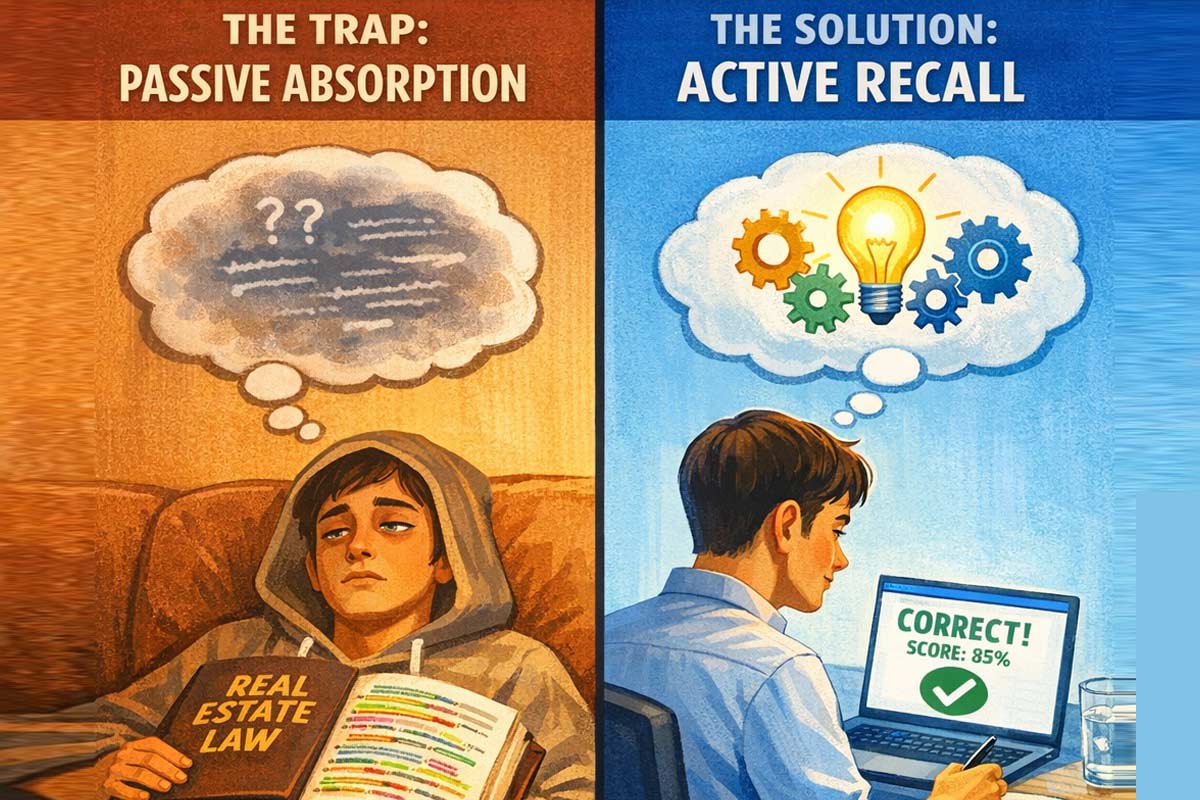
Trap #1: Passive Studying
I’ve seen students spend three weeks "reading and highlighting" a textbook without taking a single practice quiz. They feel like they are working, but they aren't retaining anything. When they finally take a quiz and fail, they get discouraged. This cycle of effort without retention is what leads to the common question: do online real estate classes actually prepare you? The answer hinges on your strategy.
Trap #2: The "Sequential" Prep Mistake
A common trap is waiting until you finish all three courses to even look at exam prep materials. This often leads to a "re-learning" phase that can add weeks to your timeline. My advice: start lightweight recall on Principles while you are still working through Practice.
Trap #3: The "Week 3" Motivation Dip
The first two weeks are fueled by excitement. By week three, the novelty wears off. Without a system, this is where most people quit. If you find yourself stalling, you need to learn how to stay motivated during real estate school to push through the mid-course slump.
How to Finish Faster Without Cutting Corners
If you want to move quickly, you don't skip the material—you optimize how you consume it.
Audit Your Environment: You can't learn "Legal Aspects of Real Estate" while watching TV. Success requires the optimal study setup for real estate school—a dedicated space where your brain knows it’s time to work.
Use the "Error Log" Method: Instead of re-reading chapters you already know, spend 80% of your time on the 20% of topics you keep getting wrong in practice quizzes.
Ask for Help Early: Don't spend three days Googling a concept. Use your instructor access. A five-minute explanation from an expert who responds quickly when you’re stuck can save you five hours of frustration.
The Planning Framework: Pick a Timeline, Then a School Structure
Your timeline shouldn't just be a wish; it should dictate which school you choose. If you need to be done in 3 months, you need a school that provides a clear roadmap, recorded or live instruction, and a support team that responds quickly when you're stuck.
Don't just take my word for it. Look at the data and what students say about online real estate schools (2026) to see which formats actually lead to completion versus which ones just leave you with a PDF and a prayer.
Frequently Asked Questions
Can I finish real estate school in 2 weeks? No. For online courses, providers generally cannot unlock the final exam until at least Day 18 of the course. Since you need three courses, the absolute minimum in California is 54 days.
What if I work a full-time job? Most students do. Expect a timeline of 4 to 6 months. By dedicating a little time every night and some time on the weekends, you can stay on track without burning out.
Can I take the three courses at the same time? It depends on the provider's structure. Most successful students find that focusing on one course at a time maintains better momentum, though you can start the 18-day clock for the next course as soon as the previous block has lapsed.
What is the fastest realistic schedule if I work full-time? A sample plan: 60 minutes of study every weekday morning, 30 minutes of practice quizzes during lunch, and one 4-hour "deep dive" on Saturday. This puts you on the "Balanced Track" (4-5 months).
What happens if I take a long break? A good course provider can keep your enrollment active for up to one year. However, if you take a break longer than two weeks, you will likely need to spend extra time reviewing previous material to reset, which extends your total timeline.
Final Thoughts
A realistic timeline is the sum of California’s legal requirements, your weekly consistency, and the support structure of your chosen school. Don't aim for the "fastest" possible route if it means you'll be unprepared for the actual state exam.
Ready to see which program aligns with your goals?
Compare the Best Real Estate Schools in California
|

Quick Take: How to Beat the Mid-Course Slump
Systems > Motivation: Motivation is a feeling that fades; systems are habits that finish the job.
The 20/2/1 Plan: Commit to 20 mins daily, 2 deep Read more...
Quick Take: How to Beat the Mid-Course Slump
Systems > Motivation: Motivation is a feeling that fades; systems are habits that finish the job.
The 20/2/1 Plan: Commit to 20 mins daily, 2 deep sessions weekly, and 1 weekly review.
Motivation ≠ Mood: You don't need to "feel like it" to start; movement creates the mood.
Active Recall: Stop passive reading. Quiz yourself early and often to see visible progress.
Protect Your Time: Treat your study blocks like non-negotiable appointments with a client.
Why "Real Estate School Motivation" Fades (And How to Get It Back)
It happens to almost everyone. You sign up for your California real estate courses with high energy. You envision the "For Sale" signs and the freedom of being your own boss. Then you hit the first boring chapter—and your calendar starts winning.
If you feel stuck, you aren't "bad at school." You are simply relying on motivation, which is a fickle emotion. After over 20 years of leading one of the Best Real Estate Schools in California, I can tell you that the most successful agents aren't the most "motivated"—they are the most disciplined.
The Motivation Truth: Identity vs. Emotion
Most students approach real estate school with the mindset of "I'll study when I have time and feel like it." This is a recipe for a "never-ending" course.
Real momentum comes from an Identity Shift. You have to decide: "I am the kind of person who finishes what I start." In my two decades of experience, I’ve seen students who work 60 hours a week finish in 54 days, while others with open schedules take two years. The difference? The former group built a "study identity" where the books opened regardless of how they felt.
Motivation ≠ Mood
It is a common myth that you need to be in the right "mood" to study. The not so big secret is that Motivation often shows up after starting. *You’re not trying to “feel motivated.”*
You’re trying to remove decisions.
When you remove the choice of whether to study, the resistance disappears.
The 7 Motivation Killers (and How to Fix Them)
1. Vague Scheduling
Symptom: Saying "I’ll study this weekend" but never opening the laptop.
If/Then Fix: If it’s 9:05 AM and you haven’t started, then open the course and commit to doing only 5 practice questions.
2. Passive Reading
Symptom: Reading the same paragraph five times without it sinking in.
If/Then Fix: If you realize you’re just staring at the page, then close the book and write down three things you remember from memory.
3. Isolation
Symptom: Feeling like you’re the only person struggling with "Escrow" or "Agency."
If/Then Fix: If you feel lonely in your studies, then sign up for a live webinar or instructor office hours to rejoin the community.
4. Unrealistic Timelines
Symptom: Feeling "behind" because you didn't finish in three weeks.
If/Then Fix: If you feel overwhelmed by the total hours, then check our guide on how long real estate school should take to reset your expectations.
5. High-Friction Environments
Symptom: Trying to study on the couch with the TV on.
If/Then Fix: If you find yourself reaching for your phone, then move to a dedicated desk. See our guide on the optimal study setup for real estate school.
6. Perfectionism
Symptom: Refusing to take a quiz until you know "everything."
If/Then Fix: If you are scared to fail a quiz, then take it anyway. A "failed" quiz is just a data point for what to review next.
7. No Feedback Loop
Symptom: Feeling like you aren't making progress.
If/Then Fix: If the finish line feels too far away, then print a physical progress bar and color in every chapter you complete.
The ADHI “Finish Line System”: The 20/2/1 Plan
To stay motivated during real estate school, stop guessing. Use this repeatable numeric framework to ensure you finish your hours:
20 Minutes Daily (The Habit Chain): This is your Minimum Viable Progress. Even on your busiest day, do 20 minutes of practice questions. It keeps the "real estate brain" active.
2 Deep-Work Blocks Weekly: Schedule two 90-minute sessions. These are your "power sessions" for heavy reading or complex topics like Finance or Legal descriptions.
1 Weekly Review: Spend 15 minutes every Sunday night. Review your "missed" questions from the week and plan your specific study times for the week ahead.
Do This Today: Set a recurring alarm on your phone for your "20-minute daily" session. Label it "Future Career Deposit."
Motivation by Scenario: Lived-In Examples
The Full-Time Professional (The 5 AM Trigger): Sarah worked 50 hours a week and felt she had no time. She stopped trying to study at night. Instead, she set a "5 AM Trigger"—coffee, then 20 minutes of online real estate classes. She finished in 60 days.
The Busy Parent (The Micro-Burst): Mark had two toddlers. Long study blocks were impossible. He switched to "micro-bursts"—doing 5-minute quizzes on his phone during nap times and park trips. He proved that online real estate classes actually prepare you even in small increments.
The "Re-Starter" (Breaking the Cycle): Elena had "started" school three times. Each time, she tried to restart from Chapter 1. The fix? She committed to picking up exactly where she left off, even if she felt "rusty." She prioritized forward motion over perfect review.
When to Pause vs. Push (The 48-Hour Reset)
There is a difference between "resistance" (procrastination) and "burnout" (true mental exhaustion).
The Rule: If you haven't made progress in three days, do a 48-Hour Reset.
The Plan: For two days, stop new content. Do a light reset: sleep, walk, and only review summaries if you feel anxious. Do not try to learn anything new. On the third day, return to your 20-minute habit.
Confidence Bridge: Progress is Visible
Motivation dies when the work feels invisible. Your fix is measurable progress: practice questions, error review, and a visible scoreboard. Remember: your goal isn't just to finish the course; it’s to pass the California State Exam on the first try. Reading student reviews of online real estate schools shows that those who stayed motivated were those who stopped "reading" and started "testing."
Frequently Asked Questions
How can I stay motivated in a self-paced real estate course? Create external pressure. Tell a friend your "graduation" date. Having someone ask "How's the school going?" creates the healthy social pressure needed to stay on track. Post that you are getting your license on social media.
Is it normal to feel overwhelmed by the real estate vocabulary? Yes. You are learning a new language. Treat the first pass like a survey and don't expect 100% comprehension until you start doing intensive practice exams.
What should I do if I’ve been away from the course for months? Don't start over. Review your last completed chapter's summary for 15 minutes, then move immediately into the next new chapter. Momentum is built by moving forward.
Does the school you choose affect your motivation? Absolutely. A school with no support or a clunky interface makes it easy to quit. Look for a program that offers clear progress tracking and access to instructors who can clarify difficult concepts.
Ready to Turn Momentum into a Career?
Staying motivated is easier when you have the right support system and a clear path to the finish line. If your current "self-paced" journey feels like a dead end, it might be time to evaluate the structure and support behind your education.
Evaluate your options and find the structure you need here: Explore the Best Real Estate Schools in California
|

In twenty years of leading students at ADHI Schools, I have seen thousands of students start their licensing journey. At this point, I can tell pretty quickly whether a student will be licensed in four Read more...
In twenty years of leading students at ADHI Schools, I have seen thousands of students start their licensing journey. At this point, I can tell pretty quickly whether a student will be licensed in four months or still "working on it" in twelve.
The difference isn't intelligence or background. It often comes down to their environment.
Folks often treat real estate school like a hobby—they fit it into the gaps of their life. First-time passers treat it like a closing. They don't rely on motivation; they rely on a Passive-to-Active (PTA) System. If you do not intentionally design your study setup, your environment will design your failure.
Quick Take: The High‑Pass System
The Framework: The "PTA System" (Environment, Tools, Routine).
The Non‑Negotiable: Total phone isolation and a "Single‑Task" browser setup.
The Metrics: Shift from "hours logged" to "concepts mastered via active recall."
The Goal: Eliminate the 3–6 month "drift" that kills most real estate careers.
The PTA System: A 3‑Pillar Framework
To pass the California state exam on your first attempt, you must move from Passive Consumption (watching videos) to Active Recall (retrieving information). My PTA System is the architecture that forces this transition.
1. Environment: The Distraction‑Free Command Center
Your brain is a proximity‑based machine. If your phone is within reach, a portion of your cognitive load is dedicated to not checking it.
The "Clean Desk" Mandate: Your workspace should contain exactly three things: your device, your notes, and a glass of water. Anything else—mail, laundry, other work—is a cognitive leak.
Phone Isolation (The "Faraday" Rule): Your phone does not belong on your desk. It belongs in another room. Research shows that even a silenced phone face-down on a desk reduces cognitive capacity.
The Lighting Trigger: Use a dedicated lamp for studying. When that light is on, you are a real estate student. When it’s off, you’re a parent/employee/spouse. This "context anchoring" is how busy professionals finish the course in record time.
The "Minimum Viable Corner": Don't have an office? Use noise-canceling headphones and a specific placemat. These are your "walls."
2. Tools: The "Single‑Task" Tech Stack
Most students fail because they use tools that encourage multitasking. A tablet with 15 open apps is not a study tool; it’s a distraction device.
The Hardware Hierarchy: A desktop or laptop is the only professional choice. You need a keyboard for rapid note-taking and a screen large enough to view the course side-by-side with practice exams.
The Browser Lockdown: Use a dedicated browser (e.g., Firefox if you usually use Chrome) solely for real estate school. No social media logins, no saved "distraction" bookmarks.
Note‑Taking (The "Write‑to‑Recall" Method):
Do not transcribe the course. That is passive and useless. Write down questions, not answers. (e.g., instead of writing "Joint Tenancy requires 4 unities," write "What are the 4 unities of Joint Tenancy?").
The 20‑Minute "Sprints": Use a physical kitchen timer. Digging into your phone to set a timer is an invitation for a 20-minute Instagram detour.
3. Routine: The "20/2/1" Execution Plan
The biggest mistake I see is “binge studying.” Students try to pull 8‑hour sessions on Sundays. They retain nothing.
The Daily 20: Twenty minutes of practice questions every morning before the world wakes up. This keeps your "exam brain" sharp.
The Deep 2: Two hours of new curriculum mid‑week.
The Sunday 1: One full, timed practice exam.
The "Start Ritual": A 60‑second sequence (Water → Headphones → Login) that signals to your brain that the "Real Estate School" gear has engaged.
The "Exam‑Readiness" Upgrade (Why Passive Students Fail)
This is where most students lose a year of their lives. They mistake familiarity for mastery.
I’ve seen students who claim to have “read” the textbook but can’t pass a 150‑question practice test. They fell into the trap of passive reading. They chose a setup that made it easy to "watch" but hard to "do."
Do online real estate classes actually prepare you? Only if your setup forces you to answer questions. If your study routine doesn't involve being "wrong" at least 30% of the time during practice, you aren't learning—you’re just scrolling.
Kartik’s Reality Check: In two decades, I have never seen a student fail the state exam because they didn't "read enough." They fail because they didn't "retrieve enough." Your setup must be a retrieval machine.
Common Setup Failures (The "Don't" List)
If your current study habit looks like this, you are effectively choosing to fail:
The "Second Screen" Trap: Having the TV on or a movie playing while "going through the slides."
The "Highlighter Fallacy": Thinking that coloring a page yellow equals moving it into your long‑term memory.
The "Drift": Not knowing exactly which lesson you will tackle before you sit down.
Skipping Practice Tests: Waiting until the "end" of the course to see if you actually know the material.
Profile
The "Pass" Strategy
The Failure Mode
The Busy Pro
20‑min daily sprints
"I'll do it all on Saturday"
The Career Changer
Active recall / PTA System
Passive reading / Highlighting
The Academic
Practice test drilling
Over‑studying theory / No testing
Implementation: Choose Your Path
You are at a crossroads that determines how long real estate school should take. You can either drift through the material and hope for the best, or you can build a PTA system that guarantees a result.
Consistency is the byproduct of a good environment. If you find yourself constantly losing steam, read our analysis on how to stay motivated during real estate school. Usually, it’s not a lack of "willpower"—it’s a broken setup.
When you compare the Best Real Estate Schools in California, look for the one that doesn't just give you a login, but gives you a framework for success. Check the student reviews of online real estate schools and you’ll see that the ones who pass are the ones who treated the process with the professional rigor it deserves.
PTA System FAQs
Q: Is it okay to study at a coffee shop?
A: Only if you have noise‑canceling headphones and can handle the "Portable PTA Kit." If people‑watching is more interesting than the Law of Agency, stay home.
Q: Should I use digital flashcards?
A: Yes, but only if you create them yourself. The act of writing the question is 50% of the learning.
Q: What if I miss a week of my routine?
A: Do not try to "catch up" by doubling your hours. You’ll just burn out. Return to the 20/2/1 plan immediately. The system is designed to absorb life’s interruptions.
Q: How do I know if my setup is working?
A: By your practice test scores. If your scores aren't rising, your environment is likely too passive.
Q: Does the PTA system work for everyone?
A: It works for everyone who actually implements it. It is the converged "best practice" of 20 years of successful California brokers.
The Verdict
If you don’t design your setup, your environment will design your outcome. A professional career starts with a professional study habit. Build your PTA Command Center today, put your phone in another room, and start your first 20‑minute sprint.
Your future as a California agent depends on the systems you build today.
|

Choosing a real estate school in California is the first major "business decision" you will make. It’s also the first time you’ll encounter the noise of the internet in the real estate world. If you Read more...
Choosing a real estate school in California is the first major "business decision" you will make. It’s also the first time you’ll encounter the noise of the internet in the real estate world. If you spend five minutes looking for student reviews of online real estate schools in California, you will find two extremes: glowing 5-star testimonials that sound like marketing copy, and 1-star "rage reviews" from students who felt abandoned by a computer screen.
In over 20 years of helping thousands of Californians through this process, I’ve noticed a consistent pattern: a school’s 'user experience' and its 'educational results' aren't always the same thing.
The truth?
Reviews are a tool, but only if you know how to read between the lines. Here is how to filter the noise and find a school that actually gets you licensed.
Quick Take: The 2026 Review Filter
Look for Outcomes, Not Ease: A "fast and easy" course often leads to a "difficult and repeated" state exam.
Check the Date: California DRE regulations and exam topics shift; reviews older than 12-18 months are less relevant.
Identify the Support Model: "Great support" should mean access to human experts, not just a technical help desk.
The Goal is the License: Prioritize reviews that mention "passing the state exam" over those that only mention "finishing the hours."
What Students Most Commonly Praise (and what it actually indicates)
When you see a 5-star review, you need to determine if the student is praising the convenience or the effectiveness.
“The platform was so simple and fast.”
In 2026, user experience matters, but "simple" can be a double-edged sword. If a platform is too simple, it may be because it lacks the depth required to pass a high-stakes exam. Students often praise a school for letting them click through quickly, but this rarely translates to retention. This is why many online real estate school reviews in California overemphasize convenience while underreporting exam outcomes. How long students should expect real estate school to take depends on the quality of the material, not just the speed of the software.
“Great support whenever I had a question.”
You must define what "support" means in these reviews. Does it mean a live person answered a question about contract law, or does it mean someone helped them reset their password? Real support—the kind that actually gets you licensed—is about how you learn, not just how the website works. Look for reviews that mention instructors who clarify complex topics like encumbrances or agency disclosure.
“The practice questions were just like the exam.”
This is the gold standard of praise. If multiple reviewers mention that the school's preparation tools mirrored the actual California State Exam environment, that is a high-value signal. It suggests the school prioritizes exam readiness over course completion.
While the exact exam questions are never public, a great program prepares you for the logic behind them. This ensures that no matter how a question is framed, you have the knowledge to answer it correctly.
What Students Most Commonly Complain About
Negative reviews are often more revealing than positive ones, but they require a "root cause" analysis.
“No one would help me / I felt like a number.”
The Root Cause: Many online schools are "set it and forget it" models. They provide the PDFs but no bridge to a human being.
How to Verify: Before enrolling, call the school. If you can’t get a human on the phone during business hours now, you won't get one when you’re stuck on Chapter 7 later.
“The materials felt outdated.”
The Root Cause: The California real estate market and laws change. A school using a curriculum from ten years ago is doing you a disservice.
How to Verify: Check if the school mentions 2026 updates or current DRE standards.
Do online real estate classes actually prepare you?
Only if the content reflects the current exam pool.
“I fell behind and lost my motivation.”
The Root Cause: Purely self-paced courses require 100% of the discipline to come from the student. Repeated complaints like this point to a system problem, not a character flaw.
The Reality: This isn't always the school's "fault," but it indicates a lack of an accountability framework. If you see this often, it means the school provides the "what" but not the "how" of staying engaged.
The Review Pattern Test: Your 3-Minute Audit
Don't read every review. Apply this framework to the top 20 reviews you find for any California real estate school.
Rule
What to Look For
The Specificity Rule
Does the reviewer mention a specific chapter, instructor, or "lightbulb moment"? (High Value)
The Recency Rule
Is the review from 2025 or 2026? Tech and DRE rules move fast. (High Value)
The Outcome Rule
Does it say "I passed the state exam"? That is the only metric that matters. (Highest Value)
The Support Signal Rule
Do multiple reviews mention access to instructors or real humans beyond tech support? (Trust Signal)
The 1-Star Filter
Is the reviewer mad about a refund policy they didn't read, or a fundamental lack of teaching? (Context is Key)
Student Checklist for Review Auditing:
Did the reviewer pass on the first or second attempt?
Does the school offer physical textbooks (often a sign of a more serious program)?
Are there mentions of "live" components or webinars?
Does the "clunkiness" mentioned in reviews affect the learning or just the aesthetics?
What Reviews Can’t Tell You (The "Hidden" Factors)
Even the best online real estate school reviews in California have blind spots. There are things you must verify directly with the school:
DRE Compliance: Is the school currently approved for the specific courses you need? Check the DRE website directly.
Repetition Logic: Does the system force you to review what you got wrong, or does it just let you move on?
Your Study Environment: A 5-star school won't help you if you’re studying on a phone in a noisy coffee shop. The optimal study setup for real estate school is as important as the curriculum itself.
Holding Periods: California law requires a minimum of 18 days per course. This is one reason timelines in reviews often conflict with reality. Some reviews complain about "delays" that are actually legal requirements the student didn't understand.
Decision Matrix: Which School Type Fits You?
Based on common student feedback, here is how to choose your path:
The "Busy Professional": Look for reviews mentioning mobile-friendly formats but high-quality physical books for weekend deep-dives.
The "Anxious Test-Taker": Prioritize schools with "heavy" practice question banks and live exam-prep crash courses.
The "Discipline Challenged": Avoid "pure" self-paced schools. Look for reviews that mention how to stay motivated during real estate school through instructor check-ins or structured schedules.
Reviews are Input, Not the Decision
In my experience, the students who succeed are those who treat their education like a job interview. They don't just look for the cheapest or "easiest" option. They look for a partner that provides the structure they lack and the expertise they need.
Reviews tell you about the experiences of others, but they don't guarantee your outcome. Your success depends on your ability to find a school that balances modern convenience with old-fashioned academic rigor.
To see how we categorize the different types of programs available today, view our complete guide on the Best Real Estate Schools in California.
|

It’s 4:00 PM on a Friday. A repair request just came back with a $15,000 credit demand, the appraisal gap is widening, and the other agent is screaming into their speakerphone.
"This is an ethics violation!" Read more...
It’s 4:00 PM on a Friday. A repair request just came back with a $15,000 credit demand, the appraisal gap is widening, and the other agent is screaming into their speakerphone.
"This is an ethics violation!" they yell.
"I’m reporting you to the DRE! You’ll never sell a house in California again!"
If you’re like most agents, your stomach just did a somersault. You start mentally cataloging every email, every disclosure, and every text message, wondering if a single mistake is about to end your career.
The reality is this: The California Department of Real Estate (DRE) is not an "everything cop." They are the License Cop. Their jurisdiction is specific, and their mission is consumer protection—not settling playground disputes between agents.
The DRE in Plain English: License Cop, Not Everything Cop
The DRE exists to protect the public from those who hold a real estate license. Think of the DRE like the DMV for your professional life. If you drive 100 mph in a school zone, the DMV (via the police) cares. If you forget to wave at your neighbor or argue over who pays for gas, the DMV does not have jurisdiction.
The DRE typically enforces license law—conduct tied to your license that impacts consumers, such as truthfulness, disclosures, money handling, and advertising. They generally do not enforce the REALTOR® Code of Ethics (that’s the Association’s job). They do not enforce the "spirit of cooperation" (conflicts here are typically handled internally by your broker). And they certainly do not care if another agent thinks you were "rude" during a negotiation. For the full compliance map, start with our California Real Estate Laws & Compliance Guide.
Where the DRE Shows Up: The Real Discipline Triggers
When the DRE does step in, it’s because a licensee has crossed a line into territory that can trigger discipline. The "Short List" of enforcement usually falls into these buckets:
Trust fund mishandling: One of the fastest ways to invite serious discipline is mishandling other people’s money—especially commingling (mixing funds) or conversion (misusing funds). When in doubt, escalate to your broker. If you’re unclear on the mechanics, read Trust Fund Handling Rules for California Agents.
Material misrepresentation / nondisclosure: This typically involves failing to disclose a material fact—like a neighbor’s unpermitted boundary wall or a known soil subsidence issue—to a buyer.
Micro-scenario: An agent fails to disclose a known, recurring roof leak because "the seller said it was fixed." The buyer moves in, the ceiling stains again during the next storm, and the buyer's attorney finds an old repair estimate in the file history during the dispute. This creates a documented trail that can support a complaint. Check our guide on Common DRE Violations and How to Avoid Them.
Advertising violations: Because it’s public and easy to document, advertising is often the first place investigators look.
Micro-scenario: An agent runs Instagram ads with “Top OC Realtor Team” but omits the broker ID in the caption and leaves the license number off the graphic. Nobody complains for months—until a transaction goes sideways and the client screenshots the posts. That’s a documentable issue investigators can verify quickly. Start with Real Estate Advertising With Your License Number and Team Name & DBA Rules for California Agents.
Criminal convictions: Certain convictions or conduct "substantially related" to the license can trigger DRE action because they raise questions about honesty or fitness. If this applies, consult your broker and legal counsel early.
Failure to supervise: Your broker is generally responsible for supervising your activities. If a team or office has no documented supervision and review procedures, the DRE can discipline the employing broker alongside the agent.
Unlicensed activity: This includes "scope creep" where unlicensed assistants perform tasks like advising on contract terms or negotiating repairs during an open house.
Where the DRE Usually Doesn’t Show Up (And Who Does)
Most "threats" you hear in the field have nothing to do with the DRE. While the DRE may get involved indirectly if facts allege misrepresentation or fraud, use this table to triage typical conflicts:
Complaint About...
Typically Handled By...
DRE Involvement?
What to Do
Commission split disputes
Your broker / mandatory arbitration or mediation
Unlikely
Escalate to your broker
"Stolen" MLS photos or remarks
Local MLS committee
Unlikely
File a violation report with your MLS
A "rude" or "unprofessional" tone
Nowhere (Business conflict)
Usually none
De-escalate, document, move on
REALTOR® ethics violation
Local Association of REALTORS®
Usually none
File an ethics complaint with the Association
Breach of contract (Buyer vs. Seller)
Civil court / mediation
Indirect (if fraud is alleged)
Loop in your broker; consult counsel if needed
Fair Housing discrimination
CRD / HUD (and can overlap with DRE)
Can overlap
Consult broker/attorney immediately
Reality Check
A bad Yelp review or an angry email does not automatically become a DRE case. The DRE typically looks for an allegation tied to license law. If the complaint is “they were rude” or “they negotiated badly,” it often ends at intake triage because it isn’t a licensing enforcement issue.
The Investigation Pathway: From Complaint to Closure
If you want to understand what the DRE investigates, look at the process. It is clinical and evidence-driven. If you receive a letter, don't improvise—provide factual records and loop in your broker immediately.
Intake & triage: They screen for jurisdiction—meaning, is this a license-law issue or just a dispute?
Request for response: If it’s in-scope, you and your broker may be asked to respond and provide documentation.
Investigation: They may review transaction files, ads, and interview parties.
Possible outcomes:
Closed / no action: No violation found.
Citation / administrative resolution: Often for fixable compliance items like advertising errors.
Formal accusation / disciplinary process: For more serious allegations.
Checklist: If You Want to Stay Compliant, Do This:
Treat trust funds like evidence: Follow broker policy, use compliant trust procedures, and adhere to the Trust Fund Handling Rules for California Agents.
When in doubt: Disclose, document, and escalate to your broker.
Quarterly Marketing Audit: Review your signs, business cards, social media bios, and landing pages against the Real Estate Advertising With Your License Number requirements.
Keep a clean file: The DRE values a well-documented, organized file that tells a clear story of the transaction.
Involve your broker early: Your broker is your first line of defense and is legally required to supervise your conduct.
Your 3-Part Compliance Shield
You don't need to live in fear if you have a system. Treat your business with surgical competence:
Document Like a Defensive Pro: Every material conversation needs an email follow-up."Per our conversation..." is a strong phrase in your vocabulary to avoid Common DRE Violations.
Audit Your Advertising: Ensure your license number and broker's identity are conspicuous. Use our guide on Real Estate Advertising With Your License Number to help stay compliant.
Marketing & Team Hygiene: Ensure your team names and DBAs are registered properly. Refer to our guide on Team Name & DBA Rules for California Agents to ensure your branding isn't a liability.
The next time someone threatens you with a DRE report over a personality clash, take a breath. Look at your jurisdictional map. If you are operating with transparency and following license law, their threat is often empty noise. The DRE isn’t your shadow—your paperwork is.
To master the nuances of license law and protect your career, bookmark our master California Real Estate Laws & Compliance Guide.
|

You’ve seen the ads. You’ve read the promises of "get your license in weeks." But as you sit in front of your laptop, a nagging question remains: “Will online real estate classes actually prepare Read more...
You’ve seen the ads. You’ve read the promises of "get your license in weeks." But as you sit in front of your laptop, a nagging question remains: “Will online real estate classes actually prepare me—or am I just buying a stack of PDFs and some videos?”
It’s a valid fear.
The California Department of Real Estate (DRE) exam is notorious for its difficulty—with pass rates often hovering around 50%—and the real-world business of selling homes is even tougher.
I’ve spent over 20 years helping students navigate the California licensing process. I can tell you this:
Online classes can absolutely prepare you for success, but only if the program provides the right structure and you—the student—bring the right system.
Quick Take: The Reality of Online Prep
The Goal: Most courses focus only on the 135 hours required by the DRE.
The Gap: Finishing the hours is not the same as being "exam-ready."
The Solution: Success requires active recall, practice testing, and a bridge to real-world application.
The Verdict: Online works for self-starters who treat the screen like a classroom.
Defining "Prepared" in Two Separate Lanes
To answer if online real estate courses work, we have to define what you are preparing for. In my experience, there are two distinct lanes of readiness:
Lane 1: Preparing to Pass the CA Exam
This is about academic knowledge. You need to understand agency, disclosure, property ownership, and financing. You must be able to navigate the California-specific phrasing, disclosure logic, and legal nuance (like the 2026 updates to AI-image disclosures) that the DRE exam is known for.
Lane 2: Preparing to Operate as an Agent
This is the "Monday Morning" reality. Can you explain a purchase agreement? Do you know how to handle a difficult client? Many programs don’t fully cover this lane because pre-licensing is built around theory and legal foundations first—so you need a plan to bridge into application.
What Online Real Estate Classes Do Well
Online learning isn't just a "budget" version of a classroom; it has specific advantages that can lead to better retention if used correctly.
Self-Paced Repetition: Unlike a live lecture where the information is gone once the teacher speaks, online modules allow you to rewatch a complex video on "Encumbrances" five times until it clicks.
Consistency and Flexibility: You can study when your brain is sharpest. For some, that’s 5:00 AM; for others, it’s midnight.
Modular Learning: Content is usually broken into "bite-sized" pieces, which is scientifically proven to prevent cognitive overload.
Immediate Feedback Loops: Most online platforms offer instant grading on quizzes, allowing you to see exactly where your logic failed.
What this means for you: If you are a working adult, an online real estate school in California offers the only realistic way to fit 135 hours of education into a busy life.
Where Online Classes Can Fall Short (The Gaps)
Without a physical instructor staring at you, it’s easy to fall into certain traps. If you don't account for these, you'll reach the end of the course and realize you've learned very little.
Passive Consumption: Scrolling through slides while Netflix is playing in the background is not studying. You might "finish" the hours, but you won't retain the law.
The "Stuck" Factor: If you don't have a way to ask questions, a confusing concept can become a permanent mental block.
Motivation Drop-off: The "Middle-of-the-Course Slump" is real. Without a cohort or deadline, many students stop halfway through. To avoid this, you should learn how to stay motivated during real estate school before you start.
Real Scenario: I've seen students who get stuck on one concept (like agency relationships or trust fund handling), keep moving forward anyway, and that gap can snowball.
What a Good Online Real Estate Program Must Include (Non-Negotiables)
Online can absolutely work—but not all online programs are built the same. Here are the features that actually move students from “completed the hours” to “ready for the CA exam and real clients”:
California-style practice questions: Not generic national content that ignores CA-specific laws.
Answer rationales: Explanations that tell you why choices are wrong, not just which one is correct.
Timed exams: Tools that help you build the 3-hour test stamina required by the DRE.
A clear help path: Access to instructor support, office hours, or an escalation path when you hit a wall.
Progress tracking: Analytics that show your weak areas early so you can pivot your study focus.
Active recall systems: Quizzes and checkpoints that force you to remember, not just recognize.
What this means for you: You’re not looking for “more videos.” You’re looking for a program that builds correct thinking under pressure.
The Readiness Test: 7 Signals You’re Actually Prepared
Before you schedule that state exam, use this "scorecard" to evaluate your readiness.
Practice Exam Scores: Consistent 80% or higher on 4+ different full-length exams.
Plain English Test: You can explain Agency, Disclosure, and Contracts without looking at your notes.
Vocabulary Mastery: You know the difference between Grantor and Grantee instantly.
Error Log Review: You have a list of every question you missed and why you missed it.
Logic over Memorization: You can spot "distractor" answers that look right but are legally wrong.
Physical Readiness: You have a plan for the exam-day commute, sleep, and nutrition.
Real Scenario: A student finishes the 135 hours quickly, feels confident, then scores 62–68% on timed practice exams because they never trained recall under pressure. The fix isn’t “more studying”—it’s structured timed sets + error log review.
If you’re wondering how your timeline should look based on these readiness markers, read How Long Should Students Expect Real Estate School to Take?
The Online Student Success System
To make online classes work, you need more than just a login. You need a routine.
The "Frictionless" Setup: Create a dedicated study space. If you have to clear off the kitchen table every time you study, you won't do it. Follow the optimal study setup for real estate school to minimize distractions.
The Active Recall Cycle: Read a section then Close the book then Summarize it out loud then Take the quiz.
The Error Log Method: Never just look at your score. Write down every topic you don’t understand. If you don't understand the explanation, that is the concept you must research until you do.
Spaced Repetition: Don't just study Chapter 10 today. Review the "must-know" facts from Chapters 1–9 for a few minutes first.
The “Online + Real World” Bridge
Passing the exam makes you a "Licensee," but it doesn't make you competent. To bridge that gap while you are still in school, try these Kartik-approved tactics:
Script Roleplay: Take the concepts of "Disclosure" and practice saying them to a spouse or friend. "I have a duty to disclose all material facts that affect the value of this property."
The Contract Deep-Dive: Don't just memorize the names of contracts. Find a sample California Residential Purchase Agreement and read it paragraph by paragraph.
Scenario Thinking: When you learn about "Ethics," ask yourself: "If a seller told me their roof leaked but asked me not to tell the buyer, what exactly would I say?"
Real Scenario: I once met a student who passed the exam with flying colors but told me they froze when a potential client asked about a basic disclosure form. They had the academic knowledge but never practiced the "bridge" to real-world conversation.
Common Myths About Online Prep
"Online is easier." False. It requires more discipline because there is no one to hold your hand.
"Finishing the hours means I'm ready." False. The hours are a legal requirement; the study is a personal requirement.
"More videos = better prep." Not necessarily. You need high-quality content that mimics the California exam's specific logic. Read what students say about online real estate schools (2026) to see which formats actually lead to passes.
FAQs
Are online real estate courses legit in California?
Yes, as long as the provider is approved by the California Department of Real Estate (DRE). Always check the DRE website for a provider's sponsor number before enrolling.
Can I pass the CA real estate exam on the first try with just online classes?
Yes, but you usually need supplemental practice exams and a crash course. The "pre-license" hours teach you the law, but "crash course" style practice exams teach you how to pass the test.
What happens if I fail the online course final?
Most reputable schools allow you to retake the final exam after a short waiting period (mandated by the DRE). It’s a sign you need to go back and review your error log.
Do online real estate classes prepare you for being an agent?
Online classes prepare you for the exam. Becoming an effective agent requires additional application, role-play, and real-world exposure—which is why bridging theory to practice is critical during school.
Is an online course better than an in-person one?
It depends on your learning style. Online is better for flexibility and repetition; in-person is better for networking and immediate Q&A. Many students find a "hybrid" approach is the most effective.
Your Next Step
Online classes can prepare you for a legendary career in California real estate, but they are just one tool in your belt. Success comes down to the quality of the curriculum and the rigor of your study habits.
If you’re still weighing your options and want to see how different programs stack up against these standards, explore our comprehensive guide on the best real estate schools in California to find the right fit for your learning style.
|