A $10,000 deposit from a client sits in your center console. You’re headed to a listing appointment, then a kid's soccer game, and you figure you’ll drop the check at the escrow office tomorrow morning. Read more...
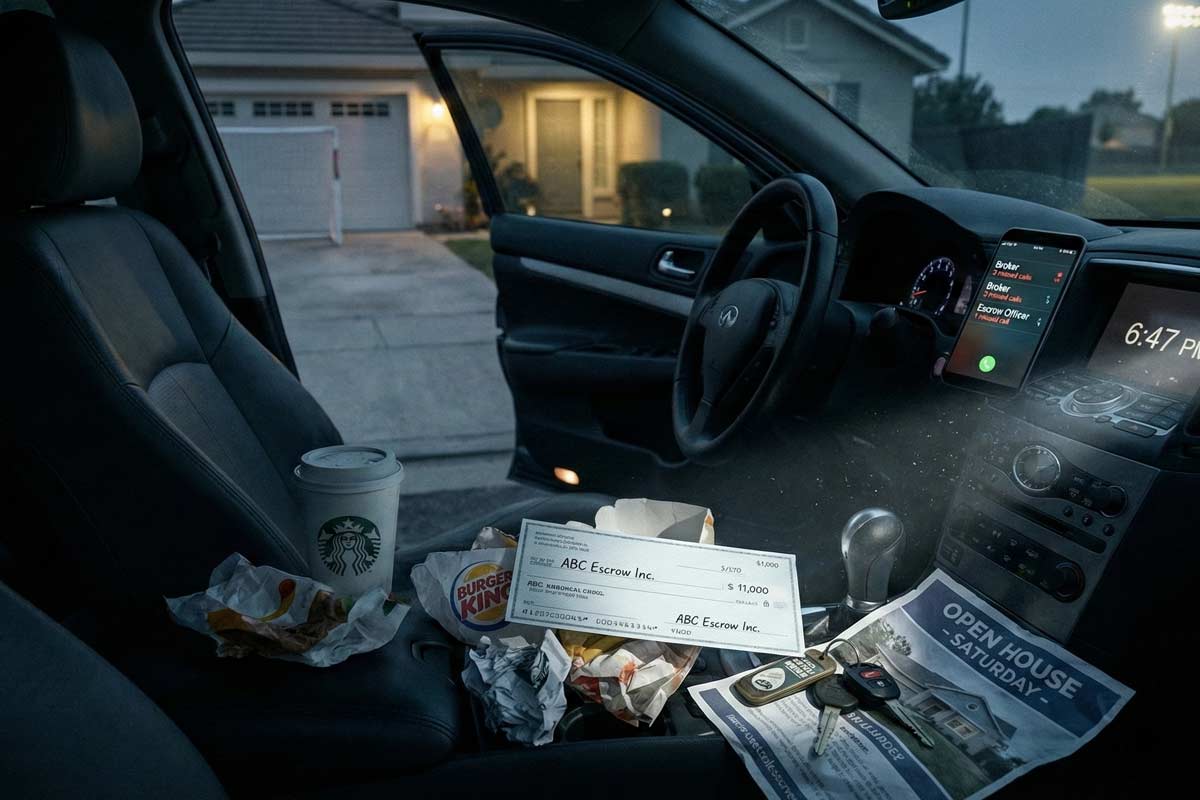
A $10,000 deposit from a client sits in your center console. You’re headed to a listing appointment, then a kid's soccer game, and you figure you’ll drop the check at the escrow office tomorrow morning. It’s just 12 hours, right?
Many trust fund cases begin with a dispute—a deal falls apart, a buyer wants their EMD back, or an escrow officer denies receiving a check on time. When the finger-pointing starts, the DRE looks at the custody trail, not your "intent."
Do this now: In modern times, it’s true that agents are less likely to take checks directly, remember if you have client funds in your possession, call the escrow officer immediately to confirm their intake hours, document the receipt in the transaction file (send a timestamped email to escrow and your broker confirming you have it), and deliver the funds today.
Trust Fund Handling: The 2-Minute Summary
The Destination: Place funds in a neutral escrow depository or the broker’s trust account according to legally imposed timeframes.
The Risk Window: Brokers treat custody as starting the second you take possession of client money.
The Safest Practice: Maintain consistent, high-standard documentation for every cent received.
The Top Risks: Commingling and Conversion are the primary causes of disciplinary actions.
What Actually Counts as “Trust Funds”?
The most common trust funds agents handle are Earnest Money Deposits (EMD), Rents, and Security Deposits. While other items like advance fees can technically be trust funds, treat these as edge cases—never touch them without the broker’s written instruction.
From an operational standpoint, your safest practice is to maintain robust documentation across all price points. If a DRE auditor sees a gap in a small transaction, they can infer there are systemic failures in your system.
Where Trust Funds Go in a Clean File
Operationally, there are two standard paths used in California real estate to handle client money.
Neutral Escrow Depository: The safest and most common path. You deliver funds directly to the escrow company named in the contract.
Broker’s Trust Account: A specifically designated account maintained by the broker, titled as a trust account.
The 4 Violations That Actually Get People Disciplined
The DRE is surgical about auditing money. To audit-proof your career, you must understand the concrete actions that trigger an investigation.
1. Commingling (Mixing Funds)
Audit Trigger: An auditor finds client funds deposited into a broker’s operating account or an agent’s personal account.
Hard Control: Safest practice: All trust fund checks go unendorsed directly to escrow or the broker’s trust account.
Refuse physical cash: Direct the client to obtain a cashier's check instead.
Depository compliance: If your broker forbids mobile deposit (many do), deliver the physical instrument directly to the designated depository.
2. Conversion (Using Funds)
Audit Trigger: A trust account balance drops below the total amount owed to all beneficiaries, often discovered after a client complaint.
Hard Control: Never "borrow": : Never use a deposit for unauthorized purposes, even if you plan to reimburse it later. Totally illegal.
Build a "defense file": Create documentation in real time (not after the fact) that explains every dollar with matching receipts and the trust account should be reconciled monthly.
3. Failure to Account (Sloppy Records)
Audit Trigger: A broker or agent cannot provide a clear paper trail for a specific deposit during a routine file review.
Hard Control: Retain proof: Keep copies of every deposit confirmation, receipt, or proof of delivery.
Cross-reference: Identify every deposit with the specific property address and client name according to DRE rules.
4. Delay / Failure to Deposit
Audit Trigger: An auditor cross-references the date on the EMD check with the date on the Escrow Receipt.
Hard Control: Timestamped communication: Document the moment you receive funds.
Exposure limit: If the timeline exceeds 3 business days, your exposure spikes.
For more on how the state monitors these audit trails, see our guide on what the California DRE actually enforces.
The Clean Trust-Fund Handling Sequence
Follow this sequence to ensure your file is defensible from the moment you take custody:
Verify Payee: Confirm the payee is the correct legal entity before you accept custody.
Secure Receipt: Document receipt of check.
No Endorsement: Never sign the back of a client's deposit check.
Approved Custody: Do not hand checks to unapproved third parties (unlicensed assistants, TCs, etc.).
Physical Storage: Store checks in a locked, designated place in your office. Never leave trust funds in your car.
Deliver & Confirm: Deliver the funds same day whenever possible and obtain a signed receipt.
Chain-of-Custody Email: Send the timestamped email to your broker and escrow. This is a core professional standard in our California Real Estate Laws & Compliance Guide.
FAQ: High-Intent Questions
Can I hold the deposit check overnight?" Generally, yes, but the risk of loss or theft makes this a failure in most brokerage policies. Deliver it immediately.
Does my Transaction Coordinator (TC) count as me?" Yes. Delegation does not transfer responsibility. If your TC or assistant mishandles a check, the DRE holds you and your broker accountable for the lack of supervision.
What if the buyer gives me the check on a Friday night?" Document the receipt Friday night, store the check in a locked location (not your car), and deliver it per your broker's Monday morning intake process.
What about wire instructions and wire fraud?" Always verify wire instructions via a phone call to a known, verified number. Never accept last-minute changes via email.
The Clean File Standard
Trust fund handling is about creating a defensible file. By following these hard controls and maintaining a strict chain of custody, you ensure that even a surprise investigation results in a clean file. Understanding these operational rules is the first step in avoiding common DRE violations and how to avoid them.
For more on state requirements, return to our California Real Estate Laws & Compliance Guide.
Disclaimer: This article provides general best practices and does not constitute legal advice. Always confirm your broker’s written policy.
|
Real Estate Compliance: Systems Over Luck
In my 20-plus years of educating California real estate professionals, I’ve seen thousands of agents move through the industry. Often what I notice is the ones Read more...
Real Estate Compliance: Systems Over Luck
In my 20-plus years of educating California real estate professionals, I’ve seen thousands of agents move through the industry. Often what I notice is the ones who stay out of trouble aren't necessarily the ones who memorized the entire Business and Professions Code; they are often the ones with consistent systems.
Most California DRE violations aren't the result of "bad" people doing "bad" things. They are the result of "busy" people doing "sloppy" things. The Department of Real Estate (DRE) is a consumer protection agency. Their job is to ensure the public is protected, and they do that by enforcing transparency, supervision, and documentation.
If you treat compliance as a "to-do" list rather than a "worry" list, you’ll find that the DRE isn't something to fear—it’s just the framework of your business.
What "A Violation" Means in Practice
A violation isn't always a dramatic headline. In the real world, enforcement is usually triggered by small, preventable issues that accumulate into compliance problems.
Complaint-Driven: A disgruntled client or a competing agent flags an ad or a missing disclosure.
Visibility Issues: When a yard sign or social media profile is missing key details, it becomes an easy target for a random inquiry or a complaint from the public.
Audit Triggers: The DRE performs audits of brokerages, including Investigative Audits (prompted by complaints) and Proactive Audits (routine checks, often targeting high-risk activities like property management).
Documentation Gaps: Most discipline stems from what is missing—a signature, a date, or a record of a deposit.
The DRE focuses on patterns of neglect. One typo on a flyer might result in a warning or a minor administrative penalty; a team of ten agents all advertising without license numbers suggests a broader failure of supervision.
The Top Common DRE Violation Categories
1. Advertising & Marketing Compliance
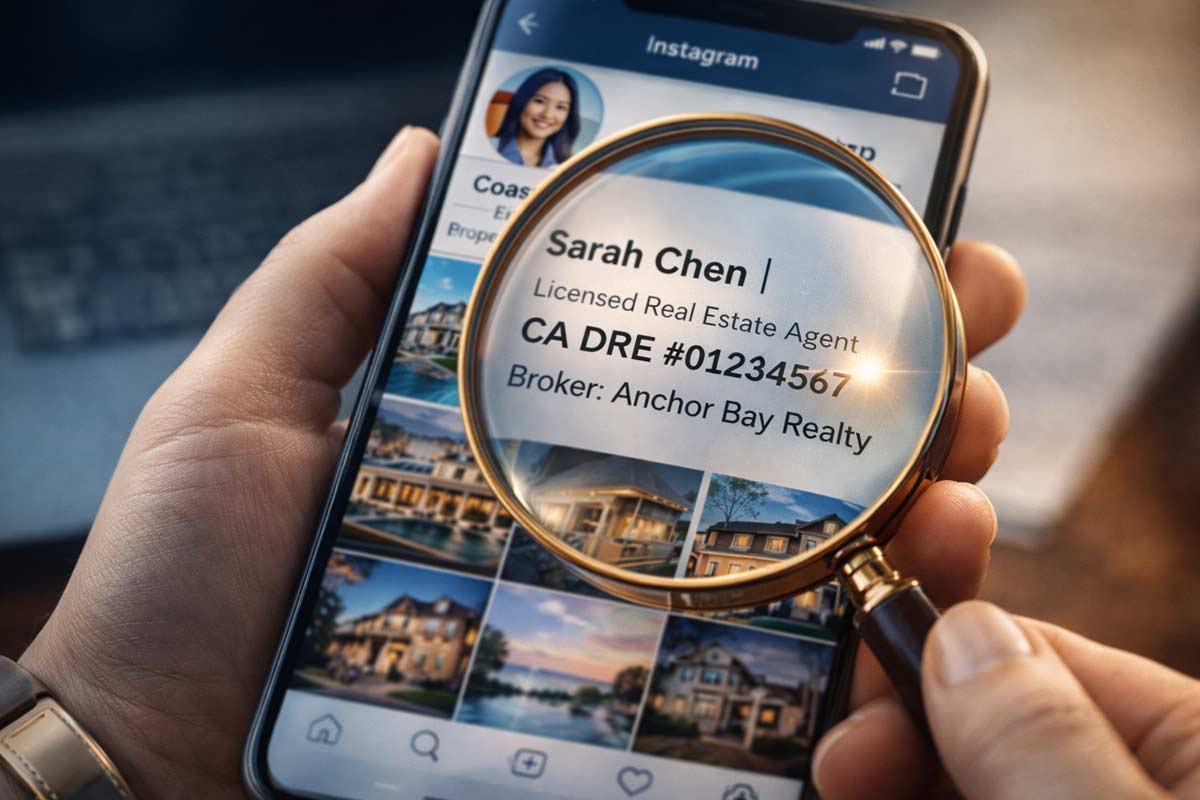
What it looks like: Business cards, yard signs, or Instagram posts that look "clean" but omit the required license information.
The trigger: Public visibility. A "For Sale" sign or a digital ad without the agent's DRE number is easily flagged by the public or competing brokers.
How to avoid it: Every piece of "first point of contact" material must have your license number and your broker's name. Review our guide on Real Estate Advertising With Your License Number for specific visibility and legibility rules.
Quick self-check:
Does my IG bio have my DRE # and Broker name?
Is my license number as prominent as the other contact info?
2. Trust Fund Mishandling
What it looks like: An agent receives an Earnest Money Deposit (EMD) check and keeps it in their car for a few days before handing it over.
The trigger: Delays in depositing or recording funds. If money isn't handled correctly, it raises flags for "commingling" or, in extreme cases, "conversion" (using funds).
How to avoid it: Per B&P §10145 and Reg 2832, a broker must generally deposit trust funds within three business days following receipt. As a salesperson, you must deliver funds to your broker or escrow immediately.Refer to Trust Fund Handling Rules for California Agents for timing nuances.
Quick self-check:
Did I deliver this check the same day I received it?
3. Team Name & DBA Misuse
What it looks like: "The Premier Group" appears on a yard sign, but that name has not been submitted to and approved by the DRE as a Fictitious Business Name (DBA). This implies a separate brokerage and lacks a required licensee surname.
The trigger: The DRE or a member of the public sees advertising under a business name not listed on the agent's or broker's license. Audits specifically check for DBA approval.
How to avoid it: Any name used in your real estate business that is not your exact personal license name is a DBA and must be pre-approved by the DRE. To be approved, a DBA typically must include the surname of a licensee (e.g., broker or salesperson) and often uses a descriptor like "& Associates," "Group," or "Team." It cannot sound like a separate corporate entity (e.g., "Inc.," "Realty," "Properties" alone). You must have the DRE's approval letter on file before using the name.
4. Inadequate Supervision
What it looks like: A broker has 50 agents but hasn’t reviewed a transaction file in months or has no system for checking marketing materials.
The trigger: An agent makes a mistake, and the DRE discovers the broker had no oversight system.
How to avoid it: Brokers must establish written policies and "review points"—such as initialing all listings and accepted offers. If you are an agent, follow your brokerage’s SOP for every document.
Quick self-check:
Has my broker or manager looked over the mandatory documents in this active file?
5. Unverified Claims & Misrepresentation
What it looks like: Advertising "brand new electrical" without verification, or claiming "#1 Agent in the City" without citing a source.
The trigger: A buyer relies on an unverified claim (B&P §10140) that turns out to be false,leading to a fraud or misrepresentation complaint.
How to avoid it: Stick to the facts. If you can't verify it with a permit or a receipt, use qualifiers like "per seller" and cite the source for any "ranking" claims.
Quick self-check:
Can I prove this statement if an auditor asks for the source?
6. Transaction File Gaps (Completeness)
What it looks like: A file is "closed" in the system, but the Transfer Disclosure Statement (TDS) is missing the seller's signature or a date.
The trigger: During an audit, the DRE finds that while the documents exist, they are legally incomplete due to missing initials or dates.
How to avoid it: Use a closing checklist. Do not move a file to "completed" until every required field is populated.
Quick self-check:
Is every "Initial Here" box actually initialed and dated?
7. Record Retention Failures
What it looks like: A transaction closed three years ago, but the agent deleted the emails and cannot produce the file.
The trigger: Audit requests a file from the previous three years.
How to avoid it: Per B&P §10148, you must retain transaction records for at least three years from the date of closing (or the listing date if the deal fell through). This includes listings, deposit receipts, and all substantive correspondence.
Quick self-check:
If the DRE asked for a file from three years ago today, could I produce it?
8. Unlicensed Activity
What it looks like: An unlicensed assistant "hosting" an open house and answering questions about the roof or neighborhood.
The trigger: A client mentions the "assistant" discussed property features or terms, which requires a license.
How to avoid it: Know the line. Assistants can handle clerical tasks, schedule appointments, and courier documents, but they cannot show properties or negotiate terms. See What the California DRE Actually Enforces.
Quick self-check:
Am I letting an unlicensed person discuss price or property features with a client?
9. Fair Housing Advertising Violations
What it looks like: Using phrases like "adults only" or "perfect for young families" in property descriptions.
The trigger: Advertising that indicates preference or limitation based on protected classes (race, religion, familial status, etc.).
How to avoid it: Focus strictly on the property’s features, not the type of person you think should live there. Avoid references to neighborhood demographics or religious facilities.
Quick self-check:
Does my ad describe the house or the person I want to buy the house?
The Compliance Operating System
You don't need to be a lawyer to stay compliant. You just need a framework.
Standardized Templates: Use your association's (C.A.R.) forms. Don't draft your own "mini-contracts."
The Transaction Checklist: Use a "master list" for every file. If a signature is missing, the file isn't "done."
Weekly Compliance Habit: Spend 15 minutes every Friday reviewing your active ads and digital profiles to ensure DRE #s are visible.
The "Stop Sign" Rule: If a client asks you to do something that feels "grey" (like skipping a disclosure), stop and call your broker immediately.
Quick Compliance Checklist (Screenshot This)
License #: On every email, business card, and social profile.
Broker Name: Clearly visible on all marketing.
Trust Funds: Handed off to broker/escrow immediately (Salesperson) or deposited within 3 business days (Broker).
DBA: Team name is DRE-approved and includes required suffixes (Team/Group).
Disclosures: Provided to the buyer as early as possible.
File Completeness: Every signature, initial, and date is present.
Retention: All records stored securely for a minimum of 3 years (§10148).
Unlicensed Staff: Limited to administrative, non-licensed tasks only.
Supervision: Broker has established review points for all contracts.
Fair Housing: All advertising language focuses on property features, not people.
FAQs
What does the DRE actually enforce most often?
The DRE frequently cites issues related to trust fund mishandling, failure to supervise, and misrepresentation of material facts.
What triggers a DRE investigation?
Most investigations are reactive, triggered by consumer complaints or issues found during routine proactive office audits.
Can a first-time mistake get me disciplined?
Yes. While the DRE may issue a warning for minor technicalities, any violation of the Real Estate Law can lead to administrative penalties, license restriction, or suspension.
What’s the fastest way to clean up my advertising compliance?
Audit your social media "Linktree" and bio. Ensure your DRE number and broker’s name are visible without needing to click deep into your profile.
How long should I keep transaction records?
Per B&P §10148, you must keep records for at least three years. However, many brokerages require longer retention (5–7 years) for liability protection. Always follow your broker’s specific policy.
Stay Protected with the Master Guide
Compliance isn’t a personality trait; it’s a system you build into your business. By following these steps, you protect your license, your broker, and your clients. For a deeper dive into the specific statutes and requirements, visit our California Real Estate Laws & Compliance Guide.
|
Your Real Estate License Number and Advertising
Imagine this: You’ve just spent $2,000 on a high-end video shoot for a new listing. The Reel goes viral—DMs, likes, and shares are pouring in. Then, Read more...
Your Real Estate License Number and Advertising
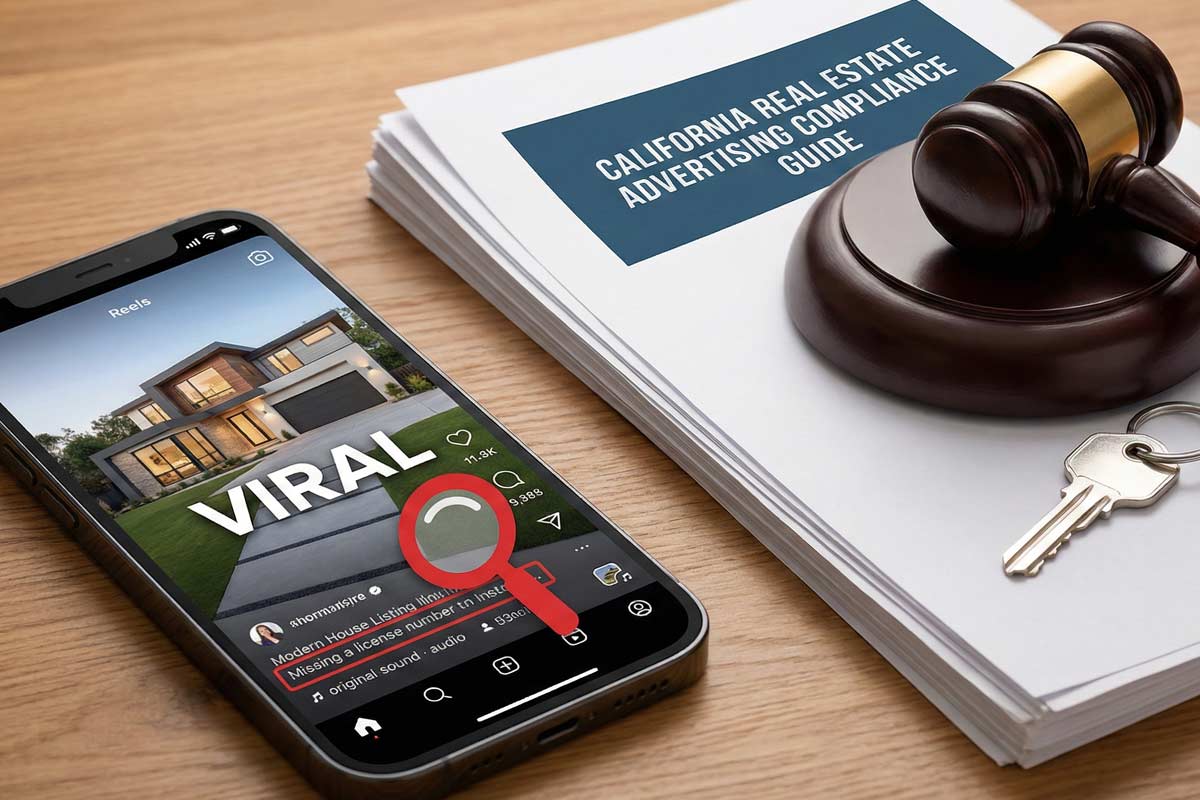
Imagine this: You’ve just spent $2,000 on a high-end video shoot for a new listing. The Reel goes viral—DMs, likes, and shares are pouring in. Then, you get a different kind of notification: a formal letter from the California Department of Real Estate (DRE).
A competitor noticed your license identification number was missing from the video. They filed a complaint through the DRE’s online portal in minutes. Now, instead of prepping for your open house, you’re prepping a response to a DRE investigator.
At ADHI Schools, I’ve spent over 20 years training agents to comply with the California Real Estate Laws.
If there is one thing I’ve learned, it’s this:
The DRE doesn't care how "aesthetic" your feed is; they care about consumer protection.
In California, your license identification number isn’t a suggestion—it’s a non-negotiable anchor for every piece of solicitation you put into the world.
TL;DR: Compliance at a Glance
Placement
Requirement Status
Bio / Profile
Required (If used for solicitation/first contact)
Individual Posts
Best Practice (Strongly recommended)
Website Pages
Required (On all pages you "own, control, and/or maintain")
Branded Signs
Required (If it identifies any individual licensee)
The Non-Negotiables: You must disclose your eight-digit license identification number AND your responsible broker’s licensed name. (Note: The broker's license number is generally optional if their name/logo appears).
Consequences:A DRE citation can include an administrative fine plus corrective actions.
The Core Rule: What Counts as "Advertising"?
Under Business and Professions Code and Commissioner’s Regulation 2773, any "solicitation materials intended to be the first point of contact with consumers" must include your license identification number. The DRE calls these "first point of contact" solicitation materials.
The Non-Negotiable Box
Licensee Name + License Identification Number.
Responsible Broker Identity: This must be the brokerage name as currently licensed with the DRE, not a nickname or team handle.
NMLS ID: Must also be included if you are performing mortgage-related acts.
The Operational Test: Content vs. Advertising
In practice, the DRE treats many consumer-inviting posts as solicitation.
Use this 3-part test: If a post contains
(1) your identity as an agent/broker,
(2) a specific property or service, and
(3) any invitation to contact, treat it as solicitation.
If the post has branding and services, even without an explicit CTA, it can still be construed as solicitation designed to incentivize a professional relationship.
Where Your License Number MUST Appear (Channel-by-Channel)
Instagram & TikTok
Required: Your license identification number must be in your Bio/Profile description if the profile is used for business.
Best Practice: Put “DRE #xxxxxxx” in your bio and on any post that could be screenshotted and shared. Legal standards focus on "first point of contact," but any single post can become that first interaction.
Common Mistake: Assuming a link aggregator (like LinkTree) counts as disclosure. The DRE expects disclosure on the solicitation surface itself, not hidden behind clicks.
YouTube & Shorts
Required: In the "About" section and the opening section of video descriptions.
Best Practice: For Shorts, where descriptions are often hidden, use an on-screen text overlay. Ensure it is legible on mobile and stays on screen long enough to be read.
Website (Agent & Team Pages)
Required: On all websites you own, control, and/or maintain. This includes agent bio pages, landing pages, valuation pages, and contact pages.
Note: This also applies to IDX or property search subdomains you control.
Placement: The footer works, but only if it’s present on every relevant page and not reduced to unreadable microtype. The type size must be no smaller than the smallest size type used elsewhere in the solicitation. ( 10 CCR § 2773)
Print & Digital Cards
Requirement: Mandatory for business cards, stationery, flyers, and mailers.
Digital Analog: Digital business cards and email signatures are explicitly viewed as "first point of contact" materials.
Yard Signs & Open House Signs
Branded Signs: If the sign displays the name of a licensee, disclosure rules trigger (§ 2773).
Unbranded Signs: A "For Sale" sign with no name, trademark, or branding (or only the responsible broker's licensed identity) is generally exempt.
The Reality of DRE Enforcement
Most complaints come with a single asset screenshot—one Reel frame or one flyer image. In practice, "it’s elsewhere on my site" is rarely a strong defense. If you’re wondering what actually gets the Department’s attention in the field, check out our report on What the California DRE Actually Enforces.
A pattern of sloppiness in your public-facing materials often signals deeper systemic issues to an investigator, which can lead to a wider review of Common DRE Violations and How to Avoid Them.
Traps: Common Compliance Misses
Collab Posts / "Featuring": If an ad names multiple licensees, you must include each individual license identification number.
Team Handle vs. Broker Name: A classic miss is a team page that shows a team name (e.g., "The Smith Group") but omits the responsible broker’s licensed name. Ensure your branding doesn't blur this line by reviewing the Team Name & DBA Rules for California Agents.
The 60-Second Compliance System
As a broker, here is exactly how I would protect your license: Systematize the boring stuff so you can focus on the selling.
The Locked Template: Create a "Footer Block" in Canva that includes your Name | DRE # | Responsible Broker's Licensed Name. Lock this as a template for all graphics.
The Bio Lock: Put your DRE# and responsible broker's licensed name in every social bio today.
The Monthly Audit: Set a recurring calendar invite to check (1) your last 5 posts, (2) your website footer, (3) your email signature, and (4) your top 2 directory profiles and team pages.
The same systems discipline required for advertising also applies to your backend operations, such as Trust Fund Handling Rules for California Agents.
FAQ: Real-World Advertising Questions
Do I need my license number on every Instagram post?
If it functions as first point-of-contact solicitation, disclosure is required. Since any "real estate" post can become someone’s first contact via a share or search, the safest system is to include it by default.
Does a real estate team page need license numbers?
Yes. Every licensee featured on the page must have their license number displayed next to their name.
What if I’m just posting market updates?
If you are presenting yourself as a professional to attract clients, it’s solicitation. The DRE is very broad in its interpretation of "incentivizing" a consumer to contact you.
If you want the full compliance map for your career, start with our California Real Estate Laws & Compliance Guide. If you’re wondering what actually gets the Department's attention in the field, check out our report on What the California DRE Actually Enforces.
|

An expired real estate license is a total freeze on your ability to earn commissions.
If your license isn’t active, you can’t represent clients—period.
The goal of this guide is to move you Read more...
An expired real estate license is a total freeze on your ability to earn commissions.
If your license isn’t active, you can’t represent clients—period.
The goal of this guide is to move you from "almost expired" to "renewed" with the cleanest submission possible. This is your operational roadmap.
Before You Hit Submit: The 4 Gatekeepers
Do not start your application for license renewal on eLicensing until these four things are true. Most renewal delays happen because agents submit before their records or documents are actually ready.
Confirm Your Eligibility Window: The DRE opens renewal only within an eligible window (typically 90 days before expiration). The eLicensing portal is the source of truth—if the "Renew" option isn't available in your profile, you aren't eligible to submit yet. Keep in mind that you can complete the CE courses anytime in the four years preceding expiration, but the application can’t be submitted until at least 90 days prior to expiration.
CE Proof in Hand: Have your Continuing Education (CE) completion certificates ready. You must verify that the provider numbers, course identifiers, and completion dates match exactly what you will enter. When you take the courses through ADHI Schools, the course completion certificates will start with 6404 for each CE course. For a full list of required courses, refer to our Checklist for Renewing a California Real Estate License.
Record Alignment: Ensure your legal name and contact details on file match your current identification. Even small mismatches (name formatting, address changes, or a stale email) can slow the file and trigger a manual review.
Broker Readiness (Salespersons Only): Confirm your broker or office manager knows they must approve the renewal inside their own portal. Your application is not considered "complete" by the DRE until your broker takes this step.
At-a-Glance Submission Checklist
✅ Eligible window visible in eLicensing
✅ CE completion certificates (PDFs) open on screen
✅ Name and contact details match your DRE record
✅ Salespersons: Broker notified and ready to approve
Takeaway: If any of these are off, fix them first. Submitting incorrect data is the fastest way to get your license stuck in the DRE’s manual review pile. See our guide on California Renewal Mistakes to avoid common "stuck points."
The Clean Submission Sequence
Step 1: Gather Your Renewal Packet
Organize these inputs before opening the eLicensing portal:
Your CA license number: Use the number exactly as shown in your DRE profile.
CE Certificates: Specifically the provider numbers and course identifiers exactly as shown on your certificates.
Payment Method: A valid credit or debit card. (To plan your budget, see How Much Does It Cost to Renew a CA Real Estate License?).
Broker Info (Salespersons): Your responsible broker’s license number and email.
Step 2: Choose Your Channel
Online (eLicensing): The standard path. Provides the fastest processing and immediate confirmation.
Mail Submission: Use only when the portal requires supporting documentation or your situation is not supported online. If you mail it, use a trackable service (USPS Tracking, FedEx, or equivalent).
Step 3: The Portal Walkthrough
Access: Log into eLicensing.
Data Entry: Do not retype from memory. Copy the identifiers and provider numbers directly from your PDF certificates. Even a minor typo in a course ID can stall verification and trigger a deficiency or manual review.
Validation: Review the summary page carefully before clicking through to payment.
Salesperson Alert: Your renewal is NOT complete until your broker signs in to their own portal and approves your application. Confirm with your broker or office manager that this step is finished immediately after you submit.
Step 4: Payment and Recovery
The DRE portal can be temperamental. To avoid double charges:
Click "Submit" only once.
If the screen freezes, wait a couple of minutes before refreshing.
Recovery Step: If you are unsure if it went through, log out, log back in, and check for a confirmation or receipt before attempting a second payment.
Step 5: Your Paper Trail (Non-Negotiable)
Portals glitch and emails disappear. Your paper trail is your insurance policy if there’s ever a question about what you submitted and when.
Screenshot the final confirmation page with the transaction ID.
Download the PDF summary of the application you just filed.
Archive the email receipt. You may need these while waiting for the record to update. See How Long Does It Take to Process a CA Renewal? for typical wait times.
What Happens After You Submit
Tracking Status: Use eLicensing as your primary status tracker to see if the application is "Pending" or "Processed."
Downstream Confirmation: Use the Public License Lookup as the final confirmation once the record officially updates with your new expiration date.
Your goal state is a "renewed/processed" status in eLicensing and an updated expiration date on the public lookup.
When to Escalate
If you are >14 days from expiration: Check eLicensing every 48 hours. It is normal for the update to take a week or more.
If you are
|
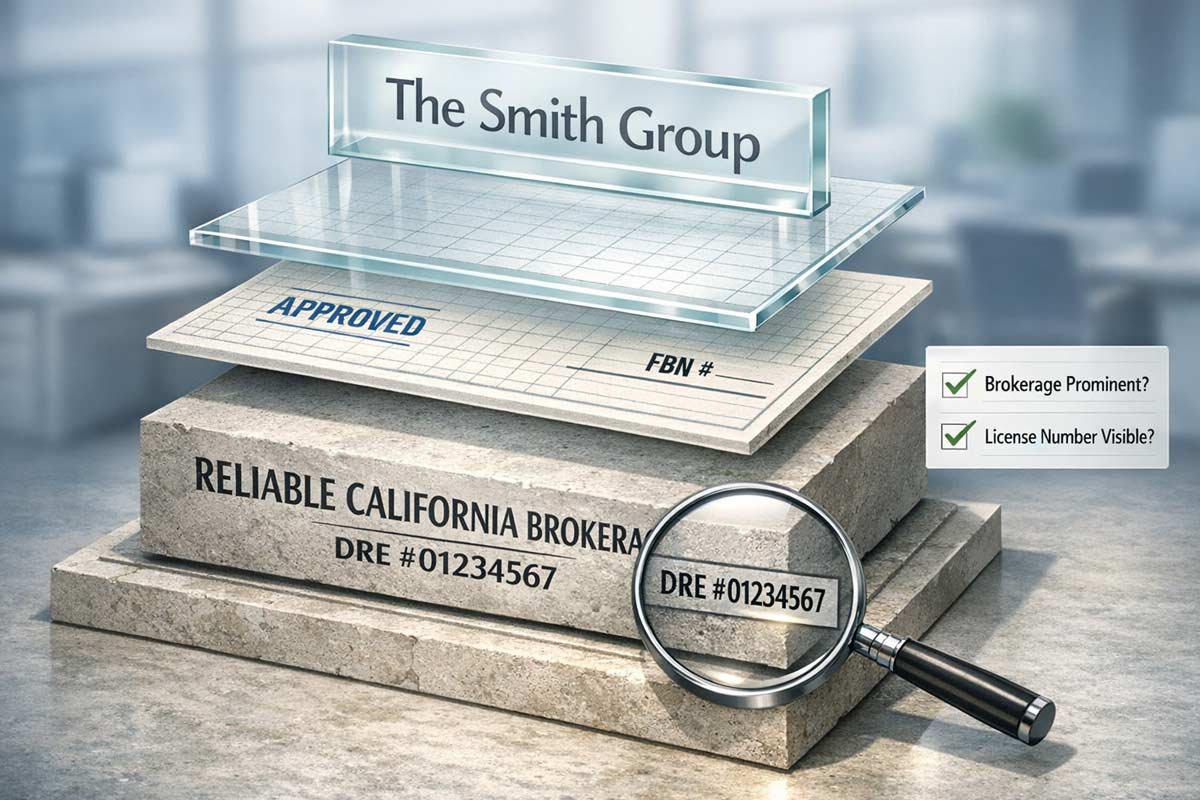
This isn't just about choosing a cool name for your Instagram bio. This is about staying compliant with the rules of the California Department of Real Estate.
In California, the line between "clever Read more...
This isn't just about choosing a cool name for your Instagram bio. This is about staying compliant with the rules of the California Department of Real Estate.
In California, the line between "clever marketing" and non-compliance is thinner than most agents realize. Get the compliance setup right from day one so you can focus on selling—not defending your license.
The "Oh No" Inquiry: A $2,500 Marketing Mistake
Imagine an agent—we’ll call her Sarah. Sarah is talented, hungry, and just launched "Elite SoCal Properties" on Instagram. It’s a great name. It sounds established and sounds like a powerhouse.
Three months later, she gets a formal inquiry from the DRE.
The issue?
"Elite SoCal Properties" sounds like a standalone brokerage. Sarah is a salesperson, but her branding suggests she’s the responsible broker or operating an independent brokerage.
By the time she pays the citation and rebrands everything—from signs to business cards—she’s out thousands of dollars and months of momentum.
A lot of these problems don’t start with the DRE "finding you"—they start with a competitor or unhappy party filing a complaint. If your branding is sloppy, you're giving your rivals a weapon to use against you.
The Foundational Mindset: Why the DRE Cares
The DRE has one primary mission: Consumer Protection. When a consumer sees your ad, they need to know exactly who the responsible broker is on that transaction. If your branding obscures that identity, you are creating consumer confusion, which is a fast track to a formal inquiry.
To build a truly bulletproof practice, you need to understand how branding fits into the bigger picture of professional responsibility. I’ve mapped the compliance hierarchy in our California Real Estate Laws & Compliance Guide—treat it as your home base for staying out of trouble and to help understand What the California DRE Actually Enforces.
Team Name vs DBA vs Brokerage Name (California)
Before you print a single flyer, you need to understand the three layers of your professional identity. In California, the name that matters legally is the one tied to the broker’s license—which is why your broker must approve your entire setup.
Term
What it is
What can go wrong
Team Name
A marketing label for your group
Looks like an independent brokerage
DBA / FBN
Name used in advertising other than the broker's licensed name (handled through broker policy)
Used without approval / inconsistent disclosures
Brokerage Name
The responsible broker identity
Hidden or minimized on advertising
Your Team Name: This is your nickname. It identifies your specific group (e.g., "The Smith Group").
A DBA (Doing Business As): This is a legal alias. If the public-facing name is not your broker’s licensed name, your broker may need to treat it as a fictitious business name. Start with your broker's policy—don’t guess.
The Brokerage: Think of this as your “last name”. No matter how big your nickname gets, the responsible broker must always be visible and dominant.
60-Second Compliance Checklist
Brokerage name is clear and prominent on all media.
My name matches exactly what is on my DRE license.
My license number is on all "first point of contact" ads.
Team name does not imply an independent brokerage.
Broker approved the setup before I printed or posted anything.
If you can’t pass this checklist in 60 seconds, don’t print, don’t post and consult with your broker.
Screenshot this checklist. It's your Friday audit.
Walk-Thru Scenarios: Is Your Brand Compliant?
Scenario A: The "Pseudo-Brokerage" Team
The Name: "Golden State Realty Team."
Risk: High. Words like "Realty" can imply you are an independent firm, which is a major trigger for What the California DRE Actually Enforces.
Why it’s risky: It suggests the team is the licensed entity, not the broker.
Do this now:
Stop using this if the DRE hasn’t approved the DBA/Corporation.
Clear the name with your broker's compliance department first.
Scenario B: The Instagram "Solo-Preneur"
The Post: A "Just Listed" graphic with your phone number and "The Luxury Specialist." No license number. No broker logo.
Risk: High. It’s a technical violation that usually leads to a citation.
Why it’s risky: Every "first point of contact" material must disclose your license status. This is a core rule in Real Estate Advertising With Your License Number.
Do this now:
Place your DRE license number on all social media graphics.
Add your broker's name to your Instagram bio.
Audit your YouTube channel for the same info.
Scenario C: The Team Branding Confusion
The Setup: You’ve created a team and want to handle property management for your clients.
Risk: Critical. Confusing your branding with the entity authorized to handle money leads to Trust Fund Handling Rules for California Agents violations.
Why it’s risky: Only the broker (or an authorized escrow) can handle funds; your "team" is not a legal repository for client money.
Do this now:
Never imply your "team" is the escrow holder.
Ensure all contracts clearly state the licensed broker’s legal name.
Review all trust fund-handling procedures with your broker.
Team Name Words That Trigger DRE Scrutiny
These words aren’t automatically illegal—but they increase the odds your branding is interpreted as implying a brokerage, which triggers higher scrutiny:
Realty / Real Estate
Broker / Brokerage
Land Company
Associates (if it implies more than one licensee is the lead)
The Friday Afternoon Audit
I tell my students to take 15 minutes every Friday to audit their brand.
Here are the four questions that prevent most of the issues we see in Common DRE Violations and How to Avoid Them:
Is my broker’s name dominant? If I look at my business card, is the brokerage name clearly visible and correctly spelled?
Is my license number everywhere? Check your email signature, your Facebook "About" section, and your latest YouTube description.
Are my "first point of contact" materials compliant? This includes business cards, stationery, flyers, and even those magnetic car signs.
Is my name consistent? Does the name on my marketing match my legal name on my DRE license?
The Compliance Coach’s Corner (FAQ)
Q: Can I use ‘Realty’ in my team name if I’m a salesperson?
A: It’s high-risk. Words like "Realty" or "Real Estate" can make your team look like a standalone brokerage. If your broker allows it, your disclosures must be crystal clear and your broker’s identity must be dominant everywhere and the DBA approved.
Q: Can my team name include “Properties,” “Homes,” or “Estates”?
A: Usually, yes—but treat them like “Realty-lite.” If the name makes you look like the brokerage, your broker identity must be dominant and consistent everywhere and you likely need the DBA approved by the DRE.
Q: Does my team name have to appear on my business card or can it be social-only?
A: If you use it anywhere, it should be used consistently and always accompanied by your broker’s identity and your license number.
Q: If I change brokerages, can I keep my team name and handles?
A: Usually, yes—but you must update every single asset (bio, headers, thumbnails) to reflect your new broker immediately.
Q: What counts as ‘first point of contact’ advertising?
A: Business cards, stationery, websites, social media profiles, and any promotional flyers or signs. If it can generate a call, DM, or lead, treat it like advertising.
Q: Can our team have a separate website domain?
A: Yes, but the website itself must comply with all disclosure rules, prominently featuring the broker’s name and your license number on every page.
Q: If my broker has multiple DBAs, which one do I use?
A: Use the one that is officially tied to your license and the office where you are hung. When in doubt, ask your manager.
The Protected Path Forward
Compliance isn't a hurdle; it’s the foundation of a scalable career. When you set up your brand correctly, you’re telling your clients—and the DRE—that you are a professional.
Start with the full map: California Real Estate Laws & Compliance Guide
Then tighten your biggest public-facing exposure: Real Estate Advertising With Your License Number
Finally, run the ‘am I accidentally violating something?’ scan: Common DRE Violations and How to Avoid Them
The goal is simple: your brand should look professional without ever looking like an unlicensed brokerage.
|
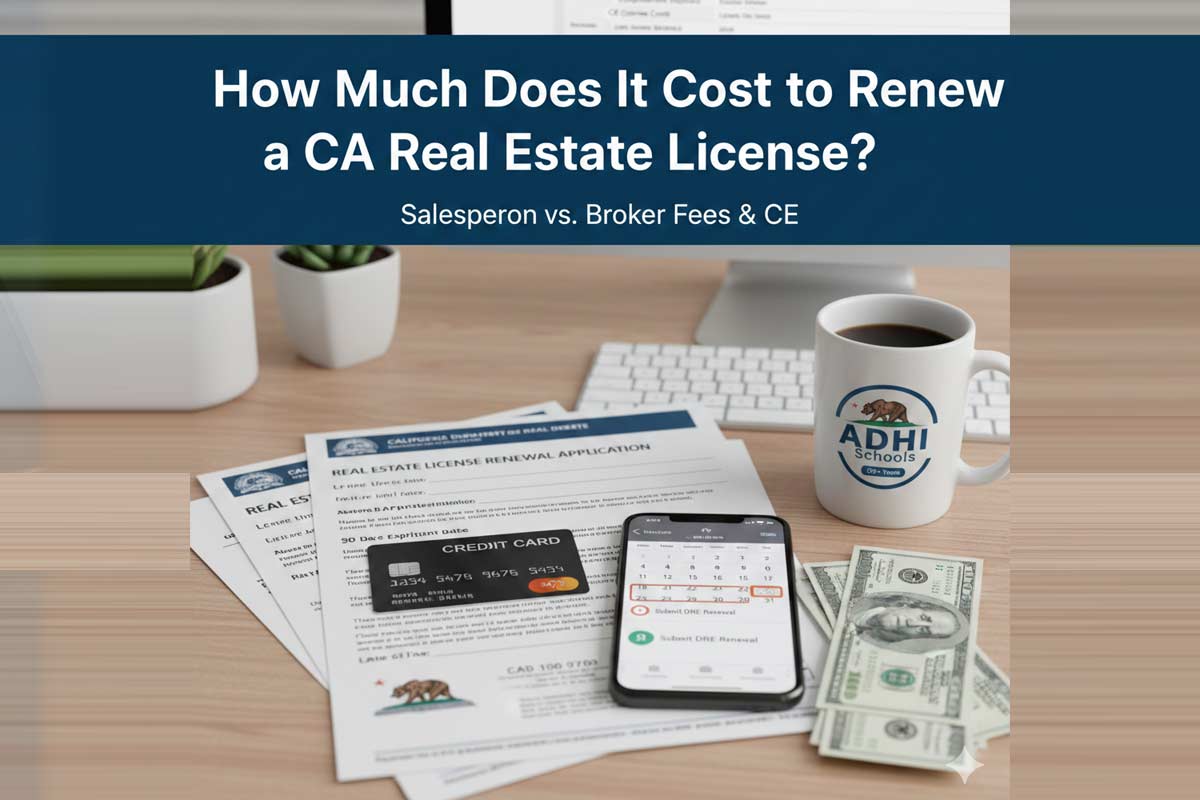
You’ve worked hard to build your business, but nothing halts momentum like a DRE deficiency notice—or worse, a license that slips into expired status. I’ve spent over 20 years helping California Read more...
You’ve worked hard to build your business, but nothing halts momentum like a DRE deficiency notice—or worse, a license that slips into expired status. I’ve spent over 20 years helping California agents and brokers at ADHI Schools navigate this process, and I’ve watched too many professionals pay an unnecessary "tax": late fees, avoidable delays, and lost commission because they didn’t budget for time and money.
If you plan ahead, the cost to renew a California real estate license is predictable. If you wait until the last minute, the price goes up—not just in dollars, but in stress.
The Quick Answer: CA Renewal Cost Snapshot
Below are the renewal fees set by the California Department of Real Estate (DRE). These figures reflect the official DRE fee schedule (fees effective July 1, 2024, and current as of March 2026).
License Type
On-Time Renewal Fee
Late Renewal Fee (within 2 years)
Salesperson
$350
$525
Broker
$450
$675
Important: These are DRE filing fees only. Your total cost also includes continuing education (CE), which is provider-dependent. A realistic "total budget" for an on-time renewal is typically:
Salesperson: ~$400–$480 (DRE fee + CE range)
Broker: ~$550–$625 (DRE fee + CE range)
The Fee You Can’t Avoid: DRE Renewal Fees
The DRE renewal fee is non-negotiable. The cleanest way to pay is through the DRE eLicensing system, because it creates a clear electronic transaction record and supports the DRE’s standard online renewal workflow.
The on-time renewal nuance most agents miss
If you renew on time, California Business & Professions Code Section 10156.2 permits you to continue operating under your existing license after its expiration date unless the DRE notifies you of a deficiency. Your renewal is considered "on-time" if your eLicensing transaction is completed—or your mailed application is postmarked—by midnight on your expiration date.
Why the late fee is a trap
Miss the deadline and a Salesperson renewal jumps from $350 to $525—a $175 penalty (a 50% increase). Most importantly, if your license is expired and you haven’t submitted the complete renewal application, you cannot perform any activities requiring a license until your renewal is officially processed.
Plan your submission: Check our guide on How to Submit Your CA License Renewal Application for the smoothest filing flow.
The Second Big Cost: Continuing Education (CE) Tuition
Renewing a real estate license in California requires 45 hours of DRE-approved continuing education. The cost depends on the provider and delivery method.
Typical CE cost range: ~$99–$199.
First renewal vs. Subsequent renewal: First-time renewals require individual courses in specific mandatory topics. For subsequent renewals, licensees whose licenses expire on or after January 1, 2023, have the option to complete a 9-hour CE survey course that covers the seven mandatory subjects.
Provider Tip: Bundled 45-hour packages are almost always the best value. Buying courses "à la carte" often leads to missing a required component and paying twice.
Hidden Costs That Blindside People (The "Late Tax")
Beyond standard fees, these cost multipliers can inflate your real total:
Deficiency delays: Typos or incorrect course numbers trigger DRE follow-up. While there is no "fine," the cost is measured in weeks of business disruption while you wait for manual processing.
Multiple licenses: If you maintain a corporation license or an additional officer license, each carries its own renewal fee under the DRE fee schedule.
Rush premiums: Waiting until the last minute for CE often results in less time to shop around to make sure you are getting the best deal on CE.
To stay organized, use our Checklist for Renewing a California Real Estate License.
3 Budget Scenarios: What Will You Actually Pay?
1) Proactive Salesperson (Clean & On-Time)
DRE fee: $350
CE package: $50–$120
Total: ~$400–$470
3) "Scramble" Renewal (Late Salesperson)
Late DRE fee: $525
Last-minute CE: Cost doesn’t change but you are less likely to cross shop if under time pressure.
Total: ~$625+ (Plus the risk of commission loss during the gap).
How to Avoid Paying More Than You Need To
Finish CE early: Build at least a 30-day buffer for any certificate issues.
Submit early: eLicensing accepts applications up to 90 days before expiration.
Save proof: Save or print the confirmation page as a PDF and screenshot the transaction/confirmation number immediately after paying.
Audit your application: Double-check your 8-digit CE course numbers to avoid the common renewal mistakes agents make.
Frequently Asked Questions
What is the late renewal fee in California for a real estate license?
The late renewal cost is $525 for Salespersons and $675 for Brokers. This applies if you renew within two years after your license expires.
If I renew on time, can I keep working after my expiration date?
In many cases, yes. If your renewal is submitted on time, California law (B&P 10156.2) may allow you to continue operating unless the DRE notifies you of a deficiency and instructs you to stop. That’s why submitting early and saving proof of your transaction is critical.
Is the CE cost included in the DRE fee?
No. The DRE fee covers state processing; CE is paid separately to your chosen education provider.
Can I renew early?
Yes—renewals can be submitted up to 90 days before expiration.
Do brokers pay more than salespersons?
Yes. An on-time Broker renewal is $450, while a Salesperson renewal is $350.
Your Next Steps
Budgeting is just step one. Timing is step two.
First: Read How Long Does It Take to Process a CA Renewal? so you submit early enough to avoid a gap.
Then: Follow the clean filing workflow in How to Submit Your CA License Renewal Application (and save your confirmation as proof).
Finally: Anchor your entire renewal strategy with the full field manual: California Real Estate License Renewal Guide.
|
Renewing your California real estate license is a high-stakes administrative task. A single oversight—a mismatched name, an incomplete CE certificate, or a missed deadline—can trigger a deficiency Read more...
Renewing your California real estate license is a high-stakes administrative task. A single oversight—a mismatched name, an incomplete CE certificate, or a missed deadline—can trigger a deficiency notice or halt your ability to work legally. Your goal isn’t just to submit; it’s to achieve a clean, provable, and on-time renewal that avoids manual review and a potential late fee.
This checklist distills decades of experience into a direct, phase-by-step action plan. It is designed to steer you clear of the common data and documentation errors that cause renewal problems, helping to ensure that your submission is seamless from the moment you start your continuing education to the final confirmation.
The 30-Second "If You Do Nothing Else" Checklist
Verify expiration date via the DRE Public License Lookup today.
Finish CE early (target at least 15–30 days before your deadline).
Confirm CE requirements for your specific cycle (First-time vs. Subsequent).
Submit via eLicensing (renewals open 90 days before expiration).
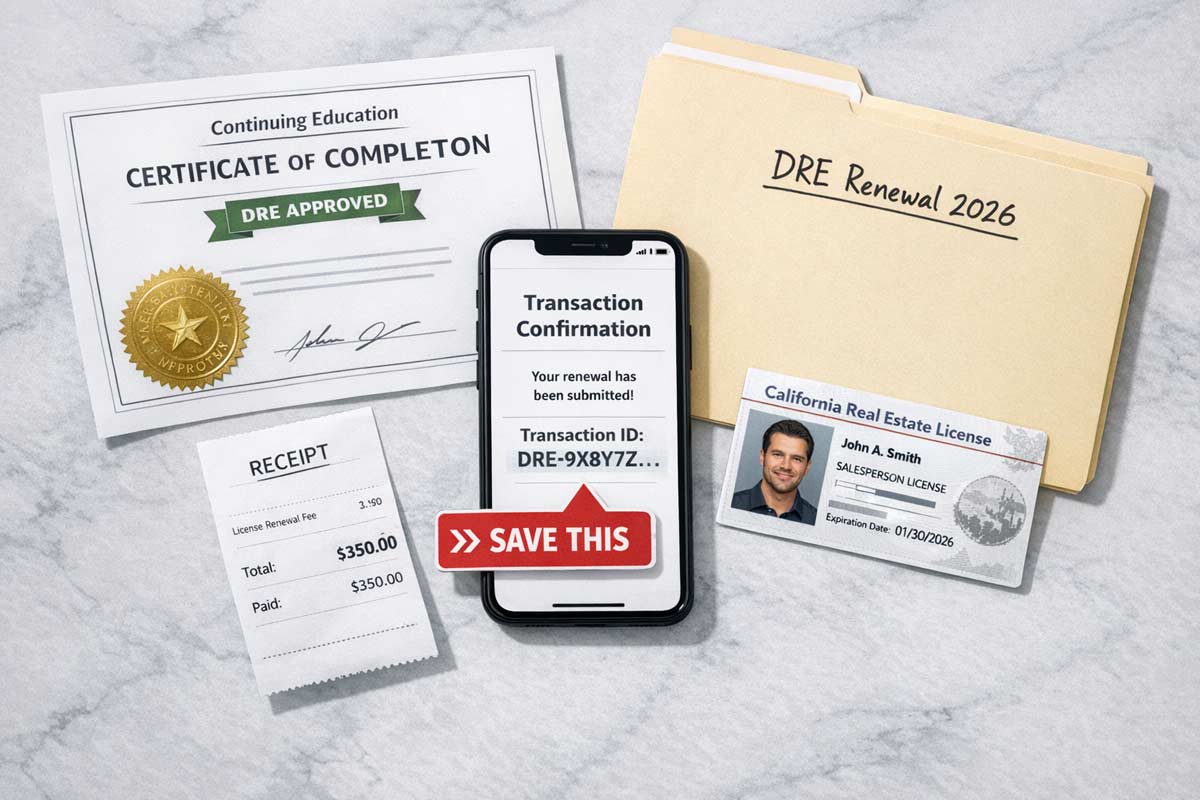
Save proof immediately: Transaction ID + confirmation page PDF + timestamped screenshot.
The Phased Renewal Checklist
Phase 1: Prep (90–60 Days Out)
Audit Your DRE Profile
Why it matters: Your name should match across elicensing and CE records closely enough to avoid a manual review (same first/last; consistent format).
Common mistake: An old mailing address means you’ll miss critical DRE deficiency notices in the event you get mailed a letter.
Proof to save: Screenshot of your current “Licensee Information” page.
Verify CE Mix & Exemptions
Why it matters: Ensure your CE includes the required topic mix for your renewal cycle (mandated topics include agency, ethics, fair housing, implicit bias and others). Some licensees may qualify for a 70/30 exemption (age 70+ and 30 years in good standing) if applicable to you.
Common mistake: Taking a package that misses required topic coverage for your cycle.
Phase 2: Execution (60–30 Days Out)
Complete DRE-Approved CE
Why it matters: Only courses with valid DRE approval/provider info count. Finishing early gives you a buffer for provider or portal issues.
Common mistake: Assuming a course is DRE-approved without verifying the current approval status and provider number at the time of your completion.
What to check: Before you enroll or start a course, verify it is currently approved using the DRE’s Approved Courses Lookup.
Budget for Fees
Why it matters: Know your on-time vs late fee and keep your payment method ready.
(On-time renewal fees: $350 salesperson / $450 broker; late renewal within 2 years: $525 salesperson / $675 broker.)
Common mistake: Using a debit/credit card that is near its limit, has expired, or has new billing information the bank’s fraud filter flags, causing the transaction to fail.
How to fix: 2-3 days before submitting: confirm it’s not expired, has sufficient available credit, and its billing address matches your bank’s record.
Phase 3: Submission (30–10 Days Out)
Enter CE Details in eLicensing
Why it matters: Accurate entry of CE details prevents delays. Use the DRE-approved course/provider 8-digit identifiers exactly as shown on your certificate—don’t guess, don’t retype from memory if you can copy/paste.
Common mistake: Inverting digits in course approval numbers.
Proof to save: Screenshot of the “Review Information” page before you click submit.
Refer to: How to Submit Your CA License Renewal Application
Capture Submission Proof
Why it matters: I’ve seen agents see a “spinning wheel” and close the tab. Without a Transaction ID, you have no proof of filing if the system crashes.
Common mistake: Closing the browser before the “Success” page loads.
Proof to save (all three): Transaction ID, PDF of the confirmation page, and the confirmation email.
???? RED FLAG: PAUSE SUBMISSION IF...
You have new criminal charges or convictions since your last renewal (may require disclosure/review).
Your CE certificates haven’t been issued yet.
Submitting with these issues often triggers a deficiency notice. Review Common Renewal Mistakes Agents Make before you hit submit.
Phase 4: Monitoring & Escalation
Verify Status & Track Timeframes
Why it matters: Check the Public License Lookup after 24–48 hours to confirm the record is moving the right direction. These time frames are important so you are aware how long it takes to process a California real estate license renewal.
Escalation Protocol: If it doesn’t update, compare against published DRE renewal processing timeframes; if you’re beyond published dates, contact the DRE with your Transaction ID ready.
Proof to save: PDF printout/screenshot of your updated license record once it updates.
Handle Deficiency Notices (Don’t Panic-Resubmit)
Why it matters: When you get a deficiency notice, sloppy “resubmits” can create duplicate transactions and confusion.
Do this instead:
Match the deficiency line-item to your proof (certificates, receipt, Transaction ID).
Respond using the method the notice specifies.
Save a copy of everything you send + the date sent.
STEP 1 — VERIFY
Confirm your facts before you do anything else
Check license expiration date
Confirm renewal window is open (90 days before expiration)
Verify name + address match across DRE & CE records
Goal: No profile mismatches → no manual review
STEP 2 — COMPLETE
Finish the right CE, early
Complete DRE-approved CE for your renewal cycle
Confirm required topics are included (Agency, Ethics, Fair Housing, Implicit Bias, etc.)
Download final CE certificates (with provider + course numbers)
Goal: CE finished 15–30 days early
STEP 3 — SUBMIT
Enter data once, carefully
Enter CE details into eLicensing (copy/paste — don’t retype)
Submit renewal application + fee
Wait for the success confirmation screen
Goal: One clean submission, no errors
STEP 4 — PROVE
Lock in your paper trail immediately
Save Transaction ID
Download confirmation PDF
Take a timestamped screenshot of success page
Save confirmation email
Goal: You can prove on-time filing instantly
(Optional but Recommended)
STEP 5 — MONITOR
Verify it actually moved
Check license status after 24–48 hours
Save screenshot once status updates
Respond carefully if a deficiency notice appears
Goal: Catch problems early, avoid downtime
FAQ
How early can I renew?
You can renew via eLicensing starting 90 days before your expiration date.
Can I practice while my renewal is “Pending”?
If you renew on time, California law may allow continued operations after expiration unless the DRE notifies you of a deficiency. Practically: confirm your transaction is complete, watch for deficiency notices, and follow your broker’s compliance policy.
What if I miss the deadline?
Your license becomes expired and you cannot practice while expired. California generally allows late renewal for up to two years after expiration, but you’ll pay the late renewal fee (e.g., $525 vs $350 for salesperson; $675 vs $450 for broker).
Does my broker get notified?
Often, brokers monitor status through internal systems—but don’t rely on it. You are responsible for your own status.
This checklist ensures you don’t miss a step. For the full deep dive on requirements, fee schedules, and legal updates, visit our California Real Estate License Renewal Guide.
|
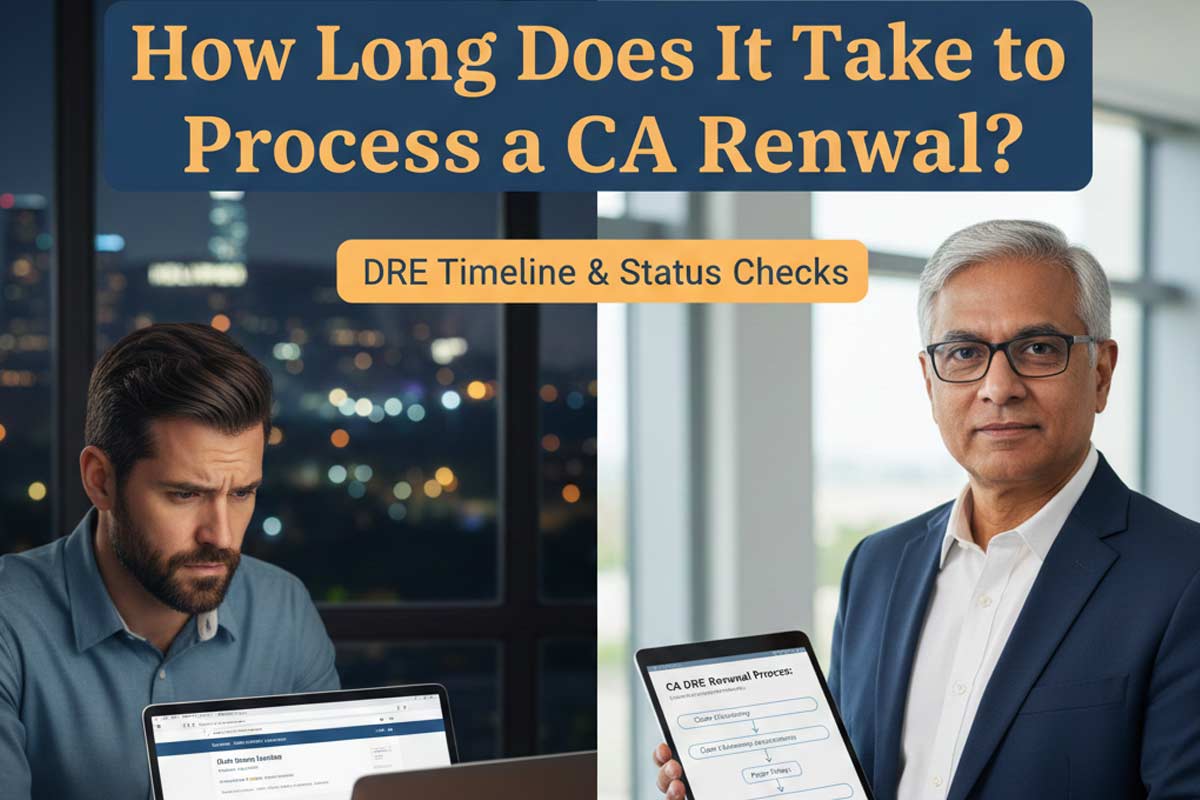
Most agents believe their license status is in jeopardy the second their printed expiration date passes. In reality, California Business and Professions Code §10156.2 provides a vital safety net: if Read more...
Most agents believe their license status is in jeopardy the second their printed expiration date passes. In reality, California Business and Professions Code §10156.2 provides a vital safety net: if you submitted a complete renewal on time, you are legally authorized to continue operating, regardless of administrative backlogs.
The real challenge isn't the expiration date—it’s the transparency of the process. How long does the DRE actually take to move your file from "received" to "renewed"? By anchoring your expectations to the DRE’s official "date received" backlog, you can replace anxiety with a predictable timeline.
Here is how to track your status like a pro.
Quick Answer: The only “real” processing timeline is whatever date the DRE is currently working.
The Backlog Rule: DRE publishes a rolling backlog (“Currently processing applications received: ___”). That date—not a guess—is your best estimate of where you are in line. Mailed in renewals are processed in date received order - this is why renewing through eLicensing is so much more reliable and easier.
The Safety Rule: If you renew on time and all renewal requirements are properly submitted, Business and Professions Code §10156.2 allows continued operations under the existing license after expiration unless notified otherwise by the DRE. Keep your eLicensing Transaction ID/receipt as your proof.
eLicensing vs. Paper: Paper renewals move much slower because they must be opened and keyed manually. DRE recommends eLicensing for faster service, though there is no true "expedited" lane.
Pro Tip: Search “DRE current processing timeframes renewals” to find the official page. If the DRE is processing dates before yours, you’re still in the queue.
For a comprehensive look at the entire cycle, see our California Real Estate License Renewal Guide.
The Fastest Way to Estimate Your Renewal Date
To get a realistic answer to "how long will this take," follow this two-step method:
Find your submission date: Look at your eLicensing receipt or check your bank statement to see when your fee was processed (DRE notes this as a primary confirmation of receipt).
Compare to the Backlog: Check the DRE’s "Current Processing Timeframes" page. Use the backlog date as your best directional estimate and re-check it every few days. This is less relevant if you submit online through eLicensing.
Many agents confuse submission with approval. While eLicensing is faster, your Public License Lookup won't update until the system verifies your Continuing Education (CE). This is why we recommend checking the Checklist for Renewing a California Real Estate License before you start.
What Affects DRE Renewal Processing Time?
Clean Submission vs. Deficiency Notice: A "clean" app goes through faster. A "deficient" app (missing info or wrong CE numbers) gets kicked to a manual reviewer.
CE Completion Timing: You may use eLicensing or submit your renewal application 90 days prior to your license expiration date. If you wait until the last minute, you lose your buffer for system syncs.
Mismatched Personal Info: Using a nickname on your CE certificate that doesn't match your DRE record can trigger a manual review delay.
Payment Issues: Check the cost to renew a CA real estate license to ensure your fees are exact. Incorrect fees on paper applications will stop the process entirely.
The Renewal Timeline: Managing Expectations
Scenario
What you should expect
Action Item
Clean eLicensing renewal
After your broker certifies your application, your license should show renewed online quickly.
Save Transaction ID + receipt. Check Lookup every 2–3 days.
CE reporting mismatch
Renewal may stall until course info is recognized/verified.
Re-check eight digit course numbers and confirm CE requirements are satisfied.
Deficiency Notice
Longer + unpredictable until the error is corrected.
Respond immediately; delays are fixable but can stop your ability to work.
Paper renewal
Not recommended as is typically slower due to mail + manual handling.
Avoid if timing is tight; eLicensing is recommended for faster service.
Visualizing the Flow:
Step 1: Submit via eLicensing 60–90 days early.
Step 2: Save your Transaction ID (this is your legal "Safety Rule" proof).
Step 3: System cross-references CE numbers.
Step 4: Public License Lookup updates after the renewal is processed.
What to Do If Processing is Taking Too Long
IF you submitted on time and have a receipt: B&P Code §10156.2 protects you as long as all requirements were properly submitted. You may continue in business without a renewed license until you are notified of a deficiency.
IF you are within 1 week of expiration and the status hasn't changed: Re-verify your CE certificates. Ensure the course numbers you entered into eLicensing are 100% accurate.
IF you receive a "Deficiency Notice": Respond immediately. You may be instructed to cease operations if the renewal is deficient.
IF you made a mistake on the form: Review our list of common renewal mistakes agents make to see if you need to contact the DRE with a correction.
If you are unsure how to navigate the portal, follow our guide on how to submit your CA license renewal application.
The “Delay Prevention” Checklist
Finish CE 30+ days before your expiration.
Use eLicensing (DRE recommends it for faster service—there’s no true ‘expedite’ lane).
Submit within the 90-day window.
Confirm your CE requirements are satisfied for your specific cycle.
Save your Transaction ID and check your bank statement for fee processing.
Double-check name formatting (e.g., "Jon" vs "Jonathan").
Renewal timing becomes predictable when you follow the full system. By submitting early and monitoring the DRE backlog, you protect your "Active" status and your commissions.
Ready to get started?
Visit our California Real Estate License Renewal Guide to map out your 90-day plan.
FAQ
Can I still work while my renewal is "Pending"?
Yes, per B&P Code §10156.2, if you renewed on time and submitted all requirements, you can continue operating unless notified otherwise by the DRE.
How do I know the DRE received my application?
Check for an eLicensing Transaction ID or verify that the fee has been processed on your bank/credit card statement.
What is the current DRE backlog?
As of January 5, 2026, the DRE is processing salesperson renewals (on time) received on November 26, 2025.
How long do paper renewals take?
Paper applications are manually processed and typically take several weeks longer than eLicensing submissions.
What happens if I receive a deficiency notice?
You must correct the error immediately. These notices take effect five days after mailing, and you may be instructed to cease operations until corrected.
|

Imagine this: You’re three days away from taking a career-best listing when your broker calls. Your license has officially expired but you had no idea.
At ADHI Schools, I’ve spent over 20 years Read more...
Imagine this: You’re three days away from taking a career-best listing when your broker calls. Your license has officially expired but you had no idea.
At ADHI Schools, I’ve spent over 20 years helping California agents navigate the DRE rules. I’ve seen hundreds of agents lose momentum because they treated their renewal like a "quick five-minute form." In reality, a single typo or a misunderstood deadline can trigger weeks of DRE renewal delays.
If you want to keep your license active and your commissions flowing, you need to avoid these 10 common California real estate license renewal mistakes.
The 10 Most Common Renewal Mistakes
1. Waiting Until the Final Week To Register For Courses
Why it happens: Agents prioritize lead generation over paperwork, assuming they can cram all the hours into one day.
What it costs: Professional paralysis. If you miss the window, your license is technically "Expired," meaning you cannot legally perform any licensed activity or claim a commission for work done during that gap.
Audit Trigger: Attempting to complete 45 hours of CE within 48 hours of your expiration date.
Hard Control: * The 9-Day Minimum: ADHI Schools requires that you schedule a minimum of 9 calendar days to complete 45 hours of CE.
The 15-Hour Cap: In practice, the DRE only allows credit for 15 hours of courses per 24-hour period. You cannot "speed-run" the 45-hour requirement in a single day.
The 8-Hour Study Lock: The system mandates 8 hours of study time per day before the final exams for those hours are unlocked.
Deadline: Aim to have your CE finished no later than Day 80 of your 90 day renewal window to leave a buffer for DRE processing.
Pro Tip: Before you gamble on a last-minute submission, read: How Long Does It Take to Process a CA Renewal?
2. Assuming CE is "Automatically" Posted
Why it happens: Thinking your education provider notifies the DRE on your behalf - CE providers don’t do this it must be done by the licensee.
What it costs: Your renewal can get delayed or kicked into manual review if your CE completion can't be verified cleanly.
The Fix: Manually verify your certificates and upload the course completion numbers to the DRE through eLicensing. Keep every completion certificate saved and ready for data entry.
3. Data Entry Typos in eLicensing
Why it happens: Rushing through the online portal on a mobile phone or tablet.
What it costs: Mismatched records that require manual DRE intervention, adding weeks to your renewal processing time.
The Fix: Only renew on a desktop with your physical license and CE certificates in front of you.
Pro Tip: Copy and paste your license number and eight digit course approval numbers directly from ADHI’s documents to avoid "fat-finger" errors.
4. Paying the Wrong Fee
Why it happens: Confusing "On-Time" fees with "Late" fees, or Salesperson fees with Broker fees.
What it costs: Underpayment stops the application entirely. Review How Much Does It Cost to Renew a CA Real Estate License? to ensure you are authorized for the correct amount.
The Fix: Double-check your current license status (Salesperson vs. Broker) and the date before submitting payment.
5. Submitting Without Completing All Courses
Why it happens: Agents assume they know the steps and skip a requirement (like the Fair Housing or Implicit Bias modules).
What it costs: An incomplete application triggers a manual review or a request for more information.
The Fix: Use a dedicated Checklist for Renewing a California Real Estate License before hitting "Submit."
6. Failing to Save the "Success" Screen
Why it happens: Thinking the email confirmation is instantaneous (it isn't always).
What it costs: No proof of "good faith" submission if there is a technical glitch.
The Fix: Take a screenshot of the final "Transaction Successful" page and the Transaction ID number immediately.
The "Paper Trail" Box: Save These 3 Things
The Transaction Confirmation: Displayed immediately after payment.
CE Certificates: Keep digital copies of all 45 hours of credit.
PDF Copy of Application: If renewing via mail (though eLicensing is safer).
7. Miscalculating the 2-Year Grace Period
Why it happens: Thinking you can still practice during the 2-year "late renewal" window.
What it costs: You can renew for up to two years after expiration, but you cannot perform licensed activity during that time.
The Fix: If you miss the deadline, stop all licensed activity immediately and file a late renewal application.
8. Using the Wrong Submission Path
Why it happens: Attempting a standard renewal when you are actually in "Reinstatement" territory with regard to fees.
What it costs: This can trigger delays, rework, or additional fees depending on your current status.
The Fix: Follow the correct steps in: How to Submit Your CA License Renewal Application
9. Broker Affiliation Mismatches
Why it happens: Changing brokerages near your renewal date without updating the DRE first.
What it costs: The DRE may flag the renewal if your supervising broker’s information doesn't match their current database records.
The Fix: Ensure your "Main Office Address" and "Responsible Broker" are updated in eLicensing before you start the renewal flow.
10. Ignoring Disclosure Requirements
Why it happens: Failing to disclose new criminal convictions or pending disciplinary actions as required.
What it costs: Serious licensing penalties for non-disclosure.
The Fix: Be transparent. If you have a reportable event, consult with a licensing expert and provide the required documentation upfront to avoid problems.
"If You're Already in Trouble" Triage
If you’ve already made a mistake, follow this decision tree:
"I submitted but it's not moving": Check the DRE’s current processing timeframes online. If they are processing applications from a date after yours, contact the DRE directly.
"My license is close to expiring": Use eLicensing renewal immediately. Do not mail it. eLicensing is typically faster and reduces avoidable delays compared to mail.
"It already expired": Stop all real estate activity. Check if you are within the 2-year window for a late renewal. You will pay a higher fee, but you won't have to retake the exam.
Always call the DRE at 877-373-4542 with questions.
The Clean Renewal Sequence
To avoid the headaches above, follow this 5-step countdown sequence:
Day 90: Confirm your eligibility window and verify your login on eLicensing and sign up for the 45 hour renewal courses.
Day 80: Finish your continuing education and download all certificates.
Day 75: Review the renewal checklist to ensure you meet all current DRE requirements.
Day 70: Submit correctly via eLicensing.
Day 69: Save proof of payment and confirm your status update on the DRE public database.
Ready to Renew?
Don't let a simple clerical error sideline your career. This article is just one part of our complete system to keep your license active. For the full, step-by-step breakdown of every requirement, fee, and deadline, see our: California Real Estate License Renewal Guide.
Pro move: Set 90/80/75/70-day reminders in your calendar using the Clean Renewal Sequence above to ensure you never miss a deadline.
|
When you decide to get your California real estate license, your first instinct is likely the same as when you pick a restaurant: you check the reviews. You look for the highest star rating and the most Read more...
When you decide to get your California real estate license, your first instinct is likely the same as when you pick a restaurant: you check the reviews. You look for the highest star rating and the most testimonials.
In the world of professional licensing, that strategy can be a trap.
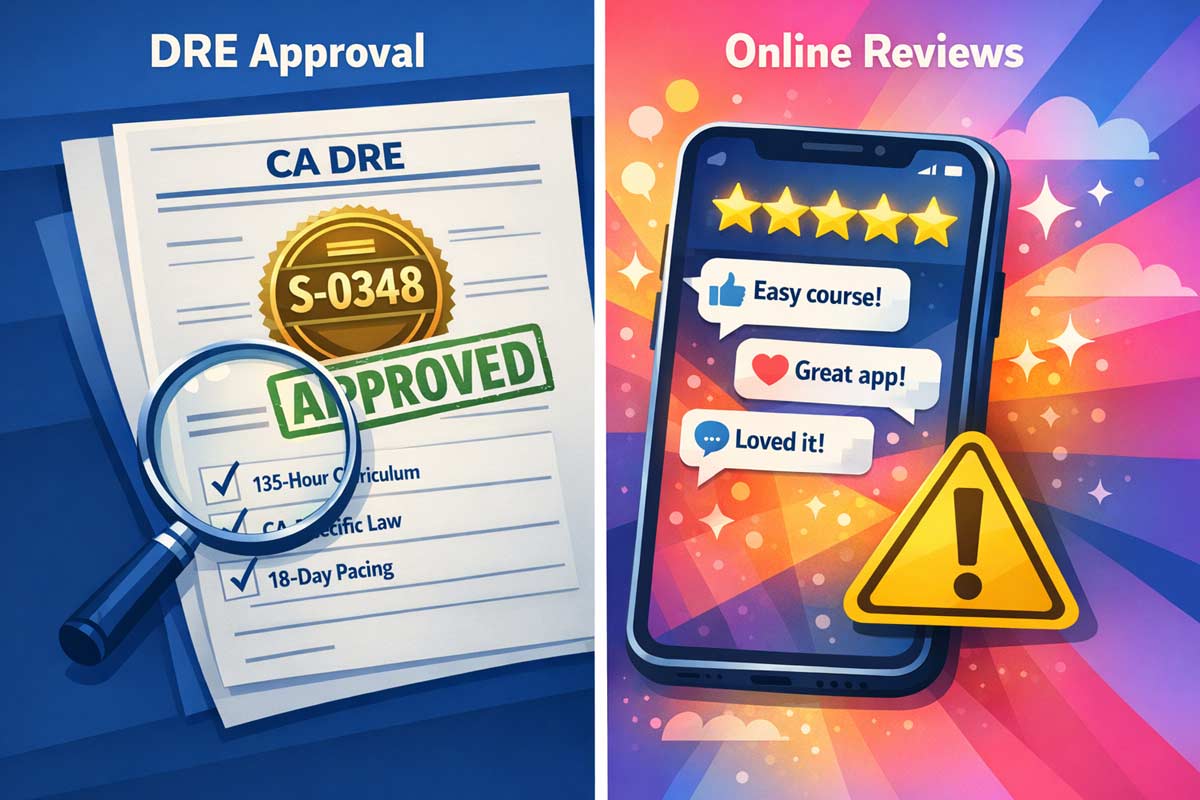
While reviews tell you about a user interface or how "easy" a course felt, they don't always tell you the one thing that actually matters: Is this a DRE-approved statutory course provider? Licensing isn't just a purchase; it is a regulatory process. To choose the right real estate school, you need a clear decision rule: DRE approval is the eligibility gate; reviews are a secondary quality filter.
The Quick Framework: DRE approval is the baseline requirement that helps ensure your education counts toward state requirements. Reviews only measure the student experience. You should always verify DRE approval by checking a school's “S-number” before evaluating their social proof. If you are comparing several providers, start with our guide on the Best Real Estate Schools in California.
What Being a "DRE-Approved Statutory Provider" Means
In California, being a "DRE-approved course provider" means the California Department of Real Estate has reviewed the provider’s curriculum, delivery methods, and identity verification processes to confirm it meets statutory requirements.
To qualify for the real estate exam, you must complete three 45-hour courses (135 hours total):
Real Estate Principles
Real Estate Practice (which covers fair housing, implicit bias, and other state-required topics)
One Elective (such as Real Estate Finance or Legal Aspects of Real Estate)
DRE Approval is what makes this education count toward the requirement. It confirms that the provider and the specific course format you are taking are currently recognized for statutory credit. Online Reviews, while helpful for gauging the student experience, do not guarantee that a school has met these legal standards.
Why Reviews Can Be Misleading
Online reviews are a helpful signal, but they rarely tell the whole story. Because many students are unaware of the underlying regulatory framework, they often review a school based on convenience rather than compliance. Before diving into stars, it is vital to understand how important online reviews are for real estate schools and where they sometimes fall short.
The "Easy" Trap: A school might have 5-star reviews because its final exams were perceived as "easy." However, the California real estate exam is California-law specific and detail-heavy. If a course doesn't challenge you on complex topics like agency disclosure obligations, you may face a steep learning curve on exam day.
Visibility vs. Validity: A high volume of reviews often means a school is strong at generating visibility—not necessarily that their coursework is superior.
Support Realities: A review might praise a beautiful mobile app, but when you hit a wall on a legal concept, you need support staff and instructors who understand California rules, not just a slick interface.
What Official DRE Approval Protects You From
Focusing on a school’s status as a DRE-approved course provider in California protects you from the most common friction points in the licensing journey:
Deficiency Notices: If you submit transcripts from a provider or course that isn't recognized for statutory credit, you will likely face delays or deficiency notices from the DRE. To ensure your school is on the right side of the law, see our guide on how to know if a real estate school is legit in California.
Pacing Compliance: California law requires a minimum of 18 days to complete a single 45-hour course. If a school’s reviews suggest you can "finish in a weekend," that is a major red flag. Non-compliant pacing can create avoidable compliance issues and delays when you apply for and schedule your exam. To protect your timeline, read more about avoiding fake or unaccredited CA real estate schools.
Outdated Material: Approved providers are expected to maintain content that reflects current California statutes. Unapproved providers often use generic, national content that won't prepare you for the nuances of the CA state exam.
The Two-Signal Decision Framework
To cut through the noise, use this simple two-step gatekeeping process:
Signal 1: DRE Approval (The Eligibility Gate)
Before reading a single review, locate the provider’s "S-number" (Statutory Provider Number).
The Action: Visit the DRE website and search for the provider by their S-number. Confirm the provider name on the DRE database matches the name on the school's website exactly.
The Goal: Confirm the school is currently authorized to offer the specific courses you need for your 135-hour requirement.
Signal 2: Reviews (The Quality Filter)
Once you’ve confirmed they are legit, use reviews to look for these "Operator-Level" details:
Support Responsiveness: Does a human answer the phone or man the online chat when you have a question?
Policy Clarity: Are there hidden fees for retakes or course extensions?
Educational Depth: Is the content tailored to CA law, or is it a generic program?
Checkpoint
What it Proves
The Reality
DRE S-Number
Legal Eligibility
No verified S-number = you can’t confirm the courses will count toward the 135 hours.
18-Day Pacing
Regulatory Compliance
Fast "hacks" can create compliance issues and delays.
Student Support
Educational Quality
You need help when California law gets complex.
How to Verify a School Fast (The 15-Minute Playbook)
Use this checklist to vet any provider before you enroll:
Locate the S-Number: Find the number starting with "S" (e.g., S0XXX) usually found in the footer of the school's website. ( ADHI Schools is S0348 as an example).
Verify on DRE.ca.gov: Search the DRE database by S-number and confirm the provider name matches exactly.
Test the Support: Call the school. If you can’t get a human on the phone before you pay, it’s a sign of how they handle student support later.
Check for Red Flags: Be wary of "guaranteed pass" claims or schools that ignore the 18-day rule. For more details, see our guide on Red Flags When Choosing a Real Estate School.
Review Extension Policies: Confirm how long course access lasts and what re-enrollment costs.
FAQ
"If a school has thousands of great reviews, doesn't that mean it's the best?" It means they are popular. While popularity is a sign of a functional business, it is not a substitute for regulatory standing. Always prioritize S-number verification first.
"What if a school says 'State Approved' but not DRE?" In California, the DRE is the only regulatory body that matters for your license. "State approved" is a vague term that could refer to a general business license.
"Can the DRE deny my education if I took it online?" Not if you used a DRE-approved statutory course provider. Online education is a standard, fully recognized path to licensure in California, provided the school and course delivery are approved.
Final Thoughts
With over 20 years of experience helping students navigate these hurdles at ADHI Schools, I have seen that the most successful students are those who treat the process with professional scrutiny.
Approval is the legal baseline.
After that, choose the provider whose structure and support fit your learning style.
Don't let a high star count distract you from the technical requirements of the law. Secure your eligibility first, then choose the provider that will actually help you pass the state exam.
Ready to see how the top providers compare? Check out our comprehensive guide: Best Real Estate Schools in California
|