One of the most common questions we hear sounds like: “I upgraded to a broker license—do I have extra CE hours now?” or “Do I have to take different classes than when I had my sales license?”
The Read more...
One of the most common questions we hear sounds like: “I upgraded to a broker license—do I have extra CE hours now?” or “Do I have to take different classes than when I had my sales license?”
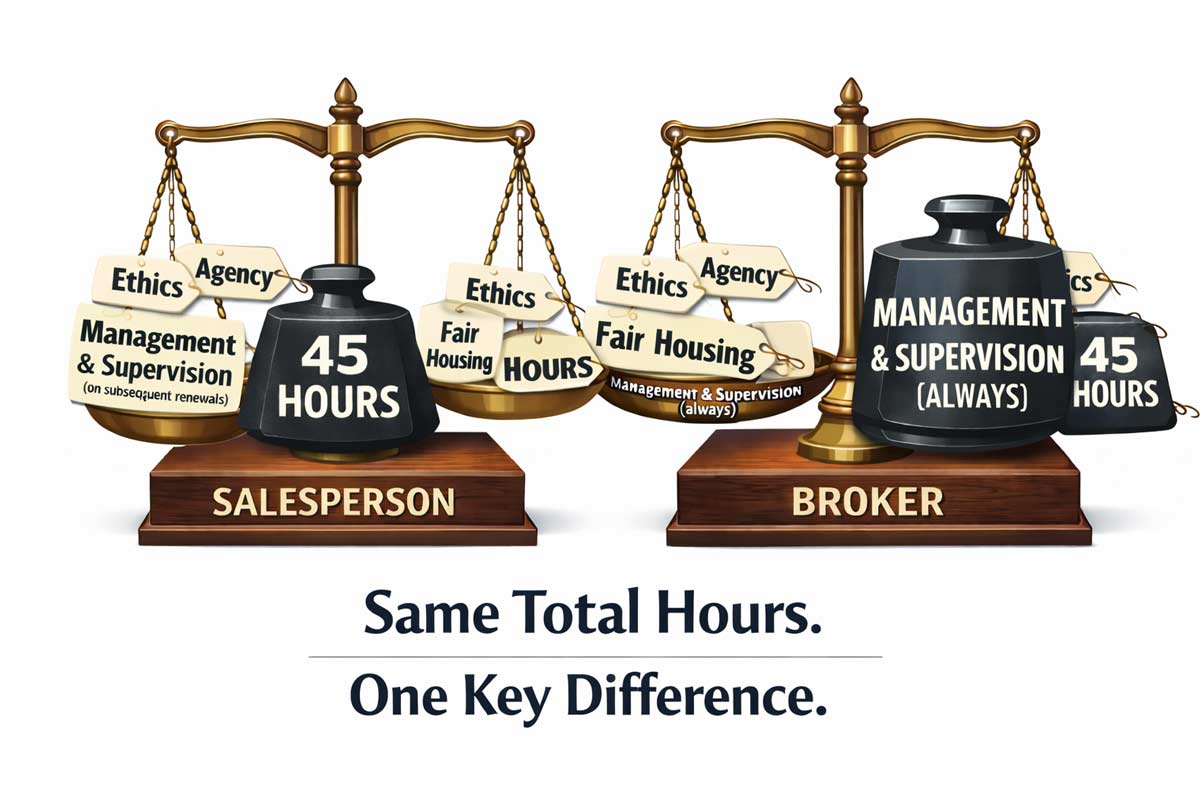
The confusion is understandable. In California, brokers carry a higher level of legal responsibility—so it feels like the DRE should require more education. The reality is simpler: the total hours are the same, but the required subject mix is where brokers can get tripped up.
Key Takeaways
Total Hours: Brokers and salespersons both complete 45 hours of DRE-approved CE each 4-year renewal cycle.
The Content Mix: Brokers must include Management and Supervision as a mandatory topic (salespersons don’t on their first renewal).
The 9-Hour Survey: For second and subsequent renewals (for licenses expiring on/after Jan 1, 2023), a 9-hour survey can cover all mandatory topics in one course.
Interactive Requirement: For licenses expiring on/after Jan 1, 2023, Fair Housing must include an interactive, participatory component.
Quick Answer: Broker vs. Salesperson CE
In California, brokers and salespersons both need 45 hours of continuing education to renew. The difference is what’s inside the 45 hours: brokers must ensure they complete Management and Supervision as part of their mandatory topic mix. While the total hour count is identical, the DRE requires brokers to undergo specific training related to their role as a potential supervisor.
Comparison Table: Salesperson vs. Broker Renewal
Feature
Salesperson (First Renewal)
Broker (First Renewal)
Second+ Renewals (Both)*
Total Hours
45 hours
45 hours
45 hours
Mandatory Core Courses
4 Subjects (3-hrs each)
5 Subjects (3-hrs each)
Included in 9-hour survey
Fair Housing
3-hr + Interactive Implicit Bias
3-hr + Interactive Implicit Bias
Included in 9-hour survey
Implicit Bias
2-hr Required
2-hr Required
Included in 9-hour survey
Mgmt. & Supervision
Not Required
Required
Included in 9-hour survey
*Applies to licenses expiring on/after Jan 1, 2023, and late renewals filed after that date.
What’s the Same for Everyone?
Regardless of license type, the DRE’s CE structure is built around consumer protection—so the baseline framework stays consistent. That’s why the California Real Estate License Renewal Requirements don’t "punish" brokers with extra hours.
The 4-year renewal cycle applies to everyone.
The total is always 45 hours—no "broker bonus hours."
Mandatory topics + consumer protection hours are the backbone of every renewal package.
What’s Different for Brokers?
If the hours are the same, why does broker CE feel different? Accountability.
A broker isn’t just responsible for their own files—they’re responsible for the supervision standard in the office: policies, advertising compliance, trust fund handling, and risk reduction. That’s why Management and Supervision is explicitly part of the broker requirement - even on the first renewal.
Operator Scenarios: Where Brokers Actually Get Exposed
The Supervision Trap: A broker assumes "supervision" just means reviewing contracts. In reality, brokers can be on the hook for agent advertising and compliance breakdowns across the entire team.
Trust Fund Risk: Most salespersons never touch trust fund handling—brokers live inside it. Small process errors can turn into big consequences during a DRE audit.
First Renewal vs. Subsequent Renewals
This is where people accidentally choose the wrong package. Your path depends on your renewal "generation."
1) First Renewal
First renewal requires the mandatory subjects as individual courses, plus the required Fair Housing and Implicit Bias components.
Salespersons: 4 separate 3-hour courses (Ethics, Agency, Trust Funds, Risk Management) + 3-hour interactive Fair Housing + 2-hour Implicit Bias.
Brokers: All of the above PLUS a 3-hour Management and Supervision course.
To avoid confusion, view the full roadmap here: California Real Estate License Renewal Guide
2) Second and Future Renewals
For licenses expiring on/after Jan 1, 2023, the DRE allows a 9-hour survey course that covers all mandatory topics (including Management and Supervision) in a single module. You then complete the remaining hours with electives—ideally from clearly qualified Courses That Count Toward CE in California.
7 Common Mistakes That Trigger Delays
REALTOR® Ethics vs. DRE Ethics: Assuming NAR training counts (it usually doesn’t unless the provider specifically issued a DRE-approved CE certificate).
Non-Interactive Fair Housing: Taking an old-style text course for Fair Housing when your license expires after Jan 1, 2023.
Missing Implicit Bias: Failing to ensure the 2-hour standalone course is in your package. See: Does California Require Implicit Bias Training for Renewal?
Overbuying Hours: Thinking brokers need more than 45. Confirm your California CE hour requirements before paying.
Unverified Providers: Using a "national" school that lacks a California DRE Sponsor Number.
Waiting Until the Final 24 Hours: Because of the 15-hour exam limit (see below), you literally cannot finish 45 hours in one day.
Wrong Package Type: A broker taking a salesperson package and missing the Management and Supervision credit.
Step-by-Step: Choosing the Right CE Package
Verify Sponsor Details: Ensure the school is DRE-approved.
Check Fair Housing: Confirm it includes the "interactive participatory component."
Respect the 24-Hour Rule: The DRE limits licensees to completing final examinations for a maximum of 15 credit hours per 24-hour period. If you have 45 hours of testing to do, you need at least three separate 24-hour windows to complete your exams.
FAQ
Do brokers need more CE hours than salespersons in California?
No. Both license types require 45 hours every four years.
Is Management and Supervision required for brokers?
Yes. It is mandatory for all broker renewals (first and subsequent).
What is the 9-hour survey course?
It's a condensed course covering all seven mandatory subjects, available only for second and subsequent renewals.
Does Fair Housing have to be interactive?
For licenses expiring on or after Jan 1, 2023, yes. This includes late renewals filed after that date.
How early can I renew?
You can submit your renewal via eLicensing up to 90 days before your expiration date.
Broker renewal shouldn’t create uncertainty or cause you to buy the wrong package. The goal is simple: meet the DRE requirements cleanly, protect your license, and keep your business.
|
One of the most frequent questions we hear from students after they finish thceir statutory college-level courses is, "Okay, I’m done with the classes. Now, how long will it take me to actually prepare Read more...
One of the most frequent questions we hear from students after they finish thceir statutory college-level courses is, "Okay, I’m done with the classes. Now, how long will it take me to actually prepare for the state test?"
Valid.
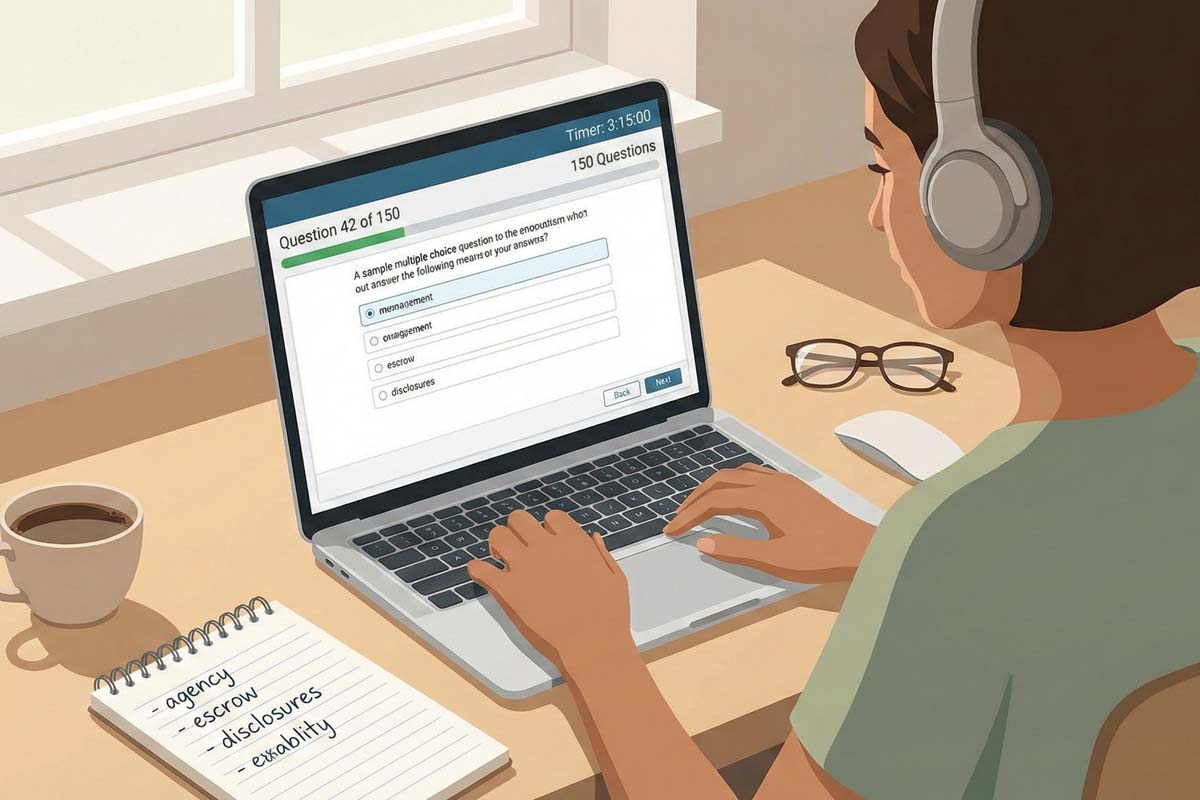
The California Department of Real Estate (DRE) salesperson exam consists of 150 multiple-choice questions to be answered in 3 hours and 15 minutes. It covers everything from property ownership to mandated disclosures. Study too little, and you risk failing and waiting weeks for a re-test. Study too long, and you risk "information decay"—forgetting the material you learned at the start of your prep.
The broker exam is 200 questions and you are given up to 4 hours to complete it.
After over 20 years of teaching real estate in California and analyzing the habits of thousands of successful agents, I can tell you there is no single "magic number" that applies to every human being. However, by looking at data from our most successful students, we can identify a distinct "success window."
This guide will help you determine where you fall on that spectrum so you can build a study timeline that maximizes your chances of passing on the first try.
The Short Answer: The 40–90 Hour Rule
For the vast majority of students, the sweet spot for exam preparation lies between 40 and 90 hours of focused study after completing the three required pre-licensing courses.
The Full-Time Student (2–3 Weeks): If you can treat studying like a job (4–6 hours a day), you can be ready in just a few weeks. This immersion method is highly effective because the material stays fresh.
The Working Professional (4–6 Weeks): If you are balancing a full-time job and can only study 1–2 hours a day and more on weekends, you will need about a month to six weeks. This requires discipline to prevent the "forgetting curve" from eroding your progress.
The Crash Course Hybrid (1–2 Weeks): Students who combine independent review with a crash course often reduce their total necessary study hours because the instruction is condensed. Instructors help with pattern recognition and point out specific exam cues, which speeds up the learning process.
FAQ: Can you pass with less than 40 hours of study?
While outlier students with extensive legal or financial backgrounds sometimes pass with 20–30 hours of prep, we strongly advise against it. The DRE exam relies heavily on specific vocabulary and tricky syntax. Under-preparing significantly increases the risk of failing, which triggers a mandatory waiting period before you can re-test.
FAQ: How many weeks should you study for the California real estate exam?
Most successful candidates schedule their exam 4 to 8 weeks after finishing their college-level courses. Extending the process beyond 8 weeks often leads to diminishing returns, as you begin to forget early material while trying to learn new concepts.
Factors That Influence Your Study Timeline
1. Prior Industry Knowledge
If you have worked as an assistant to a broker or in property management, you might be familiar with terms like "escrow" or "fiduciary." However, be careful—real estate "street knowledge" is often different from the "book knowledge" the DRE tests. You still need to study, but you may grasp concepts faster.
2. Reading Comprehension Speed
The California real estate exam is a vocabulary and reading comprehension test. Questions are often complex scenarios spanning 2–4 sentences. If you have working memory limitations or cognitive bottlenecks that make it hard to hold multiple variables in your head while reading, you will need more time to practice deconstructing these questions.
3. Chronotypes and Study Habits
When do you study? Data suggests that aligning study blocks with your natural circadian rhythm (chronotype) can improve retention by 20–30%. A morning person studying at 8:00 AM retains significantly more than when they force themselves to study at 10:00 PM while exhausted.
4. Decision Fatigue
If you spend the first 15–20 minutes of every study session deciding what to study, you are wasting valuable cognitive energy. Students who use a structured syllabus or prep course move faster because they eliminate decision fatigue.
5. Study Environment and Distraction Levels
Are you studying in a quiet office or at a kitchen table with distractions? Studies show that multitasking and constant interruptions can reduce retention by up to 40%. A fragmented hour of study is worth only about 20 minutes of "deep work." Students with high-distraction environments inevitably push their timeline toward the 90-hour mark.
Recommended Study Timelines
Note: These timelines assume you have already completed the required 135 hours of statutory coursework. Your actual pace may shift depending on your learning environment and retention style.
Based on our experience at ADHI Schools, here are three structured plans. Choose the one that fits your life.
The "Standard" Plan (4 Weeks)
Ideal for: Working professionals.
Schedule: 90 minutes every weeknight; 4–5 hours on weekends.
Focus:
Week 1: Property ownership and land use controls.
Week 2: Law of agency and valuation/market analysis.
Week 3: Financing and contracts.
Week 4: Practice exams and review of weak areas.
The "Accelerated" Plan (2 Weeks)
Ideal for: Students between jobs or with open schedules.
Schedule: 4–5 hours daily.
Focus: This is an immersion technique. You will cover two major topics per day, utilizing spaced repetition in the evenings to reinforce what you learned in the morning.
The "Hybrid" Plan (Crash Course + Self Study)
Ideal for: Visual/Auditory learners who struggle with textbooks.
Strategy: You might wonder, should you take a crash course for the CA real estate exam
If you struggle with self-motivation or complex legal jargon, a crash course acts as a force multiplier. Instructors help identify the most frequently tested concepts, cutting down your self-study time.
Schedule: Review terminology for one week, attend a weekend crash course twice and schedule your exam for the following week while the information is peak-accessible in your short-term memory.
Note: Determining your timeline is just one step. To see how this fits into the broader roadmap of prerequisites and applications, refer to our comprehensive California Real Estate Exam Guide.
How Long Is Too Long?
While under-studying is dangerous, over-studying is a real trap. We generally advise against study timelines extending beyond 8 to 10 weeks.
If your prep stretches past three months, you encounter The Forgetting Curve. By the time you are studying Week 10's topic (e.g., Taxation), you have likely forgotten the nuances of Week 1's topic (e.g., Estates in Land).
Extended timelines also can lead to emotional fatigue and procrastination. The urgency to study fades, and confidence erodes as the material starts to feel stale rather than fresh. If life circumstances force a long timeline, you must dedicate specific days to reviewing older material to keep it active.
Signs You Are Ready to Take the Exam
How do you know when you have studied enough? It isn't a feeling; it's a metric. The biggest mistake students make is scheduling their exam date based on a hope rather than data. You are ready when:
You are consistently scoring 85% or higher: At ADHI, we recommend aiming for 85–90% on practice exams regularly. The actual state exam is stressful, and your score will likely drop a few points due to nerves. You need a buffer.
You have completed at least 3–5 full-length simulations: You need to know how to take practice exams for the California real estate license test properly. This means taking full-length, 150-question mock exams in one sitting without checking your phone or notes. If you haven't simulated the fatigue of the actual test, you aren't ready.
You understand the "Why": When you answer a question correctly, can you explain why the other three answers are wrong? If you can, you have mastered the concept.
Study Smarter, Not Longer: Methods That Compress the Timeline
You can brute-force your way through 100 hours of reading, or you can use learning science to get the same result in 50 hours.
In teaching thousands of students through ADHI Schools, I have found that those who pass fastest use these specific techniques:
Retrieval Practice (Active Recall): Instead of re-reading a chapter, look at the heading and force yourself to summarize the content out loud. This strengthens neural pathways far better than passive reading.
Strategic Topic Weighting: The DRE weights the exam heavily toward specific topics like Agency and Disclosures. Focusing your energy on these high-value areas is the best way to study for the California real estate exam, ensuring you don't waste time on low-yield topics like riparian rights.
Spaced Repetition: Instead of cramming vocabulary all at once, review terms in increasing intervals (1 day, 3 days, 1 week). This relies on memorization techniques that work for the CA exam to move data from short-term to long-term memory.
When You Should Not Schedule the Exam Yet
If you are eager to get your license, it is tempting to rush. However, postpone your exam date if:
You haven't taken a timed mock exam without pausing: If you are used to taking breaks every 20 questions, you will struggle with the 3+ hour endurance required for the real test.
You are relying on memorizing answer keys: If you are memorizing "C is the answer for the question starting with 'The Truth in Lending Act'," you will fail. The DRE changes question wording constantly.
You are scoring wildly inconsistently: Scoring 90% on one topic and 50% on another indicates a knowledge gap, not exam readiness.
Vocabulary is still a struggle: If you are tripping over terms like "hypothecation" or "alienation," you are not fluent enough in the language of real estate to pass.
Putting It All Together
There is no badge of honor for studying 200 hours if you could have passed with 60 hours of focused effort. Your goal is to reach a level of "unconscious competence" where the definitions and laws come to you naturally.
Start with a diagnostic practice exam to see where you stand.
Commit to a schedule. Bring the same discipline to studying that you plan to bring to the job, and this exam becomes just the first of many deals you close.
For a full understanding of the entire testing journey, see our comprehensive California Real Estate Exam Guide.
|

As the date of your California Department of Real Estate (DRE) exam approaches, a familiar panic often sets in. You’ve finished the mandatory 135 hours of pre-licensing coursework, but looking at Read more...
As the date of your California Department of Real Estate (DRE) exam approaches, a familiar panic often sets in. You’ve finished the mandatory 135 hours of pre-licensing coursework, but looking at a textbook filled with property codes and legalese can feel overwhelming.
Many students ask me, "Kartik, is it worth paying for a crash course, or should I just study on my own?"
It is a valid question. You have likely already spent money on the pre-license courses and application fees. However, the state exam is notorious for its difficulty—pass rates often hover around 50%. Students usually seek out crash courses because they feel unstructured, have run out of time, or simply don’t trust that their solo reading was enough to retain the information.
In my 20+ years of teaching real estate in California, I have seen crash courses save careers, but I have also seen students treat them like magic pills. A crash course amplifies existing knowledge; it doesn’t replace it. Let’s break down exactly what these courses offer, the learning science behind them, and whether one is right for you.
What Exactly Is a Crash Course?
A crash course is distinct from your statutory college-level courses (Real Estate Principles, Practice, and an Elective). It is not about satisfying a legal requirement; it is about pure exam performance.
Think of it as the difference between learning to play a sport and studying the playbook right before the big game. A crash course typically takes place over a weekend (or two full days) and provides accelerated instruction focused on:
High-Yield Topics: Focusing on the concepts the DRE tests most frequently (like Agency and Property Ownership) rather than obscure laws that rarely appear.
Because the DRE heavily weights topics like Agency and Disclosures, crash courses prioritize the sections that move your score the most.
Pattern Recognition: Learning to spot how the state constructs "distractor" answers designed to trick you.
Vocabulary Density: Rapid-fire review of the specific terminology used on the test.
Who Benefits Most?
Not every student needs a crash course. Some people are autodidacts who can read a glossary once and retain it perfectly. However, based on thousands of students I’ve observed, the following learner profiles benefit the most from live or livestreamed exam prep:
The Visual/Auditory Learner: If reading a 600-page textbook makes your eyes glaze over, hearing an instructor explain why a dual agency violation is risky makes the concept stick.
The “Rusty” Student: Perhaps you finished your certificates six months ago and life got in the way. You have forgotten the difference between a freehold and a less-than-freehold estate.
The Working Professional: You don't have hours to study every evening. You need a forced, immersive environment to clear your schedule and focus.
The Retaker: If you have failed once, you likely know the material but are falling for the DRE’s trick wording.
A crash course also acts as a litmus test for your timeline. If you sit through a weekend review and feel completely lost, it is a sign you need to push your exam date back. Conversely, if you are unsure how long should you study for the CA real estate exam, a crash course can serve as a final validation that you are ready to schedule your test immediately.
How Crash Courses Improve Exam Readiness
There is cognitive science at play in a good cram session. It isn't just about stuffing facts into your brain; it’s about retrieval practice.
When you study alone, you often suffer from "illusion of competence"—you read a chapter and think you know it. In a crash course, the instructor asks questions that force you to retrieve information under pressure. This highlights your blind spots immediately.
Furthermore, these courses reduce decision fatigue. When studying alone, you waste energy deciding what to study. In a structured review, the instructor curates the curriculum based on the DRE’s weighted content outline.
Most importantly, expert instructors teach you how to practice exams for the California real estate license test by decoding the structure of the questions themselves. They show you how to identify the "stem" of the question, eliminate the two obviously wrong answers, and navigate the subtle differences between the remaining two choices.
When a Crash Course Alone Is Not Enough
I want to be transparent: a crash course is a catalyst, not a replacement for foundational knowledge. It cannot teach you an entire semester’s worth of law in 16 hours.
A crash course will likely fail you if:
You have zero prior knowledge: If you skimmed through your online courses without reading, a crash course will move too fast for you.
Your reading comprehension is low: The exam is as much a reading test as it is a real estate test.
You expect a shortcut: You cannot passively listen to a lecture and expect to pass. You must actively engage.
If your grasp of the terminology is weak, you will need to spend time mastering specific memorization techniques that work for the CA exam — such as flashcards or mnemonics — before a weekend review can truly help you.
The Hybrid Approach (Best for Most Students)
The students who pass on the first try rarely use only self-study or only a crash course. They use a hybrid strategy.
In my experience, best way to study for the California real estate exam involves a specific sequence:
Foundation: Skim your textbooks and finish your qualification courses.
Immersion: Take the crash course 1–2 weeks before your test day to organize your mental filing cabinet while the content is still fresh.
Application: Spend the final week doing nothing but timed, challenging mock exams to build stamina.
This “sandwich” approach ensures you have the background knowledge to understand the crash course, and the practice time afterward to cement what you learned.
Is It Worth It?
Deciding whether a crash course is worth it starts with understanding the critical tradeoff between time saved and clarity gained.
From a cost-benefit perspective, consider the cost of failure. If you fail the exam, you have to pay the state re-application fee, but more importantly, you lose weeks of potential income and momentum.
A crash course provides clarity, and it reduces anxiety by demystifying the exam. It allows you to walk into the testing center knowing you didn’t leave your preparation to chance. If the course helps you answer just five or six difficult questions correctly that you otherwise would have missed, it has paid for itself in the form of a passing grade.
Ultimately, the decision to take a crash course depends on your learning style and your confidence level. If you are disciplined, organized, and testing above 85% on practice exams at home, you might be fine on your own. But for most students, the structure, expert guidance, and pattern recognition taught in a weekend review are the difference between a confusing failure and a confident pass.
Assess your timeline, be honest about your study habits, and use the course to amplify your existing knowledge.
If you want to see how a crash course fits into the full licensing timeline and find resources for the next step, check out our comprehensive guide:
➡ California Real Estate Exam Guide
FAQ
1. Is a crash course required to take the California real estate exam?
No. A crash course is optional and not required by the California Department of Real Estate (DRE). The mandatory requirement is completing the 135 hours of pre-licensing education. A crash course is simply a performance booster designed to improve exam readiness.
2. Will a crash course help me pass the CA real estate exam on the first try?
For most students, yes. Crash courses improve your chances by focusing on the highest-weighted exam topics, teaching test-taking patterns, and reinforcing retention through active recall. Many students say the review helped them answer tricky “distractor” questions they would have otherwise missed.
3. How do I know if I actually need a crash course?
You may benefit from a crash course if you feel unstructured, haven’t studied in weeks, struggle with vocabulary, or score inconsistently on practice exams. If you’re unsure how long you should study for the CA real estate exam, attending a review session can confirm whether you’re ready to schedule the test.
4. Can a crash course replace studying the textbooks?
No. A crash course amplifies what you already know—it does not substitute the foundational material in your Principles, Practice, and elective courses. If you haven’t mastered basic vocabulary or concepts, you should reinforce those first with memorization techniques that work for the CA exam.
5. Should I take a crash course right before the exam?
Yes. Most students benefit most when they take a crash course 1–2 weeks before test day, then follow it with a week of timed practice exams. This sequence helps the material stay fresh and improves endurance for the 3+ hour state test.
6. Will a crash course help if I already failed the exam once?
Absolutely. Retakers often know the content but struggle with the DRE’s tricky question structure. Crash courses teach pattern recognition, how to identify the question “stem,” and how to eliminate wrong answer choices—skills that improve second-attempt success rates.
7. Is a livestream or online crash course as effective as an in-person one?
For most students, yes. Online crash courses still allow for real-time Q&A, instructor interaction, and guided pattern recognition. If you prefer learning from home or have limited time, a remote session can be equally effective.
8. What should I do after finishing a crash course?
The most important next step is taking full-length, timed practice exams to cement what you learned. This builds stamina and exposes any weak areas. Continue reviewing high-yield topics until you consistently score 85% or higher.
|
Most students use practice tests to measure what they already know. That is a fatal mistake.
To pass the California real estate exam, you must use practice tests to diagnose how you think under pressure.
After Read more...
Most students use practice tests to measure what they already know. That is a fatal mistake.
To pass the California real estate exam, you must use practice tests to diagnose how you think under pressure.
After twenty years of preparing students for the Department of Real Estate (DRE) exam, I have seen a consistent pattern. Students who score 85% on their couch often fail in the testing center.
Why?
Because the DRE doesn’t just test your memory. They test your ability to retrieve information while fighting decision fatigue. Understanding this disconnect is the key to designing a practice-exam strategy that actually prepares you for the conditions you’ll face at the DRE testing center.
This guide breaks down the exact system I’ve used to help thousands of California real estate students pass on their first attempt.
The False Confidence Trap (How Students Misuse Exams)
The most dangerous moment in exam prep isn’t when a student fails a practice test—it’s when they pass one too easily.
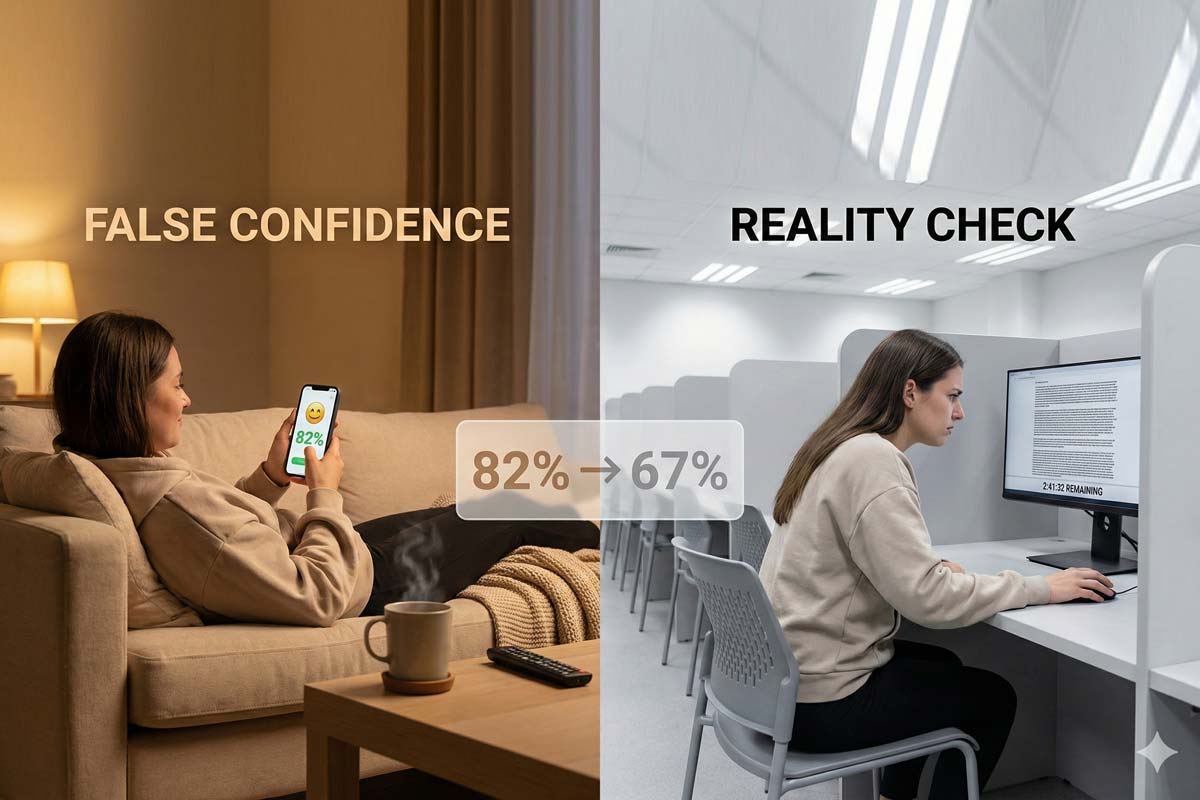
I see it constantly. A student taps through an untimed quiz on their phone while distracted. They score an 82% and assume they are ready.
But untimed success is an illusion.
The real exam is engineered to amplify pressure:
Questions are longer and often scenario-based.
Distractors are trickier and designed to catch skimmers.
The clock is always moving, creating constant pressure.
When you sit in a silent testing room with no phone, no breaks, and no instant feedback, that comfortable 82% quickly drops to a 67%.
To pass, you must stop "reviewing" and start "simulating." Before diving deeper into simulation strategy, if you’re still building your foundational study habits, I cover that process in much more depth in my guide on the best way to study for the California real estate exam.
Why Timed Exams Matter (The Neuroscience)
You need to train for the physical and neurological reality of a 3-hour exam.
The California real estate sales exam consists of 150 questions. You have 3 hours and 15 minutes. That is roughly 1 minute and 18 seconds per question.
For the broker exam it’s 200 questions over 4 hours.
Decision Fatigue
Cognitive science tells us that decision fatigue sets in significantly around the 90-minute mark. By question #75, your brain becomes less efficient at filtering out wrong answers. If you haven't trained for this endurance, you will make sloppy mistakes in the second half of the test. This is why students often miss easy vocabulary questions late in the exam—they're not fatigued intellectually, they're fatigued neurologically.
The Cognitive Switching Tax
Here is something most students ignore.
Every time you switch from an advertising to a vocabulary question to a legal scenario, your brain incurs a "switching cost." You lose about 3 to 9 seconds resetting your mental context. Over lots of questions, that "tax" adds up to 10–15 minutes of lost time. Only timed simulations can train your brain to reduce this lag.
Simulating the Environment
You cannot simulate a marathon by walking around the block. You must recreate the hostility of the testing environment.
Hard Surface, Hard Chair: Do not study in bed. Sit at a desk. Your brain needs to associate this posture with "focus mode."
Digital Silence: The testing center is quiet. Put your phone in another room. Close all browser tabs except the exam simulator.
Use a Monitor, Not a Phone: The DRE exam uses desktop screens with dense blocks of text. Your eyes need to train for that format. Scrolling on a phone creates a false sense of ease that disappears on a larger screen.
Testing Center Lighting: The testing center uses bright fluorescent lighting. If you normally study in soft or dim lighting, the contrast alone can increase eye strain. Practice under similar lighting conditions.
No Pausing: In the real exam, the clock doesn’t stop if you need a snack or a bathroom break. If you take a 150-question mock exam, sit for the full duration, or keep the clock counting down during your restroom break.
How to Analyze Your Results
Most students review their results incorrectly. They only check which letter they missed. A deep dive forces you to understand the thinking error behind each miss. Taking the test is only 50% of the work. The real learning happens here.
Here’s the framework my students use:
Error Type
The Cause
The Fix
Knowledge Gap
You simply didn’t know the definition or concept.
Go back to the textbook. Re-read the chapter.
Reading Error
You missed a key word like “NOT,” “EXCEPT,” or “buyer/seller.”
Slow down. Read the question twice before looking at answers and watch the video on our crash course website.
Logic Trap
You knew the facts but fell for a specific distractor.
Analyze why the wrong answer looked right.
If you find that you are constantly making Knowledge Gap errors, you need to revisit how you are absorbing data. If specific terms won’t stick, incorporate the memorization techniques that work for the CA exam—like mnemonics or active recall—before your next simulation.
Building a Study Rhythm
How often should you take a practice exam?
Your practice-test rhythm also depends on your overall study timeline—I outline typical timelines and prep durations in my breakdown of how long you should study for the CA real estate exam.
Generally, you want to align your testing with your body’s natural circadian rhythm. If your actual exam is scheduled for 8:00 AM, take your practice exams at 8:00 AM. Train your brain to be alert at that specific time.
The Loop:
Day 1: Full 150-question mock exam (Timed).
Day 2: The Autopsy. Deep review of missed questions.
Day 3 & 4: Targeted study on weak categories only.
Day 5: Repeat.
When students run this five-day loop even twice, their scores typically jump 10–15 points.
However, if you find that certain topics still aren’t clicking even after targeted review, that’s a sign you may benefit from structured instruction. Sometimes hearing me explain concepts like “hypothecation” or “amortization” is the only way to make it click. This is often why students decide they should take a crash course for the CA real estate exam.
When to Taper Off
A common mistake is cramming heavy mock exams right up to the finish line. This is counterproductive.
48 Hours Before the Exam: Take full simulated tests with caution. You risk burnout or shaking your confidence with a difficult outlier score.
The Final Day:
Review your glossary and Error Journal.
Mental Freshness: Your brain consolidates memory during sleep. The final 24 hours should be about reinforcing existing knowledge—not adding new material.
Circadian Reset: Go to bed and wake up at the exact same time you will on exam day. Even a small circadian shift can reduce recall by 10–12%.
Fuel Up: Focus on sleep and nutrition. Your brain consumes massive amounts of glucose during an exam; eat a solid meal with complex carbohydrates.
Action Plan: 7 Steps to Exam Success
Establish a Baseline: Take one timed exam early to see where you stand.
Isolate Weaknesses: Use the category breakdown to identify your worst subjects.
Simulate Reality: No music, no phone, hard chair, desktop monitor.
Respect the Clock: Get comfortable with the 1-minute-per-question pace.
Perform the Autopsy: Never waste a mistake; analyze the logic behind it.
Taper Down: Switch to light review 48 hours before the test.
Trust the Process: If you are consistently scoring 85-90% on timed simulations, you are ready.
Frequently Asked Questions
1. How many practice exams should I take before the real test?
I typically recommend students take at least 5 to 7 full, timed mock exams. You are looking for consistency. One passing score could be luck; three passing scores in a row is readiness.
2. How should I pace the exam to avoid timing out?
Aim to complete 50 questions every hour. This leaves you with roughly 15 minutes at the end to review flagged questions. If you aren’t at question #50 by the one-hour mark, you need to speed up slightly.
3. What percentage should I be scoring halfway through my prep?
Don't panic if you are scoring in the 50-60% range early on. That is normal. Your goal is to see a steady 5% increase with every "Autopsy" loop you complete.
4. How many questions should I expect to flag and return to?
On a healthy exam run, you should expect to flag about 15–25 questions. These are the ones where you narrowed it down to two answers but weren’t 100% sure. Flag them, guess, and move on. Do not let them stall your momentum.
5. Is the practice test harder or easier than the actual DRE exam?
Good practice exams for California real estate license test prep are designed to be slightly harder or equal to the difficulty of the real test. If a practice test feels easy, it’s likely not rigorous enough.
6. How does the DRE weight the content categories?
The exam covers seven major areas. “Practice of Real Estate” and “Agency” usually have the highest weight, often comprising 40-50 questions combined. There is no Real Estate Math on the test.
7. How do I handle “scenario” questions?
The DRE loves questions that start with “Broker A does X…” These test the application of law. Read the end of the question first to see what they are actually asking, then read the scenario to find the relevant facts.
8. What should I do if I keep failing my practice exams?
Stop testing and start studying. Repeated failure reinforces negative neural pathways. Go back to your course materials or try a different learning modality (like video or audio lectures) before testing again.
If you want to see how practice testing fits into the entire licensing journey, you can explore the full California Real Estate Exam Guide, which connects every stage of the process.
|
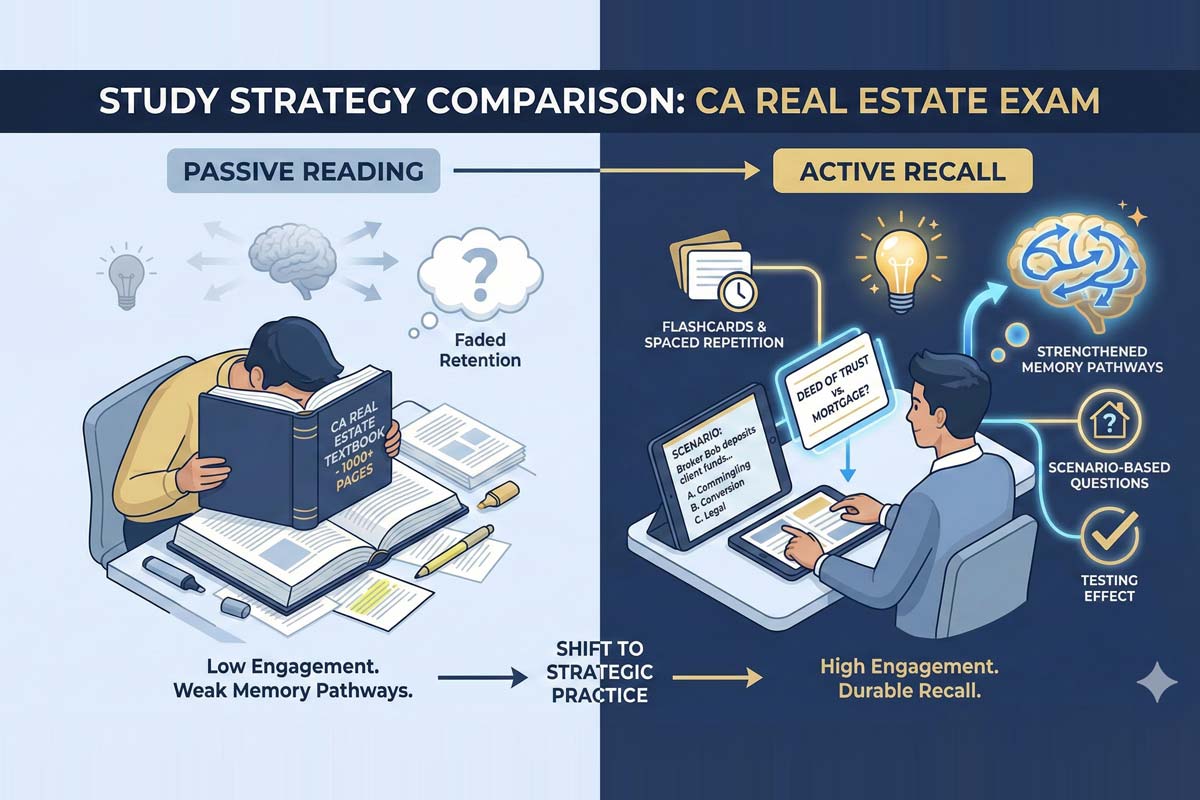
When most students enroll in real estate classes and receive their textbooks, a frequent reaction is overwhelm.
You are staring at thousands of pages covering everything from freehold estates Read more...
When most students enroll in real estate classes and receive their textbooks, a frequent reaction is overwhelm.
You are staring at thousands of pages covering everything from freehold estates to trust fund accounting, and the pressure to memorize it all can be paralyzing. But here is the truth: You do not need to memorize every single word to pass. You need a specific strategy.
The best way to study for the California real estate exam is to shift from passive reading to active, strategic practice aligned with the DRE blueprint.
While our comprehensive California Real Estate Exam Guide covers the broader scope of eligibility and the application process, this article focuses entirely on the tactical side of preparation—the specific study methods that transform confusion into passing scores.
What Is the Best Way to Study for the California Real Estate Exam?
The most effective study method is a targeted approach that prioritizes high-weight content areas and learns them through application rather than mere memorization. Think of it this way: The student who reads the textbook three times often fails, while the student who reads it once but spends their time analyzing practice scenarios usually passes.
To study effectively, you must first stop studying "everything" and start studying what matters. Your study time gains the biggest return on investment when you prioritize the sections that appear most frequently.
The California salesperson exam consists of 150 multiple-choice questions to be completed in 3 hours. The broker exam is 200 multiple-choice questions and you are given up to 4 hours to complete it. To pass, you need a score of 70% or 75% respectively. However, remember that the questions are weighted toward specific areas. While the DRE may update specific questions, these category weights remain consistent year after year.
Practice of Real Estate and Mandated Disclosures (approx. 25%)
Laws of Agency and Fiduciary Duties (approx. 17%)
Property Ownership and Land Use Controls (approx. 15%)
If you master Practice and Agency, you have already covered nearly half the exam. Your study time should reflect this distribution.
Decode the Question Style: Scenarios Over Definitions
One of the biggest shocks for students on exam day is the format of the questions. They rarely ask for simple definitions. Instead, the DRE uses scenarios to test if you understand the spirit of the law, not just the letter of it.
The "Story Problem" Pattern
Most questions are disguised as simple stories. These scenarios reflect how nearly every DRE question is structured—they present a situation and ask you to identify the legal implication. Success here comes down to pattern recognition.
Scenario A (Trust Funds): A broker named Bob deposits a client’s rent check into his personal account because he was in a rush. The test won’t ask “Define Commingling.” It asks what violation Bob committed.
Scenario B (Agency Disclosure): An agent representing a buyer writes an offer on a property listed by her own firm. She waits until the offer is accepted to tell the buyer she also represents the seller. The test won’t ask “What is Dual Agency?” It asks if the agent’s timing was legal (it wasn’t).
If you study isolated terms without applying them to these “story problems,” you may struggle to recognize the answer when it is wrapped in a real-world situation especially if you haven’t memorized and internalized the vocabulary.
Active Recall and Spaced Repetition
The “Forgetting Curve” is real. If you study contracts on Monday and don’t look at them again until Friday, you will have forgotten a significant portion of what you learned.
Why Active Recall Works
Simply re-reading a chapter feels comfortable, but it is passive. Remember: Comfort ≠ Learning. If it feels easy, you probably aren’t retaining it.
Active recall—testing yourself before looking at the answer—forces your brain to work harder to retrieve the information. For example, instead of reading a definition, cover the page and ask yourself: “What is the definition of constructive eviction?” This mental exertion strengthens neural pathways, making the memory more durable.
Build a Study Routine You Can Stick To
One of the biggest mistakes students make is waiting for "free time" to study. In our busy lives, free time rarely exists; it has to be created. You need a schedule that treats studying like a non-negotiable appointment.
Sample Weekly Plan for a Busy Adult
This schedule focuses on consistency over intensity.
Day
Focus
Activity
Monday
Learning (1 hr)
Read 1 chapter + Take notes.
Tuesday
Reinforcement (30 min)
Review Monday's notes. Do 20 practice questions on that topic.
Wednesday
Learning (1 hr)
Read the next chapter + Take notes.
Thursday
Review (30 min)
Review Mon/Wed notes. Explain concepts out loud.
Friday
Rest
No studying. Let your brain recover.
Saturday
Testing (2 hrs)
Full practice exam or comprehensive quiz. Review missed answers.
Sunday
Analysis (1 hr)
Review weak areas identified on Saturday.
The 4-Week Roadmap
To maintain momentum, visualize your month like this:
Weeks 1–2: Build foundational knowledge (Read, Note-take, Quiz).
Week 3: Transition to comprehensive practice exams and error correction. Note: Only move to this stage when you can consistently score ~70% on section quizzes.
Week 4: High-yield review of weak spots and vocabulary drills.
Note: If you work full-time or have a busy family life, don’t force a 4-week timeline. Extend this roadmap to 6–8 weeks to ensure you retain what you learn.
Establishing a routine is crucial, but determining your total timeline is personal; understanding How Long Should You Study for the CA Real Estate Exam depends heavily on your background knowledge and how many hours per week you can honestly commit. A student with a legal background might need four weeks, while someone completely new to the industry might need three months of steady preparation.
Use Practice Exams Intentionally
Taking practice exams is not about seeing what score you get; it is about diagnosing why you are getting questions wrong.
When to Start Full Mock Exams
Avoid taking full 150-question mock exams until you can consistently score 70–75% on topic-based quizzes. Taking them too early leads to discouragement. Once you hit that threshold, aim to take one full mock exam per week in a quiet environment to build stamina.
Track your errors by type to see which patterns repeat. Taking mock tests is essential, but simply churning through questions won't improve your score unless you know how to use Practice Exams for the CA Real Estate License Test to diagnose your weak spots effectively. The goal is to condition your brain to recognize how the state asks questions, which is often tricky and filled with double negatives.
When a Crash Course Can Supercharge Your Prep
Self-study requires immense discipline. Sometimes, despite your best efforts, certain concepts—like the difference between a trust deed and a mortgage—just don’t click when reading a book.
Signs You Might Need Help
The Plateau: You have been stuck at scoring 60% for two weeks.
The "Why": You know the answer is B, but you don’t understand why it isn’t C.
The Application Gap: You understand definitions but consistently miss scenario questions.
If you reach this point, deciding whether You Should Take a Crash Course for the CA Real Estate Exam often comes down to whether you need structured, instructor-led guidance—not just more reading or random YouTube videos. A well-designed crash course like crashcourseonline.com acts as a final filter, stripping away irrelevant information and focusing purely on what is likely to appear on the state exam. The right course clarifies confusing topics, shows you how questions are actually phrased, and reinforces the high-yield concepts that move your score the fastest.
Common Mistakes That Sabotage Students
Even smart students fail because they study inefficiently or panic on the big day. Avoid these common traps:
Study Pitfalls
The Highlighter Fallacy: Highlighting everything in your book makes you feel productive, but it doesn’t help you learn. It is better to write notes in the margins.
Binge Studying: Studying for eight hours straight on a Sunday is far less effective than studying for one hour a day for eight days. Your brain needs sleep to consolidate memory.
Exam-Day Trap
The Second-Guessing Trap: On exam day, avoid changing your answers unless you have found clear evidence you were wrong. Your gut instinct is usually based on your study prep; second-guessing is usually based on anxiety.
Why ADHI's System Works
At ADHI Schools, we have spent nearly two years refining our curriculum not just to meet DRE standards, but to match how students actually learn. We don’t believe in drowning you in data. Our approach focuses on the “why” behind the laws. These methods mirror the principles we teach in our courses because they consistently produce results.
FAQs
1. What is the most effective way to study for the California real estate exam?
The most effective study method is a targeted approach that focuses on the highest-weighted exam topics and uses active recall and scenario-based practice. Students who move beyond passive reading and spend more time analyzing question patterns consistently score higher than those who simply reread the textbook.
2. How many hours a day should I study for the California real estate exam?
Most students do well with 1–2 hours per day, 4–6 days a week. What matters more than total hours is consistency. Short, focused sessions with spaced repetition outperform long cram sessions. Your timeline also depends on your background—some students need four weeks; others need two to three months.
3. When should I start taking practice exams?
Start full-length practice exams only after you can consistently score 70–75% on topic-based quizzes. Taking them too early leads to discouragement and doesn’t improve retention. Once ready, take one mock exam per week and spend equal time reviewing your mistakes to identify patterns.
4. Do I need a crash course to pass the California real estate exam?
A crash course isn’t mandatory, but many students see their biggest score jumps after following a structured review program. When you’re stuck or unsure why answers are wrong, guided review—such as the approach used at crashcourseonline.com—can help you quickly identify weak areas and understand how the exam actually phrases its scenarios.
|
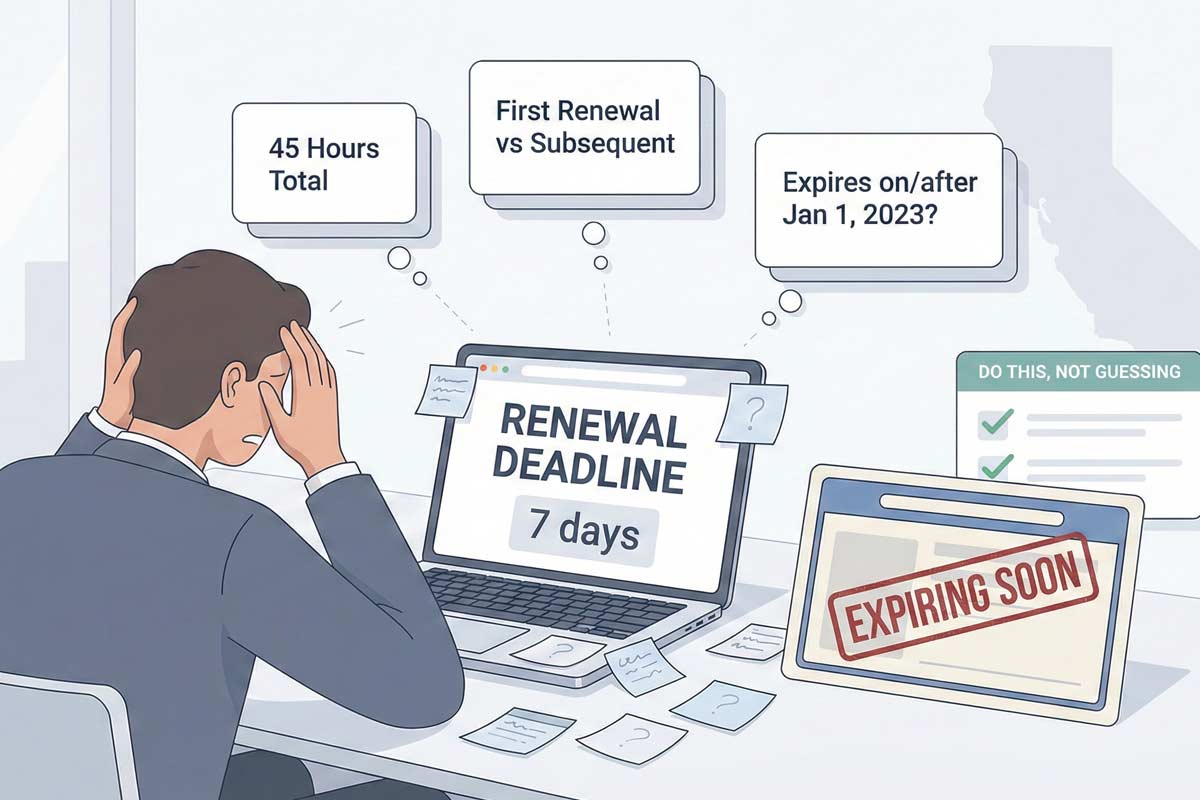
It starts with a notification or a glance at your license. The expiration date is looming—maybe next month, maybe next week—and the panic sets in.
You know you need "Continuing Education," but Read more...
It starts with a notification or a glance at your license. The expiration date is looming—maybe next month, maybe next week—and the panic sets in.
You know you need "Continuing Education," but the rules seem to change every time you check. Do you need the 9-hour survey or separate courses? Is implicit bias required this year? What happens if you take the wrong bundle?
If you are staring at a renewal deadline, stop guessing. Taking the wrong courses can result in a rejected application and a lapsed license—meaning you literally cannot practice real estate until your expired license is renewed.
Here is the no-fluff, compliance-grade breakdown of exactly how many hours you need and, more importantly, which hours count.
Fast Answer: How Many CE Hours Are Required?
The short answer: All California real estate licensees (salespersons and brokers) must complete 45 hours of DRE-approved Continuing Education to renew their license.
The critical nuance: You cannot just take "any" 45 hours. The DRE strictly regulates how those 45 hours are broken down based on three factors:
Your License Type (Salesperson vs. Broker)
Your Renewal Status (First-time renewal vs. Subsequent renewal)
Your Expiration Date (Whether your license expires on/after January 1, 2023, or you are renewing late after that date)
If you just buy the cheapest "45-hour bundle" without checking these factors, you risk taking courses that the DRE will not accept.
Bottom Line: Everyone needs 45 hours. But the composition of those hours changes depending on where you are in your career.
The 45-Hour Breakdown (Make It Simple)
To get your renewal approved, your 45 hours must be stacked correctly. The DRE divides CE into three specific buckets.
Mandatory Subjects: These are the "core" legal topics (like Ethics and Agency). You cannot skip these.
Consumer Protection: You must take a minimum of 18 hours in this category. These courses might cover technical skills like energy efficiency, land use, or valuation.
Consumer Service: These are "elective" topics (like sales skills or marketing).
First Renewal vs. Subsequent Renewals (Where People Get Burned)
This is the #1 source of confusion. The DRE requires first-time renewers to take "separate" courses to ensure they truly learn the basics. Veterans get to choose to take either a "survey" course or each course individually.
Scenario A: First-Time Renewal (Salesperson)
If you are renewing your salesperson license for the very first time, you cannot take the 9-hour survey. You must complete 5 separate 3-hour courses for the mandatory topics.
Your 45-Hour Stack:
Ethics (3 hours)
Agency (3 hours)
Fair Housing (3 hours, must include an interactive participatory component where you role-play as both a consumer and a real estate professional)
Trust Fund Handling (3 hours)
Risk Management (3 hours)
Implicit Bias Training (2 hours)
Consumer Protection (18 hours minimum)
Remaining Hours (Consumer Protection or Consumer Service)
Scenario B: First-Time Renewal (Broker)
Brokers have a higher standard of duty. If you are renewing a broker license for the first time, you have an extra mandatory topic: Management & Supervision.
Your 45-Hour Stack:
All 5 separate courses listed above
PLUS: Management & Supervision (3 hours)
Implicit Bias Training (2 hours)
Consumer Protection (18 hours minimum)
Remaining Hours (Consumer Protection or Consumer Service)
For a complete breakdown of every specific rule, bookmark our master California Real Estate License Renewal Guide.
Scenario C: Subsequent Renewals (All Licensees)
Once you have successfully renewed at least once, you graduate to "Subsequent Renewal" status. This applies to both salespersons and brokers.
Your 45-Hour Stack:
Individual courses or Survey Course: You can choose to take some of coursework either as a bundle or choose to take the courses individually.
Consumer Protection (18 hours minimum)
Remaining Hours (Consumer Protection or Consumer Service)
Warning: If you are a first-timer and you accidentally take the "9-Hour Survey" because it was cheaper or faster, the DRE will reject your renewal. You must take the separate courses.
Do Brokers Have Different CE Requirements?
Yes, but primarily on that first renewal.
As mentioned above, brokers typically need to complete the Management & Supervision course as a standalone 3-hour requirement during their first renewal cycle. The DRE expects brokers to understand how to manage offices and supervise agents from day one.
On subsequent renewals, brokers and salespersons are in the same boat—both can take the survey course, which includes the Management & Supervision module.
For a deeper dive into broker-specific nuances, read Do Brokers Have Different CE Requirements in CA?.
What Counts Toward CE Hours (And What Doesn’t)
Not every real estate class you take counts toward your 45 hours.
1. It Must Be DRE-Approved If you took a weekend seminar on "Luxury Home Marketing" at a hotel, or watched a YouTube series on sales tactics, those likely do not count. Only courses from a DRE-approved sponsor (like ADHI Schools) are valid, and you’ll enter the 8-digit CE course number in eLicensing to prove it.
2. Interactive Fair Housing (The "Interactive" Rule) Since 2023, you cannot just read a PDF on Fair Housing. If your license expires on or after January 1, 2023 (or you are renewing late after that date), your 3-hour Fair Housing course must include an interactive participatory component where you role-play as both a consumer and a real estate professional.
In-Person: This involves live role-play.
Online: This usually involves scenario-based questions where you "act" as the buyer or agent in a digital simulation.
For a full list of valid course types, check out What Courses Count Toward CE in California?
Realistic Time Planning (Stop the Last-Minute Crunch)
I see this happen every month: an agent realizes their license expires in 48 hours and tries to "cram" all 45 hours in one weekend.
This is physically impossible.
Why? Because of the 15-Hour Rule. This isn’t just an ADHI policy—DRE regulations limit correspondence CE to 15 credit hours of final exams in any 24-hour period, which is why true last-minute cramming often fails. These testing periods commence after the maximum of 8 hours per day of study time.
Day 1: Max 15 hours.
Day 2: Max 15 hours.
Day 3: Max 15 hours.
The Math: Including the study time, ADHI’s renewal package requires a minimum of just over 8 days to complete. This means if your license expires tomorrow and you haven’t started, you are going to expire.
My Advice: Start at least 30 days out. Do one course (3 hours) per evening. It’s stress-free, and you’ll actually retain the information rather than just clicking "Next" in a panic.
Common Mistakes That Delay Renewal
Over the last 20 years, we’ve seen thousands of renewals. Here are the most common reasons the DRE kicks them back:
Taking the "Subsequent" Package Too Early: First-time agents love the idea of a 9-hour survey. Don't do it. You need the separate courses.
Missing Implicit Bias: This is a newer requirement (effective 2023). If your bundle is old, check if it includes this. (Read more: Does California Require Implicit Bias Training for Renewal?)
Name Mismatch: If your CE certificate says "Bob Smith" but your license is under "Robert Smith," the eLicensing system might flag it. Ensure your profile matches your certificates.
Letting the license expire: You can renew during the two-year late renewal period, but you cannot perform licensed activity until the DRE renews you. To avoid any lapse, submit before your expiration date.
Assuming the "70/30 Exemption" Applies: Some agents think once they turn 70, they are exempt. You must be 70 AND have 30 years of continuous good standing. If you let your license lapse for a month 10 years ago, that clock might have reset.
To ensure you have the full checklist for this year, review California Real Estate License Renewal Requirements (2026).
Mini-Checklist: "Before You Hit Submit"
Before you log into eLicensing, ensure you have:
45 Hours Total on your certificates.
Correct Mandatory Topics (Separate courses for 1st timers; Survey or individual courses for subsequent).
Implicit Bias certificate (2 hours).
Interactive Fair Housing certificate.
At least 18 hours labeled "Consumer Protection."
Course Numbers (8-digit) ready to type in.
FAQ: California CE Hour Requirements
Is it always 45 hours to renew a California real estate license? Yes. Whether you are a salesperson or a broker, and whether it is your first or tenth renewal, the total requirement is 45 hours. The only exception is for licensees who qualify for the "70/30 Exemption" (70 years old with 30 years of continuous good standing).
Do brokers need more CE hours than salespersons? No, brokers also need 45 hours. However, for their first renewal, brokers must include a specific 3-hour course on "Management & Supervision," whereas salespersons do not. On subsequent renewals, both licensees typically take the same 9-hour survey course.
What if I’m renewing late—do I need extra CE? Generally, no. You can renew late for up to two years after expiration, but you cannot practice while expired. If you don’t complete late renewal within that two-year window, your renewal rights are forfeited.
Does implicit bias training count toward the 45 hours? Yes. The 2-hour Implicit Bias training is part of the 45-hour total. It is a mandatory course, meaning you cannot skip it, but the time spent on it counts toward your total requirement.
Can I finish all 45 hours in one day? No. DRE regulations limit you to completing 15 credit hours of final exams per 24-hour period. This means the fastest you can theoretically complete the 45 hours is over 3 to 4 days after the study period has lapsed.
|
You’re staring at your 45-hour renewal options and you notice a new line item: “Implicit Bias Training.”
The real question isn’t what it is—it’s whether missing it can delay your renewal.
Read more...
You’re staring at your 45-hour renewal options and you notice a new line item: “Implicit Bias Training.”
The real question isn’t what it is—it’s whether missing it can delay your renewal.
For California renewals tied to the post–January 1, 2023 CE rules, Implicit Bias is a mandatory DRE-required topic—and the only “gotcha” is how it must appear on your CE completion records depending on whether this is your first renewal or a later renewal.
This guide clarifies the rules so you can renew your license without a rejection.
Quick Answer: Do I Need This?
Yes. Implicit Bias Training is required as part of California’s renewal CE.
Requirement: 2 hours of DRE-approved Implicit Bias Training.
Does it add hours? No—it's part of your required 45 hours (not extra).
Key difference: First-time renewals must complete a standalone 2-hour Implicit Bias course. Subsequent renewals can satisfy it via the 9-hour survey course or by taking the mandatory topics as individual courses.
Related Resources:
California Real Estate License Renewal Guide
California Real Estate License Renewal Requirements (2026)
Why Is This Required? (SB 263)
This requirement comes from California’s CE rule updates implementing Senate Bill 263, which added a two-hour implicit bias training component and expanded the survey/update course to nine hours to cover the mandatory topics.
The curriculum focuses on understanding historical and systemic housing barriers and providing actionable steps to recognize unconscious bias in client interactions. The goal is risk management: protecting your license and ensuring compliance with Fair Housing laws.
The "First Renewal" vs. "Subsequent" Rule
The Department of Real Estate (DRE) has precise rules for how this training appears on your certificate. This is where most licensees make mistakes.
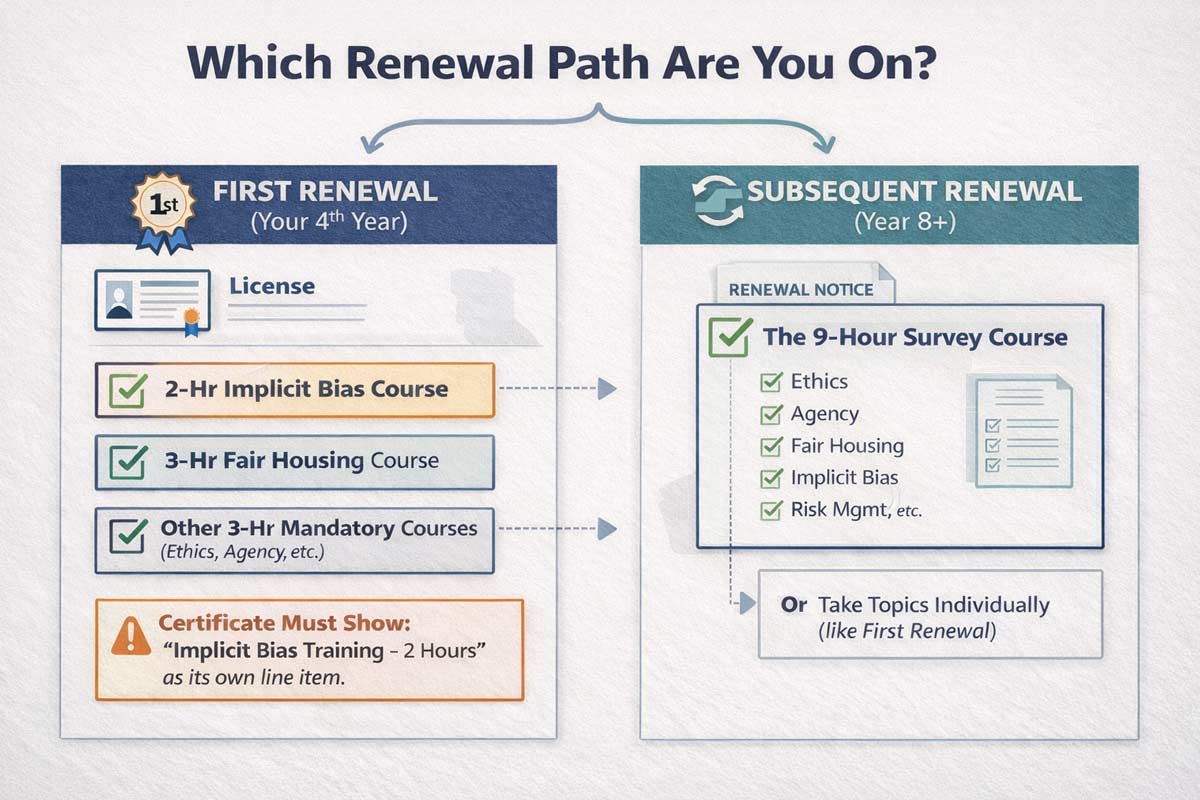
Scenario A: This is Your First Renewal
If you are renewing for the very first time (your 4-year anniversary), you cannot use the "survey course" shortcut. You must take separate courses.
If you are a Salesperson:
Your 45 hours must include:
Four separate 3-hour courses: Ethics, Agency, Trust Fund Handling, Risk Management.
One 3-hour Fair Housing course (with the required interactive component).
One 2-hour Implicit Bias Training course.
At least 18 hours of Consumer Protection, plus remaining hours in Consumer Protection or Consumer Service.
If you are a Broker (or Officer):
The structure is similar, but adds one more mandatory topic:
Five separate 3-hour courses: Ethics, Agency, Trust Fund Handling, Risk Management, Management & Supervision.
One 3-hour Fair Housing course (with the interactive component).
One 2-hour Implicit Bias Training course.
At least 18 hours of Consumer Protection, plus remaining hours in Consumer Protection or Consumer Service.
The Certificate Rule: You need a completion record that clearly shows "Implicit Bias Training – 2 Hours" as its own course line item.
Operator Note: If you want the full breakdown of what counts and how the DRE buckets these hours, read our guide on California Real Estate License Renewal Requirements (2026).
Scenario B: This is a Second (or Later) Renewal
For second and subsequent renewals, you have two compliant paths:
The Survey Option: Take the single 9-hour CE survey course that covers all mandatory topics (including Implicit Bias).
The Individual Option: Take the mandatory topics as individual courses instead of the survey.
Broker licensees will often ask ADHI Schools if brokers have different CE requirements in CA? A key difference is all broker licensees renewing must take a Management and Supervision course, but first time salespersons renewing do not.
Does It Count Toward My 45 Hours?
Yes. Implicit Bias is not "extra" work. It fits inside your existing bucket.
License Renewal Type
Total Hours Required
Does Implicit Bias Count?
First Renewal
45 Hours
Yes (Counts as 2 mandatory hours)
Subsequent Renewal
45 Hours
Yes (Could be taken in a 9-hr Survey course)
Late Renewal
45 Hours
Yes (Same rules apply)
To see exactly how the math works for your specific license type, check our breakdown of how many CE hours are required for CA license renewal?
"Audit-Proofing" Your Renewal
The DRE audits a percentage of renewals every month. If you are pulled for an audit simply follow the requests that the DRE makes and respond in a timely manner.
The Audit Checklist:
Check the Provider: Ensure the course provider is DRE-approved. A "Diversity Training" certificate from your other corporate job does not count. It must have an four-digit DRE Sponsor Number listed on the certificate of completion. Learn exactly what courses count toward CE in California to avoid registering for an invalid course.
Verify the Year: If you took a Fair Housing course in 2021 that didn't have the new interactive component or implicit bias module, it is invalid for a 2026 renewal.
Keep Your Records: Keep your certificates longer than you think. DRE recommends retaining CE completion certificates up to five years in case of audit, and providers are required to maintain participant records for five years.
Common Mistakes That Reject Renewals
We see licensees panic-renew 24 hours before their license expires. That is when mistakes happen.
Mistake #1: The "HR" Course. Submitting a workplace harassment or bias certificate from a non-real estate employer.
Result: Rejected.
Mistake #2: The "Old" Course. DRE rule of thumb: Continuing education credit expires four years from the course completion date, so older certificates can trigger rejection codes during renewal processing.
Mistake #3: Taking Courses From a Provider That is Not Approved. Make sure to ask for the 4 digit sponsor number of any course provider before registering.
Stay Compliant, Stay Active
Implicit Bias training is now a standard part of doing business in California. It isn't just about checking a box; it's about protecting your license and serving a diverse client base professionally.
Don't let a missing 2-hour certificate pause your career. If you are unsure exactly which courses you need based on your license status, check the full roadmap below.
California Real Estate License Renewal Guide →
FAQ
1. Can I take Implicit Bias training online?
Yes. As long as the provider is DRE-approved for correspondence or online study, you can take the course entirely online.
2. Does my Fair Housing course cover Implicit Bias?
No. They are separate requirements. However, if you take the 9-Hour Survey Course (for subsequent renewals), both Fair Housing and Implicit Bias are included in that single 9-hour block.
3. I am over 70 years old. Do I still need this?
If you are eligible for the "70/30" exemption (70+ years old AND 30 years of continuous good standing), you are exempt from all CE, including Implicit Bias. You simply submit the exemption form.
4. What happens if I renew late?
If you renew within your two-year grace period, the requirements are the same: you must complete the 45 hours, including Implicit Bias, before you can reinstate your license and pay the appropriate late fee.
|
The single biggest mistake I see agents make during renewal isn’t failing a test—it’s finishing 45 hours of education only to realize none of it counts.
Just because a class is about real estate Read more...
The single biggest mistake I see agents make during renewal isn’t failing a test—it’s finishing 45 hours of education only to realize none of it counts.
Just because a class is about real estate doesn’t mean the California Department of Real Estate (DRE) accepts it for your license renewal. Your office sales training? Probably doesn’t count. That motivating weekend seminar? Likely doesn’t count.
If you rely on unapproved courses, you risk a lapse in your license status where you cannot legally conduct business.
Here is the no-nonsense guide to exactly what counts, what doesn’t, and how to verify your courses before you spend a dime.
The Fast Answer: What You Need to Know
If you are in a rush, here is the bottom line on course eligibility:
Only DRE-Approved Counts: If the provider doesn’t have a DRE Sponsor Number and the course doesn’t have a DRE Course Number, it does not exist in the eyes of the state.
The Math Matters: You must complete your Mandatory Subjects first, then a minimum of 18 hours of Consumer Protection. Only the remaining hours can be Consumer Service or Consumer Protection.
Interactive Rule: Your Fair Housing course must include an interactive participatory component where you role-play as both a consumer and a professional. A PDF-only read-through is not enough.
Implicit Bias is Mandatory: For licenses expiring on or after Jan 1, 2023, you must complete an Implicit Bias training course.
Verify First: Always check the course number in the DRE database before paying.
Start Here: If you are unsure about the big picture, bookmark our California Real Estate License Renewal Guide for the complete roadmap.
What Does “DRE-Approved” Actually Mean?
For a course to count toward your Continuing Education (CE), it must meet two criteria:
It is offered by a DRE-approved Sponsor (a school or provider).
The specific course has been reviewed and assigned a DRE Course Number.
The DRE measures education in “clock hours.” When we say you need 45 hours, we mean 45 credit hours approved by the state—not necessarily 45 hours of sitting in a chair if you are a fast reader, but the content must match that volume.
Crucial: You must receive an official Completion Certificate featuring an 8-digit certificate number. You should retain these certificates for four years after your renewal in case you are audited.
The 60-Second Decision Tree: What Counts for You?
What you need depends entirely on where you are in your career.
1. Are you a Salesperson renewing for the FIRST time?
What counts: You have a strict list. You need 5 separate three-hour courses in Ethics, Agency, Trust Funds, Fair Housing (with interactive role-play), and Risk Management.
Plus: You need a 2-hour Implicit Bias course and a minimum of 18 hours of Consumer Protection.
Warning: You cannot take the Survey Course yet. You must take separate, dedicated courses.
2. Are you a Broker renewing for the FIRST time?
What counts: Same as the salesperson list above, but you also need a course in Management & Supervision. For a deep dive on this, read Do Brokers Have Different CE Requirements in CA?
3. Is this your SECOND or SUBSEQUENT renewal (Broker or Salesperson)?
What counts: You have more flexibility. You can take a single Survey Course (which covers the mandatory subjects: Ethics, Agency, Trust Funds, Fair Housing, Risk Management, Management & Supervision, and Implicit Bias).
Plus: You need a minimum of 18 hours of Consumer Protection.
Remaining Hours: The rest of your 45 hours can be filled with either Consumer Protection or Consumer Service.
To check the exact math on totals, check out How Many CE Hours Are Required for CA License Renewal?
The Three Buckets: Mandatory, Consumer Protection, and Consumer Service
To build a valid 45-hour package, you need to prioritize the categories in this order:
1. Mandatory Subjects
These are the non-negotiables. The state requires you to stay updated on the laws that protect the public.
The List: Ethics, Agency, Fair Housing, Trust Fund Handling, Risk Management, Management & Supervision, and Implicit Bias.
The “Survey” Shortcut: If you are on a subsequent renewal, a 9-hour Survey Course counts as covering all these topics.
Note: Not sure if the new bias rules apply to you? Read Does California Require Implicit Bias Training for Renewal?
2. Consumer Protection (The "Primary" Elective)
This category is the gold standard for electives.
Requirement: You generally need a minimum of 18 hours in this category.
Definition: Courses that help you protect the client’s interest.
What Counts (Common Examples):
Real Estate Valuation/Appraisal
Property Management logic
Green Real Estate/Energy Efficiency
Real Estate Finance and Truth-in-Lending
Landlord/Tenant Relationships
3. Consumer Service (The "Leftover" Elective)
This is the most confusing category. These are courses that improve your skills but don't necessarily protect the public legally.
The Rule: Consumer Service hours only count after you have satisfied your Mandatory subjects and your 18 hours of Consumer Protection. You can fill the remaining gap with these.
What Counts (Common Examples):
Real Estate Marketing
Negotiation Skills
Computer Applications/Tech for Real Estate
General Sales Skills
My Advice: Stick to Mandatory + Consumer Protection. It’s the safest path to ensure you never accidentally short yourself on the required protection hours.
What Does NOT Count (Don’t Waste Your Money)
I have seen agents spend hundreds of dollars and weekends of time on things that count for zero hours toward renewal.
Training from your Broker: Unless your brokerage is an official DRE-approved CE sponsor and issued you a course number and certificate, that Tuesday morning sales training does not count.
Motivational Seminars: Tony Robbins is great, but the DRE doesn’t care. Personal development is not CE.
Pre-License Courses: You cannot retake “Real Estate Principles” and have it count for CE. Pre-license and Continuing Ed are two different legal buckets.
Out-of-State CE: Licensed in Nevada too? Your Nevada CE usually does not count for California unless that specific provider registered that specific course with the California DRE.
Expired Courses: If you took a CE course 5 years ago, you cannot use it for this renewal. It must be completed within your current four-year license term.
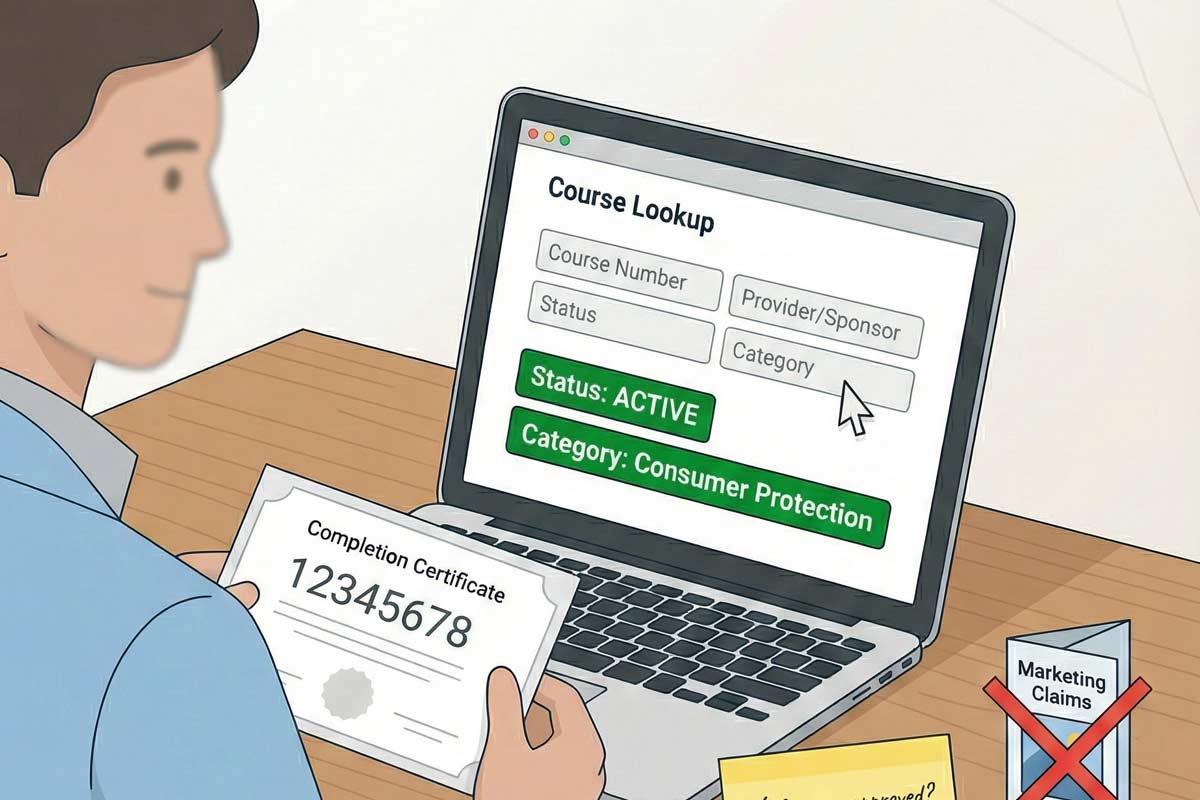
How to Verify a Course Counts (Step-by-Step)
Don’t trust the marketing on a website. Trust the database.
Get the Course Number: Ask the school for the 8-digit DRE course number.
Go to the Source: Visit the DRE’s Approved Continuing Education Courses lookup (on the DRE website).
Search: Enter the course number or the provider name.
Check the Status: Ensure the status is “Active.”
Check the Category: Make sure the category (e.g., Consumer Protection) matches what you need to fill your gap.
Verification Checklist:
Is the sponsor approved?
Is the course status "Active"?
Does the course category match my renewal requirements?
Will I receive a certificate with an 8-digit number immediately upon completion?
Real-World Scenarios: Where Agents Get Stuck
The “Cheap Bundle” Trap Agent Mark found a $30 renewal package online. He finished it in a weekend. When he uploaded it to eLicensing, he was rejected. Why? The bundle was old. The Fair Housing course lacked the required interactive participatory component (role-playing as both consumer and professional), and it was missing the Implicit Bias module entirely.
Lesson: Cheap often means outdated. Ensure the package is current for 2026 standards.
The “I Thought My Designation Counted” Trap Agent Sarah took a grueling 3-day course to get a luxury home designation. She assumed 24 hours of class time meant 24 hours of CE. It turned out the provider never registered the course with the California DRE. She got a nice pin for her lapel, but zero CE credits.
Lesson: Never assume. Check the DRE database.
Frequently Asked Questions
Do webinars count for CE? Yes, BUT only if the webinar provider is DRE-approved and they have a method to verify your attendance (like monitoring your login time or requiring exit quizzes). Live DRE-approved webinars are a valid way to knock out hours.
Can I repeat the same course every renewal? Generally, the DRE allows you to repeat courses in subsequent renewal cycles, provided the course material is still current and approved.
What is the difference between Consumer Protection and Consumer Service? Consumer Protection courses teach you how to protect the client (laws, disclosure, financing). Consumer Service courses teach you how to do your job better (marketing, computer skills). You must have at least 18 hours of Protection; Service hours only count toward the remaining balance.
How do I know if my Fair Housing course is “Interactive”? The course description should explicitly state it includes an "Interactive Participatory Component." The DRE requires this to include role-play as both a consumer and a real estate professional. If you just read a PDF and take a final exam, it likely does not meet the requirement.
What happens if my license expires before I renew? If you submit your renewal application and fees on time (before midnight of your expiration date), you can generally continue operating under B&P Code 10156.2 while the DRE processes it. However, if you are late, you enter a two-year grace period where you can still renew, but you cannot perform any licensed activity until your license is officially renewed.
What if I finish my CE early? That is great. You can upload your courses to the DRE eLicensing system up to 90 days before your expiration date. Do not wait until the last night.
Don’t Risk Your License
Renewing your license is not the time to experiment with unverified courses. The DRE audits renewals, and mistakes can delay your ability to work.
Make sure every hour counts. Stick to approved sponsors, verify your certificates, and get it done early so you can get back to selling.
Next Step: Ready to see the full roadmap? Go to our California Real Estate License Renewal Guide to get started.
|
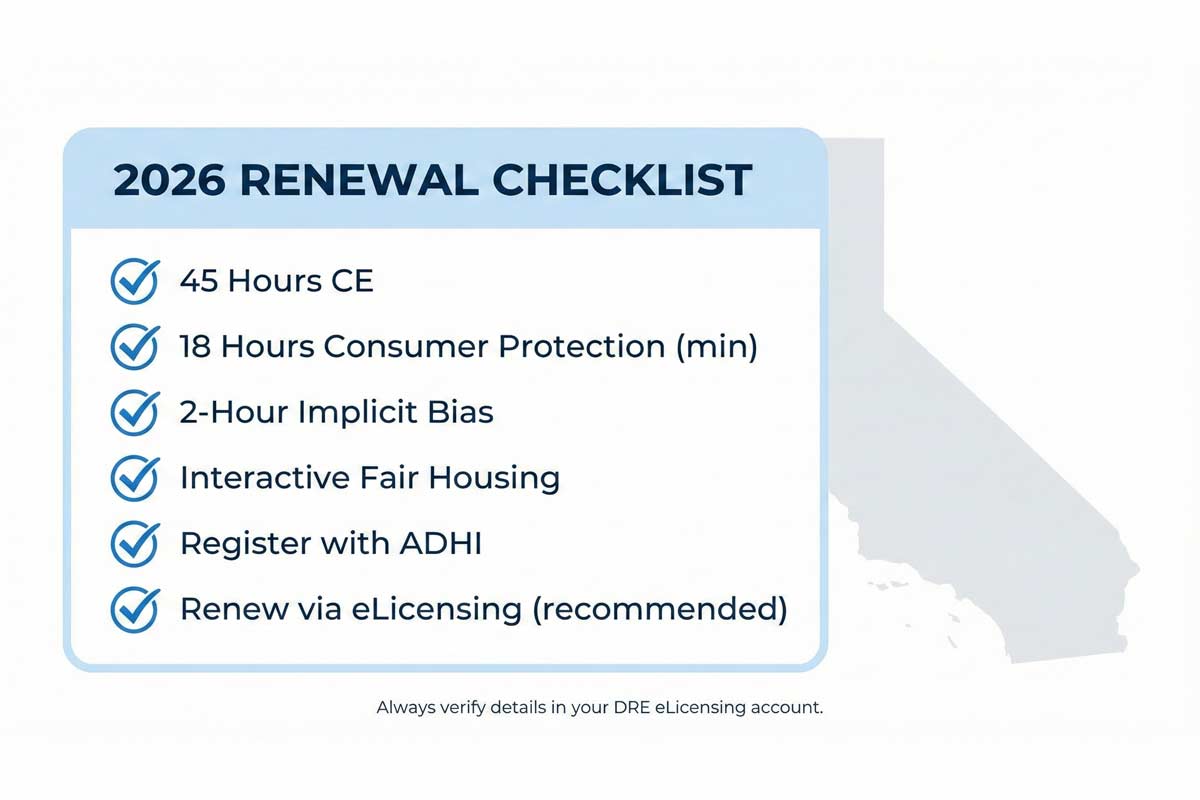
Fast Answer: Your 2026 Renewal Snapshot
If you are staring at a real estate license renewal notice (or dreading its arrival), here is the bottom line. Most (there’s an exception I will discuss in Read more...
Fast Answer: Your 2026 Renewal Snapshot
If you are staring at a real estate license renewal notice (or dreading its arrival), here is the bottom line. Most (there’s an exception I will discuss in a bit) licensees cannot renew their California real estate license without checking these boxes.
Total CE Hours: 45 hours (generally required, unless you qualify for the 70/30 exemption).
Renewal Cycle: Typically every 4 years.
The "New" Standards: If your license expires on or after Jan 1, 2023, you must have the 2-hour Implicit Bias course and the Interactive Fair Housing course. (Older certificates without these specific components will not satisfy current renewal requirements).
Submission Method: DRE eLicensing system (recommended and fastest) or mail (slower).
Earliest You Can Renew: Often about 90 days before expiration (check your eLicensing account for your specific window).
Absolute Minimum Time to Complete CE: ADHI Schools’ renewal program can be completed in about 8 days from the time of registration to completion. CE providers enforce a limit of 15 credit hours per 24-hour period to prevent "speed clicking" under DRE rules. This means you cannot cram 45 hours of course completion into a single weekend.
Who This Applies To (Read This First)
Before you buy a package, verify your status. The California real estate license renewal requirements for 2026 differ depending on where you are in your career.
First-Time Renewal vs. Subsequent Renewal
First-Time Salesperson: You cannot take the shortcut "Survey" course. You must take five separate 3-hour courses (Agency, Ethics, Trust Fund Handling, Risk Management, Fair Housing) plus the 2-hour Implicit Bias course, and at least 18 hours of Consumer Protection.
Subsequent Renewal (2nd, 3rd, etc.): You are eligible for the 9-hour Survey Course. Per DRE rules, this single course covers all 7 mandatory topics (the five above, plus Implicit Bias and Management & Supervision). It is streamlined, but you still must enter the completion details for the remaining hours.
Broker vs. Salesperson
Brokers: You must include "Management & Supervision" in the required subject set on your first renewal.
Salespersons: For subsequent renewals, Management & Supervision is effectively required because it is included in the standard 9-hour Survey Course.
Kartik’s Insider Note: "I’ve seen veteran agents assume they know the rules because they’ve renewed five times. Then they get flagged because they missed the Implicit Bias requirement or took a Fair Housing course that lacked the 'interactive' component. Don't coast on autopilot."
For a complete breakdown of the entire process from start to finish, bookmark our master California Real Estate License Renewal Guide.
The 2026 Renewal Requirements (Detailed Breakdown)
The DRE (Department of Real Estate) is strict about course validity. If your course completion dates or course numbers don't match the current requirements, your renewal may be flagged.
1. The 45-Hour CE Requirement
Most licensees must complete 45 hours of DRE-approved Continuing Education. These hours are broken down into Mandatory Subjects and Consumer Protection (with a limit on Consumer Service hours).
How Many CE Hours Are Required for CA License Renewal?
First-Time Salespersons: 5 separate 3-hour courses (Ethics, Agency, Fair Housing, Trust Funds, Risk Management) + 2-hour Implicit Bias + 18 hours Consumer Protection + remaining hours (Consumer Service max 27 hrs).
First-Time Brokers: 6 separate 3-hour courses (Adds Management & Supervision) + 2-hour Implicit Bias + 18 hours Consumer Protection + remaining hours.
Subsequent Renewals (All): 9-hour Survey Course or individual courses (covering mandatory topics) + 18 hours Consumer Protection + remaining hours.
2. The "Must-Have" Courses (Current Standard)
Two specific requirements trip people up the most:
Implicit Bias Training (2 Hours): This is non-negotiable. Does California Require Implicit Bias Training for Renewal? Yes, effective Jan 1, 2023.
Interactive Fair Housing: You cannot just read a PDF. The course must include an "interactive participatory component." While DRE mandates role-play, in online on-demand courses, this is typically built in as scenario-based interactions (you generally aren't performing live, but you must actively engage with the module).
3. Broker-Specific Rules
If you hold a broker license, you must ensure you are covered on "Management & Supervision."
Do Brokers Have Different CE Requirements in CA? Yes, specifically on the first renewal. Brokers must take "Management & Supervision" as a standalone 3-hour course. (On subsequent renewals, it is included in the 9-hour survey for everyone).
Timeline: When to Start (Don't Ignore This)
Real estate is stressful enough without losing your license because you forgot a deadline.
60 Days Out: Check your eLicensing account. Is your email address current? Do you have any citation fines outstanding?
45 Days Out: Purchase your CE package. Give yourself a buffer.
14 Days Out (The "Safe Zone"): Finish your exams. DRE systems can go down for maintenance. Certificates can get misplaced. Do not be the person finishing their exam at 11:30 PM on your expiration date.
Expiration Date: If you submit your renewal on time (before midnight), you can typically continue operating even if the processing takes a few days (under B&P Code 10156.2). However, if you miss the deadline, you are late. Once late, you cannot legally perform licensed activities until the renewal is fully processed.
Common Mistakes That Delay Renewal
After helping thousands of students, here are the real-world scenarios where I see agents get stuck.
Scenario A: The "Fast Reader" Trap
The Situation: Agent Mike waits until 3 days before his license expires. He buys a 45-hour package and tries to power through it in one weekend.
The Result: The renewal will be late. DRE rules require CE platforms to enforce a limit of 15 credit hours per 24-hour period once the exams are unlocked to prevent "speed clicking." Mike’s license expired because the platform physically wouldn't let him take the final exam in time.
Scenario B: The "Wrong Course" Disaster
The Situation: Broker Sarah takes a generic "Fair Housing" course from a cheap provider that wasn't updated for California's interactive requirement.
The Result: She submits her renewal. A week later, the DRE flags it: "Missing Interactive Component." She has to find a new course, pay again, and re-submit. What Courses Count Toward CE in California? Only those with specific DRE approval numbers that meet current legislative standards.
Step-by-Step: How to Renew Without Drama
Verify Your Expiration Date: Log into DRE eLicensing.
Complete Your 45 Hours: Ensure your provider gives you course completion certificates for each course. You will need the 8-digit Course Number for the next step.
Log in to eLicensing: Select "Renew License."
Enter Course Numbers: Use the 8-digit number printed on your CE completion certificate (the one eLicensing asks for) and the completion date exactly as they appear on your documents. Don’t share these secret codes with anyone.
Pay the On-Time Fee:
Salesperson: Check DRE fee schedule (approx. $350).
Broker: Check DRE fee schedule (approx. $450).
Print Your Receipt: If your application is on time and clean (no background issues), your status should update to "Licensed" with a new 4-year expiration date often immediately.
FAQ: Quick Renewal Answers
Q: Can I renew my license after it expires? A: Yes. You have a two-year "grace period" (Late Renewal). You must pay a higher late fee and you cannot practice real estate during this gap until the renewal is fully processed and your status shows "Licensed" again.
Q: Do I need to submit my printed certificates to the DRE? A: Usually, no. You enter the course numbers into eLicensing under penalty of perjury. However, the DRE can audit you. Keep your PDF certificates for at least 4 years.
Q: I am over 70 years old. Do I still need CE? A: Maybe not. If you are 70+ and have been licensed in good standing for 30 continuous years, you can apply for the "70/30 Exemption."
Q: How much does the renewal cost in 2026? A: Fees are subject to change. Always check the DRE fee schedule directly before paying.
Q: What is the difference between Consumer Protection and Consumer Service? A: Consumer Protection courses cover topics that directly protect the public (like laws and disclosures). Consumer Service courses focus on professional skills (like marketing). You must have at least 18 hours of Consumer Protection, meaning you are limited to a maximum of 27 hours of Consumer Service.
Don't Let a Paperwork Error Cost You a Commission
Renewal shouldn't be a guessing game. If you are approaching your deadline, get your CE done with a trusted provider like ADHI Schools, and get your application in early.
Need a deeper dive on the forms, fees, and reinstating a lapsed license? Read the full California Real Estate License Renewal Guide next.
|
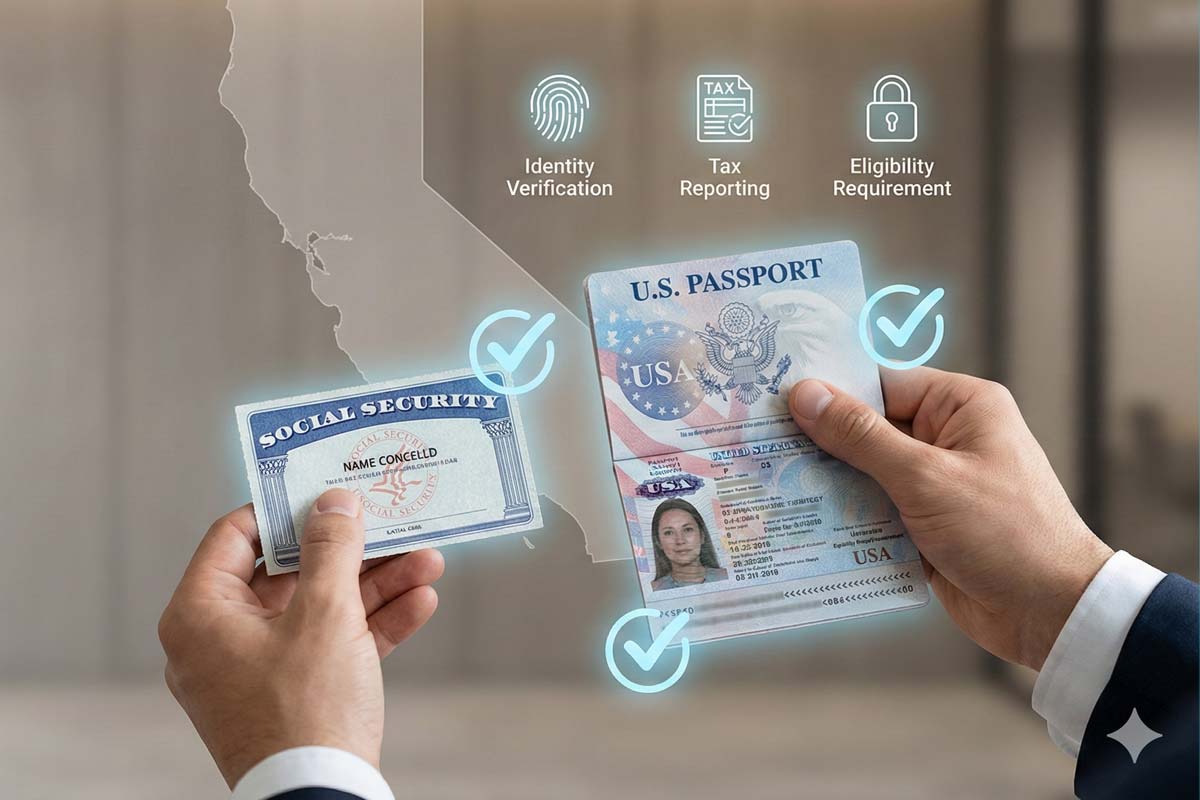
No, you don’t need to live in California to get your real estate license. But you do need to meet one specific requirement that’s often misunderstood. Before you spend money on real estate courses Read more...
No, you don’t need to live in California to get your real estate license. But you do need to meet one specific requirement that’s often misunderstood. Before you spend money on real estate courses or start planning your real estate exam, it’s important to understand how residency actually fits into the licensing process — and why it isn’t always a barrier.
Do I need to live in California to get my real estate license?
No, you don’t need to live in California to get your real estate license.
The DRE has no residency requirement. You only need a Social Security Number, a valid government-issued ID for the exam, and to take the test in person in California.
🔍 Myth: You Must Be a California Resident
This is completely false.
Your physical location — whether you live in Texas, Nevada, Oregon, or anywhere else in the U.S. — has zero effect on your eligibility.
The California Department of Real Estate (DRE) does not require:
A California address
A California driver’s license
California residency
Previous time spent in the state
You can complete the entire education portion from anywhere.
⭐ So What Is Required? A Valid SSN/ITIN
Here’s the real requirement that trips people up:
✔ You must have a Social Security Number (SSN).
This is the only “residency-adjacent” requirement — and it has nothing to do with where you physically live.
It’s strictly related to tax reporting.
If you have an SSN, you meet the identification requirement.
Residency doesn’t matter.
Your SSN does.
What About Identification? You Do Need a Valid, Acceptable ID
While residency doesn’t matter, the DRE does require that you provide valid government-issued identification when you take the state exam. This ID is used to verify your identity — not where you live.
Here’s what the DRE accepts:
✔ A current driver’s license (from any U.S. state)
✔ A state-issued ID card
✔A U.S. passport
✔ Military ID
And importantly:
❌ It does not need to be a California ID.
❌ It does not need to match a California address.
A Texas driver’s license, a Nevada state ID, a U.S. passport — all perfectly acceptable.
Your ID is simply used to confirm you are the person scheduled for the exam. It has nothing to do with proving residency, eligibility, or where you plan to live long term.
If your ID is expired, mismatched, or unusual, the DRE may not let you sit for the exam — so double-check that it’s valid and unexpired before test day.
🛠 What the Licensing Process Looks Like if You’re Out of State
If you’re living elsewhere in the U.S., here’s exactly what you can expect.
1. Complete the 135 Hours of Required Courses (Online)
This part is easy — all the courses can be done remotely from any state.
2. Submit Your Exam Application to the DRE
You’ll provide:
Your SSN
A mailing address (can be out-of-state)
Course certificates
3. Travel to California for the State Exam
The exam must be taken in person at a DRE-approved testing center.
4. Complete Fingerprinting (Live Scan) in California
You can do your LiveScan while you’re in California for the exam.
Can I Do My Fingerprints Out of State?Yes, but it requires "hard cards" rather than the electronic Live Scan. You will need two FBI Applicant Fingerprint Cards (FD-258).
Take these to a local law enforcement agency in your state to get fingerprinted, then mail the completed cards to the DRE with your application.Note on Fees: You must include the $49 fingerprint processing fee. The DRE allows you to combine this fee with your exam and license fees in a single payment.
5. Receive Your License
Your license will be mailed to you — even if your mailing address is outside California.
📋 The Real Residency Requirement Checklist
Here's what you actually need:
✔18 or older
✔ 135 hours of DRE-approved pre-license education
✔ Valid SSN
✔Pass the California state exam (in person)
✔ Live Scan fingerprinting in California
Here’s what you don’t need:
❌ California residency
❌ A California driver’s license
❌ A California mailing address
❌ Ever having lived in the state before
🧠 Why the Confusion Exists
A lot of the confusion comes from people mixing up:
DRE rules (state licensing)
Brokerage rules (company hiring policies)
Real estate practice laws (where you can legally work)
Let’s simplify:
👉 The DRE doesn’t care where you live.
👉 The DRE only cares that you can report income using your SSN and clear criminal background.
👉 You are licensed in California — not the state where you live.
🛡 In My 20+ Years of Teaching…
I’ve helped countless students who lived out of state:
Military personnel
College students home for the summer
Professionals planning to relocate later
Investors wanting a California license
Remote workers who never intended to move here
None of them were ever blocked by residency.
But some were concerned about background checks — and understandably so.
🏁 Final Word: Residency Isn’t a Requirement — But Your SSN Is
Here’s the plain-English truth:
California does not require you to live in the state.
California does require you to be identifiable for tax purposes.
If you have:
Your SSN,
Your courses,
And a trip planned for the exam,
You’re already on the right track.
Residency Requirement FAQs
1. Do I need to live in California to get my real estate license?
No. California has no residency requirement for real estate licensing. You can live anywhere in the U.S. and still qualify.
2. Can I use an out-of-state driver’s license for the California real estate exam?
Yes. Any valid U.S. government-issued ID — including an out-of-state driver’s license — is acceptable.
3. Is a Social Security Number required to get a California real estate license?
Yes. A valid SSN is required for tax reporting and identity verification. Residency has nothing to do with this requirement.
4. Can I take the California real estate exam if I live in another state?
Yes. You can complete all coursework remotely and apply from out of state, but you must travel to California to take the exam in person.
5. Do I need a California address to apply for the real estate exam or license?
No. You can use an out-of-state mailing address on your exam or license application.
6. Can I complete Live Scan fingerprinting outside California?
No. Live Scan must be completed in California, usually during your exam trip.
7. Will my out-of-state background check affect my eligibility?
California reviews background history regardless of your state of residence. Residency does not change how the DRE evaluates your record.
8. Do brokerages require California residency even if the state doesn’t?
Some brokerages have internal policies, but these are company rules, not DRE requirements.
📌 Next Steps
If you want more information or a deeper dive, here’s the complete California Real Estate License Guide, which walks you through the entire process in more detail.
🙋 Questions About Your Situation?
Email me anytime.
In 20+ years, I’ve seen every scenario — if there’s a path, we can help you find it.
|
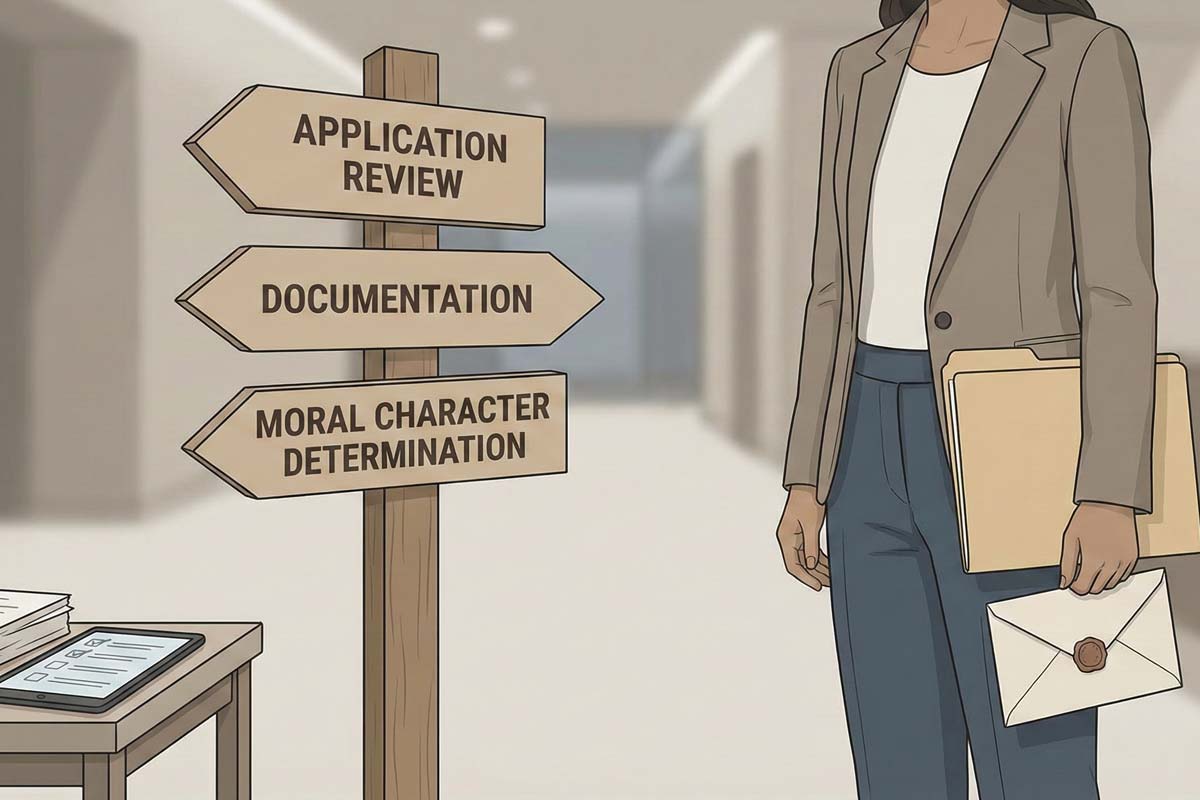
If you have a criminal record and you’re considering getting a California real estate license, you’re probably carrying a heavy question:
“Will my past prevent me from becoming an agent?” Read more...
If you have a criminal record and you’re considering getting a California real estate license, you’re probably carrying a heavy question:
“Will my past prevent me from becoming an agent?”
And if you’re anxious, confused, or even scared to begin, you’re not alone. In over 20 years of teaching real estate students in California, I’ve answered this question more times than I can count — usually from people who are motivated, hardworking, and trying to rebuild their lives.
Here’s the truth, stated plainly:
A criminal record does not automatically disqualify you.
But it also does not guarantee that you’ll be approved — even if the offense was long ago, even if it was expunged, and even if you’ve made significant progress in your life.
The California Department of Real Estate (DRE) reviews every applicant with a record through a detailed Moral Character Determination.
Some applicants are approved. Some are denied.
What determines the outcome?
Honesty, documentation, rehabilitation, and — importantly — the nature of the offense itself.
Before we get into the specifics, here’s one key distinction I tell all my students:
Eligibility rules and your government issued ID merely allow you to take the exam.
Moral character review determines whether you can actually receive the license after you pass.
You can start the process.
But whether or not you get the license depends on a thorough state review of your complete history.
How the DRE Evaluates a Criminal Record
“Moral Character” can sound vague or intimidating, but in practice it comes down to three things the DRE looks at:
1. Honesty
Did you disclose everything? Was it complete, accurate, and truthful?
2. Integrity
Does your conduct — past and present — demonstrate responsibility?
3. Trustworthiness
Can consumers trust you with confidential information, contracts, and money?
None of this is about perfection.
But it is about transparency and evidence of change.
The DRE’s review is strict.
Every applicant is fingerprinted, and the state receives full reports from both the DOJ and FBI. Nothing stays hidden. And the DRE expects disclosure of:
Every conviction ever — including DUIs, misdemeanors, and felonies
Convictions that were dismissed or expunged under Penal Code 1203.4
Any disciplinary action against a professional or business license
Any pending criminal charges
A conviction itself does not automatically lead to denial.
But failing to disclose often does.
If there’s one message I stress repeatedly, it’s this:
When in doubt, disclose. Every time.
A Realistic Understanding: Approval Is Possible — Not Guaranteed
Over the past two decades, I have had students with various criminal histories go on to become licensed real estate agents. I’ve also had students with similar histories get denied.
The difference usually comes down to:
The seriousness of the offense
The presence of fraud, dishonesty, or financial crimes
Time since the offense
Completion of probation
Documented rehabilitation
Consistency and truthfulness in disclosure
Whether the applicant took responsibility
To be clear:
Some offenses make licensure extremely difficult.
Crimes involving fraud, forgery, embezzlement, or financial misconduct carry significantly more weight because real estate involves handling money and sensitive documents.
Even with rehabilitation, these offenses may still result in denial.
I don’t say that to discourage you — I say it because you deserve accuracy, not false optimism.
The Fastest Path to Denial: Missing or Incomplete Disclosure
Let me be completely direct:
The DRE will find out everything, both before and after you are licensed.
Applicants are sometimes denied not because of the offense, but because:
Something wasn’t disclosed
A detail was incomplete
A conviction was “forgotten”
They assumed an expungement didn’t need to be listed
They relied on advice from friends or attorneys who said “don’t worry about it”
The DRE is crystal clear on this:
Failure to disclose is treated as an attempt to obtain a license by fraud or misrepresentation.
No school, no friend, and no online source can override what the DRE requires.
What You Should Do If You Have a Criminal Record
Over the years, I’ve developed a step-by-step approach I recommend to any student who is worried about their background. It doesn’t guarantee approval — nothing does — but it positions your application for the fairest review possible.
You can also contact the DRE at 877-373-4542 with other questions.
1. Obtain Your Complete Criminal Record
Do not guess.
Do not rely on memory.
Request:
DOJ criminal history
Court docket(s)
Final disposition records
Make sure you know the full picture:
The exact charges
Dates of arrest and conviction
Whether probation was completed
Whether fines were paid
Whether any part of the record was dismissed or reduced
The DRE will compare what you disclose to what the fingerprint report shows.
2. Prepare a Clear, Factual Statement of Explanation
Your Statement of Explanation matters — a lot.
A strong explanation includes:
What happened (factually, without minimizing)
Why it happened
What you learned
What’s changed in your life since
Why similar conduct won’t occur again
Avoid excuses. The DRE isn’t looking for justification — they’re looking for accountability.
3. Assemble Evidence of Rehabilitation
Rehabilitation is essential, especially for more serious offenses.
Evidence can include:
Letters of reference
Proof of stable employment
Documentation of treatment or programs completed
Community service records
Certificates from education or training
Court documents showing compliance
AA/NA attendance records (for substance-related offenses)
Counseling or therapy participation
The stronger and more organized this section is, the clearer your current character becomes.
4. Organize Your Documents for Submission
Think of this like preparing a professional portfolio.
Create a clean, organized packet containing:
All case information
All disclosures
Statement of Explanation
Rehabilitation documents
A chronological summary
Make it easy for the DRE reviewer to understand your history and see your progress.
If You Are Denied
If the DRE denies your application, the process does not necessarily end there.
You may:
Request reconsideration under Government Code 11521
Seek judicial review under Government Code 11523
Some applicants choose to consult an attorney experienced in administrative law to navigate deadlines and procedures.
Again — not a guarantee, but an available path.
The Bottom Line: Your Past Matters, but It Doesn’t Automatically Decide Your Future
A criminal record creates uncertainty in the licensing process — and you deserve a realistic understanding of that. Some applicants with records are approved. Some are denied. The outcome depends on honesty, documentation, accountability, and the specific facts of the offense.
But here’s what I can tell you after two decades of teaching:
You’re not disqualified from trying.
You’re not automatically denied.
And you’re not without a path forward at some point through the process.
If you approach the process carefully and truthfully, you give yourself the best chance at a fair review — and potentially, a career that can change your life.
When you're ready to take the next step or want help understanding the licensing process, we’re here to guide you every step of the way.
Q: Can I get a California real estate license with a felony?
A: Possibly. Felonies aren’t automatic denials, but the DRE reviews them under its moral character standards. Approval depends on disclosure, rehabilitation, and the specifics of the offense.
Q: Do I have to disclose expunged or dismissed convictions?
A: Yes. Even expunged or dismissed convictions must be disclosed. The DRE receives full DOJ/FBI fingerprint reports, and failing to disclose can lead to denial.
Q: What offenses make it hardest to get licensed?
A: Crimes involving fraud, dishonesty, theft, or financial misconduct face strict review and are the hardest to overcome. These may still result in denial even with rehabilitation.
Q: What does the DRE look at in a moral character review?
A: Honesty in disclosure, nature of the offense, completion of court requirements, time since the violation, and evidence of rehabilitation.
Q: What documents should I submit if I have a criminal record?
A: Court records, DOJ/FBI reports, a clear Statement of Explanation, and evidence of rehabilitation such as employment history and reference letters.
Q: Will the DRE find out if I don’t disclose something?
A: Yes. Fingerprint checks reveal all convictions, including expunged ones. Non-disclosure is one of the most common reasons for denial.
Q: What can I do if the DRE denies my application?
A: You may request reconsideration or pursue judicial review. Some applicants consult an attorney to navigate appeal deadlines.
Want even more information on getting your real estate license? Check out our comprehensive Real Estate License Guide.
|

Worrying about your ID for the exam is more common than you think. Over two decades of teaching, I've seen that anxiety firsthand - often at the last minute (don’t do this!).
The good news is, Read more...
Worrying about your ID for the exam is more common than you think. Over two decades of teaching, I've seen that anxiety firsthand - often at the last minute (don’t do this!).
The good news is, this is one of the easiest problems to solve. Here’s the definitive guide to what you need.
Let me be totally direct:
Not every “photo ID” works.
Only four specific IDs are accepted.
Show up with the wrong one, and you won’t be allowed into the testing room.
Let’s break down exactly what the DRE requires — in plain English.
Why This Matters (Exam Day Consequences)
Here’s the hard truth:
If you don’t bring an approved ID, the DRE will NOT admit you to the exam site.
No exceptions.
No second chances that day.
No “but I have a picture of it on my phone.”
You’ll lose your exam slot, forfeit your fee, and have to reschedule — sometimes weeks out.
The ID rules are strict because they’re tied to exam security. Eligibility and education requirements are one thing.
Exam-day check-in is another.
The ONLY DRE Approved Forms of Identification
The California Department of Real Estate accepts only four IDs at check-in:
✔ Current state-issued driver’s license or DMV identification card
✔ U.S. Passport
✔ Foreign government-issued passport
✔ U.S. Military ID
That’s the entire list.
Some quick real-world examples:
Your Arizona or Texas driver’s license? ✔ Yes — totally valid. (Out-of-state examinees should also read our guide on Residency Requirements.)
Your passport from India, Mexico, or the Philippines? ✔ Yes — if it’s valid and unexpired.
Your military CAC card? ✔ Yes — fully acceptable.
The ID must be physical, valid, and unexpired.
The proctor must be able to check it in-hand at the door.
❌ What the DRE Will NOT Accept
If it’s not on the four-item list above, assume it’s not acceptable.
That includes:
❌ Student IDs
❌ Temporary paper licenses
❌ Digital IDs (Apple Wallet, Google Wallet, photos, screenshots)
❌ Work badges
❌ Costco or membership cards (I love Costco - but the card isn’t going to get you into the exam site! Not even the Executive one!)
❌ Photo bank/debit cards
Even if they have your picture.
Even if another agency randomly accepted them.
The DRE won’t.
❌ Expired or Damaged IDs (Important Clarification)
The DRE requires that your ID must be:
Valid
Unexpired
Able to clearly establish your identity
Here’s what that means in practice at DRE testing centers:
❌ Expired = Not accepted
Even by one day.
❌ Damaged enough that the proctor cannot verify your identity = May be rejected
The DRE does not publish a detailed “damaged ID list,” but proctors are required to reject IDs that look altered or cannot be read clearly.
The types of damage that often cause problems include:
Cracks that run through your photo or information
Peeling laminate that obscures text
Scratches across the photo
Chipped edges cutting into your name or expiration date
Water damage on a passport page
Warping that prevents scanning or visual verification
Minor cosmetic wear is usually fine.
But if your ID looks questionable or unreadable, you’re taking a real risk.
Bring the cleanest, most legible version of your ID — and if in doubt, renew it.
What If You Don’t Have One of These Approved IDs?
You’re not out of luck — but you need to plan ahead.
✔ If your driver’s license is expired
Renew at the DMV.
But remember: interim/temporary paper licenses are NOT accepted.
You must wait for the physical card.
✔ If you need a passport
Standard processing: 6–8 weeks
Expedited: 2–3 weeks
Don’t schedule your exam until you have the physical passport in hand.
✔ If you lost your only accepted ID
You’ll need to replace it before taking the exam.
The DRE will not make exceptions.
ID Rules vs. Eligibility Rules — Don’t Mix Them Up
A lot of students confuse exam-day identification with overall eligibility to take the exam.
Let’s separate them clearly.
Eligibility Requirements = What allows you to apply for the exam.
For a full breakdown of the application steps, read our definitive guide on how to get a real estate license in California.
These include:
Being at least 18
Having a valid SSN/ITIN
Completing the required courses
Passing a background check after the exam
Living in California isn’t a requirement
ID Requirements = What allows you to walk into the testing room.
Only four IDs qualify — nothing else.
Two different sets of rules.
📋 Quick Exam-Day Checklist (Screenshot This!)
Here’s the exact checklist I give my ADHI students:
✔ Bring one of the four approved IDs
✔ Verify it’s valid and unexpired
✔ Check that your name matches your DRE registration
✔ Bring a clean, readable ID (no cracks or peeling)
✔ Arrive 30 minutes early
✔ Leave your phone off and stored away
Follow this and your check-in will be smooth.
🔍 Myth vs. Reality (Rapid Clarifications)
Myth: “Any government ID should work.”
Reality: Only four specific IDs are allowed.
Myth: “The DMV temporary license counts.”
Reality: It doesn’t.
Myth: “If my ID is expired but I look the same, they’ll let me in.”
Reality: They won’t.
Myth: “Digital IDs are fine now.”
Reality: Not for the real estate exam.
Myth: “A slightly damaged ID is okay.”
Reality: Minor wear is fine, but if the damage affects readability or legitimacy, the proctor must reject it.
✅ You’re Now Fully Prepared
When you understand the ID rules, exam day becomes much less stressful.
Bring one of the four approved IDs.
Make sure it’s valid.
Make sure your name matches
And make sure the ID is readable and clearly establishes who you are.
Do that — and you’ll walk into the testing center confident, calm, and focused on one thing:
Passing.
You’ve got this.
FAQ: California Real Estate License ID Requirements
1. Does the DRE accept out-of-state driver’s licenses?
Yes. Any valid U.S. state-issued license or ID is acceptable.
2. Will they accept a temporary paper license from the DMV?
No. Only physical, permanent IDs are accepted.
3. Can I take the exam with a slightly damaged ID?
If it’s minor wear, usually yes.
If the proctor cannot clearly verify your identity, they may reject it. When in doubt, replace it.
4. Can I use a digital ID on my phone?
No. Digital IDs, photos, and screenshots are not accepted.
5. What if my name changed?
Bring legal documents linking your old and new names and update the DRE record early.
{
"@context": "https://schema.org",
"@type": "WebPage",
"url": "https://www.adhischools.com/blog/california-license-id-requirements",
"speakable": {
"@type": "SpeakableSpecification",
"xpath": [
"/html/body//section[1]",
"/html/body//section[2]"
]
},
"name": "California Real Estate License ID Requirements",
"description": "Exact DRE-approved identification requirements for California real estate exam day."
}
|
If you're thinking about starting a real estate career in California, one of the first questions you’ll have is: “Do I even qualify?” Maybe you’re unsure whether your background will affect your Read more...
If you're thinking about starting a real estate career in California, one of the first questions you’ll have is: “Do I even qualify?” Maybe you’re unsure whether your background will affect your chances, whether you need to live in California, or if an out-of-state ID will cause problems.
I say all this having been in the real estate education business for over 20 years and answering this question almost daily.
At the end of the day, California’s real estate license requirements are far more accessible than most people expect. To get started, you only need to meet four core eligibility standards set by the California Department of Real Estate (DRE).
Before we break them down, one important distinction:
Eligibility rules determine whether you can apply for and take the exam. As long as you meet these, the state will let you take the test.
License requirements (Live Scan + SSN/ITIN submission) happen after you pass and you’re applying for your actual real estate license
Understanding these DRE eligibility requirements upfront can save you time, money, and stress. Let’s explore exactly what the state requires — and what it doesn’t.
The Four Pillars of California Real Estate License Eligibility
1. Age and Citizenship Requirements
You Must Be 18 or Older
California requires all real estate salesperson applicants to be at least 18 years old. No exceptions.
This means, if you're 17, you can finish your courses early, but you cannot apply or take the exam until your 18th birthday.
No Citizenship or Residency Requirement
This is where most misconceptions come from. The DRE does not require:
U.S. citizenship
California residency
Proof of legal presence or immigration status
California does not check immigration status at any point in the licensing process.
You can become a real estate agent in California even if you are not a U.S. citizen or permanent resident. Many years ago, there was a proof of legal presence document, but this has been eliminated.
What Identification Is Required
To take the exam, you must present a valid, government-issued ID such as:
U.S. driver’s license (any state)
U.S. state ID card
U.S. passport or passport card
U.S. military ID
Foreign driver’s licenses are not accepted for the real estate exam.
Your ID must be current, contain your photo and signature, and match the name on your exam registration and license application exactly.
SSN/ITIN Rules
After you pass the exam, the DRE will require either:
a Social Security Number (SSN), or
an Individual Taxpayer Identification Number (ITIN)
This requirement is only for the license stage and is tied to tax reporting and identity verification — not immigration enforcement.
2. Education Requirements
You Must Complete Three College-Level Courses
Before the DRE will schedule your exam, you must complete:
Real Estate Principles
Real Estate Practice
One approved elective, such as
Real Estate Finance
Real Estate Economics
Real Estate Appraisal
Legal Aspects of Real Estate
Property Management
Escrow
Courses must be taken through:
A California community college
A DRE-approved real estate school, like ADHI Schools.
An accredited online program
Online courses are fully acceptable if the provider is DRE-approved.
No High School Diploma or GED Required
The DRE does not require a high school diploma or GED.
However, success in the coursework and on the exam requires:
strong reading comprehension
good grasp of the English language (the real estate license exam is in English)
the ability to understand contracts and disclosures
3. Background Check and Moral Character
Live Scan Fingerprinting
Every applicant must complete a Live Scan background check. Live Scan is California’s electronic fingerprinting system used to check criminal history.
When does Live Scan happen?
After you pass the exam, when applying for the license, or
With the combined exam + license application (recommended)
Fingerprinting fees include the FBI/DOJ fee (currently $49) plus vendor fees, which vary by location.
What “Moral Character” Really Means
The DRE evaluates whether an applicant demonstrates:
honesty
integrity
trustworthiness
This is the legal standard for protecting consumers in real estate transactions.
A Criminal Record Does Not Automatically Disqualify You
This is another major misconception. A conviction is not an automatic denial.
The DRE evaluates:
the nature and seriousness of the offense
how long ago it occurred
evidence of rehabilitation
whether the offense relates to real estate activities
overall behavior and conduct
Full Disclosure Is Mandatory
Failure to disclose a conviction is often treated more seriously than the offense itself.
Be completely honest in your application — transparency increases your likelihood of approval.
4. Identification Requirements for the Exam and License
To take the exam, you must present:
valid U.S. government-issued ID or
a valid foreign passport
The ID must be:
current
government-issued
include photo + signature
match your exam registration and license application exactly
Name mismatches (initials, hyphens, missing middle names, recent name changes) are the #1 cause of exam-day problems.
Update your ID before scheduling your exam if anything has changed.
Who Qualifies for a California Real Estate License?
Here is a quick summary of the four eligibility pillars:
Eligibility Requirement
What the DRE Requires
What the DRE Does Not Require
Age
Must be 18+
No exceptions
Citizenship
SSN/ITIN for licensing
No legal presence or citizenship verification
Education
3 approved courses
No high school diploma
Background
Live Scan + honesty
Not automatically barred with a record
ID
Valid U.S. ID or foreign passport
No residency requirement
Once you meet these four requirements, the DRE will authorize you for the exam. After you pass and complete Live Scan, you’ll be eligible for your California real estate license.
You can find a more thorough breakdown of this information in our Real Estate License Guide.
Frequently Asked Questions
Do I need to live in California to get licensed?
No. California residency is not required.
Can undocumented individuals get licensed?
Applicants with an ITIN can obtain a real estate license. No proof of legal presence is required.
Are online real estate courses accepted?
Yes. Online courses are accepted if they come from a DRE-approved provider, like ADHI Schools, or accredited college.
Can you get licensed with a background event?
Yes. Background does not automatically disqualify you. The DRE evaluates each case individually based on honesty, rehabilitation, and relevance to real estate.
Ready to Take the Next Step?
If you meet the four eligibility requirements, you’ve already cleared the biggest early hurdle. With the right preparation and courses, thousands of new agents earn their California real estate licenses every year.
You could be next!
|
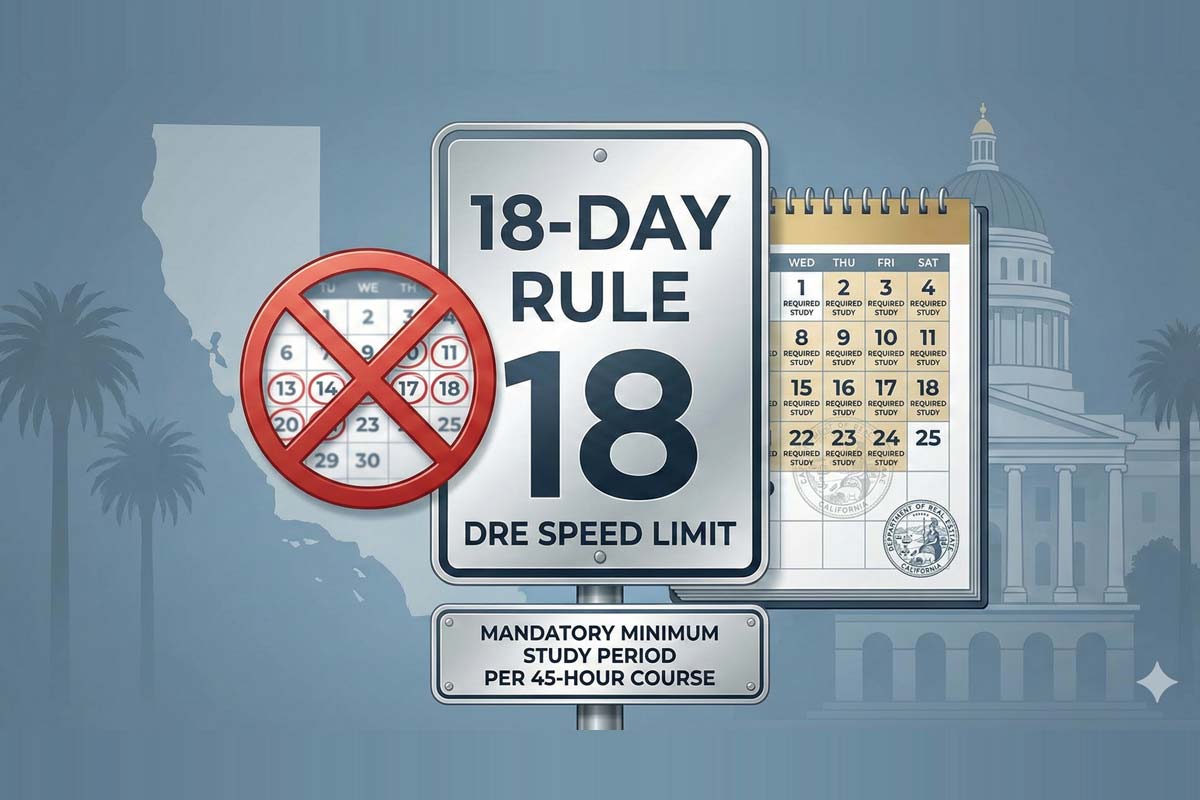
To get a California real estate license, you must complete 135 hours of approved coursework. These are the California real estate license education requirements set by the DRE. You don’t need a college Read more...
To get a California real estate license, you must complete 135 hours of approved coursework. These are the California real estate license education requirements set by the DRE. You don’t need a college degree, and you don’t need industry experience to get a sales license.
Voice Answer: You need 135 hours of DRE-approved coursework to qualify for a California real estate license. That includes Real Estate Principles, Real Estate Practice, and one elective. No degree is required. Each course must be completed over at least 18 days, which is a strict DRE timing rule.
You only need to complete three specific courses: Real Estate Principles, Real Estate Practice, and one approved elective. That’s the entire academic requirement.
These education rules form the core DRE prerequisites for exam eligibility. Once you finish the 135 hours and receive your certificates, you can apply for the salesperson exam. When your exam application is approved, remember that you'll need a valid photo ID (like a driver's license) to be admitted to the testing center on exam day.
There are no shortcuts, no alternative pathways (besides being a member of the California bar), and no substituted degrees unless directly listed in the law.
The system is strict but simple.
If you want more information or a deeper dive, check out our complete guide to getting your real estate license.
🔍 Myth vs. Reality: The College Degree
People often assume real estate is like accounting or law. They believe a degree unlocks the license. That myth stops students before they even start. The truth is blunt: The DRE does not require a degree.
You only need the mandated courses.
Some students do qualify through certain college courses they have taken in the past but most people will meet the education requirements through the standard 135-hour pathway. That’s why it’s important to understand the real rules.
Myth
Reality
Why it matters
You need a college degree.
You only need 135 hours.
Saves time and avoids unnecessary schooling.
Business majors skip everything.
Only specific real estate courses qualify.
Prevents false assumptions about automatic credit.
GPAs affect eligibility.
GPAs are irrelevant.
Removes anxiety about academic history.
These myths distract people from the simple path. Focus on what the DRE actually requires.
To be clear, I went to college at Cal Poly, got a degree and don’t regret it at all. That experience shaped a lot of how I teach today. College pushed real teamwork, deadlines, and problem-solving — all skills that translate directly into real estate, but the degree isn’t a requirement.
⭐ The "Big Three" Required Courses
Remember that California only requires one thing academically: Complete three 45 hour DRE-approved courses totaling 135 hours. Every applicant—whether new to the industry or coming from another field—must take these same classes.
Real Estate Principles
Consider this your foundation. It equips you with the vocabulary—from property types to agency laws—that you will face on test day. Many students make the mistake of underestimating this course. Don’t. Principles is the backbone of your future license.
Real Estate Practice
This course focuses on the day-to-day realities of the business. Disclosures, listings, offers, and client interactions dominate this material. It helps you think like an agent, not a test taker. Remember that the Real Estate Practice course must now contain an interactive implicit bias component according to SB1495.
One Elective
You can choose from options like Finance, Legal Aspects, or Property Management. The choice of the elective is less important than getting it done.
These are the only education requirements the DRE needs academically. Complete the Big Three, earn the certificates, and you’re eligible to apply for the real estate exam.
⏱️ The 18-Day Rule (Speed Limit)
Who doesn’t love speed? But California sets a hard limit. You cannot legally complete a 45-hour correspondence course in less than 18 days. This applies to every approved school, including ours. There is no workaround. There is no exception.
Why? The state wants meaningful study time. They want students to absorb the content instead of rushing through modules. So the DRE built this rule to slow you down. Schools must track your progress and enforce it.
You can take multiple courses at once, but each course has its own minimum timeline. That means the fastest anyone can complete the three courses is 54 days (18 days x 3 courses). Many providers imply faster completion. Don’t fall for it.
Plan your schedule with this rule in mind. You’ll finish more smoothly, and you won’t get flagged for rushing the material.
❌ The Mistakes That Slow Students Down
Most delays have nothing to do with the coursework. They come from preventable mistakes.
Here are the biggest pitfalls:
Choosing a difficult elective and stalling halfway through.
Forgetting to save course certificates for the state application.
Stopping mid-course and restarting later, losing momentum.
Using non-approved schools and discovering the courses don’t count.
Ignoring the 18-day rule and failing required chapter quizzes.
Failing to disclose a past background item. The DRE values honesty above almost everything else; attempting to hide a background issue causes more delays than the issue itself.
Each mistake adds stress and time. Avoid them and you’ll finish your education and licensing quickly and cleanly.
🧭 In My 23+ Years of Teaching…
Students sometimes fear math. They imagine complex loan calculations or high-level finance problems. But the exam isn’t built to stump you with math. The real challenge is vocabulary. California real estate uses precise language, and exam writers test your understanding of those terms.
I’ve watched strong students fail because they ignored terminology. I’ve also watched anxious students pass because they focused on consistent reading. The DRE expects you to know definitions, agency concepts, disclosures, and basic laws. That’s where the exam is won.
The best students build a pattern: short study sessions, steady note-taking, and quiz repetition. They avoid cramming. They respect the 18-day rule. They treat the material like the new language it is. Master the vocabulary and you stack the deck in your favor.
❓ Education FAQs
Q: Can I take the courses online?
A: Yes. The DRE allows fully online, self-paced courses through approved providers like ADHI Schools. Most students finish faster online because they control their study time.
Q: Do old college credits count?
A: Only specific real estate or real estate-adjacent courses qualify. General business classes don’t count. The DRE reviews transcripts individually.
Q: Do I need a degree?
A: No. Degrees are irrelevant. Only the three 45-hour courses matter for most applicants.
Q: Can I complete the courses faster than 18 days?
A: No. The 18-day rule is firm. Every 45-hour course requires a minimum of 18 days.
Q: What if I already took one of the courses?
A: If it’s from a DRE-approved provider or qualifying college program, you may use it. Keep your certificate or transcript.
Q: How long do most students take?
A: Many complete the 135 hours in 8–12 weeks.
Finishing the California real estate license education requirements is straightforward once you understand the system. Complete the Big Three, follow the 18-day rule, and avoid the common mistakes.
If you want the simplest possible path to finishing your 135 hours, check out our packages.
|
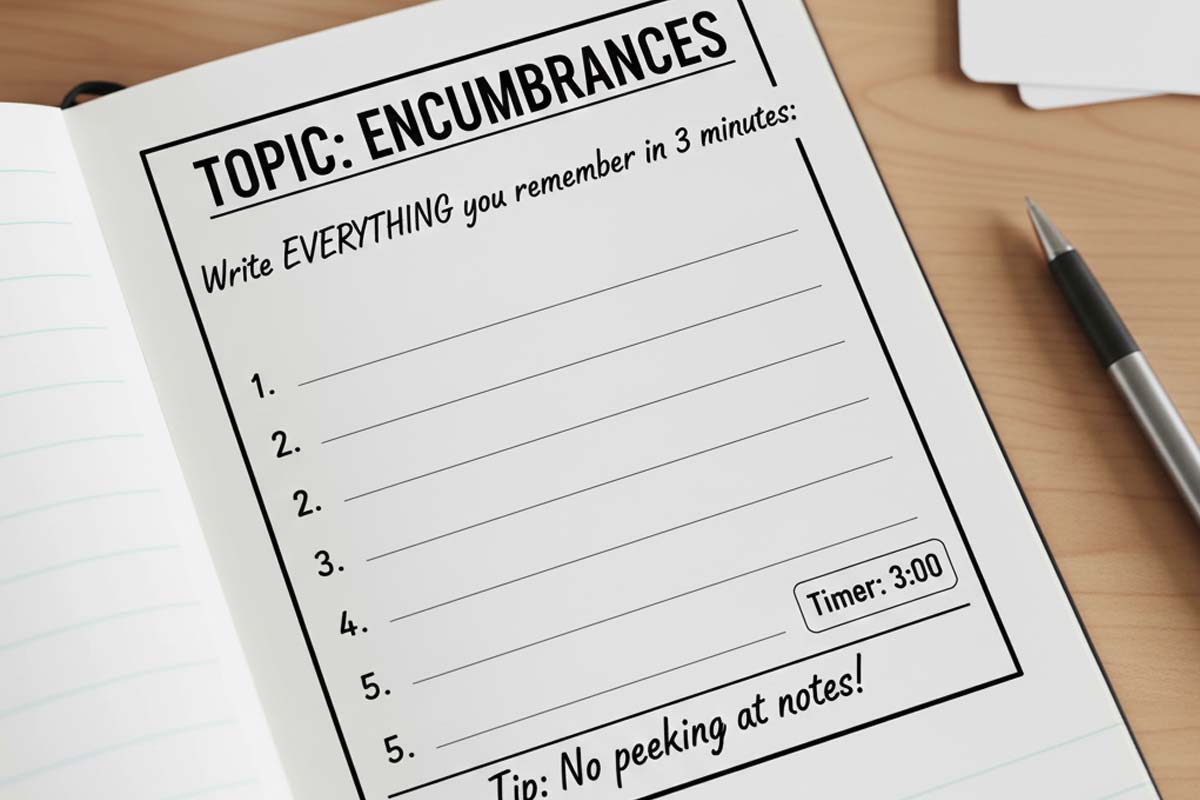
You’re staring at pages of California real estate law and you still can’t explain “constructive notice” five minutes later. If that feels familiar, you’re not alone — the DRE exam overwhelms Read more...
You’re staring at pages of California real estate law and you still can’t explain “constructive notice” five minutes later. If that feels familiar, you’re not alone — the DRE exam overwhelms thousands of students every month.
The reason is simple: the CA real estate exam doesn’t reward passive readers. It rewards students who use the right memory techniques designed for scenario-based questions.
I’m Kartik. For more than 20 years, I’ve taught students exactly how to retain DRE vocabulary, apply it under pressure, and avoid the traps baked into the exam. Everything below comes from real results — these are the techniques that consistently produce ADHI passers.
For the full roadmap of your licensing journey, start with our master guide: California Real Estate Exam Guide.
Why Simple Memorization Fails the CA Exam
Most students rely on rereading definitions, which creates a false feeling of familiarity. But the DRE exam doesn’t test direct recall.
Compare these:
Rote recall: “What is an easement appurtenant?”
Actual exam style: “A property owner grants permanent access to a neighbor. Which type of easement has been created?”
You can recognize the term and still get the question wrong. That is the trap.
Two things cause most CA test-takers to fail despite “studying”:
1. Recognition Illusion
You highlighted the page.
You nodded as you read.
You saw the term before.
But you can’t distinguish easement appurtenant from easement in gross when the DRE mixes them into four answer choices.
2. Category Confusion
The DRE doesn’t ask for definitions — it tests your ability to classify.
Examples:
Students mix up general liens vs. specific liens
Students misidentify estate types
Students confuse agency duties under pressure
If you want to avoid these traps, you need a system built for real estate exam thinking, not for a psychology class. These principles make far more sense once you see how they fit into a structured study routine, which I outline in Best Way to Study for the California Real Estate Exam.
The ADHI 4-Layer Memory Method (CA Exam Edition)
This is not abstract theory. This is the exact memory system ADHI students use to pass — built around how the DRE writes questions.
Layer 1: Vocabulary Compression (“Decluttering the Law”)
The DRE exam is vocabulary-heavy: encumbrances, estates, liens, agency, contracts — hundreds of terms that must be instantly recognizable.
We compress big concepts into tight, memorable anchors:
JT Unities → TTIPTime, Title, Interest, Possession
Bundle of Rights → DEEP CDisposition, Enjoyment, Exclusion, Possession, Control
These mnemonics accomplish two goals:
They shrink long definitions into manageable pieces
They help you recall terms correctly even when the exam twists the wording
Action Step: Pick a chapter (like Agency) and rewrite every major idea into a 3–5 letter mnemonic or short phrase.
Layer 2: Retrieval Cycles (“Training Your Exam Brain”)
Passive reading builds recognition — retrieval practice builds retention. The DRE exam rewards the latter.
Action Step: The Brain DumpChoose a topic (e.g., Encumbrances). Close your notes.
Write down everything you know — cold.
Most ADHI students see a 25–40% jump in recall after one week of doing this instead of rereading.
Retrieval, not rereading, is the reason ADHI students outperform passive readers.
Layer 3: Scenario Conversion (“Turning Definitions Into Answers”)
This is where the DRE separates passers from near-missers.
A definition alone won’t help you. You need to be able to apply it.
Action Step: Teaching-Back
Explain the difference between a Net Lease and a Gross Lease without looking at your notes.
If you can explain it, you own it.
If you stumble, the memory is incomplete.
Action Step: Build 1-Page Maps
Create a simple mind map for categories like:
Voluntary vs. involuntary liens
Freehold vs. less-than-freehold estates
These maps train your brain to identify categories — exactly what the exam demands. You’ll see how these category skills translate into higher accuracy on practice questions in our guide on How to Practice Exams for the CA Real Estate License Test.
Layer 4: Spaced Reinforcement (“Locking in Your Definitions”)
Cramming works for 24 hours.
Spacing works for 30 days.
This layer builds long-term exam recall.
Flashcard Triage System (A/B/C)
Sort your flashcards into:
A (Known Cold)
B (Shaky / Confused)
C (No clue yet)
Your schedule:
Review B every 1 hour → 1 day → 3 days → 7 days
Review C daily until it becomes a B
If you struggle with the time management needed for reinforcement, you’ll benefit from the structured study timelines we outline in How Long Should You Study for the CA Real Estate Exam?
Exam-Day Recall Simulation (Your Final Test Before the Test)
Before your official exam, test recall the same way the DRE will:
20-Question Sprint
Pick 20 practice exam questions
Answer them under time pressure
Explain why the correct answer is right
Explain why each wrong answer is wrong
If you can do this, you’re ready.
If you can’t, stay in Layers 2 and 3 until you can.
Stop These Common Memory Mistakes
These mistakes destroy DRE scores:
❌ Over-highlighting
You highlighted entire pages. That’s recognition, not retention.
❌ “I’ve read this” syndrome
If you can’t explain easement appurtenant out loud, you don’t know it.
❌ Marathon cramming sessions
They guarantee you will forget the material by test day.
❌Confusing categories
Without a mental map, the test’s scenario questions will crush you.
How a Crash Course Fits Into Memory Training
A crash course doesn’t replace memorization — it accelerates Layer 3.
During the crash course, we:
Convert definitions into real-world examples
Show you how the DRE twists vocabulary
Teach you to eliminate wrong answers quickly
Reinforce your category maps
It’s the difference between knowing a term and being able to use it under pressure. For help deciding if a crash course fits your study plan, read our guide on Should You Take a Crash Course for the CA Real Estate Exam?
FAQ
What is the best memorization technique for the CA real estate exam?
Retrieval practice (Layer 2). Nothing beats it.
How do I memorize real estate vocabulary faster?
Use mnemonics like TTIP and DEEP C to compress information.
Does the CA real estate exam require a lot of memorization?
Yes — but success comes from applying the vocabulary, not just knowing it.
Your 72-Hour ADHI Prep Protocol
72 Hours Out → Review TTIP, DEEP C, and your Pile A flashcards
48 Hours Out → Take a full 150-question timed exam
24 Hours Out → Review scenario maps only
Exam Morning → Quick review of B-pile only
Your Memory Is Your License
The California real estate exam is a test of application, not just recognition. If you walk into the testing center relying on passive reading, you will fall victim to the traps of Recognition Illusion and Category Confusion that defeat most test-takers.
The good news is that passing is a matter of strategy. By adopting the ADHI 4-Layer Memory Method, you shift your focus from simply reading the law to actively owning it.
Layer 1 (Compression): Use mnemonics like TTIP and DEEP C to declutter hundreds of terms into memorable anchors.
Layer 2 (Retrieval): Replace passive rereading with the Brain Dump technique to hardwire vocabulary into your long-term memory.
Layer 3 (Scenario Conversion): Build simple 1-Page Maps and practice Teaching-Back to master the crucial skill of classification.
Layer 4 (Reinforcement): Use the Flashcard Triage System and Spaced Reinforcement to lock in your knowledge until exam day.
Your success hinges on your ability to confidently move from knowing the definition of an easement to correctly classifying it in a complex scenario. Start implementing the Brain Dump today and begin turning your hard work into a guaranteed result.
|
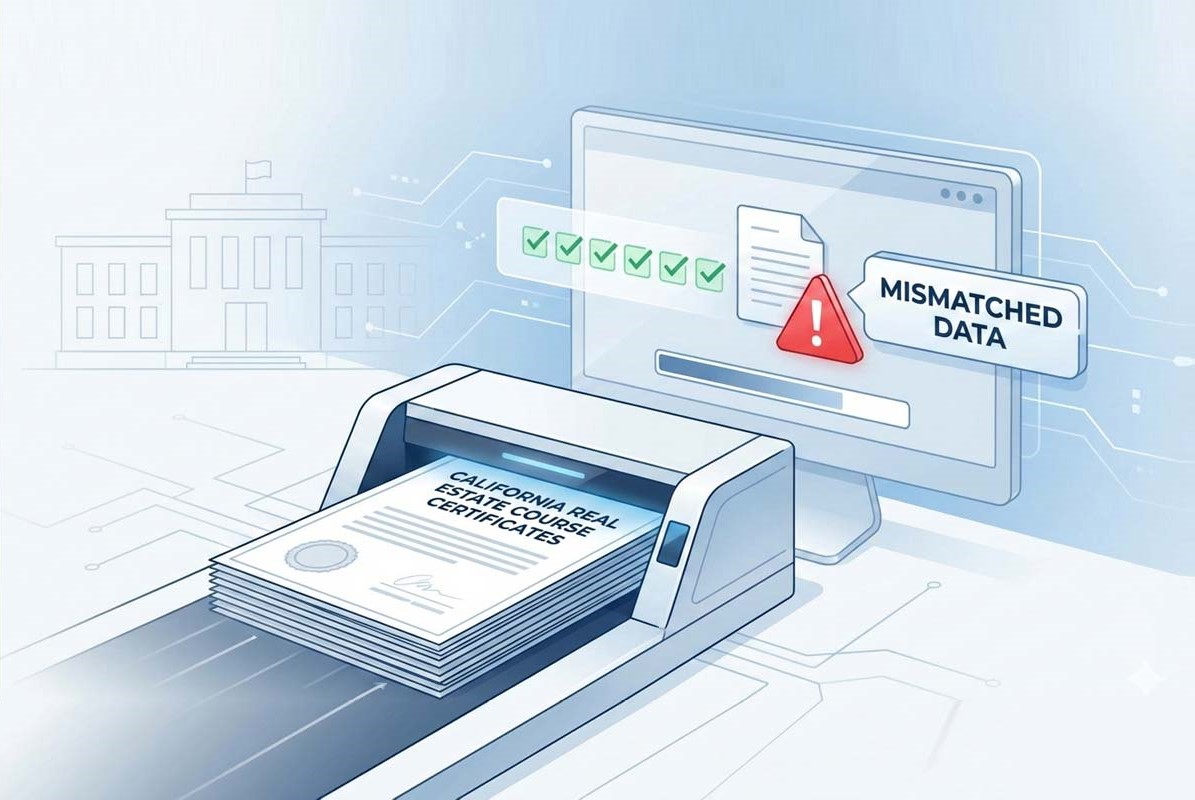
Key Takeaways (Read This First):
Match your name exactly across every certificate and application.
Verify your provider’s DRE sponsor number is valid and active.
Make sure your course titles and Read more...
Key Takeaways (Read This First):
Match your name exactly across every certificate and application.
Verify your provider’s DRE sponsor number is valid and active.
Make sure your course titles and completion dates are correct and align with DRE expectations.
You’ve completed your real estate courses, downloaded your certificates, and submitted your application — but your real estate exam application still hasn’t been approved. For most applicants, the delay begins with one easily overlooked issue: Education Verification.
The DRE’s system is designed to move efficiently when everything aligns, but it slows down immediately when it encounters inconsistencies. Understanding how the DRE evaluates education documents is key to avoiding weeks of unnecessary waiting.
How the DRE Automated Verification Works
The DRE processes thousands of applications every month (crazy right?), and most of that work happens through automated checks. The system verifies whether your certificates match what their database expects: your name, your provider, your course titles, and the timing of your completions.
If anything looks unusual — mismatched names, unexpected dates, incorrect titles, inactive provider numbers — the automated flow stops. Your file leaves the fast lane and drops into manual review, which is where delays begin.
Most applicants assume that as long as the courses are completed, the DRE will read the certificates and approve them. But the DRE’s process is literal and exact. Even small formatting errors or inconsistencies can trigger a complete review.
Top 4 Reasons for Education Verification Failure
1. The Name Match Requirement
The biggest cause of delays comes from name inconsistencies.
Your certificates must reflect your legal name exactly as it appears on your DRE application.
If your application says one thing, your ID says another, and your certificate uses a shortened version or a hyphen that appears nowhere else, the system assumes there’s a potential identity mismatch.
You may see a harmless variation. The DRE sees a documentation discrepancy that must be reviewed manually.
Example of a Name Mismatch That Triggers a DRE Delay
Name on DRE Application: Maria Laura Hernandez
Name on Driver’s License: Maria L. Hernandez-Wilson
Name on Course Certificates: Maria Hernandez
To the applicant, these all feel like harmless variations — a middle initial here, an abbreviated last name there, a maiden name.
But to the DRE’s automated system, these are three different names.
The system cannot confidently verify that the education belongs to the same person who submitted the application, so your file is pulled out of the automated queue and into manual review.
A small inconsistency that seems meaningless to you is treated by the DRE as a potential identity mismatch, and that’s enough to slow the entire licensing process down.
2. Incorrect or “Marketing” Course Titles
Course titles create another major slowdown.
The DRE expects titles to match their official naming conventions. Providers often rename courses for branding, but the DRE doesn’t process branding — they process compliance.
If the DRE expects “Legal Aspects of Real Estate” and your certificate says ““Intro to RealEstate Fundamentals,” the system may not recognize it, pushing your file into manual review.
This is not the DRE being picky. It’s the DRE preventing misclassification.
3. Invalid or Inactive Provider Numbers
Provider issues are more common than people realize.
Not every website selling real estate courses is a DRE-approved school (be careful!). Some operate as resellers.
If the DRE cannot verify the provider number printed on your certificate, the application pauses immediately because the system cannot confirm your education source.
This is one of the quickest ways for an applicant to fall into a long delay without understanding why.
4. Timestamp and Study Period Errors
Completion dates also matter. California requires minimum study periods.
If your coursework appears to be completed too quickly… you fall into manual review.
The DRE checks whether your completion timeline aligns with legally required pacing. If your provider uses a faulty timestamping system, or if your certificates don’t reflect legal timing, your application will be held until an analyst can review it manually.
Even when the student did everything correctly, tech errors on the provider side can stall an otherwise clean application.
Remember, no one course can be finished faster than 18 days and no two courses can be finished faster than 36 days, etc. Also, no course can take longer than one year to complete.
The Danger of Fragmented Submissions
Fragmented submissions are another overlooked cause of delays. Applicants sometimes send things piecemeal into the DRE.
When your education record appears split across multiple submissions, your application leaves the automated lane and waits for an analyst to reorganize the documents.
This is especially critical for broker applicants. The DRE requires all eight college-level courses submitted together. Anything less creates complications.
The DRE Submission Checklist (Use This Before You Hit “Submit”)
My name matches exactly across all certificates, application forms, and ID
Course titles match official DRE titles
Completion dates comply with minimum study periods
My provider’s DRE sponsor number was active and valid at the time of completion
All certificates are submitted together in one complete upload
PDFs are clean, readable, and fully visible
No duplicate or outdated certificate versions are included
@media(max-width:1200px){
.example{
display: inline;
}
}
Checking every box eliminates nearly all common verification delays.
When you submit clean, consistent, DRE-verified certificates, your licensing process runs exactly the way it should. And the easiest way to make that happen is to start with a provider that understands the DRE’s requirements and formats everything correctly from day one. If you want to avoid delays, start your coursework with a DRE-approved school that guarantees compliant certificates — and keeps your licensing timeline on track.
|

Disclaimer: This article is for informational purposes only and does not constitute legal advice. The information provided is based on California laws and regulations as of the date of publication, which Read more...
Disclaimer: This article is for informational purposes only and does not constitute legal advice. The information provided is based on California laws and regulations as of the date of publication, which are subject to change. Every situation is unique, and the outcome of any DRE application or appeal depends on its specific facts. Readers are strongly encouraged to consult with a qualified attorney specializing in California real estate or administrative law for guidance on their individual case. Contact the California Department of Real Estate directly at dre.ca.gov or 877-373-4542 for official information and requirements.
If your California Department of Real Estate (DRE) application is denied because of background issues—don’t panic.
A denial doesn’t always mean “permanent disqualification.” It starts a legal process, and if you act strategically, you can often turn that denial into a conditional or full license.
This guide explains what’s happening, why it happened, and—most importantly—what to do right now to fix it.
Things can and do change, however. Please be sure you check with the DRE at dre.ca.gov or call 877-373-4542 with questions.
Understanding the DRE Denial Process
The Department of Real Estate (DRE) may issue one of two types of notices if an issue is discovered during your background review via Live Scan, and each may have different timelines and procedures for requesting a hearing:
Notice of Denial of Application
Document You Receive: "Notice of Denial of Application"
Scenario: This is a Denial without a formal Statement of Issues (SOI).
Governing Law: The procedure is governed by Business and Professions Code Section 485(b).
Deadline to Request Hearing: You may have (check with your counsel) 60 days from the date of the notice to request a hearing.
Denial with Statement of Issues (SOI)
Document You Receive: "Statement of Issues"
Scenario: This is a Denial with a formal Statement of Issues (SOI).
Governing Law: The procedure for responding to the Statement of Issues is governed by Government Code Section 11506.
Deadline to Request Hearing: You may have (check with your counsel) 15 days from the date of service to file a Notice of Defense and request a hearing.
Pro tip: Always assume the shortest (15-day) window applies. Missing that deadline usually means automatic default denial and loss of hearing rights.
If you request a hearing in time, your case goes to the Office of Administrative Hearings (OAH) before an Administrative Law Judge (ALJ).
The ALJ issues a proposed decision, which the Real Estate Commissioner can adopt, modify, or reject.
The “Substantial Relation” Test — What the DRE Really Looks At
The DRE can deny a license under Business & Professions Code § 480(a) and California Code of Regulations § 2910 if the offense is “substantially related to the qualifications, functions, or duties of a real-estate licensee.”
Crimes Typically Considered Substantially Related
These involve dishonesty, fraud, or moral turpitude, directly affecting consumer trust:
Mail fraud or wire fraud
Grand theft, embezzlement, forgery
Check fraud or identity theft
Crimes Sometimes Defensible as Not Related
Offenses unconnected to honesty, fiduciary duty, or financial handling, especially if old:
A DUI from years ago with no repeat offenses
Simple possession or non-property misdemeanors fully resolved
Strategy:
With the advice of your legal counsel and being honest, explain why your incident doesn’t touch honesty or fiduciary responsibility—those are the DRE’s core concerns.
Evidence of Rehabilitation — What the DRE Wants to See
Under Cal. Code Regs § 2911 , the DRE must consider whether you’ve demonstrated rehabilitation.
That means documented change, not just words.
.why-video-now-one-table {
border: 1px solid gray !important;
border-collapse: collapse !important;
margin: 10px !important;
padding: 10px !important;
}
tbody, td, tfoot, th, thead, tr{
border: 1px solid black !important;
padding: 10px;
text-align: center;
}
.table-wrapper{
max-width: 100%;
overflow-x: scroll;
}
Evidence Type
What the DRE Needs to See
Example in Practice
References
Letters from respected, non-family members (employers, supervisors, community leaders) that specifically address honesty and professionalism.
“[Applicant's Name] consistently demonstrated unwavering honesty in handling all confidential client data and maintained the highest standards of professionalism throughout their tenure as my direct report at [Company Name].”
Restitution / Fines
Proof of full, timely payment of all court-ordered fines or restitution.
Court receipts or probation completion letter showing zero balance.
Community Involvement
Documented volunteer or leadership roles showing civic engagement.
3 years of weekly Habitat for Humanity work + supervisor statement.
Employment History
Stable, verifiable work with positive performance reviews.
HR verification showing 5 years of continuous employment.
Tip: Package your proof in a clearly labeled binder or PDF with exhibits (Exhibit A – Character Letters, Exhibit B – Restitution Proof, etc.). The easier it is to review, the more credible you appear.
How to Disclose Convictions the Right Way
Incomplete disclosure is one of the top reasons applicants receive a Statement of Issues.
Here’s how to handle it correctly on your DRE application:
Always answer “Yes” if appropriate.
Even if the conviction was expunged —you still must disclose it.
Attach a short, factual statement that includes:
Case number and court name
Date of conviction and completion
What happened, what you learned, and what’s changed
Include proof: court minute orders, dismissals, program completions, and letters of reference.
✅ Sample Disclosure Statement:
“In 2015, I was convicted of a misdemeanor DUI (Case #XYZ123, Orange County Superior Court). I completed all terms of probation and education. Since then, I’ve maintained a clean record and volunteer with MADD as a mentor for first-time offenders.”
Attorney Help and Stipulated Settlements — Smart Middle Ground
Once a Statement of Issues has been filed, your case is handled by DRE’s legal counsel.
You should consider hiring an experienced administrative attorney who can often negotiate what’s called a Stipulated Settlement—a pre-hearing resolution.
What a Stipulated Settlement Is
A mutual agreement between you and the DRE allowing licensure under specific terms:
Restricted or probationary license (e.g., quarterly supervision reports, limits on roles)
Probationary period (typically 1–2 years)
Possible upgrade to full license after successful completion
This avoids the uncertainty and cost of a full hearing and may get you licensed months sooner.
If You’re Denied — How to Reapply the Right Way
If your denial becomes final, you can reapply after the waiting period.
Make sure your new application includes:
Updated letters of recommendation
Documented community involvement since the denial
Any new training, certifications, or awards
Evidence of expungement or dismissal, if applicable
The DRE’s focus shifts heavily to “what have you done since last time?”—so show tangible progress.
Bottom Line
A DRE denial isn’t the end—it’s an opportunity to prove rehabilitation and integrity.
By understanding key codes,, fully disclosing your background, and submitting real evidence of reform, you can often turn a denial into a conditional or unrestricted license.
Key takeaway: Act fast, document everything, and build your case around trustworthiness—the DRE’s number-one concern.
|

California has always been a magnet for real estate professionals. Its market is vast, complex, and full of opportunity — from high-end coastal homes and bustling Los Angeles neighborhoods to the fast-growing Read more...
California has always been a magnet for real estate professionals. Its market is vast, complex, and full of opportunity — from high-end coastal homes and bustling Los Angeles neighborhoods to the fast-growing Inland Empire and tech-driven Silicon Valley. It’s no wonder that licensed agents from across the country often ask how they can bring their expertise to California and start working there.
But there’s one critical fact that every out-of-state agent needs to understand right away: California does not have real estate license reciprocity with any other state. No matter where you’re currently licensed — Nevada, Texas, Florida, or New York — you’ll need to go through the same process as a first-time applicant to become licensed here.
That may sound daunting at first, but the process is straightforward once you understand the California Department of Real Estate’s (DRE) requirements and how to navigate them efficiently.
This article is for informational purposes only. Licensing requirements and forms may change. Always verify details directly with the California Department of Real Estate (dre.ca.gov) before applying.
What “No Reciprocity” Really Means
Many states have reciprocity agreements, which allow agents to move between jurisdictions without having to repeat the entire licensing process. These arrangements recognize that an agent’s existing education and experience often meet the host state’s requirements.
California, however, is different. The DRE maintains its own set of standards for education, testing, and licensing, meaning every applicant — regardless of background — must satisfy them in full. There’s no fast track, no waiver, and no exemption for those who already hold a license elsewhere. In practical terms, this means that even if you’ve been selling homes in Arizona for a decade, you’ll still need to complete the same 135 hours of pre-licensing coursework, pass the California salesperson exam, and apply for your license just like any new entrant.
The Path to Getting Licensed in California
While there’s no shortcut to reciprocity, the steps are logical and accessible. The DRE requires that all applicants be at least eighteen years old, demonstrate honesty and integrity, and submit to a fingerprint-based background check . Residency in California isn’t mandatory — out-of-state applicants complete an extra form called the Consent to Service of Process
Education is the foundation of the process. California mandates 135 hours of approved coursework, divided into three 45-hour classes: Real Estate Principles, Real Estate Practice, and one elective such as Finance, Escrow, or Property Management.
ADHI Schools offers DRE-approved courses that can be taken online from anywhere in the country.
Once your coursework is complete, you’ll move on to the application phase. This is where many out-of-state agents make a small but important mistake. The DRE provides two ways to apply:
Form RE 400A, which is only for the state exam, or
Form RE 435, known as the Combination Exam and License Application, which allows you to apply for both the exam and the license at the same time.
For most applicants — especially those eager to get licensed quickly — the RE 435 “combo” application is the better choice. It saves several weeks of processing time by letting the DRE review your license paperwork while you’re preparing for or taking the exam. You’ll simply pay both the exam and license fees upfront, and once you pass the test, your license can be issued immediately after fingerprint clearance.
The California salesperson exam itself consists of 150 multiple-choice questions covering real estate law, agency, contracts, financing, property ownership, and disclosures. A passing score is 70 percent or higher.
When the DRE has processed your background check and verified your passing score, your California real estate license is activated — allowing you to officially begin working under a licensed broker.
The entire process can be tracked and managed through the DRE’s eLicensing portal , which allows you to submit forms, check exam dates, pay fees, and even schedule or reschedule your test online. Using eLicensing not only speeds up communication but also helps ensure that your application doesn’t get delayed in the mailroom queue, which is a common issue for paper submissions.
Experience Matters — But California Is Its Own Market
For out-of-state agents, experience is both a blessing and a challenge. Your background in real estate transactions, client service, and market analysis will serve you well — but California’s real estate landscape comes with its own set of rules and nuances.
Purchase agreements, disclosures, and agency laws in California are among the most detailed in the nation. The state also has unique consumer protection regulations and local ordinances that vary by county and city. That’s why, even for seasoned professionals, the real estate coursework isn’t just a formality — it’s an essential orientation to how business is done here.
Programs like ours at ADHI Schools help bridge that gap by tailoring instruction to out-of-state agents, emphasizing California-specific contracts and exam preparation. Because all of the coursework can be completed online, you can begin the process before relocating — saving months of waiting time.
A Note for Out-of-State Brokers
Brokers face a slightly higher bar. To qualify for the California Broker Exam, applicants must show at least two years of full-time licensed salesperson experience within the last five years and complete eight college-level real estate courses. Like salesperson applicants, out-of-state brokers are not exempt from these requirements. Each must apply, document their prior experience, and pass the California Broker Exam before conducting brokerage activities in the state.
This process ensures that all brokers operating in California understand local regulations, disclosure obligations, and the DRE’s stringent compliance framework — something that ultimately protects both consumers and licensees.
Clearing Up the Most Common Misunderstandings
There are several misconceptions that persist among agents seeking to transfer their real estate licenses to California. The first is the idea that prior licensing automatically waives the education requirement. It doesn’t — the DRE treats every applicant the same.
The second misconception is that California has some form of reciprocity or “mutual recognition” with nearby states. It does not. Every applicant must complete their California specific education and pass the state exam.
Finally, some assume that they can start practicing immediately upon moving to California. In reality, no real estate activity — marketing, advising, or representing clients — can occur until your California license is officially issued and hung with a broker.
Why California Is Worth It
The effort required to become licensed in California is well worth it. The state’s real estate industry is one of the most dynamic in the world, spanning everything from residential sales and new construction to commercial leasing and investment opportunities. Agents who build a foothold here gain access to a massive client base and some of the most sophisticated markets anywhere.
Out-of-state agents who complete the process often find that their broader perspective gives them a competitive edge. The key is preparation — and selecting a trusted education provider to ensure a smooth transition. Schools like ADHI Schools specialize in helping aspiring agents meet California DRE requirements efficiently, offering flexible schedules, instructor support, and comprehensive exam prep designed for busy professionals.
Final Thoughts
Relocating or expanding your real estate career to California isn’t as simple as transferring your existing license — but with clear guidance, it’s entirely achievable. Understanding that California operates without reciprocity allows you to plan correctly, meet the DRE’s expectations, and start building relationships in one of the most lucrative real estate markets in the country.
Whether you’re an agent from another state looking to get licensed or a seasoned broker ready to grow your business on the West Coast, the path begins with education. Start with your 135-hour pre-licensing courses through ADHI Schools , prepare for the state exam, and take the next step toward your California real estate career.
|
If you’re a California real estate salesperson ready to take the next step and become a broker, you’ll need more than coursework and an exam — you’ll need to prove your experience.
That’s Read more...
If you’re a California real estate salesperson ready to take the next step and become a broker, you’ll need more than coursework and an exam — you’ll need to prove your experience.
That’s where the RE 226 — Licensed Experience Verification — comes in. It’s one of the most important documents in your broker license application, and completing it correctly can mean the difference between a smooth approval and a DRE delay.
Let’s break it down.
What Is Form RE 226?
Form RE 226 is the California Department of Real Estate’s official method for confirming that you’ve been licensed — and actually working — long enough to qualify for the broker’s exam.
In plain English, it answers the question:
“Has this person truly gained enough real estate experience to become a broker?”
The form must be completed and signed by your supervising or responsible broker — not by you alone — and submitted with either your Broker Exam Application (RE 400B) or your Combined Exam/License Application (RE 436).
The Experience Requirement
To qualify for the broker exam, you must demonstrate at least two years of full-time licensed salesperson experience within the five years immediately preceding your application.
Here’s what that means:
Full-time = roughly 40 hours per week (part-time experience is prorated).
Experience must be earned under an active California real estate license.
Out-of-state licensees can use equivalent experience but must still verify it via RE 227.
Older experience (more than five years before applying) won’t be counted.
What Your Broker Must Complete
Your supervising broker certifies your experience by completing several key sections of RE 226, including:
Employment period: The dates you worked under their supervision.
Average weekly hours: Full-time or part-time.
Types of activities handled: Listings, sales, leases, loans, etc.
Approximate earnings or income: Or a signed explanation if income was minimal.
Nature of duties: A brief description of what you did — e.g., residential listings, commercial leasing, property management.
Your broker must sign, date, and include their license number and contact details.
If you’ve worked under multiple brokers, you’ll need a separate RE 226 for each one.
Common Mistakes That Delay Applications
Small errors on RE 226 often cause major delays. Avoid these pitfalls:
Missing broker signatures or dates
Leaving blank fields (use “N/A” or “none” where applicable)
Overlapping or incorrect employment dates
Reporting low transaction volume without a written explanation
Submitting an outdated form version
What If You Don’t Have Enough Experience?
If you don’t meet the full two-year salesperson requirement, you may still qualify through equivalent experience in related fields, such as:
Real estate escrow or title work
Mortgage or loan processing
Property management or development
In that case, you’ll use Form RE 227 (Equivalent Experience Verification) instead — a similar form tailored for non-salesperson roles.
Pro Tip from ADHI Schools
Start thinking about your RE 226 early. Don’t wait until you’re ready to submit your broker application.
Track down past brokers ahead of time and confirm they’re willing to sign.
Provide them with a partially pre-filled version to save time.
Double-check that their license number, business address, and phone are current — the DRE may contact them for verification.
How ADHI Schools Can Help
At ADHI Schools, we’ve helped thousands of California agents move from their first real estate class to earning their broker license. We know exactly how to make the paperwork simple.
If you’re ready to make the jump:
Enroll in our Broker Course Package (Real Estate Appraisal, Finance, Legal Aspects, and more).
Schedule a one-on-one advisor session to review your experience documentation before submission.
Final Thoughts
Form RE 226 isn’t as intimidating as it looks — it’s simply the DRE’s way of confirming that you’ve put in the work and earned your experience in the field.
Fill it out carefully, coordinate with your broker, and you’ll be one step closer to joining California’s broker ranks.
For more tips and step-by-step licensing guidance, visit ADHISchools.com — your trusted partner from first class to broker license.
|
You’ve decided to pursue a real estate career in California. The dream is clear: earning your real estate license, passing the real estate exam, and stepping into a career with unlimited potential.
But Read more...
You’ve decided to pursue a real estate career in California. The dream is clear: earning your real estate license, passing the real estate exam, and stepping into a career with unlimited potential.
But here’s the truth most students don’t realize: your choice of real estate school can make or break that journey. Pick the wrong school, and you risk being stranded mid-course, with your investment gone and your momentum lost.
This is why stability matters. And in a market where schools come and go with every housing cycle, choosing the right partner is your first big career decision.
The Risk of Fly-By-Night Schools
The real estate education market is volatile, and many schools that launched during the COVID boom have already collapsed. With the housing slowdown and new regulations like SB1495’s Interactive Impact Bias requirement taking effect in 2024, countless websites have vanished overnight.
And when a school disappears, it’s not just their problem — it’s yours.
Students could be stranded mid-course with no way to finish.
Hard-earned credits don’t transfer to another provider.
Tuition money is gone — and so is your time.
Worst of all, your momentum toward a license and career vanishes in an instant.
The Market Context: How Real Estate Schools Rise and Fall
The business of real estate education has always mirrored the housing market itself. When homes are selling quickly and prices are climbing, interest in becoming an agent naturally spikes. That was true in the mid-1990s boom leading up to 2006, when real estate schools were filled with new students eager to ride the wave. But when the 2008 financial crisis hit and the market collapsed, many of those same schools shuttered their doors almost overnight.
We saw a similar pattern during the COVID-19 surge in 2020–2021. With people stuck at home and rethinking their careers, thousands rushed to get a real estate license. It felt like new schools were appearing online almost weekly, many with flashy websites and big promises. The barrier to entry was relatively low, and in a hot market, making quick money seemed easy.
But downturns always test the foundation of a school. When the 2023 market cooled and enrollments slowed, newer operators discovered what ADHI has known for decades: running a compliant, high-quality real estate school requires deep infrastructure, experienced staff, and the strength to withstand lean years.
Without that, thin margins and mounting compliance costs quickly push pop-up schools out of business — leaving students caught in the middle.
The Pillars of Our Resilience
At ADHI Schools, we’ve proven again and again that we’re built to last. Since 2003, we’ve not only survived market turbulence — we’ve helped thousands of students thrive through it.
Here are the pillars of our resilience:
Experience Through Every Cycle: From the Great Recession (2008–2012) to the 2023 slowdown, we’ve guided students through the toughest housing markets.
Regulatory Strength: We adapt promptly to new regulations, such as SB1495. Compliance is never an afterthought — it’s part of our DNA.
Full-Journey Support: From enrollment to exam day, our infrastructure ensures you’re supported at every step.
Proven Longevity: With nearly 25 years in business, we’re not here to make a quick profit. We’re here to launch real careers.
A Trusted Community: Thousands of working agents in California today started right where you are — with ADHI Schools.
This is the stability every aspiring real estate professional deserves.
A Safer Next Step
Your real estate career is too meaningful to gamble on a school that may not be here tomorrow. Choosing ADHI Schools means choosing security, expertise, and a clear path to your license.
|