It might start with a text message at 9:30 PM.
You have the listing. You also have a serious buyer who wants to write an offer. The buyer texts you: “I really want this house. Just tell me what Read more...
It might start with a text message at 9:30 PM.
You have the listing. You also have a serious buyer who wants to write an offer. The buyer texts you: “I really want this house. Just tell me what number I need to hit to beat the other offers.”
Or perhaps the seller leans across the kitchen table and whispers, “Since you’re representing that buyer, can’t you just push them up another $10k? You know they have the money.”
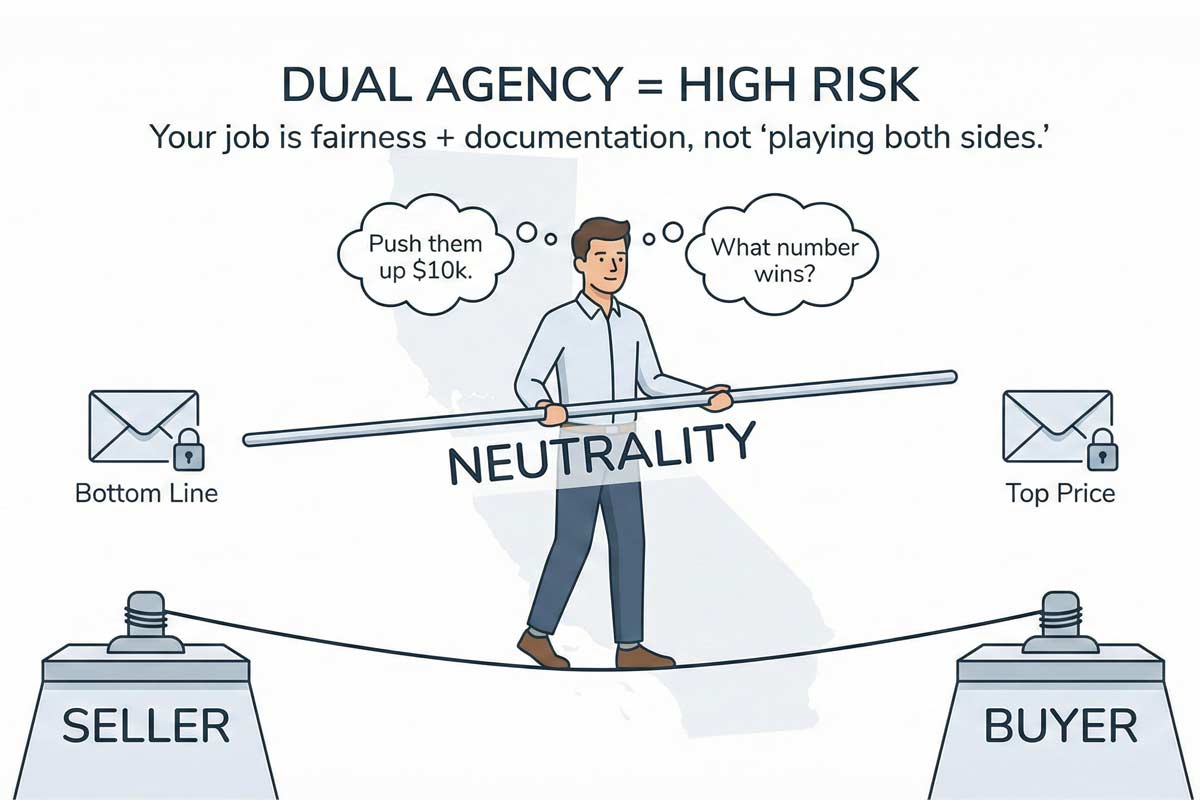
In that instant, you are navigating the core conflict of dual agency.
Dual agency is not just about collecting more commission. It is a balancing act where the slightest slip in confidentiality or neutrality can lead to complaints and a tarnished reputation.
What Dual Agency Actually Means
In plain English, dual agency occurs when a single agent (or two agents under the same broker) represents both the buyer and the seller in the same transaction.
In a standard transaction, you are like a gladiator for your client. You fight for the best interests of your client. You use strategy, leverage, and information to win.
In dual agency, you cannot be a gladiator. You become a neutral facilitator. You still owe fiduciary duties to both parties—meaning you must protect their financial interests—but you lose the full ability to advocate for one side at the expense of the other.
Is Dual Agency Legal in California?
Yes, dual agency is legal in California, but only with informed, written consent.
The danger isn’t the dual agency itself; the danger is sloppy disclosure. Best practice (and often required depending on the relationship and timing) is to disclose early—before signatures—so consent is informed and documented rather than rushed at the closing table.
You must provide the Disclosure Regarding Real Estate Agency Relationship (AD form) to the buyer before they sign an offer, and to the seller before they accept an offer.
If you fail to obtain this written consent properly, you may jeopardize your commission and expose yourself to discipline or civil claims. Worse, the transaction can create rescission/voidability risk depending on the facts. To navigate these waters safely, you need a strong grasp of the framework found in our California Real Estate Laws & Compliance Guide, which outlines the statutory foundation for agency relationships.
The Dual Agent’s Tightrope: Do’s and Don’ts
When you step into the role of a dual agent, your behavior must change immediately. You are no longer coaching one side against the other.
The Golden Rule: You owe fiduciary duties to both principals, but you must remain neutral on negotiation strategy and keep each party’s confidential bargaining info confidential unless authorized in writing.
DO
DON’T
DO disclose all material facts about the property condition to the buyer.
DON’T disclose the seller’s bottom line price (unless you have express written permission).
DO treat both parties with "honest and fair dealing."
DON’T disclose the buyer’s maximum budget or motivation (unless you have express written permission).
DO explain the pros and cons of terms neutrally.
DON’T advise the buyer on exactly "what to write" to beat another offer.
DO keep financial positions strictly confidential.
DON’T "silent auction" the deal by leaking terms between parties.
Your obligations aren't just good manners; they are rooted in specific Ethical Duties Under the California Business & Professions Code that mandate honesty and fair dealing even when you can't advocate for price.
The Confidentiality Trap
This is where most dual agents get into trouble. You know too much. For example, you might know the seller is super motivated because of a divorce. You know the buyer is willing to pay $50k over asking. You must firewall this information.
What Must Stay Confidential
Price Strategy: You cannot tell the seller, "The buyer will go higher." You cannot tell the buyer, "The seller will take lower."
Motivation: You cannot reveal why the client is buying or selling if that information compromises their negotiating position.
Terms: You cannot tell the buyer, "The seller is desperate for a 30-day close, so use that."
What Must Be Disclosed
Material Facts: If you know the roof leaks, you must tell the buyer. Dual agency does not protect you from hiding defects.
Inability to Perform: If you know the buyer lost their financing, you must disclose this to the seller.
Agency Relationship: You must disclose the conflict of interest (dual agency) itself and get consent.
You must rigorously adhere to Privacy Rules for Managing Client Information, ensuring that a buyer’s financial ceiling never leaks. Practically, this means: don’t forward pre-approvals blindly, make certain that you redact account numbers, and keep documents inside your transaction system.
Dual Agency in Multiple Offers (High-Risk Zone)
The risk multiplier explodes when you have a dual agency situation inside a multiple-offer scenario.
Imagine you have the listing. You have three offers from outside agents, and one offer from your own buyer client. The outside agents may immediately suspect you are favoring your own buyer to keep the full commission.
The Protocol:
Neutral Presentation: Present all offers to the seller at the same time, in the same format. Do not color the presentation with "My buyer is really solid" while downplaying the others.
Document Everything: If the seller chooses your buyer, ensure the file clearly shows why (better price, more down payment, waived contingencies).
When you hold the listing and also represent a buyer in a bidding war, the situation becomes volatile, requiring specific protocols for Handling Multiple Offers Ethically to ensure no party feels manipulated.
The Paper Trail: Documenting Like a Pro
If a buyer wakes up three months later feeling they overpaid, or a seller feels they left money on the table, they will blame the dual agent. Your file should act as your shield.
Quick Compliance Checklist:
Agency Disclosure (AD Form): Signed by Buyer before offer; signed by Seller before acceptance.
Consent to Dual Agency: Often part of the purchase agreement, but re-verify signatures.
Communication Log: Document every phone call regarding price. "Spoke to Seller at 2:00 PM. Seller instructed to counter at $900k. Conveyed to Buyer at 2:15 PM."
Offer Receipt & Presentation Log: Timestamp each offer received + when presented to seller + seller’s instructions.
Broker Review: Have your broker review the file along the way.
Clear documentation is your best defense against accusations, helping you learn How to Avoid Misrepresentation in CA Transactions by proving exactly what was disclosed and when.
Mandatory Scripts for the Dual Agent
You need to know exactly what to say when the pressure is on. Memorize these to stay safe.
Scenario 1: The Seller wants you to push the buyer
Seller: "You know they have more money. Just get them up to $950k."
You: "I can certainly present a counter-offer at $950k from you. However, because I also represent the buyer, I cannot pressure them or share your confidential strategy. I can present your counter; I cannot coach either side with confidential info."
Scenario 2: The Buyer wants inside info
Buyer: "Come on, what's the lowest they'll take? I don't want to overpay."
You: "I understand, but because I am a dual agent, I cannot disclose the seller's confidential bottom line. My role is to facilitate the transaction fairly. Based on the comps we looked at, what price are you comfortable offering?"
Scenario 3: The Accusation
Buyer/Seller: "You're just pushing this deal to get a double commission."
You: "You're right to be cautious. Here's how I keep it neutral: I use a consistent process, I document every communication, and I have my broker oversee the file. If you prefer separate representation, we can absolutely arrange that."
Mini Scenarios: Compliant vs. Risky
Scenario A: The Simple Transaction
Situation: You represent the seller. An unrepresented buyer calls from the sign, views the home, and wants to write an offer.
Compliant Action: You immediately present the Agency Disclosure form. You explain you will be a dual agent. You recommend they seek independent representation if they want advocacy, because as a dual agent you cannot advise them the same way. If they proceed, you write the offer exactly as dictated, without suggesting a price.
Scenario B: The Material Fact
Situation: You are a dual agent. The seller tells you, "The basement floods in heavy rain, but don't put that on the Transfer Disclosure Statement."
Compliant Action: You explain to the seller that material facts must be disclosed by law. If the seller refuses, you cannot hide it. You must disclose the flooding to the buyer. Your duty of honesty overrides the seller's instruction to conceal defects.
Closing: It’s a System, Not Vibes
Dual agency is not for the faint of heart, and it is certainly not for the disorganized. It requires a rigid adherence to procedure. You must separate your knowledge, document your steps, and prioritize the integrity of the transaction over the commission check.
Follow your broker’s policy.
Protect the file.
When done poorly, dual agency is the fastest way to create a complaint you can’t explain away.
(Note: General education only; follow your broker’s policies and consult counsel for specific legal questions.)
|

Imagine it’s 7:42 PM on a Tuesday. You are the listing agent on a home in Los Angeles and your phone is buzzing non-stop. You have nine offers in your inbox, three agents texting you for a "verbal status," Read more...
Imagine it’s 7:42 PM on a Tuesday. You are the listing agent on a home in Los Angeles and your phone is buzzing non-stop. You have nine offers in your inbox, three agents texting you for a "verbal status," and a seller who is overwhelmed and asking:
"Can we just pick the highest one and be done?"
This is the moment where careers are made or broken.
In a hot market, multiple offer scenarios are a standard pressure test. They are also a frequent trigger for disciplinary action because, under pressure, agents often cut corners. They might get sloppy with communication, inadvertently "shop" an offer, or fail to present every option clearly. To survive this without risking your license, you need a system rooted in the California Real Estate Laws & Compliance Guide.
You need a process that protects you and serves your client. Here is exactly how to handle the multiple-offer pressure cooker without crossing legal lines.
The "All Offers" Rule (No Exceptions)
Let’s start with the absolute baseline. Under California fiduciary duties, a listing agent is expected to present offers and counteroffers promptly and diligently unless the seller has previously directed the agent otherwise in writing.
It doesn’t matter if the offer is $50,000 under ask. It doesn’t matter if it’s written on a standardized form or a less formal document—if it is a bona fide offer, the seller needs to see it.
Agents often get into trouble here by "pocketing" lowball offers because they don't want to waste their time. That is a violation of your fiduciary duty. To understand the risks of filtering information, read our guide on How to Avoid Misrepresentation in CA Transactions, which details why you must never lie about the existence or number of offers to drive up the price. If you claim you have five offers, you must actually have five offers in hand.
The Spreadsheet Method & The Paper Trail
When you are juggling six different offers, relying on your memory is a recipe for disaster. You need a standardized way to present data to your client so they can make an informed decision based on facts, not just the purchase price. There are so many components in determining what constitutes a “good” offer and certainly price is one piece of the puzzle, but what about downpayment? What about credit score? What about the “certainty of close”?
Step 1: Secure Written Instructions First
Before you even respond to the first agent, get the seller’s game plan in writing. Do they want to counter everyone? Do they want to accept the best one immediately? Do not act on a verbal "just handle it."
Step 2: Build the Summary
I teach my agents to build a "Summary of Offers" spreadsheet for the seller. It should include:
Offer Price: The headline number.
Down Payment & Loan Type: Cash vs. Conventional vs. FHA.
Earnest Money Deposit (EMD): Is it 1% or 3%? Is it released early?
Contingencies: Inspection, Appraisal, Loan. How long are the timelines?
Close of Escrow: Does it align with the seller’s move-out date?
Any other notes: When does the buyer want possession?
By stripping the emotion out, you help the seller see the net value. A higher offer with no lender commitment and 45-day contingencies is often worth less than a slightly lower, fully underwritten offer with a 10-day close.
Navigating the "Best and Final" Round
Once you have reviewed the initial batch, you rarely accept one outright. You usually issue a Seller Multiple Counter Offer (SMCO).
This is where the ethics get tricky. You must treat all potential buyers fairly. You cannot give one agent a "heads up" on the price to beat while keeping the others in the dark. Your Ethical Duties require you to treat all parties honestly and fairly, even if you strictly represent the seller.
The Script for "What’s the highest offer?"
Buyer’s agents will ask you: "What do we need to write to get it?" or "What is the top offer right now?"
Be very careful. In California, offer terms are not automatically "confidential" unless the parties have a written confidentiality agreement—but disclosure still needs to be seller-directed, truthful, and applied consistently to avoid misrepresentation or favoritism.
If you tell Agent A that the high mark is $850k, and they bid $855k, you have effectively "shopped" the other buyer’s offer without giving them a chance to respond.
The Safer Approach: Communicate to all parties: "We have multiple competitive offers. The seller is requesting your highest and best offer by 5:00 PM tomorrow. Please maximize your price and tighten your terms."
The Privacy Trap: What You Can and Cannot Share
When the heat turns up, it is tempting to leverage one buyer against another by sharing details. "Hey, I have an offer from a cash buyer, so you need to waive your appraisal."
Is that true? Or are you bluffing? If it’s true, you are likely safe (provided you have seller permission). If you are bluffing, you risk serious liability for misrepresentation and deceit.
Furthermore, you need to protect the data. You are collecting proof of funds, bank statements, and pre-approval letters. Adhering to strict Privacy Rules for Managing Client Information means you generally should not disclose the specific financial details or identity of a competing buyer to other agents. Keep those bank statements redacted or hidden when you are reviewing terms with anyone other than your client.
The Dual Agency Landmine
The most dangerous scenario in a multiple-offer situation is when you represent one of the buyers.
You are now a Dual Agent. You have a listing with five offers, and one of them is yours. The other agents will immediately suspect foul play. They will assume you are guiding the seller toward your buyer to increase your commission.
How to Handle It
Disclose to Principals: Disclose dual agency to the buyer and seller and obtain their written consent immediately.
Stay Neutral: Present and document all offers objectively; don’t use inside knowledge from one side to advantage the other.
Manager Review: Ensure that your broker and manager are in the loop.
The risks multiply when you are navigating Dual Agency in California. If another offer fits the seller’s criteria better, your job is to present that clearly and document the seller’s decision—even if it’s not the outcome you’d personally prefer.
Process Protects You
When the market is moving fast, you don't rise to the occasion; you fall to the level of your training.
If you don't have a systematic way to log, present, and counter offers, you will eventually make a mistake. You will forget to respond to an agent, or you will accidentally disclose a price cap when you shouldn't have.
Work with your broker or manager to create your spreadsheet template today. Script your "highest and best" response today. When that Tuesday night rush comes, you won't be panicking—you’ll be executing.
Note: This article is general education, not legal advice; when in doubt, follow your broker’s policy and get broker/legal guidance.
|
California doesn’t expect agents to be engineers, contractors, or city planners—but it does expect licensees to communicate accurately and avoid passing off assumptions as facts. The goal of this guide Read more...
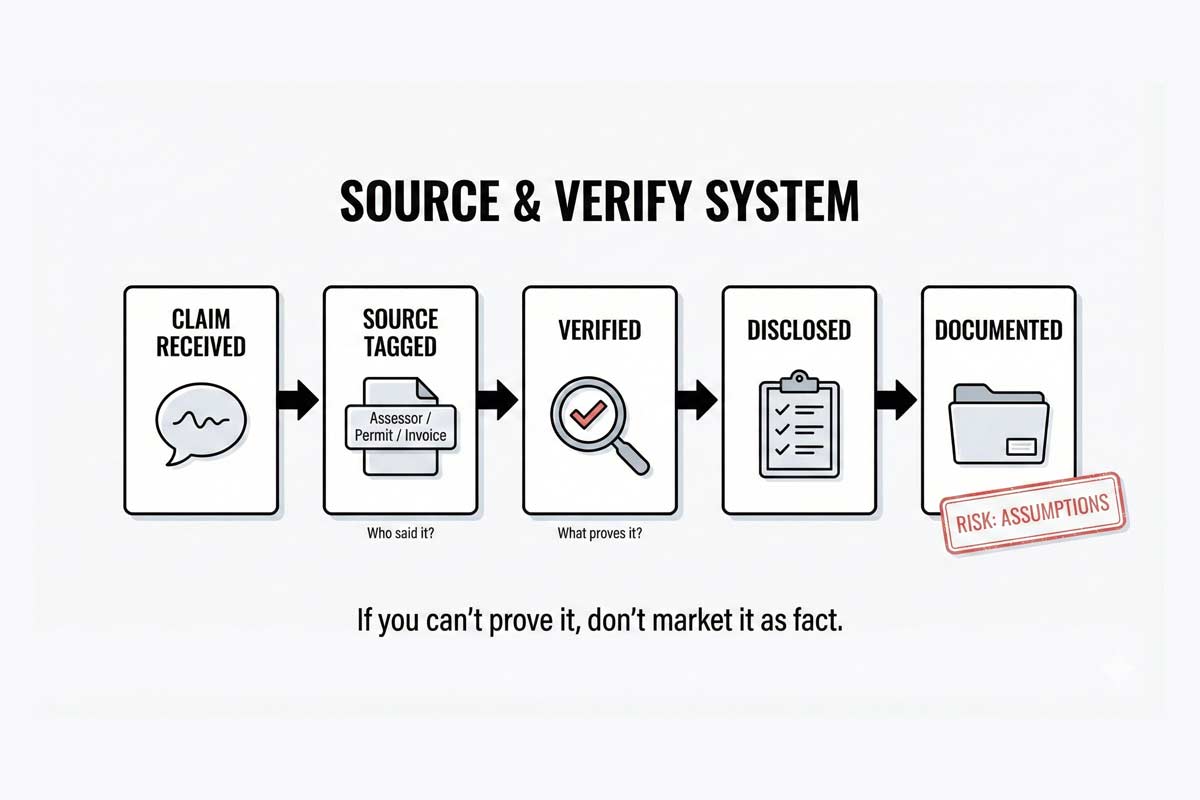
California doesn’t expect agents to be engineers, contractors, or city planners—but it does expect licensees to communicate accurately and avoid passing off assumptions as facts. The goal of this guide is simple: help you build a repeatable “source → verify → disclose → document” workflow so your MLS remarks, emails, and conversations stay clean and defensible.
Many agents assume lawsuits happen to “bad” people—scammers or fraudsters. But in California real estate, a significant portion of DRE discipline and civil litigation stems from negligent misrepresentation. It’s not that the agent lied on purpose; it’s that they repeated a seller’s claim without verifying it, or they made a casual assumption that turned out to be wrong.
If you want a long career, you must shift your mindset from salesperson to fact-checker.
What “misrepresentation” actually means
In plain English, misrepresentation is a false statement of fact that induces a party to enter into a contract. It isn’t just lying; it’s providing incorrect information that a buyer relies on.
While the definition seems simple, the application is complex because California holds licensees to a higher standard than the general public. That higher standard is the foundation of our California Real Estate Laws & Compliance Guide, and it’s why misrepresentation typically falls into three practical buckets:
1) Intentional misrepresentation (fraud)
This occurs when an agent actively hides a defect or lies about a feature.
Example: "You know the roof leaks, but you paint over the water stains and tell the buyer, 'The roof is in perfect condition.'"
Result: This is considered a career-ending category involving major civil exposure, severe discipline risk, and potentially punitive consequences.
2) Negligent misrepresentation (the danger zone)
This is where most agents get into trouble. It happens when you make a statement you believe is true, but you had no reasonable basis for believing it—usually because you didn’t verify it.
Example: The seller tells you the square footage is 2,500. You put 2,500 in the MLS without checking the source. It turns out to be 2,100.
Result: You’re exposed because you’re expected to treat material facts like verifiable facts, not casual conversation.
3) Innocent misrepresentation
This occurs when an agent makes a false statement that they had reasonable grounds to believe was true.
Example: You rely on a formal report from a licensed surveyor that later turns out to contain an error.
Result: Even without bad intent, deals can unwind and disputes can still happen.
The “material fact” rule
California operates under a strict disclosure standard. A material fact is anything that would affect the value of the property or a buyer’s decision to purchase it. If you are debating whether something is material, it almost certainly is.
The 10 most common misrepresentation traps in California
These are the scenarios where agents unknowingly drift into misrepresentation.
1) “Remodeled with permits”
The trap: The seller says, “We added that master bath with permits.” You list it as “Permitted Master Bath.”
The reality: The seller assumed their contractor pulled permits—but they didn’t.
The fix: Never claim permits exist unless you have seen the final permit sign-off or confirmed city records. Use language like “Buyer to verify all permits.”
2) Square footage & lot size
The trap: Copying the square footage from a prior MLS listing or trusting the owner’s estimate.
The fix: Always cite the source (“Per Assessor,” “Per Appraiser,” “Per Builder”). If there’s a discrepancy between records and the physical home, flag it immediately.
3) “The roof is new”
The trap: The seller says the roof is 5 years old. You market it as “Newer Roof.”
The fix: Avoid acting like a general contractor. State the age only if it’s documented, or treat it as a seller statement and recommend inspection.
4) Zoning and ADU potential
With the ADU boom, agents are eager to advertise “ADU Potential.”
The trap: Telling a buyer, “You can definitely build a back house here.”
The fix: Zoning is complex (setbacks, easements, utilities, overlays). Defer to the city: “Buyer to investigate feasibility with the city.”
5) Nuisances and stigmas
The trap: Failing to mention the loud plant that operates at night or an ongoing neighbor dispute over the fence line.
The fix: If a nuisance affects enjoyment or decision-making, it’s material. Hiding it conflicts with Ethical Duties Under the California Business & Professions Code, where honesty and fair dealing are not optional just because the deal is fragile.
6) Multiple offer pressure
The trap: Telling a buyer’s agent, “We have an offer higher than yours,” when you don’t—just to drive up price.
The fix: Communicate what’s true and only what’s true, especially in hot markets where buyers are already stressed—this is exactly why disciplined conduct matters in Handling Multiple Offers Ethically.
7) Marketing hyperbole vs. fact
The trap: “Walking distance to the beach” (it’s 3 miles) or “quiet street” (it’s a cut-through).
The fix: Let photos and maps do the persuasion. Subjective phrases can become “facts” in a dispute. Stick to measurable statements.
8) Repairs and credits
The trap: The seller agrees to fix a leak. You tell the buyer, “The leak has been fixed.”
The fix: Don’t confirm repairs yourself. Transfer documentation: invoice, contractor statement, permit (if applicable), and buyer re-inspection.
9) Natural hazards
The trap: “This area rarely floods,” or “Fire insurance shouldn’t be a problem.”
The fix: Never minimize hazard risk. Refer clients to the NHD and their insurance professional; keep your language document-based.
10) Minimizing defects
The trap: Seeing a crack and telling the buyer, “That’s just normal settling.”
The fix: Unless you’re a structural engineer, you don’t diagnose. Flag the observed condition and recommend evaluation.
The anti-misrepresentation system
You can eliminate a major share of your liability by adopting a “source and verify” habit.
1) Label fact vs. opinion
If you are sharing an opinion, label it. If you are sharing a fact, cite the source.
Instead of: “1,800 square feet.”
Write: “Approx. 1,800 sq ft per Assessor (buyer to verify).”
2) Verify before you amplify
Before you blast a feature in marketing, ask: “Do I have a document that proves this?” If not, tone it down or remove it.
3) The transaction checklist
Run this check at every stage:
Listing intake: Have the seller complete the TDS and SPQ completely; don’t let blanks slide.
Document handling: Treat client documents and sensitive details like controlled material—careless forwarding, oversharing, or casual disclosure can create liability and negotiation harm, which is exactly why disciplined workflows matter under Privacy Rules for Managing Client Information.
Marketing prep: Review MLS comments against disclosures—do they match?
Negotiation: Ensure counters and emails don’t imply promises that aren’t written.
Closing: Repairs and credits should have documentation attached and traceable.
Safe language toolkit: say this, not that
❌ Risky: “New roof”✅ Safe: “Seller states roof replaced in 2021; buyer to verify.”
❌ Risky: “Permitted guest house”✅ Safe: “Guest house present; buyer to verify permits with the city/county.”
❌ Risky: “Great rental potential”✅ Safe: “Buyer to verify rental restrictions and market rates.”
❌ Risky: “Quiet neighborhood”✅ Safe: “Located on a cul-de-sac” (stick to facts).
❌ Risky: “The plumbing is fine”✅ Safe: “No known plumbing issues per seller disclosures as of [date].”
❌ Risky: “I’m sure they’ll accept X”✅ Safe: “I will present your offer immediately and confirm receipt.”
Mini case studies: California scenarios
Scenario A: The “just cosmetic” crack
The situation: A seller points out a hairline crack and says it's from heavy rain. The agent markets “pristine condition.”
The outcome: A serious foundation issue appears after closing. The agent is sued for negligent misrepresentation.
What the agent should have done: Note the condition on the AVID, ensure disclosure is complete, and recommend specialist evaluation without diagnosing.
Scenario B: The dual agency disconnect
The situation: You represent both buyer and seller. The seller mentions divorce stress and urgency. You tell the buyer to help close the deal.
The outcome: Confidentiality and loyalty get questioned immediately, and parties often argue they relied on a misrepresented level of neutrality or advocacy. That’s why Dual Agency in California (Legal Guide) treats role clarity and confidentiality as non-negotiable.
What the agent should have done: Keep motivation confidential and stick to verifiable property facts and written terms.
Scenario C: The “updated” electrical
The situation: A flipper says the panel is “fully updated.” The agent writes “New Electrical Panel” in MLS.
The outcome: Inspector finds it’s old and painted. Buyer demands a credit and threatens claims for false advertising.
What the agent should have done: Require receipt/permit before using “new,” or describe only what you can prove.
Your license is worth more than one commission
Avoiding misrepresentation isn’t about being paranoid—it’s about being professional. It requires a shift from “selling” to “guiding.”
Your best defense is simple:
Verify what the seller tells you.
Disclose what you know.
Document where it came from.
If you don’t know the answer, “I don’t know, but let’s verify it” is one of the safest phrases in your vocabulary.
|
It happens in a split second.
You’re negotiating a deal at 9:45 PM. The listing agent says, “My seller is worried your buyers can’t close.” To prove them wrong, you pull up your client’s Proof Read more...
It happens in a split second.
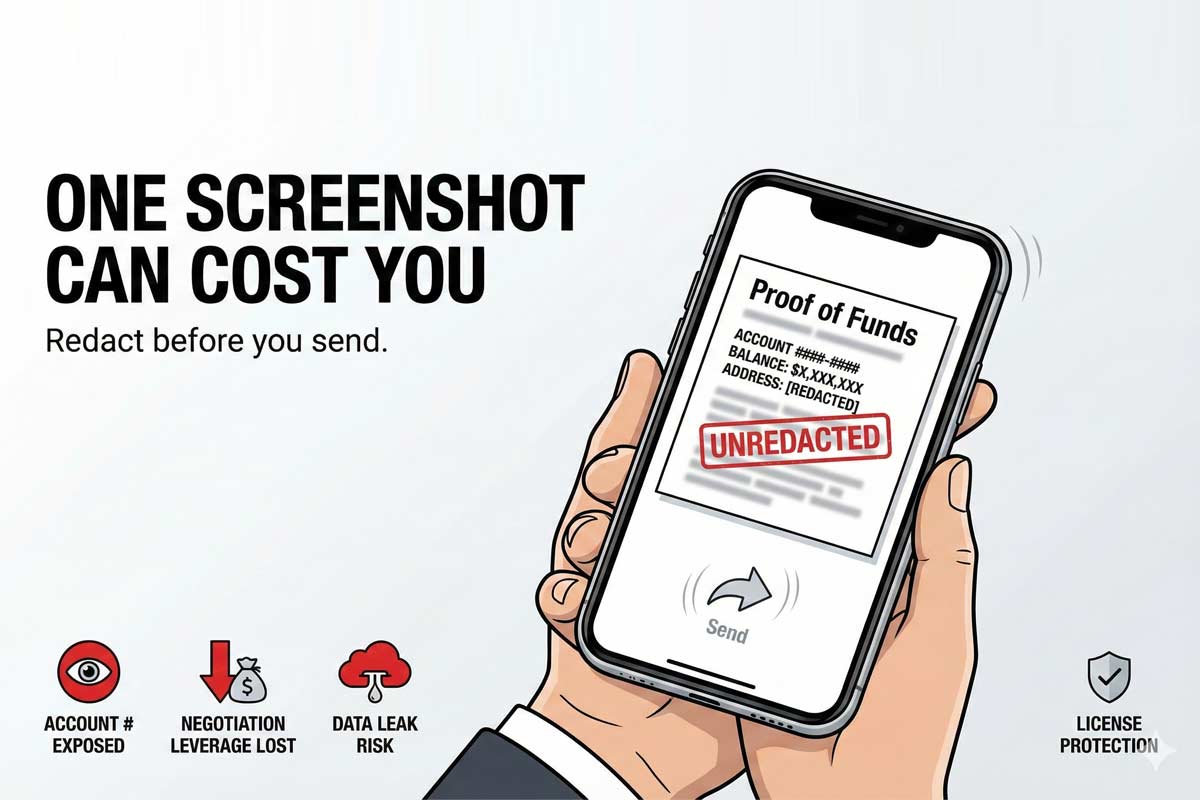
You’re negotiating a deal at 9:45 PM. The listing agent says, “My seller is worried your buyers can’t close.” To prove them wrong, you pull up your client’s Proof of Funds (POF) on your phone, take a screenshot, and text it to the listing agent.
You just sent a text containing your client’s full account number, current balance (which is $300k higher than the offer price), and home address to a third party.
That single screenshot just violated your client’s financial privacy and compromised their negotiating leverage (now the seller knows they can pay more). If that image gets forwarded or saved to an unsecured cloud, you may be blamed for the leak and exposed to discipline or civil claims.
Privacy in real estate isn’t just about being polite. It is about protecting your license from the kinds of complaints that start with “My agent gave away my personal information.”
What Counts as Confidential Client Information in California Real Estate?
Many agents think “privacy” just means not giving out the gate code. In reality, the definition is much broader. As an agent, you routinely handle private identity, financial, and negotiation information that can harm a client if mishandled.
The Four Big Categories:
Identity & Contact Info: Names, personal email addresses, phone numbers, and current home addresses.
Financials: Bank statements, 401(k) balances, credit score screenshots, and pre-approval letters with specific conditions.
Negotiation Strategy: Motivation ("They have to move by June"), bottom line ("They'll take $850K"), or urgency ("They're divorcing").
Transaction Documents: The purchase agreement itself, counter-offers, and transfer disclosure statements (TDS).
Safeguarding this data is a critical part of real estate practice. Understand the statutory framework that governs these responsibilities. Review the California Real Estate Laws & Compliance Guide, which outlines the baseline for agency relationships and duty of care.
What Can I Share With the Listing Agent?
The guiding principle for privacy is "Minimum Necessary." Share only what’s necessary to move the transaction forward, only with parties who need it, and never share strategy or financial details without explicit client authorization.
Who is a "Need-to-Know" Party?
Client(s): The principal.
Broker / Office Compliance: For file review and oversight.
Escrow / Title: As needed to open orders and clear title.
Lender: As needed for funding conditions.
Appraiser / Inspector: Only access/property details required for their job.
Other Side’s Agent: Minimum necessary to close; never client strategy.
The Golden Rule: If it helps your client’s position and you have permission, share it. If it hurts them or they haven’t authorized it, keep it private.
DO
DON'T
DO share the pre-approval letter (after redacting sensitive info).
DON'T forward a raw bank statement showing account numbers.
DO redact account numbers and excess balances before sending.
DON'T send full bank statements or unedited screenshots.
DO use secure transaction management platforms (DocuSign, SkySlope).
DON'T leave physical files visible in your car or on a coffee shop table.
DO discuss material facts about the property condition.
DON'T discuss your client’s divorce or job transfer as “negotiating leverage” without written consent.
Strict adherence to these boundaries is not optional
It is rooted in your Ethical Duties Under the California Business & Professions Code, which mandates that agents treat all parties with honesty while maintaining loyalty to their principal.
Can I Share Proof of Funds With the Listing Agent?
Yes, but you must do it carefully to balance credibility with privacy.
When it’s appropriate: To prove your buyer has the ability to close, especially for cash offers or large down payments.
What to send: A redacted bank statement or a letter from the financial institution stating "verified funds in excess of purchase price."
What NOT to send: Unedited statements, screenshots from your phone, or documents showing the client’s total net worth far beyond the purchase price.
How to send: Upload to a secure transaction platform or send a password-protected PDF link; avoid standard email attachments if possible.
Proof of Funds: What to Redact (And What Not to Send)
Sending unredacted financial documents is one of the most common ways agents expose their clients to identity theft and negotiation loss.
Redaction Rules That Are Non-Negotiable:
Black out account numbers: Show the last 4 digits only.
Black out SSN/DOB: They should not be visible in anything you transmit to the other side.
Remove full balances: Show only the amount needed to support the offer’s funding story (cash to close or down payment + reserves), and redact excess.
Remove home address: Unless necessary for the lender, black it out.
Convert to PDF: Never send screenshots; they are unprofessional and harder to secure.
Rename the file: Add "REDACTED" to the filename so you know it’s the safe version.
The 5 Most Common Privacy Failures (And the Fix for Each)
In 20+ years of training California agents, I’ve seen that most privacy violations aren't malicious—they are sloppy.
1. The "Forward" Button Fiasco
What happens: You forward an email chain to the lender or other agent, forgetting that three emails down, your client vented about their bottom line.
Why it’s risky: You just handed the other side your playbook.
Do this instead: Never forward chains. Start a new email. Copy-paste only the relevant text.
2. The Unredacted Proof of Funds
What happens: You send a bank statement showing $1.2M in liquid cash when the offer is only $900k.
Why it’s risky: The seller now knows your buyer can pay full price, weakening your client’s bargaining position.
Do this instead: Redact strictly. Only show enough funds to cover the down payment and closing costs.
3. The Screenshot Camera Roll
What happens: You take photos of checks, IDs, or docs. They save to your personal camera roll, which backs up to your family iCloud.
Why it’s risky: Your client’s IDs, account numbers, and private financial info are now mixing with your vacation photos.
Do this instead: Use a scanning app that saves directly to a secure drive or your transaction platform (e.g., SkySlope) and does not save to the camera roll.
4. The Accidental Group Text
What happens: You start a group text with the lender, escrow, and buyer, then accidentally add the Listing Agent to discuss repairs.
Why it’s risky: You might accidentally reveal your client’s desperation or strategy to the opposing negotiator.
Do this instead: Avoid group texts for strategy. Keep sensitive discussions verbal or in one-on-one emails.
5. Sloppy Fact Transmission
What happens: You are managing five deals and accidentally send Client A’s counter-offer to Client B, or mix up their repair requests.
Why it’s risky: Failing to verify what you share is a primary way to learn How to Avoid Misrepresentation in CA Transactions the hard way.
Do this instead: Verify the source and accuracy of every fact before you hit send.
If You Already Messed Up: Containment Protocol
If you realize you sent sensitive info to the wrong person, act immediately.
Ask recipient to delete: Call immediately (don't text) and ask them to delete the email/text and confirm.
Notify broker: Inform your manager so they can prepare for any fallout. Do not try to "fix it quietly"—that's how small mistakes become disciplinary events.
Notify client: Be professional and brief. "I inadvertently sent X to Y. I have asked them to delete it."
Document it: Keep a log of what happened and who received it.
Change access: If you sent a link to a folder, rotate the link or revoke access immediately.
Dual Agency: Confidentiality Rules That Will Get You Disciplined
Privacy becomes mission-critical when you represent both the buyer and the seller. Dual agency is where confidentiality mistakes happen fastest.
The Sealed Envelope Rule
Treat confidential strategy like it’s in a sealed envelope. You don’t open it for the other side. Information about material facts (the roof leaks) must flow freely. Information about price, terms, and motivation must stay sealed.
Mini Scenario:
Your buyer asks, "Why are they selling?"
Risky Answer (reveals confidential motivation): "They are getting divorced and need cash fast."
Safe Answer: "I can’t discuss the seller’s personal motivations, but I can address objective terms: timing, possession, and contingencies."
For a deeper dive into the specific disclosures and boundaries required here, refer to our Dual Agency in California (Legal Guide).
The Paper Trail & Systems: Your Privacy Operating Procedure
You need a repeatable system so you don't have to think about privacy—you just execute it.
Privacy Checklist Before You Hit Send:
Redaction: Are account numbers and SSNs blacked out?
Relevance: Does the recipient actually need this document?
Format: Is it a secure PDF link, or a loose screenshot?
Recipient: Did I check the "CC" line for accidental additions?
Your SOP
Centralize Docs: All documents live in your transaction management platform.
Naming Conventions: Name files clearly (e.g., "123_Main_St_POF_REDACTED.pdf") so you don't attach the wrong version.
Device Security: Enable 2-Factor Authentication (MFA) on your email. Your email is the master key to your client’s data.
Privacy is License Protection
Privacy is not about secrecy; it is about security. When you treat your client’s information with care, you build trust and maintain a clean file.
Tighten your systems. Redact the account numbers. Follow your broker's policy.
Protect the file, and the file will protect you.
(Note: General education only; follow your broker’s policies and consult counsel for specific legal questions.)
|

The Real Reason Cold Calling Feels “Salesy” (And How to Fix It Fast)
Most new agents pick up the phone like a hunter: “How do I get a listing? How do I get an appointment?”
That intent changes Read more...
The Real Reason Cold Calling Feels “Salesy” (And How to Fix It Fast)
Most new agents pick up the phone like a hunter: “How do I get a listing? How do I get an appointment?”
That intent changes your voice. You rush. You over-explain. You push.
To stop sounding salesy, you don’t need a “slicker” script. You need a cleaner objective:
Your job is not to sell on the first dial. Your job is to start a professional conversation.
To stop sounding salesy, you don’t need a “slicker” script. You need a cleaner objective:
We do that with a simple framework:
Permission + Local Context + Micro-Commitment
By the end of this guide, you’ll have 3 word-for-word scripts, a 10-point objection cheat sheet, and a 7-day plan you can run immediately.
The “Conversation-First” Framework: The 5-Step Blueprint
Here’s the structure closers use because it’s low-pressure and repeatable:
Permission Opener (disarm & respect)
Clear Reason for the Call (specific, local, honest)
Tiny Value Hook (a micro-insight)
Easy Diagnostic Question (invites dialogue, not defense)
Low-Pressure Next Step (a micro-commitment, not a meeting)
Script vs. Mindset: Rookie vs. Closer
Feature
Rookie (Salesy) Approach
Closer (Professional) Approach
Primary goal
Get appointment/listing now
Start a professional relationship
Opener
“Hi, I’m looking for the owner…”
“I know I’m calling out of the blue—quick question…”
Value hook
“I can get you top dollar!”
“A couple homes near you moved fast—local activity is changing.”
Handling “No”
Push harder or hang up
Offer a micro-exit (email / quick follow-up time)
Success metric
Appointments set
Quality contacts + scheduled follow-ups
Coaching note: You’re not trying to “win” the call. You’re trying to earn permission to continue.
Script #1: The Universal Permission Opener (Word-for-Word)
Never pitch someone who hasn’t agreed to listen.
Variant A: Friendly & Professional
“Hi [Name], this is [Your Name] with [Brokerage]. I know I’m calling out of the blue—do you have 60 seconds, or did I catch you at a bad time?”
Pacing: Say it slowly. Then stop talking.
Variant B: Neighborly Inquiry
“Hi [Name], [Your Name] here. I’m a local agent—do you mind if I ask you a quick question about the neighborhood?”
Variant C: Calm & Direct
“Hi [Name], [Your Name] with [Brokerage]. I’ll be brief—is now a bad time?”
(This often gets a “No, go ahead.”)
If they say “No” / “I’m busy” (Micro-Exits)
Don’t vanish. Preserve the relationship.
Text pivot: “No problem at all. Would it be easier if I just texted you a one-line local update instead?” (Follow your laws regarding opt-in text messaging)
Time lock: “Totally fair. Would later today or tomorrow morning be better for a 2-minute question?”
Your win: permission to call back at a specific time.
Script #2: California Circle Prospecting (Truthful Versions Only)
Circle prospecting = calling around a real market event (sale, listing, open house activity, inventory shift).Rule: Only say what you can verify. No fake buyers. No fake “off-market” talk.
Before you call: pick ONE true local fact
Examples you can verify quickly:
“A home around the corner sold fast.”
“Inventory is tight in this ZIP.”
“A few homes have been sitting longer recently.”
Keep it simple. You’re not delivering a data report—just a reason you’re relevant.
Version A (ONLY if true): You actually have an active buyer
“Hi [Name], I’m [Your Name] with [Brokerage]. I know this is out of the blue—do you have 60 seconds?”(Pause)“I’m calling because I’m actively representing a buyer looking for a home in this immediate area, and inventory has been tight.”
Diagnostic question (low pressure):
“Have you heard of anyone nearby who might be planning a move in the next few months?”
Version B (always safe): Inventory tracker (no fake buyer)
“Hi [Name], [Your Name] with [Brokerage]. Quick question—do you have 60 seconds?”(Pause)“I’m calling because I’m tracking inventory in this area for a few households who want to move locally, and I’ve noticed there hasn’t been much fresh activity right around you.”
Tiny value hook (no made-up stats):
“In some pockets nearby, homes have been moving quicker than people expect—so I’m checking in locally.”
Diagnostic question:
“If you ever moved—what would trigger it for you? More space, downsizing, job change…?”
Prefer face-to-face over phone? Use: Door-Knocking Script for California Neighborhoods
Script #3: Warm Follow-Up (After Open House, Sign-In, Lead Form)
This is where new agents stop being “random callers” and start being professionals.
Structure: Gratitude → Specific recall → Diagnostic → Easy offer
“Hi [Name], it’s [Your Name] with [Brokerage]. Thanks again for stopping by my open house at [Address] on [Day].”
“Quick question—when you left, was that home a hard ‘no,’ or are you still comparing options?”(Pause)“Based on what you told me you want, would it be helpful if I sent you two or three similar options to look at tonight?”
Coaching note: The goal is not to schedule a 60-minute meeting. It’s to earn the next conversation.
To generate better warm leads (and better follow-up notes), master: Open House Script for New Agents
The 10-Point Objection Cheat Sheet (California Edition)
Use this structure:
Acknowledge → Pivot → Ask (micro-commitment)
1) “Not interested.”
Rookie panic move: “Okay, bye.”
Closer response: “Totally understand. I didn’t expect you to be thinking about selling today. I’m just calling as a local resource—would you be open to me emailing you a one-line local update once in a while so you can track your equity?”
Goal: permission to talk (or permission for a short follow-up)
2) “I already have an agent.”
Rookie panic move: “Oh… okay.”
Closer response: “That’s great—having someone you trust matters most. Quick question: if they were unavailable and you needed a second opinion fast, would you be open to keeping one backup contact?”
Goal: permission to stay in their orbit
3) “Just send me the information.”
Rookie panic move: “What’s your email?” (and they vanish)
Closer response:“Happy to. Quick preference: are you more interested in what’s selling right now, or what your home might be worth in today’s market?”
Goal: steer them into a 2-question conversation, then capture contact
4) “How did you get my number?”
Rookie panic move: “Uhh… a lead provider?”
Closer response: “Fair question. I use lawful, reputable public-record and neighborhood data tools. And if you’d rather not be contacted again, just tell me and I’ll make sure you’re removed.”
Goal: keep trust + respect opt-out
5) “Call me later.”
Rookie panic move: “Okay.” (and they forget you)
Closer response: “No problem—what’s better: today at 5 or tomorrow morning? I’ll keep it to two minutes.”
Goal: lock a specific time
6) “Take me off your list / Stop calling.”
Rookie panic move: argue or explain
Closer response: “Absolutely. I’ll remove you right now. Have a good one.”
Goal: compliance and professionalism (protect your license and your broker)
7) “Are you calling to list my house?”
Rookie panic move: immediate pitch
Closer response: “Not necessarily. I’m calling to be a local resource and understand what homeowners are seeing and planning. If you ever moved, would you stay local or head somewhere else?”
Goal: open dialogue without pressure
8) “What’s your commission?”
Rookie panic move: quote numbers to a stranger
Closer response: “Good question. Fees depend on the service level and the situation. If you ever wanted to explore it, I’d walk you through a clear fee schedule—are you thinking about selling soon or just curious?”
Goal: determine intent and avoid negotiating on cold call
9) “Rates are too high / Market is awful.”
Rookie panic move: debate headlines
Closer response: “Totally fair—headlines are loud. That’s why I focus on local reality. Would it be helpful if I sent you a simple local snapshot so you can see what’s actually happening near you?”
Goal: permission to send local info
10) “Wrong number / I’m a renter.”
Rookie panic move: scramble into a pitch
Closer response: “Thanks for telling me—my mistake. Before I let you go, are you planning to buy in [City] this year, or not on your radar?”
Goal: only if the tone is friendly; otherwise exit clean
Next step when you actually secure a meeting:Prepare for that buyer consult with: Buyer Consultation Script (California Agents)
The System: Scorecard + 7-Day Launch Plan
New Agent Weekly Scorecard
Metric
Target (Week 1)
Notes
Dials
25–50/day
Consistency > hero days
Conversations (2+ min)
2–5/day
If 0, opener/timing/list issue
Contacts captured
1–3/day
Micro-commitment strength
Follow-ups scheduled
1–2/day
Lock times, don’t “floating follow-up”
Appointments
Bonus
Don’t obsess Week 1
Diagnosing your bottleneck (coach yourself)
Low conversations (e.g.,
|
Disclaimer: This article is for educational purposes only and does not constitute legal advice. For specific legal guidance regarding real estate transactions or Department of Real Estate (DRE) disciplinary Read more...
Disclaimer: This article is for educational purposes only and does not constitute legal advice. For specific legal guidance regarding real estate transactions or Department of Real Estate (DRE) disciplinary matters, please consult a qualified real estate attorney.
The Reality of Ethics: It’s Not About Being “Nice”
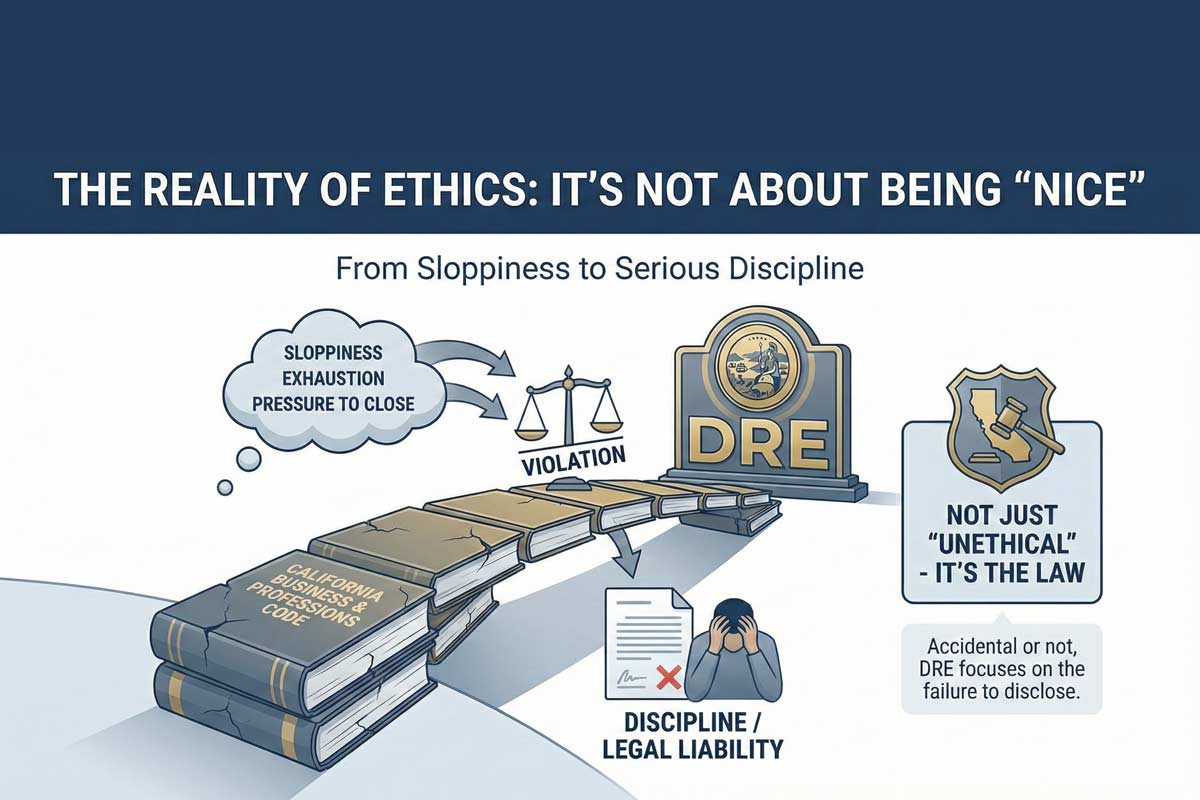
Most real estate discipline doesn’t happen because an agent wakes up one day with a plan to steal a deposit or defraud a senior citizen. In my 20+ years of teaching real estate in California, I’ve seen that many license suspensions come from sloppiness, exhaustion, or the pressure to close a deal “just this once.”
The ethical duties California real estate licensees must follow aren't just abstract moral suggestions. They are codified in the California Business & Professions Code. When you violate them, you aren't just being “unethical”—you can trigger serious discipline and legal liability. Accidental or not, the DRE doesn't focus on why the roof leak was hidden—only that you failed to disclose it.
This guide translates the jargon of the code into the daily behaviors that helps keep your license safe and your clients protected.
At-a-Glance: Ethical Duties & Risk Zones
Concept
The Bottom Line
The Standard
Ethics in CA real estate = Fiduciary Duty + Honesty + Fair Dealing.
Top Failure Point
Disclosure. Assuming a defect isn't "material" enough to mention.
Dual Agency
Legal, but requires neutral fidelity to both sides. No playing favorites.
Money Handling
Commingling funds is one of the fastest ways to trigger discipline.
Competence
Don't go solo beyond your competence—escalate or refer out.
The Golden Rule
If you have to ask, "Is this material?", treat it as material until verified.
What the California Business & Professions Code Actually Is
The California Business & Professions Code (Sections 10000 et seq.) is the rulebook that governs your actions as a licensee. It establishes the Real Estate Commissioner’s authority to investigate complaints and revoke licenses.
Under this code, honesty isn't just a virtue; it's a requirement for licensure. Competence isn't just about intelligence; it's about avoiding negligence.
Honesty isn't just a virtue; it's a requirement for licensure.
Competence isn't just about smarts; it's about not acting negligently.
If you lie in an advertisement, this can be grounds for DRE discipline under Section 10177(c). If you fail to supervise your team, you expose yourself to risk under Section 10159.2.
Clarifying the Terms: Fiduciary vs. Ethical Duties
It is helpful to distinguish between the two types of duties you carry, though they often overlap:
Fiduciary Duties are owed specifically to your client (loyalty, confidentiality, utmost care).
Statutory Duties are owed to everyone (honesty, fair dealing, disclosure of material facts).
Put simply: Fiduciary duties are client-facing; statutory duties are license-facing (DRE discipline risk). Even if you are fighting for your client, you cannot lie to the other side.
Transaction Reality Check: The DRE doesn’t usually patrol the streets looking for violations. They often react to complaints. Your adherence to these rules is your defense shield against those complaints turning into investigations.
The Core Ethical Duties
To stay compliant, you need to master these specific duties. Here is how they break down in the trenches using a consistent safety protocol.
1. Honesty & Truthfulness
What it requires: You must be honest with all parties, including lenders, appraisers, and other agents.
How it fails: A buyer asks if the addition is permitted. You say, "I believe so," to keep the deal alive, even though you never checked the public record.
The Fix:
Never guess. If you don’t know, say "I don't know, but let's find out."
Treat silence about a known negative fact as the same thing as a lie.
Source your data (e.g., "According to the tax records...").
2. Disclosure of Material Facts
What it requires: You must disclose any fact affecting the value or desirability of the property, including what you should have known from a visual inspection.
How it fails: You see water stains on a ceiling but accept the seller’s "it was fixed years ago" story without asking for receipts or noting the stain on the AVID.
The Fix:
Document every visual defect you see on the AVID.
If a seller tells you to "leave that off the form," refuse.
When in doubt, disclose it.
3. Competence & Escalation
What it requires: You generally owe a duty of care to possess the skill of a real estate professional in the same or similar circumstances. If a transaction is beyond your expertise, you must involve someone who is competent.
How it fails: A residential agent tries to lease a warehouse without understanding power requirements or industrial gross lease structures.
The Fix:
Refer out complex commercial, probate, or land deals if you aren't trained in them.
Partner with a senior agent who has the specific experience needed.
Say: "This is outside my scope of expertise; we need to bring in a specialist."
4. Conflicts of Interest (Self-Dealing)
What it requires: You must put the client's interest above your own. Buying your own listing or selling your own property to a client requires massive, written disclosure.
How it fails: You recommend a specific roof inspector because that inspector gives you a kickback (referral fee) under the table.
The Fix:
Disclose any relationship you have with vendors in writing.
Never accept undisclosed compensation.
Recuse yourself if your personal interest clouds your judgment.
5. Advertising & Public Representations
What it requires: Marketing must be true and not misleading. You cannot advertise a price the seller has not agreed to accept just to generate leads.
How it fails: Posting "Coming Soon" signs without written authorization, or using Photoshop to remove power lines from a listing photo.
The Fix:
Ensure all claims in ads are objectively verifiable.
Get written authorization for all signage and price representations.
Include your license identification where required by DRE rules and brokerage policy.
6. Documentation Discipline
What it requires: If it isn't written down, it didn't happen. In disputes, the file wins.
How it fails: Negotiating repairs via phone call and never transferring those agreements to a formal Addendum or Amendment that is signed by all parties.
The Fix:
Screenshot texts and email them to the transaction file immediately.
Use standard forms for all agreements.
Keep a communication log for phone calls.
Discipline Triggers
Trigger Behavior
Why it's a Code Problem
What it Looks Like
Prevention Strategy
Secret Profits
Violation of 10176(g); Secret Profit.
Having your brother-in-law buy the property at a reduced price and flipping it later.
You must disclose that the buyer is related to you before the seller accepts the offer and not disclose any seller secrets to him.
Phantom Offers
Fraud/Misrepresentation.
Telling a buyer "we have another offer" when you don't, just to bump the price.
Never bluff. Only mention offers that physically exist in writing.
Signing for Clients
Forgery/Exceeding Authority.
"My client is on a plane, so I just Docusigned for them."
NEVER sign a client's name.
Trust Fund Mishaps
Commingling/Conversion.
Deposit check sits in your car console for days.
Treat deposits as immediate; follow Commissioner's Regulations & broker trust procedures.
Mini Playbooks: Compliance in Action
Here is how to handle the four biggest ethical traps using correct DRE discipline prevention tactics.
1. How to Avoid Misrepresentation
Misrepresentation is the #1 cause of lawsuits. It happens when you pass along bad info as fact—a risk you can mitigate by learning How to Avoid Misrepresentation in CA Transactions.
Do this every time: Source your data. "According to the Tax Assessor..." not "The square footage is..."
Say this: "The seller states the roof is 5 years old; I recommend we verify that with a roofing certification."
Don't say: "The roof is basically new, you don't need to worry about it."
2. Handling Multiple Offers Ethically
The market heats up, and greed takes over. This is where Handling Multiple Offers Ethically becomes your safety net against bias complaints.
Do this every time: Create a spreadsheet summarizing net proceeds, timelines, and contingencies for the seller.
Say this: "I have received 3 offers. My duty is to present all of them to you objectively so you can decide."
Don't say: "Ignore that low offer, it's a waste of time" (unless you have written instruction to filter).
Rule: Present offers promptly per the seller’s lawful written instructions and your broker’s policy—then document what you did.
3. Dual Agency in California
Representing both sides is legal, but as our Dual Agency in California Guide explains, you must walk a tightrope of neutrality.
Do this every time: Get the "Disclosure Regarding Real Estate Agency Relationship" signed before you act as a dual agent.
Say this: "As a dual agent, I cannot advise you on the top price to pay or the lowest price to accept. I am a neutral facilitator."
Don't say: "I can get the seller to come down for you." (This violates fiduciary duty to the seller).
4. Privacy Rules for Managing Client Information
In the digital age, strict adherence to Privacy Rules for Managing Client Information prevents you from leaking motivation and destroying negotiation power.
Do this every time: Keep client financial docs in a secure, encrypted portal.
Say this: "I cannot discuss why my clients are moving, but I can tell you they are motivated to close quickly."
Don't say: "They're getting divorced and need to sell fast."
What the Exam Tests vs. What Gets You Disciplined
The Exam Focuses On:
Memorizing the 3-year record retention rule.
Defining "commingling" vs. "conversion."
Identifying the protected classes under the Unruh Act and Rumford Acts.
The Real-World "Kill Zone" (Discipline Risks):
Lazy Documentation: Agreeing to terms via phone call and forgetting to formalize them.
Rushed AVIDs: Writing "Nothing noted" on the Visual Inspection simply to save time.
Assumed Knowledge: Telling a buyer the schools are "great" without defining what that means, leading to a lawsuit when they aren't.
Social Media: Posting photos of your clients inside the home without permission, violating privacy.
Exam Alert: On the state exam, the answer is usually the one that offers the most consumer protection. In real life, that principle still holds: protect the consumer, and you protect yourself.
FAQs:
Ethical Duties Under the Microscope
What counts as misrepresentation in California real estate?
Misrepresentation encompasses three things: Innocent (accidental), Negligent (careless), and Fraudulent (intentional). Even if you didn’t mean to deceive, if you stated a fact as true without verifying it—and it turned out to be false—you can face liability for negligent misrepresentation.
Can the DRE discipline an agent for an “honest mistake”?
Yes. Negligence is a failure to use the care and skill that a reasonable real estate agent would use. If an “honest mistake” results in financial harm to a client because you were sloppy or didn’t check the file, the DRE can issue citations or fines.
What is a material fact and who decides?
A material fact is anything that would affect a reasonable person’s decision to buy or the price they would pay. Ultimately, a judge or the DRE decides, but the rule of thumb is: if it affects value, desirability, or safety, it is material.
How should agents handle dual agency ethically?
Dual agency ethical duties require you to be a neutral conduit. You cannot advocate for one side to the detriment of the other. You must disclose all material facts to both, but keep price negotiation strategy and personal motivations confidential unless authorized to share.
What should I do if my client asks me to “leave something out”?
You must explain that your license and the law require full disclosure of material facts. Refuse to follow instructions that violate the law. If a client insists on concealing a known defect, you may need to terminate the listing to avoid being an accessory to fraud.
What records should I keep to protect myself?
Statutorily, you must keep all transaction documents for at least three years (B&P Code 10148). As a best practice, you should also retain email chains and text logs that clarify why decisions were made, as these are often critical in a defense.
The Path to Compliance
Viewing ethics as a burden is a mistake. Ethical duties are your roadmap to a long, profitable career without legal headaches. By adhering to the standards outlined in our California Real Estate Laws & Compliance Guide, you build a reputation as a professional who can be trusted with a client’s largest financial asset.
|

TL;DR: The Agent’s Quick-Start Guide
The Mission: Transition from an "unpaid tour guide" to a "fiduciary consultant" by leading a structured diagnostic process.
The 15-Minute Phone Flow: A verbatim Read more...
TL;DR: The Agent’s Quick-Start Guide
The Mission: Transition from an "unpaid tour guide" to a "fiduciary consultant" by leading a structured diagnostic process.
The 15-Minute Phone Flow: A verbatim script to qualify leads and book the deep-dive consultation.
The 30-Minute Playbook: A timed framework for the in-person meeting to uncover "deal-killer" obstacles.
California Precision: Language focused on the C.A.R. RPA, contingency periods, and deposit protection.
The High-Stakes First Conversation
In the high-speed California market, a transaction rarely dies because of a bad inspection—it dies because of a missed question in the first meeting. I have seen countless escrows in markets like the Inland Empire or Orange County implode because an agent didn't verify if a down payment was liquid, coming from a 1031 exchange, or was a gift fund that hadn't yet been documented.
The buyer consultation is your Transaction Control Room. It is the single most important leverage point for preventing 90% of future transaction drama. By the end of this guide, you will have a word-for-word framework to build trust, verify financial credibility, and establish yourself as a professional advisor.
Agent Action: Print the 30-minute agenda in Section C and place it in a professional folder.
Psychology/Why It Works: : Buyers relax when the process is clearly led. When you lead with a visible agenda, you signal that you are a project manager capable of navigating the complex California disclosure environment.
The 5 Goals of a Flawless Buyer Consult
Before you conclude the meeting, you must have clarity on these five success metrics:
The “Why”: Their true motivation and "hard-stop" timeline (e.g., school start dates or lease ends).
The “How”: Verified financial readiness (Monthly comfort zone vs. max approval).
The “What”: Core non-negotiable criteria vs. lifestyle dealbreakers.
The “Process”: Understanding of the California RPA and how contingency windows protect the deposit.
The “Commitment”: Completion of "Gate 1" (Lender verification) and an agreement on the search cadence.
The 30-Minute Consultation Agenda: The Control Map
Time
Phase
Focus
Verbatim Transition Line
0–5 mins
Rapport & Frame
Establish the agenda and your role as a fiduciary.
"To respect your time and ensure we are prepared to win, I’ve prepared an agenda for our strategy session. Shall we dive in?"
5–15 mins
Diagnostic Dive
Uncover motivation, timeline, and financial documentation.
"Before we look at property, I want to understand the 'why' behind this move. What happens if you don’t find a home in 90 days?"
15–22 mins
Criteria & Reality
Separating needs from wants; neighborhood specifics.
"If we found a home that was perfect but lacked [Feature X], would that be a dealbreaker or a 'maybe'?"
22–27 mins
The CA Process
Explaining the RPA, speed of market, and disclosures.
"In California, clarity is our best tool. Let’s talk about how the contract protects your deposit during the investigation period."
27–30 mins
Next Steps
Securing the first "Commitment Gate" and scheduling.
"Based on our talk, I’m confident we can achieve this. Are you ready to follow the three steps we discussed to get started?"
THE CORE SCRIPT: Verbatim Dialogue
1. The 15-Minute Phone/Zoom Qualification (Initial Contact)
Agent Action: Use this flow to vet leads coming from your Open House Script Script or a recent Cold Calling Script session.
Step / You Say:
Buyer Response / Objection:
Your Verbatim Response:
Opener: "I'd love to help. To ensure you're in a position of strength, I always start with a 15-minute Strategy Call. Do you have your calendar?"
"Can't we just meet at the house today?"
"I understand! To ensure we are credible when we talk to the seller, I need to verify our strategy first. Does 4 PM work for our call?"
Objection: Weekends
"We only want to see houses this weekend."
"I'd love to show you. To be competitive, we need to have our strategy locked in before we hit the field. Let's do a 15-min call now to prep."
Objection: Signing
"We don't want to sign any exclusive agreements yet."
"No problem. Our first meeting is just to see if we're a fit. We'll review representation later per office policy when you're ready to view property."
Objection: Rates
"We're worried about these high rates."
"Valid concern. You may be able to refinance later if market conditions allow, but it’s not guaranteed. Let's find a payment that works today."
The Close (No Pre-App): "Most buyers find it helpful to talk to a local lender before we meet so we know our exact 'Comfort Zone.' Shall I have my partner call you?"
"We haven't talked to a bank yet."
"That's the best first step. I'll have them reach out so we have the numbers ready for our meeting on Tuesday."
2. Core Objection Handling + Consult Spine (In-Person)
0-5 mins: Establishing Leadership
You Say: "My goal today is to move you from 'browsing' to a position of credibility. In California, winning a home means being better prepared than the competition. We’re going to walk through your timeline, your monthly comfort zone, and the contract protections. Ready?"
5-15 mins: The Discovery (Motivation & Money)
You Say: "Regardless of what a bank says you're 'approved' for, what is the absolute maximum monthly check you want to write—including taxes and insurance? Regarding your down payment, are those funds currently liquid in a US bank account, or is any part of that a gift from family?"
If they say "I don't know": "That's exactly why we're meeting. Let’s look at recent sales in [Neighborhood] to see what that monthly payment might look like."
15-22 mins: Criteria vs. Inventory
You Say: "If a home is perfect but near a busy intersection, is that a 'Maybe' or a 'Hard No'?"
If they want to "Keep options open": "I understand, but in this market, being too broad leads to 'search fatigue.' Let’s pick the top 3 'must-haves' so we can act fast when they hit."
22-27 mins: The California RPA Talk
You Say: "In California, the contract provides windows for investigation, appraisal, and loan. Your deposit is generally protected during these windows, but that protection depends on the contract terms, timing, and your performance. We will follow broker supervision at every step to ensure your interests are guarded."
27-30 mins: The Path Forward (Commitment Gates)
You Say: "To get started, we follow these gates: 1. Verify your monthly comfort with my lender. 2. A 'Test Tour' to calibrate your criteria. 3. When you're ready to write offers, we'll formalize representation per office policy. Shall we schedule that tour?"
The Diagnostic Question Bank: Uncovering Deal-Killers
Agent Action: Use these categories to interpret buyer readiness. This is the same diagnostic level required for a successful Listing Presentation Script.
Category
The Questions to Ask
What the Answer Means (Interpretation)
Timeline
"When does your current lease end?" / "When do you start the new job?"
If 12 months, they are "researching."
Another Agent
"How long have you been looking, and have you worked with another pro?"
If they've seen 20+ homes and haven't bought, there may be a deeper motivation/finance issue.
Readiness
"If the perfect home hits on a Tuesday, can you see it that afternoon?"
If they insist on "weekend only," they will likely lose out on the best CA inventory.
Payment vs. Max
"If the bank approves $5k but your comfort is $4k, which number are we using?"
Always search within the "Comfort Zone" to prevent mid-escrow cold feet.
The “California Reality” Talk: Setting Process Expectations
In California, you are a project manager. Use this fiduciary-focused language:
The Credible Offer: "To be competitive, your offer needs to be credible. This means having a lender who has cleared your file. This documentation is commonly required for a credible offer and is sometimes requested by listing agents early in the process."
Contingency Removal Flow: "The RPA has default timelines for you to investigate the property. Deposit protection depends on your performance. Once contingencies are removed, the deposit is at risk if you fail to close. We move with precision at every gate."
The Disclosure Avalanche: "You will receive Natural Hazard Disclosures (NHD), Transfer Disclosures (TDS), and more. My role is to summarize the 'Red Flags' for you."
7 Deadly Sins of the First Buyer Meeting
Sin: Showing homes without a consultation.
Fix: Use the first showing as the "entry" to the strategy session.
Sin: Promising a "guaranteed" refinance.
Fix: "Rates may shift, but we must ensure you are happy with this payment today."
Sin: Failing to identify "Gift Fund" delays.
Fix: Ask: "Is the gift already in your account?" on Day 1.
Sin: Ignoring the "Contingent" Buyer.
Fix: Use your Door-Knocking Script knowledge to see if they have a home to sell first.
Sin: Talking more than listening.
Fix: Follow the 70/30 rule.
Sin: Letting the buyer dictate a "Weekend-Only" search.
Fix: Explain the speed of the CA market.
Sin: Failing to book the next "Gate."
Fix: Never leave the table without the Lender Call or the Test Tour on the calendar.
The Post-Consultation System: Templates
The Immediate Follow-Up Email
"Hi [Name], great meeting today! I’ve set up your custom search for [Area]. I’ve also introduced you to [Lender Name] via CC to verify your Monthly Comfort Zone. Looking forward to our 'Test Tour' this Sunday at 10:00 AM."
The 24-Hour Check-In Text
"Hey [Name], just checking in. Did you have a chance to connect with [Lender] yet? Once that’s verified, we can officially lock in our Sunday tour times. Let me know!"
The "Lost Buyer" Script
"Hi [Name], I haven't heard back, so I'll assume your plans have changed. I’ll pause your search for now. Out of curiosity, was there a specific factor that led to the change? Best of luck!"
The Agent’s One-Page Consultation Checklist
Before: Review their lead source (e.g., from a recent door-knocking or cold-calling session).
During: Verify "Hard-Stop" timeline and liquidity of funds.
During: Explain the RPA contingency flow and deposit risk.
After: Log motivation, timeline, funds source, and dealbreakers in CRM.
After: Schedule the next touchpoint immediately.
FAQ: California Buyer Consultation
"How do I bring up the representation agreement without scaring them?"
"This document simply formalizes my commitment to you. It ensures I am legally bound to protect your interests above everyone else's. We’ll review this in detail before we write our first offer."
"What if they’re not pre-approved—do I show homes?"
"I’m happy to do one 'test tour' so we can calibrate your criteria, but to be credible with sellers and protect your time, we'll need that pre-approval before the second outing."
"How detailed should my CRM notes be?"
Document the operational facts: Motivation, hard-stop dates, funds source, decision-makers, and current lender status. This builds the foundation of your California Real Estate Agent Skills Guide.
From Consult to Career
A professional buyer consultation is the anchor of a high-performance business. To build a sustainable career, you must bridge the gap between finding leads and managing transactions with precision. Whether you are winning a listing or securing a buyer, the principle is the same:
Control the process, or the process will control you.
For more advanced strategies on building your professional foundation, visit the California Real Estate Agent Skills Guide.
Disclaimer: This guide is provided for educational purposes by ADHI Schools. Real estate practices, forms, and laws are subject to change. Always consult with your designated broker regarding specific office policies and legal compliance.
|

TL;DR: Winning a listing in California isn't about being a "closer"; it’s about positioning yourself as the project manager for an owner’s equity. This guide provides a step-by-step system for the Read more...
TL;DR: Winning a listing in California isn't about being a "closer"; it’s about positioning yourself as the project manager for an owner’s equity. This guide provides a step-by-step system for the entire appointment—from the initial tour to the final signature.
Compliance Disclaimer: This article is for educational purposes only. All real estate activities in California must be conducted under the supervision of a licensed broker. Agents must comply with all California Department of Real Estate (DRE) regulations, Fair Housing laws, and local MLS rules. Always verify specific disclosure requirements and local "Clear Cooperation" policies with your broker.
The Role of the Professional Consultant
In the California market, homeowners are looking for a high-level advisor to navigate a complex legal and financial process. When you walk into a home, your goal is to provide a framework that reduces risk and protects the seller's final net check. Mastering this consultative dialogue is a core pillar of the California Real Estate Agent Skills Guide and is what separates top producers from those who simply "wing it."
1. Pre-Appointment Intelligence: The Foundation Call
Walking into a listing appointment blind is a primary cause of agent anxiety. Use this 5-minute conversation to identify potential deal-breakers and earn the right to lead the meeting.
The Script:
"I’m looking forward to our meeting on [Day] at [Time]. To make our time efficient, I have a few quick questions."
"What are the top two or three things you're looking for in the agent you hire to represent you?"
"Besides yourself, are there any other decision-makers who will be involved in the sale or the move?"
"On a scale of 1 to 10, how would you rate the condition of the home? What would it take to make it a 10?"
"If we agree on the marketing plan and the pricing strategy, is there any reason we wouldn't be ready to move forward with the paperwork that night?"
2. THE MAIN SCRIPT: The Consultative Flow
Part 1: The Arrival & The Tour
Stage Direction: Be warm, keep it professional, and stay standing. Let the seller lead the tour, but maintain control of the conversation.
Say: "Before we sit down, show me the home through your eyes. I’ll ask a few 'buyer-style' questions as we walk so I can hear how you describe the features. Also, point out any specific showing friction—like pets, work-from-home schedules, or any repairs you’ve been considering."
The Condition Conversation:
Say: "You mentioned the home is a [Number on a scale of 1-10]. Looking at this [Specific Room/Repair], do you feel this is something we should address before we go live to maximize your price, or would you prefer to price the home 'as-is' and prioritize a faster, more convenient sale?"
Why it works: It frames the repair as a strategic choice for the seller, not a personal criticism.
Part 2: Setting the Agenda & Discovery
Stage Direction: Transition to the kitchen or dining table. Sit where you can see all decision-makers.
Say: "Thank you for the tour. I have a three-part agenda: First, I want to understand what a 'win' looks like for you. Second, I’ll explain the process of taking the property to market. Third, we’ll look at the data to choose a list price. Does that work for you?"
The Discovery Questions (Defining Success):
"What is the one thing you don’t want to happen during this process?"
"Have you sold a home before? What was your favorite (and least favorite) part of that experience?"
"If you had to pick one: is price, timing, or certainty the most important to you?"
"If we received a full-price offer with your preferred closing date tomorrow, would you take it?"
Transition: If they are buying another property, this is the natural moment to mention your Buyer Consultation Script to ensure both sides of their move are synchronized.
Part 3: The Marketing & Launch Strategy
Say: "We don't just 'list' a home; we launch it. Depending on your needs for privacy or speed, we have a few options. Generally, a high-impact launch looks like this:
Professional Assets: High-end photography and 3D tours.
Proper Marketing: We market the property's features (e.g., 'remodeled kitchen,' 'quarter-acre lot') to reach the widest audience while remaining compliant.
The Launch Window: We often go live on a Wednesday or Thursday to build momentum for the weekend.
The Showing Window: Using a targeted Open House Script strategy, we aim to maximize market overlap and compress the showing window to create a sense of demand."
The Condition Conversation:
Say: "You mentioned the home is a [Number on a scale of 1-10]. Looking at this [Specific Room/Repair], do you feel this is something we should address before we go live to maximize your price, or would you prefer to price the home 'as-is' and prioritize a faster, more convenient sale?"
Why it works: It frames the repair as a strategic choice for the seller, not a personal criticism.
Part 4: The Pricing Decision Framework
Say: "The market determines value; I help you position the home to capture it. We generally look at three buckets:
Aspirational: Testing a higher price. This requires patience and may lead to price reductions.
Market Value: Pricing in line with recent sales to attract steady traffic.
The Competitive Launch: Pricing slightly under market to maximize visibility, which often drives the final price to its true ceiling."
The KPI Principle: "We will agree on activity targets based on your specific neighborhood and price point. If we don't see the expected engagement within the first 14 days, the market is telling us we need to adjust our position. Does that seem like a fair way to monitor our progress?"
3. Offer Strategy: Beyond the Price
Say: "Once offers arrive, I provide a summary that goes deeper than just the sales price. We focus on the 'net probability' of the deal:
Contingency Strength: We analyze how long until the buyer's deposit is truly non-refundable.
Appraisal Risk: We address potential appraisal gaps early to avoid mid-escrow price drops.
Lender Strength: I personally vet the buyer's lender to ensure they can close.
Credits/Concessions: We review the likelihood of buyer requests for repair credits, which can eat into your final check. My goal is to protect you from 'deal fall-apart' risk after you’ve already started packing."
4. Objection Playbook: Acknowledge → Clarify → Counsel → Question
"We want to wait until spring / when rates drop."
Acknowledge: "I understand wanting to time the market perfectly."
Clarify: "Are you more concerned about the price you’ll get for this home, or the rate you’ll get on the one you’re buying?"
Counsel: "In California, when rates drop, buyer demand can surge, but so does your competition. Right now, inventory is lower, which gives us more leverage. If you wait, you may get more for your home, but you’ll likely pay more for the next one."
Question: "Would you rather beat the spring competition or join it?"
"Can you cut your commission?"
Acknowledge: "I appreciate you bringing that up. Every dollar of your equity matters."
Clarify: "Are you asking because you’re looking to reduce the total cost of the sale, or have you heard a lower fee elsewhere?"
Counsel: "My fee covers the launch, the professional assets, and the negotiation process that protects your net equity from credits and concessions. If we cut the budget that finds the best buyers, it can result in a lower final check for you."
Question: "Do you want to optimize for the lowest fee or the highest probability of achieving your target net?"
"We don't want open houses / We want privacy."
Acknowledge: "I completely understand. Having strangers in your home is a big ask."
Clarify: "Is it a security concern, or just the inconvenience of the schedule?"
Counsel: "We can do showings by appointment only. However, a compressed showing window shows buyers they have competition, which is often what triggers higher offers. We can set a very limited window—say, two hours on a Saturday—to minimize the disruption."
Question: "If we focused on one managed window to maximize your price, would you be open to that?"
"We’re interviewing 3 agents—why should we choose you?"
Acknowledge: "You should! This is a major decision."
Counsel: "I’m not here to promise you the highest number just to get your signature. I’m here to implement a risk-management system. I focus on proactive marketing, vetting the buyers' financial strength, and a weekly communication loop so you are never left in the dark."
Question: "Do you want the agent who gives you the most optimistic number, or the agent with the most logical plan to protect your net?"
5. Closing: Three Ways to Get the Signature
The Decision-Recap Close: "You said your top priorities were moving by August and protecting your net equity. Based on our launch plan, this is the strategy that hits those marks. Shall we get the paperwork started?"
The "Next Step" Close: "I have the photographer's schedule open for Tuesday or Wednesday. Which works better for you so we can stay on our launch timeline?"
The "No-Sign" Control Move: "I respect that you need to discuss this privately. I’ll leave you the CMA summary, the Net Sheet, and our Launch Calendar. I’ll call you tomorrow—would 10:00 AM or 4:00 PM work better for a 5-minute check-in?"
6. Follow-Up: The "Movement" Sequence
If you are prospecting for new business using a Door-Knocking Script, the same persistence must apply to your follow-up.
Immediate Text: "Great meeting you. I've confirmed my photographer's availability for Tuesday. I'm sending the draft timeline and the three core comps we discussed to your email now."
The "Lost Listing" Move: If they choose another agent, send a polite note: "Congratulations on choosing a partner. I’m always looking to improve—was there one specific thing the other agent offered that I missed?" This is a professional Cold Calling Script technique that often leads to future opportunities even if you lose out on the immediate business.
7. The Printable One-Page Script (Rehearsal Guide)
1. The Agenda
"First, your goals; second, the launch plan; third, the price. Does that work?"
2. Discovery & Condition
"What is the one thing you don't want to happen?"
"Price, timing, or certainty—which is #1?"
"Address this repair now to maximize price, or sell 'as-is' for speed?"
3. Pricing Buckets
Aspirational: Testing the high end; requires patience.
Market: Pricing with the data to attract steady traffic.
Competitive: The "Launch Price" to maximize visibility and offers.
4. Key Objection Responses
Commission: "I negotiate to protect your net equity, not just my fee."
Wait: "Beat the spring competition or join it?"
Privacy: "We can compress the showing window to one managed time."
5. Offer Strategy
"We focus on contingency strength, appraisal risk, and credit protection to ensure we close."
6. The Close
"I have Tuesday open for photos. Shall we get started?"
"I'll call you tomorrow at [Time] for your decision."
FAQ: California Listing Appointments
"What is the Clear Cooperation Policy?"
Rules vary by local MLS and brokerage, but it generally requires a listing to be submitted to the MLS within one business day of being marketed to the public. This often increases exposure and can increase competition compared to "pocket listings." Keep in mind that your broker and local MLS guidelines govern the specific implementation.
"How should I dress?"
Clean, neutral, and professional. Aim for one step more polished than the seller’s everyday attire to reinforce your role as a consultant.
Master your craft. A script is just the foundation; your consistency is what builds the business. For a deep dive into the technical and interpersonal skills required to dominate the California market, visit our California Real Estate Agent Skills Guide.
|

The Anxiety is Real (And It’s Your Advantage)
You’re standing on a porch in an Irvine cul-de-sac or a tree-lined street in Sacramento. Your mouth is dry, your hands are slightly clammy, and you’re Read more...
The Anxiety is Real (And It’s Your Advantage)
You’re standing on a porch in an Irvine cul-de-sac or a tree-lined street in Sacramento. Your mouth is dry, your hands are slightly clammy, and you’re staring at the doorbell. You’re worried about being "that agent"—the annoying solicitor who gets the door slammed in their face.
Here is the truth: that anxiety is your greatest asset. In 20 years of coaching California agents, I’ve found that the "licensed and scared" rookie is often the most successful door-knocker because they are empathetic, not pushy. Using a door-knocking script for California neighborhoods isn't about "closing" someone on their porch; it's about professional neighborhood networking.
Reframe the task: You are a local expert providing data to homeowners in a complex market.
The Bridge Line: Your license lets you practice real estate. Prospecting skills like this get you paid.
The 3-Part Mindset: Permission, Context, Micro-Ask
To stop sounding "salesy," every interaction must follow this professional flow:
Permission: Acknowledge their time immediately.
Context: Why are you here specifically today? (e.g., a nearby sale or neighborhood report).
Micro-Ask: A low-stakes question that doesn't require a "yes" to a listing appointment.
Mastering these California Real Estate Agent Skills is the difference between random prospecting and a repeatable system.
The Pro’s Setup: What to Bring (and What to Avoid)
New agent panic usually stems from feeling unprepared. Carry yourself like a consultant by following this gear list:
The "Must-Have" List
Visible Name Badge: Clearly identifying your name and brokerage.
Minimalist Flyer: Exactly one relevant piece of data (e.g., a "Just Sold" flyer or Market Snapshot).
Slim Notepad & Pen: For taking notes after you walk away from the door.
Digital Contact Card: A QR code on your phone or a clean business card.
The "Never-Do" List
No Large Binders: These scream "long presentation" and trigger immediate rejection.
No Clipboard Theatrics: You aren't a city inspector; don't try to look like one.
Never Step Inside: Even if invited, politely decline to keep the interaction professional and safe.
Don't Ramble: If you can't get to your point in 20 seconds, you've lost them.
What to Say When the Door Opens (The 10-Second Version)
If you are nervous about the first few seconds, use this universal, low-pressure opener to lower the homeowner's guard:
"Hi, I'll be very brief—I'm [Name] with [Brokerage]. I’m just doing a quick neighborhood update to provide some info on [specific local house or report]."
Word-for-Word Scripts (For 6 Key Scenarios)
1. "Just Listed / Just Sold" Notice
Goal: Establish yourself as the active agent on the block.
The Opener: "Hi, I'll be brief—I’m [Name] with [Brokerage]. I wanted to give you a quick update that your neighbor’s home on Elm Street just hit the market/sold."
The Micro-Ask: "When a home like that moves, it usually impacts values on the rest of the street. If it's helpful, I can email you the final sales price once it closes so you have the data? If not, no worries at all."
Graceful Exit: "I'll get out of your hair—have a great day!"
2. Open House Invitation
Goal: Invite neighbors to build your local database.
The Opener: "Hi! I’m hosting an open house around the corner at 123 Maple this Saturday. We’re doing a 'Neighbors Only' preview from 10:00 to 11:00."
The Micro-Ask: "Are you curious what this one sells for compared to yours? What’s the best email to send you the final number after it closes?"
Next Step: To fill the room, pair this with an Open House Script for New Agents.
3. "Market Update" Knock
Goal: Provide value to identify future sellers.
The Opener: "Hi, I'm [Name]. I’m doing some research for a report on [Neighborhood] home values. Many neighbors are asking if the market is cooling off or staying hot."
The Micro-Ask: "I’m putting together a 1-page summary of local trends, like median days on market. Would you like me to email that over when it’s finished? No pressure either way."
4. "Buyer Need" / "Pick Your Neighbor"
Goal: Find off-market inventory for a specific client.
The Opener: "Hi, I’m [Name]. I’m working with a family who loves this specific street, but as you know, there’s nothing for sale right now."
The Micro-Ask: "Have you heard of anyone on the block mentioning a move? And totally separately—are you personally considering a move in the next year, or just staying put?"
Next Step: If they mention they might move, transition to the Buyer Consultation Script (California Agents).
5. The "Professional Valuation"
Goal: Move a "What's my home worth?" comment into an appointment.
The Script: "That’s the million-dollar question. Online 'Zestimates' are often off—sometimes by a lot—because they don't know your specific upgrades."
The Micro-Ask: "I can run a quick net sheet and comp set so you have a realistic range of what you’d walk away with in today’s market. Would you want to do that sometime next week?"
Next Step: If they say yes, be ready with The Best Listing Presentation Script for California Agents.
6. The "Professional Valuation"
Goal: End the interaction when they are busy or uninterested.
The Script: "I completely understand! If appropriate for your neighborhood, I’ll leave my card here—it has my cell if you ever have a quick real estate question. Have a great day!"
Objection Handling: Your Quick-Response Bank
Objection
Your Response (Validate + Exit)
"I'm busy."
"I apologize for the interruption! I'll leave this info here for you. Have a productive day."
"We have an agent."
"That's great! It's vital to have a pro you trust. If you ever need a second opinion, I'm always available."
"How'd you get my address?"
"I'm just working the immediate area today because of [Anchor Property/Report]—it's part of how I stay updated on the neighborhood!"
"Not interested."
"No problem at all! I appreciate your time. Have a great afternoon."
The Conversation Outcomes Scorecard
Outcome
Frequency
What to Do Next
No Answer
Most common
Move to the next door immediately.
Polite Rejection
Frequent
Log the address to avoid double-knocking.
Quality Conversation
Occasional
Log name + house color + specific topic.
Contact Captured
Rare / high-value
Send an immediate “nice to meet you” follow-up.
California Reality: Safety, Compliance, & Disclaimers
Professional Standard: Municipal solicitation ordinances and HOA rules vary significantly across California. Respect all posted “No Soliciting” signs and private property restrictions.
Disclaimer: This guide provides practical training on communication and marketing for real estate professionals. It does not constitute legal advice. Always check your local city ordinances, HOA rules, and brokerage policies regarding door-to-door canvassing.
Safety & Access Rules:
Respect gates and access controls; do not "tailgate" into private communities.
Stay outside the threshold at all times and maintain a 6-foot distance from the door.
Carry a charged phone and let a colleague know your route.
End any conversation immediately if your intuition flags a concern.
The Follow-Up System (The 2-Minute Rule)
The moment you walk away from a door where you had a conversation, stop and log it. In my years of coaching, I’ve seen that the "friendly follow-up" is where the commissions are actually made.
Text Message (follow all opt-in laws): "Hi [Name], it was great meeting you on [Street] today! Just sending my digital contact info so you have it. — [Your Name], [Brokerage]"
Value-Add Email: "Hi [Name], as promised, here is that market snapshot for [Neighborhood]. Inventory is currently [high/low] compared to last year. Let me know if you have questions!"
FAQs for Featured Snippets
Q: Is door knocking legal in California?
A: Rules vary by municipality and HOA. You must check local city ordinances, respect all "No Soliciting" signs, and respect gates or access controls in private communities.
Q: What is the best door-knocking script for California neighborhoods?
A: Use a "Context-Based" opener: "Hi, I'm [Name]. I'm not here to sell anything, I just wanted to share an update on a home that recently sold on your block."
Q: What is the best time to door knock?
A: Target 4:00 PM to 6:30 PM on weekdays or 10:00 AM to 12:00 PM on Saturdays for the highest engagement rates.
Q: How do I handle a "No Soliciting" sign?
A: Respect the sign and move to the next house. Maintaining a professional reputation is more important than any single lead.
Your "Quick Start" 1-Hour Plan (Do This Today)
Print 20 flyers for a "Just Listed" or "Market Update."
Pick a 20-house radius (avoid "No Soliciting" zones).
Knock doors 1-5. Your only goal is to say the script out loud.
Log every contact in your phone immediately.
Send a "nice to meet you" text (following all opt-in laws) within 60 minutes to anyone who shared contact info.
Door-knocking is just one spoke in your prospecting wheel. To round out your skills, pair this with the Cold Calling Script That Doesn’t Sound Salesy to keep your pipeline full regardless of the weather.
|
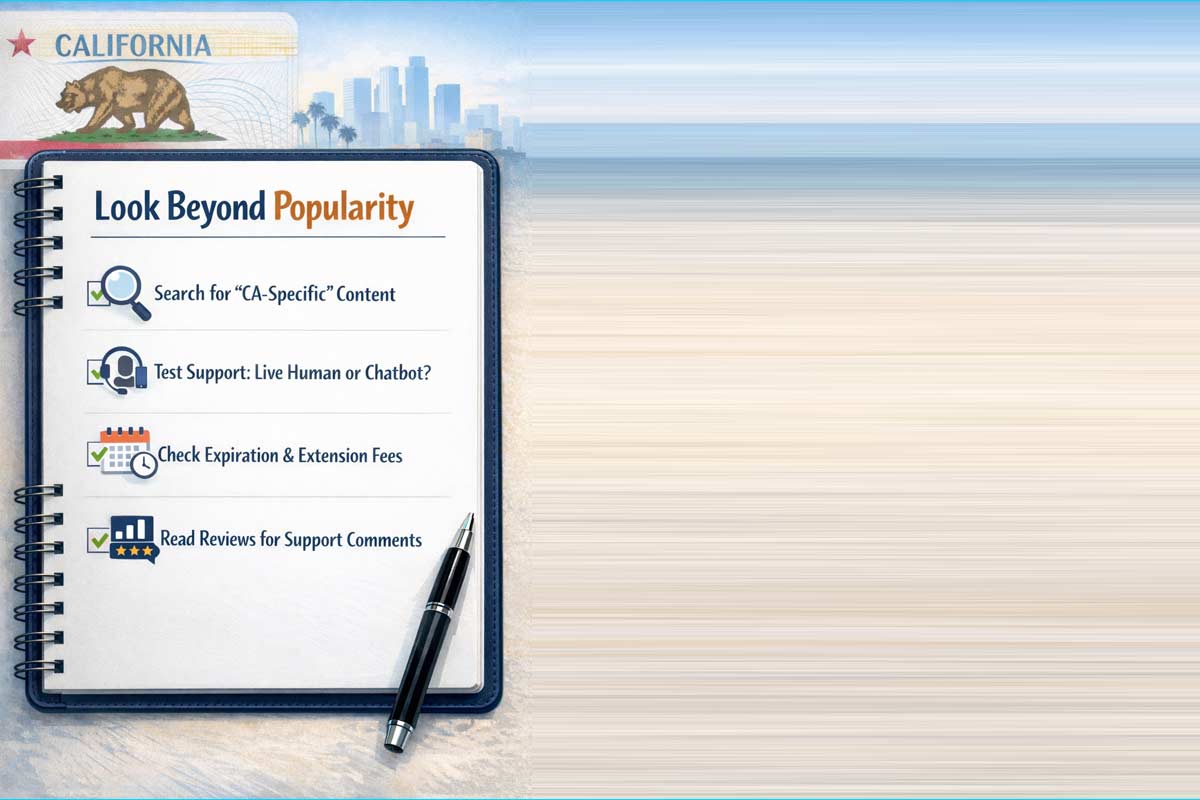
When you begin the journey toward a California real estate license, the fear of choosing the "wrong" school is often the first hurdle. For most applicants, the natural instinct is to search for the most Read more...
When you begin the journey toward a California real estate license, the fear of choosing the "wrong" school is often the first hurdle. For most applicants, the natural instinct is to search for the most popular real estate schools in California.
I guess the logic is simple: if thousands of other students are using a specific program, it must be the “safest path” to passing the state exam.
However, in my 20+ years of helping students navigate the DRE’s 135-hour requirement, I’ve seen that popularity is often a reflection of marketing scale rather than individual student success. While high-volume schools offer certain advantages, "popular" does not always mean "best fit" for your specific learning needs or timeline.
How can I identify the most popular real estate schools?
Since the California DRE does not publicly rank schools by enrollment or pass rates, popularity is best identified through visibility signals like high search volume, large numbers of reviews on third-party platforms, and established partnerships with major brokerage firms. To find the Best Real Estate Schools in California, look past the volume and verify the school's specific support channels, course expiration policies, and the depth of their California-specific exam prep.
What Popularity Actually Signals (and What It Doesn't)
Before you enroll based on a brand name, it is important to distinguish between a school’s size and its effectiveness for your learning style.
What Popularity Signals
What Popularity Does NOT Signal
Broad Accessibility: The school likely has a highly stable online platform and mobile app.
Individual Support: High volume can sometimes lead to automated "support tickets" rather than live instructor access.
Social Proof: You can find thousands
of reviews to gauge the general user experience.
High Pass Rates: A large enrollment base does not guarantee a higher percentage of students pass the DRE exam.
Familiarity: Seeing lots of content on
Instagram or Reddit might make the school “feel familiar”.
Curriculum Depth: Large national schools may use generic content that doesn't always capture the nuances of California agency law.
How to Observe Popularity Signals Without a Brand List
Since enrollment data isn't public, you can verify a school’s "popular" status by looking for these three indicators:
Search Visibility: Are they consistently at the top of search results (be careful to look for "Sponsored" labels vs. organic rankings)?
Review Density: Do they have thousands of reviews on platforms like Trustpilot or Google, rather than just a few dozen?
Broker Mentions: Ask a local office manager which school they see most often on incoming certificates.
The "Fit Framework": An Operator’s Due Diligence Checklist
Instead of choosing the "biggest" school, use this checklist to verify the artifacts of a quality education. This is the same framework we use to evaluate the Best Real Estate Schools in California.
1. The Support Infrastructure
Don't just look for a "Help" button. Identify the channel :
The Test: Send an email or call the school on a Tuesday morning. Do you get a live human or a chatbot?
Instructor Access: Is there a designated time for live Q&A, or are you limited to searching a knowledge base?
2. Policy-Driven Costs (The "Expiration Trap")
Many popular, low-cost programs have rigid policies that can lead to unexpected fees:
Expiration Windows: Does the course expire in 6 months or 12?
Extension Fees: If you get busy and need another 30 days, is it a $50 fee or do you have to repurchase the entire course?
Retake Policies: If you fail a final school exam, is there a waiting period or an additional charge to retake it?
3. Seat-Time and Access Rules
Module Locking: Does the school force a specific "timer" on every page, or can you move at your own natural reading pace?
Content Freshness: Look for California-specific references. Does the material mention current CA-specific nuances?
Why Students Search for Popular Options
The 135-hour pre-licensing grind is a significant time investment. Students often gravitate toward online real estate schools in California that have high volume because they want to avoid "making a mistake."
This is especially true for those looking for the fastest way to get a real estate license in California. The logic is: "If it's popular, the system must be efficient." While often true for the tech platform, speed without comprehension can lead to multiple failed attempts at the state exam.
Two Paths: Real-World Scenarios
I’ve observed that the "popular" choice works differently depending on the student's background:
The Autonomous Learner: A student with a high degree of self-discipline chooses a high-volume online program. They don't need help, they never call the school, and they move through the material flawlessly. For them, popularity was a great signal for a stable platform.
The Momentum-Seeker: Another student chooses the same program but hits a point of confusion regarding Trust Fund Handling. They submit a support ticket but don't hear back for 48 hours. That delay causes them to lose momentum, and they eventually miss their 6-month completion window, resulting in a "re-enrollment fee" that makes the cheapest real estate school in California much more expensive in the long run.
Which Path Matches Your Learning Style?
"I need structure and peer interaction": Popularity in the online world doesn't replace the accountability of in-person real estate classes in California.
"I'm tech-focused and self-driven": You may find that the best online real estate schools in California offer the best mobile apps and user interfaces.
"I want the lowest entry price": You can often find the cheapest real estate schools in California among high-volume providers, provided you are confident you won't need extensions.
Common Mistakes When Choosing by Volume
1. Confusing "Top of Search" with "Top of Class": Heavy advertising is a sign of a healthy marketing budget, not necessarily a superior educational outcome.
2. Overlooking "Generic" Content: Some national brands use "multi-state" materials. Always verify the content focuses on California-specific law and practice.
3. Assuming a "Popular" Prep is Enough: Many high-volume schools are excellent at the 135-hour requirement but provide only basic "practice questions" for the state exam. Real exam prep should include simulated exams and a targeted study plan.
Frequently Asked Questions
How do I know if a popular school is DRE-approved?
You can verify any school by searching the California DRE's searchable database of approved providers. Never enroll until you've confirmed their license status.
Are big national schools better than local California schools?
For this purpose, not really. Local California schools have more direct access to instructors who understand the specific nuances of the state exam and the licensing process in California that is unlike any other state.
Does a "popular" school have better pass rates?
There is no publicly available data to prove this. Pass rates are generally a reflection of the student's dedication and the quality of the school's specific "Exam Prep" product, not the size of the school.
What happens if I start with a popular school and want to switch?
You can usually switch, but your progress doesn’t transfer. You will likely have to restart the specific 45-hour course you were in and pay a new enrollment fee.
Making an Informed Choice
Popularity is a helpful data point, but it shouldn't be your only decision rule. Your goal isn't just to enroll—it's to get licensed.
If you’re ready to see how the top programs in the state stack up based on actual quality, support, and student outcomes, visit our main decision hub: Best Real Estate Schools in California.
|